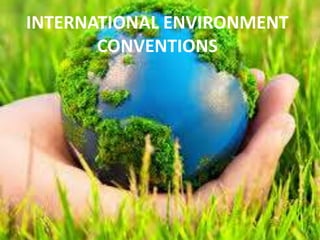
INTERNATIONAL ENVIRONMENT
CONVENTIONS
WHAT IS CONVENTION?
• It is an agreement between states covering
particular matters, especially one less formal
than a treaty.
• A convention, in the sense of a meeting, is a
gathering of individuals who meet at an
arranged place and time in order to discuss or
engage in some common interest.
Multilateral convention
• A multilateral convention is a convention to
which three or more sovereign states are
parties. Each party owes the same obligations
to all other parties.
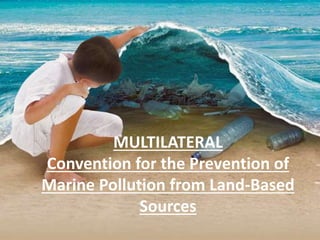
MULTILATERAL
Convention for the Prevention of
Marine Pollution from Land-Based
Sources
FACTS
• This conference was held at Paris by the
European Economic Community.
• It was Done at Paris, June 4th, 1974
• Also known as Paris convention
• This convention was basically held to prevent
the marine pollution from land sources.
• As marine pollution was of growing concerns.
PARTICIPANTS
• The participants of the convention were
• Austria Belgium Denmark, France, Federal
Republic of Germany, Iceland, Luxembourg,
The Netherlands, Norway ,Portugal, Spain,
Sweden. Switzerland, United Kingdom
• Finland and Italy were observers.
OBJECTIVES
• The marine environment, fauna and flora
which it supports are of vital importance to all
nations.
• AS the ecological equilibrium is threatened by
pollution..
• combined action at national, regional and
global levels is essential to prevent and
combat marine pollution
GOALS
• The Contracting Parties will take all possible
steps to prevent pollution of the sea.
• Parties will adopt individually and jointly
measures to combat marine pollution from
land-based sources
• Preserving and enhancing the quality of the
marine environment is the main goal
Cont..
• Will establish complementary or joint
programs of scientific and technical research.
• Including research into the best methods of
eliminating or replacing noxious substances
to reduce marine pollution from land-based
sources.
IMPORTANT PRINCIPALS
• The present convention shall apply to the
maritime area,
• Those parts of the Atlantic and Arctic Ocean
and dependent seas
• The Baltic Sea
• The Mediterranean Sea and its dependent
seas
• ‘Maritime area' means: the high seas, the
territorial seas of Contracting Parties and
waters on the landward side of the base lines
from which the breadth of the territorial sea is
measured
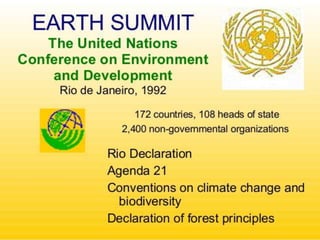
Rio Declaration on Environment and
Development
• A short document
produced by UNCED
• Consisted of 27
principles intended to
guide countries in
future sustainable
development
• It was signed by over
170 countries.
GOALS
Establishing a new and equitable global partnership
through the creation of new levels of cooperation
among States, key sectors of societies and people
Working towards international agreements which
respect the interests of all and protect the integrity
of the global environment and developmental
system
Addressed Issues
protection of air, land and water
conservation of biological diversity,
forests, and natural resources
sound management of wastes and
technology.
to restrict the human activities that
are threatening our planet
Addressed Issues
patterns of development that cause stress to the
environment
poverty in developing countries
economic growth
unsustainable patterns of consumption
demographic pressures and their impact on the
international economy
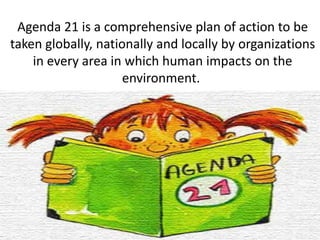
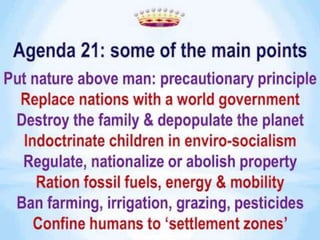
Agenda 21 is a comprehensive plan of action to be
taken globally, nationally and locally by organizations
in every area in which human impacts on the
environment.
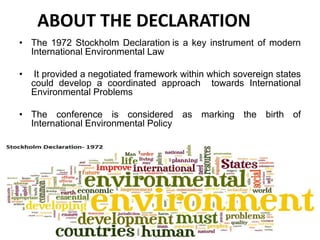
ABOUT THE DECLARATION
• The 1972 Stockholm Declaration is a key instrument of modern
International Environmental Law
• It provided a negotiated framework within which sovereign states
could develop a coordinated approach towards International
Environmental Problems
• The conference is considered as marking the birth of
International Environmental Policy
FACTS
• An international conference convened under
United Nations from June 5-16 in 1972
• It was held in Stockholm ,Sweden
• It was the UN’s first major conference on
International environmental issues.
• It was attended by representatives of 113
countries ,19 intergovernmental agencies and
more than 400 non governmental organizations
• It agreed upon 26 principles concerning
environment and development
• It laid the framework for future environmental
cooperation between countries
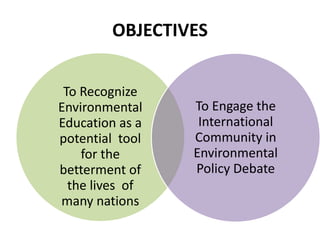
OBJECTIVES
To Recognize
Environmental
Education as a
potential tool
for the
betterment of
the lives of
many nations
To Engage the
International
Community in
Environmental
Policy Debate
SOME IMPORTANT PRINCIPLES
Principles 2 ,3,4,5 addressed that natural resources and wildlife
must be safeguarded
Principles 6,7,8 for preventing the environment from pollution
Principles 9,10,12,13 stressed on improvement of environment
and roles of developing countries to achieve these goals
Principle 19 stressing on Environmental education and 26
stressing on the elimination of WMDS
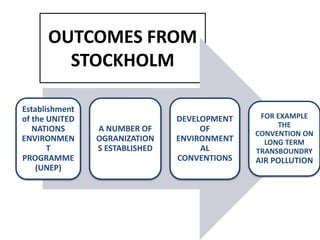
OUTCOMES FROM
STOCKHOLM
Establishment
of the UNITED
NATIONS
ENVIRONMEN
T
PROGRAMME
(UNEP)
A NUMBER OF
OGRANIZATION
S ESTABLISHED
DEVELOPMENT
OF
ENVIRONMENT
AL
CONVENTIONS
FOR EXAMPLE
THE
CONVENTION ON
LONG TERM
TRANSBOUNDRY
AIR POLLUTION
INTRODUCTION:
• The Kyoto Protocol is an international
treaty which extends the 1992 United
Nations Framework Convention on
Climate Change (UNFCCC) that commits
State Parties to reduce greenhouse gas
emissions, based on that
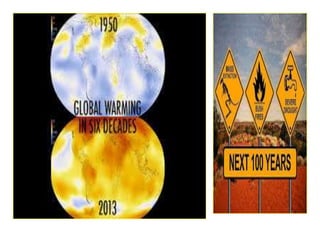
• global warming exists
• and human-made CO2 emissions have
caused it.
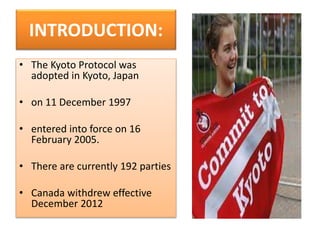
INTRODUCTION:
• The Kyoto Protocol was
adopted in Kyoto, Japan
• on 11 December 1997
• entered into force on 16
February 2005.
• There are currently 192 parties
• Canada withdrew effective
December 2012
GOAL?
“ to protect the
climate system for
the benefit of present
and future
generations of
mankind. ”
OBJECTIVES?
“ to achieve stabilisation of
greenhouse gas
concentrations in the
atmosphere at a level
that would prevent
dangerous
anthropogenic
interference with the
climate system. ”
ISSUE OF MAIN CONCERN:
• Global warming potential
(GWPs), as defined by the
IPCC, are “a measure of
the relative effect of a
substance in warming the
atmosphere over a given
time period compared
against a value of one for
carbon dioxide”.
SECTORS OF MAIN CONCERN IN
GLOBAL WARMING
• Energy supply (24 to 48% of total GHG)
Fuel combustion (energy production, manufacturing,
transport, etc.)
Fugitive emissions (oil and natural gas, solid fuels, etc.)
• Industrial processes (5 to 36% of total GHG)
Production (metal production, mineral products, chemical
industry etc.)
Consumption (halocarbons and sulphur hexafluoride,
solvents etc.)
• Waste management (primarily CH4)
Solid waste disposal on land, wastewater handling etc.
• Land use (0,3 to 9% of total GHG)
Agriculture (enteric fermentation, manure management,
rice cultivation, agricultural
soils etc.)
Forestry.
POLICIES AND MEASURES
• To achieve the Protocol’s Parties will need
to implement domestic climate change
policies and measures.
• Possible measures include:
• Enhancing energy efficiency.
• Protecting GHG sinks.
• Promoting sustainable agriculture.
• Promoting renewable energy and
environmentally friendly technologies.
• Tackling transport sector emissions.
UNRESOLVED ISSUES IN KYOTO
• No details on specific policies and
measures to meet reduction targets.
• No commitments from developing
nations.
• No details on implementing permits
system including penalties.
• No details on funding mechanisms for
developing nation.
• ‘bunkers fuels’ issue unresolved i.e. The
fuel used in shipping and air travels
International environment conventions 2

International environment conventions 2

  • 2.
  • 3.
    WHAT IS CONVENTION? •It is an agreement between states covering particular matters, especially one less formal than a treaty. • A convention, in the sense of a meeting, is a gathering of individuals who meet at an arranged place and time in order to discuss or engage in some common interest.
  • 4.
    Multilateral convention • Amultilateral convention is a convention to which three or more sovereign states are parties. Each party owes the same obligations to all other parties.
  • 5.
    MULTILATERAL Convention for thePrevention of Marine Pollution from Land-Based Sources
  • 6.
    FACTS • This conferencewas held at Paris by the European Economic Community. • It was Done at Paris, June 4th, 1974 • Also known as Paris convention • This convention was basically held to prevent the marine pollution from land sources. • As marine pollution was of growing concerns.
  • 7.
    PARTICIPANTS • The participantsof the convention were • Austria Belgium Denmark, France, Federal Republic of Germany, Iceland, Luxembourg, The Netherlands, Norway ,Portugal, Spain, Sweden. Switzerland, United Kingdom • Finland and Italy were observers.
  • 8.
    OBJECTIVES • The marineenvironment, fauna and flora which it supports are of vital importance to all nations. • AS the ecological equilibrium is threatened by pollution.. • combined action at national, regional and global levels is essential to prevent and combat marine pollution
  • 9.
    GOALS • The ContractingParties will take all possible steps to prevent pollution of the sea. • Parties will adopt individually and jointly measures to combat marine pollution from land-based sources • Preserving and enhancing the quality of the marine environment is the main goal
  • 10.
    Cont.. • Will establishcomplementary or joint programs of scientific and technical research. • Including research into the best methods of eliminating or replacing noxious substances to reduce marine pollution from land-based sources.
  • 11.
    IMPORTANT PRINCIPALS • Thepresent convention shall apply to the maritime area, • Those parts of the Atlantic and Arctic Ocean and dependent seas • The Baltic Sea • The Mediterranean Sea and its dependent seas
  • 12.
    • ‘Maritime area'means: the high seas, the territorial seas of Contracting Parties and waters on the landward side of the base lines from which the breadth of the territorial sea is measured
  • 14.
    Rio Declaration onEnvironment and Development • A short document produced by UNCED • Consisted of 27 principles intended to guide countries in future sustainable development • It was signed by over 170 countries.
  • 15.
    GOALS Establishing a newand equitable global partnership through the creation of new levels of cooperation among States, key sectors of societies and people Working towards international agreements which respect the interests of all and protect the integrity of the global environment and developmental system
  • 17.
    Addressed Issues protection ofair, land and water conservation of biological diversity, forests, and natural resources sound management of wastes and technology. to restrict the human activities that are threatening our planet
  • 18.
    Addressed Issues patterns ofdevelopment that cause stress to the environment poverty in developing countries economic growth unsustainable patterns of consumption demographic pressures and their impact on the international economy
  • 19.
    Agenda 21 isa comprehensive plan of action to be taken globally, nationally and locally by organizations in every area in which human impacts on the environment.
  • 22.
    ABOUT THE DECLARATION •The 1972 Stockholm Declaration is a key instrument of modern International Environmental Law • It provided a negotiated framework within which sovereign states could develop a coordinated approach towards International Environmental Problems • The conference is considered as marking the birth of International Environmental Policy
  • 23.
    FACTS • An internationalconference convened under United Nations from June 5-16 in 1972 • It was held in Stockholm ,Sweden • It was the UN’s first major conference on International environmental issues. • It was attended by representatives of 113 countries ,19 intergovernmental agencies and more than 400 non governmental organizations • It agreed upon 26 principles concerning environment and development • It laid the framework for future environmental cooperation between countries
  • 24.
    OBJECTIVES To Recognize Environmental Education asa potential tool for the betterment of the lives of many nations To Engage the International Community in Environmental Policy Debate
  • 25.
    SOME IMPORTANT PRINCIPLES Principles2 ,3,4,5 addressed that natural resources and wildlife must be safeguarded Principles 6,7,8 for preventing the environment from pollution Principles 9,10,12,13 stressed on improvement of environment and roles of developing countries to achieve these goals Principle 19 stressing on Environmental education and 26 stressing on the elimination of WMDS
  • 26.
    OUTCOMES FROM STOCKHOLM Establishment of theUNITED NATIONS ENVIRONMEN T PROGRAMME (UNEP) A NUMBER OF OGRANIZATION S ESTABLISHED DEVELOPMENT OF ENVIRONMENT AL CONVENTIONS FOR EXAMPLE THE CONVENTION ON LONG TERM TRANSBOUNDRY AIR POLLUTION
  • 27.
    INTRODUCTION: • The KyotoProtocol is an international treaty which extends the 1992 United Nations Framework Convention on Climate Change (UNFCCC) that commits State Parties to reduce greenhouse gas emissions, based on that • global warming exists • and human-made CO2 emissions have caused it.
  • 28.
    INTRODUCTION: • The KyotoProtocol was adopted in Kyoto, Japan • on 11 December 1997 • entered into force on 16 February 2005. • There are currently 192 parties • Canada withdrew effective December 2012
  • 29.
    GOAL? “ to protectthe climate system for the benefit of present and future generations of mankind. ”
  • 30.
    OBJECTIVES? “ to achievestabilisation of greenhouse gas concentrations in the atmosphere at a level that would prevent dangerous anthropogenic interference with the climate system. ”
  • 31.
    ISSUE OF MAINCONCERN: • Global warming potential (GWPs), as defined by the IPCC, are “a measure of the relative effect of a substance in warming the atmosphere over a given time period compared against a value of one for carbon dioxide”.
  • 33.
    SECTORS OF MAINCONCERN IN GLOBAL WARMING • Energy supply (24 to 48% of total GHG) Fuel combustion (energy production, manufacturing, transport, etc.) Fugitive emissions (oil and natural gas, solid fuels, etc.) • Industrial processes (5 to 36% of total GHG) Production (metal production, mineral products, chemical industry etc.) Consumption (halocarbons and sulphur hexafluoride, solvents etc.) • Waste management (primarily CH4) Solid waste disposal on land, wastewater handling etc. • Land use (0,3 to 9% of total GHG) Agriculture (enteric fermentation, manure management, rice cultivation, agricultural soils etc.) Forestry.
  • 34.
    POLICIES AND MEASURES •To achieve the Protocol’s Parties will need to implement domestic climate change policies and measures. • Possible measures include: • Enhancing energy efficiency. • Protecting GHG sinks. • Promoting sustainable agriculture. • Promoting renewable energy and environmentally friendly technologies. • Tackling transport sector emissions.
  • 35.
    UNRESOLVED ISSUES INKYOTO • No details on specific policies and measures to meet reduction targets. • No commitments from developing nations. • No details on implementing permits system including penalties. • No details on funding mechanisms for developing nation. • ‘bunkers fuels’ issue unresolved i.e. The fuel used in shipping and air travels