UNITED NATION
ENVIRONMENT
PROGRAMME
ENVIRONMENTAL LAW
PRESENTATION
WHAT IS UNEP?
The United Nations Environment
Program (UNEP) is an agency of
United Nations and coordinates its
environmental activities, assisting
developing countries in
implementing environmentally
sound policies and practices.
MISSION
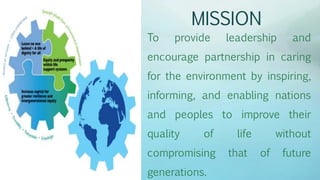
To provide leadership and
encourage partnership in caring
for the environment by inspiring,
informing, and enabling nations
and peoples to improve their
quality of life without
compromising that of future
generations.
WORKING OF UNEP
Assessing global, regional and national environmental
conditions and trends
Developing international and national environmental
instruments
Strengthening institutions for the wise management of
the environment
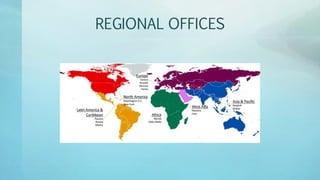
REGIONAL OFFICES
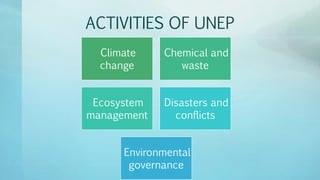
ACTIVITIES OF UNEP
Climate
change
Chemical and
waste
Ecosystem
management
Disasters and
conflicts
Environmental
governance
PARTNERSHIPS AND
COLLABORATIONS
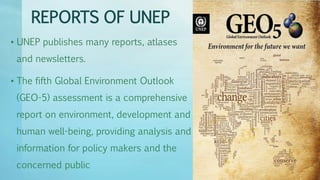
REPORTS OF UNEP
• UNEP publishes many reports, atlases
and newsletters.
• The fifth Global Environment Outlook
(GEO-5) assessment is a comprehensive
report on environment, development and
human well-being, providing analysis and
information for policy makers and the
concerned public
CLIMATE CHANGE
SUB PROGRAME OF UNEP
CLIMATE CHANGE
• Climate change is one of the major challenges of our time.
• It adds considerable stress to our societies and to the
environment.
• From shifting weather patterns that threaten food
production
• To rising sea levels that increase the risk of flooding
• The impacts of climate change are global in scope.
UNEP GOALS
• All of UNEP’s work on climate change is shaped by the
negotiations process of the United Nations Framework Convention
on Climate Change (UNFCCC)
• Goals are,
1. To strengthen their ability to adapt to climate change,
2. Move towards low-carbon societies,
3. Improve understanding of climate science
1. ADAPTING TO CLIMATE CHANGE:
• UNEP supports countries in making sound policy, technology and
investment choices.
• UNEP’s adaptation work focuses on incorporating planning,
financing and cost-effective preventative actions into national
development processes
• That are supported by scientific information,
• Integrated climate impact assessments,
• local climate data.
2: Low carbon societies
• UNEP helps countries make sound policy, technology and
investment choices
• That accelerate their transition towards low-carbon economies
and societies.
• UNEP’s focus is on clean and renewable energy sources, energy
efficiency and energy conservation.
• UNEP also helps countries phase out obsolescent technologies
and deploy cleaner ones,
• Financed through public and private sources.
3: Understanding climate science
• UNEP works with partners to provide policymakers, the private
sector and the general public with access to information on
effective climate change solutions.
• It helps to develop better climate data
• Make that data available to a wide range of stakeholders to
inform adaptation and mitigation policies.
ENVIRONMENTAL GOVERNANCE:
Refers to the processes of decision-making involved in
the control and management of the environment and
natural resources.
Environmental governance is a key driver for the
achievement of sustainable development.
The environment and its links with the social and
economic dimensions of sustainable development relies
on good decision making processes, effective
institutions, policies, laws, standards and norms.
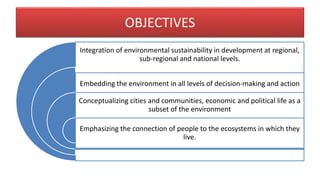
OBJECTIVES
Integration of environmental sustainability in development at regional,
sub-regional and national levels.
Embedding the environment in all levels of decision-making and action
Conceptualizing cities and communities, economic and political life as a
subset of the environment
Emphasizing the connection of people to the ecosystems in which they
live.
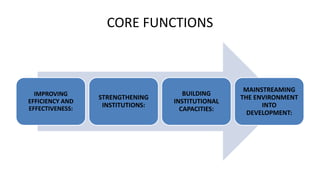
CORE FUNCTIONS
IMPROVING
EFFICIENCY AND
EFFECTIVENESS:
STRENGTHENING
INSTITUTIONS:
BUILDING
INSTITUTIONAL
CAPACITIES:
MAINSTREAMING
THE ENVIRONMENT
INTO
DEVELOPMENT:
IMPROVING EFFICIENCY AND EFFECTIVENESS:
• MEA,S are one of the most effective ways in which
governments meet environmental commitments to
protecting biodiversity, safely managing chemicals
and waste and mitigating and adapting to climate
change.
• The Convention on Biological Diversity, and the
Strategic Approach to International Chemicals
Management
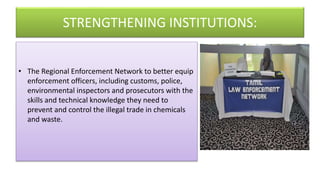
STRENGTHENING INSTITUTIONS:
• The Regional Enforcement Network to better equip
enforcement officers, including customs, police,
environmental inspectors and prosecutors with the
skills and technical knowledge they need to
prevent and control the illegal trade in chemicals
and waste.
BUILDING INSTITUTIONAL CAPACITIES
UNEP build national capacities to develop and enforce laws and
strengthen institutions
•Increase the understanding of inter-linkages
between human rights and the environment
•Identify methods to strengthen institutions and laws
which protect natural resources
•Enhance national water laws, especially related to
transboundary resources
MAINSTREAMING THE ENVIRONMENT INTO DEVELOPMENT:
It assists countries to mainstream environmental sustainability
objectives into national and regional development policies and
plans.
Under the joint UNDP and UN Environment Poverty
Environment Initiative in 24 countries were provided with
technical and financial support to integrate poverty and
environment objectives into their development plans.
ECOSYSTEM
MANAGEMENT
ECOSYSTEM MANAGEMENT
WHAT IS AN ECOSYSTEM?
An ecosystem is a dynamic complex of plants, animals
and microorganism communities and their nonliving
environment interacting as a functional unit.
AN INTEGRATED APPROACH TO
ECOSYSTEM MANAGEMENT
“An integrated approach to ecosystem
management recognizes the growing pressure
on natural resources and seeks to reconcile
competing demands and interdependencies in
order to achieve all 17 Sustainable
Development Goals”
AIM OF ECOSYSTEM MANAGEMENT
• This thematic area aims at assisting countries in utilizing the
ecosystem approach to enhance human well-being.
• At the national and regional level, UNEP facilitates policies and
laws that promote environment for development
• It also emphasize the socio-economic aspects of ecosystem
services through payment for ecosystem services
• Incorporate biodiversity as a working system for ecosystem
functioning.
SIX KEY BUILDING BLOCKS FOR THE
ECOSYSTEM MANAGEMENT
• UN Environment fosters the transition towards integrated and multi-
dimensional ecosystem management by strengthening six of the key
building blocks
• 70% of the planet is covered by water
• 2.5% of the planet’s water is freshwater
• 25% of land area is rangeland
• 80% of terrestrial biodiversity is in forests
• Less than 30% of terrestrial areas are forested
• 31% of the land area on our planet.
•
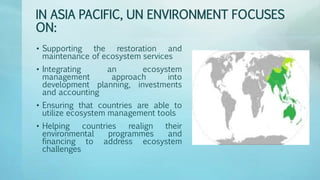
IN ASIA PACIFIC, UN ENVIRONMENT FOCUSES
ON:
• Supporting the restoration and
maintenance of ecosystem services
• Integrating an ecosystem
management approach into
development planning, investments
and accounting
• Ensuring that countries are able to
utilize ecosystem management tools
• Helping countries realign their
environmental programmes and
financing to address ecosystem
challenges
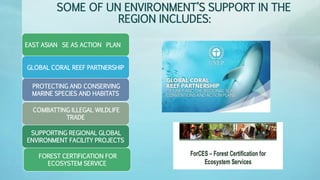
SOME OF UN ENVIRONMENT’S SUPPORT IN THE
REGION INCLUDES:
EAST ASIAN SE AS ACTION PLAN
GLOBAL CORAL REEF PARTNERSHIP
PROTECTING AND CONSERVING
MARINE SPECIES AND HABITATS
COMBATTING ILLEGAL WILDLIFE
TRADE
SUPPORTING REGIONAL GLOBAL
ENVIRONMENT FACILITY PROJECTS
FOREST CERTIFICATION FOR
ECOSYSTEM SERVICE
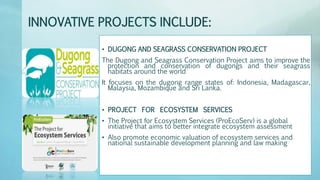
INNOVATIVE PROJECTS INCLUDE:
• DUGONG AND SEAGRASS CONSERVATION PROJECT
The Dugong and Seagrass Conservation Project aims to improve the
protection and conservation of dugongs and their seagrass
habitats around the world
It focuses on the dugong range states of: Indonesia, Madagascar,
Malaysia, Mozambique and Sri Lanka.
• PROJECT FOR ECOSYSTEM SERVICES
• The Project for Ecosystem Services (ProEcoServ) is a global
initiative that aims to better integrate ecosystem assessment
• Also promote economic valuation of ecosystem services and
national sustainable development planning and law making
• AGROBIODIVERSITY: “Mainstreaming Agrobiodiversity
Conservation and Utilization in Agricultural Sector to Ensure
Ecosystem Services and Reduce Vulnerability”
• INTERNATIONAL WATERS/CLIMATE CHANGE: “Establishment of
Fishery Refugia for Economic Important Fish Species”
• ECOSYSTEM SERVICES: “targeting Vietnam and three other
countries from other regions
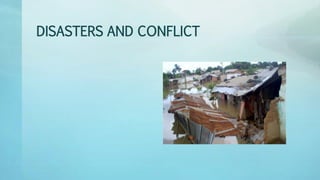
DISASTERS AND CONFLICT
UNEP
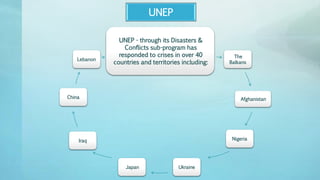
UNEP - through its Disasters &
Conflicts sub-program has
responded to crises in over 40
countries and territories including:
The
Balkans
Afghanistan
Nigeria
UkraineJapan
Iraq
China
Lebanon
CLIMATE CHANGE IN AFGHANISTAN
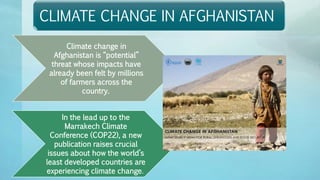
Climate change in
Afghanistan is “potential”
threat whose impacts have
already been felt by millions
of farmers across the
country.
In the lead up to the
Marrakech Climate
Conference (COP22), a new
publication raises crucial
issues about how the world’s
least developed countries are
experiencing climate change.
Continue…
UN Environment and NEPA
have worked closely to
address climate change at
both the policy and
practical levels, including
the development of the
country’s most accurate
and up-to-date climate
change projections.
PROMOTING GENDER RESPONSIVE APPROACHES TO
NATURAL RESOURCES
UN Environment, UN Women and the UN Development Programme
(UNDP) signed a joint project document for promoting gender responsive
approaches to natural resources management
The project’s objectives are to strengthen community structures to
address conflict over natural resources in a gender responsive manner
A baseline assessment is currently ongoing to better understand
community context and conduct participatory conflict, gender and
environmental analysis for law making process
THE LAUNCH OF THE NATIONAL ADAPTION PROGRAMME OF
ACTION (NAPA) FOR CLIMATE CHANGE IN JUBA, SOUTH SUDAN
• The NAPA document was prepared with
technical support from UN Environment and
funding support from Global Environment
Facility (GEF) as part of the Government of
South Sudan’s action to lessen effects of
climate change
• After the completion of the NAPA document,
South Sudan is eligible to benefit from a 40 to
50 million US dollars funds to deal with the
effects of climate change.
WORKSHOP WITH STAKEHOLDERS IN JUBA FOR SOUTH SUDAN’S
FIRST EVER STATE OF ENVIRONMENT AND OUTLOOK REPORT
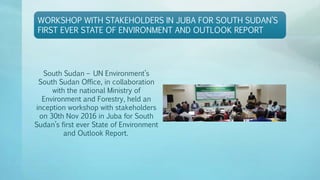
South Sudan – UN Environment’s
South Sudan Office, in collaboration
with the national Ministry of
Environment and Forestry, held an
inception workshop with stakeholders
on 30th Nov 2016 in Juba for South
Sudan’s first ever State of Environment
and Outlook Report.
Continue…
The purpose of the inception workshop was to consult
sectoral and other stakeholders and experts on a
proposed structure and content for the Environment
Report and Outlook for the Republic of South Sudan.
UNEP ENV LAW PRESENTATION

UNEP ENV LAW PRESENTATION

  • 2.
  • 3.
    WHAT IS UNEP? TheUnited Nations Environment Program (UNEP) is an agency of United Nations and coordinates its environmental activities, assisting developing countries in implementing environmentally sound policies and practices.
  • 4.
    MISSION To provide leadershipand encourage partnership in caring for the environment by inspiring, informing, and enabling nations and peoples to improve their quality of life without compromising that of future generations.
  • 5.
    WORKING OF UNEP Assessingglobal, regional and national environmental conditions and trends Developing international and national environmental instruments Strengthening institutions for the wise management of the environment
  • 6.
  • 7.
    ACTIVITIES OF UNEP Climate change Chemicaland waste Ecosystem management Disasters and conflicts Environmental governance
  • 8.
  • 9.
    REPORTS OF UNEP •UNEP publishes many reports, atlases and newsletters. • The fifth Global Environment Outlook (GEO-5) assessment is a comprehensive report on environment, development and human well-being, providing analysis and information for policy makers and the concerned public
  • 10.
  • 11.
    CLIMATE CHANGE • Climatechange is one of the major challenges of our time. • It adds considerable stress to our societies and to the environment. • From shifting weather patterns that threaten food production • To rising sea levels that increase the risk of flooding • The impacts of climate change are global in scope.
  • 12.
    UNEP GOALS • Allof UNEP’s work on climate change is shaped by the negotiations process of the United Nations Framework Convention on Climate Change (UNFCCC) • Goals are, 1. To strengthen their ability to adapt to climate change, 2. Move towards low-carbon societies, 3. Improve understanding of climate science
  • 13.
    1. ADAPTING TOCLIMATE CHANGE: • UNEP supports countries in making sound policy, technology and investment choices. • UNEP’s adaptation work focuses on incorporating planning, financing and cost-effective preventative actions into national development processes • That are supported by scientific information, • Integrated climate impact assessments, • local climate data.
  • 14.
    2: Low carbonsocieties • UNEP helps countries make sound policy, technology and investment choices • That accelerate their transition towards low-carbon economies and societies. • UNEP’s focus is on clean and renewable energy sources, energy efficiency and energy conservation. • UNEP also helps countries phase out obsolescent technologies and deploy cleaner ones, • Financed through public and private sources.
  • 15.
    3: Understanding climatescience • UNEP works with partners to provide policymakers, the private sector and the general public with access to information on effective climate change solutions. • It helps to develop better climate data • Make that data available to a wide range of stakeholders to inform adaptation and mitigation policies.
  • 17.
    ENVIRONMENTAL GOVERNANCE: Refers tothe processes of decision-making involved in the control and management of the environment and natural resources. Environmental governance is a key driver for the achievement of sustainable development. The environment and its links with the social and economic dimensions of sustainable development relies on good decision making processes, effective institutions, policies, laws, standards and norms.
  • 18.
    OBJECTIVES Integration of environmentalsustainability in development at regional, sub-regional and national levels. Embedding the environment in all levels of decision-making and action Conceptualizing cities and communities, economic and political life as a subset of the environment Emphasizing the connection of people to the ecosystems in which they live.
  • 19.
  • 20.
    IMPROVING EFFICIENCY ANDEFFECTIVENESS: • MEA,S are one of the most effective ways in which governments meet environmental commitments to protecting biodiversity, safely managing chemicals and waste and mitigating and adapting to climate change. • The Convention on Biological Diversity, and the Strategic Approach to International Chemicals Management
  • 21.
    STRENGTHENING INSTITUTIONS: • TheRegional Enforcement Network to better equip enforcement officers, including customs, police, environmental inspectors and prosecutors with the skills and technical knowledge they need to prevent and control the illegal trade in chemicals and waste.
  • 22.
    BUILDING INSTITUTIONAL CAPACITIES UNEPbuild national capacities to develop and enforce laws and strengthen institutions •Increase the understanding of inter-linkages between human rights and the environment •Identify methods to strengthen institutions and laws which protect natural resources •Enhance national water laws, especially related to transboundary resources
  • 23.
    MAINSTREAMING THE ENVIRONMENTINTO DEVELOPMENT: It assists countries to mainstream environmental sustainability objectives into national and regional development policies and plans. Under the joint UNDP and UN Environment Poverty Environment Initiative in 24 countries were provided with technical and financial support to integrate poverty and environment objectives into their development plans.
  • 24.
  • 25.
    ECOSYSTEM MANAGEMENT WHAT ISAN ECOSYSTEM? An ecosystem is a dynamic complex of plants, animals and microorganism communities and their nonliving environment interacting as a functional unit.
  • 26.
    AN INTEGRATED APPROACHTO ECOSYSTEM MANAGEMENT “An integrated approach to ecosystem management recognizes the growing pressure on natural resources and seeks to reconcile competing demands and interdependencies in order to achieve all 17 Sustainable Development Goals”
  • 27.
    AIM OF ECOSYSTEMMANAGEMENT • This thematic area aims at assisting countries in utilizing the ecosystem approach to enhance human well-being. • At the national and regional level, UNEP facilitates policies and laws that promote environment for development • It also emphasize the socio-economic aspects of ecosystem services through payment for ecosystem services • Incorporate biodiversity as a working system for ecosystem functioning.
  • 28.
    SIX KEY BUILDINGBLOCKS FOR THE ECOSYSTEM MANAGEMENT • UN Environment fosters the transition towards integrated and multi- dimensional ecosystem management by strengthening six of the key building blocks • 70% of the planet is covered by water • 2.5% of the planet’s water is freshwater • 25% of land area is rangeland • 80% of terrestrial biodiversity is in forests • Less than 30% of terrestrial areas are forested • 31% of the land area on our planet. •
  • 29.
    IN ASIA PACIFIC,UN ENVIRONMENT FOCUSES ON: • Supporting the restoration and maintenance of ecosystem services • Integrating an ecosystem management approach into development planning, investments and accounting • Ensuring that countries are able to utilize ecosystem management tools • Helping countries realign their environmental programmes and financing to address ecosystem challenges
  • 30.
    SOME OF UNENVIRONMENT’S SUPPORT IN THE REGION INCLUDES: EAST ASIAN SE AS ACTION PLAN GLOBAL CORAL REEF PARTNERSHIP PROTECTING AND CONSERVING MARINE SPECIES AND HABITATS COMBATTING ILLEGAL WILDLIFE TRADE SUPPORTING REGIONAL GLOBAL ENVIRONMENT FACILITY PROJECTS FOREST CERTIFICATION FOR ECOSYSTEM SERVICE
  • 31.
    INNOVATIVE PROJECTS INCLUDE: •DUGONG AND SEAGRASS CONSERVATION PROJECT The Dugong and Seagrass Conservation Project aims to improve the protection and conservation of dugongs and their seagrass habitats around the world It focuses on the dugong range states of: Indonesia, Madagascar, Malaysia, Mozambique and Sri Lanka. • PROJECT FOR ECOSYSTEM SERVICES • The Project for Ecosystem Services (ProEcoServ) is a global initiative that aims to better integrate ecosystem assessment • Also promote economic valuation of ecosystem services and national sustainable development planning and law making
  • 32.
    • AGROBIODIVERSITY: “MainstreamingAgrobiodiversity Conservation and Utilization in Agricultural Sector to Ensure Ecosystem Services and Reduce Vulnerability” • INTERNATIONAL WATERS/CLIMATE CHANGE: “Establishment of Fishery Refugia for Economic Important Fish Species” • ECOSYSTEM SERVICES: “targeting Vietnam and three other countries from other regions
  • 33.
  • 34.
    UNEP UNEP - throughits Disasters & Conflicts sub-program has responded to crises in over 40 countries and territories including: The Balkans Afghanistan Nigeria UkraineJapan Iraq China Lebanon
  • 35.
    CLIMATE CHANGE INAFGHANISTAN Climate change in Afghanistan is “potential” threat whose impacts have already been felt by millions of farmers across the country. In the lead up to the Marrakech Climate Conference (COP22), a new publication raises crucial issues about how the world’s least developed countries are experiencing climate change.
  • 36.
    Continue… UN Environment andNEPA have worked closely to address climate change at both the policy and practical levels, including the development of the country’s most accurate and up-to-date climate change projections.
  • 37.
    PROMOTING GENDER RESPONSIVEAPPROACHES TO NATURAL RESOURCES UN Environment, UN Women and the UN Development Programme (UNDP) signed a joint project document for promoting gender responsive approaches to natural resources management The project’s objectives are to strengthen community structures to address conflict over natural resources in a gender responsive manner A baseline assessment is currently ongoing to better understand community context and conduct participatory conflict, gender and environmental analysis for law making process
  • 38.
    THE LAUNCH OFTHE NATIONAL ADAPTION PROGRAMME OF ACTION (NAPA) FOR CLIMATE CHANGE IN JUBA, SOUTH SUDAN • The NAPA document was prepared with technical support from UN Environment and funding support from Global Environment Facility (GEF) as part of the Government of South Sudan’s action to lessen effects of climate change • After the completion of the NAPA document, South Sudan is eligible to benefit from a 40 to 50 million US dollars funds to deal with the effects of climate change.
  • 39.
    WORKSHOP WITH STAKEHOLDERSIN JUBA FOR SOUTH SUDAN’S FIRST EVER STATE OF ENVIRONMENT AND OUTLOOK REPORT South Sudan – UN Environment’s South Sudan Office, in collaboration with the national Ministry of Environment and Forestry, held an inception workshop with stakeholders on 30th Nov 2016 in Juba for South Sudan’s first ever State of Environment and Outlook Report.
  • 40.
    Continue… The purpose ofthe inception workshop was to consult sectoral and other stakeholders and experts on a proposed structure and content for the Environment Report and Outlook for the Republic of South Sudan.