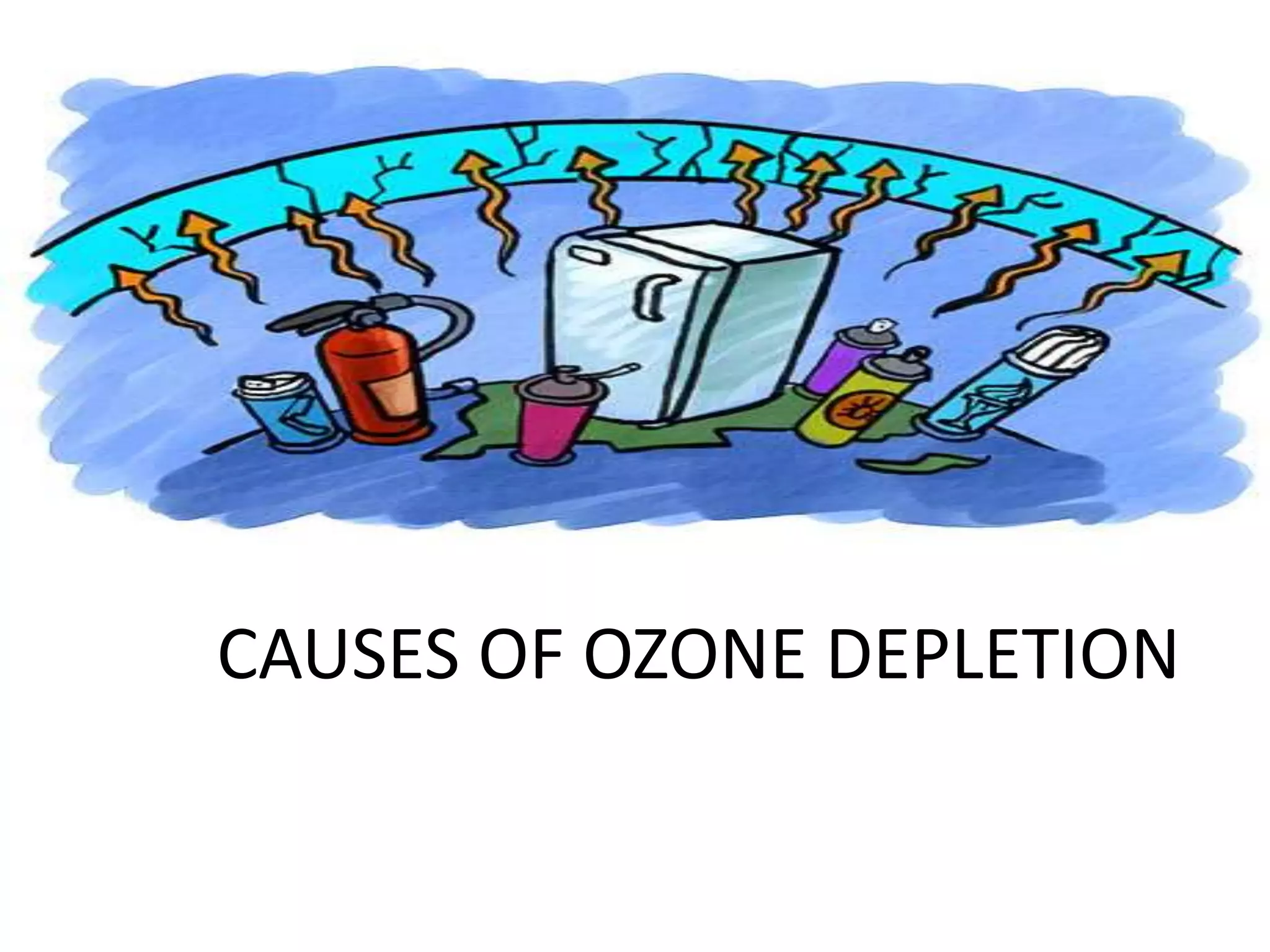
CAUSES OF OZONE DEPLETION
OZONE DEPLETING SUBSTANCES
• The stratospheric ozone is being
destroyed by a group of
manufactured chemicals
• These chemicals are called "ozone-
depleting substances" (ODS)
• ODS are very stable, nontoxic and
environmentally safe in the lower
atmosphere
• Their stability allows them to float
up, intact, to the stratosphere. Once
there, they are broken apart by the
intense ultraviolet light
• They demolish ozone at an alarming
rate. A single molecule of chlorine
can break apart thousands of
molecules of ozone.
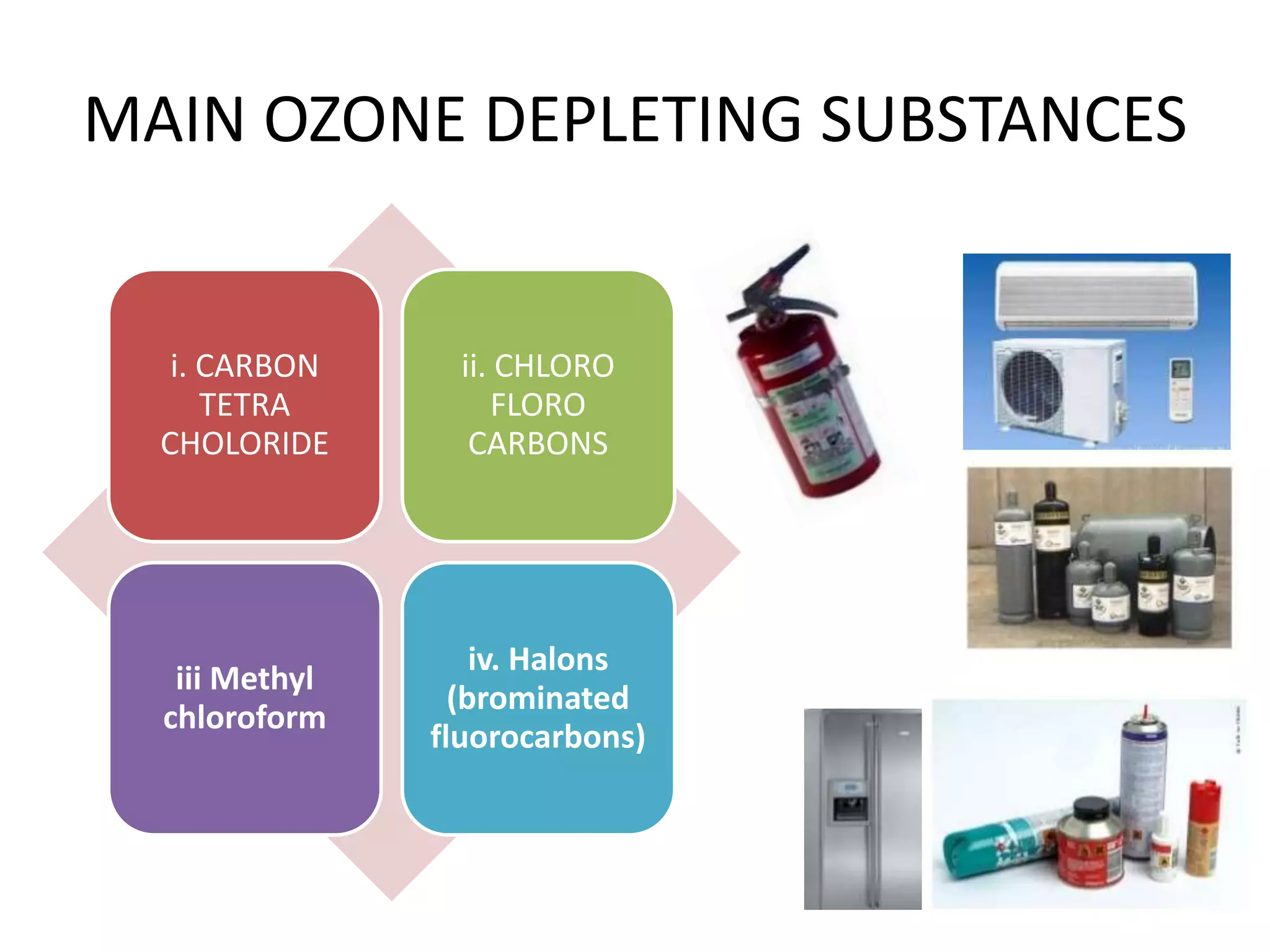
MAIN OZONE DEPLETING SUBSTANCES
i. CARBON
TETRA
CHOLORIDE
ii. CHLORO
FLORO
CARBONS
iii Methyl
chloroform
iv. Halons
(brominated
fluorocarbons)
THE MAIN ODS AND THEIR USES
CHLOROFLUOROCARBONS (CFCS)
The most widely used ODS, accounting for over 80% of total
stratospheric ozone depletion.
Used as coolants in refrigerators, freezers and air conditioners
in buildings and cars manufactured before 1995.
Found in industrial solvents, dry-cleaning agents and hospital
sterilants.
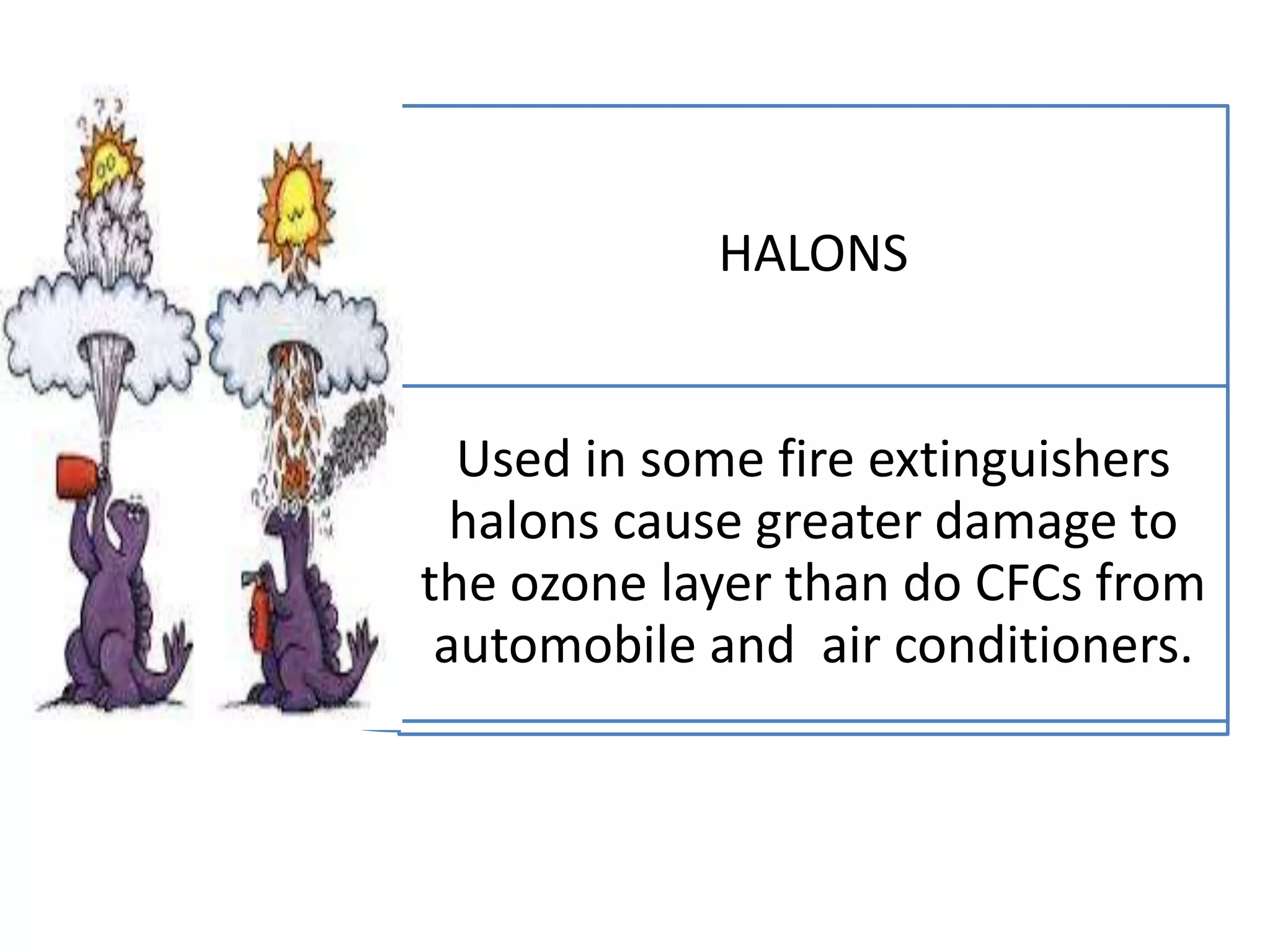
HALONS
Used in some fire extinguishers
halons cause greater damage to
the ozone layer than do CFCs from
automobile and air conditioners.
• METHYL CHLOROFORM
• Used mainly in industry — for vapour
degreasing, some aerosols, cold cleaning,
adhesives and chemical processing.
• CARBON TETRACHLORIDE
• Used in solvents and some fire extinguishers.
• HYDROFLUOROCARBONS (HCFCs)
• HCFCs have become major, “transitional”
substitutes for CFCs. They are much less
harmful to stratospheric ozone than CFCs are
But HCFCs they still cause some ozone
destruction and are potent greenhouse gases
CLIMATIC CHANGE DUE TO OZONE
DEPLETION:
• Most man-made ODS are also very potent
greenhouse gases.
• Some of them are up to 14000 times stronger than
carbon dioxide (CO2), the main greenhouse gas.
DISEASES CAUSED DUE TO OZONE
DEPLETION:
BASAL AND SQUAMOUS CELL CARCINOMAS
The most common forms of skin cancer in humans, basal and squamous cell
carcinomas, have been strongly linked to UVB exposure
MALIGNANT MELANOMA
Another form of skin cancer, malignant melanoma, is much less common but
far more dangerous, being lethal in about 15–20% of the cases diagnosed.
• CORTICAL CATARACTS
Epidemiological studies suggest an association between cortical cataracts and
UVB exposure

Causes of ozone depletion

  • 1.
    CAUSES OF OZONEDEPLETION
  • 2.
    OZONE DEPLETING SUBSTANCES •The stratospheric ozone is being destroyed by a group of manufactured chemicals • These chemicals are called "ozone- depleting substances" (ODS) • ODS are very stable, nontoxic and environmentally safe in the lower atmosphere • Their stability allows them to float up, intact, to the stratosphere. Once there, they are broken apart by the intense ultraviolet light • They demolish ozone at an alarming rate. A single molecule of chlorine can break apart thousands of molecules of ozone.
  • 3.
    MAIN OZONE DEPLETINGSUBSTANCES i. CARBON TETRA CHOLORIDE ii. CHLORO FLORO CARBONS iii Methyl chloroform iv. Halons (brominated fluorocarbons)
  • 5.
    THE MAIN ODSAND THEIR USES CHLOROFLUOROCARBONS (CFCS) The most widely used ODS, accounting for over 80% of total stratospheric ozone depletion. Used as coolants in refrigerators, freezers and air conditioners in buildings and cars manufactured before 1995. Found in industrial solvents, dry-cleaning agents and hospital sterilants.
  • 6.
    HALONS Used in somefire extinguishers halons cause greater damage to the ozone layer than do CFCs from automobile and air conditioners.
  • 7.
    • METHYL CHLOROFORM •Used mainly in industry — for vapour degreasing, some aerosols, cold cleaning, adhesives and chemical processing. • CARBON TETRACHLORIDE • Used in solvents and some fire extinguishers. • HYDROFLUOROCARBONS (HCFCs) • HCFCs have become major, “transitional” substitutes for CFCs. They are much less harmful to stratospheric ozone than CFCs are But HCFCs they still cause some ozone destruction and are potent greenhouse gases
  • 8.
    CLIMATIC CHANGE DUETO OZONE DEPLETION: • Most man-made ODS are also very potent greenhouse gases. • Some of them are up to 14000 times stronger than carbon dioxide (CO2), the main greenhouse gas.
  • 9.
    DISEASES CAUSED DUETO OZONE DEPLETION: BASAL AND SQUAMOUS CELL CARCINOMAS The most common forms of skin cancer in humans, basal and squamous cell carcinomas, have been strongly linked to UVB exposure MALIGNANT MELANOMA Another form of skin cancer, malignant melanoma, is much less common but far more dangerous, being lethal in about 15–20% of the cases diagnosed. • CORTICAL CATARACTS Epidemiological studies suggest an association between cortical cataracts and UVB exposure