WIND
ENERGY
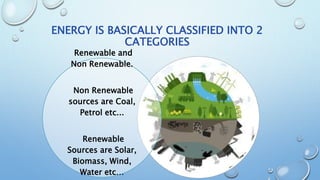
ENERGY IS BASICALLY CLASSIFIED INTO 2
CATEGORIES
Renewable and
Non Renewable.
Non Renewable
sources are Coal,
Petrol etc...
Renewable
Sources are Solar,
Biomass, Wind,
Water etc…
WIND ENERGY
• All renewable energy ultimately comes from the sun.
• The earth receives 1.74 x 10¹⁷ watts of power (per hour) from
the sun.
• About one or 2 percent of this energy is converted to wind
energy
WINDMILL DESIGN
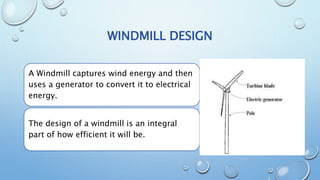
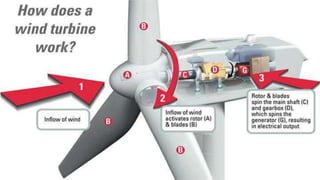
A Windmill captures wind energy and then
uses a generator to convert it to electrical
energy.
The design of a windmill is an integral
part of how efficient it will be.
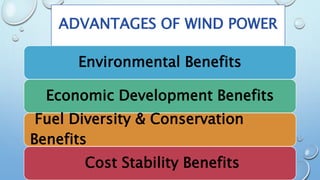
ADVANTAGES OF WIND POWER
Environmental Benefits
Economic Development Benefits
Fuel Diversity & Conservation
Benefits
Cost Stability Benefits
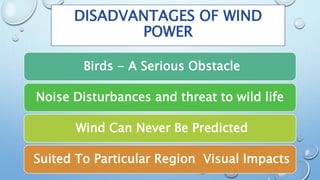
DISADVANTAGES OF WIND
POWER
Birds - A Serious Obstacle
Noise Disturbances and threat to wild life
Wind Can Never Be Predicted
Suited To Particular Region Visual Impacts
SORPTION AND COST-EFFECTIVE REMOVAL OF
IODOSULFURON THROUGH ACTIVATED CARBON
FROM SELECTED SOILS
INTRODUCTION
Iodosulfuron is a vital herbicide used throughout the
world by virtue of its distinctive properties.
It is known as a post-emergent pesticide which poses
minimal crop damage.
Due to its extensive applications, it has obtained
immense communal interest
The adsorption capacity of herbicide Iodosulfuron was
deliberated through batch equilibrium experimentations
EXPERIMENTAL
SOIL SAMPLING AND PREPARATION
•Four to five kg soil samples were collected from six
distinct regions of Pakistan including Taxila, Attock and
Chakwal, Kotli and Karachi.
•Sample assortment was completed in February 2017 with
the mean temperature of 25℃ over all districts.
•Samples were gathered from definite points for each site
through random selection and then they were kept in
clean polythene bags.
ADSORPTION EXPERIMENT
All experiments were completed at laboratory at ambient
conditions 24-26°C.
The adsorption experiments were conducted using a
batch equilibrium technique in duplicate.
Acetone was used to prepare a stock solution of
Iodosulfuron.
UV-visible spectrophotometer was used to find out the
pesticide concentration
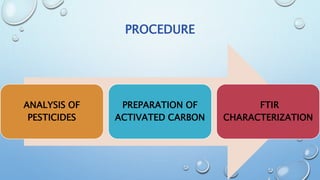
PROCEDURE
ANALYSIS OF
PESTICIDES
PREPARATION OF
ACTIVATED CARBON
FTIR
CHARACTERIZATION
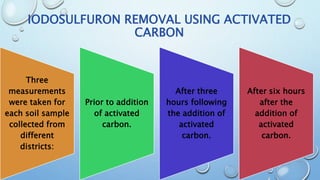
IODOSULFURON REMOVAL USING ACTIVATED
CARBON
Three
measurements
were taken for
each soil sample
collected from
different
districts:
Prior to addition
of activated
carbon.
After three
hours following
the addition of
activated
carbon.
After six hours
after the
addition of
activated
carbon.
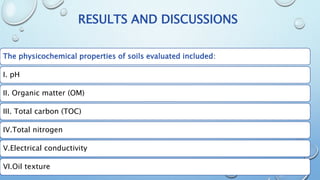
RESULTS AND DISCUSSIONS
The physicochemical properties of soils evaluated included:
I. pH
II. Organic matter (OM)
III. Total carbon (TOC)
IV.Total nitrogen
V.Electrical conductivity
VI.Oil texture
RESULTS AND DISCUSSIONS
• The adsorption coefficient values varied broadly.
• Highest adsorption coefficient value was shown by s1 with highest organic
matter of 1.4% and lowest ph of 5.62. Values of R² (0.89-0.99) presented that
the adsorption outcomes were best fitted to linear adsorption model.
• The gibbs free energy values were found negative ranging from -17 kj mol-1
to -20 kj mol-1 proposing physio-sorption and exothermic collaboration
with particular soils.
• Statistical analysis of regression and correlation showed negative correlation
of soil ph and kd(ads) (r2= -0.91 and p= 0.011) and positive correlation with
organic matter (R2= 0.87).
• The highest removal percentages by s1 and s2 were 5 ppm (56%) and 7.5ppm
(47%) respectively.
FIGURE 11: UV SPECTRUMS AT 5 ppm CONCENTRATION
HIGHEST REMOVAL IN S1
(A)
LOWEST REMOVAL IN S3
(B)Results were examined then graphs were
plotted of absorbance versus time.
Chief removal percentages by activated carbon
was displayed by S2 at both concentrations of 5
ppm (56%) and 7.5ppm (69%) respectively.
At the concentration of 5ppm maximum
elimination presented by S2 (56%) and
minimum removal is displayed by S3 (21%)
(Figure 11).
FIGURE 12: UV SPECTRUMS AT 5 ppm CONCENTRATION
HIGHEST REMOVAL IN S5
(A)
LOWEST REMOVAL IN S3
(B)
At the concentration of 7.5ppm maximum removal displayed by S5 (47%) and minimum removal is
displayed again by S3 (22%) (Figure 12).
3.Pesticid
es are the
chief
means of
disease
and pest
control in
crops, but
they have
both
adverse
and
beneficial
effects.
The
pesticide
uses in
Pakistan
augmente
d
dramatica
lly and is
now a
major risk
for the
sustainabi
lity of our
environm
Iodosulfuron
adsorption
was
principally
reliant on
soil
physicoche
mical
features
with organic
matter and
also pH
played a
critical role
in
determining
the degree
The current
research
recognized
improved
process for
the supreme
elimination
of pesticide
by means of
activated
carbon
which was
prepared
from
sawdust.
This
technique
has been
found to be
better when
compared to
other
methods of
pesticide
removal in
terms of
cost efficacy
and being
an
environment
-friendly
approach
WIND ENERGY

WIND ENERGY

  • 2.
  • 3.
    ENERGY IS BASICALLYCLASSIFIED INTO 2 CATEGORIES Renewable and Non Renewable. Non Renewable sources are Coal, Petrol etc... Renewable Sources are Solar, Biomass, Wind, Water etc…
  • 4.
    WIND ENERGY • Allrenewable energy ultimately comes from the sun. • The earth receives 1.74 x 10¹⁷ watts of power (per hour) from the sun. • About one or 2 percent of this energy is converted to wind energy
  • 5.
    WINDMILL DESIGN A Windmillcaptures wind energy and then uses a generator to convert it to electrical energy. The design of a windmill is an integral part of how efficient it will be.
  • 7.
    ADVANTAGES OF WINDPOWER Environmental Benefits Economic Development Benefits Fuel Diversity & Conservation Benefits Cost Stability Benefits
  • 8.
    DISADVANTAGES OF WIND POWER Birds- A Serious Obstacle Noise Disturbances and threat to wild life Wind Can Never Be Predicted Suited To Particular Region Visual Impacts
  • 9.
    SORPTION AND COST-EFFECTIVEREMOVAL OF IODOSULFURON THROUGH ACTIVATED CARBON FROM SELECTED SOILS
  • 10.
    INTRODUCTION Iodosulfuron is avital herbicide used throughout the world by virtue of its distinctive properties. It is known as a post-emergent pesticide which poses minimal crop damage. Due to its extensive applications, it has obtained immense communal interest The adsorption capacity of herbicide Iodosulfuron was deliberated through batch equilibrium experimentations
  • 11.
    EXPERIMENTAL SOIL SAMPLING ANDPREPARATION •Four to five kg soil samples were collected from six distinct regions of Pakistan including Taxila, Attock and Chakwal, Kotli and Karachi. •Sample assortment was completed in February 2017 with the mean temperature of 25℃ over all districts. •Samples were gathered from definite points for each site through random selection and then they were kept in clean polythene bags.
  • 12.
    ADSORPTION EXPERIMENT All experimentswere completed at laboratory at ambient conditions 24-26°C. The adsorption experiments were conducted using a batch equilibrium technique in duplicate. Acetone was used to prepare a stock solution of Iodosulfuron. UV-visible spectrophotometer was used to find out the pesticide concentration
  • 13.
  • 14.
    IODOSULFURON REMOVAL USINGACTIVATED CARBON Three measurements were taken for each soil sample collected from different districts: Prior to addition of activated carbon. After three hours following the addition of activated carbon. After six hours after the addition of activated carbon.
  • 15.
    RESULTS AND DISCUSSIONS Thephysicochemical properties of soils evaluated included: I. pH II. Organic matter (OM) III. Total carbon (TOC) IV.Total nitrogen V.Electrical conductivity VI.Oil texture
  • 16.
    RESULTS AND DISCUSSIONS •The adsorption coefficient values varied broadly. • Highest adsorption coefficient value was shown by s1 with highest organic matter of 1.4% and lowest ph of 5.62. Values of R² (0.89-0.99) presented that the adsorption outcomes were best fitted to linear adsorption model. • The gibbs free energy values were found negative ranging from -17 kj mol-1 to -20 kj mol-1 proposing physio-sorption and exothermic collaboration with particular soils. • Statistical analysis of regression and correlation showed negative correlation of soil ph and kd(ads) (r2= -0.91 and p= 0.011) and positive correlation with organic matter (R2= 0.87). • The highest removal percentages by s1 and s2 were 5 ppm (56%) and 7.5ppm (47%) respectively.
  • 17.
    FIGURE 11: UVSPECTRUMS AT 5 ppm CONCENTRATION HIGHEST REMOVAL IN S1 (A) LOWEST REMOVAL IN S3 (B)Results were examined then graphs were plotted of absorbance versus time. Chief removal percentages by activated carbon was displayed by S2 at both concentrations of 5 ppm (56%) and 7.5ppm (69%) respectively. At the concentration of 5ppm maximum elimination presented by S2 (56%) and minimum removal is displayed by S3 (21%) (Figure 11).
  • 18.
    FIGURE 12: UVSPECTRUMS AT 5 ppm CONCENTRATION HIGHEST REMOVAL IN S5 (A) LOWEST REMOVAL IN S3 (B) At the concentration of 7.5ppm maximum removal displayed by S5 (47%) and minimum removal is displayed again by S3 (22%) (Figure 12).
  • 19.
    3.Pesticid es are the chief meansof disease and pest control in crops, but they have both adverse and beneficial effects. The pesticide uses in Pakistan augmente d dramatica lly and is now a major risk for the sustainabi lity of our environm Iodosulfuron adsorption was principally reliant on soil physicoche mical features with organic matter and also pH played a critical role in determining the degree The current research recognized improved process for the supreme elimination of pesticide by means of activated carbon which was prepared from sawdust. This technique has been found to be better when compared to other methods of pesticide removal in terms of cost efficacy and being an environment -friendly approach