Transpiration
Plant Physiology
Jegatheeswari Karthik
Key concepts
 Concept of transpiration and its importance to plants
 Experiments related to transpiration:
 (a)Loss in weight of a potted plant or a leafy shoot in a test tube as a result of
transpiration.
 (b)Use of cobalt chloride paper to demonstrate unequal rate of transpiration in a
dorsiventral leaf.
 Mechanism of stomatal transpiration on the basis of potassium ion exchange theory.
 Adaptations in plants to reduce transpiration.
 A brief idea of guttation and bleeding.
Transpiration
 It is the process of loss of water in the form of water vapour from the
leaves and other aerial parts of the plant.
 Water is absorbed from the soil by the roots.
 Only 2% of it is utilised by the plant. (PhotoSynthesis and other
activities)
 Rest is lost as water vapor.
Importance of transpiration
1. Cooling of the plant: the loss of water vapour from the plant cools
down the plant when the weather is very hot.
2. The transpirational pull: when the plant loses water through
transpiration from the leaves, water and mineral salts from the stem and
roots moves, or is `pulled', upwards into the leaves. Water and is
therefore taken up from the soil by osmosis and finally exits the plants
through the stomata.
3. Plant structure: young plants or plants without woody stems require
water for structural support. Transpiration helps maintain the turgidity in
plants.
Demonstration of Transpiration
Experiment -1
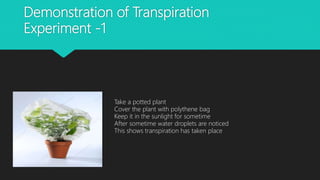
Take a potted plant
Cover the plant with polythene bag
Keep it in the sunlight for sometime
After sometime water droplets are noticed
This shows transpiration has taken place
Inference
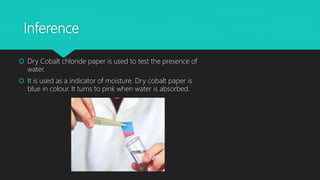
 Dry Cobalt chloride paper is used to test the presence of
water.
 It is used as a indicator of moisture. Dry cobalt paper is
blue in colour. It turns to pink when water is absorbed.
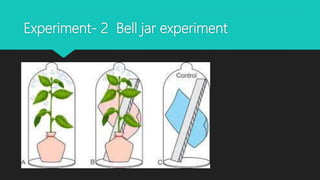
Experiment- 2 Bell jar experiment
Transpiration is the evaporation of water from the surface of leaves through
stomata. The phenomenon of transpiration can be explained by Bell jar
experiment.
 REQUIREMENTS:
• Bell jar
• Well watered potted plant
• Rubber sheet
• Glass plate
 PROCEDURE:
• Take the well watered potted plant and cover it with the rubber sheet. The aerial parts of the plant should be left
uncovered.
• Put the plant on the glass plate and cover with the bell jar.
• Prepare a same setup but without a plant in the second bell jar.
• Place the apparatus in sunlight for sometime.
 OBSERVATIONS:
 Water drops appear inside the walls of the bell jar containing potted plant whereas no water drops appear in the bell jar
without a plant. This demonstrates that water is evaporated from the surface of leaves in presence of sunlight.
Double visual proof of transpiration
 Condensation of water vapour into droplets.
 Change in colour of Cobalt-Chloride Paper.
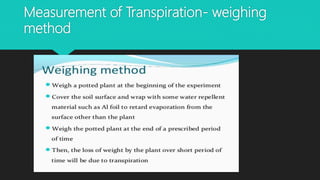
Measurement of Transpiration- weighing
method
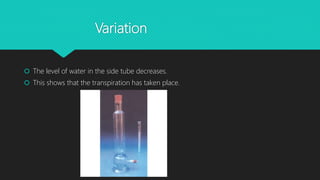
Variation
 The level of water in the side tube decreases.
 This shows that the transpiration has taken place.
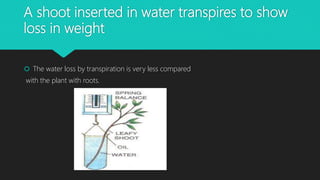
A shoot inserted in water transpires to show
loss in weight
 The water loss by transpiration is very less compared
with the plant with roots.
Potometer method
 Photon means water
 Meter means measure
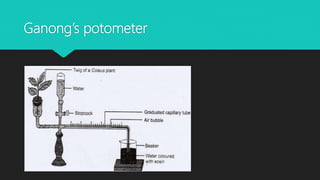
 Potometer is a device that measures the rate of water intake by the plants.
 Water intake is almost equal to the water lost during evaporation
Various types of potometer
 Farmer’s potometer and Ganong’s potometer – Help to measure the rate
of water intake by a plant.
 Darwin’s potometer – Helps to demonstrate suction pressure created due
to transpiration.
 Garreau’s potometer – Demonstrates unequal transpiration from the two
surfaces of a dorsiventral leaf.
Ganong’s potometer
Coleus
Procedure
 Perform the following steps under water:
1. Cut the stem of the leafy shoot (at an angle to increase the surface area) under water . The
reason we cut it under water is to prevent air bubbles entering the xylem vessel. You must use a
very sharp knife or new scalpel and cut at an angle in order to increase surface area for water
uptake in the xylem. Florists who cut plants before immersing them in water follow the same
procedure for this reason.
2. Test to make sure the stem of the leafy twig will fit snugly into the top of the straw.
3. Remove the leafy shoot from the straw and set aside, keeping the stem submerged, and the leaves
above water.
4. Fill the straw with water. Place your finger over one end of the straw to stop the water from running
out.
5. Put the leafy shoot into the open end and seal it with play dough/ putti/ Prestick while removing it
from water KEEPING YOUR FINGER ON THE STRAW! Perform the following steps above water.
Procedure
6. Seal with Vaseline. Make sure it is air tight and water tight. If not, all the water will run out when you
take your finger off the straw.
7. Mark the water level on the straw.
8. Place your potometer under one of the following conditions for one hour:
1. as is, in a warm, sunny place (no wind)
2. as is, in a warm, windy place
3. with a plastic bag tied around the leaf, in a warm, sunny place
4. a shady place.
9. Every 10 minutes use a marking pen to mark the change in water level on the straw. Continue
taking measurements for 1 hour.
10. Measure the distance the water moves during each time interval.
Ganong’s potometer
 Potometers do not measure the water lost during transpiration
 It measures the water uptake by cut shoots.
 Some water is used by cells for photosynthesis.
Precautions
 Completely water tight.
 Twig should be cut obliquely.
 Twig should kept under water to avoid suction of the air
bubble into the twig.
Limitations
• Introducing air bubble is not easy.
• Twig may not be remain fully alive for a long time.
• Changes in the outside air temperature may affect the position of air bubble.
Kinds of transpiration
 Transpiration occurs in three different aerial parts of a plant
1. Stomatal transpiration
2. Cuticular transpiration
3. Lenticular transpiration
Kinds of transpiration
Stomatal transpiration --
Water vapor escapes through the stomata of the leaf.
Cuticular transpiration
Transpiration occurs directly from the surface of the leaves and stems.
Lenticular transpiration
Transpiration occurs through lenticels present on old stems.
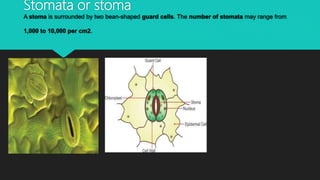
Stomata or stoma
A stoma is surrounded by two bean-shaped guard cells. The number of stomata may range from
1,000 to 10,000 per cm2.
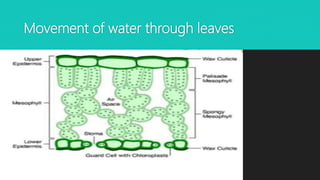
Movement of water through leaves
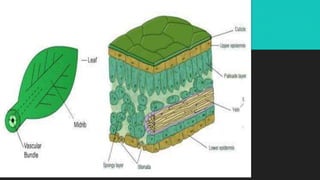
Internal leaf structure
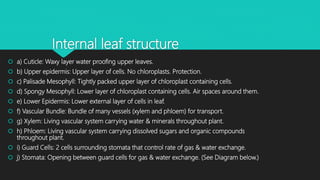
 a) Cuticle: Waxy layer water proofing upper leaves.
 b) Upper epidermis: Upper layer of cells. No chloroplasts. Protection.
 c) Palisade Mesophyll: Tightly packed upper layer of chloroplast containing cells.
 d) Spongy Mesophyll: Lower layer of chloroplast containing cells. Air spaces around them.
 e) Lower Epidermis: Lower external layer of cells in leaf.
 f) Vascular Bundle: Bundle of many vessels (xylem and phloem) for transport.
 g) Xylem: Living vascular system carrying water & minerals throughout plant.
 h) Phloem: Living vascular system carrying dissolved sugars and organic compounds
throughout plant.
 i) Guard Cells: 2 cells surrounding stomata that control rate of gas & water exchange.
 j) Stomata: Opening between guard cells for gas & water exchange. (See Diagram below.)
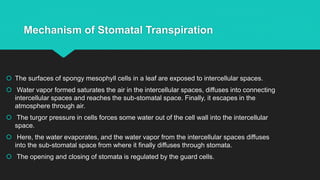
Mechanism of Stomatal Transpiration
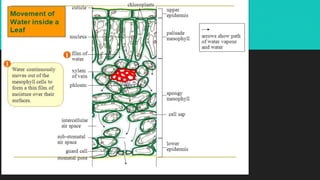
 The surfaces of spongy mesophyll cells in a leaf are exposed to intercellular spaces.
 Water vapor formed saturates the air in the intercellular spaces, diffuses into connecting
intercellular spaces and reaches the sub-stomatal space. Finally, it escapes in the
atmosphere through air.
 The turgor pressure in cells forces some water out of the cell wall into the intercellular
space.
 Here, the water evaporates, and the water vapor from the intercellular spaces diffuses
into the sub-stomatal space from where it finally diffuses through stomata.
 The opening and closing of stomata is regulated by the guard cells.
Stomatal transpiration
 Thousands of leaf cells evaporate water in this way, causing more of water
to be pulled from below.
 The transpirational pull thus created can draw up to 50 metres or more in
tall trees.
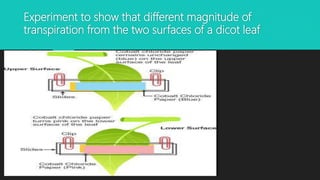
Experiment to show that different magnitude of
transpiration from the two surfaces of a dicot leaf
Inference
 The cobalt paper on the lower side turns pink in much lesser time than the
one on the upper surface.
 This shows that more transpiration occurs from the lower surface of the
leaf which is due to more number of stomata on the lower surface.
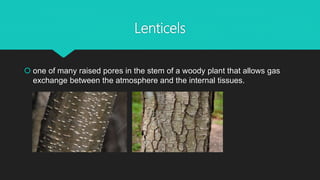
Lenticels
 one of many raised pores in the stem of a woody plant that allows gas
exchange between the atmosphere and the internal tissues.
Factors Affecting the Rate of Transpiration
External factors
Intensity of sunlight With increase in the intensity of sunlight, the rate of
transpiration increases.
Temperature Increase in the temperature of the air increases the rate of
transpiration.
Velocity of wind Transpiration increases with rapid or active air movement.
Humidity If the air is humid, then the rate of transpiration is reduced.
Carbon dioxide Increase in the CO2 level in the atmosphere over normal
0.03% causes stomatal closure. Hence, it decreases the rate of transpiration.
Atmospheric pressure With decrease in atmospheric pressure, the rate of
transpiration increases
Factors Affecting the Rate of Transpiration
Internal factors
 Water content of the leaves:
 If the water content of the leaves decreases due to insufficient
absorption of water by the roots, the leaves wilt and
transpiration is reduced.
 It is indirectly due to the closure of the stomata.
 It is the natural mechanism of conserving water within the
plant.
Adaptation in Plants to Control Excessive Transpiration
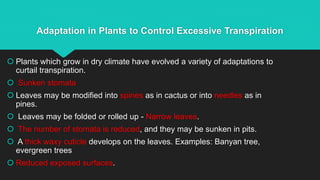
 Plants which grow in dry climate have evolved a variety of adaptations to
curtail transpiration.
 Sunken stomata
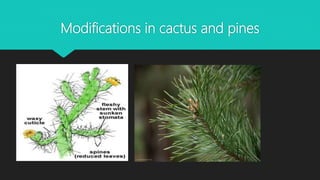
 Leaves may be modified into spines as in cactus or into needles as in
pines.
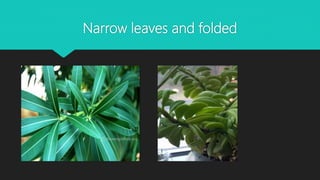
 Leaves may be folded or rolled up - Narrow leaves.
 The number of stomata is reduced, and they may be sunken in pits.
 A thick waxy cuticle develops on the leaves. Examples: Banyan tree,
evergreen trees
 Reduced exposed surfaces.
Sunken stomata
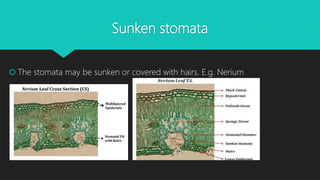
 The stomata may be sunken or covered with hairs. E.g. Nerium
Narrow leaves and folded
Modifications in cactus and pines
Significance of Transpiration
 Cooling effect
 Suction force
 Distribution of water and mineral salts
Transpiration affects climate
 A single sunflower plant loses half litre of water per day in the form of
water vapour.
 A maize plant loses two litres of water per day.
 A apple tree loses thirty litres of water.
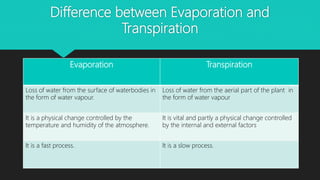
Difference between Evaporation and
Transpiration
Evaporation Transpiration
Loss of water from the surface of waterbodies in
the form of water vapour.
Loss of water from the aerial part of the plant in
the form of water vapour
It is a physical change controlled by the
temperature and humidity of the atmosphere.
It is vital and partly a physical change controlled
by the internal and external factors
It is a fast process. It is a slow process.
Exudation
 Exude means ooze out or sweat out
 Some plants may lose water or other fluids along with
dissolved substances directly as liquids and not as water
vapor.
 This is called exudation.
 The fluid given out is called exudate
 Guttation and Bleeding
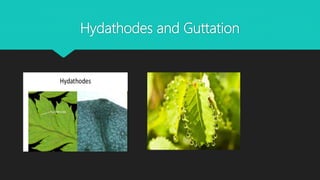
Guttation
 The water appears as tiny drops along the margins or tips of
leaves. This loss of excessive water is called guttation.
 Guttation occurs through hydathodes.
 Hydathodes are the pore bearing structures present on the
margins of the leaf.
 Common in Banana, Nasturtium and Strawberry
Hydathodes and Guttation
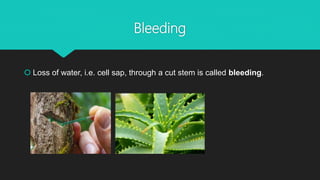
Bleeding
 Loss of water, i.e. cell sap, through a cut stem is called bleeding.
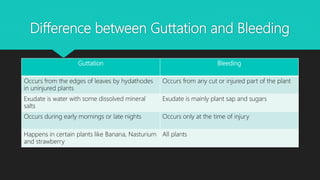
Difference between Guttation and Bleeding
Guttation Bleeding
Occurs from the edges of leaves by hydathodes
in uninjured plants
Occurs from any cut or injured part of the plant
Exudate is water with some dissolved mineral
salts
Exudate is mainly plant sap and sugars
Occurs during early mornings or late nights Occurs only at the time of injury
Happens in certain plants like Banana, Nasturium
and strawberry
All plants

Transpiration

  • 1.
  • 2.
    Key concepts  Conceptof transpiration and its importance to plants  Experiments related to transpiration:  (a)Loss in weight of a potted plant or a leafy shoot in a test tube as a result of transpiration.  (b)Use of cobalt chloride paper to demonstrate unequal rate of transpiration in a dorsiventral leaf.  Mechanism of stomatal transpiration on the basis of potassium ion exchange theory.  Adaptations in plants to reduce transpiration.  A brief idea of guttation and bleeding.
  • 3.
    Transpiration  It isthe process of loss of water in the form of water vapour from the leaves and other aerial parts of the plant.  Water is absorbed from the soil by the roots.  Only 2% of it is utilised by the plant. (PhotoSynthesis and other activities)  Rest is lost as water vapor.
  • 4.
    Importance of transpiration 1.Cooling of the plant: the loss of water vapour from the plant cools down the plant when the weather is very hot. 2. The transpirational pull: when the plant loses water through transpiration from the leaves, water and mineral salts from the stem and roots moves, or is `pulled', upwards into the leaves. Water and is therefore taken up from the soil by osmosis and finally exits the plants through the stomata. 3. Plant structure: young plants or plants without woody stems require water for structural support. Transpiration helps maintain the turgidity in plants.
  • 5.
    Demonstration of Transpiration Experiment-1 Take a potted plant Cover the plant with polythene bag Keep it in the sunlight for sometime After sometime water droplets are noticed This shows transpiration has taken place
  • 6.
    Inference  Dry Cobaltchloride paper is used to test the presence of water.  It is used as a indicator of moisture. Dry cobalt paper is blue in colour. It turns to pink when water is absorbed.
  • 7.
    Experiment- 2 Belljar experiment
  • 8.
    Transpiration is theevaporation of water from the surface of leaves through stomata. The phenomenon of transpiration can be explained by Bell jar experiment.  REQUIREMENTS: • Bell jar • Well watered potted plant • Rubber sheet • Glass plate  PROCEDURE: • Take the well watered potted plant and cover it with the rubber sheet. The aerial parts of the plant should be left uncovered. • Put the plant on the glass plate and cover with the bell jar. • Prepare a same setup but without a plant in the second bell jar. • Place the apparatus in sunlight for sometime.  OBSERVATIONS:  Water drops appear inside the walls of the bell jar containing potted plant whereas no water drops appear in the bell jar without a plant. This demonstrates that water is evaporated from the surface of leaves in presence of sunlight.
  • 9.
    Double visual proofof transpiration  Condensation of water vapour into droplets.  Change in colour of Cobalt-Chloride Paper.
  • 10.
  • 11.
    Variation  The levelof water in the side tube decreases.  This shows that the transpiration has taken place.
  • 12.
    A shoot insertedin water transpires to show loss in weight  The water loss by transpiration is very less compared with the plant with roots.
  • 13.
    Potometer method  Photonmeans water  Meter means measure  Potometer is a device that measures the rate of water intake by the plants.  Water intake is almost equal to the water lost during evaporation
  • 14.
    Various types ofpotometer  Farmer’s potometer and Ganong’s potometer – Help to measure the rate of water intake by a plant.  Darwin’s potometer – Helps to demonstrate suction pressure created due to transpiration.  Garreau’s potometer – Demonstrates unequal transpiration from the two surfaces of a dorsiventral leaf.
  • 15.
  • 16.
  • 17.
    Procedure  Perform thefollowing steps under water: 1. Cut the stem of the leafy shoot (at an angle to increase the surface area) under water . The reason we cut it under water is to prevent air bubbles entering the xylem vessel. You must use a very sharp knife or new scalpel and cut at an angle in order to increase surface area for water uptake in the xylem. Florists who cut plants before immersing them in water follow the same procedure for this reason. 2. Test to make sure the stem of the leafy twig will fit snugly into the top of the straw. 3. Remove the leafy shoot from the straw and set aside, keeping the stem submerged, and the leaves above water. 4. Fill the straw with water. Place your finger over one end of the straw to stop the water from running out. 5. Put the leafy shoot into the open end and seal it with play dough/ putti/ Prestick while removing it from water KEEPING YOUR FINGER ON THE STRAW! Perform the following steps above water.
  • 18.
    Procedure 6. Seal withVaseline. Make sure it is air tight and water tight. If not, all the water will run out when you take your finger off the straw. 7. Mark the water level on the straw. 8. Place your potometer under one of the following conditions for one hour: 1. as is, in a warm, sunny place (no wind) 2. as is, in a warm, windy place 3. with a plastic bag tied around the leaf, in a warm, sunny place 4. a shady place. 9. Every 10 minutes use a marking pen to mark the change in water level on the straw. Continue taking measurements for 1 hour. 10. Measure the distance the water moves during each time interval.
  • 19.
    Ganong’s potometer  Potometersdo not measure the water lost during transpiration  It measures the water uptake by cut shoots.  Some water is used by cells for photosynthesis.
  • 20.
    Precautions  Completely watertight.  Twig should be cut obliquely.  Twig should kept under water to avoid suction of the air bubble into the twig.
  • 21.
    Limitations • Introducing airbubble is not easy. • Twig may not be remain fully alive for a long time. • Changes in the outside air temperature may affect the position of air bubble.
  • 22.
    Kinds of transpiration Transpiration occurs in three different aerial parts of a plant 1. Stomatal transpiration 2. Cuticular transpiration 3. Lenticular transpiration
  • 23.
    Kinds of transpiration Stomataltranspiration -- Water vapor escapes through the stomata of the leaf. Cuticular transpiration Transpiration occurs directly from the surface of the leaves and stems. Lenticular transpiration Transpiration occurs through lenticels present on old stems.
  • 24.
    Stomata or stoma Astoma is surrounded by two bean-shaped guard cells. The number of stomata may range from 1,000 to 10,000 per cm2.
  • 25.
    Movement of waterthrough leaves
  • 26.
    Internal leaf structure a) Cuticle: Waxy layer water proofing upper leaves.  b) Upper epidermis: Upper layer of cells. No chloroplasts. Protection.  c) Palisade Mesophyll: Tightly packed upper layer of chloroplast containing cells.  d) Spongy Mesophyll: Lower layer of chloroplast containing cells. Air spaces around them.  e) Lower Epidermis: Lower external layer of cells in leaf.  f) Vascular Bundle: Bundle of many vessels (xylem and phloem) for transport.  g) Xylem: Living vascular system carrying water & minerals throughout plant.  h) Phloem: Living vascular system carrying dissolved sugars and organic compounds throughout plant.  i) Guard Cells: 2 cells surrounding stomata that control rate of gas & water exchange.  j) Stomata: Opening between guard cells for gas & water exchange. (See Diagram below.)
  • 28.
    Mechanism of StomatalTranspiration  The surfaces of spongy mesophyll cells in a leaf are exposed to intercellular spaces.  Water vapor formed saturates the air in the intercellular spaces, diffuses into connecting intercellular spaces and reaches the sub-stomatal space. Finally, it escapes in the atmosphere through air.  The turgor pressure in cells forces some water out of the cell wall into the intercellular space.  Here, the water evaporates, and the water vapor from the intercellular spaces diffuses into the sub-stomatal space from where it finally diffuses through stomata.  The opening and closing of stomata is regulated by the guard cells.
  • 30.
    Stomatal transpiration  Thousandsof leaf cells evaporate water in this way, causing more of water to be pulled from below.  The transpirational pull thus created can draw up to 50 metres or more in tall trees.
  • 31.
    Experiment to showthat different magnitude of transpiration from the two surfaces of a dicot leaf
  • 32.
    Inference  The cobaltpaper on the lower side turns pink in much lesser time than the one on the upper surface.  This shows that more transpiration occurs from the lower surface of the leaf which is due to more number of stomata on the lower surface.
  • 33.
    Lenticels  one ofmany raised pores in the stem of a woody plant that allows gas exchange between the atmosphere and the internal tissues.
  • 34.
    Factors Affecting theRate of Transpiration External factors Intensity of sunlight With increase in the intensity of sunlight, the rate of transpiration increases. Temperature Increase in the temperature of the air increases the rate of transpiration. Velocity of wind Transpiration increases with rapid or active air movement. Humidity If the air is humid, then the rate of transpiration is reduced. Carbon dioxide Increase in the CO2 level in the atmosphere over normal 0.03% causes stomatal closure. Hence, it decreases the rate of transpiration. Atmospheric pressure With decrease in atmospheric pressure, the rate of transpiration increases
  • 35.
    Factors Affecting theRate of Transpiration Internal factors  Water content of the leaves:  If the water content of the leaves decreases due to insufficient absorption of water by the roots, the leaves wilt and transpiration is reduced.  It is indirectly due to the closure of the stomata.  It is the natural mechanism of conserving water within the plant.
  • 36.
    Adaptation in Plantsto Control Excessive Transpiration  Plants which grow in dry climate have evolved a variety of adaptations to curtail transpiration.  Sunken stomata  Leaves may be modified into spines as in cactus or into needles as in pines.  Leaves may be folded or rolled up - Narrow leaves.  The number of stomata is reduced, and they may be sunken in pits.  A thick waxy cuticle develops on the leaves. Examples: Banyan tree, evergreen trees  Reduced exposed surfaces.
  • 37.
    Sunken stomata  Thestomata may be sunken or covered with hairs. E.g. Nerium
  • 38.
  • 39.
  • 40.
    Significance of Transpiration Cooling effect  Suction force  Distribution of water and mineral salts
  • 41.
    Transpiration affects climate A single sunflower plant loses half litre of water per day in the form of water vapour.  A maize plant loses two litres of water per day.  A apple tree loses thirty litres of water.
  • 42.
    Difference between Evaporationand Transpiration Evaporation Transpiration Loss of water from the surface of waterbodies in the form of water vapour. Loss of water from the aerial part of the plant in the form of water vapour It is a physical change controlled by the temperature and humidity of the atmosphere. It is vital and partly a physical change controlled by the internal and external factors It is a fast process. It is a slow process.
  • 43.
    Exudation  Exude meansooze out or sweat out  Some plants may lose water or other fluids along with dissolved substances directly as liquids and not as water vapor.  This is called exudation.  The fluid given out is called exudate  Guttation and Bleeding
  • 44.
    Guttation  The waterappears as tiny drops along the margins or tips of leaves. This loss of excessive water is called guttation.  Guttation occurs through hydathodes.  Hydathodes are the pore bearing structures present on the margins of the leaf.  Common in Banana, Nasturtium and Strawberry
  • 45.
  • 46.
    Bleeding  Loss ofwater, i.e. cell sap, through a cut stem is called bleeding.
  • 47.
    Difference between Guttationand Bleeding Guttation Bleeding Occurs from the edges of leaves by hydathodes in uninjured plants Occurs from any cut or injured part of the plant Exudate is water with some dissolved mineral salts Exudate is mainly plant sap and sugars Occurs during early mornings or late nights Occurs only at the time of injury Happens in certain plants like Banana, Nasturium and strawberry All plants