Hem Sheela Model School
Durgapur
Biology Investigatory project
NAME – Md Sakib Hossain
CLASS – XII
SECTION – B
ROLL NO – 31
SUBJECT – Biology (044)
CONTENTS
1. OBJECTIVE ........................................................................................................3
2. INTRODUCTION................................................................................................4
2.1.Mechanism of Transpiration:.........................................................................4
2.2.Factors Affecting Transpiration.....................................................................5
2.3.Significance of Transpiration.........................................................................6
3. HYPOTHESIS: ....................................................................................................7
4. MATERIALS REQUIRED:.................................................................................8
5. PROCEDURE......................................................................................................9
5.1.Setting up the potometer ................................................................................9
5.2.Recording the rate of transpiration...............................................................11
6. OBSERVATIONS .............................................................................................13
7. RESULT:............................................................................................................14
8. ANALYSIS:.......................................................................................................15
9. LIMITATIONS:.................................................................................................16
10.PRECAUTIONS: ...............................................................................................17
11. BIBLIOGRAPHY:.............................................................................................18
OBJECTIVE
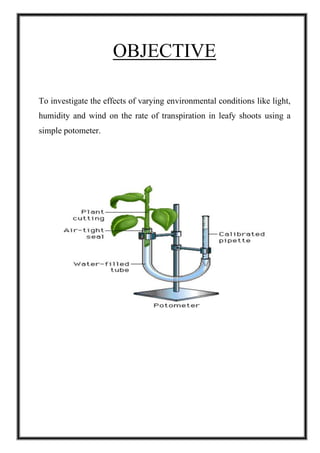
To investigate the effects of varying environmental conditions like light,
humidity and wind on the rate of transpiration in leafy shoots using a
simple potometer.
INTRODUCTION
The terrestrial plants take up water through their roots and xylem. But,
only a small fraction of the absorbed water is used by the plants and the
rest is lost through the aerial parts of the plant. This loss of water in the
form of vapour through the aerial parts of the plant like stem, fruits,
flowers, stomata of the leaves etc. is known as transpiration.
Mechanism of Transpiration:
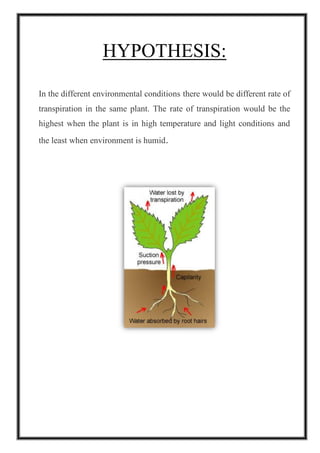
Water rises up in the stem through xylem due to the suction pull caused
by the evaporated water. The upward transpiration pull is greater than
the downward gravitational pull so, the column of water moves up.
According to cohesion tension theory, the evaporation of water from the
leaves causes the upwards movement of water. The water molecules
have a high cohesion as they are polar and so are electrically attracted to
each other. The column of water does not tend to break as it has a very
high tensile strength from the hydrogen bonds between the water
molecules.
From xylem vessels of leaves water diffuses (down the concentration
gradient) into mesophyll tissue making cells turgid. The walls of
mesophyll cells remain saturated with water. From cell walls water is
lost into intercellular spaces in the form of water vapour. Soon, the
concentration of water vapour in the intercellular spaces is connected to
atmosphere through stomata. The air surrounding the leaves thus
becomes more humid, and water vapours from there diffuses into dry
region of the atmosphere. The process of water loss involving
evaporation from the cell walls into intercellular spaces and then
diffusion of water vapour from intercellular spaces into the atmosphere
through stomata, lenticels or cuticles goes on continuously. When
Pressure begins to build in the leaves, to prevent downward movement,
guttation occurs. Guttation is the loss if water through leaf openings on
the leaf margins called hydrathodes.
Loss of water through transpiration can be facilitated by the opening and
closing of the stomata depending on environmental conditions.
The stomata open in the day to let carbon dioxide diffuse in, and to let
oxygen diffuse out as part of photosynthesis. At night photosynthesis is
unable to take place due to the absence of light so the stomata are closed
to reduce water loss. Light causes potassium ions to be pumped into the
guard cells which lowers their water potential and so water diffuses into
the guard cells causing them to go turgid and so open. At night
potassium moves out of the guard cells into the surrounding cells so the
water diffuses out of the guard cells causing them to close. In hot
climates the water loss by transpiration can exceed the water uptake
from the roots which causes the plants to suffer from water stress. To
combat this ABA is produced by the plant which causes the rapid
pumping of potassium ions out of the guard cells which closes them and
so reduces the water loss by transpiration.
Factors Affecting Transpiration
A) Internal Factors:
i. Leaf area: Larger leaves lose more water than smaller leaves.
ii. Leaf structure: The rate of transpiration is large due to large leaf
structure.
iii. Succulence: The succulent stem contains mucilage in their tissues.
This reduces the rate of transpiration with an increase in the shoot-
root ratio.
B) External Factors:
i. Atmosphere Humidity: Lesser the humidity higher is rate of
transpiration.
ii. Temperature: Higher the temp higher will be transpiration.
iii. Wind Velocity: Higher the wind velocity higher will be
transpiration.
iv. Availability of water: It also cause higher or lower transpiration.
Significance of Transpiration
1. Ascent of Sap: Transpiration exerts a tension pull on water column in
xylem which is responsible for the ascent of sap.
2. Absorption of Water: Transpiration helps passive absorption of
water.
3. Transport of Minerals: Transpiration assists translocation of mineral
salts through xylem.
4. Cooling Effect: Transpiration create cooling in the plants.
5. Diffusion of CO2: Transpiration is needed to keep the cells of the
spongy and palisade mesophyll cells moist as this allows carbon dioxide
to dissolve before diffusing into the cells for Photosynthesis.
HYPOTHESIS:
In the different environmental conditions there would be different rate of
transpiration in the same plant. The rate of transpiration would be the
highest when the plant is in high temperature and light conditions and
the least when environment is humid.
MATERIALS REQUIRED:
➢ A spinach plant
➢ A glass tube
➢ Screw gauge
➢ Bunsen burner
➢ Conical flask
➢ Two Titration stands
➢ Bowl of water
➢ Petroleum jelly
➢ An electric bulb
➢ A plastic bag
➢ Stop watch
➢ Ruler
➢ Marker
➢ Cello tape
➢ Table fan
PROCEDURE
Setting up the potometer
➢ A glass tube of diameter 0.56 cm measured using a screw gauge
was taken.
➢ It was made U-shaped using flame which was longer at one end
than the other.
➢ The longer end was graduated to 0.25 ml which was 1cm using a
scale and marker.
➢ A Spinach plant was selected based on the diameter of the stem
and with more number of leaves so as to provide maximum surface
area, and kept immersed in water to maintain its freshness.
➢ The spinach shoot was then cut under water in a large bowl about 1
inch up the root using a blade in a single stroke to avoid damage to
the vascular bundle and inserted along with the water through the
smaller end of the tube taking care that there were no air bubbles in
the tube.
➢ Petroleum jelly (Vaseline) was immediately applied around the
tube edging to form an airtight seal around the stem.
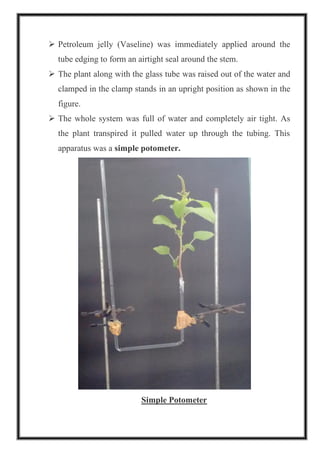
➢ The plant along with the glass tube was raised out of the water and
clamped in the clamp stands in an upright position as shown in the
figure.
➢ The whole system was full of water and completely air tight. As
the plant transpired it pulled water up through the tubing. This
apparatus was a simple potometer.
Simple Potometer
Recording the rate of transpiration
➢ The apparatus was allowed to equilibrate for about 15 minutes and
then the rate of transpiration was recorded in different
environmental condition.
➢ The time required for unit volume (0.25 ml) of water transpired in
various conditions was noted. The whole experiment was carried
out at normal room temperature.
➢ Various environmental conditions used in the experiment
✓ Wind: A table fan was used for this purpose. It was operated in
medium mode so that it doesn’t disturb the apparatus.
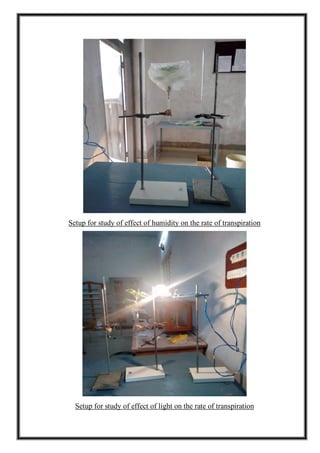
✓ Light: An electric bulb was used such that all the leaves
surface get maximum intensity of light and no wind in the area.
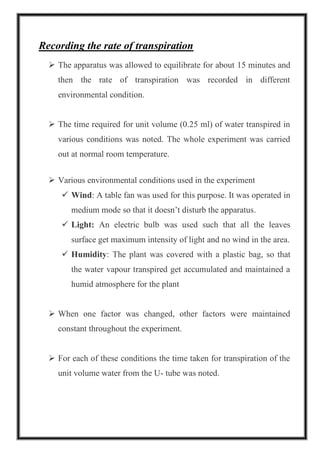
✓ Humidity: The plant was covered with a plastic bag, so that
the water vapour transpired get accumulated and maintained a
humid atmosphere for the plant
➢ When one factor was changed, other factors were maintained
constant throughout the experiment.
➢ For each of these conditions the time taken for transpiration of the
unit volume water from the U- tube was noted.
Setup for study of effect of humidity on the rate of transpiration
Setup for study of effect of light on the rate of transpiration
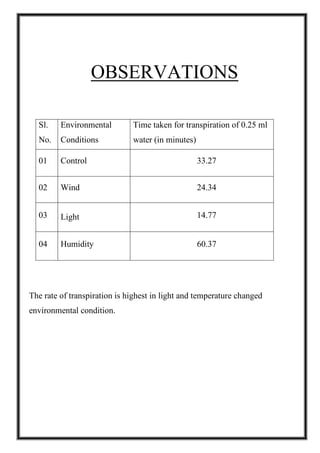
OBSERVATIONS
Sl.
No.
Environmental
Conditions
Time taken for transpiration of 0.25 ml
water (in minutes)
01 Control 33.27
02 Wind 24.34
03 Light 14.77
04 Humidity 60.37
The rate of transpiration is highest in light and temperature changed
environmental condition.
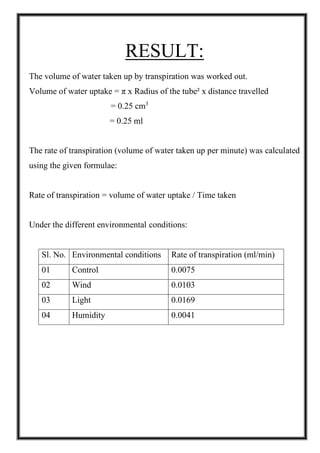
RESULT:
The volume of water taken up by transpiration was worked out.
Volume of water uptake = π x Radius of the tube² x distance travelled
= 0.25 cm3
= 0.25 ml
The rate of transpiration (volume of water taken up per minute) was calculated
using the given formulae:
Rate of transpiration = volume of water uptake / Time taken
Under the different environmental conditions:
Sl. No. Environmental conditions Rate of transpiration (ml/min)
01 Control 0.0075
02 Wind 0.0103
03 Light 0.0169
04 Humidity 0.0041
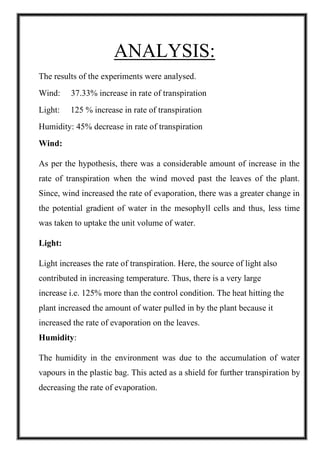
ANALYSIS:
The results of the experiments were analysed.
Wind: 37.33% increase in rate of transpiration
Light: 125 % increase in rate of transpiration
Humidity: 45% decrease in rate of transpiration
Wind:
As per the hypothesis, there was a considerable amount of increase in the
rate of transpiration when the wind moved past the leaves of the plant.
Since, wind increased the rate of evaporation, there was a greater change in
the potential gradient of water in the mesophyll cells and thus, less time
was taken to uptake the unit volume of water.
Light:
Light increases the rate of transpiration. Here, the source of light also
contributed in increasing temperature. Thus, there is a very large
increase i.e. 125% more than the control condition. The heat hitting the
plant increased the amount of water pulled in by the plant because it
increased the rate of evaporation on the leaves.
Humidity:
The humidity in the environment was due to the accumulation of water
vapours in the plastic bag. This acted as a shield for further transpiration by
decreasing the rate of evaporation.
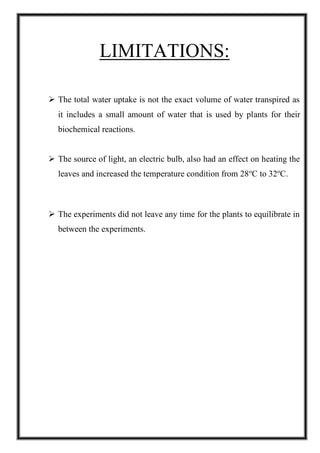
LIMITATIONS:
➢ The total water uptake is not the exact volume of water transpired as
it includes a small amount of water that is used by plants for their
biochemical reactions.
➢ The source of light, an electric bulb, also had an effect on heating the
leaves and increased the temperature condition from 28o
C to 32o
C.
➢ The experiments did not leave any time for the plants to equilibrate in
between the experiments.
PRECAUTIONS:
➢ The fan was fairly close to the leaves but not so close that it would
buffet the leaves as this may cause the stomata to close.
➢ When measuring the distances the eye was at a 90º angle from the
Lower meniscus of the glass tube. This way parallax error can be
avoided when looking at the scale on the ruler.
➢ There should be no wind in the area where the experiment is taking
place except supplied by table fan.
BIBLIOGRAPHY:
Books:
➢ NCERT LABORATORY MANUAL FOR BIOLOGY CLASS XII
➢ BIOLOGY NCERT TEXTBOOK FOR CLASS XI
➢ CORE LABORATORY MANUAL FOR CLASS XI- PHYSICS
Websites:
➢ www.google.co.in
➢ http://amrita.olabs.co.in
➢ http://users.rcn.com
➢ http://www.scienceproject.com
➢ http://www.allprojectreports.com
➢ http://www.tutorvista.com/content/physics/physics-i/measurement-
and-experimentation/screw-gauge.php
➢ http://www.reviewmylife.co.uk
➢ http://www.biologyjunction.com

Class 12 (CBSE) Investigatory project.pdf

  • 1.
    Hem Sheela ModelSchool Durgapur Biology Investigatory project NAME – Md Sakib Hossain CLASS – XII SECTION – B ROLL NO – 31 SUBJECT – Biology (044)
  • 2.
    CONTENTS 1. OBJECTIVE ........................................................................................................3 2.INTRODUCTION................................................................................................4 2.1.Mechanism of Transpiration:.........................................................................4 2.2.Factors Affecting Transpiration.....................................................................5 2.3.Significance of Transpiration.........................................................................6 3. HYPOTHESIS: ....................................................................................................7 4. MATERIALS REQUIRED:.................................................................................8 5. PROCEDURE......................................................................................................9 5.1.Setting up the potometer ................................................................................9 5.2.Recording the rate of transpiration...............................................................11 6. OBSERVATIONS .............................................................................................13 7. RESULT:............................................................................................................14 8. ANALYSIS:.......................................................................................................15 9. LIMITATIONS:.................................................................................................16 10.PRECAUTIONS: ...............................................................................................17 11. BIBLIOGRAPHY:.............................................................................................18
  • 3.
    OBJECTIVE To investigate theeffects of varying environmental conditions like light, humidity and wind on the rate of transpiration in leafy shoots using a simple potometer.
  • 4.
    INTRODUCTION The terrestrial plantstake up water through their roots and xylem. But, only a small fraction of the absorbed water is used by the plants and the rest is lost through the aerial parts of the plant. This loss of water in the form of vapour through the aerial parts of the plant like stem, fruits, flowers, stomata of the leaves etc. is known as transpiration. Mechanism of Transpiration: Water rises up in the stem through xylem due to the suction pull caused by the evaporated water. The upward transpiration pull is greater than the downward gravitational pull so, the column of water moves up. According to cohesion tension theory, the evaporation of water from the leaves causes the upwards movement of water. The water molecules have a high cohesion as they are polar and so are electrically attracted to each other. The column of water does not tend to break as it has a very high tensile strength from the hydrogen bonds between the water molecules. From xylem vessels of leaves water diffuses (down the concentration gradient) into mesophyll tissue making cells turgid. The walls of mesophyll cells remain saturated with water. From cell walls water is lost into intercellular spaces in the form of water vapour. Soon, the concentration of water vapour in the intercellular spaces is connected to atmosphere through stomata. The air surrounding the leaves thus becomes more humid, and water vapours from there diffuses into dry
  • 5.
    region of theatmosphere. The process of water loss involving evaporation from the cell walls into intercellular spaces and then diffusion of water vapour from intercellular spaces into the atmosphere through stomata, lenticels or cuticles goes on continuously. When Pressure begins to build in the leaves, to prevent downward movement, guttation occurs. Guttation is the loss if water through leaf openings on the leaf margins called hydrathodes. Loss of water through transpiration can be facilitated by the opening and closing of the stomata depending on environmental conditions. The stomata open in the day to let carbon dioxide diffuse in, and to let oxygen diffuse out as part of photosynthesis. At night photosynthesis is unable to take place due to the absence of light so the stomata are closed to reduce water loss. Light causes potassium ions to be pumped into the guard cells which lowers their water potential and so water diffuses into the guard cells causing them to go turgid and so open. At night potassium moves out of the guard cells into the surrounding cells so the water diffuses out of the guard cells causing them to close. In hot climates the water loss by transpiration can exceed the water uptake from the roots which causes the plants to suffer from water stress. To combat this ABA is produced by the plant which causes the rapid pumping of potassium ions out of the guard cells which closes them and so reduces the water loss by transpiration.
  • 6.
    Factors Affecting Transpiration A)Internal Factors: i. Leaf area: Larger leaves lose more water than smaller leaves. ii. Leaf structure: The rate of transpiration is large due to large leaf structure. iii. Succulence: The succulent stem contains mucilage in their tissues. This reduces the rate of transpiration with an increase in the shoot- root ratio. B) External Factors: i. Atmosphere Humidity: Lesser the humidity higher is rate of transpiration. ii. Temperature: Higher the temp higher will be transpiration. iii. Wind Velocity: Higher the wind velocity higher will be transpiration. iv. Availability of water: It also cause higher or lower transpiration. Significance of Transpiration 1. Ascent of Sap: Transpiration exerts a tension pull on water column in xylem which is responsible for the ascent of sap. 2. Absorption of Water: Transpiration helps passive absorption of water. 3. Transport of Minerals: Transpiration assists translocation of mineral salts through xylem. 4. Cooling Effect: Transpiration create cooling in the plants. 5. Diffusion of CO2: Transpiration is needed to keep the cells of the spongy and palisade mesophyll cells moist as this allows carbon dioxide to dissolve before diffusing into the cells for Photosynthesis.
  • 7.
    HYPOTHESIS: In the differentenvironmental conditions there would be different rate of transpiration in the same plant. The rate of transpiration would be the highest when the plant is in high temperature and light conditions and the least when environment is humid.
  • 8.
    MATERIALS REQUIRED: ➢ Aspinach plant ➢ A glass tube ➢ Screw gauge ➢ Bunsen burner ➢ Conical flask ➢ Two Titration stands ➢ Bowl of water ➢ Petroleum jelly ➢ An electric bulb ➢ A plastic bag ➢ Stop watch ➢ Ruler ➢ Marker ➢ Cello tape ➢ Table fan
  • 9.
    PROCEDURE Setting up thepotometer ➢ A glass tube of diameter 0.56 cm measured using a screw gauge was taken. ➢ It was made U-shaped using flame which was longer at one end than the other. ➢ The longer end was graduated to 0.25 ml which was 1cm using a scale and marker. ➢ A Spinach plant was selected based on the diameter of the stem and with more number of leaves so as to provide maximum surface area, and kept immersed in water to maintain its freshness. ➢ The spinach shoot was then cut under water in a large bowl about 1 inch up the root using a blade in a single stroke to avoid damage to the vascular bundle and inserted along with the water through the smaller end of the tube taking care that there were no air bubbles in the tube.
  • 10.
    ➢ Petroleum jelly(Vaseline) was immediately applied around the tube edging to form an airtight seal around the stem. ➢ The plant along with the glass tube was raised out of the water and clamped in the clamp stands in an upright position as shown in the figure. ➢ The whole system was full of water and completely air tight. As the plant transpired it pulled water up through the tubing. This apparatus was a simple potometer. Simple Potometer
  • 11.
    Recording the rateof transpiration ➢ The apparatus was allowed to equilibrate for about 15 minutes and then the rate of transpiration was recorded in different environmental condition. ➢ The time required for unit volume (0.25 ml) of water transpired in various conditions was noted. The whole experiment was carried out at normal room temperature. ➢ Various environmental conditions used in the experiment ✓ Wind: A table fan was used for this purpose. It was operated in medium mode so that it doesn’t disturb the apparatus. ✓ Light: An electric bulb was used such that all the leaves surface get maximum intensity of light and no wind in the area. ✓ Humidity: The plant was covered with a plastic bag, so that the water vapour transpired get accumulated and maintained a humid atmosphere for the plant ➢ When one factor was changed, other factors were maintained constant throughout the experiment. ➢ For each of these conditions the time taken for transpiration of the unit volume water from the U- tube was noted.
  • 12.
    Setup for studyof effect of humidity on the rate of transpiration Setup for study of effect of light on the rate of transpiration
  • 13.
    OBSERVATIONS Sl. No. Environmental Conditions Time taken fortranspiration of 0.25 ml water (in minutes) 01 Control 33.27 02 Wind 24.34 03 Light 14.77 04 Humidity 60.37 The rate of transpiration is highest in light and temperature changed environmental condition.
  • 14.
    RESULT: The volume ofwater taken up by transpiration was worked out. Volume of water uptake = π x Radius of the tube² x distance travelled = 0.25 cm3 = 0.25 ml The rate of transpiration (volume of water taken up per minute) was calculated using the given formulae: Rate of transpiration = volume of water uptake / Time taken Under the different environmental conditions: Sl. No. Environmental conditions Rate of transpiration (ml/min) 01 Control 0.0075 02 Wind 0.0103 03 Light 0.0169 04 Humidity 0.0041
  • 15.
    ANALYSIS: The results ofthe experiments were analysed. Wind: 37.33% increase in rate of transpiration Light: 125 % increase in rate of transpiration Humidity: 45% decrease in rate of transpiration Wind: As per the hypothesis, there was a considerable amount of increase in the rate of transpiration when the wind moved past the leaves of the plant. Since, wind increased the rate of evaporation, there was a greater change in the potential gradient of water in the mesophyll cells and thus, less time was taken to uptake the unit volume of water. Light: Light increases the rate of transpiration. Here, the source of light also contributed in increasing temperature. Thus, there is a very large increase i.e. 125% more than the control condition. The heat hitting the plant increased the amount of water pulled in by the plant because it increased the rate of evaporation on the leaves. Humidity: The humidity in the environment was due to the accumulation of water vapours in the plastic bag. This acted as a shield for further transpiration by decreasing the rate of evaporation.
  • 16.
    LIMITATIONS: ➢ The totalwater uptake is not the exact volume of water transpired as it includes a small amount of water that is used by plants for their biochemical reactions. ➢ The source of light, an electric bulb, also had an effect on heating the leaves and increased the temperature condition from 28o C to 32o C. ➢ The experiments did not leave any time for the plants to equilibrate in between the experiments.
  • 17.
    PRECAUTIONS: ➢ The fanwas fairly close to the leaves but not so close that it would buffet the leaves as this may cause the stomata to close. ➢ When measuring the distances the eye was at a 90º angle from the Lower meniscus of the glass tube. This way parallax error can be avoided when looking at the scale on the ruler. ➢ There should be no wind in the area where the experiment is taking place except supplied by table fan.
  • 18.
    BIBLIOGRAPHY: Books: ➢ NCERT LABORATORYMANUAL FOR BIOLOGY CLASS XII ➢ BIOLOGY NCERT TEXTBOOK FOR CLASS XI ➢ CORE LABORATORY MANUAL FOR CLASS XI- PHYSICS Websites: ➢ www.google.co.in ➢ http://amrita.olabs.co.in ➢ http://users.rcn.com ➢ http://www.scienceproject.com ➢ http://www.allprojectreports.com ➢ http://www.tutorvista.com/content/physics/physics-i/measurement- and-experimentation/screw-gauge.php ➢ http://www.reviewmylife.co.uk ➢ http://www.biologyjunction.com