Transpiration
KAMALJIT SIDHU
ASSOCIATE PROFESSOR
DEPARTMENT OF BOTANY
KHALSA COLLEGE FOR WOMEN,CIVIL LINES
LUDHIANA
Transpiration
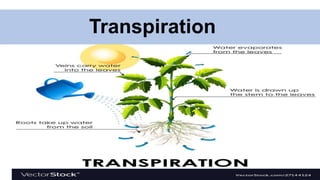
Transpiration
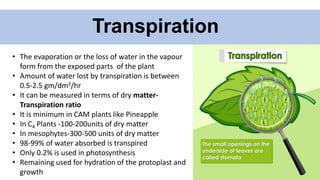
• The evaporation or the loss of water in the vapour
form from the exposed parts of the plant
• Amount of water lost by transpiration is between
0.5-2.5 gm/dm2/hr
• It can be measured in terms of dry matter-
Transpiration ratio
• It is minimum in CAM plants like Pineapple
• In C4 Plants -100-200units of dry matter
• In mesophytes-300-500 units of dry matter
• 98-99% of water absorbed is transpired
• Only 0.2% is used in photosynthesis
• Remaining used for hydration of the protoplast and
growth
Types of Transpiration
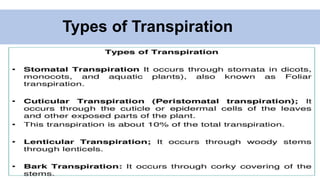
Stomatal Transpiration
• Stomatal transpiration- Takes place
through stomata
• 2 stages of stomatal transpiration-
Diffusion of water from the moist cell
walls into intercellular spaces and
passage of water vapours from the
intercellular spaces through the stomata
• 75% of the evapouration occurs through
the inner surface of the epidermal cells-
Peristomatal transpiration
• It stops only when the stomata are
closed completely
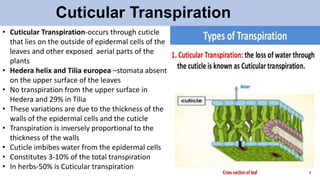
Cuticular Transpiration
• Cuticular Transpiration-occurs through cuticle
that lies on the outside of epidermal cells of the
leaves and other exposed aerial parts of the
plants
• Hedera helix and Tilia europea –stomata absent
on the upper surface of the leaves
• No transpiration from the upper surface in
Hedera and 29% in Tilia
• These variations are due to the thickness of the
walls of the epidermal cells and the cuticle
• Transpiration is inversely proportional to the
thickness of the walls
• Cuticle imbibes water from the epidermal cells
• Constitutes 3-10% of the total transpiration
• In herbs-50% is Cuticular transpiration
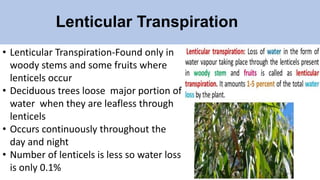
Lenticular Transpiration
• Lenticular Transpiration-Found only in
woody stems and some fruits where
lenticels occur
• Deciduous trees loose major portion of
water when they are leafless through
lenticels
• Occurs continuously throughout the
day and night
• Number of lenticels is less so water loss
is only 0.1%
Bark Transpiration
• Bark Transpiration-Through
the bark or cork occurring on
outside of woody stems
• Cork is impermeable
• Looses water slowly
• Looses 5 times more water
than all the lenticels together
Stomatal Apparatus
• Stomata are tiny pores found in the epidermis of the
leaves and soft aerial parts
• Allow the exchange of gases between the leaf cells
and the atmosphere
• Expose the wet interior parts of the plant to the dry
air outside which cause transpiration
• The stomatal pore is elliptical in outline
• Pore size varies in different plants
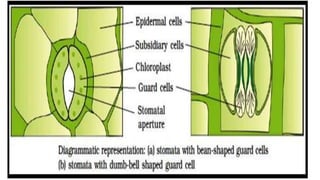
• Each stomata is surrounded by two specialized
epidermal guard cells
• Guard cells are kidney shaped
• They are joined at the ends
• Guard cell wall is thick on the concave or the inner
side and thin on the convex or the outer side
• In Graminae , Palmaceae and Cypreaceae the guard
cells are dumb bell shaped
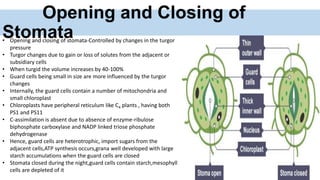
Opening and Closing of
Stomata• Opening and closing of stomata-Controlled by changes in the turgor
pressure
• Turgor changes due to gain or loss of solutes from the adjacent or
subsidiary cells
• When turgid the volume increases by 40-100%
• Guard cells being small in size are more influenced by the turgor
changes
• Internally, the guard cells contain a number of mitochondria and
small chloroplast
• Chloroplasts have peripheral reticulum like C4 plants , having both
PS1 and PS11
• C-assimilation is absent due to absence of enzyme-ribulose
biphosphate carboxylase and NADP linked triose phosphate
dehydrogenase
• Hence, guard cells are heterotrophic, import sugars from the
adjacent cells,ATP synthesis occurs,grana well developed with large
starch accumulations when the guard cells are closed
• Stomata closed during the night,guard cells contain starch,mesophyll
cells are depleted of it
Opening and Closing of
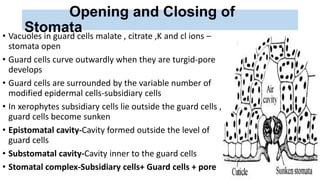
Stomata• Vacuoles in guard cells malate , citrate ,K and cl ions –
stomata open
• Guard cells curve outwardly when they are turgid-pore
develops
• Guard cells are surrounded by the variable number of
modified epidermal cells-subsidiary cells
• In xerophytes subsidiary cells lie outside the guard cells ,
guard cells become sunken
• Epistomatal cavity-Cavity formed outside the level of
guard cells
• Substomatal cavity-Cavity inner to the guard cells
• Stomatal complex-Subsidiary cells+ Guard cells + pore
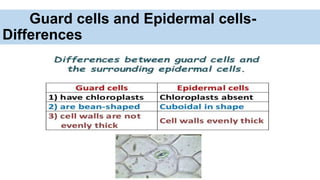
Guard cells and Epidermal cells-
Differences
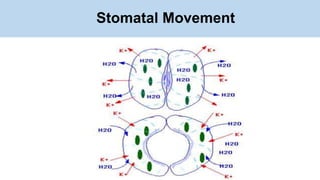
Stomatal Movement
Stomatal Movement
Theories of Stomatal
Movement•Hypothesis of guard cell photosynthesis-Put forth by
Schwendner
•Guard cells have chloroplasts,perform photosynthesis during
the day
•Produce sugar which increase their solute concentration
•Water enters the guard cells by endosmosis
•Guard cells swell up , bend outwards and create a pore
•Fails to explain the stomatal opening during the night in CAM
plants
•Appreciable sugar content has not been found in the guard
Theories of Stomatal Movement
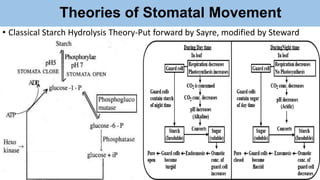
• Classical Starch Hydrolysis Theory-Put forward by Sayre, modified by Steward
Mechanism of Stomatal movement
Theories of Stomatal Movement
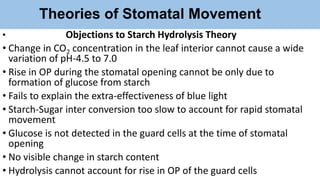
• Objections to Starch Hydrolysis Theory
• Change in CO2 concentration in the leaf interior cannot cause a wide
variation of pH-4.5 to 7.0
• Rise in OP during the stomatal opening cannot be only due to
formation of glucose from starch
• Fails to explain the extra-effectiveness of blue light
• Starch-Sugar inter conversion too slow to account for rapid stomatal
movement
• Glucose is not detected in the guard cells at the time of stomatal
opening
• No visible change in starch content
• Hydrolysis cannot account for rise in OP of the guard cells
Theories of Stomatal Movement
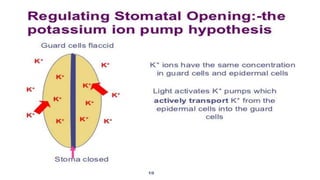
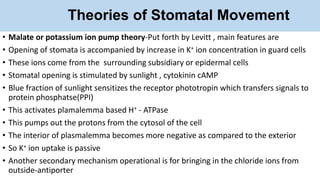
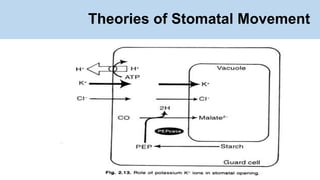
• Malate or potassium ion pump theory-Put forth by Levitt , main features are
• Opening of stomata is accompanied by increase in K+ ion concentration in guard cells
• These ions come from the surrounding subsidiary or epidermal cells
• Stomatal opening is stimulated by sunlight , cytokinin cAMP
• Blue fraction of sunlight sensitizes the receptor phototropin which transfers signals to
protein phosphatse(PPI)
• This activates plamalemma based H+ - ATPase
• This pumps out the protons from the cytosol of the cell
• The interior of plasmalemma becomes more negative as compared to the exterior
• So K+ ion uptake is passive
• Another secondary mechanism operational is for bringing in the chloride ions from
outside-antiporter
Theories of Stomatal Movement
• Some protons picked up by mitochondria and chloroplast of guard cells
• Internal CO2 conc decreases, pH rises causes hydrolysis of starch to phosphoenol
pyruvate(PEP)
• PEP combines with CO2 to produce oxalo acetic acid , which is converted into
malic acid
• Malic acid dissociates into malate ions and H+ ions
• H+ ions pass out of the guard cells and K+ ions enter
• More K+ ions enter than which could be counter balanced so chloride ion is taken
in
• These ions pass into the vacuoles and get stored
• Produce suitable OP for the entry of water
• Guard cells become turgid and stomata open
Theories of Stomatal Movement
• Stomatal closure towards the evening , when the light is less
• In absence of light H+ -ATP ase of plasmalemma stops its activity of hydrogen ions
• They diffuse out of the guard cells , chloroplast and mitochondria
• It decreases the pH of the guard cells
• Malate ions present in the guard cells combines with hydrogen ions to form malic
acid
• Excess of the malic acid inhibits its own biosynthesis
• Un dissociated malic acid promoted the leakage of ions
• Anion channels open
• This causes ex osmosis
• Turgidity of the cells lost , the pore closes
Theories of Stomatal Movement
• Mid-day closure is directly mediated by ABA
• It induces the formation of phosphotidic acid
• This blocks the action of PPI
• This de polarises the plasma membrane
• Outward anion channels open ,chloride ions pass out
• Potassium ions pass out
• This efflux reduces OP
• Decrease in the size of pores
• Stomata close
Theories of Stomatal Movement
Factors Affecting Stomatal
Movement• Light-In some plants light induces the opening of stomata , darkness-closing,red and blue parts
of spectrum are favourable for photosynthesis are suitable for the stomatal movement as well,
blue light is exceptionally favourable.
• Temperature-Rate of stomatal opening has a temperature coefficient Q10 equal to 2,high
temperature can offset the effect of light
• Atmospheric humidity-higher the humidity ,stomata remain open for a longer time . At 70%
humidity the stomata open 50%humidity the stomata tend to close
• Water content of the leaves-It reaches a minimum of -7to 18 atm, guard cells loose turgidity
and close.
• Mechanical shock-Different types of shocks , as sudden high wind velocity closes the stomata
• Mineral status-Deficiency of N,P or K stomata become sluggish
• CO2 concentration-Low internal CO2 conc inside, stomata open
• Oxygen-Stomata close when oxygen is deficient
• Growth Hormones-Cytokinins are essential for stomatal opening , AbA for closure
• pH-Rise in pH, Stomata open
Factors Affecting Transpiration
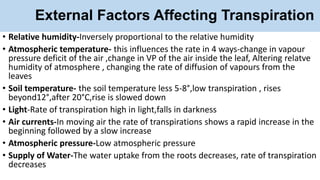
External Factors Affecting Transpiration
• Relative humidity-Inversely proportional to the relative humidity
• Atmospheric temperature- this influences the rate in 4 ways-change in vapour
pressure deficit of the air ,change in VP of the air inside the leaf, Altering relatve
humidity of atmosphere , changing the rate of diffusion of vapours from the
leaves
• Soil temperature- the soil temperature less 5-8°,low transpiration , rises
beyond12°,after 20°C,rise is slowed down
• Light-Rate of transpiration high in light,falls in darkness
• Air currents-In moving air the rate of transpirations shows a rapid increase in the
beginning followed by a slow increase
• Atmospheric pressure-Low atmospheric pressure
• Supply of Water-The water uptake from the roots decreases, rate of transpiration
decreases
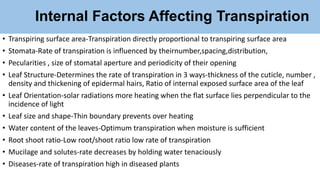
Internal Factors Affecting Transpiration
• Transpiring surface area-Transpiration directly proportional to transpiring surface area
• Stomata-Rate of transpiration is influenced by theirnumber,spacing,distribution,
• Pecularities , size of stomatal aperture and periodicity of their opening
• Leaf Structure-Determines the rate of transpiration in 3 ways-thickness of the cuticle, number ,
density and thickening of epidermal hairs, Ratio of internal exposed surface area of the leaf
• Leaf Orientation-solar radiations more heating when the flat surface lies perpendicular to the
incidence of light
• Leaf size and shape-Thin boundary prevents over heating
• Water content of the leaves-Optimum transpiration when moisture is sufficient
• Root shoot ratio-Low root/shoot ratio low rate of transpiration
• Mucilage and solutes-rate decreases by holding water tenaciously
• Diseases-rate of transpiration high in diseased plants
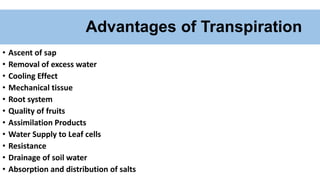
Advantages of Transpiration
• Ascent of sap
• Removal of excess water
• Cooling Effect
• Mechanical tissue
• Root system
• Quality of fruits
• Assimilation Products
• Water Supply to Leaf cells
• Resistance
• Drainage of soil water
• Absorption and distribution of salts
Disadvantages of Transpiration
• Transpiration is an Essential Evil
• Modifications
• Reduced photosynthesis
• Reduced growth
• Formation of AbA
• Reduced Yield
• Desiccation
• Breakdown of organic compounds
• Fall in metabolism
• Formation of proline
• Accumulation of Betaine
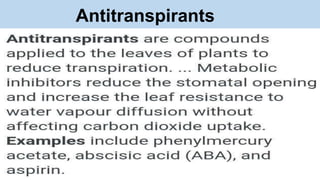
Antitranspirants
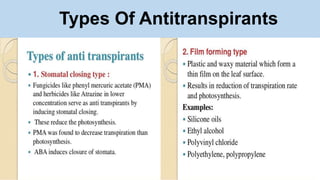
Types Of Antitranspirants

Transpiration

  • 1.
    Transpiration KAMALJIT SIDHU ASSOCIATE PROFESSOR DEPARTMENTOF BOTANY KHALSA COLLEGE FOR WOMEN,CIVIL LINES LUDHIANA
  • 2.
  • 4.
    Transpiration • The evaporationor the loss of water in the vapour form from the exposed parts of the plant • Amount of water lost by transpiration is between 0.5-2.5 gm/dm2/hr • It can be measured in terms of dry matter- Transpiration ratio • It is minimum in CAM plants like Pineapple • In C4 Plants -100-200units of dry matter • In mesophytes-300-500 units of dry matter • 98-99% of water absorbed is transpired • Only 0.2% is used in photosynthesis • Remaining used for hydration of the protoplast and growth
  • 5.
  • 6.
    Stomatal Transpiration • Stomataltranspiration- Takes place through stomata • 2 stages of stomatal transpiration- Diffusion of water from the moist cell walls into intercellular spaces and passage of water vapours from the intercellular spaces through the stomata • 75% of the evapouration occurs through the inner surface of the epidermal cells- Peristomatal transpiration • It stops only when the stomata are closed completely
  • 7.
    Cuticular Transpiration • CuticularTranspiration-occurs through cuticle that lies on the outside of epidermal cells of the leaves and other exposed aerial parts of the plants • Hedera helix and Tilia europea –stomata absent on the upper surface of the leaves • No transpiration from the upper surface in Hedera and 29% in Tilia • These variations are due to the thickness of the walls of the epidermal cells and the cuticle • Transpiration is inversely proportional to the thickness of the walls • Cuticle imbibes water from the epidermal cells • Constitutes 3-10% of the total transpiration • In herbs-50% is Cuticular transpiration
  • 8.
    Lenticular Transpiration • LenticularTranspiration-Found only in woody stems and some fruits where lenticels occur • Deciduous trees loose major portion of water when they are leafless through lenticels • Occurs continuously throughout the day and night • Number of lenticels is less so water loss is only 0.1%
  • 9.
    Bark Transpiration • BarkTranspiration-Through the bark or cork occurring on outside of woody stems • Cork is impermeable • Looses water slowly • Looses 5 times more water than all the lenticels together
  • 10.
    Stomatal Apparatus • Stomataare tiny pores found in the epidermis of the leaves and soft aerial parts • Allow the exchange of gases between the leaf cells and the atmosphere • Expose the wet interior parts of the plant to the dry air outside which cause transpiration • The stomatal pore is elliptical in outline • Pore size varies in different plants • Each stomata is surrounded by two specialized epidermal guard cells • Guard cells are kidney shaped • They are joined at the ends • Guard cell wall is thick on the concave or the inner side and thin on the convex or the outer side • In Graminae , Palmaceae and Cypreaceae the guard cells are dumb bell shaped
  • 12.
    Opening and Closingof Stomata• Opening and closing of stomata-Controlled by changes in the turgor pressure • Turgor changes due to gain or loss of solutes from the adjacent or subsidiary cells • When turgid the volume increases by 40-100% • Guard cells being small in size are more influenced by the turgor changes • Internally, the guard cells contain a number of mitochondria and small chloroplast • Chloroplasts have peripheral reticulum like C4 plants , having both PS1 and PS11 • C-assimilation is absent due to absence of enzyme-ribulose biphosphate carboxylase and NADP linked triose phosphate dehydrogenase • Hence, guard cells are heterotrophic, import sugars from the adjacent cells,ATP synthesis occurs,grana well developed with large starch accumulations when the guard cells are closed • Stomata closed during the night,guard cells contain starch,mesophyll cells are depleted of it
  • 13.
    Opening and Closingof Stomata• Vacuoles in guard cells malate , citrate ,K and cl ions – stomata open • Guard cells curve outwardly when they are turgid-pore develops • Guard cells are surrounded by the variable number of modified epidermal cells-subsidiary cells • In xerophytes subsidiary cells lie outside the guard cells , guard cells become sunken • Epistomatal cavity-Cavity formed outside the level of guard cells • Substomatal cavity-Cavity inner to the guard cells • Stomatal complex-Subsidiary cells+ Guard cells + pore
  • 14.
    Guard cells andEpidermal cells- Differences
  • 15.
  • 16.
  • 17.
    Theories of Stomatal Movement•Hypothesisof guard cell photosynthesis-Put forth by Schwendner •Guard cells have chloroplasts,perform photosynthesis during the day •Produce sugar which increase their solute concentration •Water enters the guard cells by endosmosis •Guard cells swell up , bend outwards and create a pore •Fails to explain the stomatal opening during the night in CAM plants •Appreciable sugar content has not been found in the guard
  • 18.
    Theories of StomatalMovement • Classical Starch Hydrolysis Theory-Put forward by Sayre, modified by Steward
  • 19.
  • 20.
    Theories of StomatalMovement • Objections to Starch Hydrolysis Theory • Change in CO2 concentration in the leaf interior cannot cause a wide variation of pH-4.5 to 7.0 • Rise in OP during the stomatal opening cannot be only due to formation of glucose from starch • Fails to explain the extra-effectiveness of blue light • Starch-Sugar inter conversion too slow to account for rapid stomatal movement • Glucose is not detected in the guard cells at the time of stomatal opening • No visible change in starch content • Hydrolysis cannot account for rise in OP of the guard cells
  • 22.
    Theories of StomatalMovement • Malate or potassium ion pump theory-Put forth by Levitt , main features are • Opening of stomata is accompanied by increase in K+ ion concentration in guard cells • These ions come from the surrounding subsidiary or epidermal cells • Stomatal opening is stimulated by sunlight , cytokinin cAMP • Blue fraction of sunlight sensitizes the receptor phototropin which transfers signals to protein phosphatse(PPI) • This activates plamalemma based H+ - ATPase • This pumps out the protons from the cytosol of the cell • The interior of plasmalemma becomes more negative as compared to the exterior • So K+ ion uptake is passive • Another secondary mechanism operational is for bringing in the chloride ions from outside-antiporter
  • 23.
    Theories of StomatalMovement • Some protons picked up by mitochondria and chloroplast of guard cells • Internal CO2 conc decreases, pH rises causes hydrolysis of starch to phosphoenol pyruvate(PEP) • PEP combines with CO2 to produce oxalo acetic acid , which is converted into malic acid • Malic acid dissociates into malate ions and H+ ions • H+ ions pass out of the guard cells and K+ ions enter • More K+ ions enter than which could be counter balanced so chloride ion is taken in • These ions pass into the vacuoles and get stored • Produce suitable OP for the entry of water • Guard cells become turgid and stomata open
  • 24.
  • 25.
    Theories of StomatalMovement • Stomatal closure towards the evening , when the light is less • In absence of light H+ -ATP ase of plasmalemma stops its activity of hydrogen ions • They diffuse out of the guard cells , chloroplast and mitochondria • It decreases the pH of the guard cells • Malate ions present in the guard cells combines with hydrogen ions to form malic acid • Excess of the malic acid inhibits its own biosynthesis • Un dissociated malic acid promoted the leakage of ions • Anion channels open • This causes ex osmosis • Turgidity of the cells lost , the pore closes
  • 26.
    Theories of StomatalMovement • Mid-day closure is directly mediated by ABA • It induces the formation of phosphotidic acid • This blocks the action of PPI • This de polarises the plasma membrane • Outward anion channels open ,chloride ions pass out • Potassium ions pass out • This efflux reduces OP • Decrease in the size of pores • Stomata close
  • 27.
  • 28.
    Factors Affecting Stomatal Movement•Light-In some plants light induces the opening of stomata , darkness-closing,red and blue parts of spectrum are favourable for photosynthesis are suitable for the stomatal movement as well, blue light is exceptionally favourable. • Temperature-Rate of stomatal opening has a temperature coefficient Q10 equal to 2,high temperature can offset the effect of light • Atmospheric humidity-higher the humidity ,stomata remain open for a longer time . At 70% humidity the stomata open 50%humidity the stomata tend to close • Water content of the leaves-It reaches a minimum of -7to 18 atm, guard cells loose turgidity and close. • Mechanical shock-Different types of shocks , as sudden high wind velocity closes the stomata • Mineral status-Deficiency of N,P or K stomata become sluggish • CO2 concentration-Low internal CO2 conc inside, stomata open • Oxygen-Stomata close when oxygen is deficient • Growth Hormones-Cytokinins are essential for stomatal opening , AbA for closure • pH-Rise in pH, Stomata open
  • 29.
  • 30.
    External Factors AffectingTranspiration • Relative humidity-Inversely proportional to the relative humidity • Atmospheric temperature- this influences the rate in 4 ways-change in vapour pressure deficit of the air ,change in VP of the air inside the leaf, Altering relatve humidity of atmosphere , changing the rate of diffusion of vapours from the leaves • Soil temperature- the soil temperature less 5-8°,low transpiration , rises beyond12°,after 20°C,rise is slowed down • Light-Rate of transpiration high in light,falls in darkness • Air currents-In moving air the rate of transpirations shows a rapid increase in the beginning followed by a slow increase • Atmospheric pressure-Low atmospheric pressure • Supply of Water-The water uptake from the roots decreases, rate of transpiration decreases
  • 31.
    Internal Factors AffectingTranspiration • Transpiring surface area-Transpiration directly proportional to transpiring surface area • Stomata-Rate of transpiration is influenced by theirnumber,spacing,distribution, • Pecularities , size of stomatal aperture and periodicity of their opening • Leaf Structure-Determines the rate of transpiration in 3 ways-thickness of the cuticle, number , density and thickening of epidermal hairs, Ratio of internal exposed surface area of the leaf • Leaf Orientation-solar radiations more heating when the flat surface lies perpendicular to the incidence of light • Leaf size and shape-Thin boundary prevents over heating • Water content of the leaves-Optimum transpiration when moisture is sufficient • Root shoot ratio-Low root/shoot ratio low rate of transpiration • Mucilage and solutes-rate decreases by holding water tenaciously • Diseases-rate of transpiration high in diseased plants
  • 32.
    Advantages of Transpiration •Ascent of sap • Removal of excess water • Cooling Effect • Mechanical tissue • Root system • Quality of fruits • Assimilation Products • Water Supply to Leaf cells • Resistance • Drainage of soil water • Absorption and distribution of salts
  • 33.
    Disadvantages of Transpiration •Transpiration is an Essential Evil • Modifications • Reduced photosynthesis • Reduced growth • Formation of AbA • Reduced Yield • Desiccation • Breakdown of organic compounds • Fall in metabolism • Formation of proline • Accumulation of Betaine
  • 34.
  • 35.