Exchange and Transport
          Lesson 13
     Learning objectives:
 By the end of the lesson you
     should understand…
•why transpiration is a
consequence of gaseous
exchange
•how the leaves of some
xerophytes are adapted to reduce
water loss by transpiration
Stomata
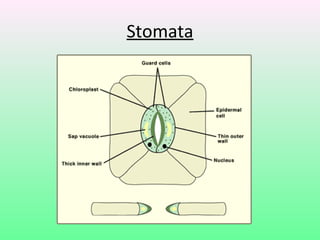
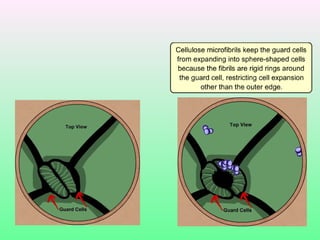
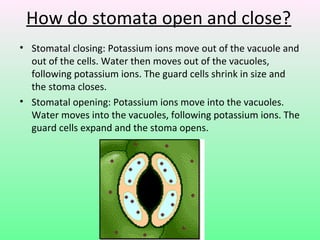
How do stomata open and close?
• Stomatal closing: Potassium ions move out of the vacuole and
  out of the cells. Water then moves out of the vacuoles,
  following potassium ions. The guard cells shrink in size and
  the stoma closes.
• Stomatal opening: Potassium ions move into the vacuoles.
  Water moves into the vacuoles, following potassium ions. The
  guard cells expand and the stoma opens.
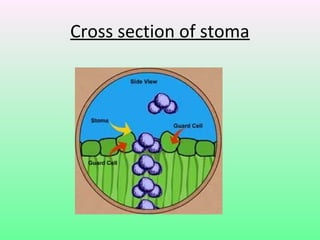
Cross section of stoma
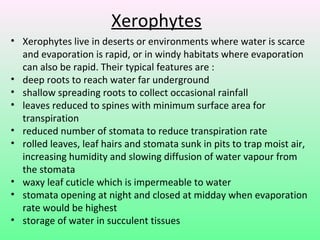
Xerophytes
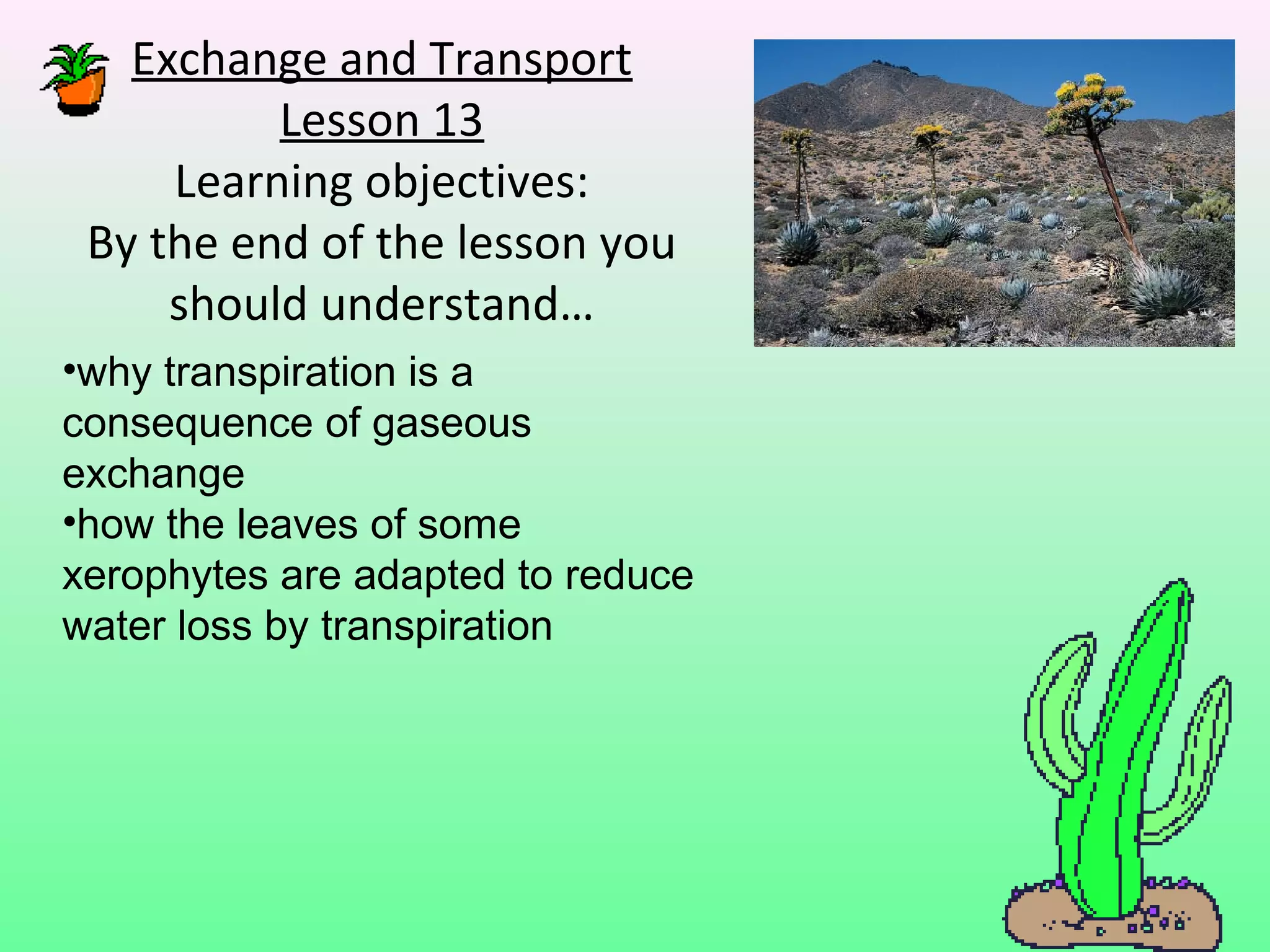
• Xerophytes live in deserts or environments where water is scarce
  and evaporation is rapid, or in windy habitats where evaporation
  can also be rapid. Their typical features are :
• deep roots to reach water far underground
• shallow spreading roots to collect occasional rainfall
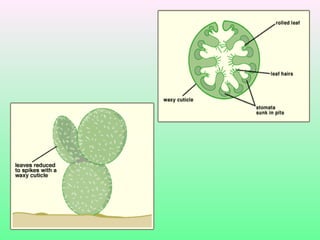
• leaves reduced to spines with minimum surface area for
  transpiration
• reduced number of stomata to reduce transpiration rate
• rolled leaves, leaf hairs and stomata sunk in pits to trap moist air,
  increasing humidity and slowing diffusion of water vapour from
  the stomata
• waxy leaf cuticle which is impermeable to water
• stomata opening at night and closed at midday when evaporation
  rate would be highest
• storage of water in succulent tissues
Activity 16
• Comparing the transpiration rate in two
  different plants.
Xerophytes activity
• http://www.kscience.co.uk/as/module3/exerc
  ises/xerophytes.htm
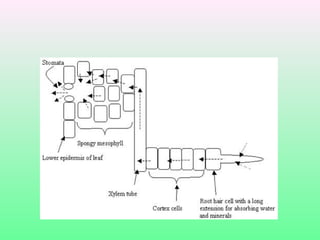
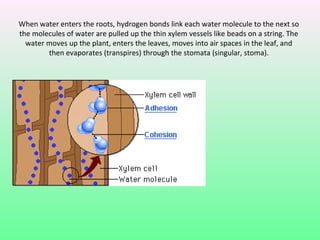
When water enters the roots, hydrogen bonds link each water molecule to the next so
the molecules of water are pulled up the thin xylem vessels like beads on a string. The
  water moves up the plant, enters the leaves, moves into air spaces in the leaf, and
        then evaporates (transpires) through the stomata (singular, stoma).
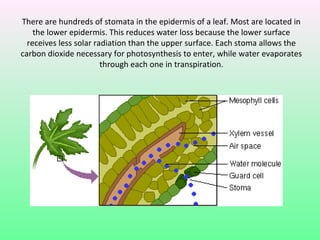
There are hundreds of stomata in the epidermis of a leaf. Most are located in
    the lower epidermis. This reduces water loss because the lower surface
  receives less solar radiation than the upper surface. Each stoma allows the
carbon dioxide necessary for photosynthesis to enter, while water evaporates
                        through each one in transpiration.
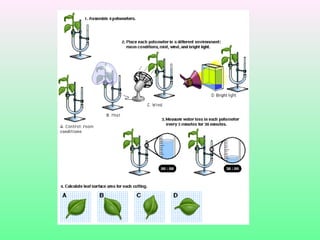
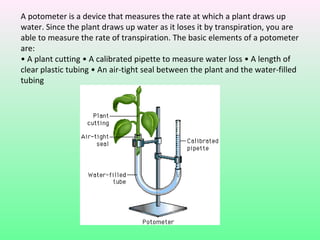
A potometer is a device that measures the rate at which a plant draws up
water. Since the plant draws up water as it loses it by transpiration, you are
able to measure the rate of transpiration. The basic elements of a potometer
are:
• A plant cutting • A calibrated pipette to measure water loss • A length of
clear plastic tubing • An air-tight seal between the plant and the water-filled
tubing
Calculating area of leaf


•   The rate of transpiration is measured as the amount of water lost/ square
    meter/ minute. Because water evaporates through the many stomata on
    the leaf surface, the rate of transpiration is directly related to the surface
    area. To arrive at the rate of transpiration, therefore, you must calculate
    the leaf surface area of each plant: Because most stomata are found in
    the lower epidermis, you will determine that surface area.
•   • Lay the leaves to be measured on a 1-cm grid and trace their outlines. •
    Count the number of square centimeters. Estimate the area of the partial
    squares. (Here's a simple method for this estimate: Count a partial square
    if it is at least half covered by the leaf; do not count partial squares that
    are less than half covered.) • Do not include the area of the stem (petiole)
    in your calculations.
•   http://www.phschool.com/science/biology_place/labbench/lab9/quiz1.ht
    ml

transpiration in plants

  • 1.
    Exchange and Transport Lesson 13 Learning objectives: By the end of the lesson you should understand… •why transpiration is a consequence of gaseous exchange •how the leaves of some xerophytes are adapted to reduce water loss by transpiration
  • 2.
  • 4.
    How do stomataopen and close? • Stomatal closing: Potassium ions move out of the vacuole and out of the cells. Water then moves out of the vacuoles, following potassium ions. The guard cells shrink in size and the stoma closes. • Stomatal opening: Potassium ions move into the vacuoles. Water moves into the vacuoles, following potassium ions. The guard cells expand and the stoma opens.
  • 5.
  • 6.
    Xerophytes • Xerophytes livein deserts or environments where water is scarce and evaporation is rapid, or in windy habitats where evaporation can also be rapid. Their typical features are : • deep roots to reach water far underground • shallow spreading roots to collect occasional rainfall • leaves reduced to spines with minimum surface area for transpiration • reduced number of stomata to reduce transpiration rate • rolled leaves, leaf hairs and stomata sunk in pits to trap moist air, increasing humidity and slowing diffusion of water vapour from the stomata • waxy leaf cuticle which is impermeable to water • stomata opening at night and closed at midday when evaporation rate would be highest • storage of water in succulent tissues
  • 8.
    Activity 16 • Comparingthe transpiration rate in two different plants.
  • 9.
  • 12.
    When water entersthe roots, hydrogen bonds link each water molecule to the next so the molecules of water are pulled up the thin xylem vessels like beads on a string. The water moves up the plant, enters the leaves, moves into air spaces in the leaf, and then evaporates (transpires) through the stomata (singular, stoma).
  • 13.
    There are hundredsof stomata in the epidermis of a leaf. Most are located in the lower epidermis. This reduces water loss because the lower surface receives less solar radiation than the upper surface. Each stoma allows the carbon dioxide necessary for photosynthesis to enter, while water evaporates through each one in transpiration.
  • 14.
    A potometer isa device that measures the rate at which a plant draws up water. Since the plant draws up water as it loses it by transpiration, you are able to measure the rate of transpiration. The basic elements of a potometer are: • A plant cutting • A calibrated pipette to measure water loss • A length of clear plastic tubing • An air-tight seal between the plant and the water-filled tubing
  • 15.
    Calculating area ofleaf • The rate of transpiration is measured as the amount of water lost/ square meter/ minute. Because water evaporates through the many stomata on the leaf surface, the rate of transpiration is directly related to the surface area. To arrive at the rate of transpiration, therefore, you must calculate the leaf surface area of each plant: Because most stomata are found in the lower epidermis, you will determine that surface area. • • Lay the leaves to be measured on a 1-cm grid and trace their outlines. • Count the number of square centimeters. Estimate the area of the partial squares. (Here's a simple method for this estimate: Count a partial square if it is at least half covered by the leaf; do not count partial squares that are less than half covered.) • Do not include the area of the stem (petiole) in your calculations. • http://www.phschool.com/science/biology_place/labbench/lab9/quiz1.ht ml