Plant Transpiration
1.   Importance of
     Transpiration
2.   Process of
     Transpiration
3.   Role of Stomata in
     the Process
4.   Factors Affecting
     Transpiration
5.   Xerophytes
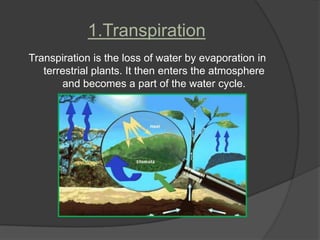
1.Transpiration
Transpiration is the loss of water by evaporation in
   terrestrial plants. It then enters the atmosphere
       and becomes a part of the water cycle.
The Water Cycle
The Importance of
                      Transpiration
        The process of transpiration is a very
          important procedure for plants.
    It creates a negative pressure gradient that helps
     draw water and minerals up through the plant from
     its roots.

    Helps to keep the plant cool on hot weather - a
     method of evaporative cooling.

    It supports photosynthesis and encourages the
     exchange of gases, helping maintain levels of CO2
     and O2 in the atmosphere.

It also-
     plays an significant role in the water cycle and
      releases approx 10% of water back into the
      environment.

    produces 200 to 1,000 lb (90–450 kg) of water for
     each pound of solid material produced by the plant.

    Creates water vapor that forms into fog and clouds.
2.The Process of
  Transpiration
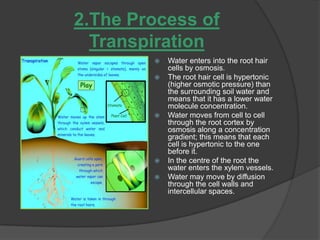
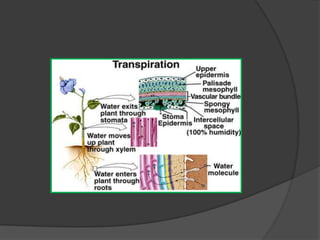
           Water enters into the root hair
            cells by osmosis.
           The root hair cell is hypertonic
            (higher osmotic pressure) than
            the surrounding soil water and
            means that it has a lower water
            molecule concentration.
           Water moves from cell to cell
            through the root cortex by
            osmosis along a concentration
            gradient; this means that each
            cell is hypertonic to the one
            before it.
           In the centre of the root the
            water enters the xylem vessels.
           Water may move by diffusion
            through the cell walls and
            intercellular spaces.
3. Role of Stomata
                 The pores in the stoma play an essential
                  role in the process of transpiration.
                 The two guard cells control the opening
                  and closing of the pore .
                 The rate is dependant upon the opening
                  time and the number of stomata present.
                 In sunlight the stomates are open and
                  the sun provides the energy that keeps
                  moving all of the way to the stomata
                  where water changes form from a liquid
                  to a vapor. At night, the cells remain
                  closed.
                 The stomata release water in the
                  atmosphere, which is then broken down
                  into oxygen and hydrogen. In return, the
                  atmosphere gives carbon-dioxide to the
                  plant to complete its process of
                  photosynthesis.
                  The number of stomata varies in from
                  plant to plant. In xerophytes the number
                  of stomata will be less as compared to
                  the other plants. This reduces the water
                  loss and helps the plant to survive in very
                  dry conditions. The plant may also close
                  its leaves if there is excesive sunlight, to
                  save the water from transpiration. All
                  these activities form a part of plant
                  biology.
Transpiration

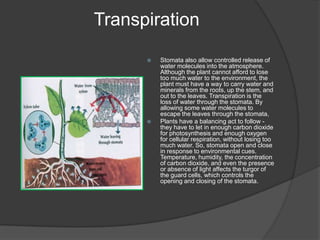
         Stomata also allow controlled release of
          water molecules into the atmosphere.
          Although the plant cannot afford to lose
          too much water to the environment, the
          plant must have a way to carry water and
          minerals from the roots, up the stem, and
          out to the leaves. Transpiration is the
          loss of water through the stomata. By
          allowing some water molecules to
          escape the leaves through the stomata,
         Plants have a balancing act to follow -
          they have to let in enough carbon dioxide
          for photosynthesis and enough oxygen
          for cellular respiration, without losing too
          much water. So, stomata open and close
          in response to environmental cues.
          Temperature, humidity, the concentration
          of carbon dioxide, and even the presence
          or absence of light affects the turgor of
          the guard cells, which controls the
          opening and closing of the stomata.
6.Factors affecting
Transpiration
   Factors effecting transpiration rate
   The opening and closing of the stomata is
    controlled by the guard cells.
   In light, guard cells take up water by osmosis
    and become turgid. Because their inner
    walls are rigid they are pulled apart, opening
    the pore. In darkness water is lost and the
    inner walls move together closing the pore.
   Because of this, the transpiration rate is
    increased by an increase in light intensity.
    The rate of transpiration can be affected by
    several factors:
   The opening and closing of the stomata by
    the guard cells (stomatal rhythm) - In
    light, guard cells take up water by osmosis
    and become turgid. Because their inner walls
    are rigid they are pulled apart, opening the
    pore. In darkness water is lost and the inner
    walls move together closing the pore.
    Because of this, the transpiration rate is
    increased by an increase in light intensity.
   Plants which live in extreme environments
    have adaptations to control their transpiration
    rate.
6. xerophytes
   Desert plants have a real challenge to               Water is transported from the roots to the
    minimize water loss, since their environment          leaves through a vein structure known as the
    is so hot and dry.                                    Xylem. Water and minerals are 'sucked up'
   Xerophytes live in deserts where water is             as water evaporates from the leaves of
    scarce and evaporation is rapid, or in windy          plants in a process known as Transpiration.
    habitats where evaporation can also be               The process of transpiration- Transpiration is
    rapid. Their typical features are:                    a process of emission of water from the plant
   deep roots to reach water far underground             with the help of small openings known as
   shallow spreading roots to collect occasional         stomata. Stomata are small openings or
    rainfall                                              pores which are present in the aerial part of
                                                          the plants like in the
   leaves reduced to spines with minimum                 leaves, stem, flowers, etc. But leaves
    surface area for transpiration                        constitute the major portion of stomata.
   reduced number of stomata to reduce
    transpiration rate
   rolled leaves, leaf hairs and stomata sunk in
    pits to trap moist air, increasing humidity and
    slowing diffusion of water vapour from the
    stomata
   waxy leaf cuticle which is impermeable to
    water (preventing evaporation)
   stomata opening at night and closed at
    midday when evaporation rate would be
    highest (reversed stomatal rhythm).
   storage of water in succulent tissues
5. Factors Affecting
Transpiration
    Factors affecting the rate of transpiration.
   High temperature may result in the opening of stomata and
    hence, increases the transpiration.
   In the normal procedure, plant gets water from the soil. If plant
    does not get water from the soil, the stomata remains closed.
   The rate of humidity is inversely proportional to the rate of
    transpiration. That means when humidity
    increases, transpiration decreases.
   Light increases the temperature which in turn, increases
    transpiration.
   Transpiration increases with the wind but high winds result in
    the closing of stomata which reduces transpiration.
   Leaf structure, type of stomata, root and shoot ratio, etc., may
    also affect the rate of transpiration.
Bibliography
   http://www.buzzle.com/articles/what-is-transpiration.html
   http://dtc.pima.edu/blc/182/lesson7/stomata/stomatapage1.htm
   http://www.encyclopedia.com/doc/1E1-transpir.html
   http://www.bbc.co.uk/scotland/learning/bitesize/higher/biol
    ogy/genetics_adaptation/maintaining_water_balance_rev4
    .shtml
   http://www2.selu.edu/orgs/pbrp/lessons/definitions/transpi
    ration.html
   http://cals.arizona.edu/arizonawet/teachersupport/support
    mats/transpiration
   http://www.school.net.th/library/create-
    web/10000/science/10000-6580.html
   http://www.pdesas.org/module/content/resources/14008/vi
    ew.ashx

Plant transpiration

  • 1.
  • 2.
    1. Importance of Transpiration 2. Process of Transpiration 3. Role of Stomata in the Process 4. Factors Affecting Transpiration 5. Xerophytes
  • 3.
    1.Transpiration Transpiration is theloss of water by evaporation in terrestrial plants. It then enters the atmosphere and becomes a part of the water cycle.
  • 4.
  • 5.
    The Importance of Transpiration The process of transpiration is a very important procedure for plants.  It creates a negative pressure gradient that helps draw water and minerals up through the plant from its roots.  Helps to keep the plant cool on hot weather - a method of evaporative cooling.  It supports photosynthesis and encourages the exchange of gases, helping maintain levels of CO2 and O2 in the atmosphere. It also-  plays an significant role in the water cycle and releases approx 10% of water back into the environment.  produces 200 to 1,000 lb (90–450 kg) of water for each pound of solid material produced by the plant.  Creates water vapor that forms into fog and clouds.
  • 6.
    2.The Process of Transpiration  Water enters into the root hair cells by osmosis.  The root hair cell is hypertonic (higher osmotic pressure) than the surrounding soil water and means that it has a lower water molecule concentration.  Water moves from cell to cell through the root cortex by osmosis along a concentration gradient; this means that each cell is hypertonic to the one before it.  In the centre of the root the water enters the xylem vessels.  Water may move by diffusion through the cell walls and intercellular spaces.
  • 7.
    3. Role ofStomata  The pores in the stoma play an essential role in the process of transpiration.  The two guard cells control the opening and closing of the pore .  The rate is dependant upon the opening time and the number of stomata present.  In sunlight the stomates are open and the sun provides the energy that keeps moving all of the way to the stomata where water changes form from a liquid to a vapor. At night, the cells remain closed.  The stomata release water in the  atmosphere, which is then broken down into oxygen and hydrogen. In return, the atmosphere gives carbon-dioxide to the plant to complete its process of photosynthesis. The number of stomata varies in from plant to plant. In xerophytes the number of stomata will be less as compared to the other plants. This reduces the water loss and helps the plant to survive in very dry conditions. The plant may also close its leaves if there is excesive sunlight, to save the water from transpiration. All these activities form a part of plant biology.
  • 8.
    Transpiration  Stomata also allow controlled release of water molecules into the atmosphere. Although the plant cannot afford to lose too much water to the environment, the plant must have a way to carry water and minerals from the roots, up the stem, and out to the leaves. Transpiration is the loss of water through the stomata. By allowing some water molecules to escape the leaves through the stomata,  Plants have a balancing act to follow - they have to let in enough carbon dioxide for photosynthesis and enough oxygen for cellular respiration, without losing too much water. So, stomata open and close in response to environmental cues. Temperature, humidity, the concentration of carbon dioxide, and even the presence or absence of light affects the turgor of the guard cells, which controls the opening and closing of the stomata.
  • 11.
    6.Factors affecting Transpiration  Factors effecting transpiration rate  The opening and closing of the stomata is controlled by the guard cells.  In light, guard cells take up water by osmosis and become turgid. Because their inner walls are rigid they are pulled apart, opening the pore. In darkness water is lost and the inner walls move together closing the pore.  Because of this, the transpiration rate is increased by an increase in light intensity. The rate of transpiration can be affected by several factors:  The opening and closing of the stomata by the guard cells (stomatal rhythm) - In light, guard cells take up water by osmosis and become turgid. Because their inner walls are rigid they are pulled apart, opening the pore. In darkness water is lost and the inner walls move together closing the pore. Because of this, the transpiration rate is increased by an increase in light intensity.  Plants which live in extreme environments have adaptations to control their transpiration rate.
  • 12.
    6. xerophytes  Desert plants have a real challenge to  Water is transported from the roots to the minimize water loss, since their environment leaves through a vein structure known as the is so hot and dry. Xylem. Water and minerals are 'sucked up'  Xerophytes live in deserts where water is as water evaporates from the leaves of scarce and evaporation is rapid, or in windy plants in a process known as Transpiration. habitats where evaporation can also be  The process of transpiration- Transpiration is rapid. Their typical features are: a process of emission of water from the plant  deep roots to reach water far underground with the help of small openings known as  shallow spreading roots to collect occasional stomata. Stomata are small openings or rainfall pores which are present in the aerial part of the plants like in the  leaves reduced to spines with minimum leaves, stem, flowers, etc. But leaves surface area for transpiration constitute the major portion of stomata.  reduced number of stomata to reduce transpiration rate  rolled leaves, leaf hairs and stomata sunk in pits to trap moist air, increasing humidity and slowing diffusion of water vapour from the stomata  waxy leaf cuticle which is impermeable to water (preventing evaporation)  stomata opening at night and closed at midday when evaporation rate would be highest (reversed stomatal rhythm).  storage of water in succulent tissues
  • 13.
    5. Factors Affecting Transpiration Factors affecting the rate of transpiration.  High temperature may result in the opening of stomata and hence, increases the transpiration.  In the normal procedure, plant gets water from the soil. If plant does not get water from the soil, the stomata remains closed.  The rate of humidity is inversely proportional to the rate of transpiration. That means when humidity increases, transpiration decreases.  Light increases the temperature which in turn, increases transpiration.  Transpiration increases with the wind but high winds result in the closing of stomata which reduces transpiration.  Leaf structure, type of stomata, root and shoot ratio, etc., may also affect the rate of transpiration.
  • 14.
    Bibliography  http://www.buzzle.com/articles/what-is-transpiration.html  http://dtc.pima.edu/blc/182/lesson7/stomata/stomatapage1.htm  http://www.encyclopedia.com/doc/1E1-transpir.html  http://www.bbc.co.uk/scotland/learning/bitesize/higher/biol ogy/genetics_adaptation/maintaining_water_balance_rev4 .shtml  http://www2.selu.edu/orgs/pbrp/lessons/definitions/transpi ration.html  http://cals.arizona.edu/arizonawet/teachersupport/support mats/transpiration  http://www.school.net.th/library/create- web/10000/science/10000-6580.html  http://www.pdesas.org/module/content/resources/14008/vi ew.ashx