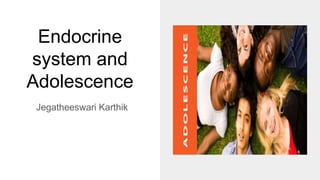


Endocrine
system and
Adolescence
Jegatheeswari Karthik
Think of a question
your classmates
might have about
Adolescence.
Glands Glands are important organs located
throughout the body.
They produce and release substances
that perform certain functions.
Though you have many glands
throughout your body, they fall into two
types:
1. Endocrine and
2. Exocrine.
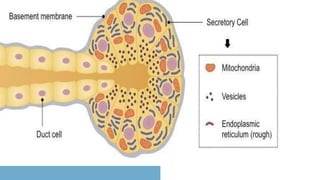
Exocrine gland
● Exocrine glands are the
glands of external
secretion.
● Exocrine glands
Discharge their products
through ducts.
● Salivary glands, mammary
glands, sweat glands, are
some of the exocrine
glands.
Function of
Exocrine
Glands
● Depending on the exocrine gland, they
can function to
● Regulate body temperature,
● Lubricate,
● Nurture newborns (lactation),
● Aid in digestion,
● Aid in reproduction.
Examples of
Exocrine Glands
(and Secreted
Product)
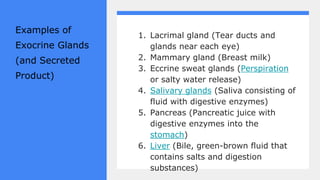
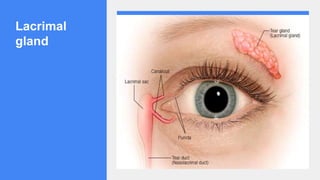
1. Lacrimal gland (Tear ducts and
glands near each eye)
2. Mammary gland (Breast milk)
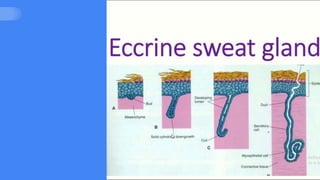
3. Eccrine sweat glands (Perspiration
or salty water release)
4. Salivary glands (Saliva consisting of
fluid with digestive enzymes)
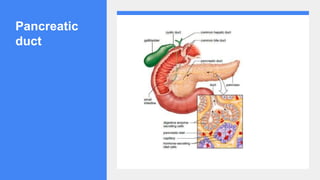
5. Pancreas (Pancreatic juice with
digestive enzymes into the
stomach)
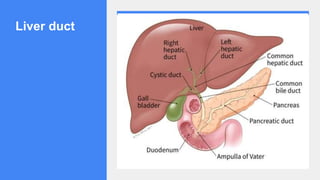
6. Liver (Bile, green-brown fluid that
contains salts and digestion
substances)
Lacrimal
gland
Mammary
gland
Pancreatic
duct
Liver duct
Endocrine
gland
● Are ductless glands
● They secrete chemical substances
● They are called as hormones, which
are poured directly into the blood
● Blood carries them to the target
organs.
● They are the hormone producing
glands.
● They are secreted in very small
quantities yet they are vital.
Hormone Hormone is a chemical substance secreted by
an endocrine gland,which is directly poured
into the bloodstream and acts on a target
organ or cell.
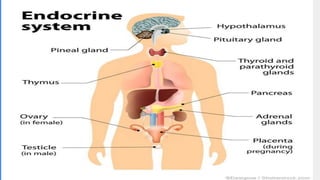
Important endocrine gland in humans include
pineal gland, pituitary gland, pancreas,
ovaries, testes, thyroid gland, parathyroid
gland, hypothalamus and adrenal glands.
Pancreas The pancreas has two main functions:
An exocrine function that helps in
digestion and
An endocrine function that regulates
blood sugar.
Thyroid
gland
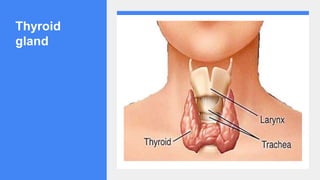
● It is bilobed
● Situated on either side of wind pipe,
just below the larynx
● Secretes hormone called Thyroxine
● Thyroxine is a Iodine containing protein
● It speeds up the rate of metabolic
activities
Thyroid
gland
Insufficient
secretion of
Thyroxine
Hypothyroidism
● Causes three ailments
1. Simple Goitre
2. Cretinism
3. Myxoedema
● Thyroid deficiencies are common in
many parts of India
● Use of iodised salt is required for the
production of thyroxine.
Insufficient
secretion of
Thyroxine
Simple
Goitre
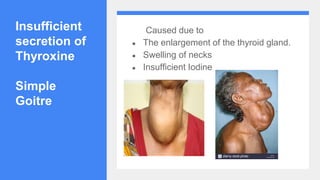
Caused due to
● The enlargement of the thyroid gland.
● Swelling of necks
● Insufficient Iodine
Insufficient
secretion of
Thyroxine
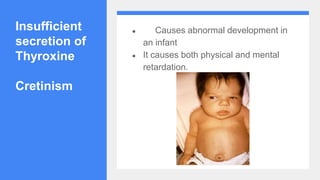
Cretinism
● Causes abnormal development in
an infant
● It causes both physical and mental
retardation.
Insufficient
secretion of
Thyroxine
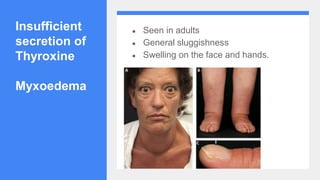
Myxoedema
● Seen in adults
● General sluggishness
● Swelling on the face and hands.
Over secretion
of thyroxine
Hyperthyroidism
● Causes
1. Increased metabolic rate
2. Increased heart beat
3. Weight loss
4. General restlessness
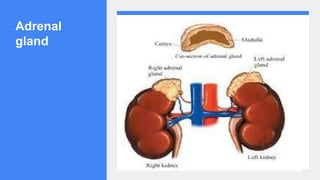
Adrenal
gland
● Caps over the kidney
● Each adrenal gland consists of two
parts.
● Medulla
● Cortex
Adrenal
gland
Adrenal
gland
● Medulla secretes Adrenaline
● Also called Epinephrine or Emergency
Hormone
● Secreted when person is under severe
stress, fear or anger.
● This hormone prepares the body to
face any situation
● FLIGHT FIGHT Hormone
Adrenal
gland
Working of
Adrenaline
● It provides extra energy and strength to
the body in any adverse situation.
● Increases the heart beat
● Increases the rate of respiration
● Rise in Blood Pressure
● Increase in blood supply to the muscles
and release of more glucose into the
blood.
Adrenal
gland
● Cortex secretes many hormones.
● Cortisone is the main hormone
● Influences carbohydrate, fat and
protein metabolism
● Regulate salt and water balance in the
body
● They adapt the body to stress.
● (Extreme heat, cold, infections)
Pancreas ● Situated behind the stomach
● Mainly it is digestive gland
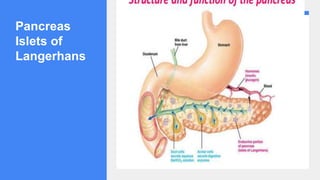
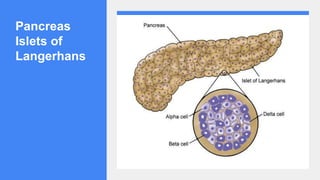
● It has a cluster of hormone secreting
cells ISLETS OF LANHERHANS
● Secrete two hormones
1. Insulin
2. Glucagon
Pancreas
Islets of
Langerhans
Pancreas
Islets of
Langerhans
Insulin
● It lowers glucose from the blood stream
1. Converts extra glucose to glycogen
which is stored in liver and muscles.
2. Induces cell to burn extra glucose to
produce heat and energy for the body.
3. Causes the cells to convert extra
glucose into fat.
Insufficient
secretion of
Insulin
● Causes diabetes mellitus.
● Sugar patients blood contains more
glucose
● In urine also glucose will be excreted
● Frequent urination
● Feel thirsty due to loss of water through
too much urination
● Loses weight
● Weak
Over secretion
of Insulin
● Very rare
● The persons glucose level will come
down
● Harmful
● Severe consequences
Glucagon ● Opposite action of Insulin
● Stimulates the breakdown of glycogen
in the liver to Glucose
● It raises the sugar levels in the blood.
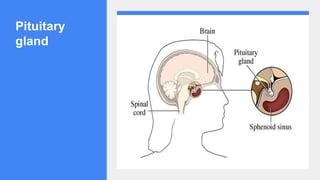
Pituitary
gland
● pea sized
● Located behind the brain
● Secretes several hormones which
regulate the activity of other endocrine
glands.
● Master gland
● Hormones secreted by pituitary gland
1. Growth hormone
2. Thyroid stimulating hormone
3. Follicle stimulating hormone
4. Prolactin
Pituitary
gland
Growth
hormone
● Regulates growth in adolescent years
● Insufficient amount of growth hormone
causes Dwarfism.
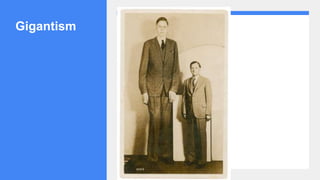
● Excess amount of growth hormone
causes Gigantism.
Dwarfism
Gigantism
Thyroid
stimulating
hormone
● Stimulates the thyroid gland to produce
thyroxine.
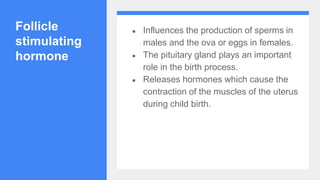
Follicle
stimulating
hormone
● Influences the production of sperms in
males and the ova or eggs in females.
● The pituitary gland plays an important
role in the birth process.
● Releases hormones which cause the
contraction of the muscles of the uterus
during child birth.
Prolactin
● Stimulates the breasts to
produce milk after child
birth.
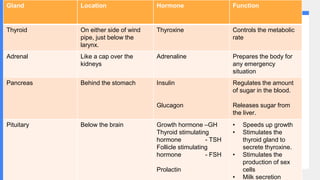
Gland Location Hormone Function
Thyroid On either side of wind
pipe, just below the
larynx.
Thyroxine Controls the metabolic
rate
Adrenal Like a cap over the
kidneys
Adrenaline Prepares the body for
any emergency
situation
Pancreas Behind the stomach Insulin
Glucagon
Regulates the amount
of sugar in the blood.
Releases sugar from
the liver.
Pituitary Below the brain Growth hormone –GH
Thyroid stimulating
hormone - TSH
Follicle stimulating
hormone - FSH
Prolactin
• Speeds up growth
• Stimulates the
thyroid gland to
secrete thyroxine.
• Stimulates the
production of sex
cells
• Milk secretion
What do you
wonder about
tomorrow’s topic
ADOLESCENCE
Adolescence ● Growth begins from day 1
● New born baby has sex organs
● Testes of new born boy not able to
make sperms
● Ovaries of a baby girl can’t produce
eggs.
● But hundreds of immature eggs are
present.
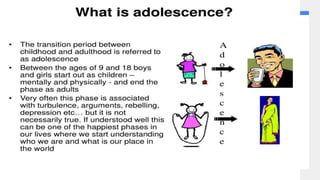
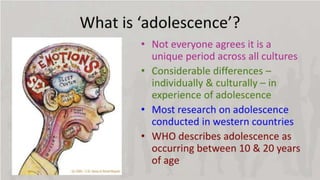
Adolescence ● The period of life when the body
undergoes development leading to
reproductive maturity is called
ADOLESCENCE.
● Is a transitional stage of physical and
mental development between
childhood and adulthood.
● Adolescence word derived from Latin
word.
● Adolescence means “to grow into
maturity”
Adolescence ● Is a rapid development of growing
towards sexual maturity.
● Neither a child nor an adult.
● 10- 19 yrs of life is considered as
adolescence.
● 12 to 18-19 yrs of age
● Vary from person to person
● In girls, adolescence begin a year or
two earlier than in boys.
Physical
changes
during
adolescence
● Increase in height
● Change in body shape
● Change in voice
● Increased activity of sweat and
sebaceous glands
Physical
changes
during
adolescence
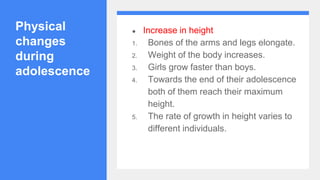
● Increase in height
1. Bones of the arms and legs elongate.
2. Weight of the body increases.
3. Girls grow faster than boys.
4. Towards the end of their adolescence
both of them reach their maximum
height.
5. The rate of growth in height varies to
different individuals.
Physical
changes
during
adolescence
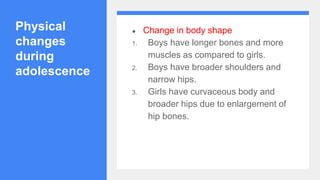
● Change in body shape
1. Boys have longer bones and more
muscles as compared to girls.
2. Boys have broader shoulders and
narrow hips.
3. Girls have curvaceous body and
broader hips due to enlargement of
hip bones.
Physical
changes
during
adolescence
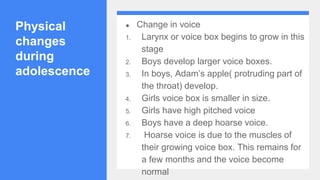
● Change in voice
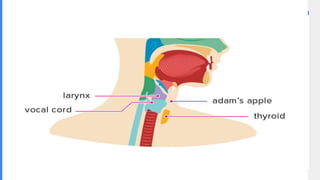
1. Larynx or voice box begins to grow in this
stage
2. Boys develop larger voice boxes.
3. In boys, Adam’s apple( protruding part of
the throat) develop.
4. Girls voice box is smaller in size.
5. Girls have high pitched voice
6. Boys have a deep hoarse voice.
7. Hoarse voice is due to the muscles of
their growing voice box. This remains for
a few months and the voice become
normal
Physical
changes
during
adolescence
● Increased activity of sweat and
sebaceous glands
1. The secretion of sweat and
sebaceous glands(oil glands)
increases.
2. Acne and pimples develop on the face
at this time because of the increased
activity of these glands in the skin.
Adolescence
Development
of sexual and
secondary
sexual
characters
during
adolescence
● The sex organs become active
● Testes start producing sperms
● Ovaries start producing eggs.
● This stage is called puberty.
● In girls it starts at the age of 12.
● In boys it starts at the age of 13.
● But it’s normal for the start of puberty
to range from 8-13 years in girls and 9-
14 years in boys. Every child is different.
Puberty ● Puberty is the time when the child moves
through a series of significant, natural and
healthy changes. These physical,
psychological and emotional
changes signal your child is moving from
childhood to adolescence.
● Changes in puberty include:
• physical growth and development inside
and outside children’s bodies
• changes to children’s sexual organs
• brain changes
• social and emotional changes.
Puberty ● It is brought out by hormones.
● Male sex hormones are called
Androgens.{Testosterone}
● Female sex hormones are called
oestrogens.
● These hormones are activated by FSH
produced by pituitary gland.
Puberty
changes in
boys
● Voice breaks
● Hair starts growing on the legs, chest
and face.
● Enlargement of testes and male
reproductive organs.
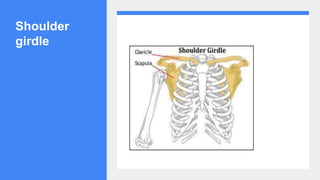
● Sudden spurt in growth, shoulder girdle
grows more than the hip girdle.
● Voice becomes deep and hoarse, low
pitched voice
Shoulder
girdle
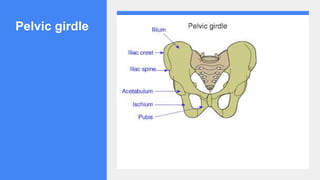
Pelvic girdle
Puberty
changes in
Girls
● Breasts start developing
● Fat laid down in thighs.
● Ovaries mature, the release of egg
starts.
● Female reproductive part grows in size.
● Menstruation cycle starts.
● Hip girdle becomes trough shaped and
bigger than the shoulder girdle.
● No hair on chest or abdomen.
● High pitched voice.
Mood swings
during
adolescence
● The changes that occur at puberty are
perfectly normal
● The changes in the hormones
sometimes cause depression and
emotional swing.
● You can consult with parents or
counsellors in school.
Psychological
changes in
adolescence
● Boys and girls become too conscious
and start worrying about the growth in
various parts of their body.
● Start feeling shy and feel hesitant in
sharing problems with others.
● Go on finding faults with themselves
and develop the complex.
● Worried about the future.
● No goals, they start fearing, which
develop depressions.
Psychological
changes in
adolescence
● It is a temporary phase.
● Like to remain with the peer group.
● Feel safe in the groups.
● Try to imitate what others do in the
peer group.
● Sometimes lead to wrong company.
● Smoking, drinking or drug addiction.
● This may cause harm to them in the
long run.
Importance
of personal
hygiene
● Maintaining personal hygiene during
adolescence stage is very important to
maintain their health.
● The following procedures should be
taken care.
1. Proper and safe food
2. Proper life style.
3. Cleanliness
4. Physical exercise.
Importance
of personal
hygiene
1. Proper and safe food
● It is the stage of rapid growth and
development.
● An adolescence should take care of the
diet
● It should be balanced diet.
● It should contain Carbohydrates,
proteins, fats, vitamins, minerals, water
and fibres.
Advised diet
during
adolescence
● Milk is good for our bones.
● Fruits and fresh vegetables provide
proper nourishment.
● Prefer freshly prepared food.
● Cooked food, milk, butter, fish and
meat are few examples of perishable
food items.
● It should be stored properly.
● Avoid excessive consumption of fast
foods.
Importance
of personal
hygiene
Proper life style.
● Sleep and regular exercise are
necessary for maintaining good health.
● Avoid long hours of continuous work.
● Avoid watching television or playing
games on computer for long hours.
● Avoid consumption of alcohol, smoking
and drugs.
Importance
of personal
hygiene
Cleanliness
● Always wash your hands with soap
before and after taking the meals.
● Clean your teeth after each meal and
before going to bed.
● Take bath regularly.
● Clothes should be changed daily.
● Wearing tight clothes should be
avoided.
Importance
of personal
hygiene
Cleanliness
● Regular toilet habits should be adopted
● The feet should be washed and well
protected.
● Hair wash should be done regularly. use of
clean comb is recommended.
● Eyes should be washed with clean and cold
water.
● Rubbing of eyes should be avoided.
● If these are not followed there is a chance of
bacterial infection.
● Girls should take special care during the
menstrual cycle.
Importance
of personal
hygiene
Physical exercise.
● All boys and girls should
1. Walk
2. Exercise
3. Play outdoor games
● It is important to combat the stress and
strain.
Stress ● Is a state of mental or emotional strain.
● Is also called as tension.
● It is body’s way of responding to any
kind of demand.
● Caused by both good and bad
experiences.
● When people feel stressed, their
bodies react by releasing certain
hormones.
Stress
effects
● Alteration in attention.
● Alteration in thought processes
● Alteration in body functions
Which will lead to physiological and
psychological disorders.
● When you are stressed, your body
responds as if we are in danger.
● It makes hormones to
1. speed up heart beat,
2. Breathe faster
3. Give a burst of energy
● This leads to decline in physical and
mental health.
Management
of stress
● Stress management is about taking
charge of your lifestyle, thoughts,
emotions and the way you deal with the
problems.
● It is needed to manage anxiety and
maintain overall well-being.
Self help
approaches
to prevent
stress
1. Yoga
2. Exercise – 30- 45 minutes at least
three times in a week.
3. Proper sleep schedule
4. Reading
5. Thinking positively
6. Laughing
7. Deep breathing
8. Meditation
9. Time management
10. Hobbies
Self help
approaches
to prevent
stress
1. Yoga
● It is a mind-body practice
● Includes physical poses, controlled
breathing, meditation or relaxation.
● It help to reduce the stress by
1. Increased flexibility
2. Increased muscle strength and tone
3. Improved respiration, energy and
vitality.
4. Weight reduction
5. Improved athletic performance.
Self help
approaches
to prevent
stress
Meditation
15- 20 minutes everyday
Eyes closed
Focus on inhalation and exhalation

Endocrine system and adolescence

  • 1.
  • 2.
    Think of aquestion your classmates might have about Adolescence.
  • 3.
    Glands Glands areimportant organs located throughout the body. They produce and release substances that perform certain functions. Though you have many glands throughout your body, they fall into two types: 1. Endocrine and 2. Exocrine.
  • 4.
    Exocrine gland ● Exocrineglands are the glands of external secretion. ● Exocrine glands Discharge their products through ducts. ● Salivary glands, mammary glands, sweat glands, are some of the exocrine glands.
  • 6.
    Function of Exocrine Glands ● Dependingon the exocrine gland, they can function to ● Regulate body temperature, ● Lubricate, ● Nurture newborns (lactation), ● Aid in digestion, ● Aid in reproduction.
  • 7.
    Examples of Exocrine Glands (andSecreted Product) 1. Lacrimal gland (Tear ducts and glands near each eye) 2. Mammary gland (Breast milk) 3. Eccrine sweat glands (Perspiration or salty water release) 4. Salivary glands (Saliva consisting of fluid with digestive enzymes) 5. Pancreas (Pancreatic juice with digestive enzymes into the stomach) 6. Liver (Bile, green-brown fluid that contains salts and digestion substances)
  • 8.
  • 9.
  • 11.
  • 12.
  • 13.
    Endocrine gland ● Are ductlessglands ● They secrete chemical substances ● They are called as hormones, which are poured directly into the blood ● Blood carries them to the target organs. ● They are the hormone producing glands. ● They are secreted in very small quantities yet they are vital.
  • 14.
    Hormone Hormone isa chemical substance secreted by an endocrine gland,which is directly poured into the bloodstream and acts on a target organ or cell. Important endocrine gland in humans include pineal gland, pituitary gland, pancreas, ovaries, testes, thyroid gland, parathyroid gland, hypothalamus and adrenal glands.
  • 16.
    Pancreas The pancreashas two main functions: An exocrine function that helps in digestion and An endocrine function that regulates blood sugar.
  • 17.
    Thyroid gland ● It isbilobed ● Situated on either side of wind pipe, just below the larynx ● Secretes hormone called Thyroxine ● Thyroxine is a Iodine containing protein ● It speeds up the rate of metabolic activities
  • 18.
  • 19.
    Insufficient secretion of Thyroxine Hypothyroidism ● Causesthree ailments 1. Simple Goitre 2. Cretinism 3. Myxoedema ● Thyroid deficiencies are common in many parts of India ● Use of iodised salt is required for the production of thyroxine.
  • 20.
    Insufficient secretion of Thyroxine Simple Goitre Caused dueto ● The enlargement of the thyroid gland. ● Swelling of necks ● Insufficient Iodine
  • 21.
    Insufficient secretion of Thyroxine Cretinism ● Causesabnormal development in an infant ● It causes both physical and mental retardation.
  • 22.
    Insufficient secretion of Thyroxine Myxoedema ● Seenin adults ● General sluggishness ● Swelling on the face and hands.
  • 23.
    Over secretion of thyroxine Hyperthyroidism ●Causes 1. Increased metabolic rate 2. Increased heart beat 3. Weight loss 4. General restlessness
  • 24.
    Adrenal gland ● Caps overthe kidney ● Each adrenal gland consists of two parts. ● Medulla ● Cortex
  • 25.
  • 26.
    Adrenal gland ● Medulla secretesAdrenaline ● Also called Epinephrine or Emergency Hormone ● Secreted when person is under severe stress, fear or anger. ● This hormone prepares the body to face any situation ● FLIGHT FIGHT Hormone
  • 27.
    Adrenal gland Working of Adrenaline ● Itprovides extra energy and strength to the body in any adverse situation. ● Increases the heart beat ● Increases the rate of respiration ● Rise in Blood Pressure ● Increase in blood supply to the muscles and release of more glucose into the blood.
  • 28.
    Adrenal gland ● Cortex secretesmany hormones. ● Cortisone is the main hormone ● Influences carbohydrate, fat and protein metabolism ● Regulate salt and water balance in the body ● They adapt the body to stress. ● (Extreme heat, cold, infections)
  • 29.
    Pancreas ● Situatedbehind the stomach ● Mainly it is digestive gland ● It has a cluster of hormone secreting cells ISLETS OF LANHERHANS ● Secrete two hormones 1. Insulin 2. Glucagon
  • 30.
  • 31.
  • 32.
    Insulin ● It lowersglucose from the blood stream 1. Converts extra glucose to glycogen which is stored in liver and muscles. 2. Induces cell to burn extra glucose to produce heat and energy for the body. 3. Causes the cells to convert extra glucose into fat.
  • 33.
    Insufficient secretion of Insulin ● Causesdiabetes mellitus. ● Sugar patients blood contains more glucose ● In urine also glucose will be excreted ● Frequent urination ● Feel thirsty due to loss of water through too much urination ● Loses weight ● Weak
  • 34.
    Over secretion of Insulin ●Very rare ● The persons glucose level will come down ● Harmful ● Severe consequences
  • 35.
    Glucagon ● Oppositeaction of Insulin ● Stimulates the breakdown of glycogen in the liver to Glucose ● It raises the sugar levels in the blood.
  • 36.
    Pituitary gland ● pea sized ●Located behind the brain ● Secretes several hormones which regulate the activity of other endocrine glands. ● Master gland ● Hormones secreted by pituitary gland 1. Growth hormone 2. Thyroid stimulating hormone 3. Follicle stimulating hormone 4. Prolactin
  • 37.
  • 38.
    Growth hormone ● Regulates growthin adolescent years ● Insufficient amount of growth hormone causes Dwarfism. ● Excess amount of growth hormone causes Gigantism.
  • 39.
  • 40.
  • 41.
    Thyroid stimulating hormone ● Stimulates thethyroid gland to produce thyroxine.
  • 42.
    Follicle stimulating hormone ● Influences theproduction of sperms in males and the ova or eggs in females. ● The pituitary gland plays an important role in the birth process. ● Releases hormones which cause the contraction of the muscles of the uterus during child birth.
  • 43.
    Prolactin ● Stimulates thebreasts to produce milk after child birth.
  • 44.
    Gland Location HormoneFunction Thyroid On either side of wind pipe, just below the larynx. Thyroxine Controls the metabolic rate Adrenal Like a cap over the kidneys Adrenaline Prepares the body for any emergency situation Pancreas Behind the stomach Insulin Glucagon Regulates the amount of sugar in the blood. Releases sugar from the liver. Pituitary Below the brain Growth hormone –GH Thyroid stimulating hormone - TSH Follicle stimulating hormone - FSH Prolactin • Speeds up growth • Stimulates the thyroid gland to secrete thyroxine. • Stimulates the production of sex cells • Milk secretion
  • 45.
    What do you wonderabout tomorrow’s topic ADOLESCENCE
  • 46.
    Adolescence ● Growthbegins from day 1 ● New born baby has sex organs ● Testes of new born boy not able to make sperms ● Ovaries of a baby girl can’t produce eggs. ● But hundreds of immature eggs are present.
  • 47.
    Adolescence ● Theperiod of life when the body undergoes development leading to reproductive maturity is called ADOLESCENCE. ● Is a transitional stage of physical and mental development between childhood and adulthood. ● Adolescence word derived from Latin word. ● Adolescence means “to grow into maturity”
  • 48.
    Adolescence ● Isa rapid development of growing towards sexual maturity. ● Neither a child nor an adult. ● 10- 19 yrs of life is considered as adolescence. ● 12 to 18-19 yrs of age ● Vary from person to person ● In girls, adolescence begin a year or two earlier than in boys.
  • 49.
    Physical changes during adolescence ● Increase inheight ● Change in body shape ● Change in voice ● Increased activity of sweat and sebaceous glands
  • 50.
    Physical changes during adolescence ● Increase inheight 1. Bones of the arms and legs elongate. 2. Weight of the body increases. 3. Girls grow faster than boys. 4. Towards the end of their adolescence both of them reach their maximum height. 5. The rate of growth in height varies to different individuals.
  • 51.
    Physical changes during adolescence ● Change inbody shape 1. Boys have longer bones and more muscles as compared to girls. 2. Boys have broader shoulders and narrow hips. 3. Girls have curvaceous body and broader hips due to enlargement of hip bones.
  • 52.
    Physical changes during adolescence ● Change invoice 1. Larynx or voice box begins to grow in this stage 2. Boys develop larger voice boxes. 3. In boys, Adam’s apple( protruding part of the throat) develop. 4. Girls voice box is smaller in size. 5. Girls have high pitched voice 6. Boys have a deep hoarse voice. 7. Hoarse voice is due to the muscles of their growing voice box. This remains for a few months and the voice become normal
  • 54.
    Physical changes during adolescence ● Increased activityof sweat and sebaceous glands 1. The secretion of sweat and sebaceous glands(oil glands) increases. 2. Acne and pimples develop on the face at this time because of the increased activity of these glands in the skin.
  • 55.
  • 58.
    Development of sexual and secondary sexual characters during adolescence ●The sex organs become active ● Testes start producing sperms ● Ovaries start producing eggs. ● This stage is called puberty. ● In girls it starts at the age of 12. ● In boys it starts at the age of 13. ● But it’s normal for the start of puberty to range from 8-13 years in girls and 9- 14 years in boys. Every child is different.
  • 59.
    Puberty ● Pubertyis the time when the child moves through a series of significant, natural and healthy changes. These physical, psychological and emotional changes signal your child is moving from childhood to adolescence. ● Changes in puberty include: • physical growth and development inside and outside children’s bodies • changes to children’s sexual organs • brain changes • social and emotional changes.
  • 60.
    Puberty ● Itis brought out by hormones. ● Male sex hormones are called Androgens.{Testosterone} ● Female sex hormones are called oestrogens. ● These hormones are activated by FSH produced by pituitary gland.
  • 61.
    Puberty changes in boys ● Voicebreaks ● Hair starts growing on the legs, chest and face. ● Enlargement of testes and male reproductive organs. ● Sudden spurt in growth, shoulder girdle grows more than the hip girdle. ● Voice becomes deep and hoarse, low pitched voice
  • 62.
  • 63.
  • 64.
    Puberty changes in Girls ● Breastsstart developing ● Fat laid down in thighs. ● Ovaries mature, the release of egg starts. ● Female reproductive part grows in size. ● Menstruation cycle starts. ● Hip girdle becomes trough shaped and bigger than the shoulder girdle. ● No hair on chest or abdomen. ● High pitched voice.
  • 65.
    Mood swings during adolescence ● Thechanges that occur at puberty are perfectly normal ● The changes in the hormones sometimes cause depression and emotional swing. ● You can consult with parents or counsellors in school.
  • 66.
    Psychological changes in adolescence ● Boysand girls become too conscious and start worrying about the growth in various parts of their body. ● Start feeling shy and feel hesitant in sharing problems with others. ● Go on finding faults with themselves and develop the complex. ● Worried about the future. ● No goals, they start fearing, which develop depressions.
  • 67.
    Psychological changes in adolescence ● Itis a temporary phase. ● Like to remain with the peer group. ● Feel safe in the groups. ● Try to imitate what others do in the peer group. ● Sometimes lead to wrong company. ● Smoking, drinking or drug addiction. ● This may cause harm to them in the long run.
  • 68.
    Importance of personal hygiene ● Maintainingpersonal hygiene during adolescence stage is very important to maintain their health. ● The following procedures should be taken care. 1. Proper and safe food 2. Proper life style. 3. Cleanliness 4. Physical exercise.
  • 69.
    Importance of personal hygiene 1. Properand safe food ● It is the stage of rapid growth and development. ● An adolescence should take care of the diet ● It should be balanced diet. ● It should contain Carbohydrates, proteins, fats, vitamins, minerals, water and fibres.
  • 70.
    Advised diet during adolescence ● Milkis good for our bones. ● Fruits and fresh vegetables provide proper nourishment. ● Prefer freshly prepared food. ● Cooked food, milk, butter, fish and meat are few examples of perishable food items. ● It should be stored properly. ● Avoid excessive consumption of fast foods.
  • 71.
    Importance of personal hygiene Proper lifestyle. ● Sleep and regular exercise are necessary for maintaining good health. ● Avoid long hours of continuous work. ● Avoid watching television or playing games on computer for long hours. ● Avoid consumption of alcohol, smoking and drugs.
  • 72.
    Importance of personal hygiene Cleanliness ● Alwayswash your hands with soap before and after taking the meals. ● Clean your teeth after each meal and before going to bed. ● Take bath regularly. ● Clothes should be changed daily. ● Wearing tight clothes should be avoided.
  • 73.
    Importance of personal hygiene Cleanliness ● Regulartoilet habits should be adopted ● The feet should be washed and well protected. ● Hair wash should be done regularly. use of clean comb is recommended. ● Eyes should be washed with clean and cold water. ● Rubbing of eyes should be avoided. ● If these are not followed there is a chance of bacterial infection. ● Girls should take special care during the menstrual cycle.
  • 74.
    Importance of personal hygiene Physical exercise. ●All boys and girls should 1. Walk 2. Exercise 3. Play outdoor games ● It is important to combat the stress and strain.
  • 75.
    Stress ● Isa state of mental or emotional strain. ● Is also called as tension. ● It is body’s way of responding to any kind of demand. ● Caused by both good and bad experiences. ● When people feel stressed, their bodies react by releasing certain hormones.
  • 76.
    Stress effects ● Alteration inattention. ● Alteration in thought processes ● Alteration in body functions Which will lead to physiological and psychological disorders. ● When you are stressed, your body responds as if we are in danger. ● It makes hormones to 1. speed up heart beat, 2. Breathe faster 3. Give a burst of energy ● This leads to decline in physical and mental health.
  • 77.
    Management of stress ● Stressmanagement is about taking charge of your lifestyle, thoughts, emotions and the way you deal with the problems. ● It is needed to manage anxiety and maintain overall well-being.
  • 78.
    Self help approaches to prevent stress 1.Yoga 2. Exercise – 30- 45 minutes at least three times in a week. 3. Proper sleep schedule 4. Reading 5. Thinking positively 6. Laughing 7. Deep breathing 8. Meditation 9. Time management 10. Hobbies
  • 79.
    Self help approaches to prevent stress 1.Yoga ● It is a mind-body practice ● Includes physical poses, controlled breathing, meditation or relaxation. ● It help to reduce the stress by 1. Increased flexibility 2. Increased muscle strength and tone 3. Improved respiration, energy and vitality. 4. Weight reduction 5. Improved athletic performance.
  • 80.
    Self help approaches to prevent stress Meditation 15-20 minutes everyday Eyes closed Focus on inhalation and exhalation

Editor's Notes

  • #3 Ask a Question Use the template to prompt students to form a question. By asking them to consider a question their classmate might have, as opposed to their own question, you can help unlock their creative thinking and remove insecurities they might have around asking their own questions. 🍐 This is a Pear Deck Text Slide 🍐 To edit the type of question, go back to the "Ask Students a Question" in the Pear Deck sidebar.
  • #46 Thinking Broadly Identifying and articulating questions we have is an important thinking skill. Give students the opportunity to think broadly about today’s topic and identify their own questions. Show their responses anonymously on the projector to discuss. 🍐 This is a Pear Deck Text Slide 🍐 To edit the type of question, go back to the "Ask Students a Question" in the Pear Deck sidebar.