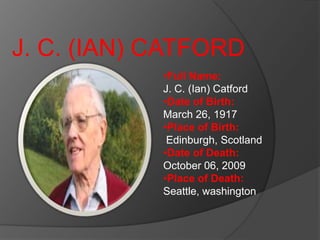
J. C. (IAN) CATFORD
            •Full Name:
            J. C. (Ian) Catford
            •Date of Birth:
            March 26, 1917
            •Place of Birth:
             Edinburgh, Scotland
            •Date of Death:
            October 06, 2009
            •Place of Death:
            Seattle, washington
Translation is defined by catford
               as...
   An operation performed on languages, a
    process of substituting a text in one
    language for a text in another.

   The replacement of textual material in
    one language (source language) by
    equivalent material in other language
    (target language).
Catford’s theories and
concepts regarding translation
   Translation is unidirectional (from source
    language to a target language).

   A linguistic theory of translation is an
    analysis of the process of translation,
    such theory is directed to answer
    general or specific problems that may
    arise when any translation is undertaken
 Catford examined several issues
  involved in the translation process like
  extent, meaning, level of languages
  ,   phonological     and    graphological
  translation, to evolve his theory of
  translation.
 He also stated that the central task of
  any translation is to find out the target
  language’ equivalents.
   A textual equivalence is defined as any
    target language, text or portion of text
    which is to be equivalent of a given
    source language text or portion of text.

   A formal correspondent is defined as
    any target language category which can
    be said to occupy as nearly as possible
    the same place in the economy of the
    target language as the given source
    language category occupies      in the
    source language
Based on extent of source
language text he distinguishes
to types of translation…
 Full translation, every part of source
  language is replaced by target language
  text material throough translation
 Partial translation,some parts of source
  language text are left untranslated and
  or incorporated in the target language
  text.
Based on levels of language,he
differentiates between to types
of translation…
 Total translation which involves
  translation at all levels (grammar,
  lexis,phonological and graphological
  levels)
 Partial translation, involves translation at
  one or two levels.
Catford analyses the
importance of meaning through
translation…
 Meaning captures the essence of the
  text and meaningful translation also can
  transfer the essence.
 Meaning is defined as total network of
  relations entered by any linguistic form.
 “Each language carries with it its own
  meaning since message is property of a
  language”

catford

  • 1.
    J. C. (IAN)CATFORD •Full Name: J. C. (Ian) Catford •Date of Birth: March 26, 1917 •Place of Birth: Edinburgh, Scotland •Date of Death: October 06, 2009 •Place of Death: Seattle, washington
  • 2.
    Translation is definedby catford as...  An operation performed on languages, a process of substituting a text in one language for a text in another.  The replacement of textual material in one language (source language) by equivalent material in other language (target language).
  • 3.
    Catford’s theories and conceptsregarding translation  Translation is unidirectional (from source language to a target language).  A linguistic theory of translation is an analysis of the process of translation, such theory is directed to answer general or specific problems that may arise when any translation is undertaken
  • 4.
     Catford examinedseveral issues involved in the translation process like extent, meaning, level of languages , phonological and graphological translation, to evolve his theory of translation.  He also stated that the central task of any translation is to find out the target language’ equivalents.
  • 5.
    A textual equivalence is defined as any target language, text or portion of text which is to be equivalent of a given source language text or portion of text.  A formal correspondent is defined as any target language category which can be said to occupy as nearly as possible the same place in the economy of the target language as the given source language category occupies in the source language
  • 6.
    Based on extentof source language text he distinguishes to types of translation…  Full translation, every part of source language is replaced by target language text material throough translation  Partial translation,some parts of source language text are left untranslated and or incorporated in the target language text.
  • 7.
    Based on levelsof language,he differentiates between to types of translation…  Total translation which involves translation at all levels (grammar, lexis,phonological and graphological levels)  Partial translation, involves translation at one or two levels.
  • 8.
    Catford analyses the importanceof meaning through translation…  Meaning captures the essence of the text and meaningful translation also can transfer the essence.  Meaning is defined as total network of relations entered by any linguistic form.  “Each language carries with it its own meaning since message is property of a language”