Translation Theory and
the Translation
Research
Erikson Saragih
S3 Linguistik USU, 2023
A few general distinctions
Translating v. interpreting
Source language/text – SL / ST
Target language/text - TL / TT
Intralingual v. interlingual v.
intersemiotic translation
Translation as language learning
Contrastive linguistics
Comparative literature
“Translation Studies”
– self-perception
 Many people today think that Translation Studies is
mainly:
 Literary theory
 Cultural studies
 And, possibly:
 Communication studies
 Stylistics & Genre analysis
Translation Theory - TT
– perspective from Philosophy
 Linguistic philosophy - attempts to discover WHAT
language means:
 the ideal language(s) of logic etc.
 'ordinary language' philosophy
 Philosophy of language – attempts to find out HOW
language means:
certain general features of language such as
meaning, reference, truth, verification, speech
acts and logical necessity
 Philosophy of linguistics - the study of language
through linguistics
TT – perspective from
Philosophy of Linguistics
 Structuralism - language reflects structure of
thought, culture and society
 Transformational-Generative grammar -
underlying universal language
 Functionalism - Language and its social functions
 Cognitivism - Language as it reflects our
cognitive appraisal of the world, categorization
of experience and use of metaphor
TT – perspective from
Linguistics
 Linguists perceive it as related to:
 Contrastive linguistics
 Pragmatics
 Discourse Analysis
 Stylistics
 Once dismissed as useless to TT– all of these areas
have been re-animated by corpora linguistics
TT – perspective from
Information Technoclogy
 IT specialists are increasingly fascinated by human language
and:
 Machine assisted translation
 Machine Translation
 Knowledge Engineering
 Information Retrieval
 Artificial Intelligence
TT - the professional
perspective
 Translator training
 Interpreter training
 Translation aids
 Translation criticism
 Translation quality
 Translation policy
 Professional translation standards
Translation Theories
 The objectives of this seminar are:
 To give a general outline of translation theories in this
century
 To show how these theories apply to non literary texts
 To demonstrate that translation practice can benefit
from theory
Translation theories
 Most TT is:
 Product-orientated – focuses the translation
 Function-orientated – examines the context and purpose
of the translation
 Process-orientated – analyses the psychology of
translation and process
 But usually has elements of all three
Partial theories of translation
 Medium restricted – man or machine?
 Area restricted – specific languages/cultures
 Rank-restricted – word/sentence/text
 Text-type restricted –different genres
 Time-restricted – historical view
 Problem-restricted – specific problems, e.g
equivalence
Problems
 Position of Translation Studies in academia
 Split between theory and practice
 Translation teachers' fear of theory
 Researchers still encouraged to focus on literature
 Therefore teacher/researcher faced with dilemma
Early distinctions
People have been arguing for
centuries about
literal v. free v. faithful translation
word-for-word v. sense-for-sense
Bible translation
Bassnett (1991: 45-50) - "The history of
Bible translation is accordingly a
history of western culture ".
St. Jerome's translation into Latin in 384
A.D.
 John Wycliffe (1330-84)and the 'Lollards'
William Tyndale (1494-1536) – burnt at
stake
Martin Luther – New Testament 1522, Old
Testament 1534
The Qur’an
See University of Southern California:
http://www.usc.edu/dept/MSA/qura
n/
Warning: "Note that any translation of
the Qur'an immediately ceases to be
the literal word of Allah, and hence
cannot be equated with the Qur'an
in its original Arabic form. In fact,
each of the translations on this site is
actually an interpretation which has
been translated."
Science in Translation
a historical view
 Scott L. Montgomery. 2000. Science in Translation.
Movements of Knowledge through Cultures and Time.
University of Chicago Press.
 Describes how scientific texts have been translated,
‘adapted’, ‘revised’ and added to down the
centuries e.g.
 Western Astronomy
 Greek and Arabic Science
 Japanese Science
‘Linguistic’
theories of translation
Language Universals v. Linguistic
Relativism
Science of translation
Equivalence
Semantic and communicative
translation
Korrespondenz and Äquivalenz
Translation ‘shifts’
Discourse and register analysis
Language Universals v.
Linguistic Relativism
 Language Universals – presuppose that languages
and/or our capacity for language are universal and/or
innate
 long history leading to Chomsky and beyond
 Language Relativism – different languages show us
different ways of viewing the world
 Sapir-Whorf theory and most translation theory
Science of translation
Nida (1964)
Linguistic meaning
Referential or denotative meaning
Emotive or connotative meaning
Hierarchical structuring
Componential analysis
Semantic structure analysis
Formal and dynamic equivalence
Applications to Bible translation
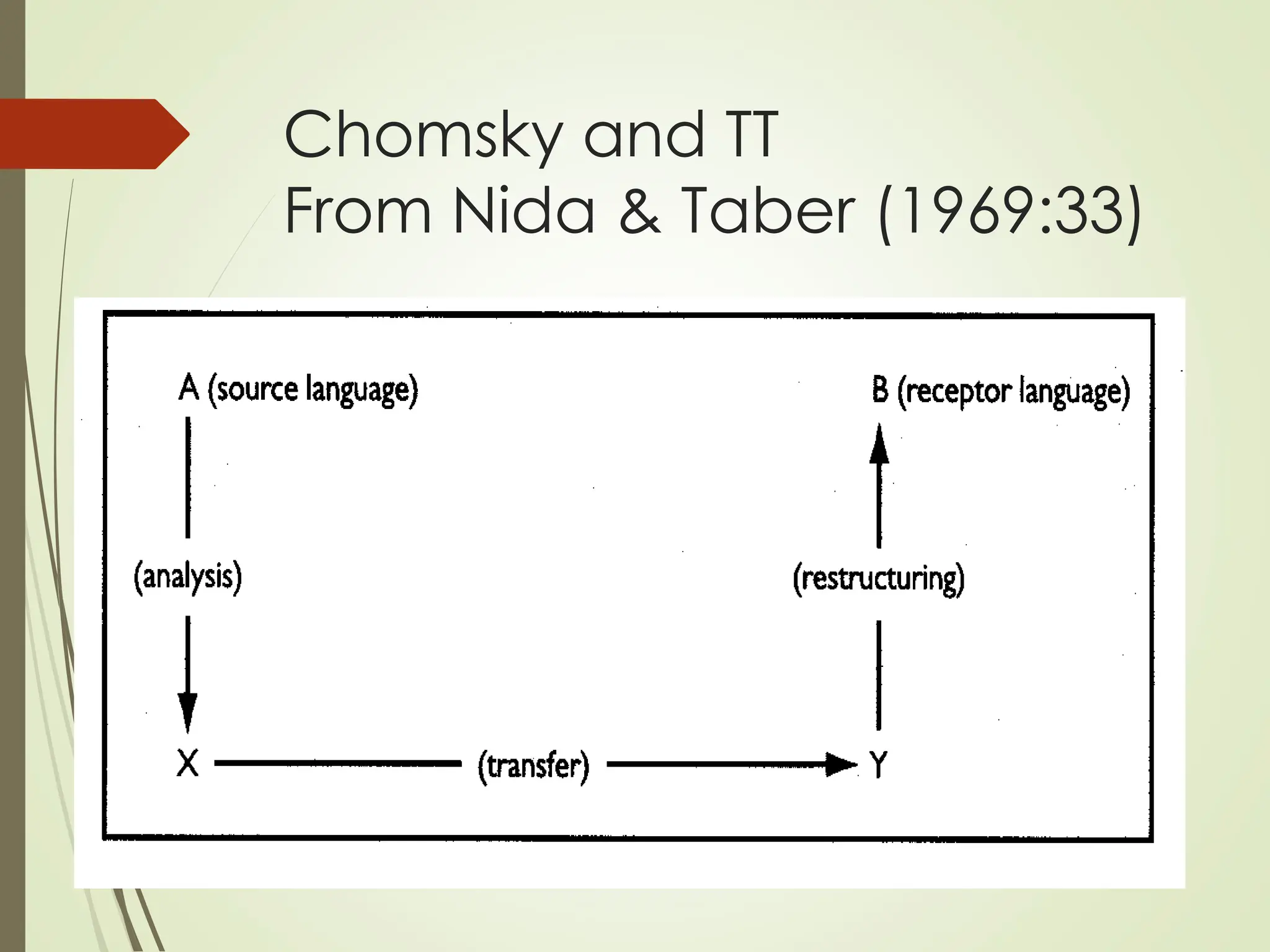
Chomsky and TT
From Nida & Taber (1969:33)
From Munday (2001: 50)
Equivalence
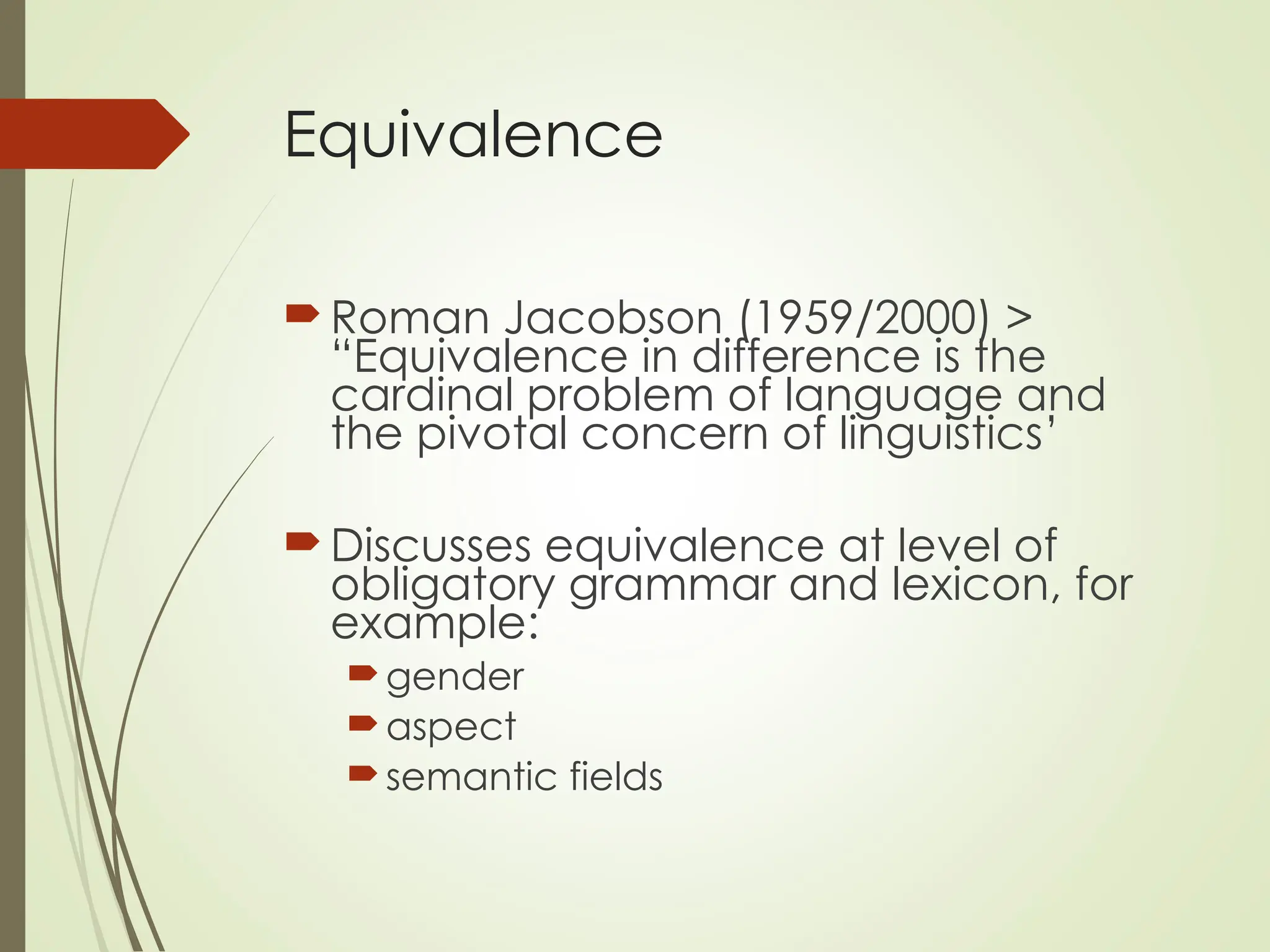
Roman Jacobson (1959/2000) >
“Equivalence in difference is the
cardinal problem of language and
the pivotal concern of linguistics’
Discusses equivalence at level of
obligatory grammar and lexicon, for
example:
gender
aspect
semantic fields
Equivalence at word level
Baker (1992) – Chapter 2
 Morphology – lexical and syntactic
 Lexical Meaning
 Propositional v. Expressive meaning
 Presupposed meaning
 Evoked meaning
 dialect – geographical, temporal, social
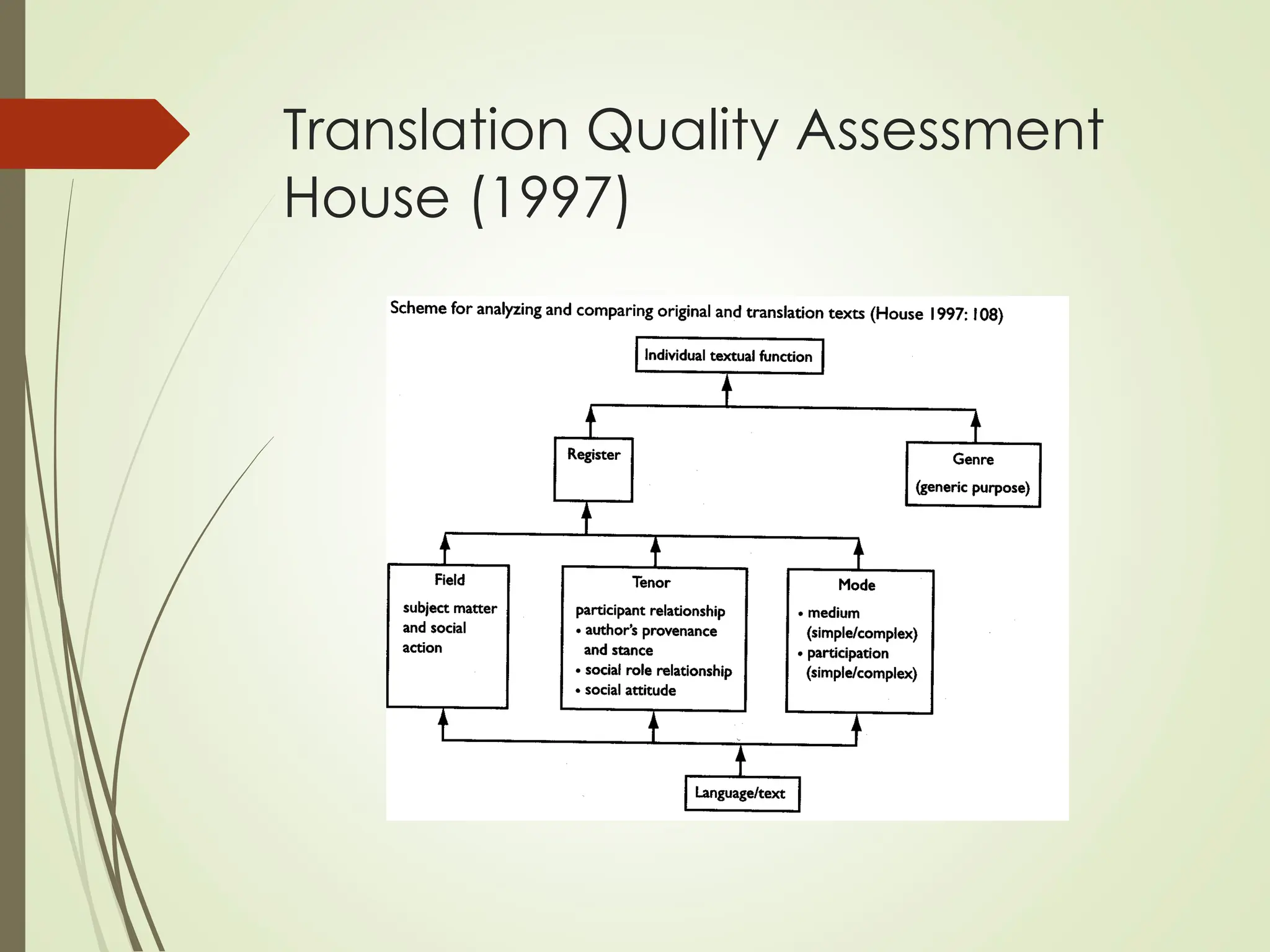
 Register – field/tenor/mode of discourse
 Semantic fields and lexical sets
Equivalence above word level
Baker (1992) – Chapter 3
 Collocation
 Collocational range and markedness
 Collocation and register
 Collocational meaning
 Idioms and Fixed Expressions
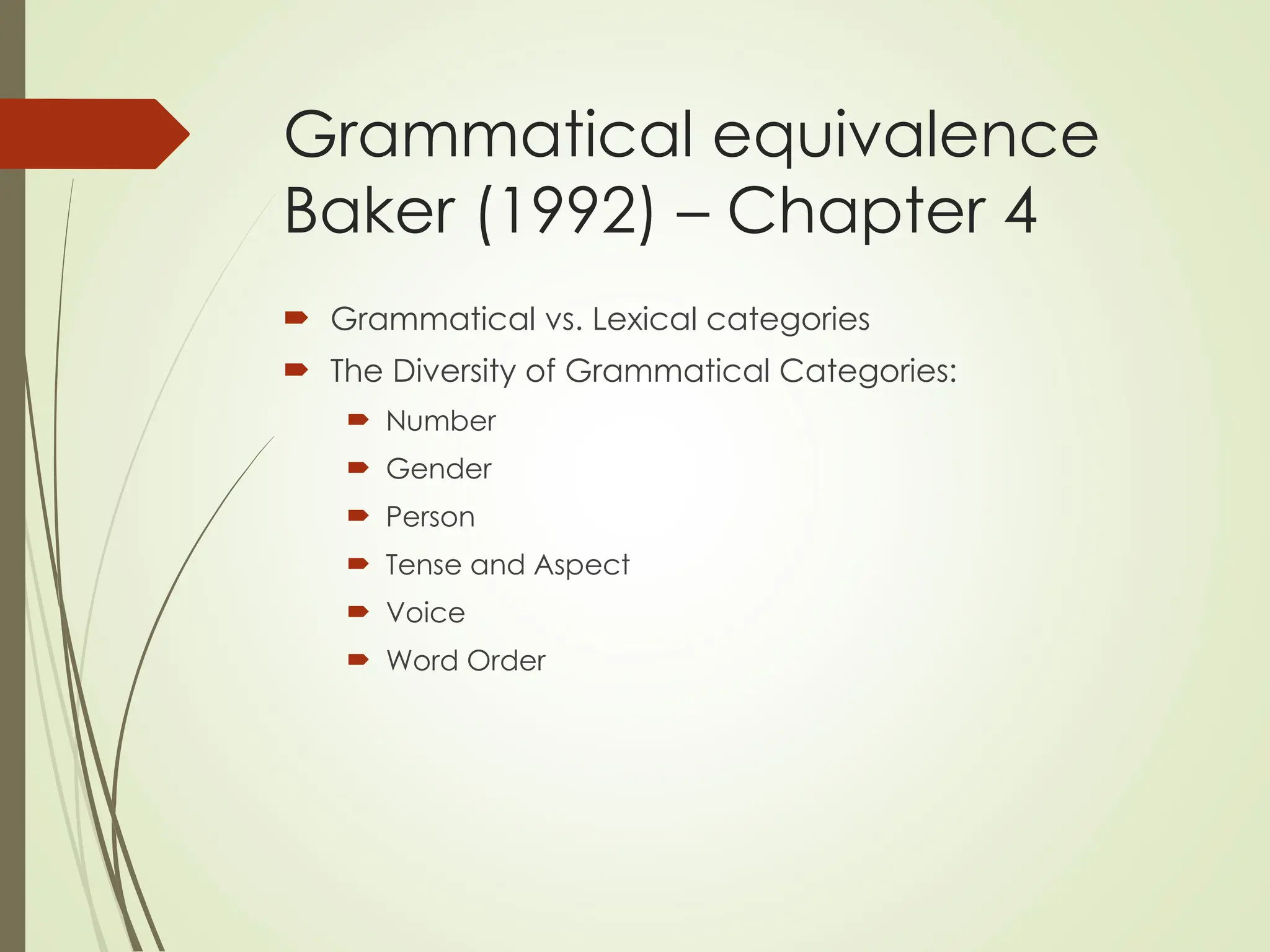
Grammatical equivalence
Baker (1992) – Chapter 4
 Grammatical vs. Lexical categories
 The Diversity of Grammatical Categories:
 Number
 Gender
 Person
 Tense and Aspect
 Voice
 Word Order
Newmark (1981)
 Semantic / communicative
translation at level of:
Transmitter/addressee focus
Culture
Time and origin
Relation to ST
Use of form of SL
Form of TL
Appropriateness
Criterion for evaluation
Koller (1976/89)
Korrespondenz and Äquivalenz
 Denotative equivalence
 Connotative equivalence
 Text-normative equivalence
 Pragmatic equivalence
 Formal equivalence
Vinay & Darbelnet (1977/2000)
Translation ‘shifts’
 Direct translation:
 Borrowing
 Calque
 Literal translation
 Oblique translation
 Transposition
 Modulation
 Equivalence
 Adaptation
 Function at the level of the lexicon,
syntax and message
Translation ‘shifts’
Catford (1965/2000)
1. level shifts
2. category shifts:
 structural
 class
 unit or rank
 intra-system
Van Leuven-Zwart (1989/90)
 8 categories and 37 sub-categories!
Linguistic theories and
translation
 Most of these theories are considered ‘linguistic’ and
are useful for teaching translation
 Most translation occurs at the linguistic level at some
stage of the process
 However, too much stress on linguistic levels can have
negative effect at the text level
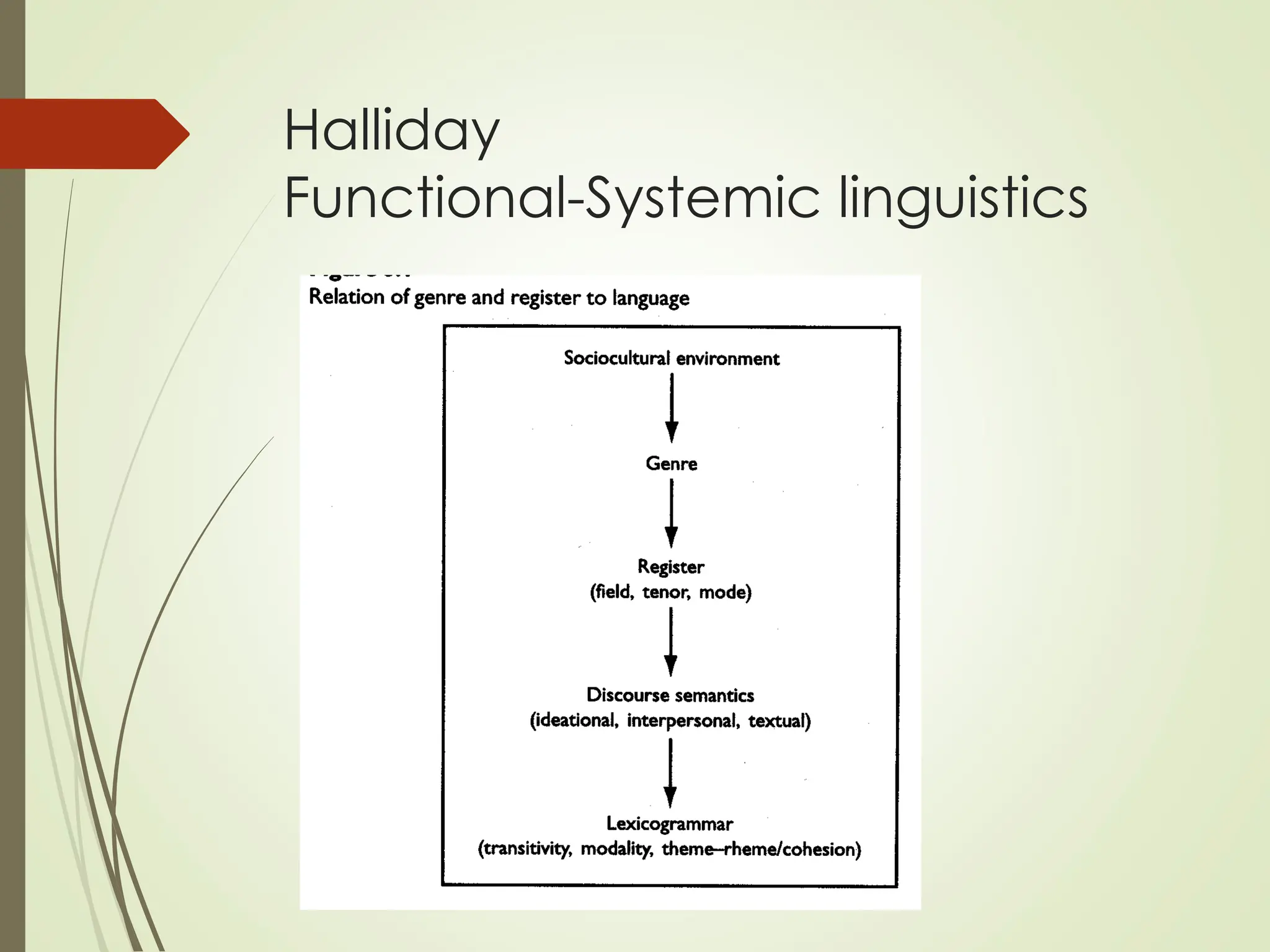
Halliday
Functional-Systemic linguistics
Textual equivalence
Baker (1992) Chapter 5
 Thematic and Information Structures
 Theme and Rheme
 Sentence analysis – S Od Oi Cs Co Cp Adj Conj Disj
 Information Structure: Given and New
 Word Order and Communicative Function
Textual equivalence
Baker (1992) Chapter 6
 Cohesion
 Reference
 Substitution and Ellipsis
 Conjunction
 Lexical Cohesion
Translation Quality Assessment
House (1997)
Focus on the function of the
text
 Baker (1992) Chapter 7 - Pragmatic equivalence
 Reiss (1970s) – Functional approach
 Holz-Mäntarri (1984) – Translational action
 Vermeer (1970s) and Reiss & Vermeer (1984) – ‘Skopos’
theory
 Nord (1988/91) – Text Analysis in Translation
Pragmatic equivalence
Baker (1992) Chapter 7
 Coherence
 Presupposition
 Implicature
 Grice's maxims of
 Quantity
 Quality
 Relevance
 Manner
 Politeness
Reiss (1970s)
Functional approach
 Classification of texts as:
 'informative‘
 'expressive‘
 'operative‘
 'audiomedial'
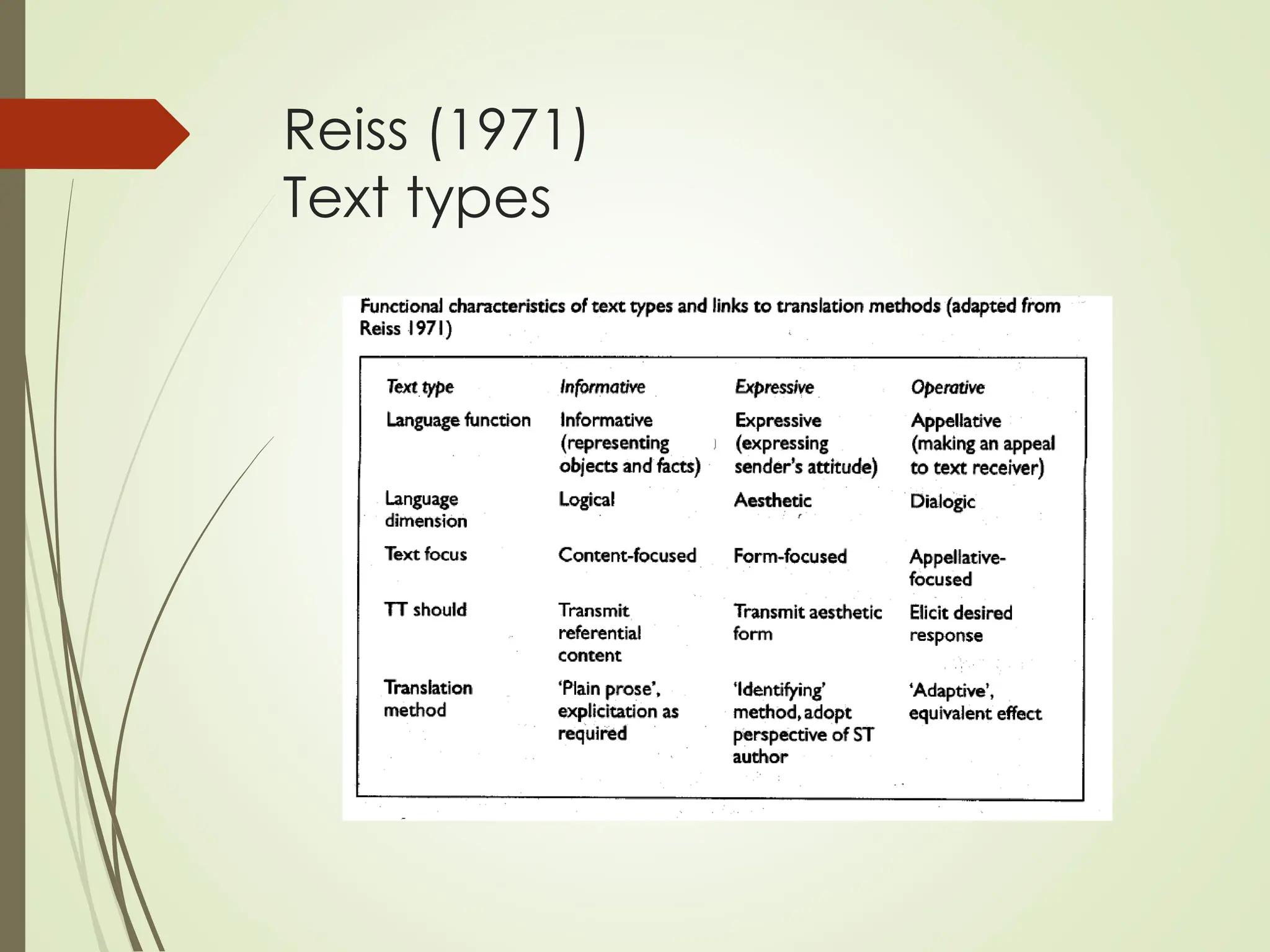
Reiss (1971)
Text types
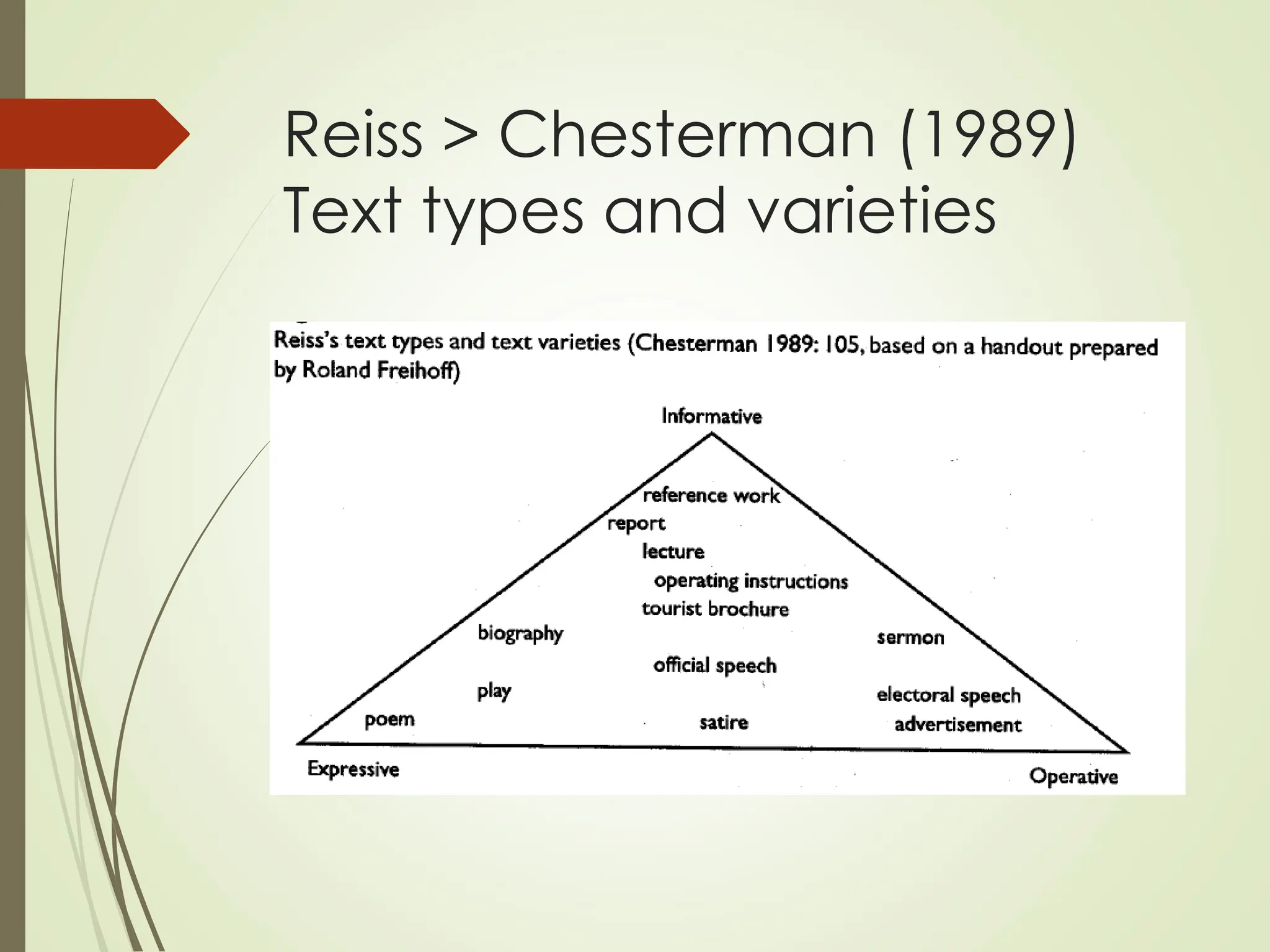
Reiss > Chesterman (1989)
Text types and varieties
Holz-Mäntarri (1984)
Translational action
 A communicative process involving:
 The initiator
 The commissioner
 The ST producer
 The TT producer
 The TT user
 The TT receiver
Reiss & Vermeer (1984) –
‘Skopos’ theory
 Focuses purpose or skopos of translation
 Rules
1. A TT is determined by its skopos
2. A TT is message in a target culture/TL concerning a
message in a source culture/SL
3. A TT is not clearly reversible
4. A TT must be internally coherent
5. A TT must be coherent with the ST
Nord (1988/91)
Text Analysis
Functional approach
1. The importance of the translation commission
2. The role of ST analysis
3. The functional hierarchy of translation problems
Polysystem Theory
Focus - social and cultural norms
 Even-Zohar (1978/2000)
 Toury (1995)
 Chesterman (1997)
 Lambert, Van Gorp, Hermans and the Manipulation
school (1985 & 1999)
Even-Zohar (1978/2000)
Even-Zohar considers translated
literature to include:
children's literature
thrillers
other popular works of fiction,
 (auto-)biography
CONSIDER: informative writing of all
kinds – e.g. travel, art and sport,
journalism, university textbooks.
Toury (1995) Descriptive
Translation Studies
Important point in Translation Studies
It encouraged the description of all
kinds of translation and provided a
wide basis on which to conduct
research.
The tertium comparationis = attempt
to postulate 'neutral translation' v.
culturally and socially 'loaded' real
translations
BUT proved unsatisfactory and
abandoned
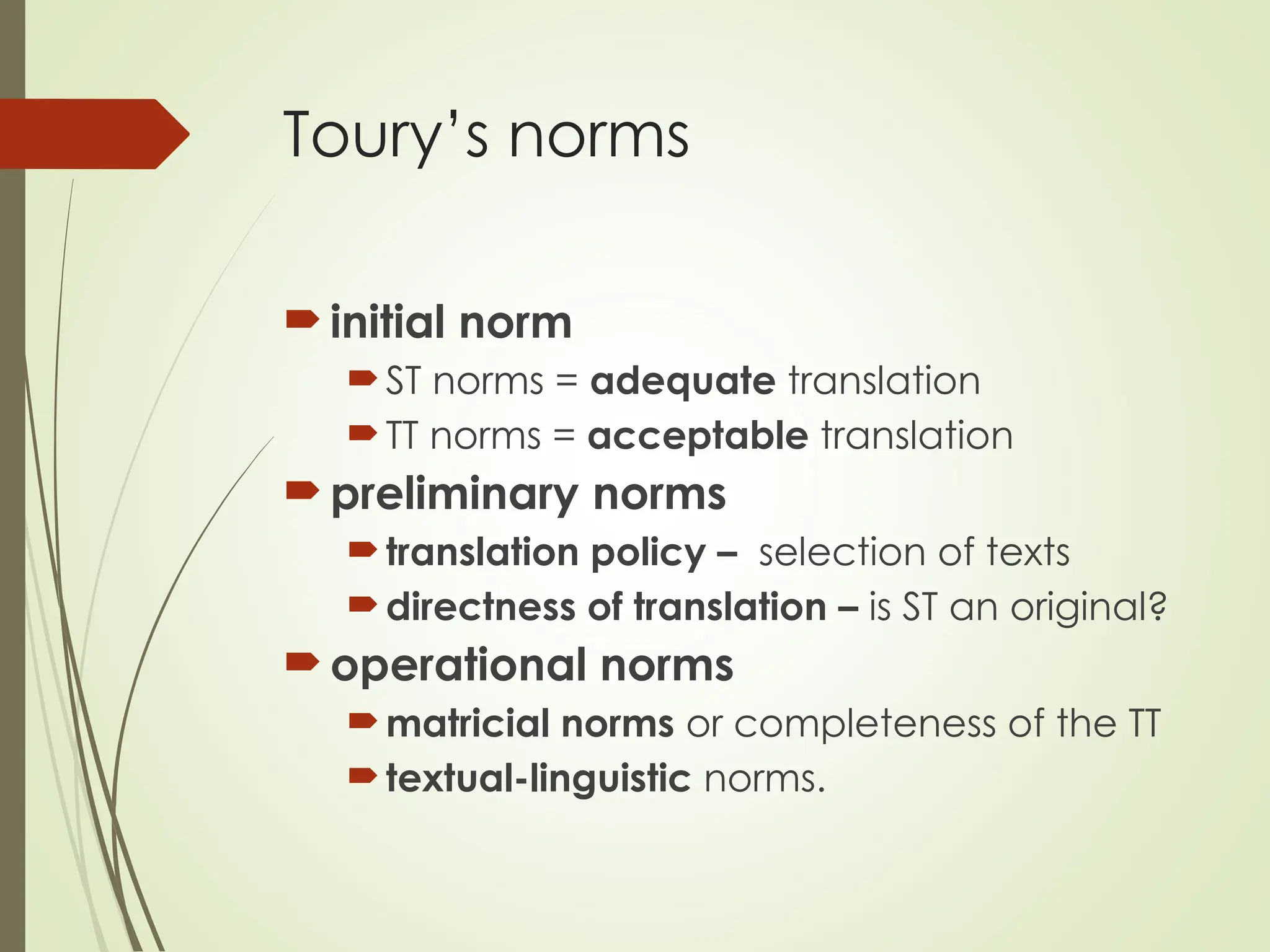
Toury’s norms
initial norm
ST norms = adequate translation
TT norms = acceptable translation
preliminary norms
translation policy – selection of texts
directness of translation – is ST an original?
operational norms
matricial norms or completeness of the TT
textual-linguistic norms.
Toury’s ‘laws’
 The law of growing standardization - suggests that the
TT standards override those of the original text. This will
happen when the TL culture is more powerful.
 The law of interference - suggests that the ST interferes
in the TT by default. This will happen when the SL
culture is more powerful.
Chesterman’s norms (1997)
 Expectancy norms – expectations of readers
 Allow evaluative judgements
 Validated by a norm-authority
 Professional norms
 Accountability norm – ethical norm
 Communication norm – social norm
 ‘Relation’ norm – linguistic norm (between SL and TL)
Polysystem theory and the
NON Literary text
 Even-Zohar, Toury, Chesteman, and others see ST and
TT as part of a much wider social and cultural context
 Although they may consider literary text primary, their
theories and suggestions are applicable to all texts
Cultural Studies
 Bassnett & Lefevere (1991) dismissed ‘linguistic
theories’ as having ‘moved from word to text as a unit,
but not beyond’ and talked of ‘painstaking
comparisons between orginals and translations’ which
do not consider the text in its cultural environment.
(Munday, 2001: 127)
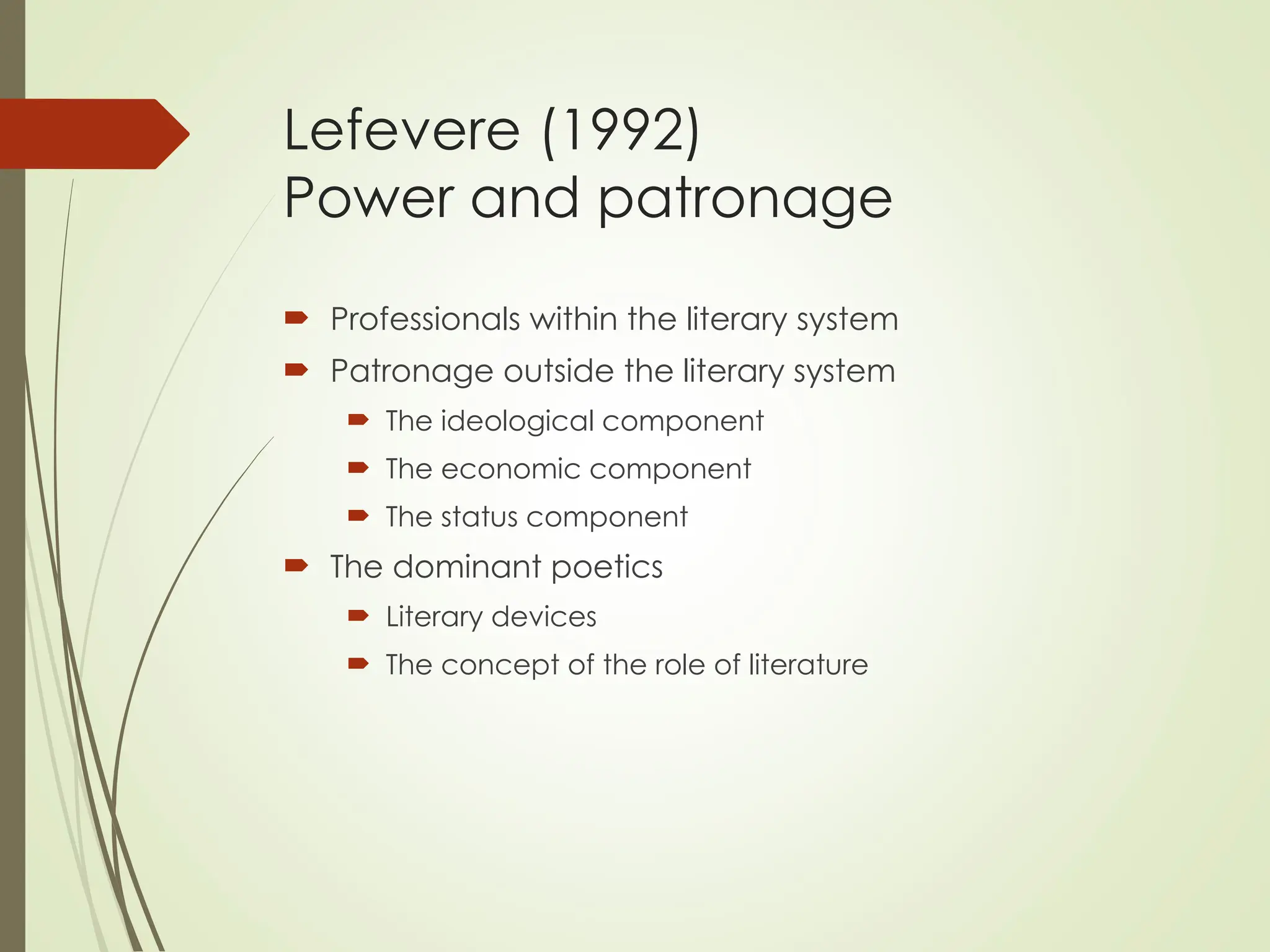
Lefevere (1992)
Power and patronage
 Professionals within the literary system
 Patronage outside the literary system
 The ideological component
 The economic component
 The status component
 The dominant poetics
 Literary devices
 The concept of the role of literature
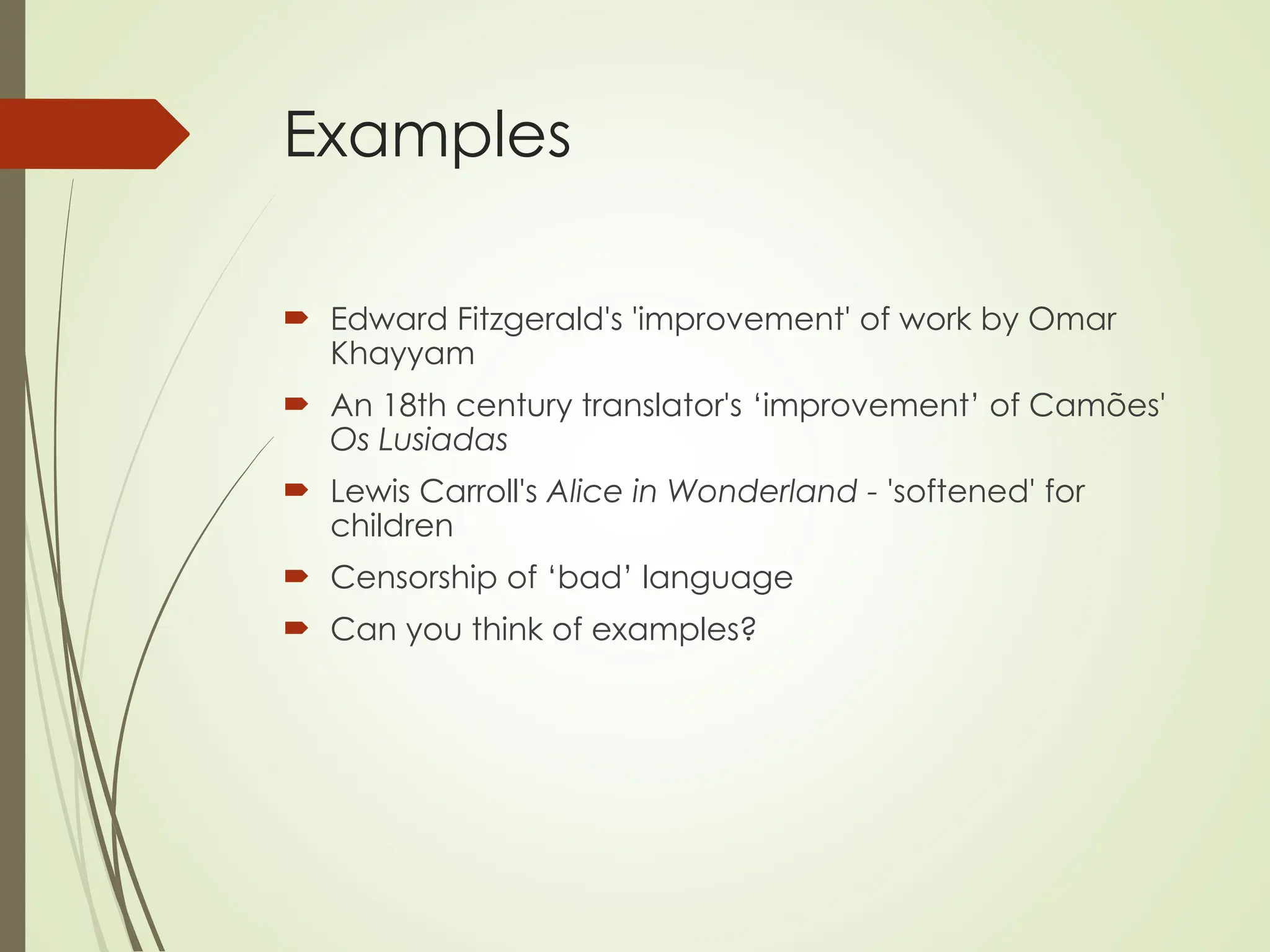
Examples
 Edward Fitzgerald's 'improvement' of work by Omar
Khayyam
 An 18th century translator's ‘improvement’ of Camões'
Os Lusiadas
 Lewis Carroll's Alice in Wonderland - 'softened' for
children
 Censorship of ‘bad’ language
 Can you think of examples?
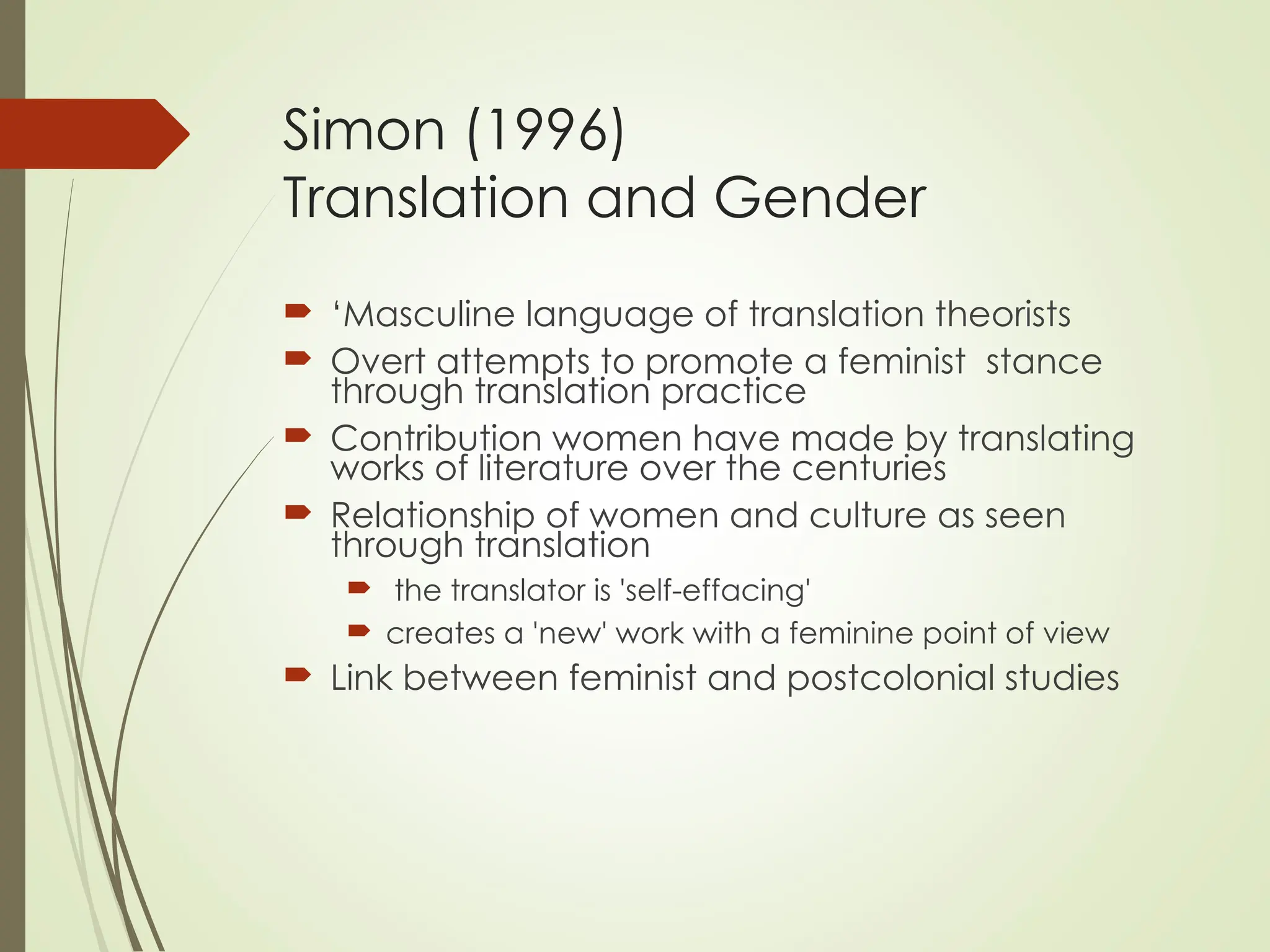
Simon (1996)
Translation and Gender
 ‘Masculine language of translation theorists
 Overt attempts to promote a feminist stance
through translation practice
 Contribution women have made by translating
works of literature over the centuries
 Relationship of women and culture as seen
through translation
 the translator is 'self-effacing'
 creates a 'new' work with a feminine point of view
 Link between feminist and postcolonial studies
Postcolonial Translation
Theory
 Spivak (1993/2000) and Niranjana (1992)
 Cultural implications - translating between:
 Colonized and colonizing
 Politically powerful and weaker languages and cultures
 Power relations
 Translational and transnational factors
Example
Spivak (2000) translates out of Bengali
into English
Try to imagine how an educated bi-
lingual (English/Bengali) woman with
international feminist connections
might try to translate poetry by
Mahasweta Devi – a poet in an
Indian village.
http://www.emory.edu/ENGLISH/Bahr
i/Contents.html#Authors
Other Situations
 Brazilian cannibalism (1960-1999)
 Colonized devours colonizer and is enriched
 Cronin (1996)
 The Irish language and English imperialism over the
centuries
Cultural Studies ETC
 My suggestion - surf the Internet with:
 cultural studies
 communication studies
 comparative literature
 literary studies
 translation studies
Cultural Studies and
the NON Literary text
 Cultural Studies theorists:
 Rarely refer to NON Literary text
 Then tend to claim any ‘interesting’ text as ‘literary’!
 YET Cultural Studies should – by its very nature – go
beyond literature – or at least Literature.
Reaction against
TL orientated texts
 What can be done to avoid too much
standardization?
 How can one avoid social or cultural bias?
 How can one truly represent the original?
Antoine Berman (1984)
‘the Experience of the Foreign’
 Berman’s ‘negative analytic’ of translation focuses the
following:
 Rationalization
 Clarification
 Expansion
 Ennoblement
 Qualitative impoverishment
 Quantitative impoverishment
Antoine Berman (1984)
‘the Experience of the Foreign’
 The destruction of rhythms
 The destruction of underlying networks of signification
 The destruction of linguistic patternings
 The destruction of vernacular networks or their
exoticization
 The destruction of expressions and idioms
 The effacement of the superimposition of languages
Venuti (1995)
The Translator’s Invisibility
Criticizes those, like Toury, who aim to
produce value-free norms and laws
of translation.
Interpretes Lefevere's notions of
patronage and its influence in the
context of Anglo-American publishing
Uses 'Invisibility' to describe the
translator's situation and activity in
contemporary Anglo-American
culture
QUESTIONS
 Can the Translator be ‘Invisible’?
 Should the Translator be ‘Invisible’?
 If, so – when? Give examples
 Can the Translator be ‘invisible’ and creative?
 If, so – when? Give examples
Pride, Prejudice ......
and Power
 Consider:
 How literary translators’ describe their work – Pride
 How reviewers and the public receive translations -
Prejudice
 The publishing industry and the effect of globalization
– Power
Philosophy and translation
 Philosophers often find translation fascinating - a few
examples:
 Walter Benjamin (1923/2000)
 Ezra Pound (1929/2000)
 Steiner (1975/92/98)
 Derrida & Deconstruction (1960 >)
Walter Benjamin (1923/2000)
Benjamin's metaphor - liberation of
the original text through translation.
Believed in interlinear translation >
reveals the original in all its complexity
TL is 'powerfully affected by the
foreign tongue‘
An extreme example of foreignization
Believed this would allow 'pure
language' to emerge from the
harmonization of the two languages.
Ezra Pound (1929/2000) –
and his followers
Ezra Pound influenced much literary
translation
Idea that one does not need to know
the SL well – it is enough to feel the
‘spirit’
Belief in archaizing and foreignizing to
effect
Led to ‘literary translation workshops’
- inspiration
Leads to very good translation – OR
pretentious and impenetrable texts!
Steiner (1975/92/98)
Beyond Babel
 Hermeneutic motion
1. Initiative trust
2. Aggression
3. Incorporation
4. Compensation
 Imbalance between ST and TT
 Resistant difference of the text
 Elective affinity of the translator
Derrida & Deconstruction
(1960 >)
 Objective of Derrida - and
Deconstruction - to demonstrate the
instability of language in general and
the relationship between signified and
signifier in particular.
 'Deconstruction' can and has been used
to 'deconstruct' much more than
'traditional literature‘ . E.g.
 Political discourse
 Philosophy
 Psychology & Sociology
 Science
Philosophy
and the NON Literary text
 At first sight, these theories would seem to be furthest
from the NON Literary text
 BUT – consider implications for:
 Knowledge engineering
 Ontologies
 Semantic frameworks
 Descriptive terminology
Interdisciplinary
Translation Studies
 In practice - Literary translation is confined to Modern
Languages departments
 NON Literary translation is essentially interdisciplinary in:
 Use of language
 Use of text
 Use of technology
 Snell Hornby (1995) - Text types
Technology and Translation
 Desktop Publishing
 Translation memories
 Terminology databases
 Translator’s Workbench
 Machine translation
 Information resources
Other aspects
Bert Esselink –Localizaton
Yves Gambier –MultMedia
Translation, Conference Interpreting,
Translation in Context
Daniel Gouadec –Terminology and
Translator Training
Don Kiraly- A Social Constructivist
Approach to Translator Education –
Empowerment from Theory to
Practice.
Anthony Pym
 Perhaps one of the best examples of multi-disciplinary
work and interests
 Have a look at his homepage
 http://www.fut.es/~apym/
Bibliography
 BAKER, M. (ed) 1977. The Routledge Encyclopedia of Translation Studies. Part II: History and
Traditions. London and New York: Routledge.
 BAKER, M. (ed) 1977. The Routledge Encyclopedia of Translation.
 BASSNETT, Susan. 1991. Translation Studies. Revised Edition. London and New York: Routledge.
 TR. BASSNETT, S & A. Lefevere (eds.) 1990. Translation, History and Culture, London and New York:
Pinter.
 TR. BASSNETT, S & H. Trivedi (eds.) 1999. Post-Colonial Translation: Theory and Practics, London and
New York: Longman.
 BENJAMIN; W. 1923/2000 The task of the Translator, translated bz H. Zohn (1969) in L. Venuti(ed.)
2000, pp. 15-25.
 BERMAN, A. 1985/2000. Translation and the Trials of the foreign, in L. Venuti(ed.) 2000, pp. 284-97.
 CAMPOS, H. de. 1992. Metalinguagem e outras metas: Ensaios de teoria e crítica literária, S. Paulo:
Perspectiva.
 CATFORD, J.C. (1965) A Linguistic Theory of Translation, London: Academic Press.
 CHESTERMAN, Andrew. 1997. Memes of Translation. Amsterdam/ Philadelphia: John Benjamins
Pub. Co.
 CHESTERMAN, A. 1989. Readings in Translation Theory. Helsinki: Finn Lectura.
 CRONIN, M. 1996. Translating Ireland: Translation, Languages and Culture, Cork: Cork
University Press.
 DERRIDA, J. 1985. 'Des tours de Babel', in J.F. Graham (ed.) pp. 209-48.
 ESSELINK, B. 2000. A Practical Guide to Localization. Amsterdam/Philadelphia: John
Benjamins Pub. Co.
 EVEN-ZOHAR, I. 1978/2000. 'The position of translated literature within the literary
polysystem', in in L. Venuti(ed.) 2000, pp. 192-7.
 FAWCETT, P 1995. Translation and Language: Linguistics Approaches Explained,
Manchester: St. Jerome.
 GENTZLER, Edwin. 2001. Contemporary Translation Theories. 2nd Edition. Clevedon:
Multilingual Matters Ltd.
 GRAHAM, J.F.(ed) 1985. Difference in Translation, Ithaca, NY: Cornell UniversityPress.
 HALLIDAY, M.A.K. 1978. Language as Social Semiotic, London and New York: Arnold.
 HATIM, Basil. 1997. Communication across Cultures - Translation Theory and Contrastive
Text Linguistics. Exeter: University of Exeter Press.
 HATIM, Basil & MASON, Ian. (1990) Discourse and the Translator. Harlow: Longman.
 HERMANS, T. (ed.) 1985. The Manipulation of Literature: Studies in Literary Translation,
Beckenham: Croom Helm.
 HERMANS, T. 1999. Translation in Systems, Manchester: St.Jerome.
 HOLMES, James S. (1988) Translated! Amsterdam : Editions Rodopi.
 HOLZ-MÄNTARRI; J. 1984. 'Translatorisches Handeln - theoretsche fundierte Berufsprofile' in
M. Snell-Hornby (ed.) Übersertzungwissenschaft: Eine neuorienterung, Tübingen: Franke, pp
348-74.
 HOUSE, J. 1997. Translation Quality: A Model Revisited, Tubingen: Gunter Narr.
 JAKOBSON; R. 1959/2000. 'On linguistic aspects of translation', in L. Venuti(ed.) 2000, pp.113-18.
 KIRALY, Don. 2000. A Social Constructivist Approach to Translator Education – Empowerment from
Theory to Practice. Manchester/ Northampton: St. Jerome Publishing.
 KOLLER, W. 1979. 'equivalence in translation theory', in A. Chesterman (ed.) pp. 99-104.
 LAMBERT, J-R. & H. van GORP 19865. 'On describing translation`', in T. Hermans (ed.) 1985, pp 42-
53.
 LEFEVERE, André. (1992) Translation / History / Culture - a sourcebook. London and New York.
Routledge.
 LEFEVERE, André. (1992) Translation, Rewriting & the Manipulation of Literary Fame. London and
New York. Routledge.
 Leuven- Zwart, Kitty & Ton Naajikens 1991 (eds.) Translation Studies: the State of the Art.
Amsterdam/Atlanta: Rodopi.
 MUNDAY, Jeremy. 2001. Introducing Translation Studies – Theories and Applications. London and
New York: Routledge.
 NEWMARK, Peter. (1988) A Textbook of Translation. New York. Prentice-Hall.
 NIDA, E. 1964. Towards a Science of Translating, Leiden: E.J. Brill.
 NIDA, Eugene A. & TABER, Charles R. (1969) The Theory and Practice of Translation, Leiden: E.J.Brill.
 NIRANJANA; T. 1992. Siting Translation: History, Post-Structuralism, and the Colonial Context,
Berkeley, CA: University of California Press.
 NORD, Christiane. 1997, Translating as a Purposeful Activity. Manchester: St. Jerome Pub.Co.
 PYM, A. 1998. Method in Translation History, Manchester: St. Jerome Pub.Co.
 REISS, Katharina. 2000. Translation Criticism – The Potentials & Limitations. Manchester: St. Jerome
Pub.Co.
 REISS, K. 1977/89 'Text types and translation assessment' in A. Chesterman (ed) pp 160-71.
 REISS, K. & H.J. Vermeer 1984 Grundleging einer allgemeinen Translationstheorie, Tübingen:
Niemeyer.
 ROBINSON, Douglas. 1997. Becoming a Translator: An Accelerated Course. London and
New York: Routledge.
 ROBINSON, Douglas. 1997/2002. Western Translation Theory - from Herodotus to Nietzsche.
Manchester/Northampton: St. Jerome Publishing.
 SCHULTE, Rainer & BIGUENET, John. (Eds.) (1992) Theories of Translation - An Anthology of
Essays from Dryden to Derrida. Chicago and Longon : Univ. of Chicago Press.
 SNELL-HORNBY, Mary. (1988) Translation Studies - An Integrated Approach. Amsterdam/
Philadelphia. John Benjamins.
 SIMON, S. 1996 Gender in Translation: Cultural Identity and the Politics of Transmission,
Londond and New York: Routledge.
 SPIVAK, G. 1993/2000 'The Politics of translation', in L. Venuti(ed.) 2000, pp. 397-416.
 STEINER, George. 1992 After Babel. (New Edition). Oxford University Press.
 TOURY, Gideon. 1995. Descriptive Translation Studies - and Beyond. Amsterdam : John
Benjamin Pub. Co.
 VENUTI, Lawrence. (1995) The Translator's Invisibility. London and New York : Routledge.
 VENUTI, L. 1998. The Scandals of Translation, Towards an Ethics of Difference, London &
New York: Routledge.
 VENUTI, Lawrence. (Ed.) 2000. The Translation Studies Reader. London and New York:
Routledge.
 VINAY J.P. & DARBELNET, J (1958) Stylistique Comparée do Français et de L'Ánglais, Paris:
Didier. A classic text which compares English and French language structures.
Links
 Anthony Pym’s homepage
http://www.fut.es/~apym/
 The virtual symposium "INNOVATION IN
TRANSLATOR AND INTERPRETER TRAINING (ITIT) " at
- http://www.fut.es/~apym/tti.htm.
 Post-Colonial Studies at Emory Web site
http://www.emory.edu/ENGLISH/Bahri/Contents.
html#Authors
 Biblegateway:
 http://www.biblegateway.com/cgi-bin/bible
 University of Southern California:
http://www.usc.edu/dept/MSA/quran/
 European Commission’s translators’ workshop
/seminar /interesting articles:
 http://europa.eu.int/comm/translation/theory/in
dex_en.htm
 http://europa.eu.int/comm/translation/theory/w
orkshops_en.htm
 http://europa.eu.int/comm/translation/theory/se
minars_en.htm
 http://europa.eu.int/comm/translation/reading/
articles/theory_and_practice_en.htm

1. Theory and research in translation.ppt

  • 1.
    Translation Theory and theTranslation Research Erikson Saragih S3 Linguistik USU, 2023
  • 2.
    A few generaldistinctions Translating v. interpreting Source language/text – SL / ST Target language/text - TL / TT Intralingual v. interlingual v. intersemiotic translation Translation as language learning Contrastive linguistics Comparative literature
  • 6.
    “Translation Studies” – self-perception Many people today think that Translation Studies is mainly:  Literary theory  Cultural studies  And, possibly:  Communication studies  Stylistics & Genre analysis
  • 7.
    Translation Theory -TT – perspective from Philosophy  Linguistic philosophy - attempts to discover WHAT language means:  the ideal language(s) of logic etc.  'ordinary language' philosophy  Philosophy of language – attempts to find out HOW language means: certain general features of language such as meaning, reference, truth, verification, speech acts and logical necessity  Philosophy of linguistics - the study of language through linguistics
  • 8.
    TT – perspectivefrom Philosophy of Linguistics  Structuralism - language reflects structure of thought, culture and society  Transformational-Generative grammar - underlying universal language  Functionalism - Language and its social functions  Cognitivism - Language as it reflects our cognitive appraisal of the world, categorization of experience and use of metaphor
  • 9.
    TT – perspectivefrom Linguistics  Linguists perceive it as related to:  Contrastive linguistics  Pragmatics  Discourse Analysis  Stylistics  Once dismissed as useless to TT– all of these areas have been re-animated by corpora linguistics
  • 10.
    TT – perspectivefrom Information Technoclogy  IT specialists are increasingly fascinated by human language and:  Machine assisted translation  Machine Translation  Knowledge Engineering  Information Retrieval  Artificial Intelligence
  • 11.
    TT - theprofessional perspective  Translator training  Interpreter training  Translation aids  Translation criticism  Translation quality  Translation policy  Professional translation standards
  • 12.
    Translation Theories  Theobjectives of this seminar are:  To give a general outline of translation theories in this century  To show how these theories apply to non literary texts  To demonstrate that translation practice can benefit from theory
  • 13.
    Translation theories  MostTT is:  Product-orientated – focuses the translation  Function-orientated – examines the context and purpose of the translation  Process-orientated – analyses the psychology of translation and process  But usually has elements of all three
  • 14.
    Partial theories oftranslation  Medium restricted – man or machine?  Area restricted – specific languages/cultures  Rank-restricted – word/sentence/text  Text-type restricted –different genres  Time-restricted – historical view  Problem-restricted – specific problems, e.g equivalence
  • 15.
    Problems  Position ofTranslation Studies in academia  Split between theory and practice  Translation teachers' fear of theory  Researchers still encouraged to focus on literature  Therefore teacher/researcher faced with dilemma
  • 16.
    Early distinctions People havebeen arguing for centuries about literal v. free v. faithful translation word-for-word v. sense-for-sense
  • 17.
    Bible translation Bassnett (1991:45-50) - "The history of Bible translation is accordingly a history of western culture ". St. Jerome's translation into Latin in 384 A.D.  John Wycliffe (1330-84)and the 'Lollards' William Tyndale (1494-1536) – burnt at stake Martin Luther – New Testament 1522, Old Testament 1534
  • 18.
    The Qur’an See Universityof Southern California: http://www.usc.edu/dept/MSA/qura n/ Warning: "Note that any translation of the Qur'an immediately ceases to be the literal word of Allah, and hence cannot be equated with the Qur'an in its original Arabic form. In fact, each of the translations on this site is actually an interpretation which has been translated."
  • 19.
    Science in Translation ahistorical view  Scott L. Montgomery. 2000. Science in Translation. Movements of Knowledge through Cultures and Time. University of Chicago Press.  Describes how scientific texts have been translated, ‘adapted’, ‘revised’ and added to down the centuries e.g.  Western Astronomy  Greek and Arabic Science  Japanese Science
  • 20.
    ‘Linguistic’ theories of translation LanguageUniversals v. Linguistic Relativism Science of translation Equivalence Semantic and communicative translation Korrespondenz and Äquivalenz Translation ‘shifts’ Discourse and register analysis
  • 21.
    Language Universals v. LinguisticRelativism  Language Universals – presuppose that languages and/or our capacity for language are universal and/or innate  long history leading to Chomsky and beyond  Language Relativism – different languages show us different ways of viewing the world  Sapir-Whorf theory and most translation theory
  • 22.
    Science of translation Nida(1964) Linguistic meaning Referential or denotative meaning Emotive or connotative meaning Hierarchical structuring Componential analysis Semantic structure analysis Formal and dynamic equivalence Applications to Bible translation
  • 23.
    Chomsky and TT FromNida & Taber (1969:33)
  • 24.
  • 25.
    Equivalence Roman Jacobson (1959/2000)> “Equivalence in difference is the cardinal problem of language and the pivotal concern of linguistics’ Discusses equivalence at level of obligatory grammar and lexicon, for example: gender aspect semantic fields
  • 26.
    Equivalence at wordlevel Baker (1992) – Chapter 2  Morphology – lexical and syntactic  Lexical Meaning  Propositional v. Expressive meaning  Presupposed meaning  Evoked meaning  dialect – geographical, temporal, social  Register – field/tenor/mode of discourse  Semantic fields and lexical sets
  • 27.
    Equivalence above wordlevel Baker (1992) – Chapter 3  Collocation  Collocational range and markedness  Collocation and register  Collocational meaning  Idioms and Fixed Expressions
  • 28.
    Grammatical equivalence Baker (1992)– Chapter 4  Grammatical vs. Lexical categories  The Diversity of Grammatical Categories:  Number  Gender  Person  Tense and Aspect  Voice  Word Order
  • 29.
    Newmark (1981)  Semantic/ communicative translation at level of: Transmitter/addressee focus Culture Time and origin Relation to ST Use of form of SL Form of TL Appropriateness Criterion for evaluation
  • 30.
    Koller (1976/89) Korrespondenz andÄquivalenz  Denotative equivalence  Connotative equivalence  Text-normative equivalence  Pragmatic equivalence  Formal equivalence
  • 31.
    Vinay & Darbelnet(1977/2000) Translation ‘shifts’  Direct translation:  Borrowing  Calque  Literal translation  Oblique translation  Transposition  Modulation  Equivalence  Adaptation  Function at the level of the lexicon, syntax and message
  • 32.
    Translation ‘shifts’ Catford (1965/2000) 1.level shifts 2. category shifts:  structural  class  unit or rank  intra-system Van Leuven-Zwart (1989/90)  8 categories and 37 sub-categories!
  • 33.
    Linguistic theories and translation Most of these theories are considered ‘linguistic’ and are useful for teaching translation  Most translation occurs at the linguistic level at some stage of the process  However, too much stress on linguistic levels can have negative effect at the text level
  • 34.
  • 35.
    Textual equivalence Baker (1992)Chapter 5  Thematic and Information Structures  Theme and Rheme  Sentence analysis – S Od Oi Cs Co Cp Adj Conj Disj  Information Structure: Given and New  Word Order and Communicative Function
  • 36.
    Textual equivalence Baker (1992)Chapter 6  Cohesion  Reference  Substitution and Ellipsis  Conjunction  Lexical Cohesion
  • 37.
  • 38.
    Focus on thefunction of the text  Baker (1992) Chapter 7 - Pragmatic equivalence  Reiss (1970s) – Functional approach  Holz-Mäntarri (1984) – Translational action  Vermeer (1970s) and Reiss & Vermeer (1984) – ‘Skopos’ theory  Nord (1988/91) – Text Analysis in Translation
  • 39.
    Pragmatic equivalence Baker (1992)Chapter 7  Coherence  Presupposition  Implicature  Grice's maxims of  Quantity  Quality  Relevance  Manner  Politeness
  • 40.
    Reiss (1970s) Functional approach Classification of texts as:  'informative‘  'expressive‘  'operative‘  'audiomedial'
  • 41.
  • 42.
    Reiss > Chesterman(1989) Text types and varieties
  • 43.
    Holz-Mäntarri (1984) Translational action A communicative process involving:  The initiator  The commissioner  The ST producer  The TT producer  The TT user  The TT receiver
  • 44.
    Reiss & Vermeer(1984) – ‘Skopos’ theory  Focuses purpose or skopos of translation  Rules 1. A TT is determined by its skopos 2. A TT is message in a target culture/TL concerning a message in a source culture/SL 3. A TT is not clearly reversible 4. A TT must be internally coherent 5. A TT must be coherent with the ST
  • 45.
    Nord (1988/91) Text Analysis Functionalapproach 1. The importance of the translation commission 2. The role of ST analysis 3. The functional hierarchy of translation problems
  • 46.
    Polysystem Theory Focus -social and cultural norms  Even-Zohar (1978/2000)  Toury (1995)  Chesterman (1997)  Lambert, Van Gorp, Hermans and the Manipulation school (1985 & 1999)
  • 47.
    Even-Zohar (1978/2000) Even-Zohar considerstranslated literature to include: children's literature thrillers other popular works of fiction,  (auto-)biography CONSIDER: informative writing of all kinds – e.g. travel, art and sport, journalism, university textbooks.
  • 48.
    Toury (1995) Descriptive TranslationStudies Important point in Translation Studies It encouraged the description of all kinds of translation and provided a wide basis on which to conduct research. The tertium comparationis = attempt to postulate 'neutral translation' v. culturally and socially 'loaded' real translations BUT proved unsatisfactory and abandoned
  • 49.
    Toury’s norms initial norm STnorms = adequate translation TT norms = acceptable translation preliminary norms translation policy – selection of texts directness of translation – is ST an original? operational norms matricial norms or completeness of the TT textual-linguistic norms.
  • 50.
    Toury’s ‘laws’  Thelaw of growing standardization - suggests that the TT standards override those of the original text. This will happen when the TL culture is more powerful.  The law of interference - suggests that the ST interferes in the TT by default. This will happen when the SL culture is more powerful.
  • 51.
    Chesterman’s norms (1997) Expectancy norms – expectations of readers  Allow evaluative judgements  Validated by a norm-authority  Professional norms  Accountability norm – ethical norm  Communication norm – social norm  ‘Relation’ norm – linguistic norm (between SL and TL)
  • 52.
    Polysystem theory andthe NON Literary text  Even-Zohar, Toury, Chesteman, and others see ST and TT as part of a much wider social and cultural context  Although they may consider literary text primary, their theories and suggestions are applicable to all texts
  • 53.
    Cultural Studies  Bassnett& Lefevere (1991) dismissed ‘linguistic theories’ as having ‘moved from word to text as a unit, but not beyond’ and talked of ‘painstaking comparisons between orginals and translations’ which do not consider the text in its cultural environment. (Munday, 2001: 127)
  • 54.
    Lefevere (1992) Power andpatronage  Professionals within the literary system  Patronage outside the literary system  The ideological component  The economic component  The status component  The dominant poetics  Literary devices  The concept of the role of literature
  • 55.
    Examples  Edward Fitzgerald's'improvement' of work by Omar Khayyam  An 18th century translator's ‘improvement’ of Camões' Os Lusiadas  Lewis Carroll's Alice in Wonderland - 'softened' for children  Censorship of ‘bad’ language  Can you think of examples?
  • 56.
    Simon (1996) Translation andGender  ‘Masculine language of translation theorists  Overt attempts to promote a feminist stance through translation practice  Contribution women have made by translating works of literature over the centuries  Relationship of women and culture as seen through translation  the translator is 'self-effacing'  creates a 'new' work with a feminine point of view  Link between feminist and postcolonial studies
  • 57.
    Postcolonial Translation Theory  Spivak(1993/2000) and Niranjana (1992)  Cultural implications - translating between:  Colonized and colonizing  Politically powerful and weaker languages and cultures  Power relations  Translational and transnational factors
  • 58.
    Example Spivak (2000) translatesout of Bengali into English Try to imagine how an educated bi- lingual (English/Bengali) woman with international feminist connections might try to translate poetry by Mahasweta Devi – a poet in an Indian village. http://www.emory.edu/ENGLISH/Bahr i/Contents.html#Authors
  • 59.
    Other Situations  Braziliancannibalism (1960-1999)  Colonized devours colonizer and is enriched  Cronin (1996)  The Irish language and English imperialism over the centuries
  • 60.
    Cultural Studies ETC My suggestion - surf the Internet with:  cultural studies  communication studies  comparative literature  literary studies  translation studies
  • 61.
    Cultural Studies and theNON Literary text  Cultural Studies theorists:  Rarely refer to NON Literary text  Then tend to claim any ‘interesting’ text as ‘literary’!  YET Cultural Studies should – by its very nature – go beyond literature – or at least Literature.
  • 62.
    Reaction against TL orientatedtexts  What can be done to avoid too much standardization?  How can one avoid social or cultural bias?  How can one truly represent the original?
  • 63.
    Antoine Berman (1984) ‘theExperience of the Foreign’  Berman’s ‘negative analytic’ of translation focuses the following:  Rationalization  Clarification  Expansion  Ennoblement  Qualitative impoverishment  Quantitative impoverishment
  • 64.
    Antoine Berman (1984) ‘theExperience of the Foreign’  The destruction of rhythms  The destruction of underlying networks of signification  The destruction of linguistic patternings  The destruction of vernacular networks or their exoticization  The destruction of expressions and idioms  The effacement of the superimposition of languages
  • 65.
    Venuti (1995) The Translator’sInvisibility Criticizes those, like Toury, who aim to produce value-free norms and laws of translation. Interpretes Lefevere's notions of patronage and its influence in the context of Anglo-American publishing Uses 'Invisibility' to describe the translator's situation and activity in contemporary Anglo-American culture
  • 66.
    QUESTIONS  Can theTranslator be ‘Invisible’?  Should the Translator be ‘Invisible’?  If, so – when? Give examples  Can the Translator be ‘invisible’ and creative?  If, so – when? Give examples
  • 67.
    Pride, Prejudice ...... andPower  Consider:  How literary translators’ describe their work – Pride  How reviewers and the public receive translations - Prejudice  The publishing industry and the effect of globalization – Power
  • 68.
    Philosophy and translation Philosophers often find translation fascinating - a few examples:  Walter Benjamin (1923/2000)  Ezra Pound (1929/2000)  Steiner (1975/92/98)  Derrida & Deconstruction (1960 >)
  • 69.
    Walter Benjamin (1923/2000) Benjamin'smetaphor - liberation of the original text through translation. Believed in interlinear translation > reveals the original in all its complexity TL is 'powerfully affected by the foreign tongue‘ An extreme example of foreignization Believed this would allow 'pure language' to emerge from the harmonization of the two languages.
  • 70.
    Ezra Pound (1929/2000)– and his followers Ezra Pound influenced much literary translation Idea that one does not need to know the SL well – it is enough to feel the ‘spirit’ Belief in archaizing and foreignizing to effect Led to ‘literary translation workshops’ - inspiration Leads to very good translation – OR pretentious and impenetrable texts!
  • 71.
    Steiner (1975/92/98) Beyond Babel Hermeneutic motion 1. Initiative trust 2. Aggression 3. Incorporation 4. Compensation  Imbalance between ST and TT  Resistant difference of the text  Elective affinity of the translator
  • 72.
    Derrida & Deconstruction (1960>)  Objective of Derrida - and Deconstruction - to demonstrate the instability of language in general and the relationship between signified and signifier in particular.  'Deconstruction' can and has been used to 'deconstruct' much more than 'traditional literature‘ . E.g.  Political discourse  Philosophy  Psychology & Sociology  Science
  • 73.
    Philosophy and the NONLiterary text  At first sight, these theories would seem to be furthest from the NON Literary text  BUT – consider implications for:  Knowledge engineering  Ontologies  Semantic frameworks  Descriptive terminology
  • 74.
    Interdisciplinary Translation Studies  Inpractice - Literary translation is confined to Modern Languages departments  NON Literary translation is essentially interdisciplinary in:  Use of language  Use of text  Use of technology  Snell Hornby (1995) - Text types
  • 76.
    Technology and Translation Desktop Publishing  Translation memories  Terminology databases  Translator’s Workbench  Machine translation  Information resources
  • 77.
    Other aspects Bert Esselink–Localizaton Yves Gambier –MultMedia Translation, Conference Interpreting, Translation in Context Daniel Gouadec –Terminology and Translator Training Don Kiraly- A Social Constructivist Approach to Translator Education – Empowerment from Theory to Practice.
  • 78.
    Anthony Pym  Perhapsone of the best examples of multi-disciplinary work and interests  Have a look at his homepage  http://www.fut.es/~apym/
  • 79.
    Bibliography  BAKER, M.(ed) 1977. The Routledge Encyclopedia of Translation Studies. Part II: History and Traditions. London and New York: Routledge.  BAKER, M. (ed) 1977. The Routledge Encyclopedia of Translation.  BASSNETT, Susan. 1991. Translation Studies. Revised Edition. London and New York: Routledge.  TR. BASSNETT, S & A. Lefevere (eds.) 1990. Translation, History and Culture, London and New York: Pinter.  TR. BASSNETT, S & H. Trivedi (eds.) 1999. Post-Colonial Translation: Theory and Practics, London and New York: Longman.  BENJAMIN; W. 1923/2000 The task of the Translator, translated bz H. Zohn (1969) in L. Venuti(ed.) 2000, pp. 15-25.  BERMAN, A. 1985/2000. Translation and the Trials of the foreign, in L. Venuti(ed.) 2000, pp. 284-97.  CAMPOS, H. de. 1992. Metalinguagem e outras metas: Ensaios de teoria e crítica literária, S. Paulo: Perspectiva.  CATFORD, J.C. (1965) A Linguistic Theory of Translation, London: Academic Press.  CHESTERMAN, Andrew. 1997. Memes of Translation. Amsterdam/ Philadelphia: John Benjamins Pub. Co.  CHESTERMAN, A. 1989. Readings in Translation Theory. Helsinki: Finn Lectura.
  • 80.
     CRONIN, M.1996. Translating Ireland: Translation, Languages and Culture, Cork: Cork University Press.  DERRIDA, J. 1985. 'Des tours de Babel', in J.F. Graham (ed.) pp. 209-48.  ESSELINK, B. 2000. A Practical Guide to Localization. Amsterdam/Philadelphia: John Benjamins Pub. Co.  EVEN-ZOHAR, I. 1978/2000. 'The position of translated literature within the literary polysystem', in in L. Venuti(ed.) 2000, pp. 192-7.  FAWCETT, P 1995. Translation and Language: Linguistics Approaches Explained, Manchester: St. Jerome.  GENTZLER, Edwin. 2001. Contemporary Translation Theories. 2nd Edition. Clevedon: Multilingual Matters Ltd.  GRAHAM, J.F.(ed) 1985. Difference in Translation, Ithaca, NY: Cornell UniversityPress.  HALLIDAY, M.A.K. 1978. Language as Social Semiotic, London and New York: Arnold.  HATIM, Basil. 1997. Communication across Cultures - Translation Theory and Contrastive Text Linguistics. Exeter: University of Exeter Press.  HATIM, Basil & MASON, Ian. (1990) Discourse and the Translator. Harlow: Longman.  HERMANS, T. (ed.) 1985. The Manipulation of Literature: Studies in Literary Translation, Beckenham: Croom Helm.  HERMANS, T. 1999. Translation in Systems, Manchester: St.Jerome.  HOLMES, James S. (1988) Translated! Amsterdam : Editions Rodopi.  HOLZ-MÄNTARRI; J. 1984. 'Translatorisches Handeln - theoretsche fundierte Berufsprofile' in M. Snell-Hornby (ed.) Übersertzungwissenschaft: Eine neuorienterung, Tübingen: Franke, pp 348-74.  HOUSE, J. 1997. Translation Quality: A Model Revisited, Tubingen: Gunter Narr.
  • 81.
     JAKOBSON; R.1959/2000. 'On linguistic aspects of translation', in L. Venuti(ed.) 2000, pp.113-18.  KIRALY, Don. 2000. A Social Constructivist Approach to Translator Education – Empowerment from Theory to Practice. Manchester/ Northampton: St. Jerome Publishing.  KOLLER, W. 1979. 'equivalence in translation theory', in A. Chesterman (ed.) pp. 99-104.  LAMBERT, J-R. & H. van GORP 19865. 'On describing translation`', in T. Hermans (ed.) 1985, pp 42- 53.  LEFEVERE, André. (1992) Translation / History / Culture - a sourcebook. London and New York. Routledge.  LEFEVERE, André. (1992) Translation, Rewriting & the Manipulation of Literary Fame. London and New York. Routledge.  Leuven- Zwart, Kitty & Ton Naajikens 1991 (eds.) Translation Studies: the State of the Art. Amsterdam/Atlanta: Rodopi.  MUNDAY, Jeremy. 2001. Introducing Translation Studies – Theories and Applications. London and New York: Routledge.  NEWMARK, Peter. (1988) A Textbook of Translation. New York. Prentice-Hall.  NIDA, E. 1964. Towards a Science of Translating, Leiden: E.J. Brill.  NIDA, Eugene A. & TABER, Charles R. (1969) The Theory and Practice of Translation, Leiden: E.J.Brill.  NIRANJANA; T. 1992. Siting Translation: History, Post-Structuralism, and the Colonial Context, Berkeley, CA: University of California Press.  NORD, Christiane. 1997, Translating as a Purposeful Activity. Manchester: St. Jerome Pub.Co.  PYM, A. 1998. Method in Translation History, Manchester: St. Jerome Pub.Co.  REISS, Katharina. 2000. Translation Criticism – The Potentials & Limitations. Manchester: St. Jerome Pub.Co.  REISS, K. 1977/89 'Text types and translation assessment' in A. Chesterman (ed) pp 160-71.
  • 82.
     REISS, K.& H.J. Vermeer 1984 Grundleging einer allgemeinen Translationstheorie, Tübingen: Niemeyer.  ROBINSON, Douglas. 1997. Becoming a Translator: An Accelerated Course. London and New York: Routledge.  ROBINSON, Douglas. 1997/2002. Western Translation Theory - from Herodotus to Nietzsche. Manchester/Northampton: St. Jerome Publishing.  SCHULTE, Rainer & BIGUENET, John. (Eds.) (1992) Theories of Translation - An Anthology of Essays from Dryden to Derrida. Chicago and Longon : Univ. of Chicago Press.  SNELL-HORNBY, Mary. (1988) Translation Studies - An Integrated Approach. Amsterdam/ Philadelphia. John Benjamins.  SIMON, S. 1996 Gender in Translation: Cultural Identity and the Politics of Transmission, Londond and New York: Routledge.  SPIVAK, G. 1993/2000 'The Politics of translation', in L. Venuti(ed.) 2000, pp. 397-416.  STEINER, George. 1992 After Babel. (New Edition). Oxford University Press.  TOURY, Gideon. 1995. Descriptive Translation Studies - and Beyond. Amsterdam : John Benjamin Pub. Co.  VENUTI, Lawrence. (1995) The Translator's Invisibility. London and New York : Routledge.  VENUTI, L. 1998. The Scandals of Translation, Towards an Ethics of Difference, London & New York: Routledge.  VENUTI, Lawrence. (Ed.) 2000. The Translation Studies Reader. London and New York: Routledge.  VINAY J.P. & DARBELNET, J (1958) Stylistique Comparée do Français et de L'Ánglais, Paris: Didier. A classic text which compares English and French language structures.
  • 83.
    Links  Anthony Pym’shomepage http://www.fut.es/~apym/  The virtual symposium "INNOVATION IN TRANSLATOR AND INTERPRETER TRAINING (ITIT) " at - http://www.fut.es/~apym/tti.htm.  Post-Colonial Studies at Emory Web site http://www.emory.edu/ENGLISH/Bahri/Contents. html#Authors  Biblegateway:  http://www.biblegateway.com/cgi-bin/bible  University of Southern California: http://www.usc.edu/dept/MSA/quran/
  • 84.
     European Commission’stranslators’ workshop /seminar /interesting articles:  http://europa.eu.int/comm/translation/theory/in dex_en.htm  http://europa.eu.int/comm/translation/theory/w orkshops_en.htm  http://europa.eu.int/comm/translation/theory/se minars_en.htm  http://europa.eu.int/comm/translation/reading/ articles/theory_and_practice_en.htm