Translation and gender
Presented by
Dr. Nighat Ahmed
Department of English (UGS)
NUML, Islamabad
BS-English (Afternoon)
Course = Introduction to
Translation Studies
7th Semester
Section A,B & C
Semester : Spring 2021
12th Lecture (Online)
Translation and gender
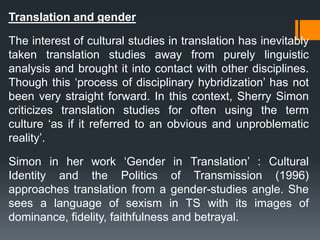
The interest of cultural studies in translation has inevitably
taken translation studies away from purely linguistic
analysis and brought it into contact with other disciplines.
Though this ‘process of disciplinary hybridization’ has not
been very straight forward. In this context, Sherry Simon
criticizes translation studies for often using the term
culture ‘as if it referred to an obvious and unproblematic
reality’.
Simon in her work ‘Gender in Translation’ : Cultural
Identity and the Politics of Transmission (1996)
approaches translation from a gender-studies angle. She
sees a language of sexism in TS with its images of
dominance, fidelity, faithfulness and betrayal.
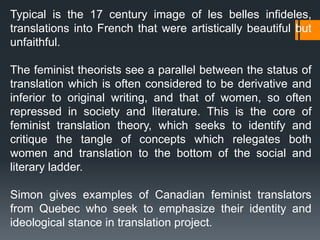
Typical is the 17 century image of les belles infideles,
translations into French that were artistically beautiful but
unfaithful.
The feminist theorists see a parallel between the status of
translation which is often considered to be derivative and
inferior to original writing, and that of women, so often
repressed in society and literature. This is the core of
feminist translation theory, which seeks to identify and
critique the tangle of concepts which relegates both
women and translation to the bottom of the social and
literary ladder.
Simon gives examples of Canadian feminist translators
from Quebec who seek to emphasize their identity and
ideological stance in translation project.
In this context Barbara Godard theorist and translator is
openly assertive about the manipulation this involves:
‘The feminist translator, affirming her critical
difference, her delight in interminable re-reading and
re-writing, flaunts the signs of her manipulation of the
text.’
Another feminist translator, Susanne – de-Harwood
explains her translation strategy in political terms as
follows:
‘My translation practice is a political activity aimed at
making language speak for women. So my signature
on a translation means : this translation has used
every translation strategy to make feminine visible in
language.’

Translation and gender.pptx

  • 1.
    Translation and gender Presentedby Dr. Nighat Ahmed Department of English (UGS) NUML, Islamabad BS-English (Afternoon) Course = Introduction to Translation Studies 7th Semester Section A,B & C Semester : Spring 2021 12th Lecture (Online)
  • 2.
    Translation and gender Theinterest of cultural studies in translation has inevitably taken translation studies away from purely linguistic analysis and brought it into contact with other disciplines. Though this ‘process of disciplinary hybridization’ has not been very straight forward. In this context, Sherry Simon criticizes translation studies for often using the term culture ‘as if it referred to an obvious and unproblematic reality’. Simon in her work ‘Gender in Translation’ : Cultural Identity and the Politics of Transmission (1996) approaches translation from a gender-studies angle. She sees a language of sexism in TS with its images of dominance, fidelity, faithfulness and betrayal.
  • 3.
    Typical is the17 century image of les belles infideles, translations into French that were artistically beautiful but unfaithful. The feminist theorists see a parallel between the status of translation which is often considered to be derivative and inferior to original writing, and that of women, so often repressed in society and literature. This is the core of feminist translation theory, which seeks to identify and critique the tangle of concepts which relegates both women and translation to the bottom of the social and literary ladder. Simon gives examples of Canadian feminist translators from Quebec who seek to emphasize their identity and ideological stance in translation project.
  • 4.
    In this contextBarbara Godard theorist and translator is openly assertive about the manipulation this involves: ‘The feminist translator, affirming her critical difference, her delight in interminable re-reading and re-writing, flaunts the signs of her manipulation of the text.’ Another feminist translator, Susanne – de-Harwood explains her translation strategy in political terms as follows: ‘My translation practice is a political activity aimed at making language speak for women. So my signature on a translation means : this translation has used every translation strategy to make feminine visible in language.’