MORAL EVIL
By: Xyrille Yves Zaide
MORAL

         is
 any one practice
    or teaching
within a moral code.
EVIL
    evil is either metaphysical, physical, or moral.
• Metaphysical evil is not evil properly so called; it is
  but the negation of a greater good, or the limitation
  of finite beings by other finite beings.
• Physical evil deprives the subject affected by it of
  some natural good, and is adverse to the well-being
  of the subject, as pain and suffering.
• Moral evil is found only in intelligent beings; it
  deprives them of some moral good.
EVIL
                 is defined by
          St. Thomas (De malo, 2:2)
as a privation of form or order or due measure


    Evil implies a deficiency in perfection,
hence it cannot exist in God who is essentially
             and by nature good
WHAT IS MORAL EVIL?

                    Moral evil
is the result of any morally negative event caused
      by the intentional action or inaction of an
 agent, such as a person. An example of a moral
  evil might be murder, or any other evil event for
    which someone can be held responsible or
                      culpable.
NATURE OF SIN
We are created to love God, to do God’s will. If we love ourselves more
 than God, if we do our own will instead of God’s will, we commit sin.
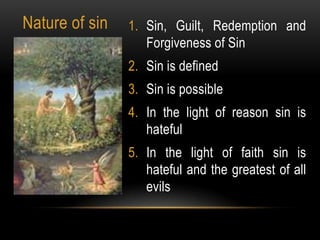
Nature of sin   1. Sin, Guilt, Redemption and
                   Forgiveness of Sin
                2. Sin is defined
                3. Sin is possible
                4. In the light of reason sin is
                   hateful
                5. In the light of faith sin is
                   hateful and the greatest of all
                   evils
SIN AND GUILT, REDEMPTION AND
           FORGIVENESS OF SIN
• Matthew 9:13 – It was Christ’s mission to call sinners to repentance
• Luke 18:9 – Whoever humbles himself before God and acknowledges
  his sins receives forgiveness, whereas pride and hypocrisy make
  forgiveness impossible
• Mark 2:1-12 – Several times we see Him forgiving people’s sins by a
  miracle
• Mark 10:45 – He redeemed mankind from sin by His death: “The son of
  Man is come to give His life for the redemption of many”
• John 1:29 – He is the Lamb of God that takes away the sin of the world
SIN IS DEFINED
                   BY ST. AUGUSTINE

• Factum vel dictum vel concupitum aliquid contra legem
  aeternam
  “Any thought, word or deed against the eternal law of
  God.”


• Sin is the turning away from God, our true end
SIN IS POSSIBLE
         because we possess free will
which we can abuse and turn against the purpose
          for which God gave it to us.
IN THE LIGHT OF REASON
             SIN IS HATEFUL
Because:
a. It humiliates and degrades our nature;
b. It is often an injury to our fellow-men, always an
   injury to ourselves; and
c. In itself and its effects it is a disturbance of the
   moral order of which God is the true source.
IN THE LIGHT OF FAITH SIN IS HATEFUL
   AND THE GREATEST OF ALL EVILS
Because in its innermost nature, it is:
a. A rebellion against God’s most holy will;
b. A contemptuous defiance of the Almighty Creator;
c. A base act of ingratitude towards God;
d. An insult to the thrice holy God;
e. A mockery of Christ;
f. An assault to our own soul;
g. A surrender of true interior liberty and peace
KINDS OF SIN
THE WORD SIN IS USED
FOR THREE DIFFERENT THINGS

      ORIGINAL SIN


       MORTAL SIN


       VENIAL SIN
ORIGINAL SIN

• also called ancestral sin, is, according to a
  Christian theological doctrine, humanity's
  state of sin resulting from the fall of man.


• A state of complete separation from God
  inherited from our first parents.
MORTAL SIN

• Mortal sin is called mortal because it is the
  "spiritual" death of the soul.


• Complete separation from God brought
  about by an act of our own free will.
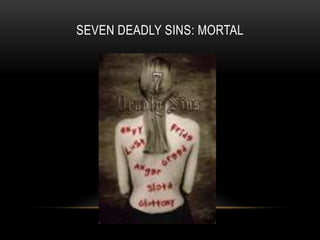
SEVEN DEADLY SINS: MORTAL
WE MUST REMEMBER:

        • If we die without repenting
         we will lose Him for eternity.
• However, by turning our hearts back to Him
  and receiving the Sacrament of Penance,
      we are restored to His friendship.
   • Catholics are not allowed to receive
    Communion if they have NOT confessed
                   MORTAL sins.
VENIAL SIN
• Venial sins are slight sins. They do not break our
  friendship with God, although they injure it. They
  involve disobedience of the law of God in slight
  (venial) matters.


• Not a complete separation from God, yet a willful
  deviation from the right path and weakening of
  the life of grace.
THE DISTINCTION BETWEEN
            MORTAL AND VENIAL SIN


Mortal sins = sufficient acts to destroy our
                 relationship with God


Venial sins = weakens our relationship
                 with God
WHAT MAKES A REAL MORTAL SIN?
CONDITIONS TO CONSIDER SIN AS MORTAL:
      1. it must be a grave matter;
    2. we know we are sinning; and
       3. we freely choose to sin.

The absence of one will make a sin NOT
              MORTAL,
          or not a sin at all.
MORTAL SINS DIFFER MUCH IN GRAVITY
The Catechism of the Catholic Church (CCC) defines these sins as grave matter:
(This is not necessarily all of the possible grave matters.)
• Abortion
• Adulation of another's grave faults if it makes one an accomplice in another's vices
  or grave sins, but it is not grave when it only seeks to be agreeable, to avoid evil, to
  meet a need, or to obtain legitimate advantages.
• Adultery
• Blasphemy
• Defrauding a worker of his wages
• Deliberate failure to go to mass on Sunday unless excused for a serious reason or
  dispensed by one's own pastor
• Divination, magic, and sorcery
• Divorce (If civil divorce, which cannot do anything to the spiritual marriage in the
  eyes of God, remains the only possible way of ensuring certain legal rights, the
  protection of inheritance, or the care of the children it is not a sin.) [21]
• Drug Abuse
• Endangering their own and others' safety by drunkenness or a love of speed on the
  road, at sea or in the air
• Envy (if to the level of wishing grave harm to another)
• Euthanasia
• Extreme Anger (at the level of truly desiring to seriously hurt or kill someone)
• Fornication
• Gluttony
• Hatred of a neighbor/to deliberately desire him or her great harm
• Homosexual acts
• Incest
• Lying (gravity measured by various conditions in catechism)
• Masturbation
• Murder
• Perjury and False Oaths
• Pornography
• Prostitution
• Rape
• Rich nation's refusal to aid those which are unable to ensure the means of their
  development by themselves
• Sacrilege
• Scandal (deliberately causing someone to sin gravely)
• Suicide
• Terrorism that threatens, wounds and kills indiscriminately
• Unfair wagers and cheating at games unless the damage is unusually light
Venial sins are usually divided into
   deliberate and indeliberate.
TEMPTATION AND THE OCCASIONS OF SIN
“ I delight in the law of God after the inward
   man, but I behold another law in my
  members fighting against the law of my
mind, and making me captive to the law of
                     sin”

                -St. Paul
                  (Rom. 7:22)
WHAT IS TEMPTATION?
It is the incitement to choose some personal
satisfaction in place of the will of God.
Thomas à Kempis: “So long as we live inthis
world, we cannot be without tribulation and
temptation”
Job: “The life of man upon earth is a life of
temptation. No man is so perfect and holy but he
hath sometimes temptation”
3 STEPS TO DISTINGUISH TEMPTATION
a. Occasion of temptation:
    • Either some external object that fall under our senses; or
    • Some stimulus, feeling, or emotion within us.
  Conflict arises in our soul between passion and duty.
b. Temptation itself:
         “Let no man, when he is tempted, say that he is tempted by
God. For God is not a tempter of evils, and He tempts no man. But every
man is tempted by his own concupiscence, being drawn away and
allured” (James 1:13)
c. Outcome – Temptation comes to an end when our will decides either
   for or against our duty.
TEMPTATION IS NOT SIN


• It is a conflict


• It must be remembered that: “ where the
  will withholds consent there is no sin”
TEMPTATIONS ARE USEFUL
• God would not permit them unless useful in
  many ways.
• The Holy Ghost promises the victor’s crown to
  all who have stood the test of temptation:
         “Blessed is the man that endureth
  temptation, for when he hath been proved, he
  shall receive the crown of life, which God hath
          promised to them that love Him.”
• Temptation steels and fortifies the will
• Temptation makes us aware of our
  helplessness and learn to cast ourselves
  with humility and childlike trust into the
  arms of God.
• Where there is conflict, there is
  courage, vigilance, fidelity, wisdom, pruden
  ce, firmness, ardor and endurance.
PREPARE TO MEET TEMPTATION

a.Prayer: all-important means for gaining the
  victory in temptations
b.In times of peace we must prepare for war;
  training our will by deliberate acts of self-
  denial and self-conquest.
c. Turn away from objects or imaginations
   that give rise to temptation.
d. Resist temptation from the very beginning
      “ The enemy is more easily to overcome, if
he be not suffered to enter the door of our
hearts, but be resisted at the very gate of his first
knocking” (Imitation of Christ, 1, 13:5)


      Resist beginnings; al too late the cure,
      when ills have gathered strength through
                   long delay.
e. Real personal love of Christ is the best armor
   against temptation.
      “Many waters cannot quench charity, neither
can the floods drown it” (Cant. 8:7)
St. Agatha: “My mind is settles and grounded in
Christ. Your words are winds, your promises are
rains, your terrors are floods. With that violence so
ever that may beat against my house, it can never
fail, for it is founded upon solid rock.”
WE CANNOT AVOID TEMPTATION


• BUT we are strictly bound to avoid the
  proximate occasions of sin, whenever it is
  possible.
SIN AND PUNISHMENT
BEING WISDOM ITSELF, GOD MUST HAVE
PROVIDED A PERFECT SELECTION FOR HIS LAW
• To suppose would imply that He could be
  indifferent to its being observed. His
  justice, too, demands such a sanction.
  “For it would be clearly a negation of justice for
  Him to show Himself equally kind to those who
  do His will and to those who maliciously set it
  aside.”
THE ETERNAL GOD HAS PROVIDED AN ETERNAL
 SANCTION FOR THE MORAL LAW
• If we deliberately violate that law in an important
  matter, we separate ourselves completely from God --- we
  say to His face:
   Non serviam – “I will not serve thee.”
• If we die in mortal sin, our separation from God becomes
  eternal.
  We have forfeited our right to the kingdom of light and
  joy, and our lot is cast with those who dwell in the realm of
  darkness and eternal pain.
• Over the gate of hell, these dreadful words are
  written:


      Through me you pass into the city of woe:
      Through me you pass eternal pain.
      Through me among the people lost for aye.
      All hope abandon, ye who enter here.
                  -- Dante, Inferno
LOVE AND FEAR
• LOVE OF GOD – noblest motive which ought to
  inspire us in the battle of sin.
• FEAR OF GOD, of judgment and Hell – was
  needed to ensure their perseverance in God as
  declared by many saints. They were doing what
  Christ bade them to do:
  “Fear Him that can destroy both soul and body
  into Hell” (Matt. 10:28)
IF SIN IS SUCH A DREADFUL EVIL, THE
GREATEST OF ALL EVILS, WHY DID GOD PERMIT
IT? WHY DOES HE NOT HINDER IT?
• Mysterium inquitatis – the mystery of inquinity
                    (2 Thess. 2:7)


                     Divine Wisdom
                    has good grounds
           for not hindering the entrance of sin
                      into this world

Moral evil

  • 1.
  • 2.
    MORAL is any one practice or teaching within a moral code.
  • 3.
    EVIL evil is either metaphysical, physical, or moral. • Metaphysical evil is not evil properly so called; it is but the negation of a greater good, or the limitation of finite beings by other finite beings. • Physical evil deprives the subject affected by it of some natural good, and is adverse to the well-being of the subject, as pain and suffering. • Moral evil is found only in intelligent beings; it deprives them of some moral good.
  • 4.
    EVIL is defined by St. Thomas (De malo, 2:2) as a privation of form or order or due measure Evil implies a deficiency in perfection, hence it cannot exist in God who is essentially and by nature good
  • 5.
    WHAT IS MORALEVIL? Moral evil is the result of any morally negative event caused by the intentional action or inaction of an agent, such as a person. An example of a moral evil might be murder, or any other evil event for which someone can be held responsible or culpable.
  • 6.
    NATURE OF SIN Weare created to love God, to do God’s will. If we love ourselves more than God, if we do our own will instead of God’s will, we commit sin.
  • 7.
    Nature of sin 1. Sin, Guilt, Redemption and Forgiveness of Sin 2. Sin is defined 3. Sin is possible 4. In the light of reason sin is hateful 5. In the light of faith sin is hateful and the greatest of all evils
  • 8.
    SIN AND GUILT,REDEMPTION AND FORGIVENESS OF SIN • Matthew 9:13 – It was Christ’s mission to call sinners to repentance • Luke 18:9 – Whoever humbles himself before God and acknowledges his sins receives forgiveness, whereas pride and hypocrisy make forgiveness impossible • Mark 2:1-12 – Several times we see Him forgiving people’s sins by a miracle • Mark 10:45 – He redeemed mankind from sin by His death: “The son of Man is come to give His life for the redemption of many” • John 1:29 – He is the Lamb of God that takes away the sin of the world
  • 9.
    SIN IS DEFINED BY ST. AUGUSTINE • Factum vel dictum vel concupitum aliquid contra legem aeternam “Any thought, word or deed against the eternal law of God.” • Sin is the turning away from God, our true end
  • 10.
    SIN IS POSSIBLE because we possess free will which we can abuse and turn against the purpose for which God gave it to us.
  • 11.
    IN THE LIGHTOF REASON SIN IS HATEFUL Because: a. It humiliates and degrades our nature; b. It is often an injury to our fellow-men, always an injury to ourselves; and c. In itself and its effects it is a disturbance of the moral order of which God is the true source.
  • 12.
    IN THE LIGHTOF FAITH SIN IS HATEFUL AND THE GREATEST OF ALL EVILS Because in its innermost nature, it is: a. A rebellion against God’s most holy will; b. A contemptuous defiance of the Almighty Creator; c. A base act of ingratitude towards God; d. An insult to the thrice holy God; e. A mockery of Christ; f. An assault to our own soul; g. A surrender of true interior liberty and peace
  • 13.
  • 14.
    THE WORD SINIS USED FOR THREE DIFFERENT THINGS ORIGINAL SIN MORTAL SIN VENIAL SIN
  • 15.
    ORIGINAL SIN • alsocalled ancestral sin, is, according to a Christian theological doctrine, humanity's state of sin resulting from the fall of man. • A state of complete separation from God inherited from our first parents.
  • 16.
    MORTAL SIN • Mortalsin is called mortal because it is the "spiritual" death of the soul. • Complete separation from God brought about by an act of our own free will.
  • 17.
  • 18.
    WE MUST REMEMBER: • If we die without repenting we will lose Him for eternity. • However, by turning our hearts back to Him and receiving the Sacrament of Penance, we are restored to His friendship. • Catholics are not allowed to receive Communion if they have NOT confessed MORTAL sins.
  • 19.
    VENIAL SIN • Venialsins are slight sins. They do not break our friendship with God, although they injure it. They involve disobedience of the law of God in slight (venial) matters. • Not a complete separation from God, yet a willful deviation from the right path and weakening of the life of grace.
  • 20.
    THE DISTINCTION BETWEEN MORTAL AND VENIAL SIN Mortal sins = sufficient acts to destroy our relationship with God Venial sins = weakens our relationship with God
  • 21.
    WHAT MAKES AREAL MORTAL SIN? CONDITIONS TO CONSIDER SIN AS MORTAL: 1. it must be a grave matter; 2. we know we are sinning; and 3. we freely choose to sin. The absence of one will make a sin NOT MORTAL, or not a sin at all.
  • 22.
    MORTAL SINS DIFFERMUCH IN GRAVITY The Catechism of the Catholic Church (CCC) defines these sins as grave matter: (This is not necessarily all of the possible grave matters.) • Abortion • Adulation of another's grave faults if it makes one an accomplice in another's vices or grave sins, but it is not grave when it only seeks to be agreeable, to avoid evil, to meet a need, or to obtain legitimate advantages. • Adultery • Blasphemy • Defrauding a worker of his wages • Deliberate failure to go to mass on Sunday unless excused for a serious reason or dispensed by one's own pastor • Divination, magic, and sorcery
  • 23.
    • Divorce (Ifcivil divorce, which cannot do anything to the spiritual marriage in the eyes of God, remains the only possible way of ensuring certain legal rights, the protection of inheritance, or the care of the children it is not a sin.) [21] • Drug Abuse • Endangering their own and others' safety by drunkenness or a love of speed on the road, at sea or in the air • Envy (if to the level of wishing grave harm to another) • Euthanasia • Extreme Anger (at the level of truly desiring to seriously hurt or kill someone) • Fornication • Gluttony • Hatred of a neighbor/to deliberately desire him or her great harm • Homosexual acts • Incest
  • 24.
    • Lying (gravitymeasured by various conditions in catechism) • Masturbation • Murder • Perjury and False Oaths • Pornography • Prostitution • Rape • Rich nation's refusal to aid those which are unable to ensure the means of their development by themselves • Sacrilege • Scandal (deliberately causing someone to sin gravely) • Suicide • Terrorism that threatens, wounds and kills indiscriminately • Unfair wagers and cheating at games unless the damage is unusually light
  • 25.
    Venial sins areusually divided into deliberate and indeliberate.
  • 26.
    TEMPTATION AND THEOCCASIONS OF SIN
  • 27.
    “ I delightin the law of God after the inward man, but I behold another law in my members fighting against the law of my mind, and making me captive to the law of sin” -St. Paul (Rom. 7:22)
  • 28.
    WHAT IS TEMPTATION? Itis the incitement to choose some personal satisfaction in place of the will of God. Thomas à Kempis: “So long as we live inthis world, we cannot be without tribulation and temptation” Job: “The life of man upon earth is a life of temptation. No man is so perfect and holy but he hath sometimes temptation”
  • 29.
    3 STEPS TODISTINGUISH TEMPTATION a. Occasion of temptation: • Either some external object that fall under our senses; or • Some stimulus, feeling, or emotion within us. Conflict arises in our soul between passion and duty. b. Temptation itself: “Let no man, when he is tempted, say that he is tempted by God. For God is not a tempter of evils, and He tempts no man. But every man is tempted by his own concupiscence, being drawn away and allured” (James 1:13) c. Outcome – Temptation comes to an end when our will decides either for or against our duty.
  • 30.
    TEMPTATION IS NOTSIN • It is a conflict • It must be remembered that: “ where the will withholds consent there is no sin”
  • 31.
    TEMPTATIONS ARE USEFUL •God would not permit them unless useful in many ways. • The Holy Ghost promises the victor’s crown to all who have stood the test of temptation: “Blessed is the man that endureth temptation, for when he hath been proved, he shall receive the crown of life, which God hath promised to them that love Him.”
  • 32.
    • Temptation steelsand fortifies the will • Temptation makes us aware of our helplessness and learn to cast ourselves with humility and childlike trust into the arms of God. • Where there is conflict, there is courage, vigilance, fidelity, wisdom, pruden ce, firmness, ardor and endurance.
  • 33.
    PREPARE TO MEETTEMPTATION a.Prayer: all-important means for gaining the victory in temptations b.In times of peace we must prepare for war; training our will by deliberate acts of self- denial and self-conquest. c. Turn away from objects or imaginations that give rise to temptation.
  • 34.
    d. Resist temptationfrom the very beginning “ The enemy is more easily to overcome, if he be not suffered to enter the door of our hearts, but be resisted at the very gate of his first knocking” (Imitation of Christ, 1, 13:5) Resist beginnings; al too late the cure, when ills have gathered strength through long delay.
  • 35.
    e. Real personallove of Christ is the best armor against temptation. “Many waters cannot quench charity, neither can the floods drown it” (Cant. 8:7) St. Agatha: “My mind is settles and grounded in Christ. Your words are winds, your promises are rains, your terrors are floods. With that violence so ever that may beat against my house, it can never fail, for it is founded upon solid rock.”
  • 36.
    WE CANNOT AVOIDTEMPTATION • BUT we are strictly bound to avoid the proximate occasions of sin, whenever it is possible.
  • 37.
  • 38.
    BEING WISDOM ITSELF,GOD MUST HAVE PROVIDED A PERFECT SELECTION FOR HIS LAW • To suppose would imply that He could be indifferent to its being observed. His justice, too, demands such a sanction. “For it would be clearly a negation of justice for Him to show Himself equally kind to those who do His will and to those who maliciously set it aside.”
  • 39.
    THE ETERNAL GODHAS PROVIDED AN ETERNAL SANCTION FOR THE MORAL LAW • If we deliberately violate that law in an important matter, we separate ourselves completely from God --- we say to His face: Non serviam – “I will not serve thee.” • If we die in mortal sin, our separation from God becomes eternal. We have forfeited our right to the kingdom of light and joy, and our lot is cast with those who dwell in the realm of darkness and eternal pain.
  • 40.
    • Over thegate of hell, these dreadful words are written: Through me you pass into the city of woe: Through me you pass eternal pain. Through me among the people lost for aye. All hope abandon, ye who enter here. -- Dante, Inferno
  • 41.
    LOVE AND FEAR •LOVE OF GOD – noblest motive which ought to inspire us in the battle of sin. • FEAR OF GOD, of judgment and Hell – was needed to ensure their perseverance in God as declared by many saints. They were doing what Christ bade them to do: “Fear Him that can destroy both soul and body into Hell” (Matt. 10:28)
  • 42.
    IF SIN ISSUCH A DREADFUL EVIL, THE GREATEST OF ALL EVILS, WHY DID GOD PERMIT IT? WHY DOES HE NOT HINDER IT? • Mysterium inquitatis – the mystery of inquinity (2 Thess. 2:7) Divine Wisdom has good grounds for not hindering the entrance of sin into this world