Introduction to SystemicIntroduction to Systemic
Functional GrammarFunctional Grammar
Sugeng Hariyanto (Dr.)
State Polytechnic of Malang, Indonesia
sg_hariyanto[at]ahoo.co.id
Functional ViewFunctional View
B.K Malinowski views meaning as function
in context. (see Figure 1.1.)
Firth continued Malinowski’s emphasis on a
social and functional approach to
language.
He began to use the word “system”.
``The first principle of analysis is to
distinguish between STRUCTURE and
SYSTEM. Structure consists of elements in
interior syntagmatic relation and these
elements have their places in an order of
mutual expectancy. ... Systems of
commutable terms or units are set up
to state the paradigmatic values of the
elements.'' [Firth 1957]
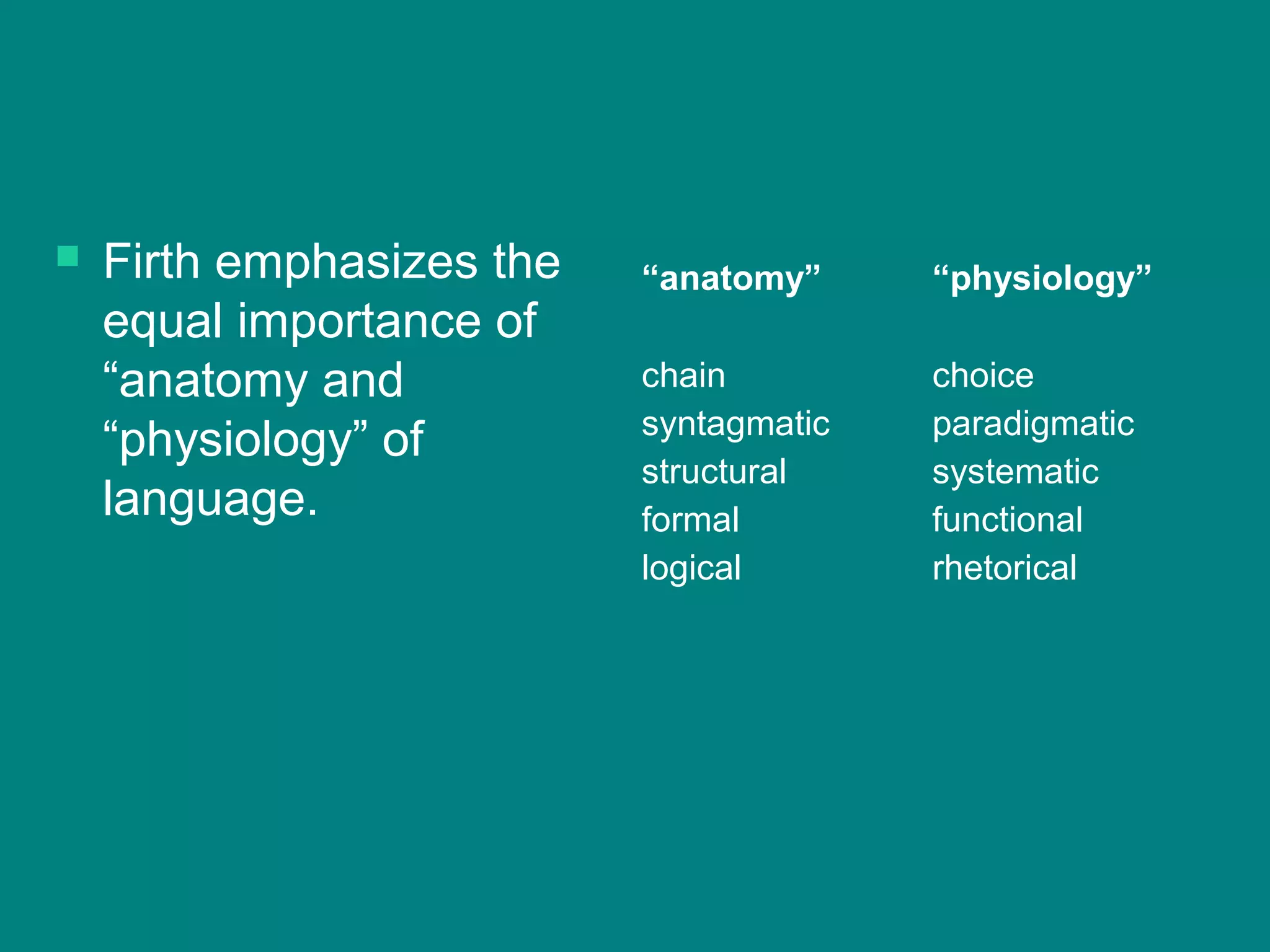
 Firth emphasizes the
equal importance of
“anatomy and
“physiology” of
language.
“anatomy” “physiology”
chain
syntagmatic
structural
formal
logical
choice
paradigmatic
systematic
functional
rhetorical
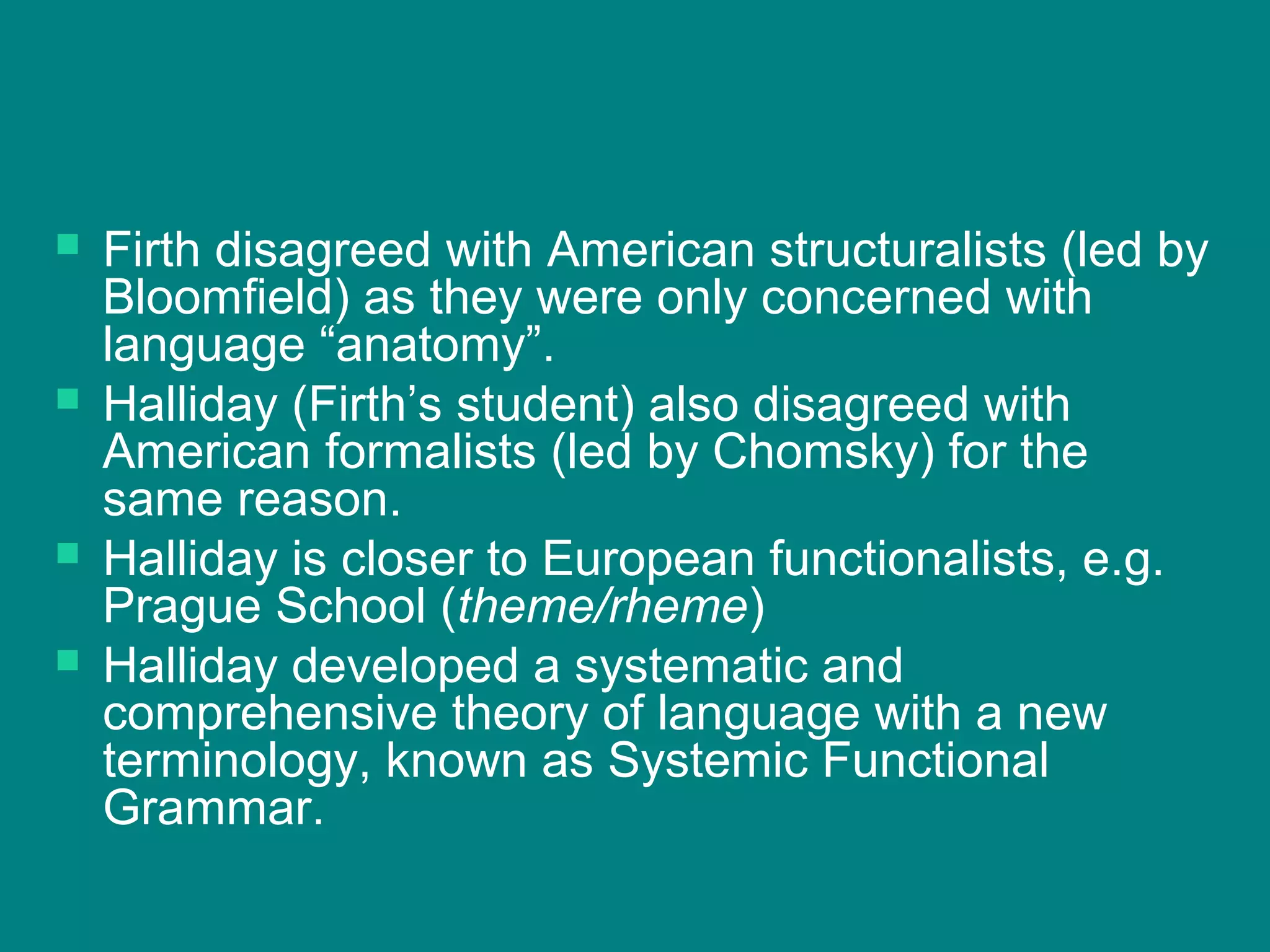
 Firth disagreed with American structuralists (led by
Bloomfield) as they were only concerned with
language “anatomy”.
 Halliday (Firth’s student) also disagreed with
American formalists (led by Chomsky) for the
same reason.
 Halliday is closer to European functionalists, e.g.
Prague School (theme/rheme)
 Halliday developed a systematic and
comprehensive theory of language with a new
terminology, known as Systemic Functional
Grammar.
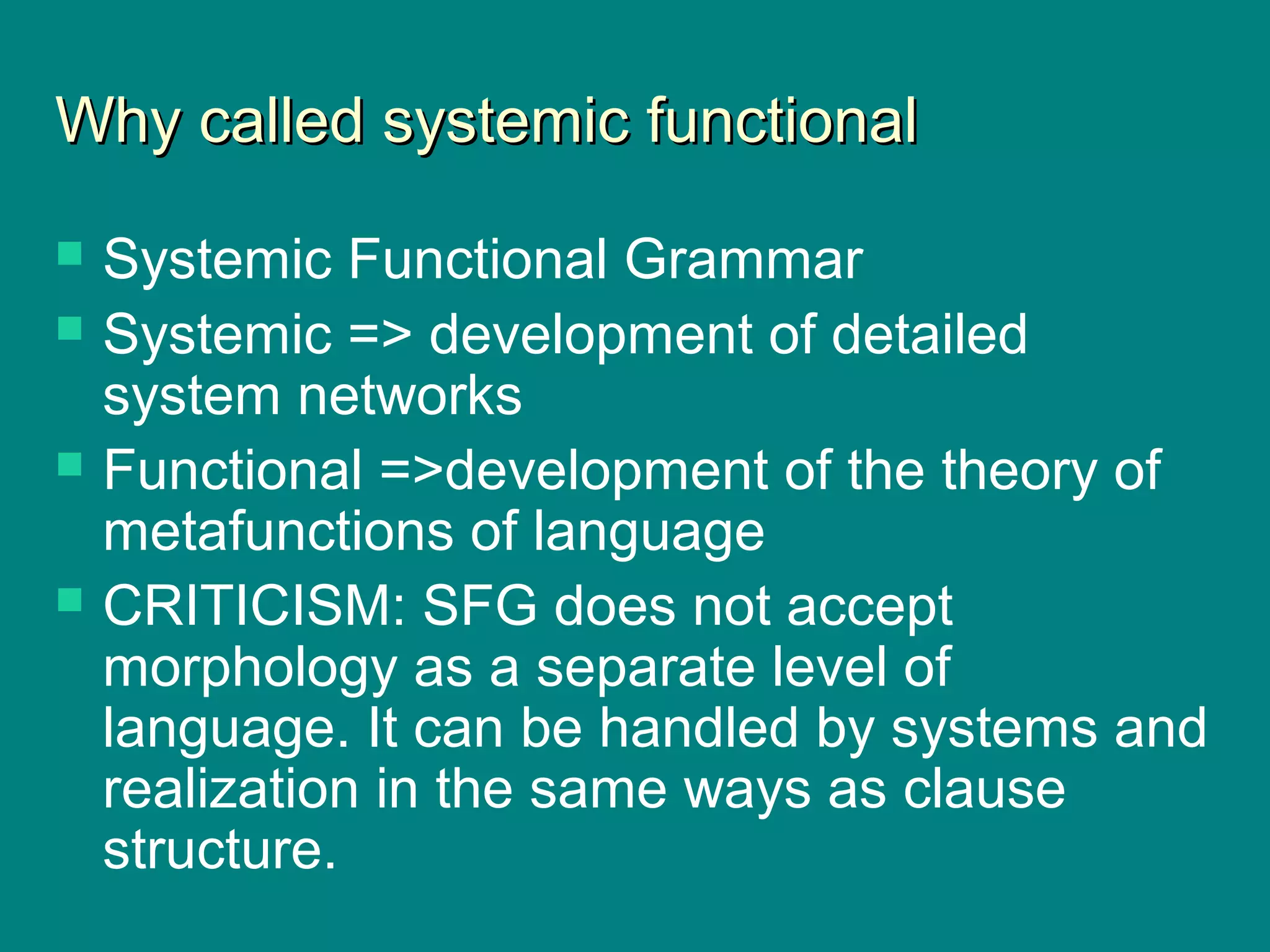
Why called systemic functionalWhy called systemic functional
 Systemic Functional Grammar
 Systemic => development of detailed
system networks
 Functional =>development of the theory of
metafunctions of language
 CRITICISM: SFG does not accept
morphology as a separate level of
language. It can be handled by systems and
realization in the same ways as clause
structure.
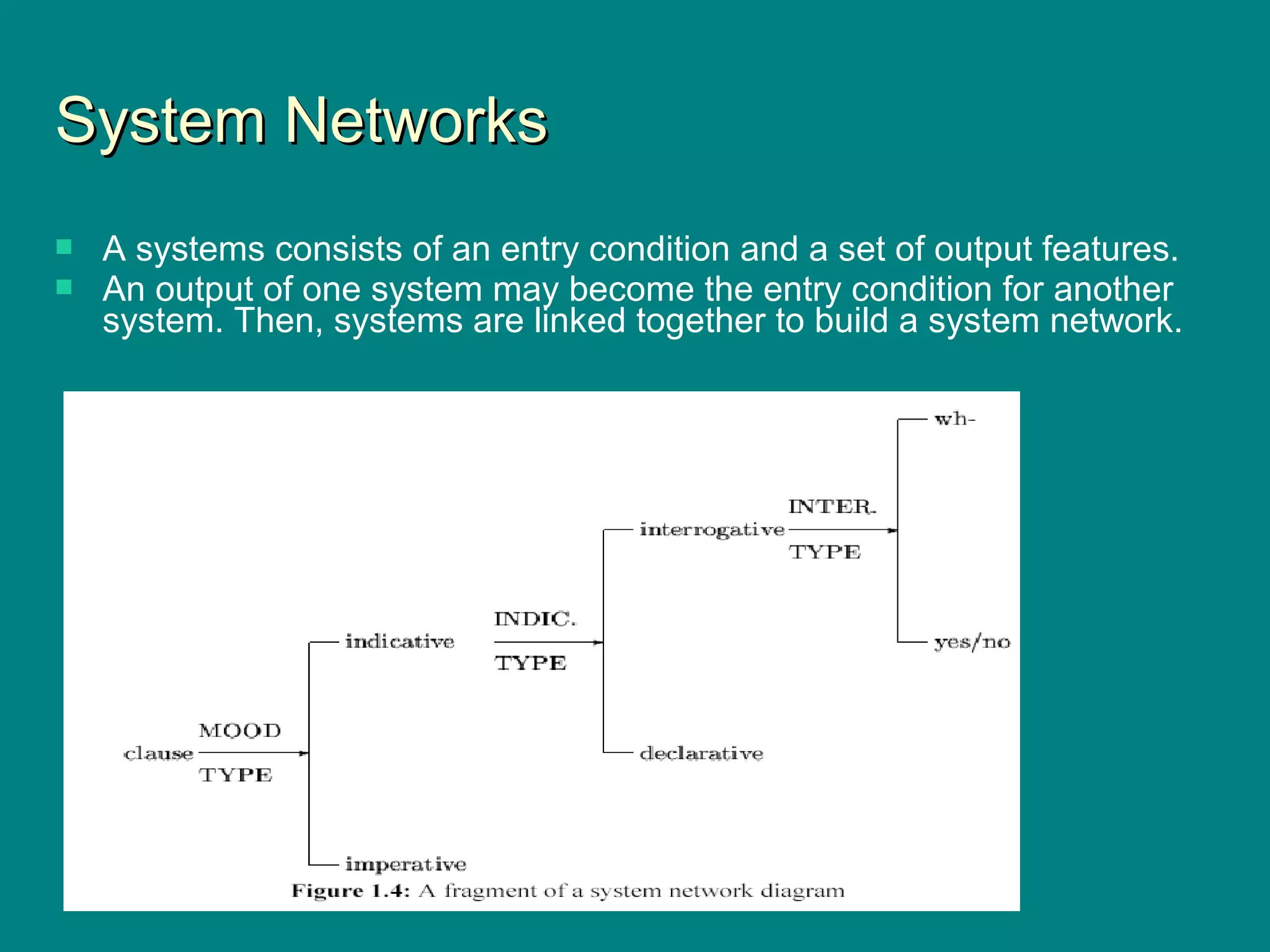
System NetworksSystem Networks
 A systems consists of an entry condition and a set of output features.
 An output of one system may become the entry condition for another
system. Then, systems are linked together to build a system network.
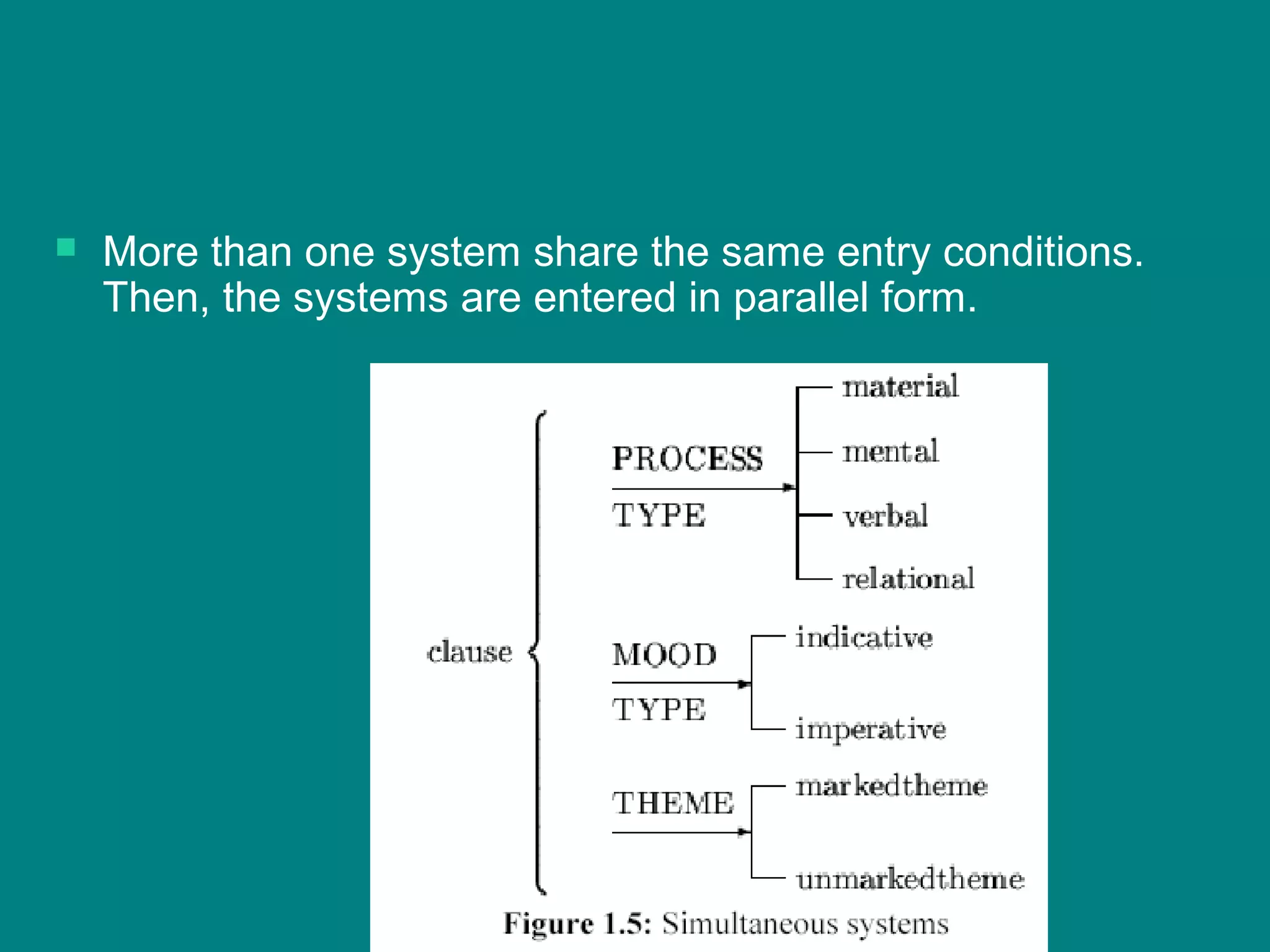
 More than one system share the same entry conditions.
Then, the systems are entered in parallel form.
 Systems represent paradigmatic choice between grammatical
alternatives and between lexical alternatives.
 Lexicon is considered as a thesaurus.
 Halliday has no clear definition between grammar and lexicon;
he calls it lexicogrammar to include both.
 The explicit desciption of paradigmatic choices distinguishes
SFG drom other approaches to grammar.
 Halliday describes the choices as “meaning potential” of that
language.
 The system shows meanings, which are realized in the
structure of the language as wording.
 Realization rule shows how the paradigmatic choices are
expressed as syntagmatic chains in the structure of the
language.
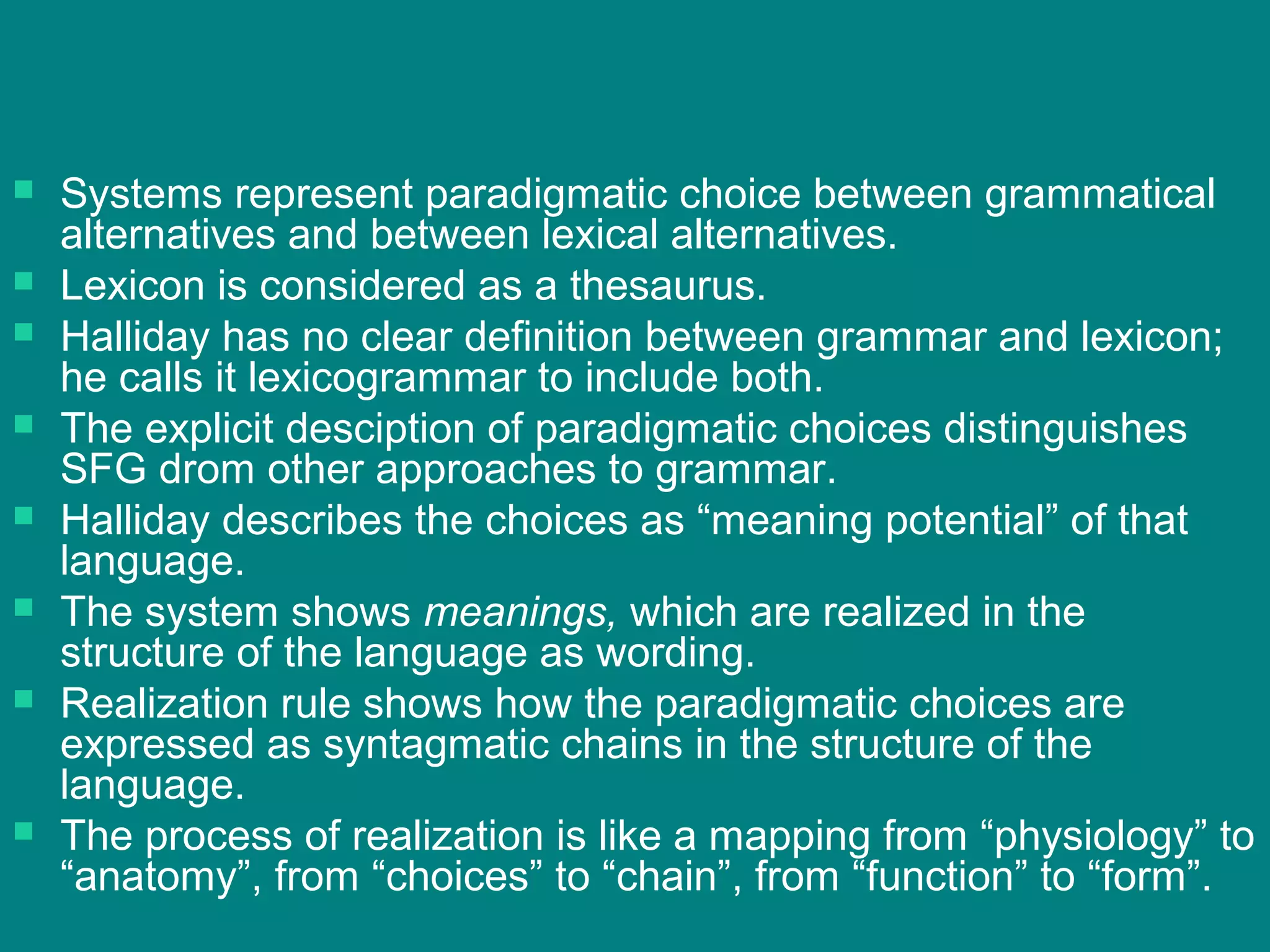
 The process of realization is like a mapping from “physiology” to
“anatomy”, from “choices” to “chain”, from “function” to “form”.
The process of realization is like a mapping from “physiology” toThe process of realization is like a mapping from “physiology” to
“anatomy”, from “choices” to “chain”, from “function” to “form”.“anatomy”, from “choices” to “chain”, from “function” to “form”.
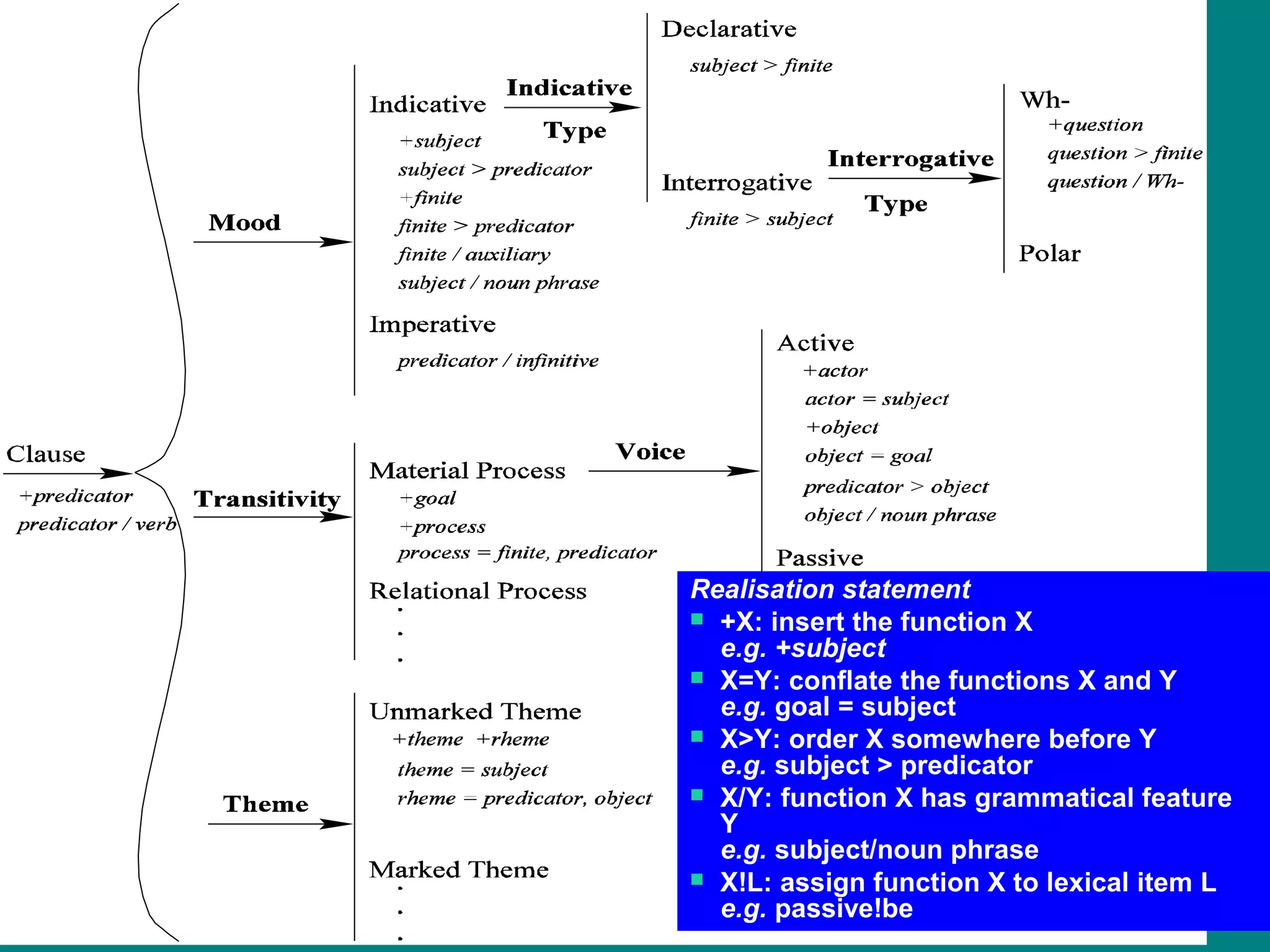
 The output feature “indicative” has two associated realization rules: “+Subject” and
“+Finite”. The output of Declarative has one associated realization rule” “Subject
^Finite”.
 +Subject” requires the presence of a subject when a clause is indicative, and “+Finite”
requires the presence of a finite verb.
 The “Subject ^ Finite” requires the subject to precede the finite verb when the clause
is declarative.
Systemic GrammarSystemic Grammar
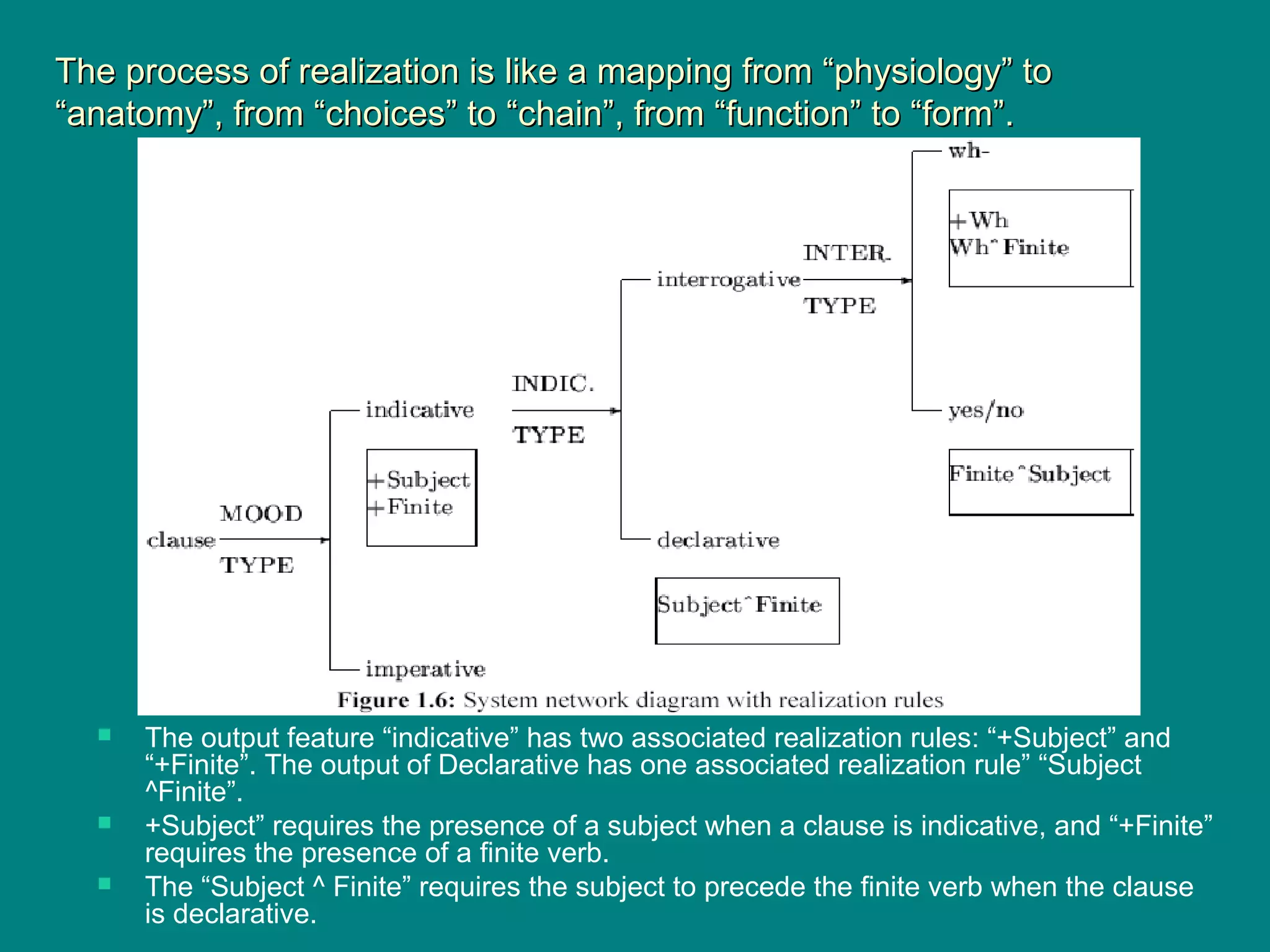
 Grammar is represented as a graph
called a system network. This comprises
 and systems (curly braces)
 conjunctive features in boldface
 or systems (straight vertical lines)
 disjunctive features in normal face
 realisation statements (in italic).
 specify how disjunctive features are
realised
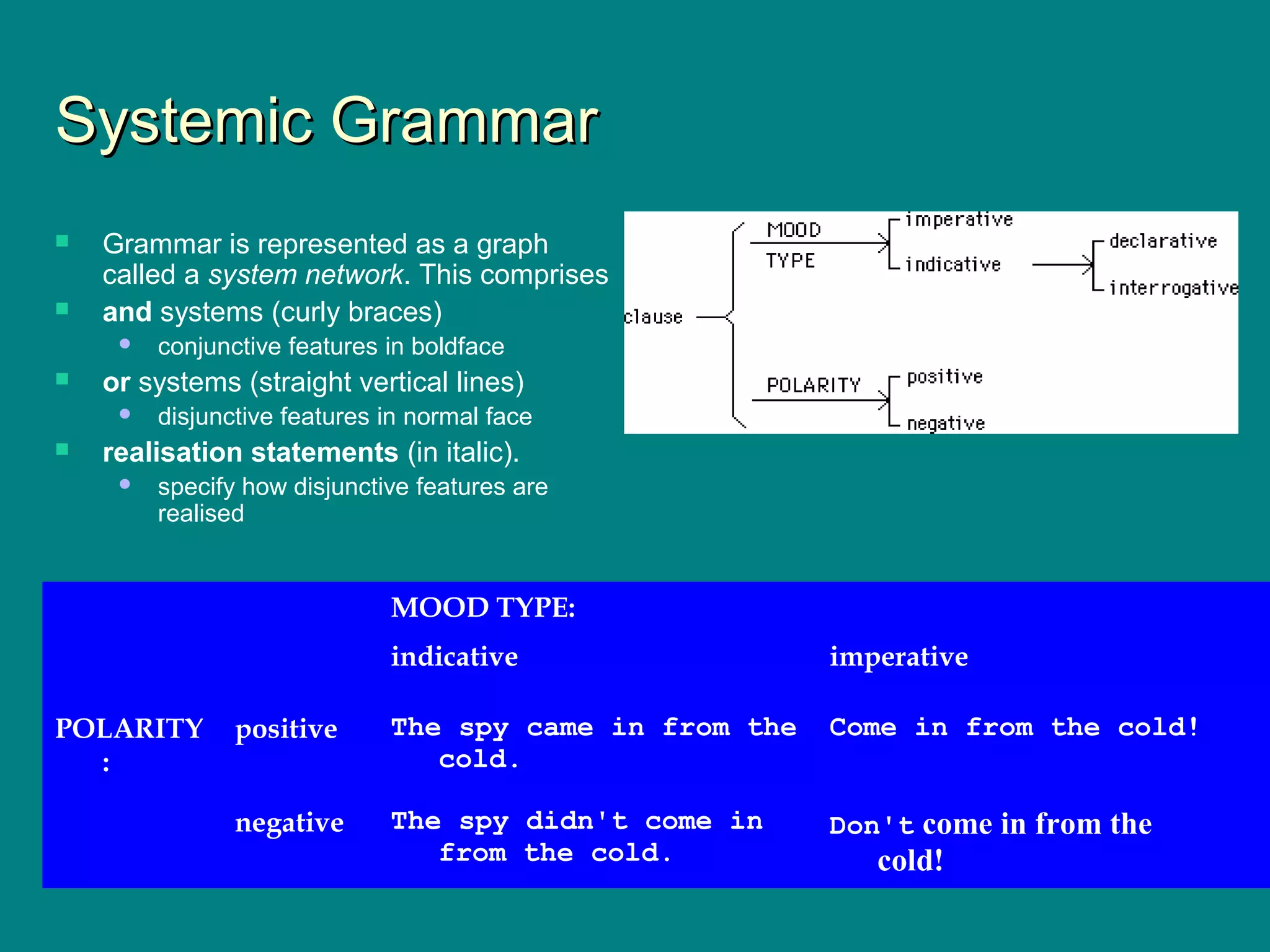
    MOOD TYPE: 
    indicative imperative
POLARITY
:
positive The spy came in from the
cold.
Come in from the cold!
  negative The spy didn't come in
from the cold.
Don't come in from the 
cold!
Realisation statement
 +X: insert the function X
e.g. +subject
 X=Y: conflate the functions X and Y
e.g. goal = subject
 X>Y: order X somewhere before Y
e.g. subject > predicator
 X/Y: function X has grammatical feature
Y
e.g. subject/noun phrase
 X!L: assign function X to lexical item L
e.g. passive!be
FUNCTIONAL MODEL OF LANGUAGEFUNCTIONAL MODEL OF LANGUAGE
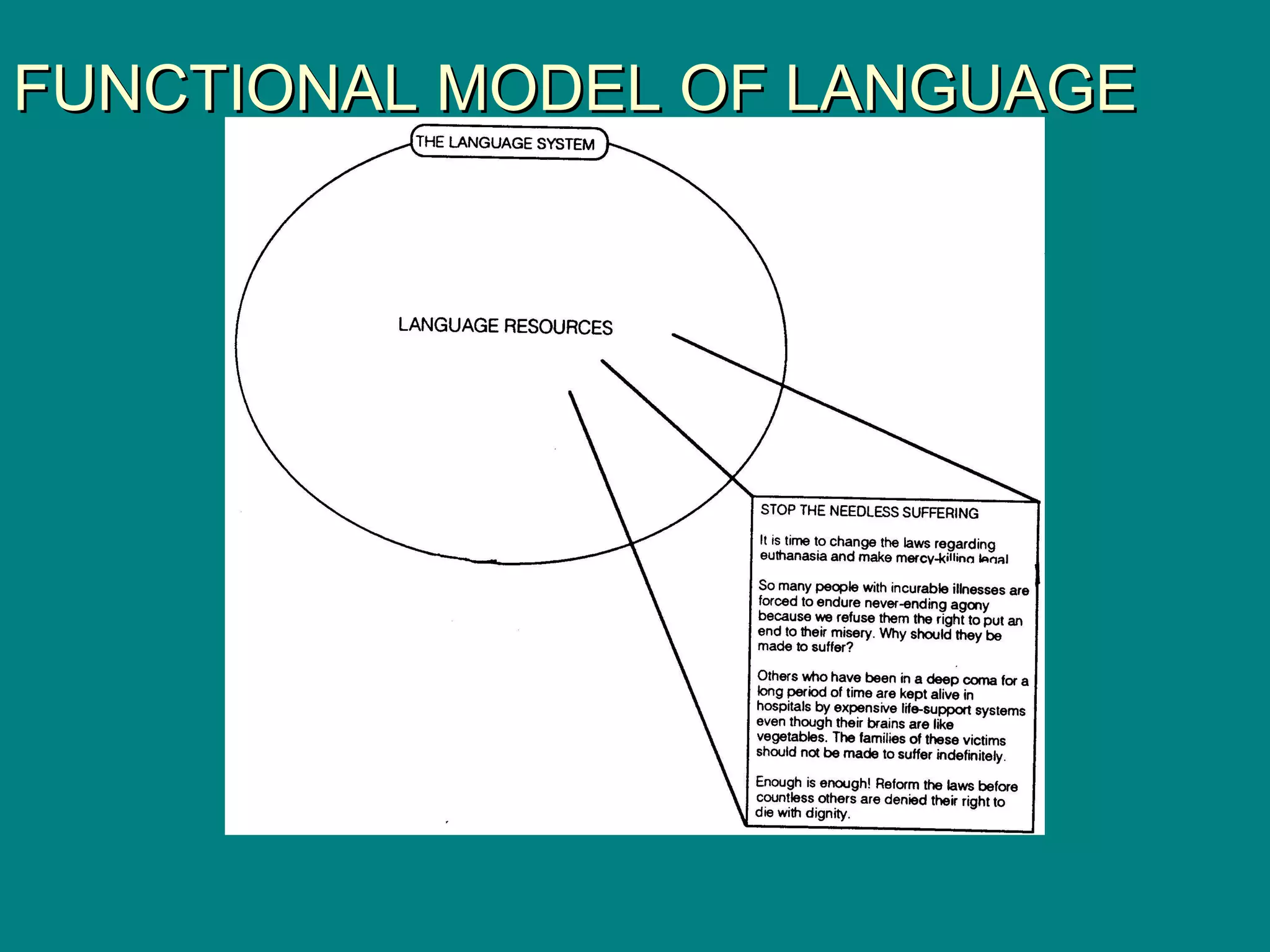
 Language is a resource. Man can narrow
the meanings which speaker/writer means
from the entire context of culture to specific
context of situation by means of extra
linguistics factors: FIELD, TENOR, MODE
Three language functionsThree language functions
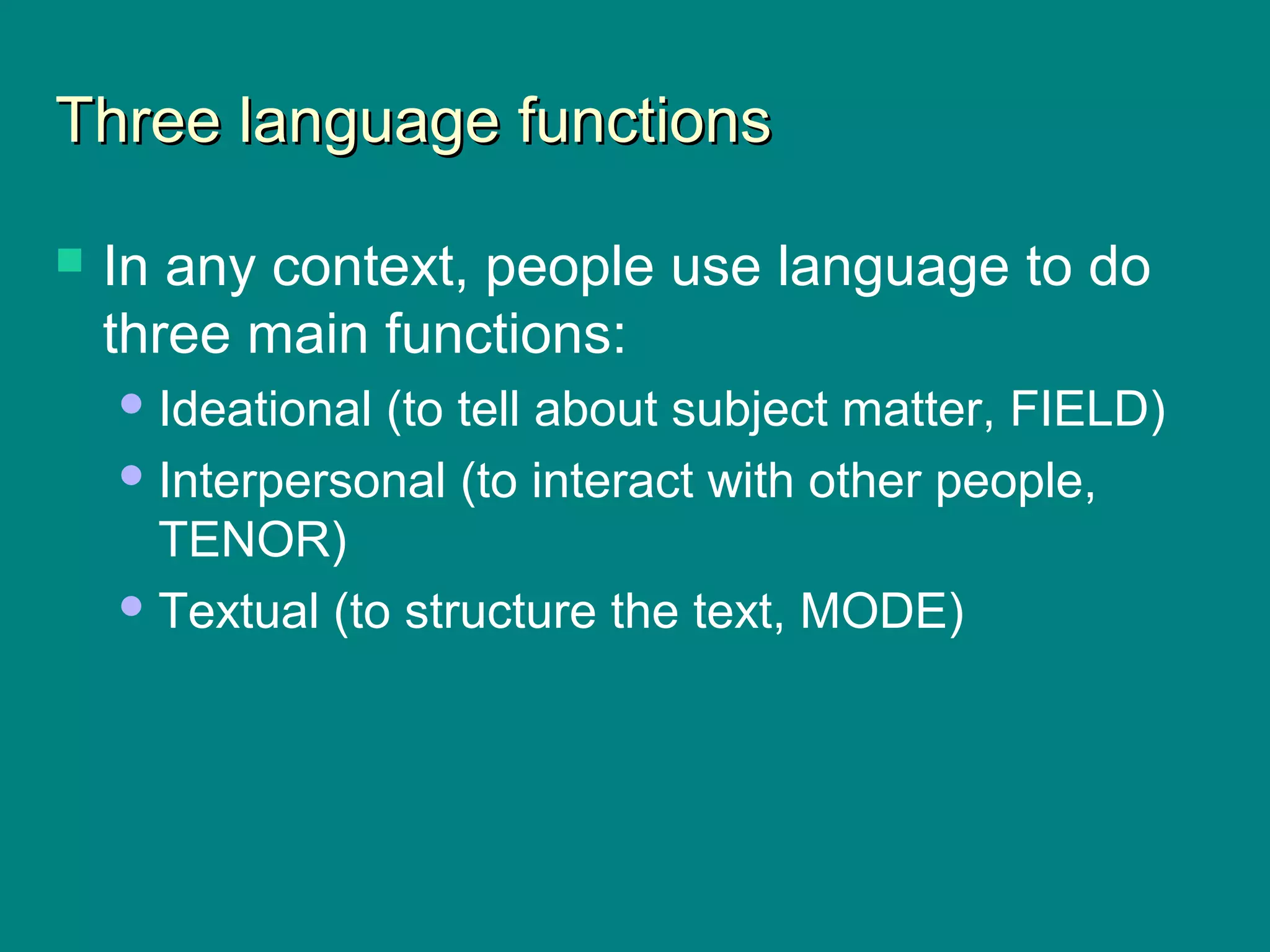
 In any context, people use language to do
three main functions:
Ideational (to tell about subject matter, FIELD)
Interpersonal (to interact with other people,
TENOR)
Textual (to structure the text, MODE)
FUNCTIONAL MODEL OF LANGUAGEFUNCTIONAL MODEL OF LANGUAGE
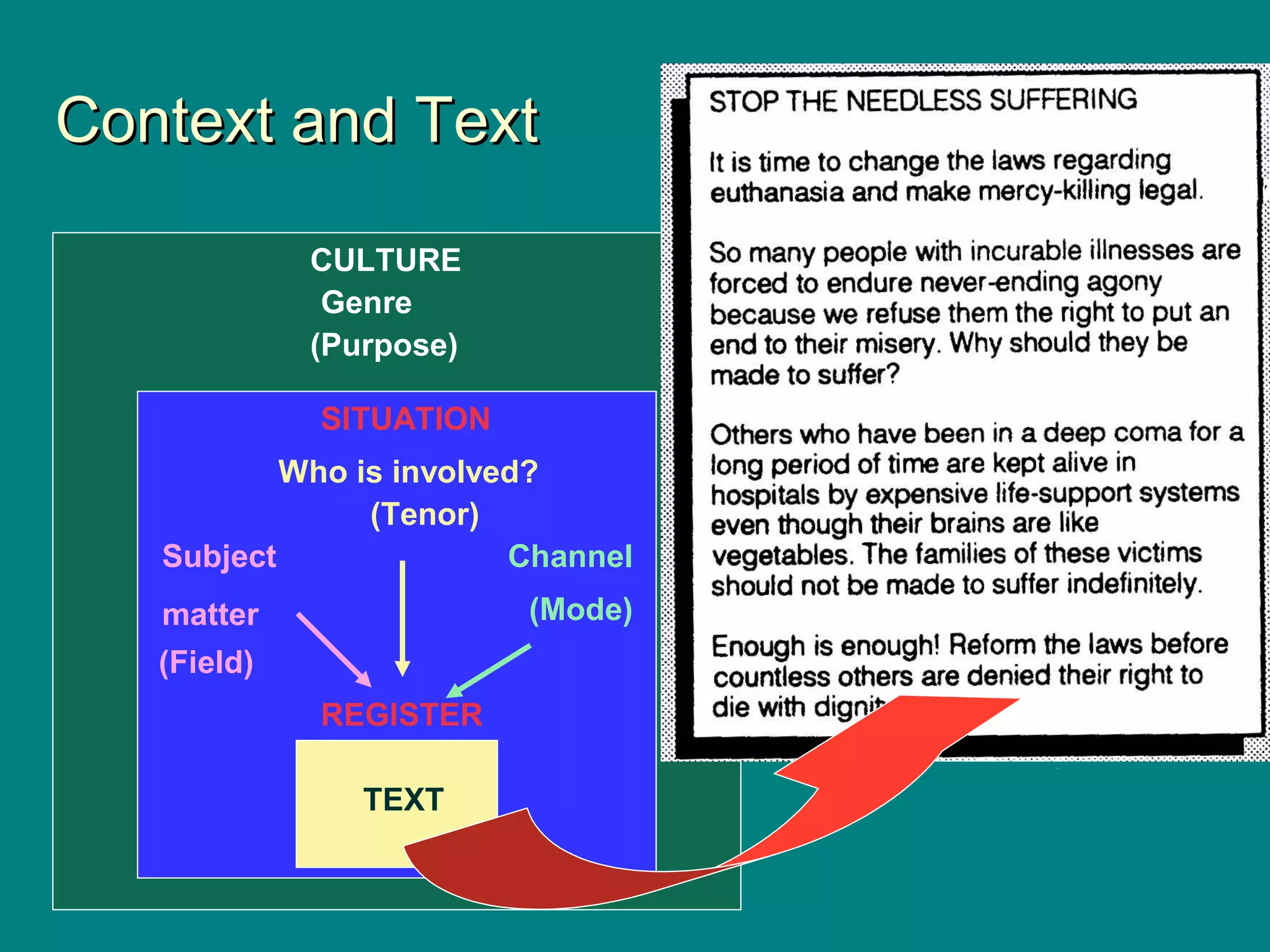
Context and TextContext and Text
CULTURE
Genre
(Purpose)
SITUATION
Who is involved?
(Tenor)
Channel
(Mode)
Subject
matter
(Field)
TEXT
REGISTER
 As a matter of fact, the text consists of
clauses.
 Each clause carries: ideational,
interpersonal and textual function of
language
How the writer “wrap” the function in those
clauses?
How the writer connect clauses to form the whole
paragraph?
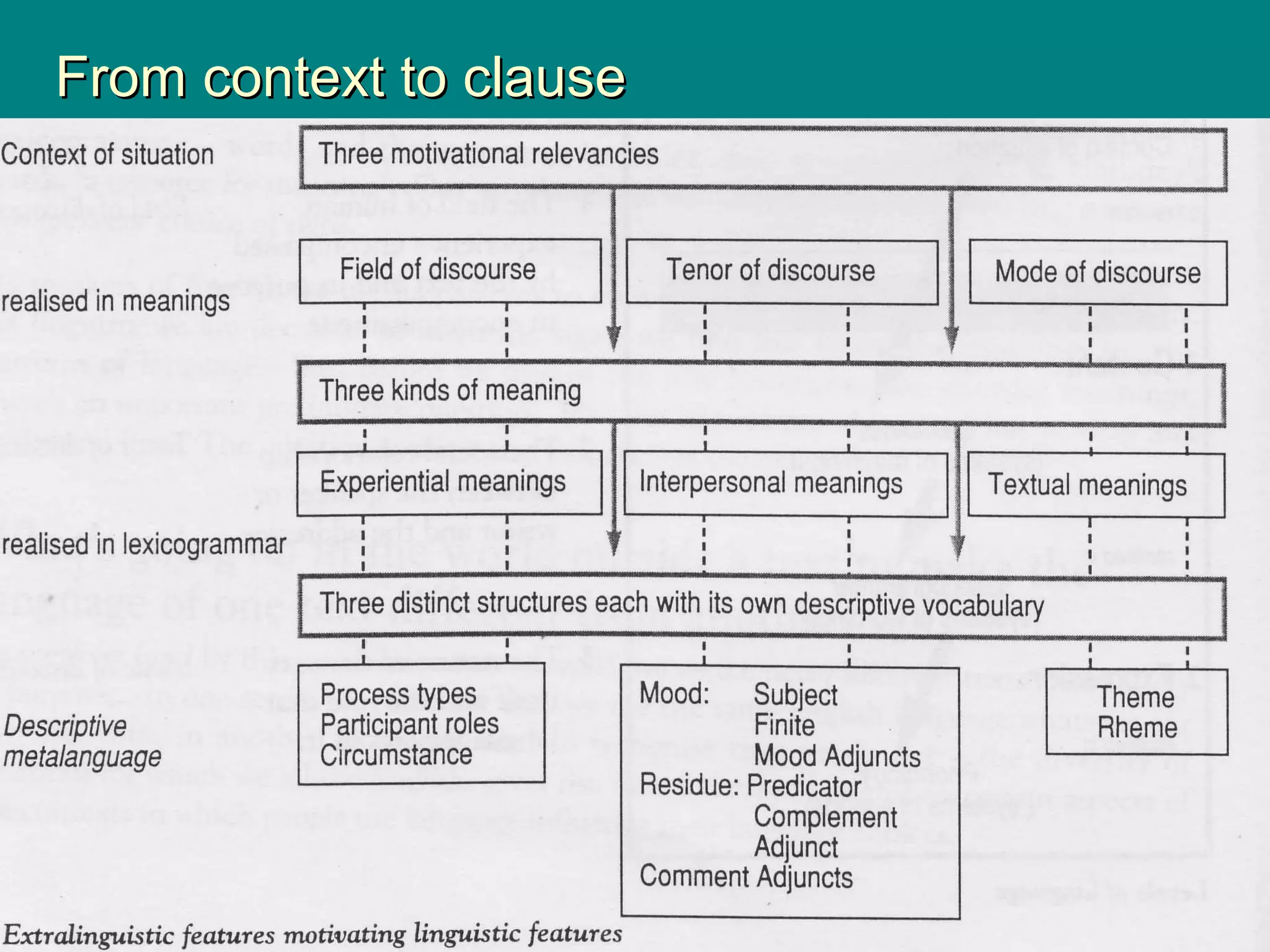
From context to clauseFrom context to clause
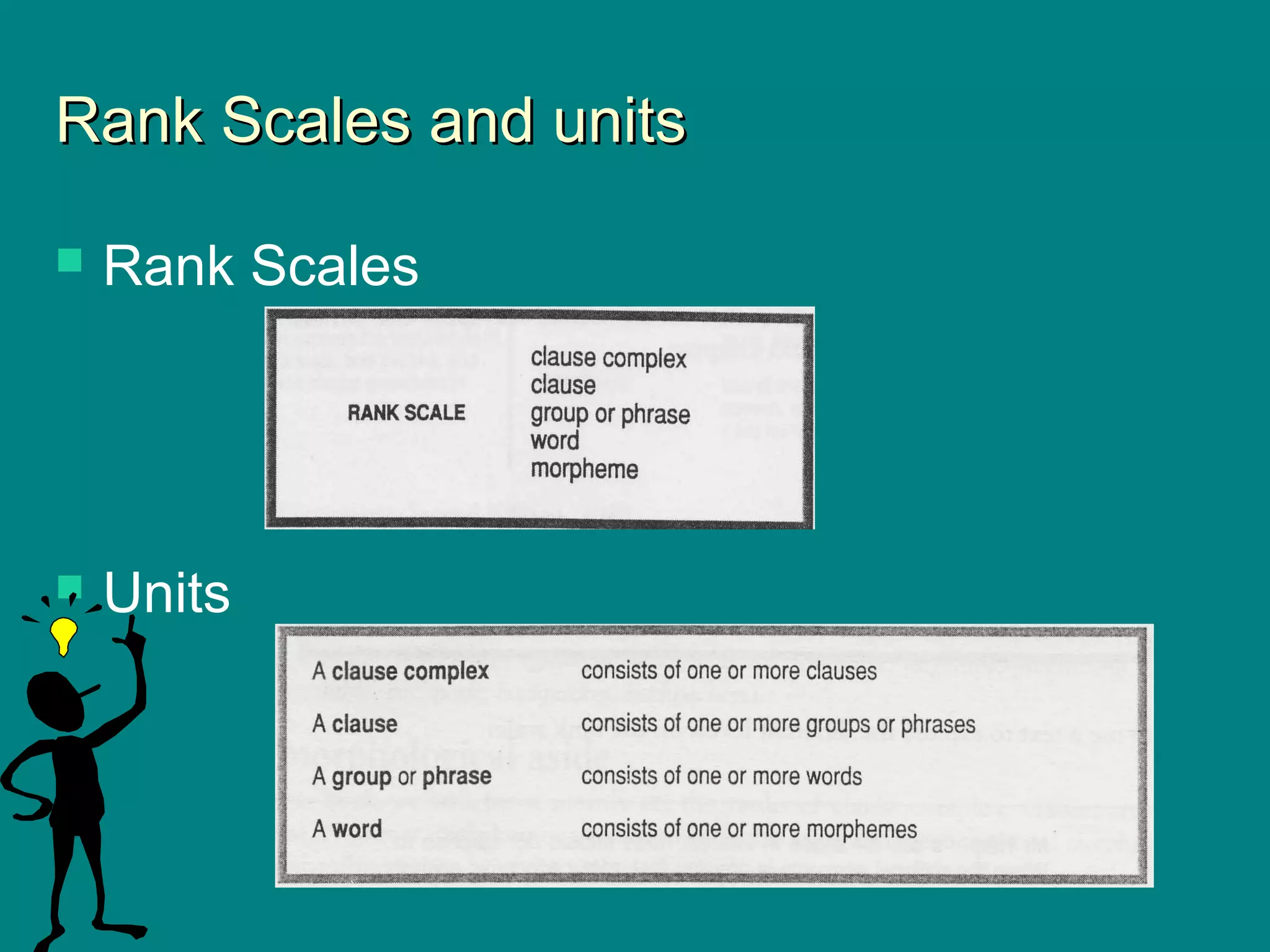
Rank Scales and unitsRank Scales and units
 Rank Scales
 Units
ExampleExample
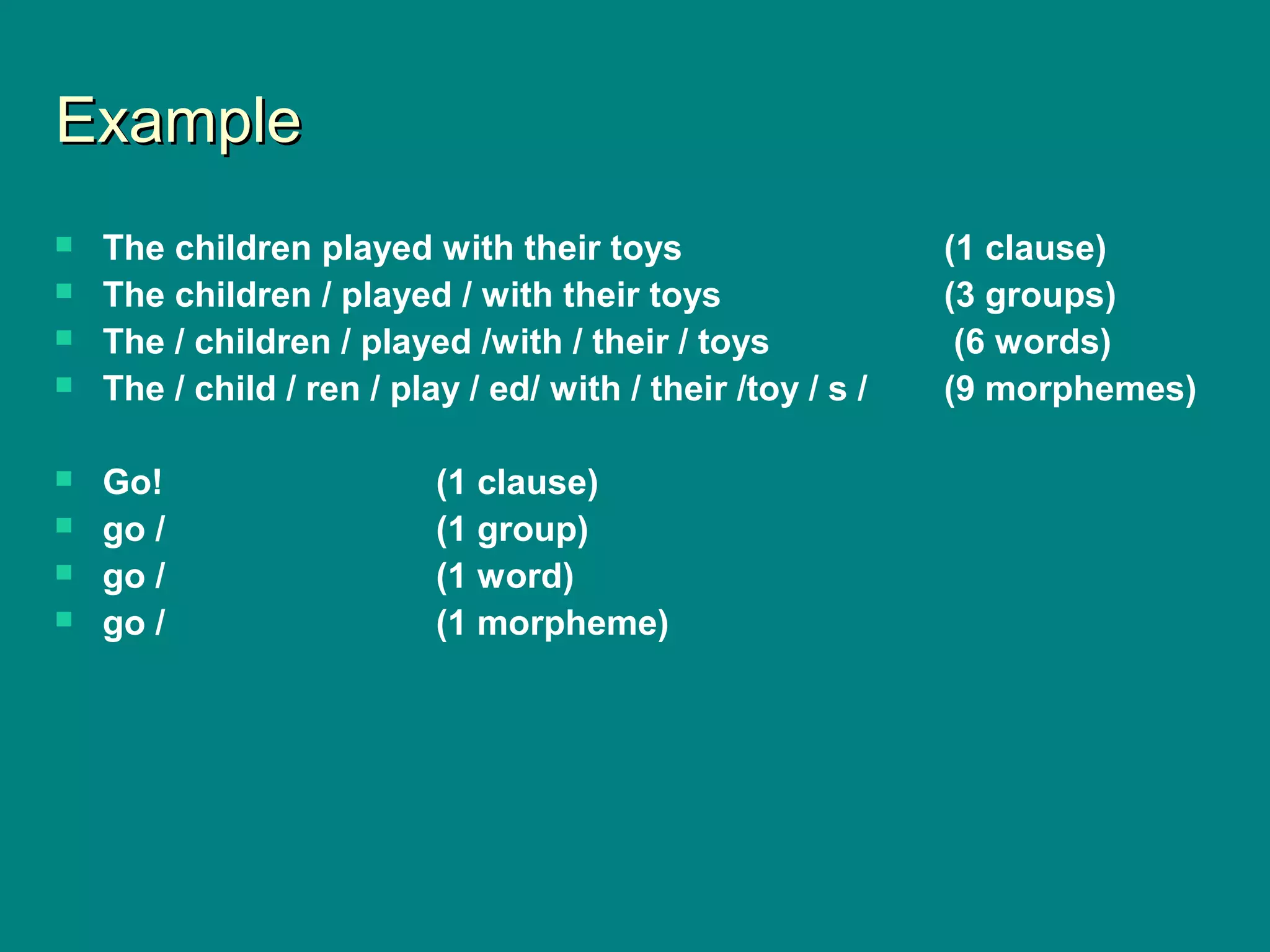
 The children played with their toys (1 clause)
 The children / played / with their toys (3 groups)
 The / children / played /with / their / toys (6 words)
 The / child / ren / play / ed/ with / their /toy / s / (9 morphemes)
 Go! (1 clause)
 go / (1 group)
 go / (1 word)
 go / (1 morpheme)
Clause LevelClause Level
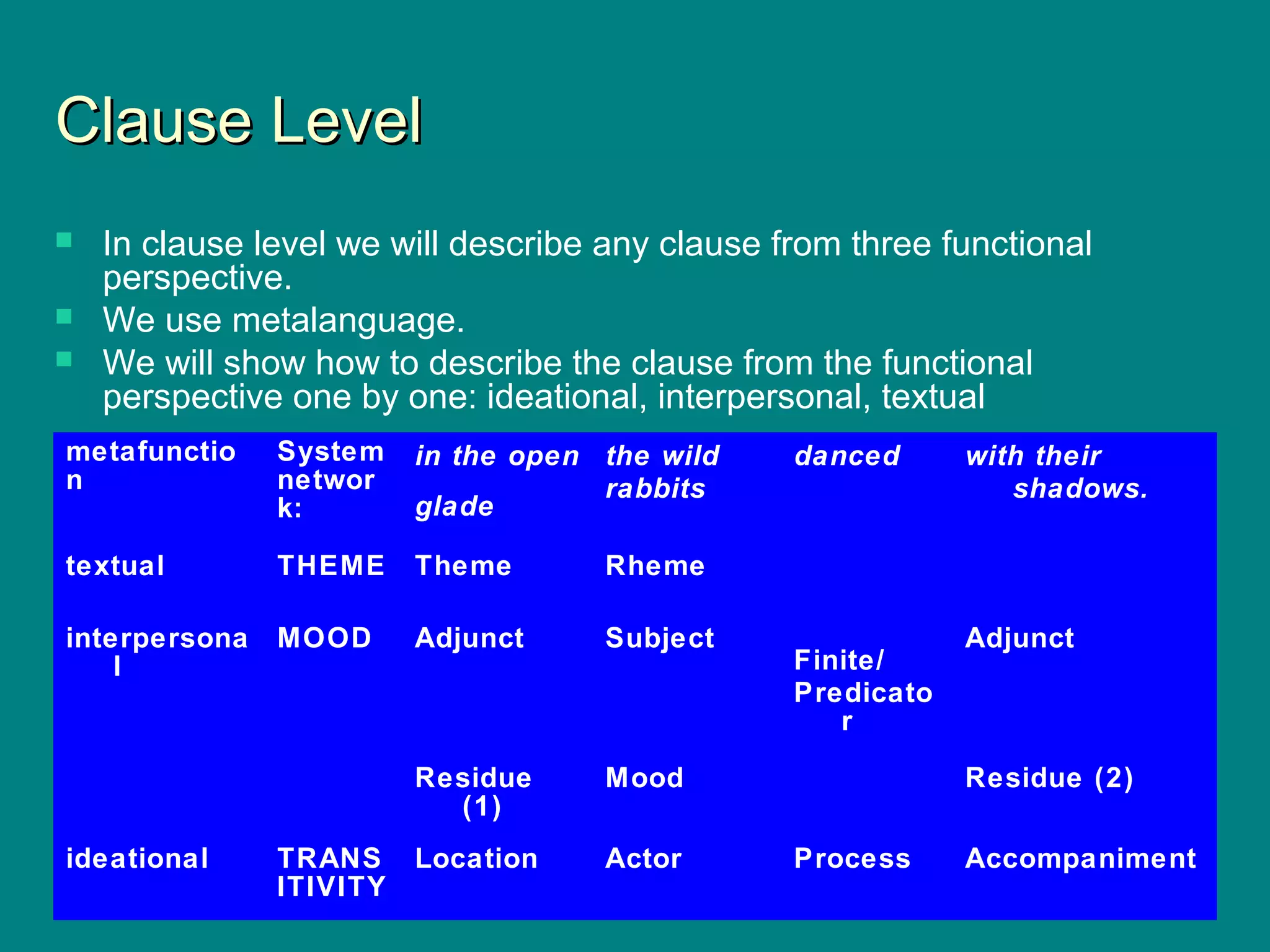
 In clause level we will describe any clause from three functional
perspective.
 We use metalanguage.
 We will show how to describe the clause from the functional
perspective one by one: ideational, interpersonal, textual
metafunctio
n
System
networ
k:
in the open
glade 
the wild
rabbits
danced with their
shadows.
textual THEME Theme Rheme
   
interpersona
l
 
MOOD
 
Adjunct Subject
Finite/  
Predicato
r
Adjunct
Residue
(1)
Mood Residue (2)
ideational TRANS
ITIVITY
Location Actor Process Accompaniment
Robinho plays football.
Three types of meaning in one clauseThree types of meaning in one clause
Situation
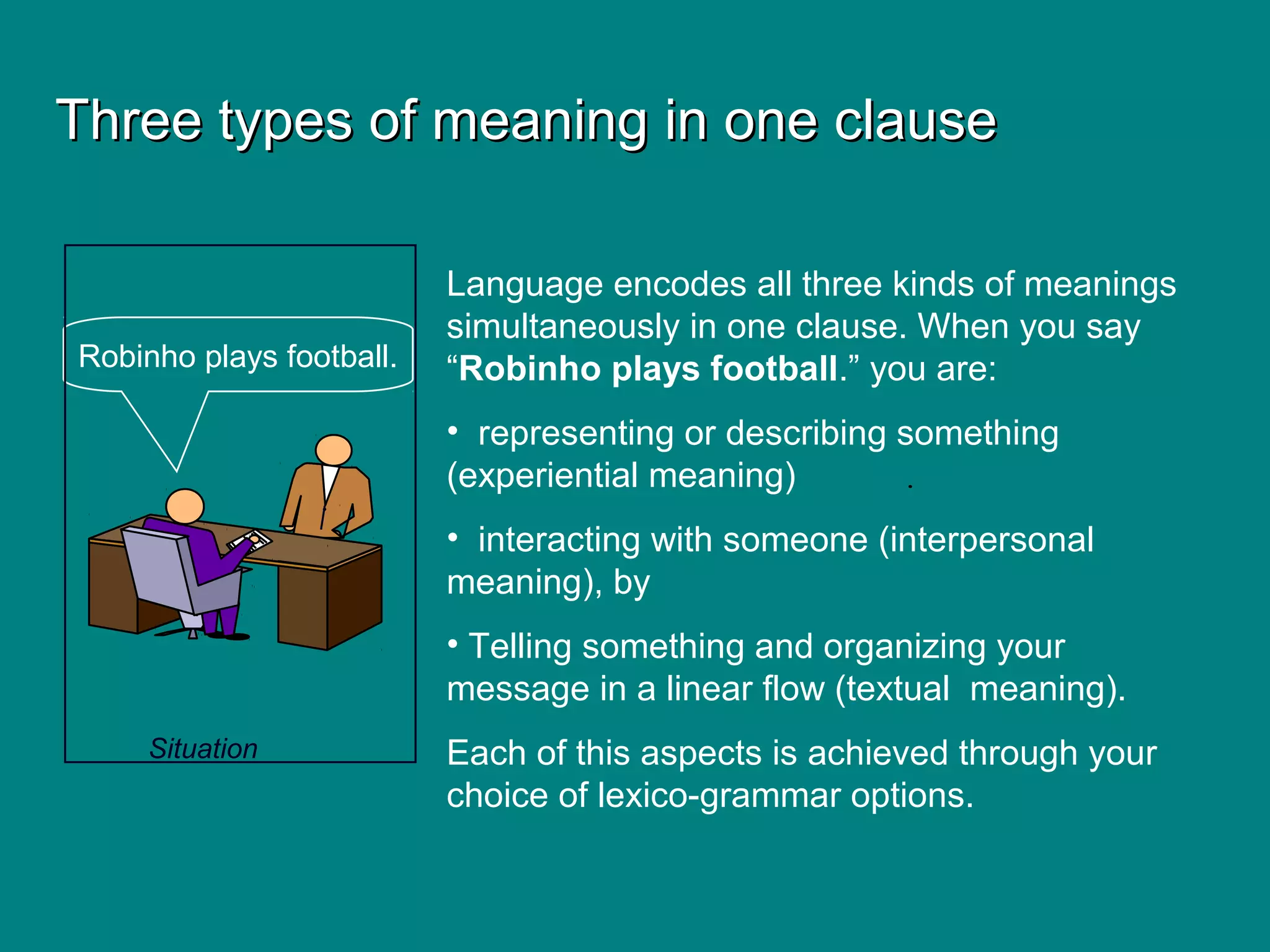
Language encodes all three kinds of meanings
simultaneously in one clause. When you say
“Robinho plays football.” you are:
• representing or describing something
(experiential meaning)
• interacting with someone (interpersonal
meaning), by
• Telling something and organizing your
message in a linear flow (textual meaning).
Each of this aspects is achieved through your
choice of lexico-grammar options.
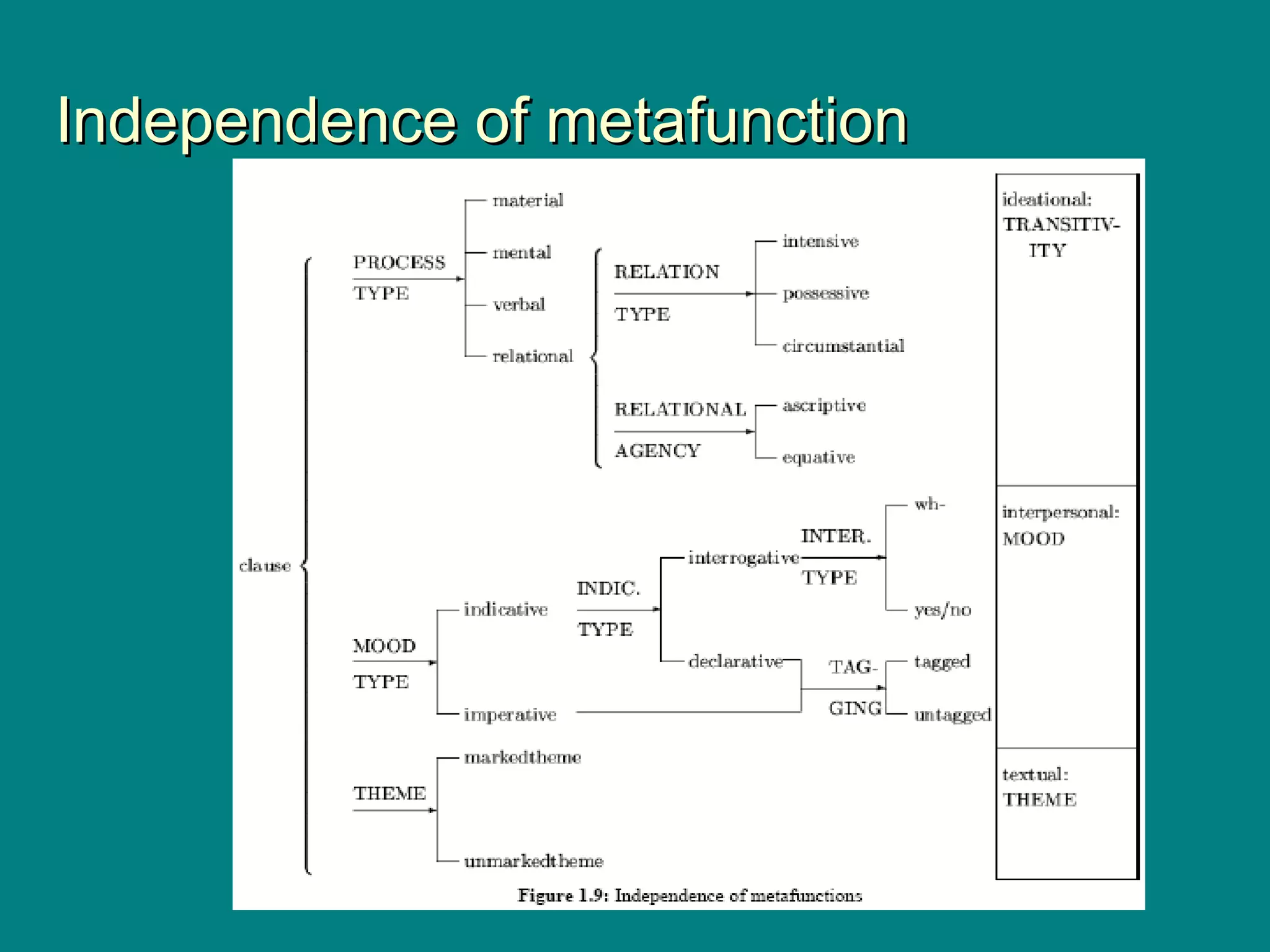
TRANSITIVITY, MOOD, THEMETRANSITIVITY, MOOD, THEME
 TRANSITIVITY: grammatical system that aims to
describe the option of representational/ideational
meaning
 MOOD: grammatical system that relates to
interpersonal meaning
 THEME: grammatical system that captures the
organization of message
If we put these part of grammar in the previous
system network, we have the following graphs.
Independence of metafunctionIndependence of metafunction
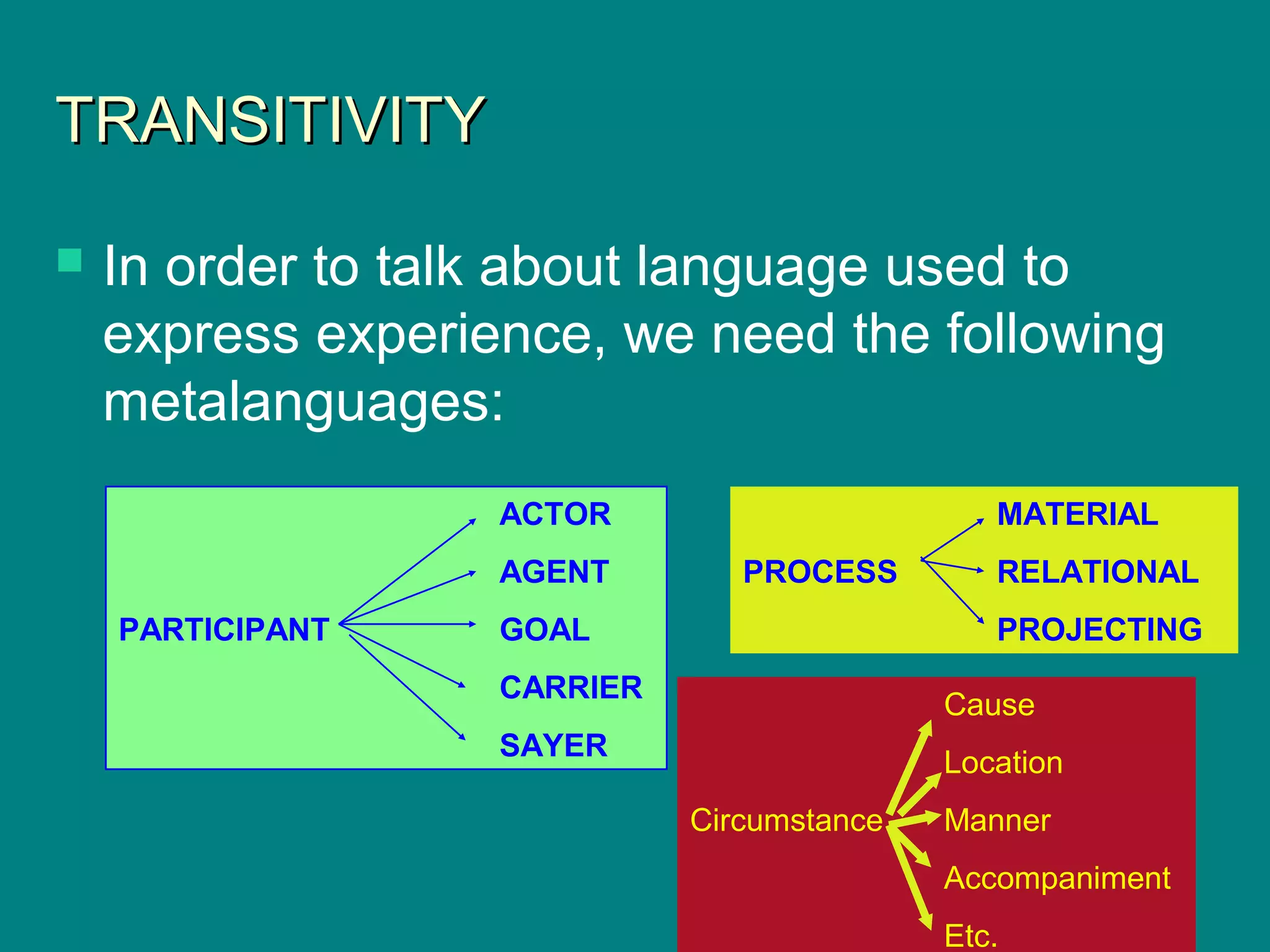
TRANSITIVITYTRANSITIVITY
 In order to talk about language used to
express experience, we need the following
metalanguages:
ACTOR
AGENT
PARTICIPANT GOAL
CARRIER
SAYER
MATERIAL
PROCESS RELATIONAL
PROJECTING
Cause
Location
Circumstance Manner
Accompaniment
Etc.
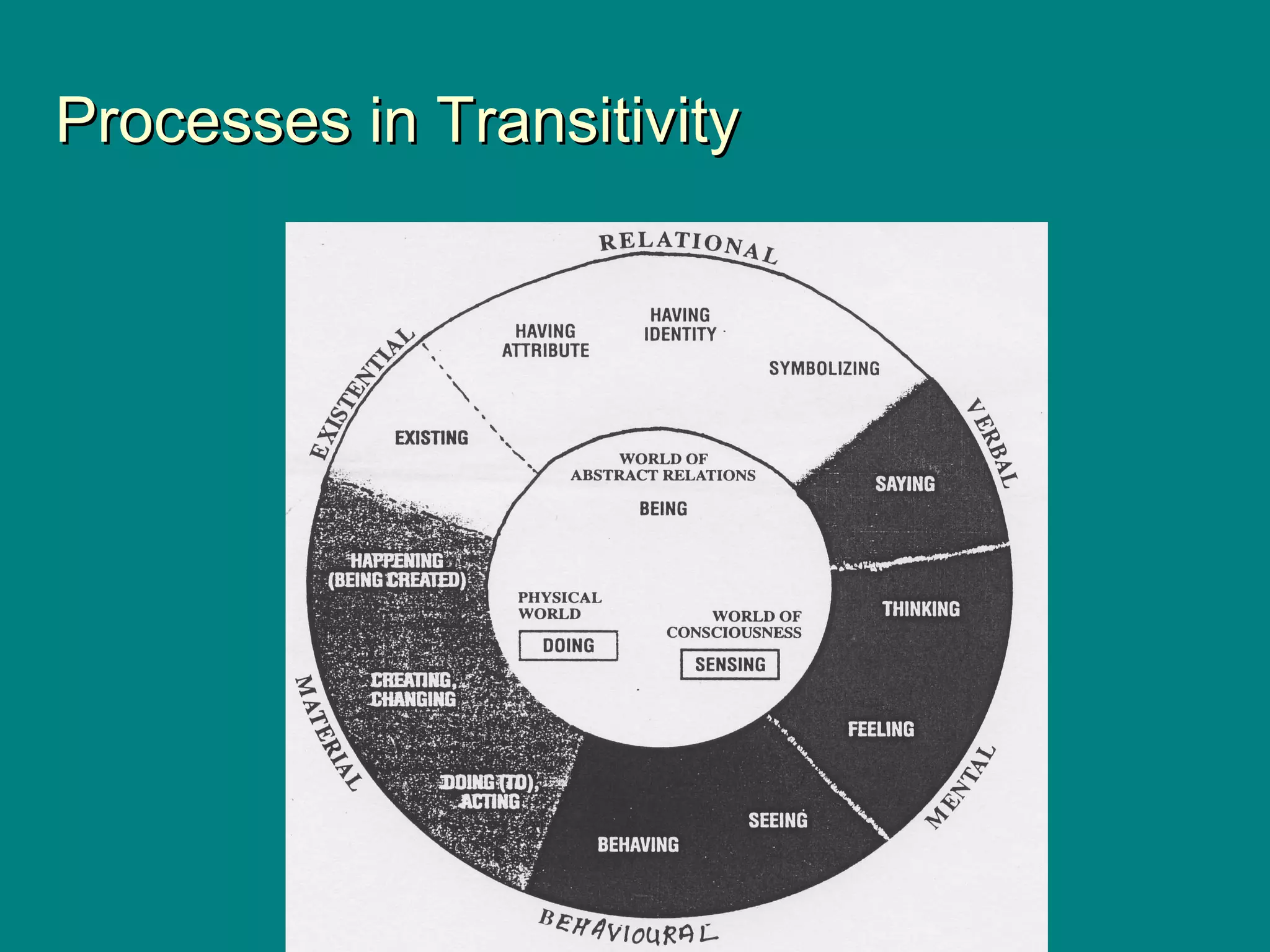
Processes in TransitivityProcesses in Transitivity
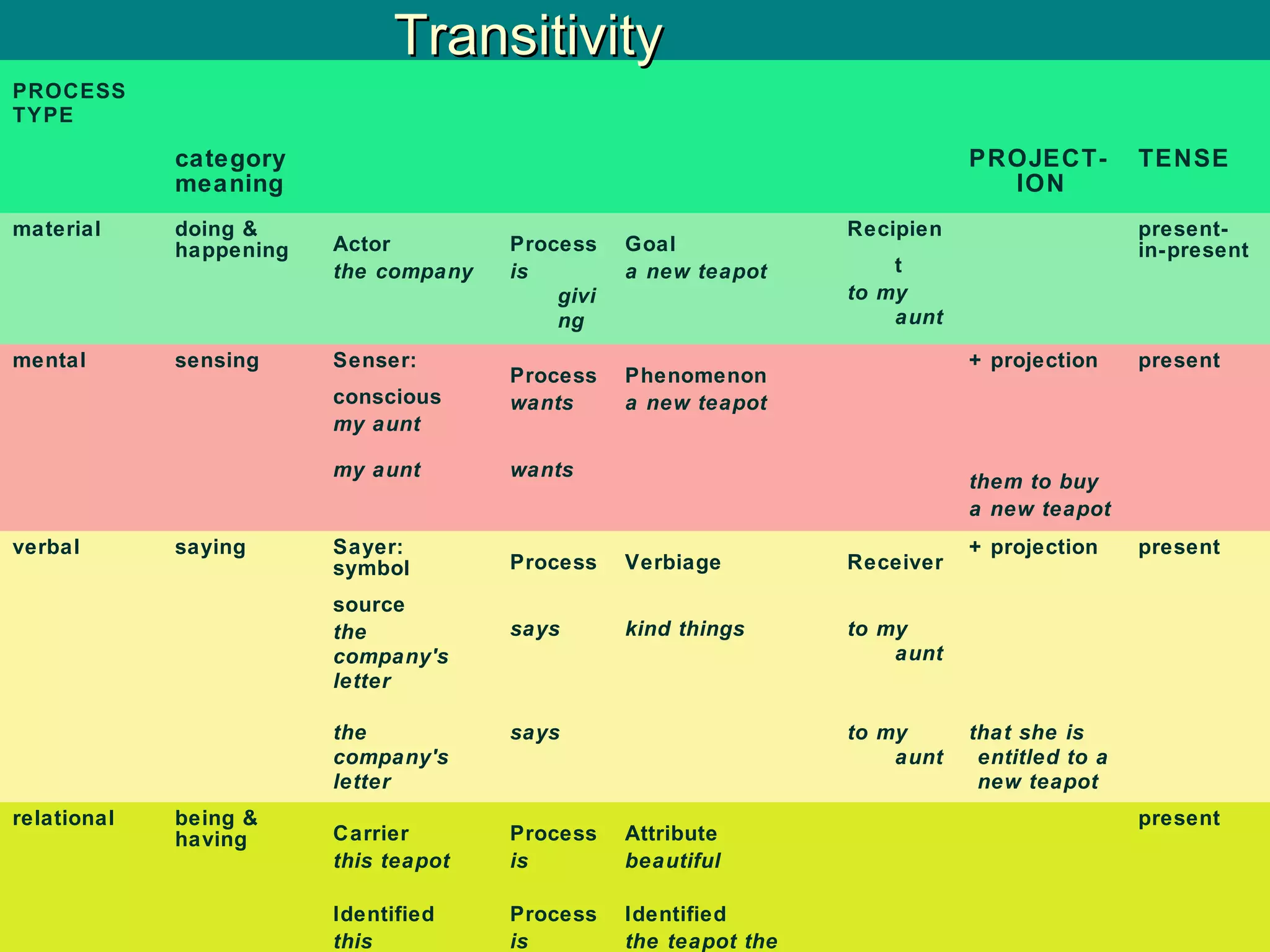
PROCESS
TYPE
category
meaning
PROJECT-
ION
TENSE
material doing &
happening Actor
the company
Process
is
givi
ng
Goal
a new teapot
Recipien
t
to my
aunt
present-
in-present
mental sensing Senser:
conscious
my aunt
Process
wants
Phenomenon
a new teapot
+ projection present
my aunt wants
them to buy
a new teapot
verbal saying Sayer:
symbol
source
the
company's
letter
Process
says
Verbiage
kind things
Receiver
to my
aunt
+ projection present
the
company's
letter
says to my
aunt
that she is
entitled to a
new teapot
relational being &
having Carrier
this teapot
Process
is
Attribute
beautiful
present
Identified
this
Process
is
Identified
the teapot the
TransitivityTransitivity
Phrase LevelPhrase Level
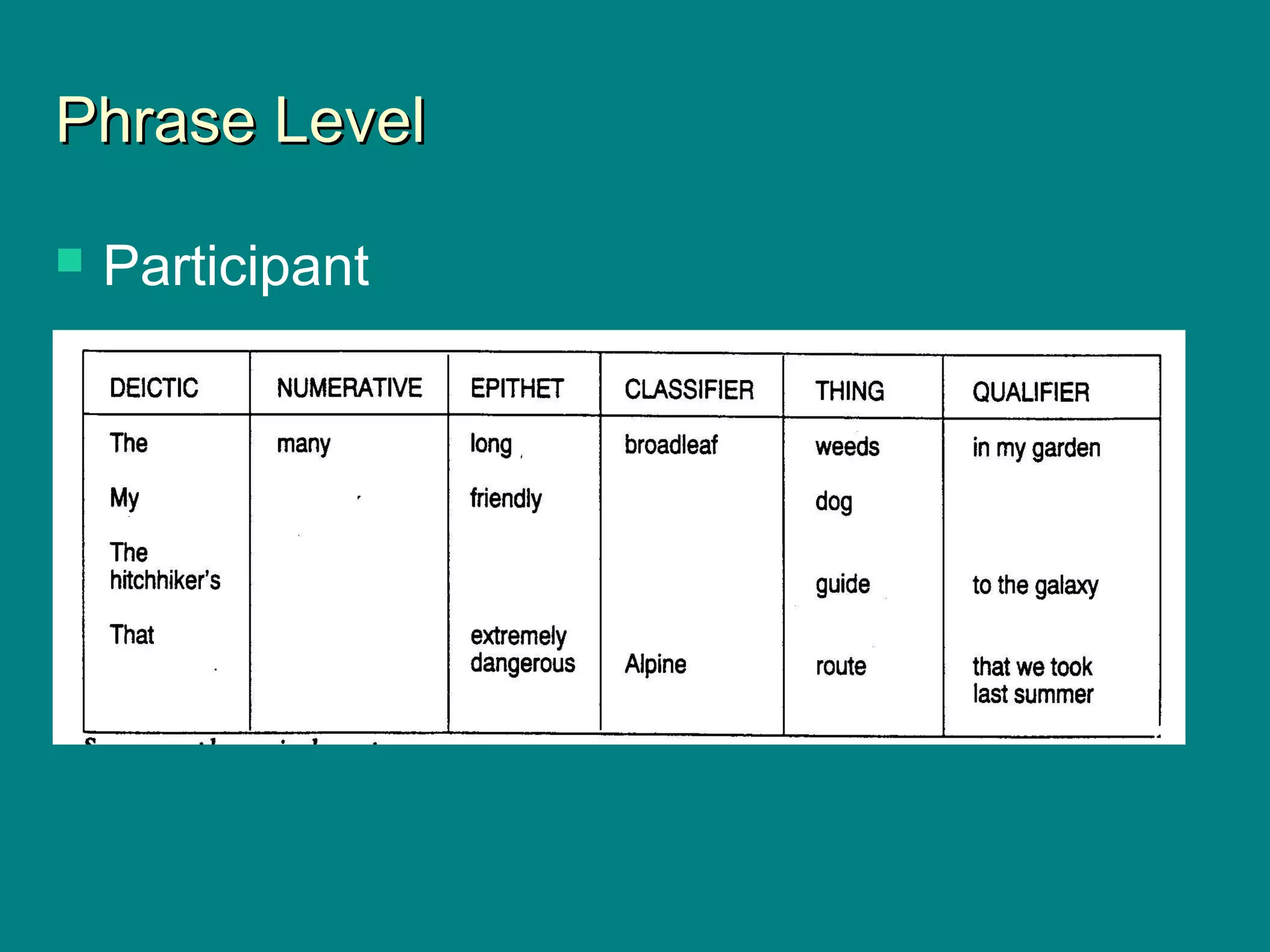
 Participant
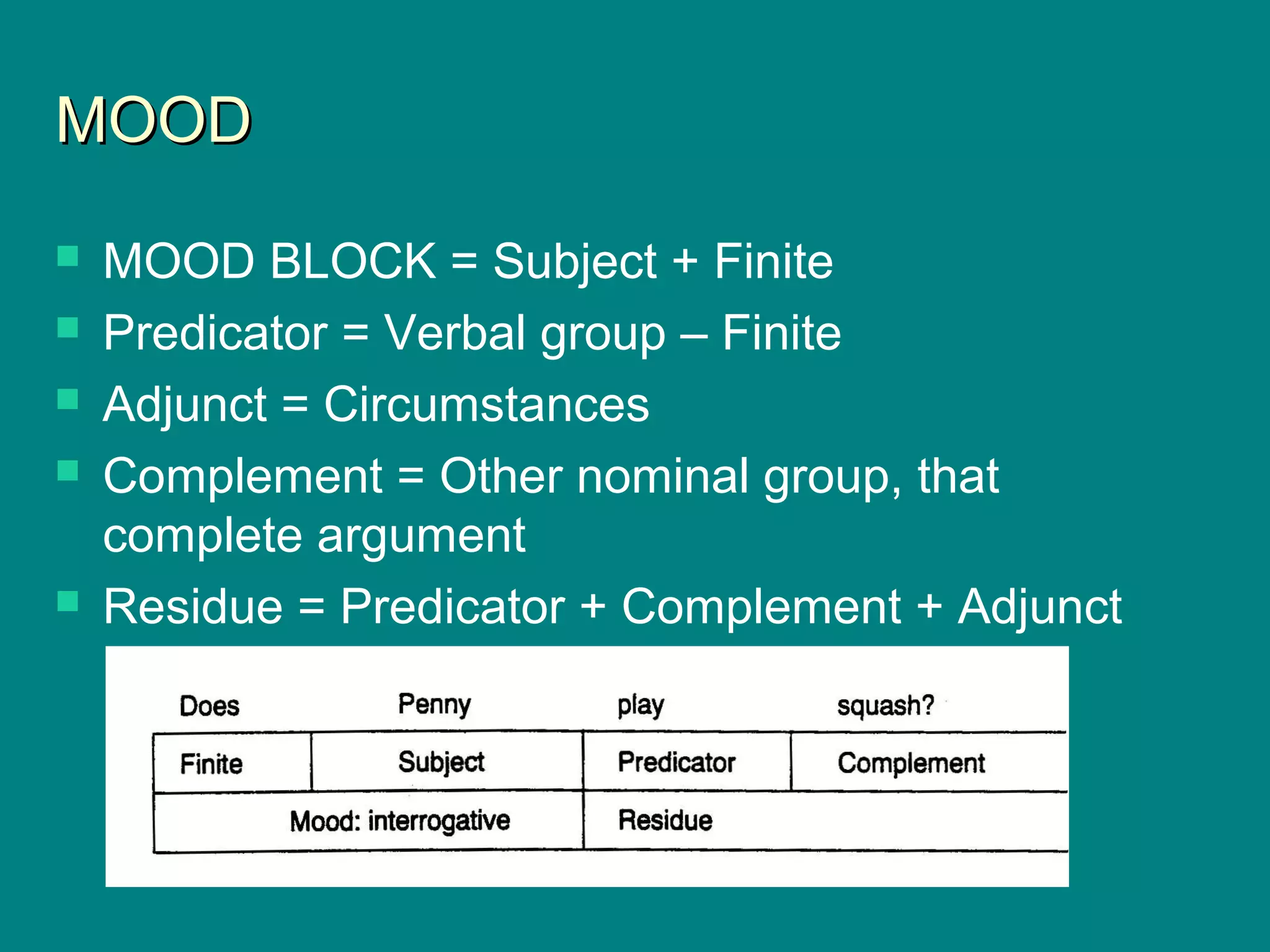
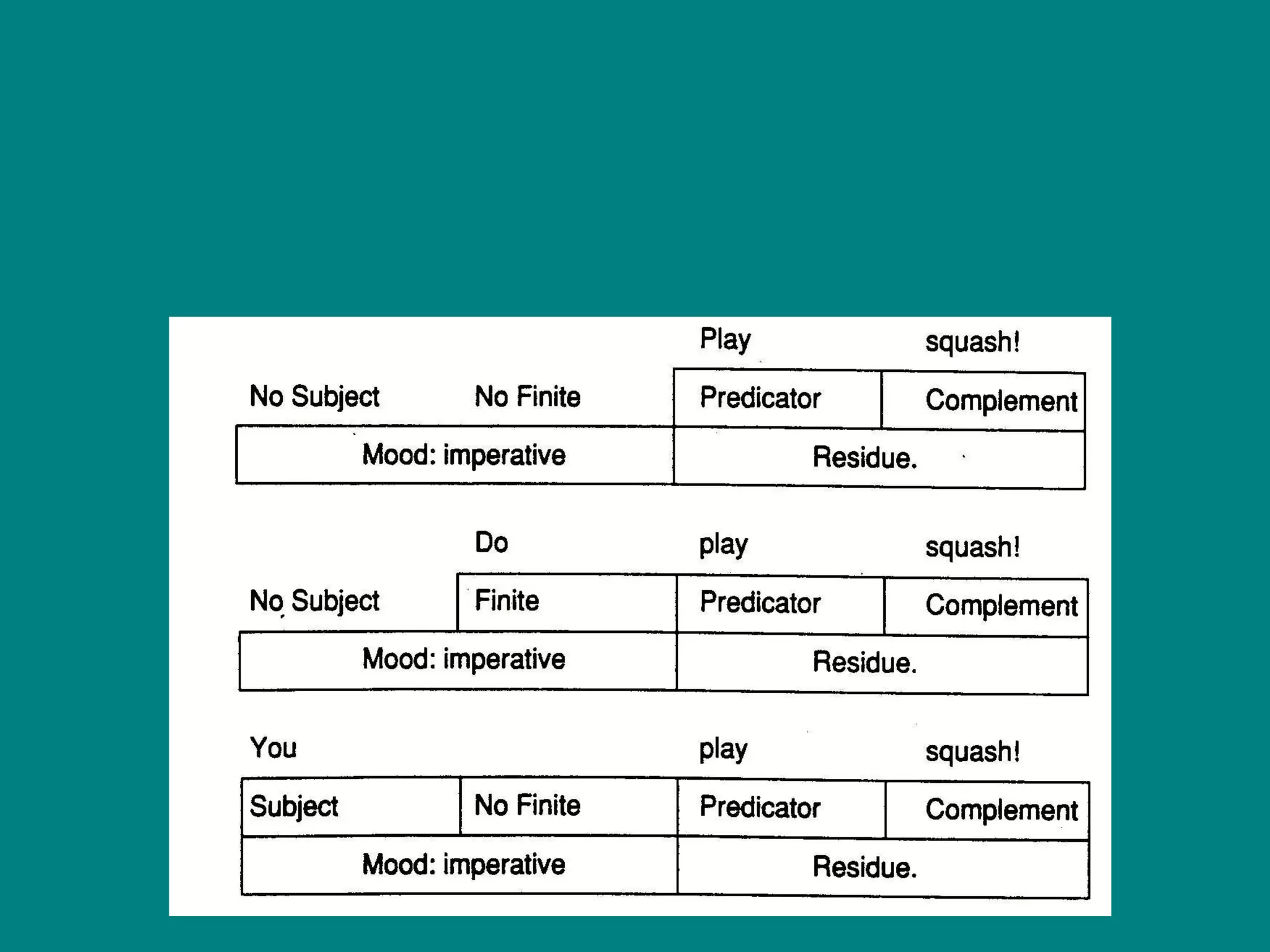
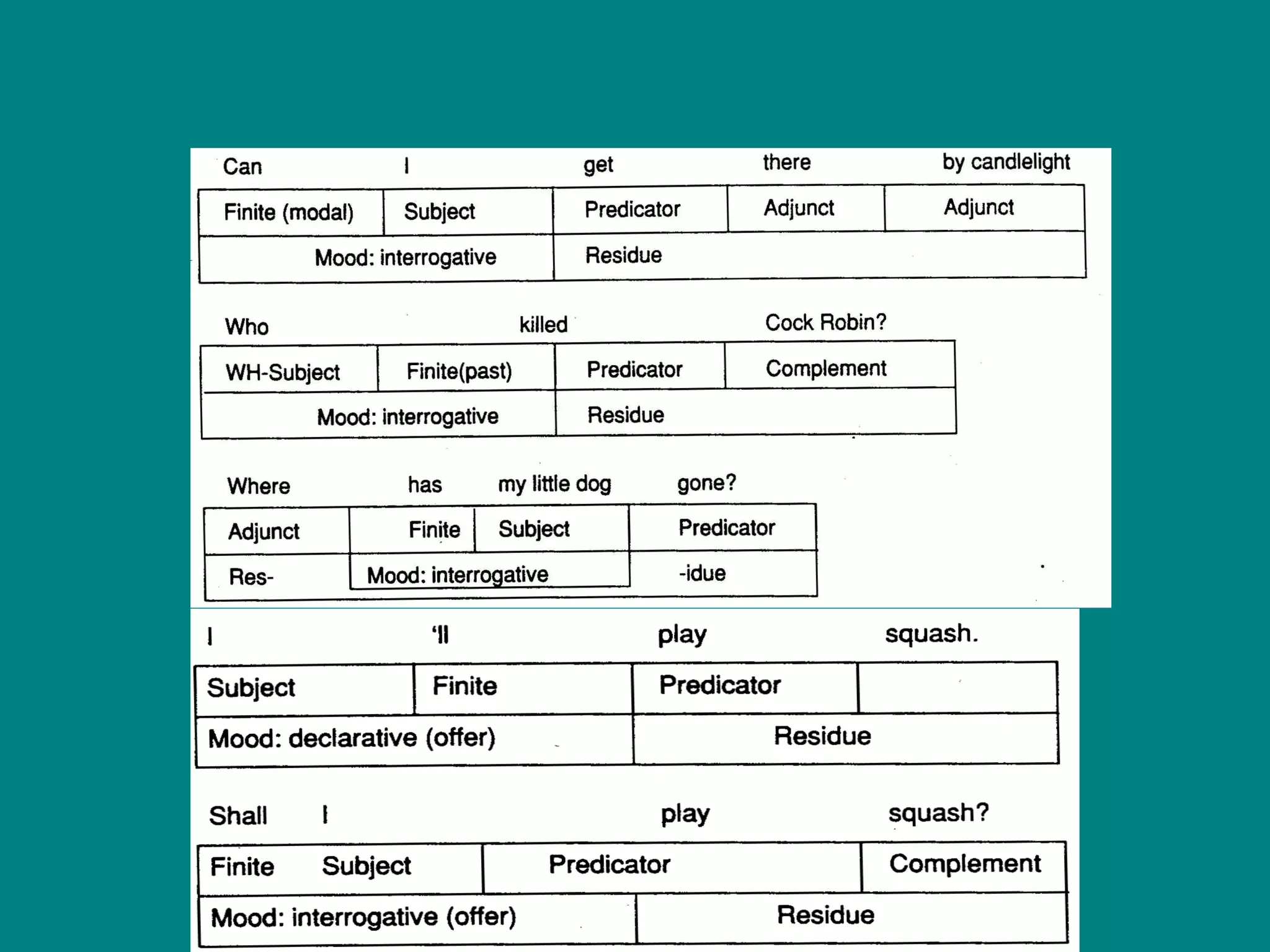
MOODMOOD
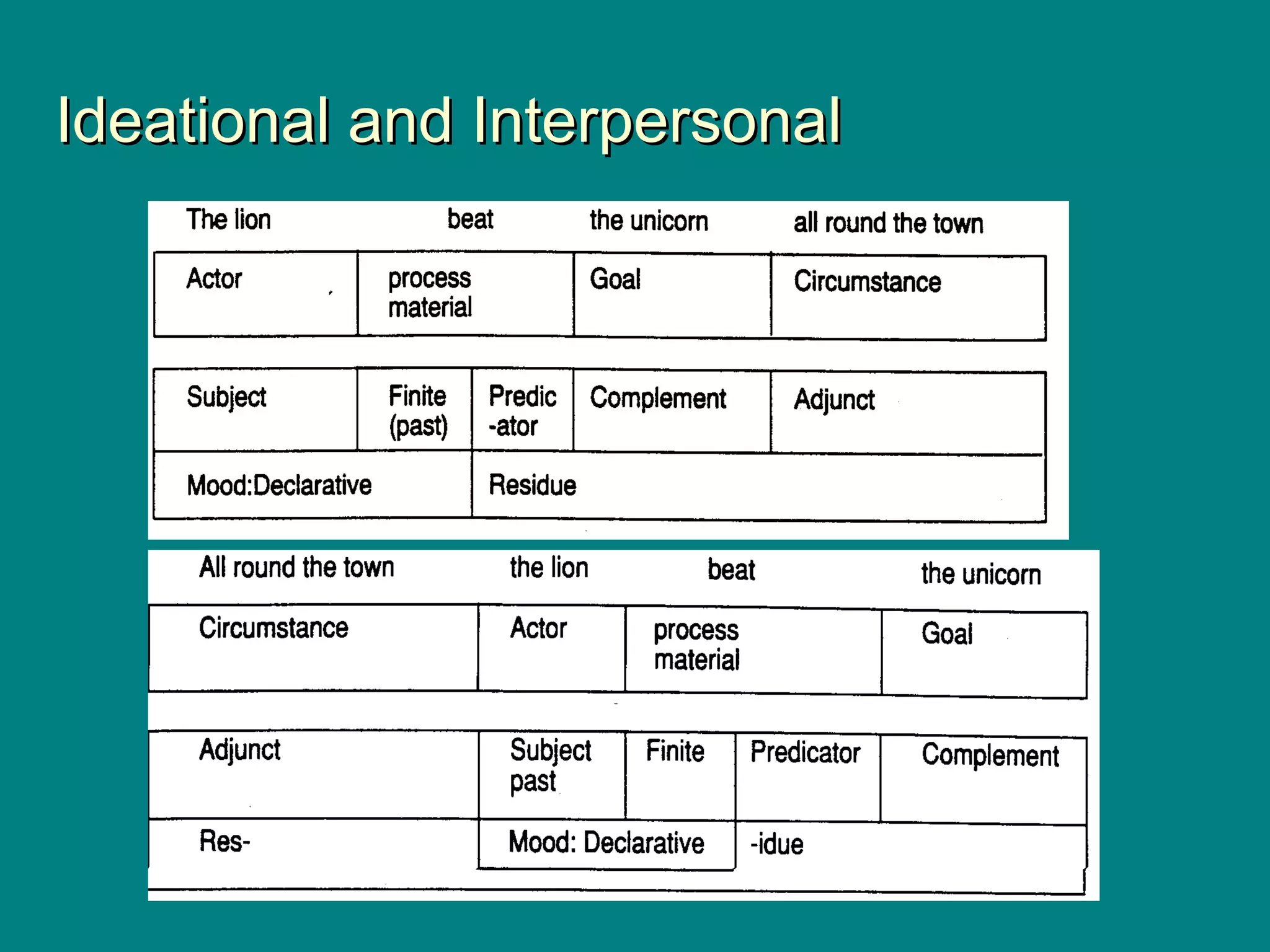
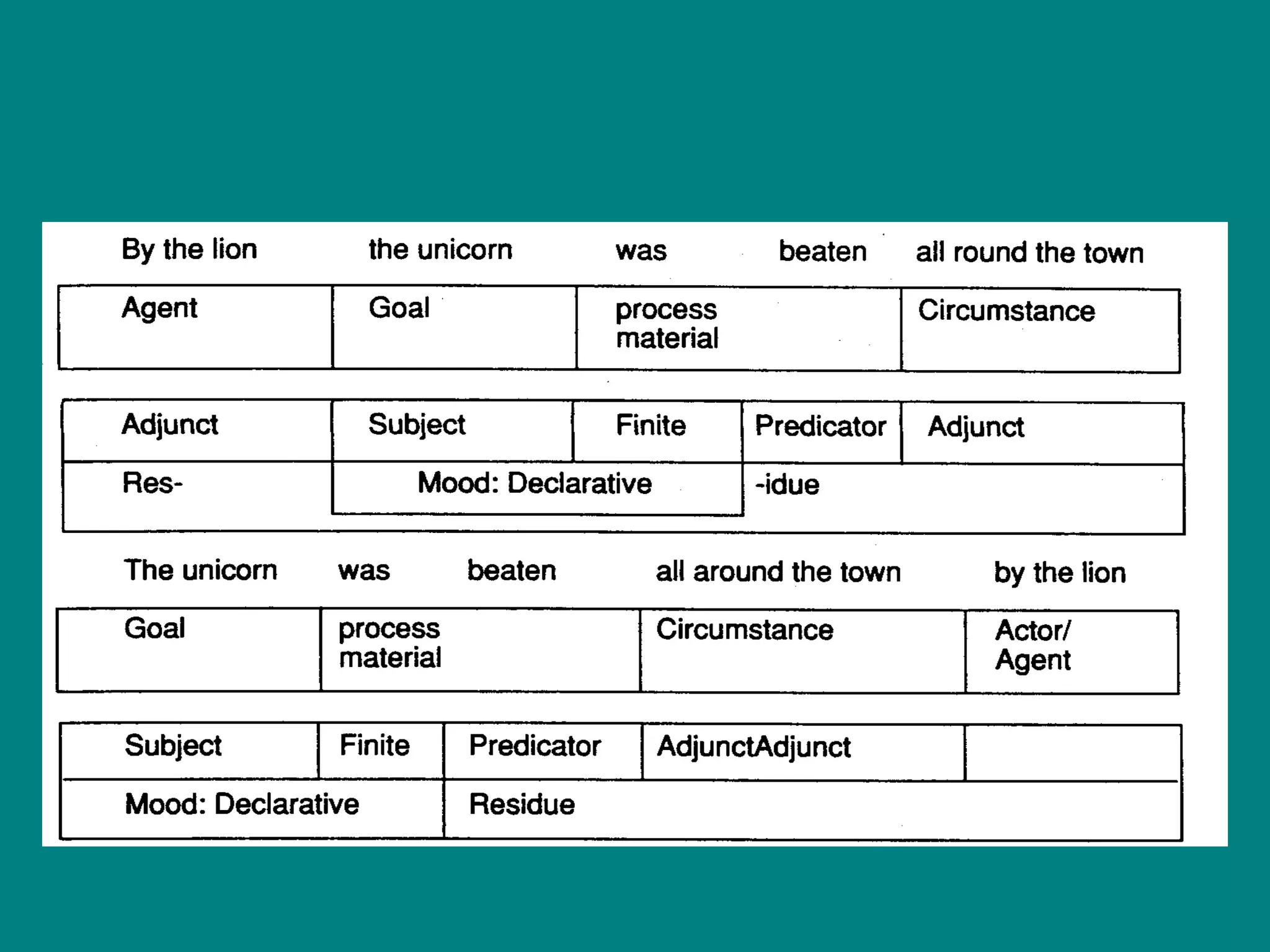
 MOOD BLOCK = Subject + Finite
 Predicator = Verbal group – Finite
 Adjunct = Circumstances
 Complement = Other nominal group, that
complete argument
 Residue = Predicator + Complement + Adjunct
Ideational and InterpersonalIdeational and Interpersonal
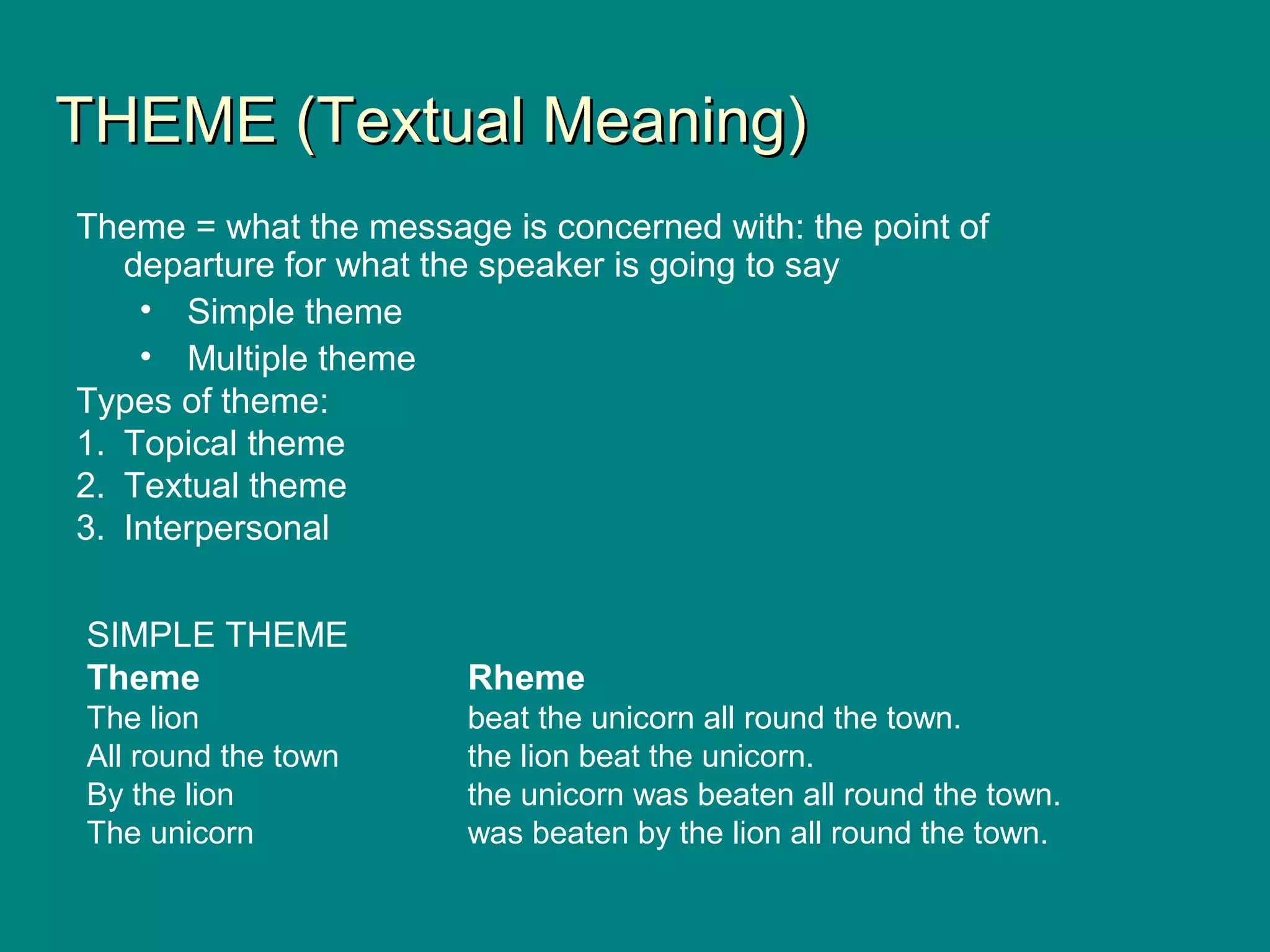
THEME (Textual Meaning)THEME (Textual Meaning)
SIMPLE THEME
Theme Rheme
The lion beat the unicorn all round the town.
All round the town the lion beat the unicorn.
By the lion the unicorn was beaten all round the town.
The unicorn was beaten by the lion all round the town.
Theme = what the message is concerned with: the point of
departure for what the speaker is going to say
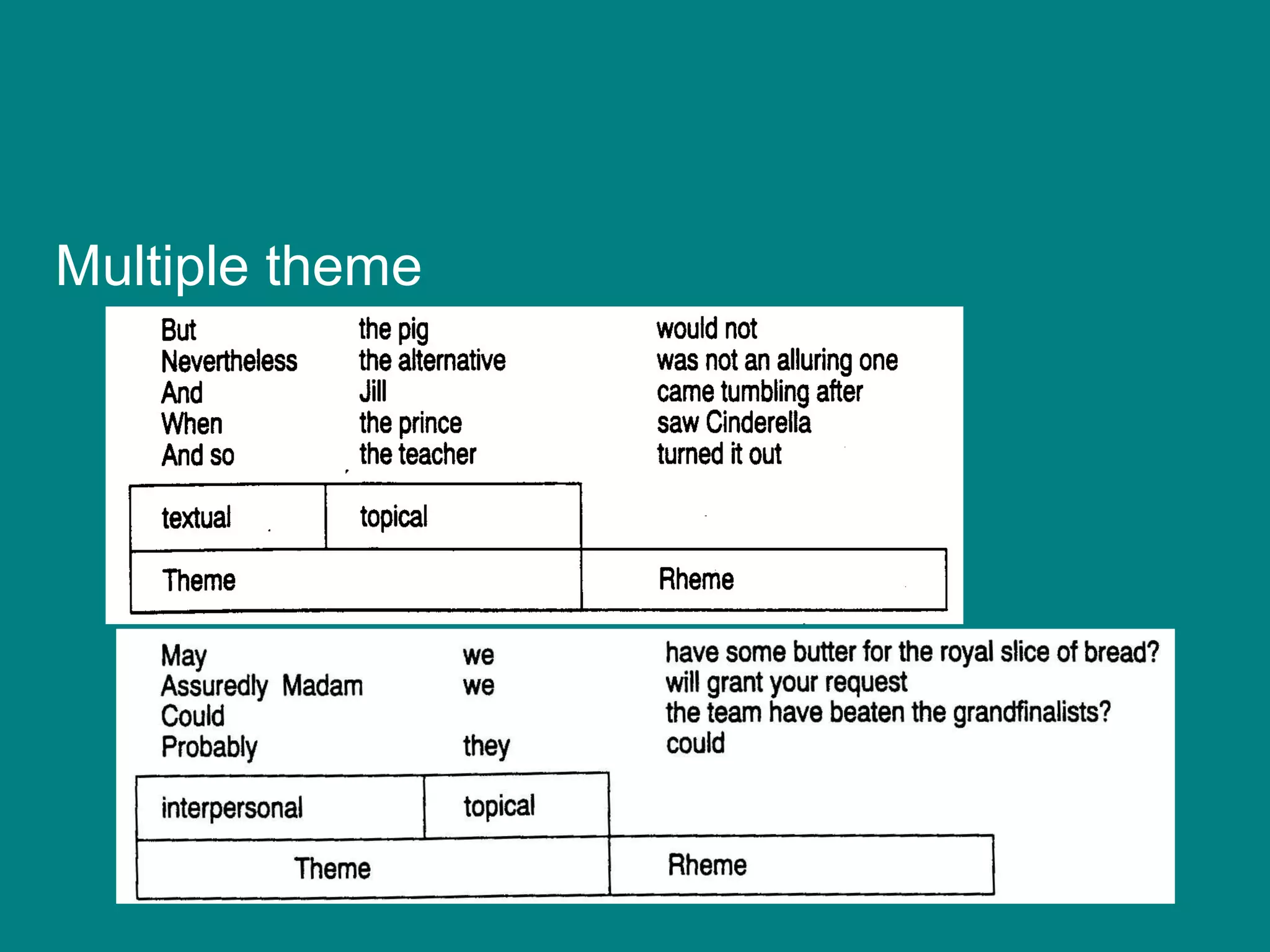
• Simple theme
• Multiple theme
Types of theme:
1. Topical theme
2. Textual theme
3. Interpersonal
Multiple theme
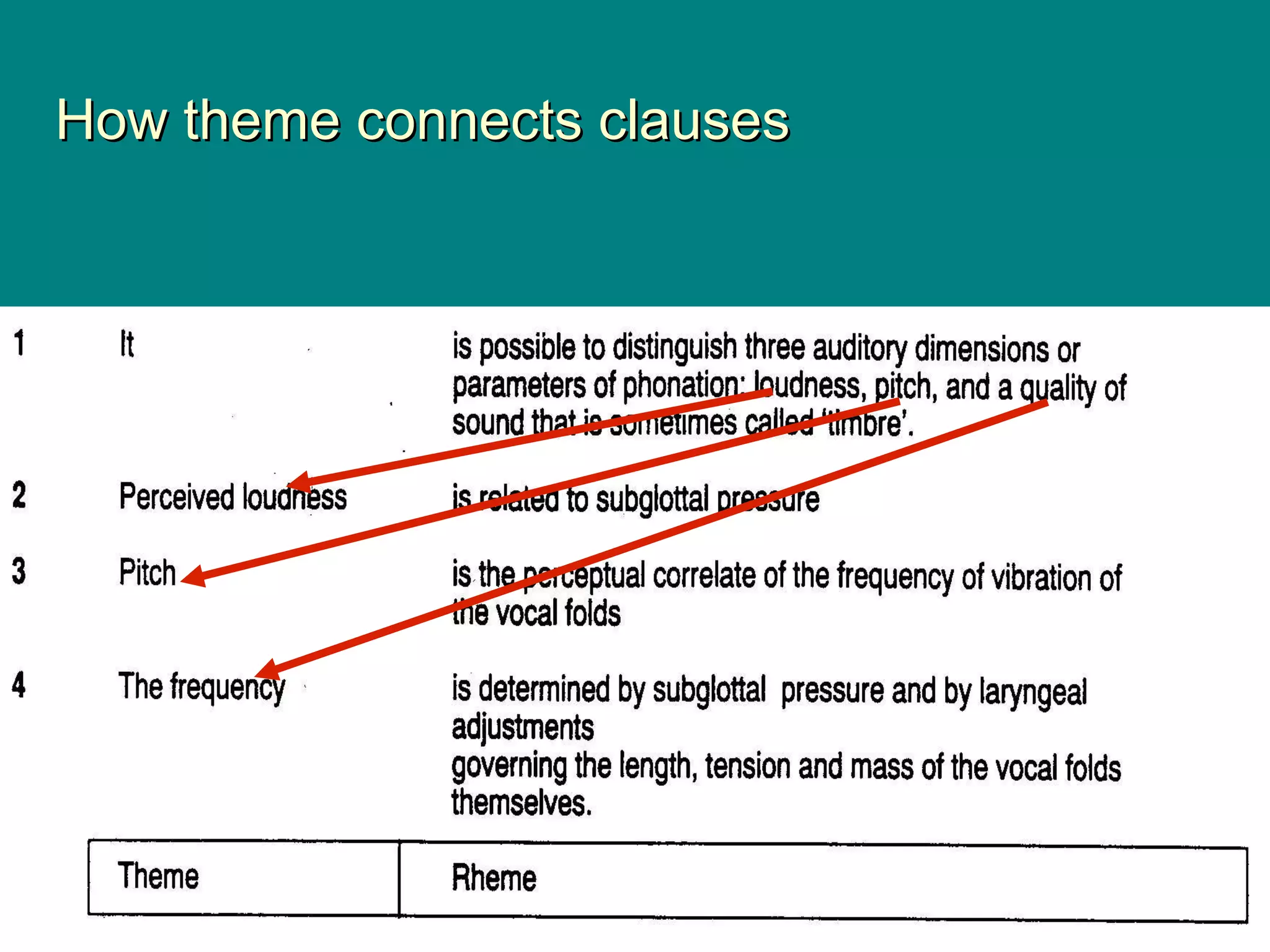
How theme connects clausesHow theme connects clauses
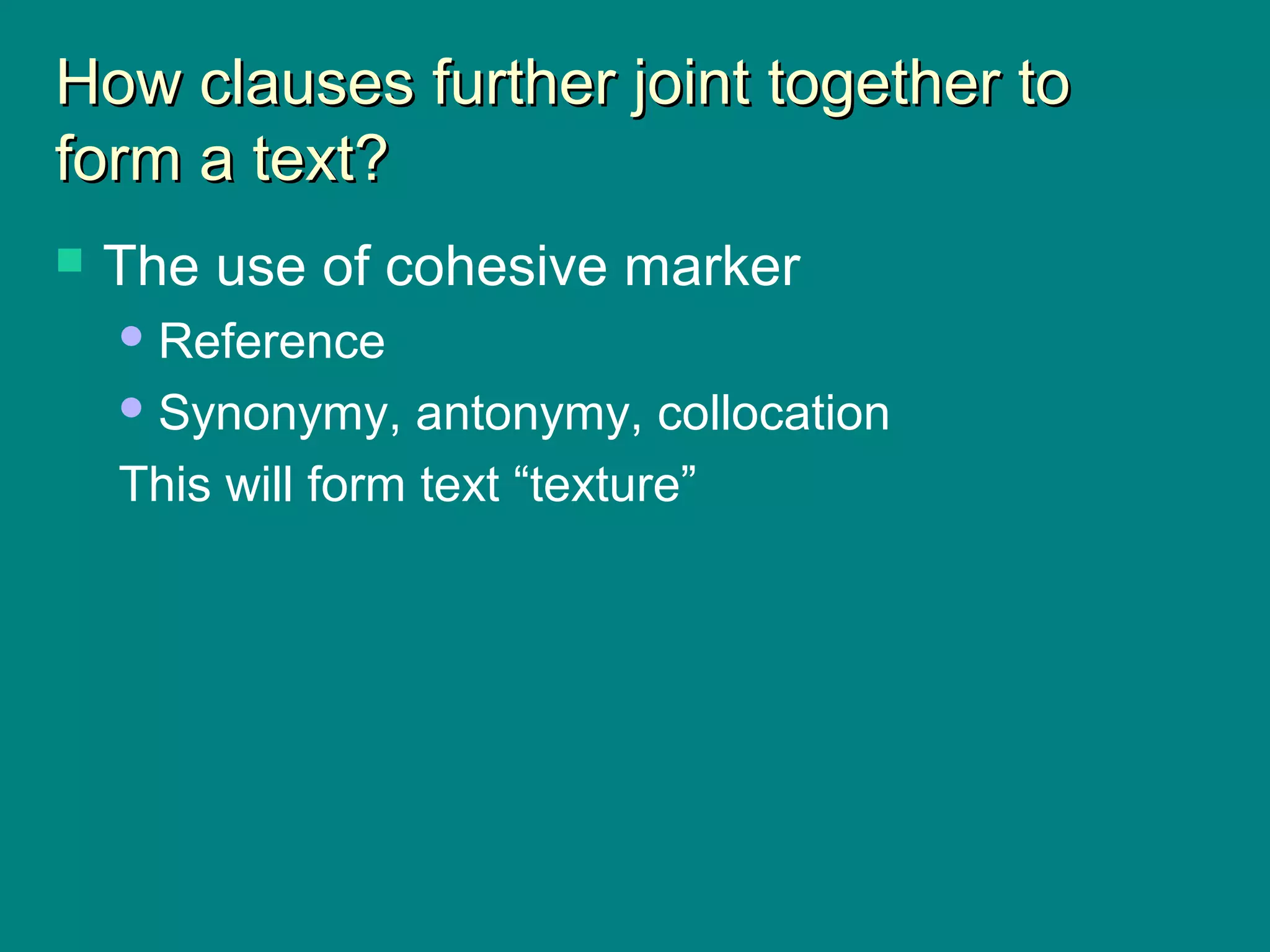
How clauses further joint together toHow clauses further joint together to
form a text?form a text?
 The use of cohesive marker
Reference
Synonymy, antonymy, collocation
This will form text “texture”
Application of SFLApplication of SFL
 Education, e.g. Indonesia
 Computer => Natural language Generation
 Translation => to improve translation
machine

Systemic Functional Grammar

  • 1.
    Introduction to SystemicIntroductionto Systemic Functional GrammarFunctional Grammar Sugeng Hariyanto (Dr.) State Polytechnic of Malang, Indonesia sg_hariyanto[at]ahoo.co.id
  • 2.
    Functional ViewFunctional View B.KMalinowski views meaning as function in context. (see Figure 1.1.) Firth continued Malinowski’s emphasis on a social and functional approach to language. He began to use the word “system”. ``The first principle of analysis is to distinguish between STRUCTURE and SYSTEM. Structure consists of elements in interior syntagmatic relation and these elements have their places in an order of mutual expectancy. ... Systems of commutable terms or units are set up to state the paradigmatic values of the elements.'' [Firth 1957]
  • 3.
     Firth emphasizesthe equal importance of “anatomy and “physiology” of language. “anatomy” “physiology” chain syntagmatic structural formal logical choice paradigmatic systematic functional rhetorical
  • 4.
     Firth disagreedwith American structuralists (led by Bloomfield) as they were only concerned with language “anatomy”.  Halliday (Firth’s student) also disagreed with American formalists (led by Chomsky) for the same reason.  Halliday is closer to European functionalists, e.g. Prague School (theme/rheme)  Halliday developed a systematic and comprehensive theory of language with a new terminology, known as Systemic Functional Grammar.
  • 5.
    Why called systemicfunctionalWhy called systemic functional  Systemic Functional Grammar  Systemic => development of detailed system networks  Functional =>development of the theory of metafunctions of language  CRITICISM: SFG does not accept morphology as a separate level of language. It can be handled by systems and realization in the same ways as clause structure.
  • 6.
    System NetworksSystem Networks A systems consists of an entry condition and a set of output features.  An output of one system may become the entry condition for another system. Then, systems are linked together to build a system network.
  • 7.
     More thanone system share the same entry conditions. Then, the systems are entered in parallel form.
  • 8.
     Systems representparadigmatic choice between grammatical alternatives and between lexical alternatives.  Lexicon is considered as a thesaurus.  Halliday has no clear definition between grammar and lexicon; he calls it lexicogrammar to include both.  The explicit desciption of paradigmatic choices distinguishes SFG drom other approaches to grammar.  Halliday describes the choices as “meaning potential” of that language.  The system shows meanings, which are realized in the structure of the language as wording.  Realization rule shows how the paradigmatic choices are expressed as syntagmatic chains in the structure of the language.  The process of realization is like a mapping from “physiology” to “anatomy”, from “choices” to “chain”, from “function” to “form”.
  • 9.
    The process ofrealization is like a mapping from “physiology” toThe process of realization is like a mapping from “physiology” to “anatomy”, from “choices” to “chain”, from “function” to “form”.“anatomy”, from “choices” to “chain”, from “function” to “form”.  The output feature “indicative” has two associated realization rules: “+Subject” and “+Finite”. The output of Declarative has one associated realization rule” “Subject ^Finite”.  +Subject” requires the presence of a subject when a clause is indicative, and “+Finite” requires the presence of a finite verb.  The “Subject ^ Finite” requires the subject to precede the finite verb when the clause is declarative.
  • 10.
    Systemic GrammarSystemic Grammar Grammar is represented as a graph called a system network. This comprises  and systems (curly braces)  conjunctive features in boldface  or systems (straight vertical lines)  disjunctive features in normal face  realisation statements (in italic).  specify how disjunctive features are realised     MOOD TYPE:      indicative imperative POLARITY : positive The spy came in from the cold. Come in from the cold!   negative The spy didn't come in from the cold. Don't come in from the  cold!
  • 11.
    Realisation statement  +X:insert the function X e.g. +subject  X=Y: conflate the functions X and Y e.g. goal = subject  X>Y: order X somewhere before Y e.g. subject > predicator  X/Y: function X has grammatical feature Y e.g. subject/noun phrase  X!L: assign function X to lexical item L e.g. passive!be
  • 12.
    FUNCTIONAL MODEL OFLANGUAGEFUNCTIONAL MODEL OF LANGUAGE  Language is a resource. Man can narrow the meanings which speaker/writer means from the entire context of culture to specific context of situation by means of extra linguistics factors: FIELD, TENOR, MODE
  • 13.
    Three language functionsThreelanguage functions  In any context, people use language to do three main functions: Ideational (to tell about subject matter, FIELD) Interpersonal (to interact with other people, TENOR) Textual (to structure the text, MODE)
  • 14.
    FUNCTIONAL MODEL OFLANGUAGEFUNCTIONAL MODEL OF LANGUAGE
  • 15.
    Context and TextContextand Text CULTURE Genre (Purpose) SITUATION Who is involved? (Tenor) Channel (Mode) Subject matter (Field) TEXT REGISTER
  • 16.
     As amatter of fact, the text consists of clauses.  Each clause carries: ideational, interpersonal and textual function of language How the writer “wrap” the function in those clauses? How the writer connect clauses to form the whole paragraph?
  • 17.
    From context toclauseFrom context to clause
  • 18.
    Rank Scales andunitsRank Scales and units  Rank Scales  Units
  • 19.
    ExampleExample  The childrenplayed with their toys (1 clause)  The children / played / with their toys (3 groups)  The / children / played /with / their / toys (6 words)  The / child / ren / play / ed/ with / their /toy / s / (9 morphemes)  Go! (1 clause)  go / (1 group)  go / (1 word)  go / (1 morpheme)
  • 20.
    Clause LevelClause Level In clause level we will describe any clause from three functional perspective.  We use metalanguage.  We will show how to describe the clause from the functional perspective one by one: ideational, interpersonal, textual metafunctio n System networ k: in the open glade  the wild rabbits danced with their shadows. textual THEME Theme Rheme     interpersona l   MOOD   Adjunct Subject Finite/   Predicato r Adjunct Residue (1) Mood Residue (2) ideational TRANS ITIVITY Location Actor Process Accompaniment
  • 21.
    Robinho plays football. Threetypes of meaning in one clauseThree types of meaning in one clause Situation Language encodes all three kinds of meanings simultaneously in one clause. When you say “Robinho plays football.” you are: • representing or describing something (experiential meaning) • interacting with someone (interpersonal meaning), by • Telling something and organizing your message in a linear flow (textual meaning). Each of this aspects is achieved through your choice of lexico-grammar options.
  • 22.
    TRANSITIVITY, MOOD, THEMETRANSITIVITY,MOOD, THEME  TRANSITIVITY: grammatical system that aims to describe the option of representational/ideational meaning  MOOD: grammatical system that relates to interpersonal meaning  THEME: grammatical system that captures the organization of message If we put these part of grammar in the previous system network, we have the following graphs.
  • 23.
  • 24.
    TRANSITIVITYTRANSITIVITY  In orderto talk about language used to express experience, we need the following metalanguages: ACTOR AGENT PARTICIPANT GOAL CARRIER SAYER MATERIAL PROCESS RELATIONAL PROJECTING Cause Location Circumstance Manner Accompaniment Etc.
  • 25.
  • 26.
    PROCESS TYPE category meaning PROJECT- ION TENSE material doing & happeningActor the company Process is givi ng Goal a new teapot Recipien t to my aunt present- in-present mental sensing Senser: conscious my aunt Process wants Phenomenon a new teapot + projection present my aunt wants them to buy a new teapot verbal saying Sayer: symbol source the company's letter Process says Verbiage kind things Receiver to my aunt + projection present the company's letter says to my aunt that she is entitled to a new teapot relational being & having Carrier this teapot Process is Attribute beautiful present Identified this Process is Identified the teapot the TransitivityTransitivity
  • 27.
  • 28.
    MOODMOOD  MOOD BLOCK= Subject + Finite  Predicator = Verbal group – Finite  Adjunct = Circumstances  Complement = Other nominal group, that complete argument  Residue = Predicator + Complement + Adjunct
  • 31.
  • 33.
    THEME (Textual Meaning)THEME(Textual Meaning) SIMPLE THEME Theme Rheme The lion beat the unicorn all round the town. All round the town the lion beat the unicorn. By the lion the unicorn was beaten all round the town. The unicorn was beaten by the lion all round the town. Theme = what the message is concerned with: the point of departure for what the speaker is going to say • Simple theme • Multiple theme Types of theme: 1. Topical theme 2. Textual theme 3. Interpersonal
  • 34.
  • 35.
    How theme connectsclausesHow theme connects clauses
  • 36.
    How clauses furtherjoint together toHow clauses further joint together to form a text?form a text?  The use of cohesive marker Reference Synonymy, antonymy, collocation This will form text “texture”
  • 37.
    Application of SFLApplicationof SFL  Education, e.g. Indonesia  Computer => Natural language Generation  Translation => to improve translation machine