Linguistics
vs/and
Translation (Studies)
What isthe relationship?
Is translation only about Linguistics?
Can translation exist without the discussion
of Linguistics?
We need to take translation to the level of
Translation Studies
3.
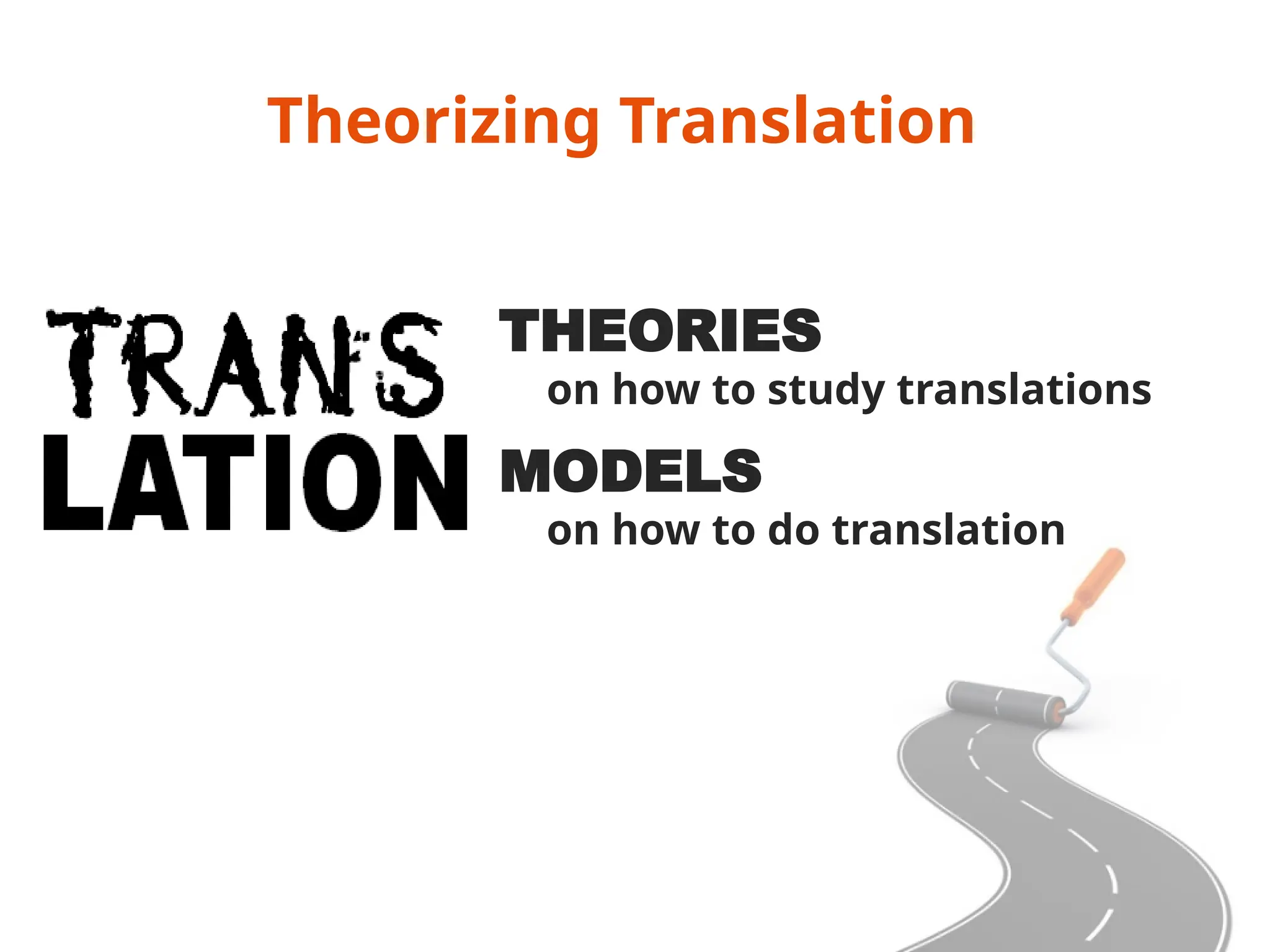
Theorizing Translation
• Tolkaappiam(3-643) ‘tokuttal, virittal, tokaiviri,
mozhipeyarttu atarpaTa yaattal’ (2nd
Century BC)
• Cicero and Horace (1st
Century BC)
Cicero – Roman Philosopher – translated Greek to Latin
– was for sense to sense translation
– capture the essence of the original
Horace – Ars Poetica – was for borrowing words from the
original to enrich his language
• Etienne Dolet – French – 1540 – How to translate well from
one language into another – first martyr for translation –
‘mistranslating’ Plato as an atheist
4.
Theorizing Translation
• Dryden– (17th
Century) metaphrase, paraphrase and
imitation
• ‘A translation remains perhaps the most direct form of
commentary.’ (D.G.Rossetti 1861)
• Niranjana, T. (1992) Siting Translation: History,
Poststructuralism, and the Colonial Context. Berkeley and
Los Angeles: University of California Press.
Dryden (1680) Preface to translation of Ovid’s Epistles
Rossetti, Dante Gabriel (1861) The early Italian poets from Ciullo d'Alcamo to
Dante Alighieri (1100–1200–1300) in the original metres together with Dante's
Vita Nuova. London: Smith, Elder & co.
Linguistics and TranslationTheory
• When theoretical and pedagogical†
models of
translation were to be developed in the modern
academic context initially (middle of 20th
Century),
scholars resorted to linguistics.
• These scholars* themselves were from linguistics
which was emerging as a scientific and objective
discipline of analyzing and documenting language.
†
The methods and theoretical models of teaching
* Firth, J R. 1956a. ‘Linguistic Analysis and Translation’, For Roman
Jakobson: Essays on the Occasion of his Sixtieth Birthday
7.
Linguistics and TranslationTheory
• Some of these scholars were trying and testing
their linguistic theory (theories on the nature
and functioning of languages) on translation.†
• Others ‡
were scholars of translation whose
main concern was to promote the study of
translation and who have simply looked to
linguistics to provide reliable tools of analysis
for achieving this end. (M. Baker 2005)
†
Firth (1956a, 1956b), Haas (1962), Halliday (1964), Catford (1965, 1994) and de Beaugrande (1978).
‡
Nida (1964, 1969, 1975a, 1975b), Delisle (1980, 1993), House (1977, 1997), Hatim and Mason
(1990, 1997), Mason (1994), Bell (1991), Baker (1992, 1993, 1995,1996b), Neubert and Shreve (1992)
Baker, Mona. 2005. ‘Linguistic Models & Methods in the Study of Translation’ in Harald Kittel,
Armin Paul Frank, Norbert Greiner, Theo Hermans, Werner Koller, José Lambert, Fritz Paul (eds)
(2005) Übersetzung* Translation* Traduction, Berlin and New York: Walter de Gruyter, 285-294.
8.
Linguistics and TranslationTheory
Broadly…
• Category 1 – Linguists testing their
linguistic theory on translation
• Category 2 – Translation scholars using
linguistic theory as tool for explanation
†
Firth (1956a, 1956b), Haas (1962), Catford (1965, 1994), Halliday (1964) and de
Beaugrande (1978).
‡
Nida (1964, 1969, 1975a, 1975b), Delisle (1980, 1993), House (1977, 1997), Hatim and
Mason (1990, 1997), Mason (1994), Bell (1991), Baker (1992, 1993, 1995,1996b), Neubert
and Shreve (1992)
9.
Linguistics and TranslationTheory
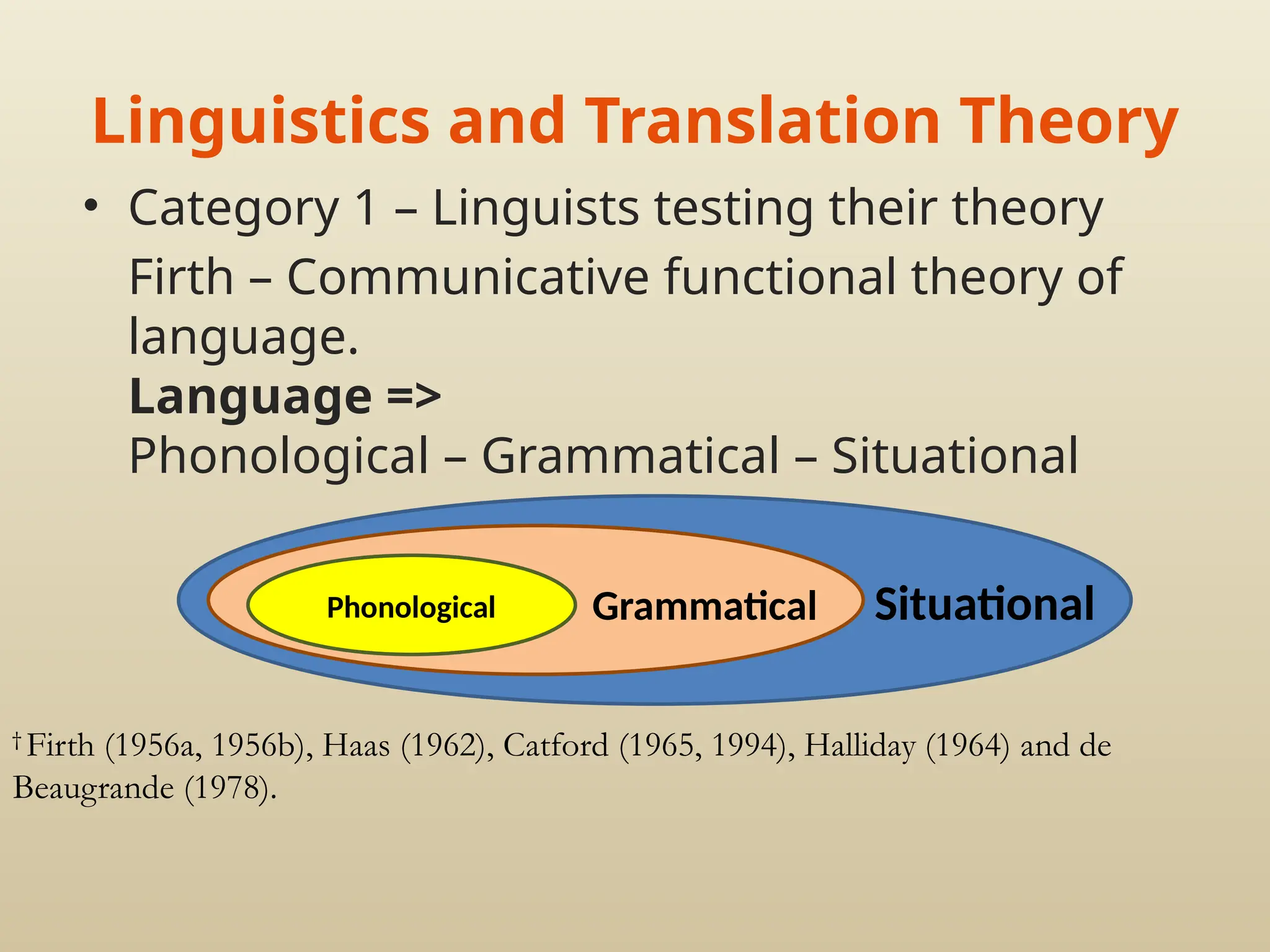
• Category 1 – Linguists testing their theory
Firth – Communicative functional theory of
language.
Language =>
Phonological – Grammatical – Situational
†
Firth (1956a, 1956b), Haas (1962), Catford (1965, 1994), Halliday (1964) and de
Beaugrande (1978).
Situational
Grammatical
Phonological
10.
Linguistics and TranslationTheory
• Category 1 – Linguists testing their theory
Firth – Communicative functional theory of language.
Language =>
Phonological – Grammatical – Situational
“I want to make it clear that the linguistic systems and structures are
related to the systems and structures in the events, relevant objects and
people and what they are doing. You have the option of connecting
structures and systems of language with structures and systems of
thought or with structures and systems in situations comprising the
human participants, their non-verbal behaviour, the relevant objects
and other events and of these two alternatives, I suggest - difficult
though as it may appear - that the situational matrix is the more
manageable one and more easily related to problems of translation.”
†
Firth (1956a, 1956b), Haas (1962), Catford (1965, 1994), Halliday (1964) and de
Beaugrande (1978).
11.
Linguistics and TranslationTheory
Firth – Communicative functional theory of
language.
Language =>
Phonological – Grammatical – Situational
• “the situational matrix is the more manageable
one and more easily related to problems of
translation.”
• “The fact of translation is a main challenge both to
linguistic theory and to philosophy” (Firth
1956a:77)
†
Firth (1956a, 1956b), Haas (1962), Catford (1965, 1994), Halliday (1964) and de
Beaugrande (1978).
12.
Linguistics and TranslationTheory
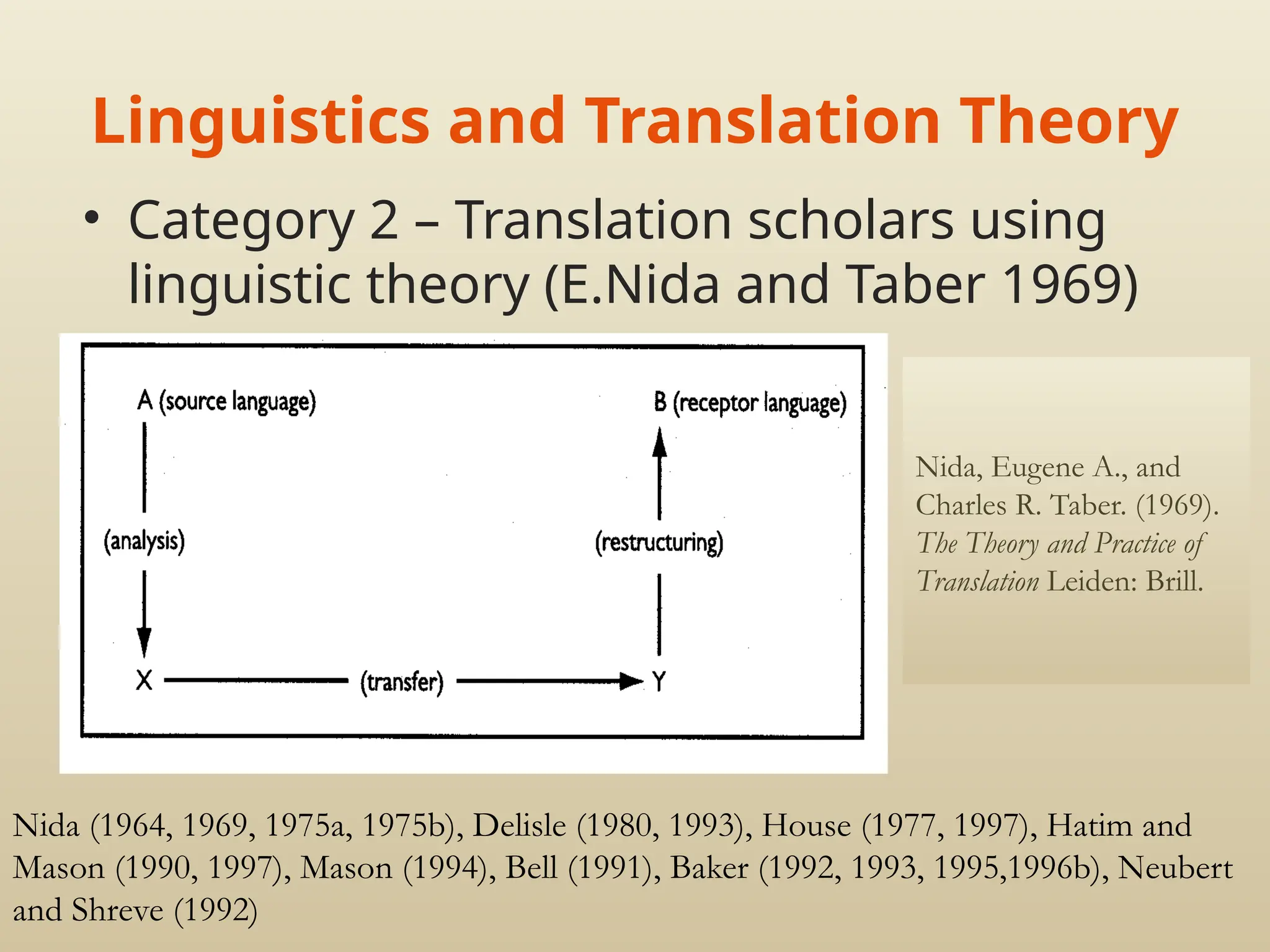
• Category 2 – Translation scholars using
linguistic theory (E.Nida and Taber 1969)
Nida (1964, 1969, 1975a, 1975b), Delisle (1980, 1993), House (1977, 1997), Hatim and
Mason (1990, 1997), Mason (1994), Bell (1991), Baker (1992, 1993, 1995,1996b), Neubert
and Shreve (1992)
Nida, Eugene A., and
Charles R. Taber. (1969).
The Theory and Practice of
Translation Leiden: Brill.
13.
Linguistics and TranslationTheory
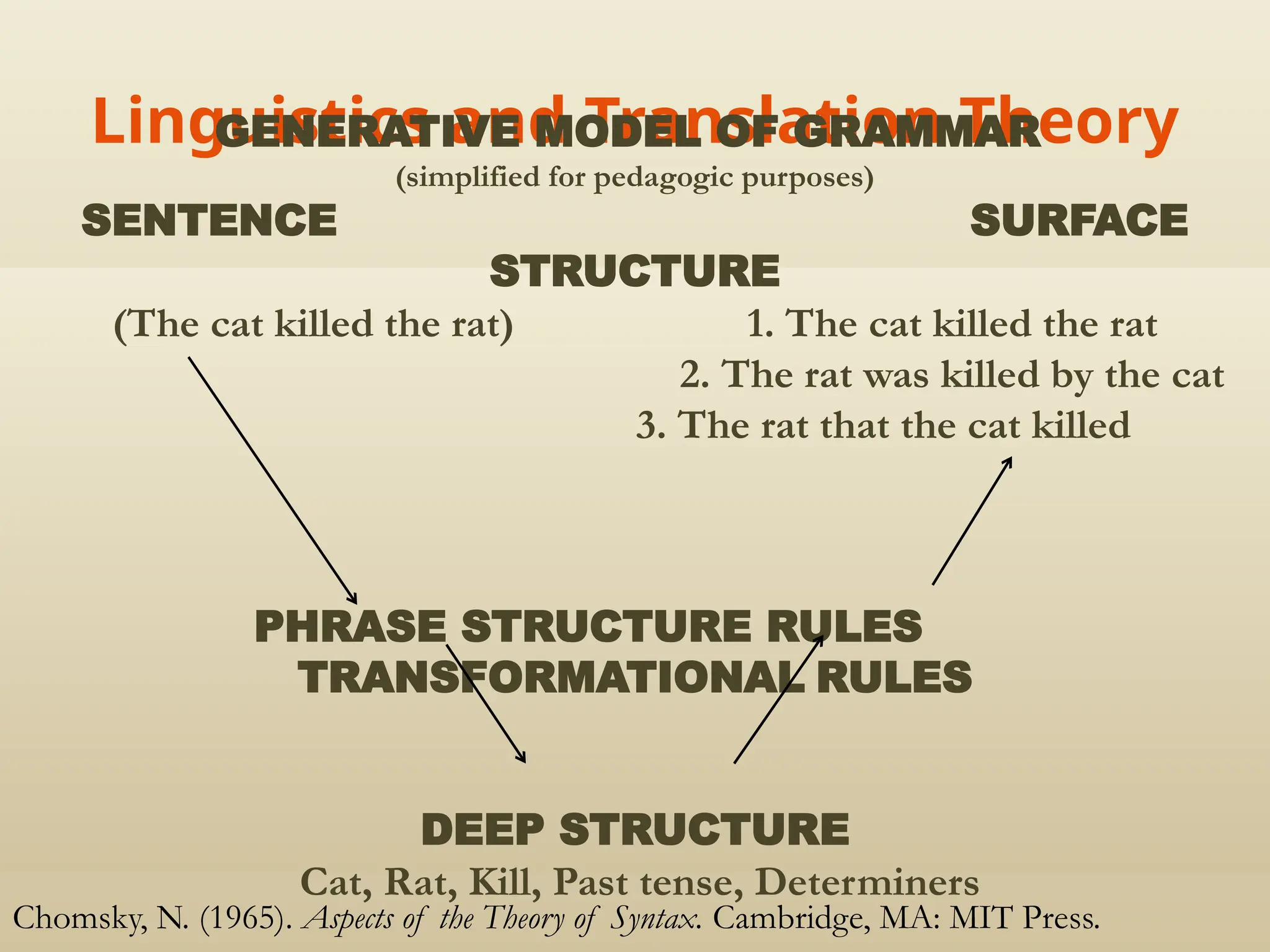
GENERATIVE MODEL OF GRAMMAR
(simplified for pedagogic purposes)
SENTENCE SURFACE
STRUCTURE
(The cat killed the rat) 1. The cat killed the rat
2. The rat was killed by the cat
3. The rat that the cat killed
PHRASE STRUCTURE RULES
TRANSFORMATIONAL RULES
DEEP STRUCTURE
Cat, Rat, Kill, Past tense, Determiners
Chomsky, N. (1965). Aspects of the Theory of Syntax. Cambridge, MA: MIT Press.
14.
Linguistics and TranslationTheory
Chomkyan Tradition – D-Structure and S-Structure
‘The existence of deep-seated formal universals… does not, for
example, imply that there must be reasonable procedure for
translating between languages’ (Chomsky, 1965:30)
Firthian Tradition – Systemic Linguistics
‘Outline the kinds of knowledge and skill which… underlie the
practical abilities of the translator…(and) build this outline into
a model of the translation process’ (Bell, 1991:xvi)
Nida (1964, 1969, 1975a, 1975b), Delisle (1980, 1993), House (1977, 1997), Hatim and
Mason (1990, 1997), Mason (1994), Bell (1991), Baker (1992, 1993, 1995,1996b), Neubert
and Shreve (1992)
Chomsky, N. (1965). Aspects of the Theory of Syntax. Cambridge, MA: MIT Press.
15.
Linguistics and TranslationTheory
Gentzler, E.(1993) Contemporary Translation Theories . London: Routledge
Wilss, W. (1982) The Science of Translation: Problems and Methods (transl.) Tubingen: M M Verlag
The German Implementation
‘The translatability of a text is thus guaranteed by the existence of universal
categories in syntax, semantics and the logic of experience’
Failure of a translation – not because of insufficiency of lexical or syntactic
inventories but because of the inability … for text analysis (Wilss 1982)
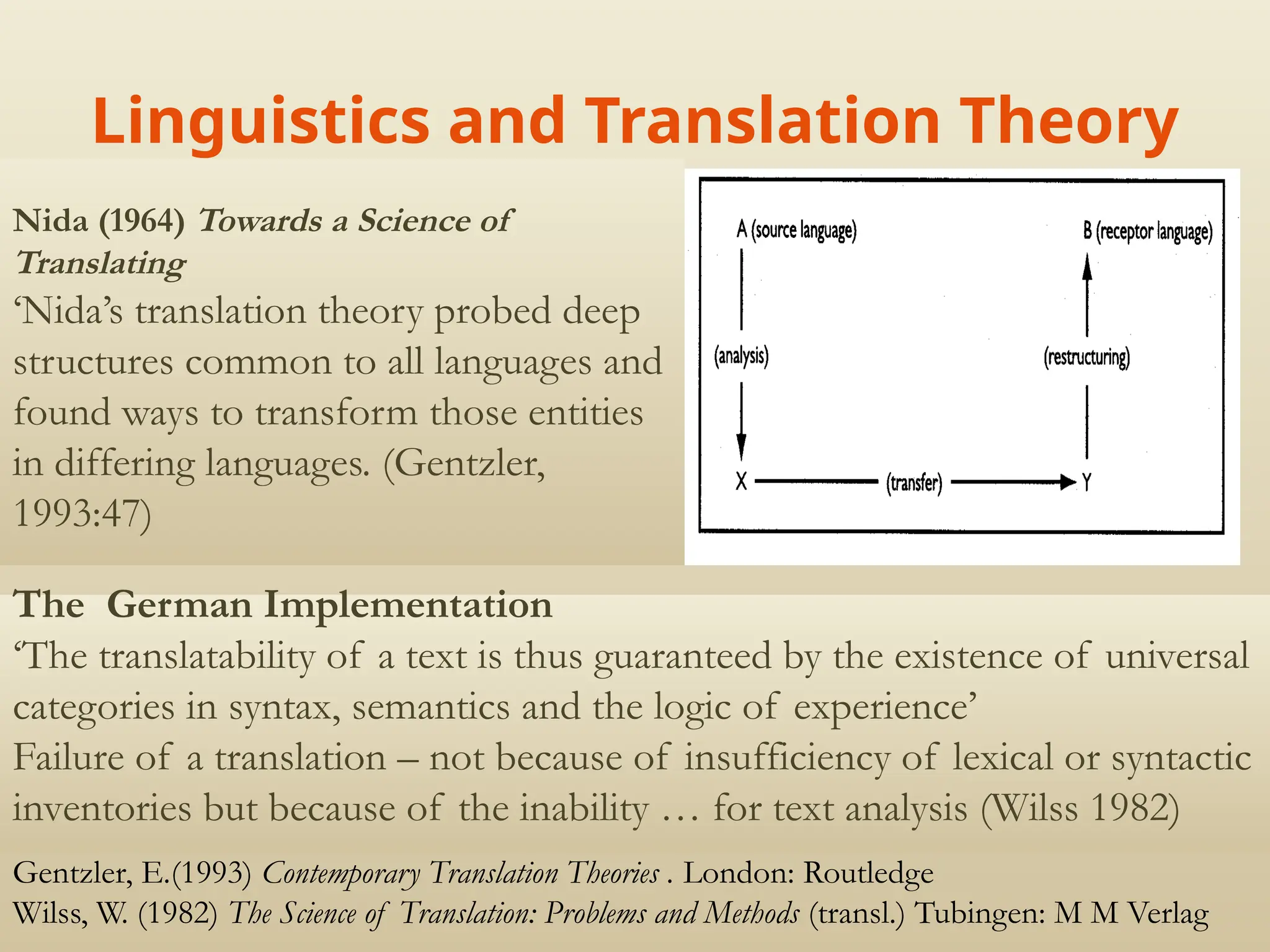
Nida (1964) Towards a Science of
Translating
‘Nida’s translation theory probed deep
structures common to all languages and
found ways to transform those entities
in differing languages. (Gentzler,
1993:47)
16.
Linguistics and TranslationTheory
‘Scientistic approach to Translation’ and its opposition
Lambert (1991) – ‘In Quest of Literary World Maps’
There are reasons for testing other explanatory principles
Lefevere – was against ‘academization of criticism’, the
complexity of deconstructive criticism, scientificity of
translation analysis….
Mary Snell Hornby – abandon scientistic attitude and move
from “text” as a translation unit to “culture”.
Bassnett and Lefevere (1990) “MOMENTOUS”
Snell Hornby, M. (1990) – ‘Linguistic Transcoding or Cultural Transfer? A Critique of
Translation Theory in Germany’ in Bassnett and Lefevere (eds) Translation, History and
Culture, London:Pinter
Gentzler (1993) Contemporary Translation Theories
17.
Linguistics and TranslationTheory
†
Lefevere, André and Susan Bassnett (1990) ‘Introduction. Proust’s Grandmother and the
Thousand and One Nights: The Cultural Turn in Translation Studies’, in Susan Bassnett & Andre
Lefevere (eds) Translation, History & Culture, London & New York: Routledge, 1-13.
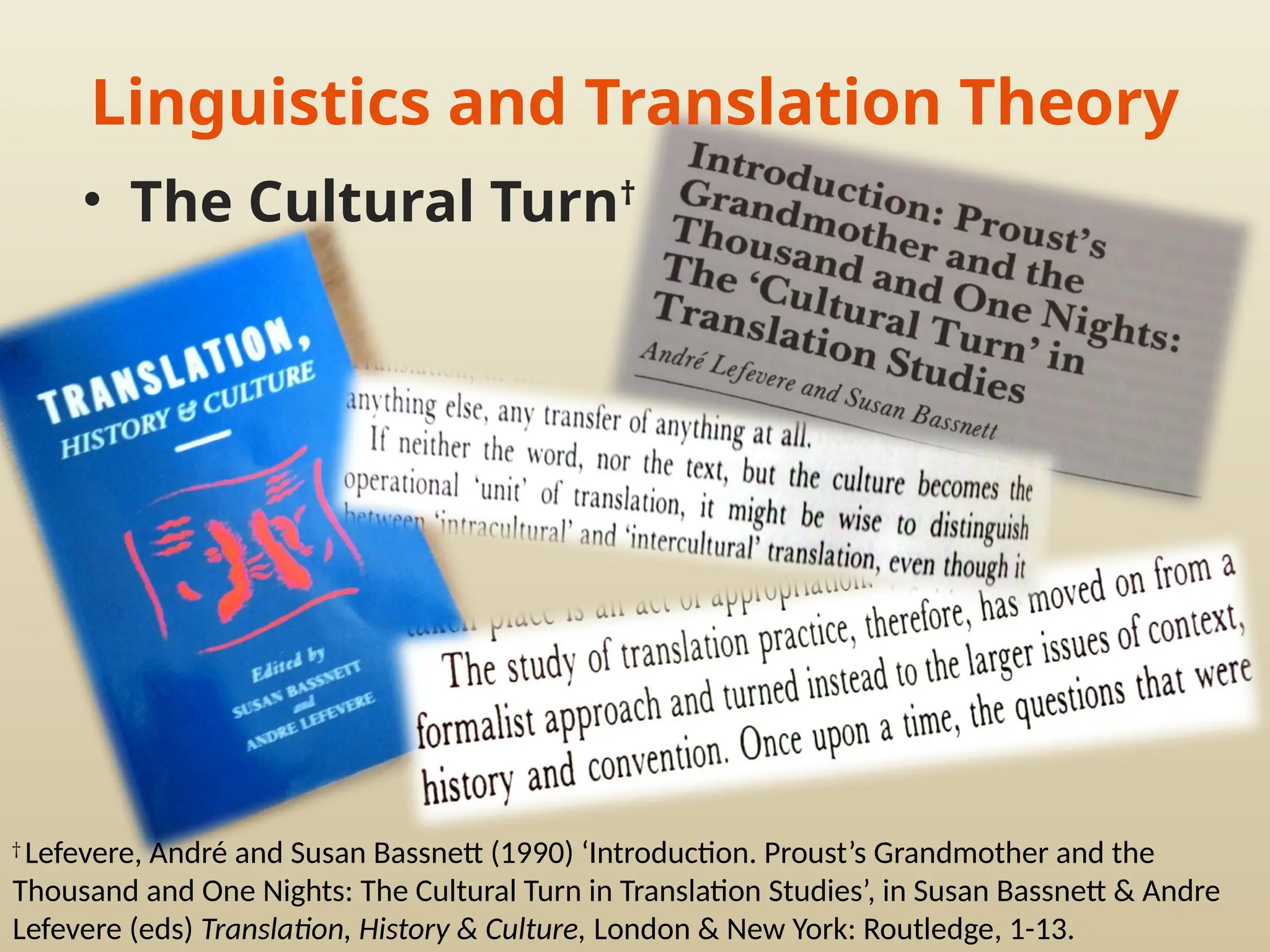
• The Cultural Turn†
18.
Linguistics and TranslationTheory
• The Cultural Turn†
‘Now the questions have changed. The object
of study has been redefined; what is
studied is the text embedded in its network
of both source and target cultural signs and
in this way TS has been able to both utilize
the linguistic approach and move out
beyond it.’ (Bassnett and Lefevere, 1990).
• The corpus linguistics challenge
†
Lefevere, André and Susan Bassnett (1990) ‘Introduction. Proust’s Grandmother and the
Thousand and One Nights: The Cultural Turn in Translation Studies’, in Susan Bassnett & Andre
Lefevere (eds) Translation, History & Culture, London & New York: Routledge, 1-13.
19.
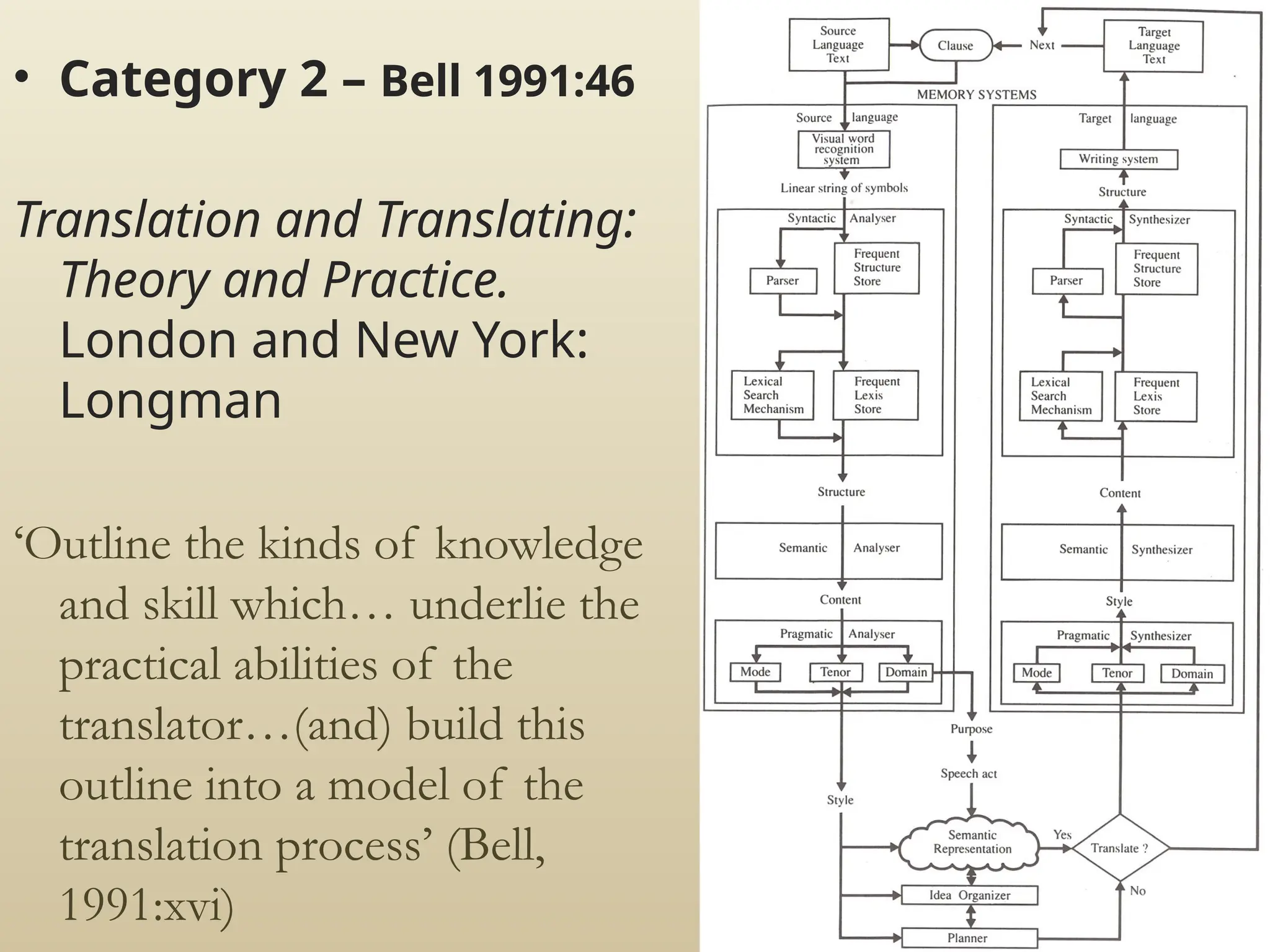
• Category 2– Bell 1991:46
Translation and Translating:
Theory and Practice.
London and New York:
Longman
‘Outline the kinds of knowledge
and skill which… underlie the
practical abilities of the
translator…(and) build this
outline into a model of the
translation process’ (Bell,
1991:xvi)
20.
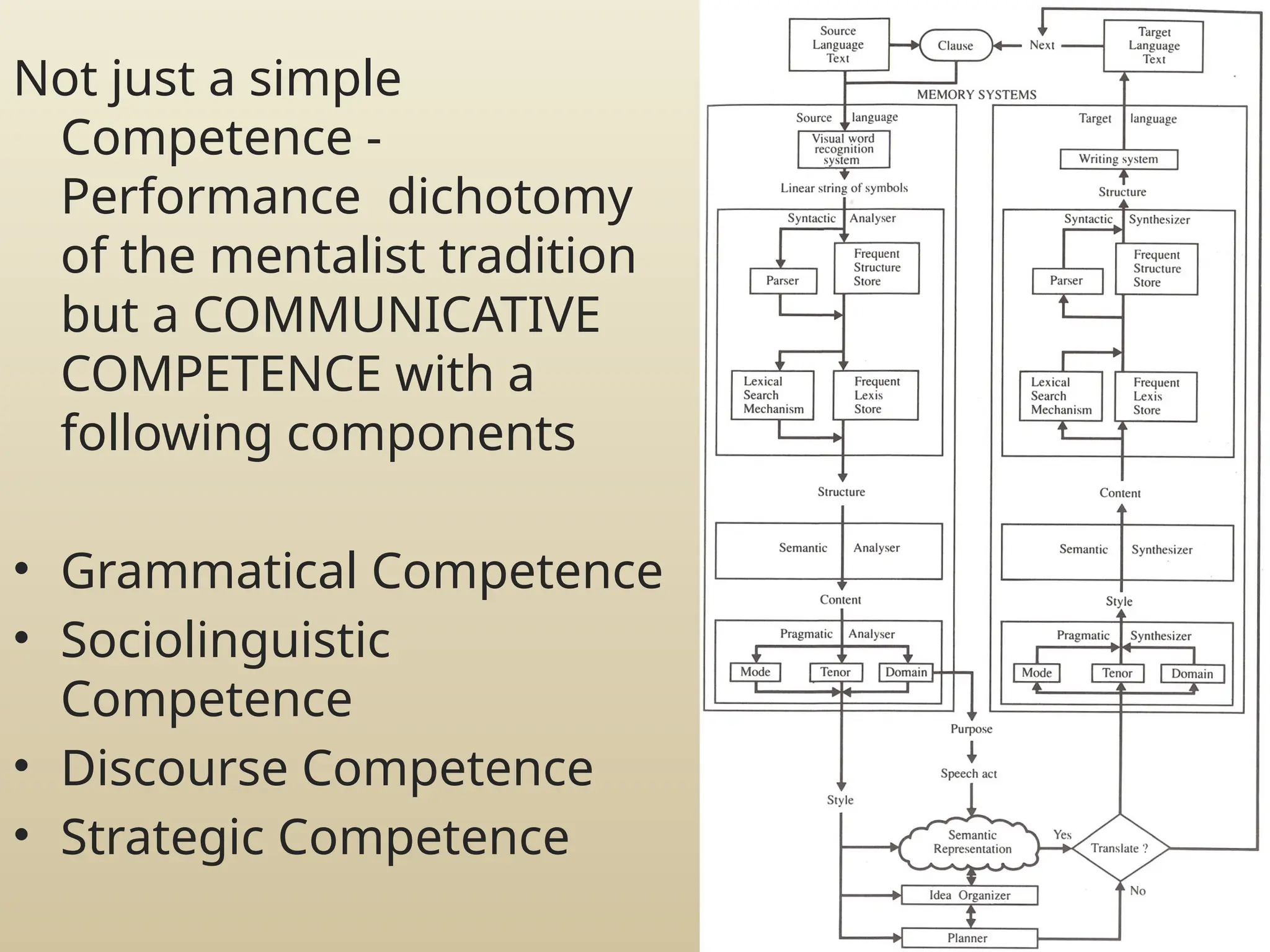
Not just asimple
Competence -
Performance dichotomy
of the mentalist tradition
but a COMMUNICATIVE
COMPETENCE with a
following components
• Grammatical Competence
• Sociolinguistic
Competence
• Discourse Competence
• Strategic Competence
21.
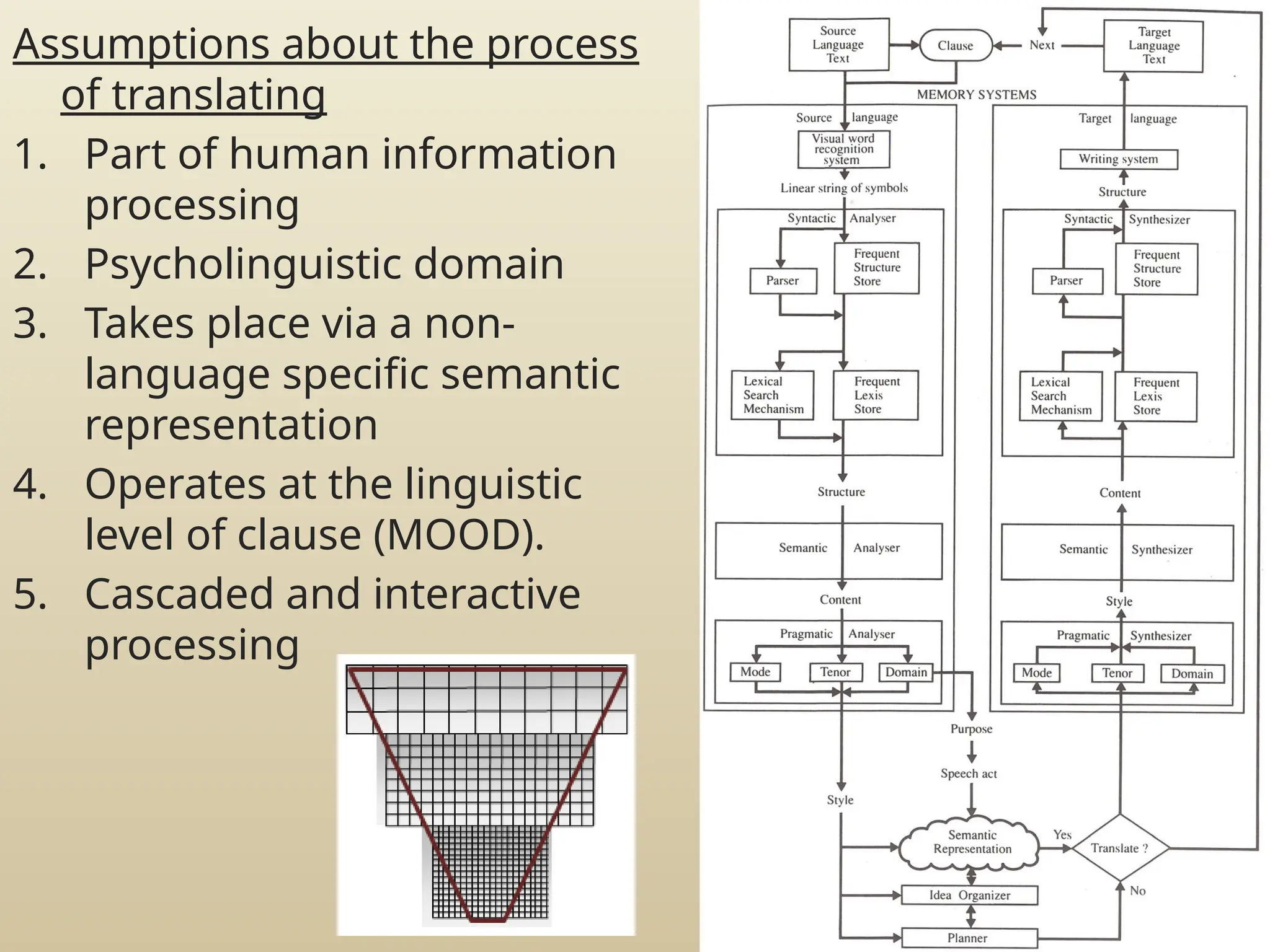
Assumptions about theprocess
of translating
1. Part of human information
processing
2. Psycholinguistic domain
3. Takes place via a non-
language specific semantic
representation
4. Operates at the linguistic
level of clause (MOOD).
5. Cascaded and interactive
processing
22.
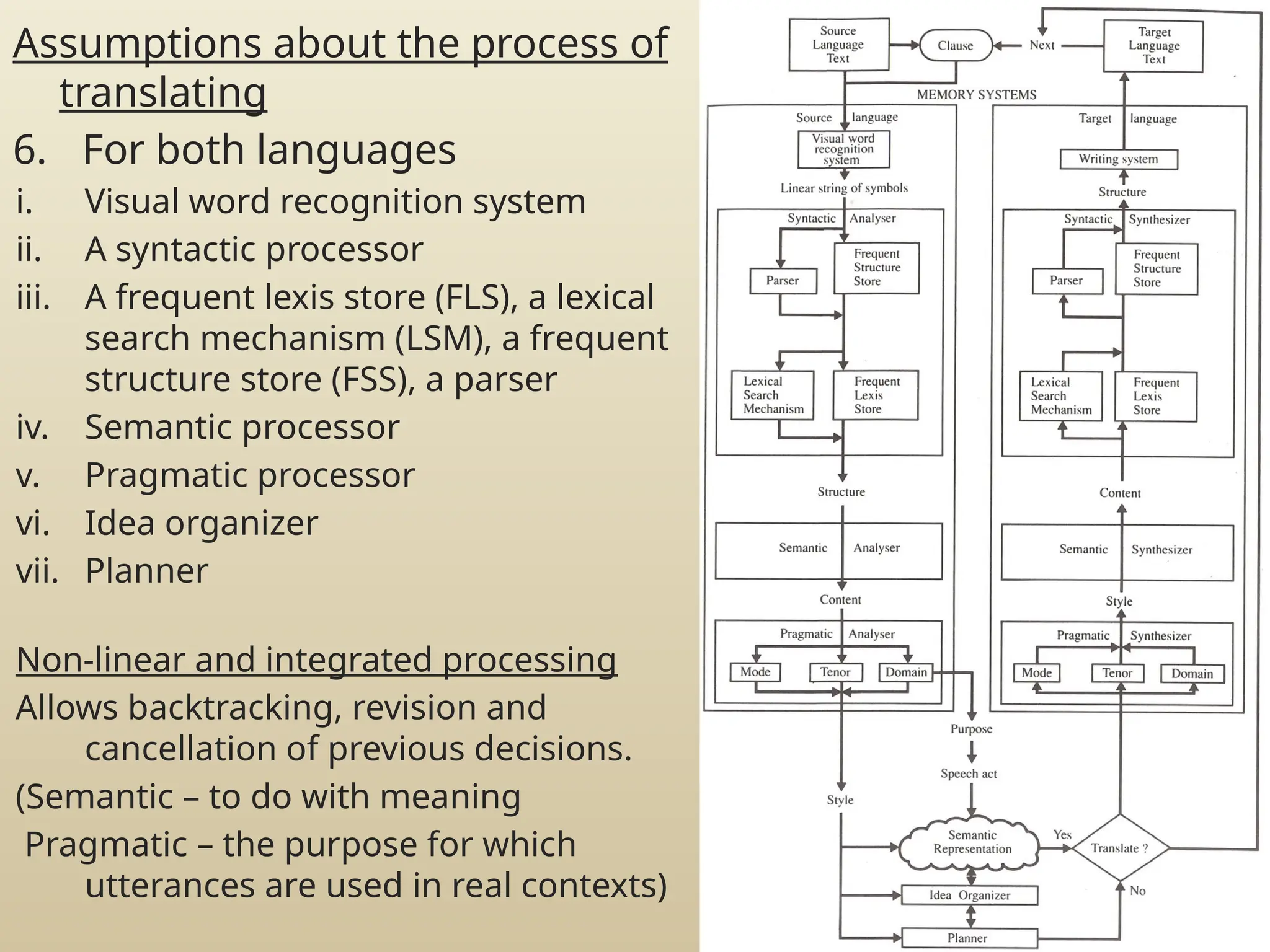
Assumptions about theprocess of
translating
6. For both languages
i. Visual word recognition system
ii. A syntactic processor
iii. A frequent lexis store (FLS), a lexical
search mechanism (LSM), a frequent
structure store (FSS), a parser
iv. Semantic processor
v. Pragmatic processor
vi. Idea organizer
vii. Planner
Non-linear and integrated processing
Allows backtracking, revision and
cancellation of previous decisions.
(Semantic – to do with meaning
Pragmatic – the purpose for which
utterances are used in real contexts)
23.
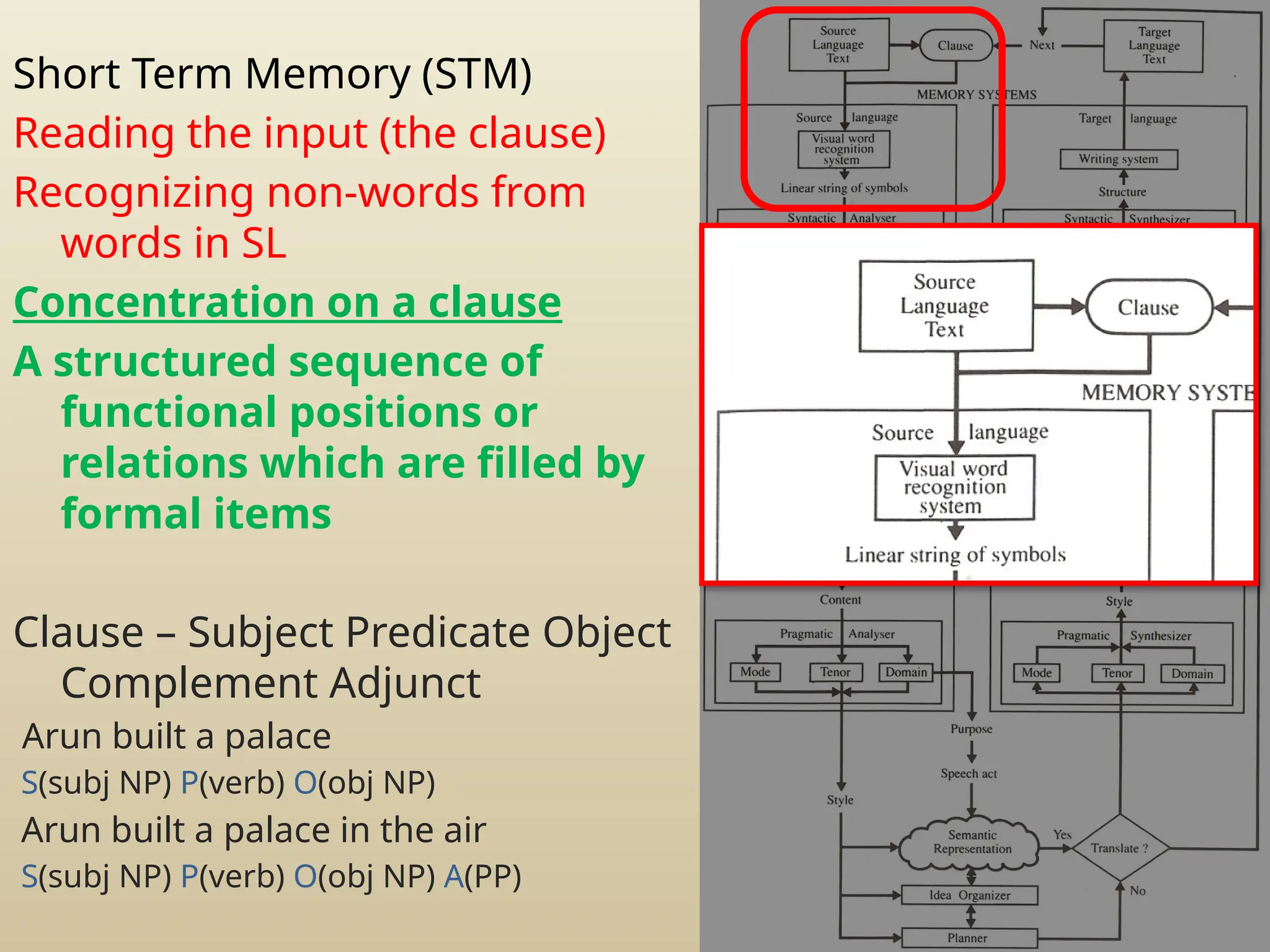
Short Term Memory(STM)
Reading the input (the clause)
Recognizing non-words from
words in SL
Concentration on a clause
A structured sequence of
functional positions or
relations which are filled by
formal items
Clause – Subject Predicate Object
Complement Adjunct
Arun built a palace
S(subj NP) P(verb) O(obj NP)
Arun built a palace in the air
S(subj NP) P(verb) O(obj NP) A(PP)
24.
Syntactic Analyser
Ex. Onceupon a time…
Takes a default route for the
Italian - C’era una volta
Kannada – ondaanoMdu kaaladalli
Frequent Structure Store (FSS)
Clause level Ex.vah aayi (S P)
The monkey ate the oranges (S P O)
Arun built the palace (S P O)
Phrase level
Ex.a beautiful flower
(m[det] m[adj] h[noun)
Frequent Lexis Store (FLS)
Instant look up glossary
Lexical items usually associated with
structures
Ex. kauva = ‘crow’
‘this’ = yah, is
Marked structures are not available
25.
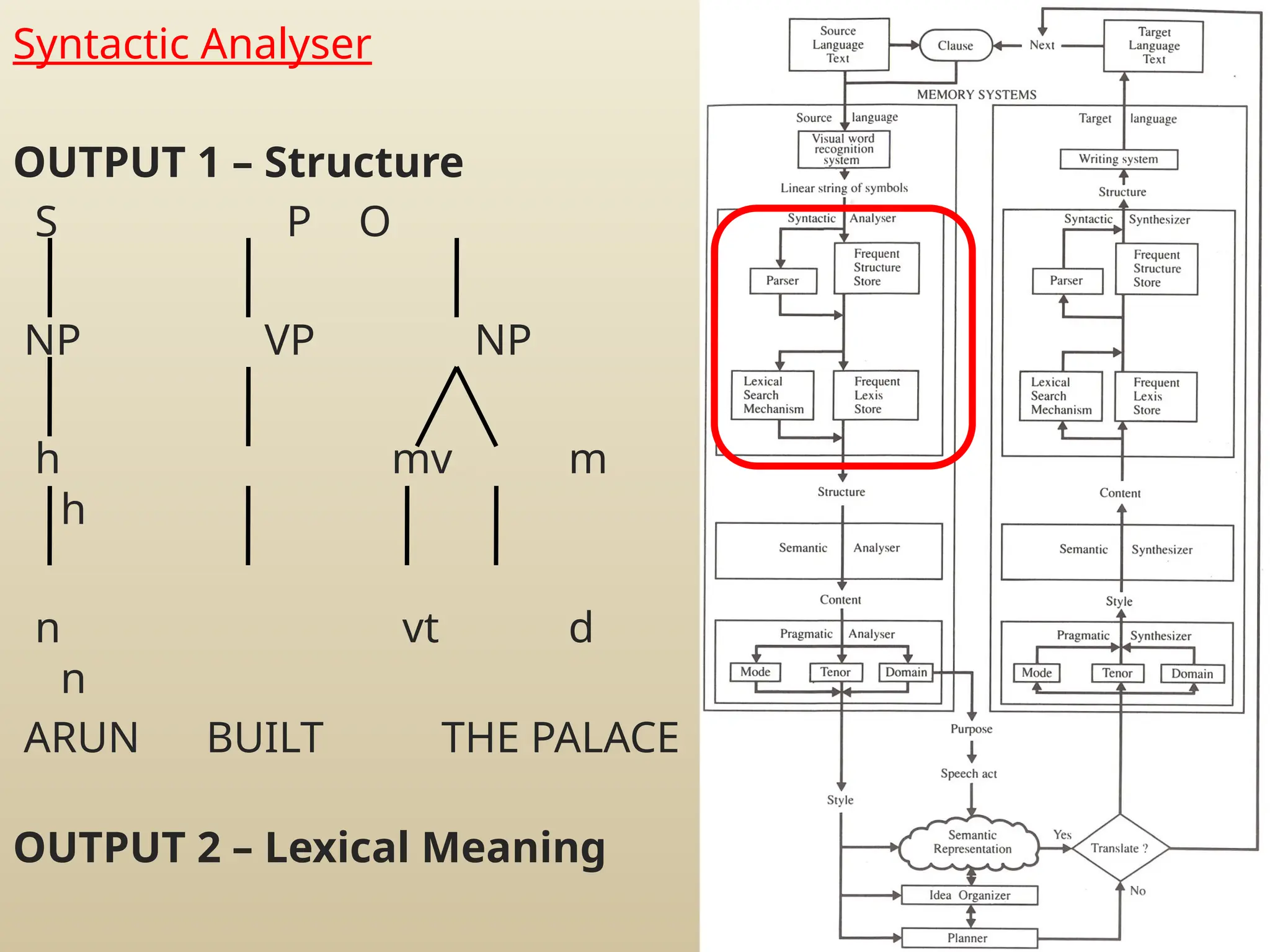
Syntactic Analyser
OUTPUT 1– Structure
S P O
NP VP NP
h mv m
h
n vt d
n
ARUN BUILT THE PALACE
OUTPUT 2 – Lexical Meaning
26.
Syntactic Analyser
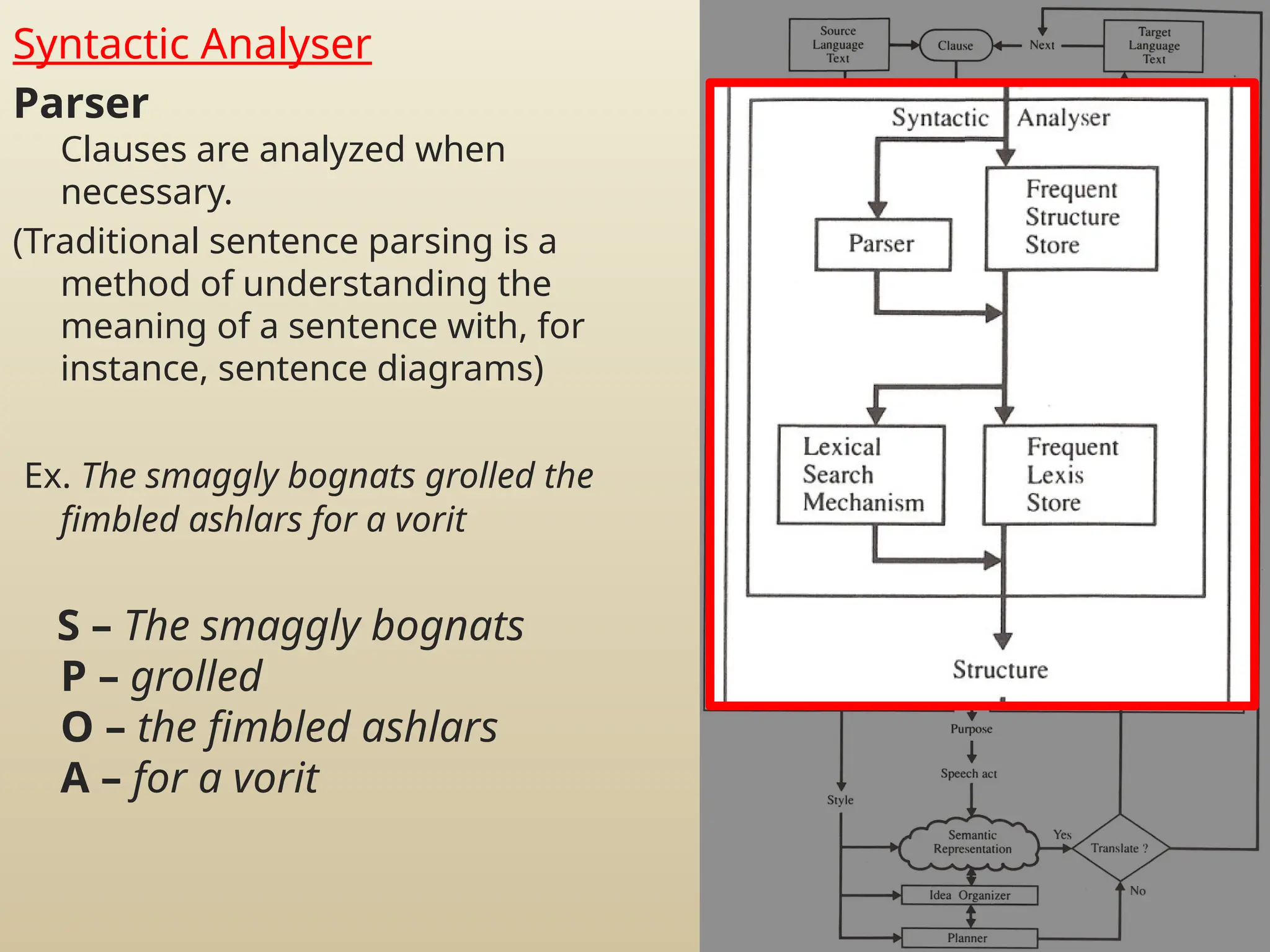
Parser
Clauses areanalyzed when
necessary.
(Traditional sentence parsing is a
method of understanding the
meaning of a sentence with, for
instance, sentence diagrams)
Ex. The smaggly bognats grolled the
fimbled ashlars for a vorit
S – The smaggly bognats
P – grolled
O – the fimbled ashlars
A – for a vorit
27.
Syntactic Analyser
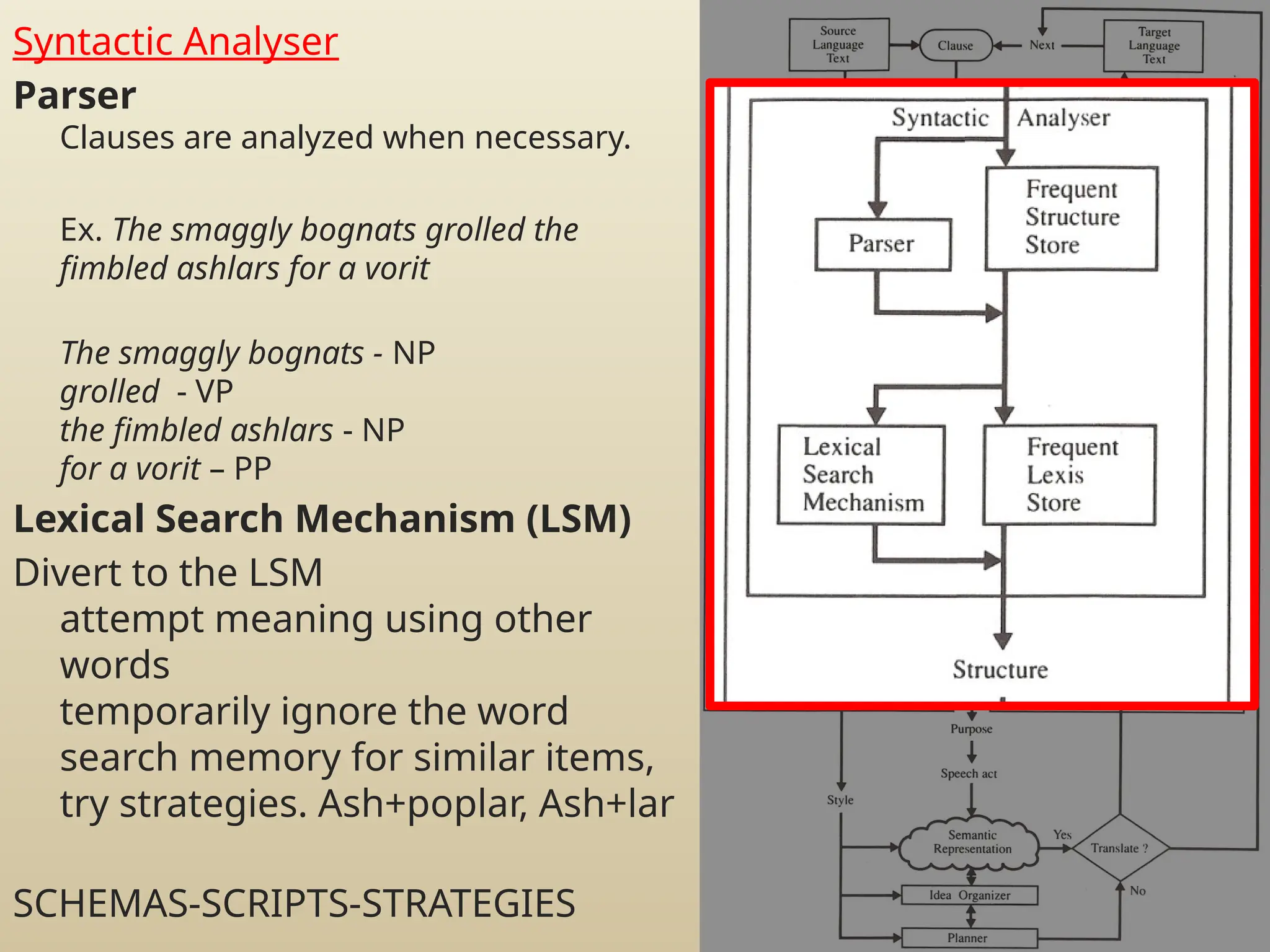
Parser
Clauses areanalyzed when necessary.
Ex. The smaggly bognats grolled the
fimbled ashlars for a vorit
The smaggly bognats - NP
grolled - VP
the fimbled ashlars - NP
for a vorit – PP
Lexical Search Mechanism (LSM)
Divert to the LSM
attempt meaning using other
words
temporarily ignore the word
search memory for similar items,
try strategies. Ash+poplar, Ash+lar
SCHEMAS-SCRIPTS-STRATEGIES
28.
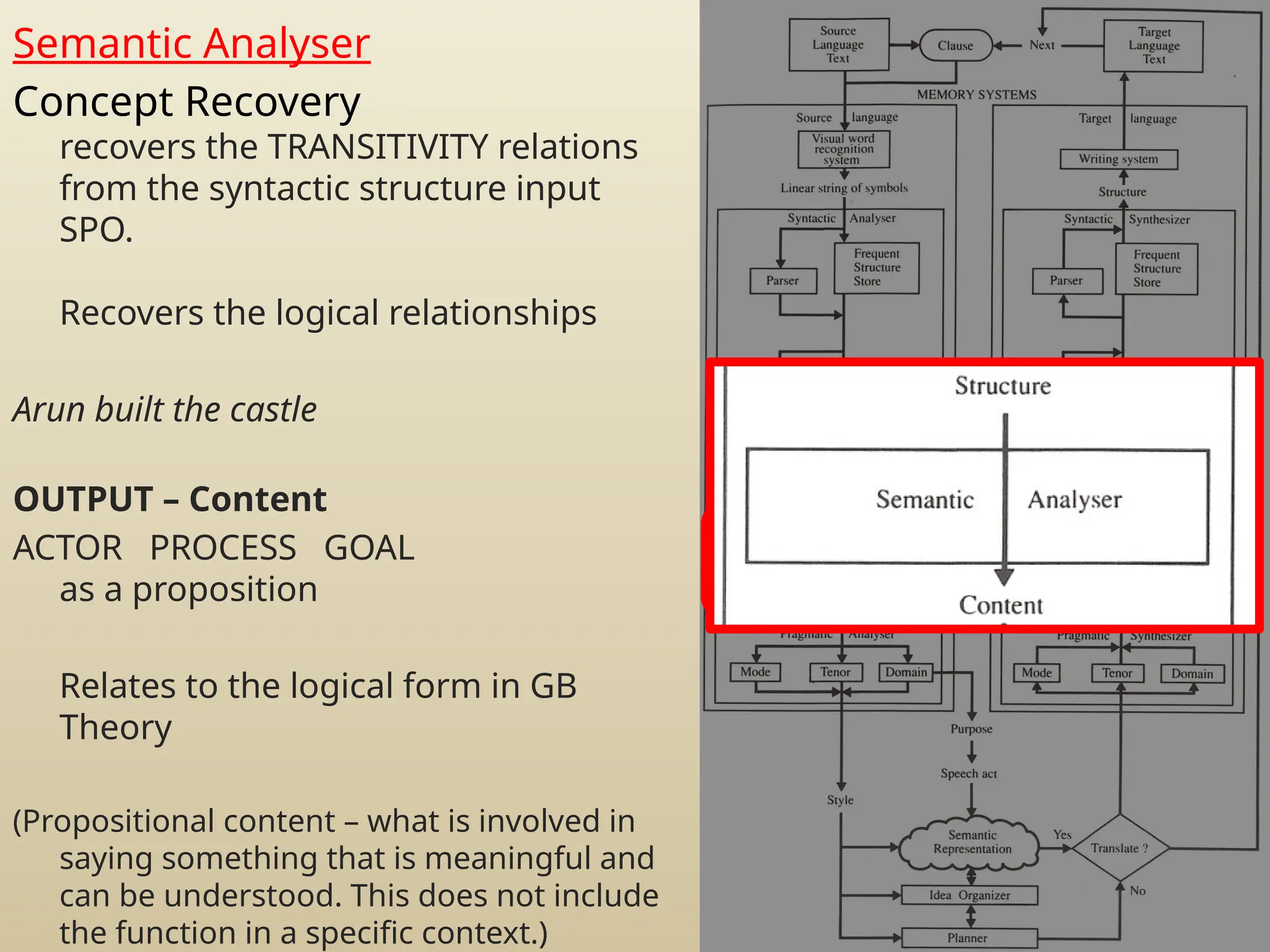
Semantic Analyser
Concept Recovery
recoversthe TRANSITIVITY relations
from the syntactic structure input
SPO.
Recovers the logical relationships
Arun built the castle
OUTPUT – Content
ACTOR PROCESS GOAL
as a proposition
Relates to the logical form in GB
Theory
(Propositional content – what is involved in
saying something that is meaningful and
can be understood. This does not include
the function in a specific context.)
29.
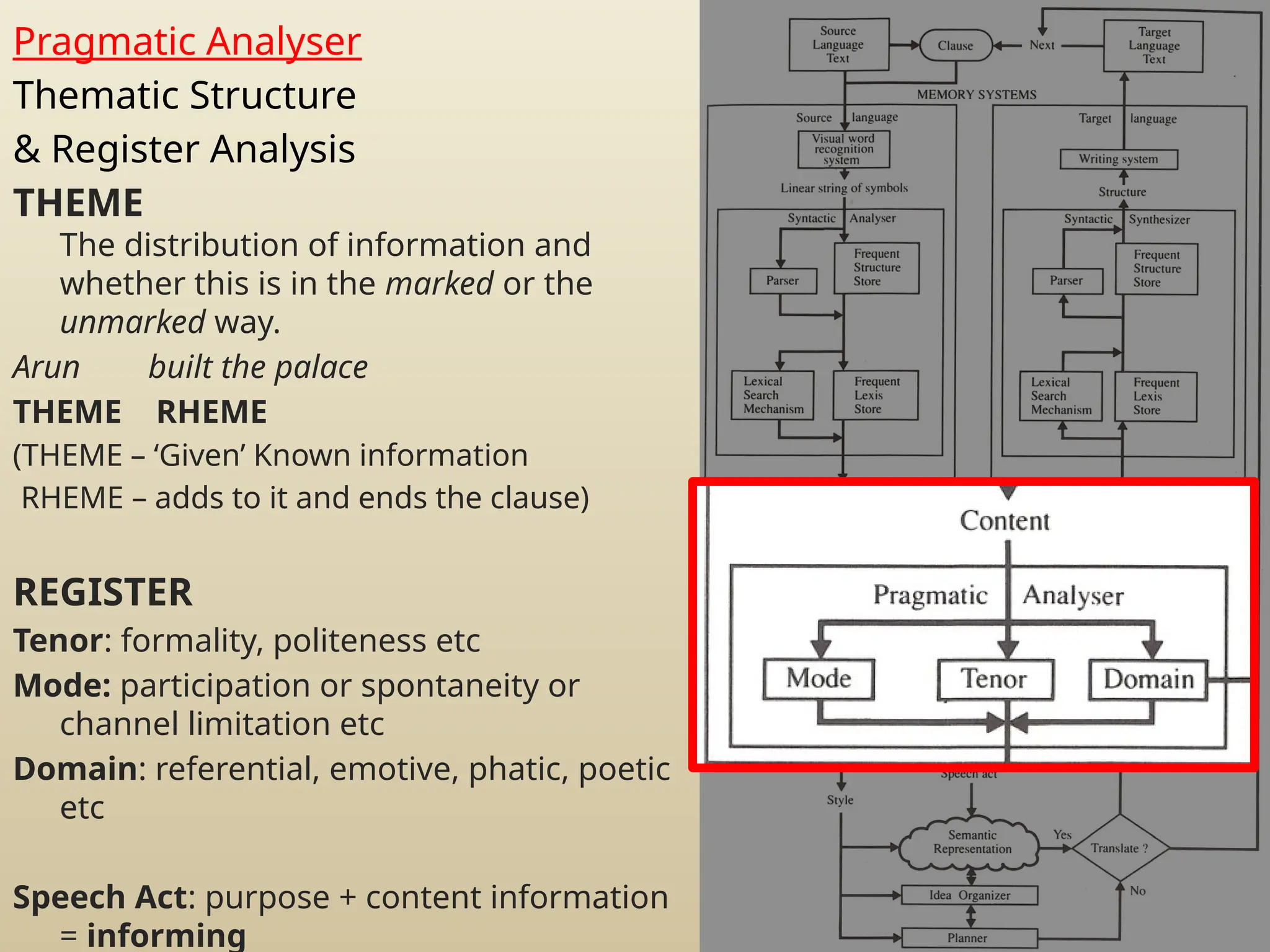
Pragmatic Analyser
Thematic Structure
&Register Analysis
THEME
The distribution of information and
whether this is in the marked or the
unmarked way.
Arun built the palace
THEME RHEME
(THEME – ‘Given’ Known information
RHEME – adds to it and ends the clause)
REGISTER
Tenor: formality, politeness etc
Mode: participation or spontaneity or
channel limitation etc
Domain: referential, emotive, phatic, poetic
etc
Speech Act: purpose + content information
= informing
30.
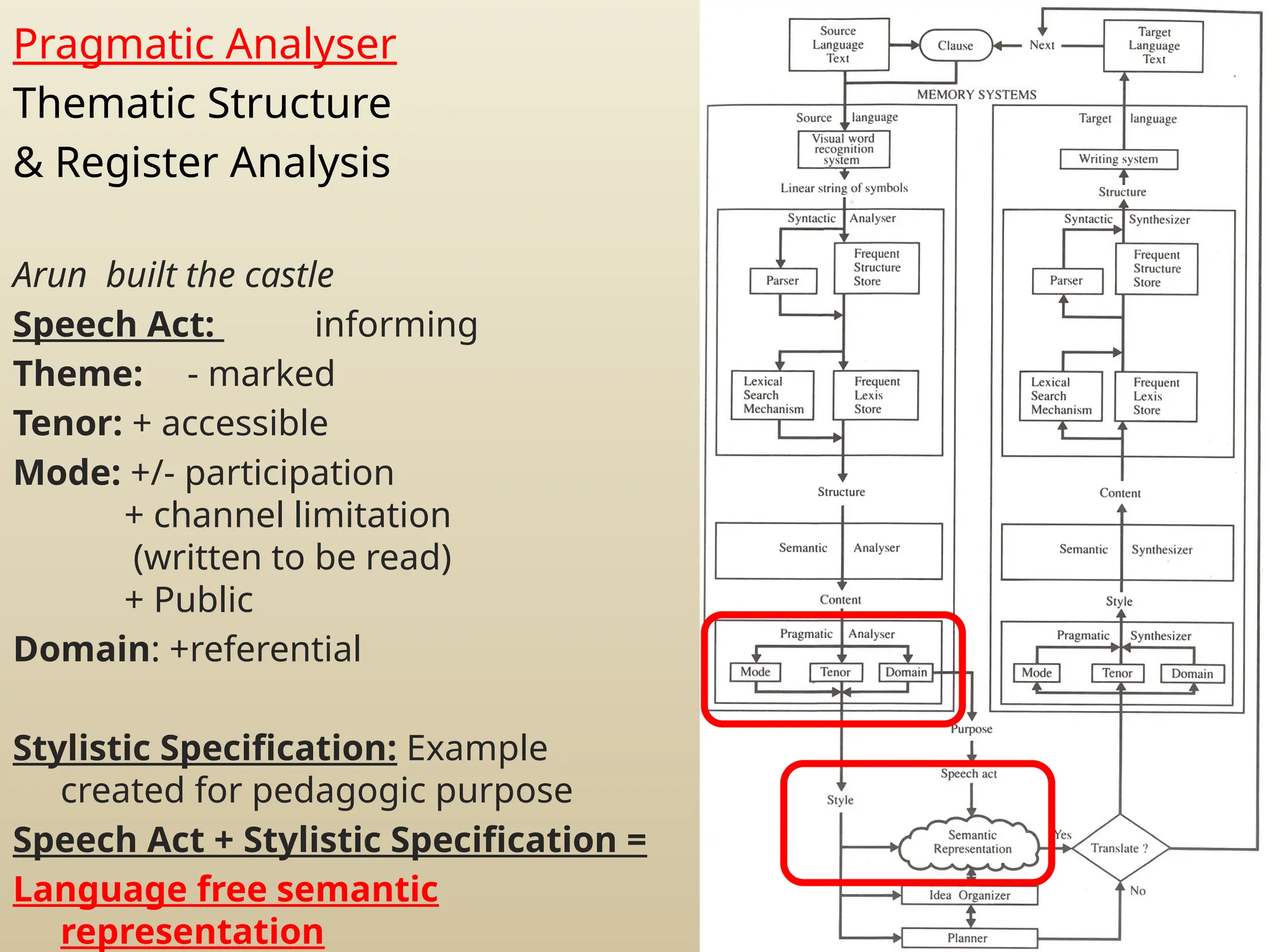
Pragmatic Analyser
Thematic Structure
&Register Analysis
Arun built the castle
Speech Act: informing
Theme: - marked
Tenor: + accessible
Mode: +/- participation
+ channel limitation
(written to be read)
+ Public
Domain: +referential
Stylistic Specification: Example
created for pedagogic purpose
Speech Act + Stylistic Specification =
Language free semantic
representation
31.
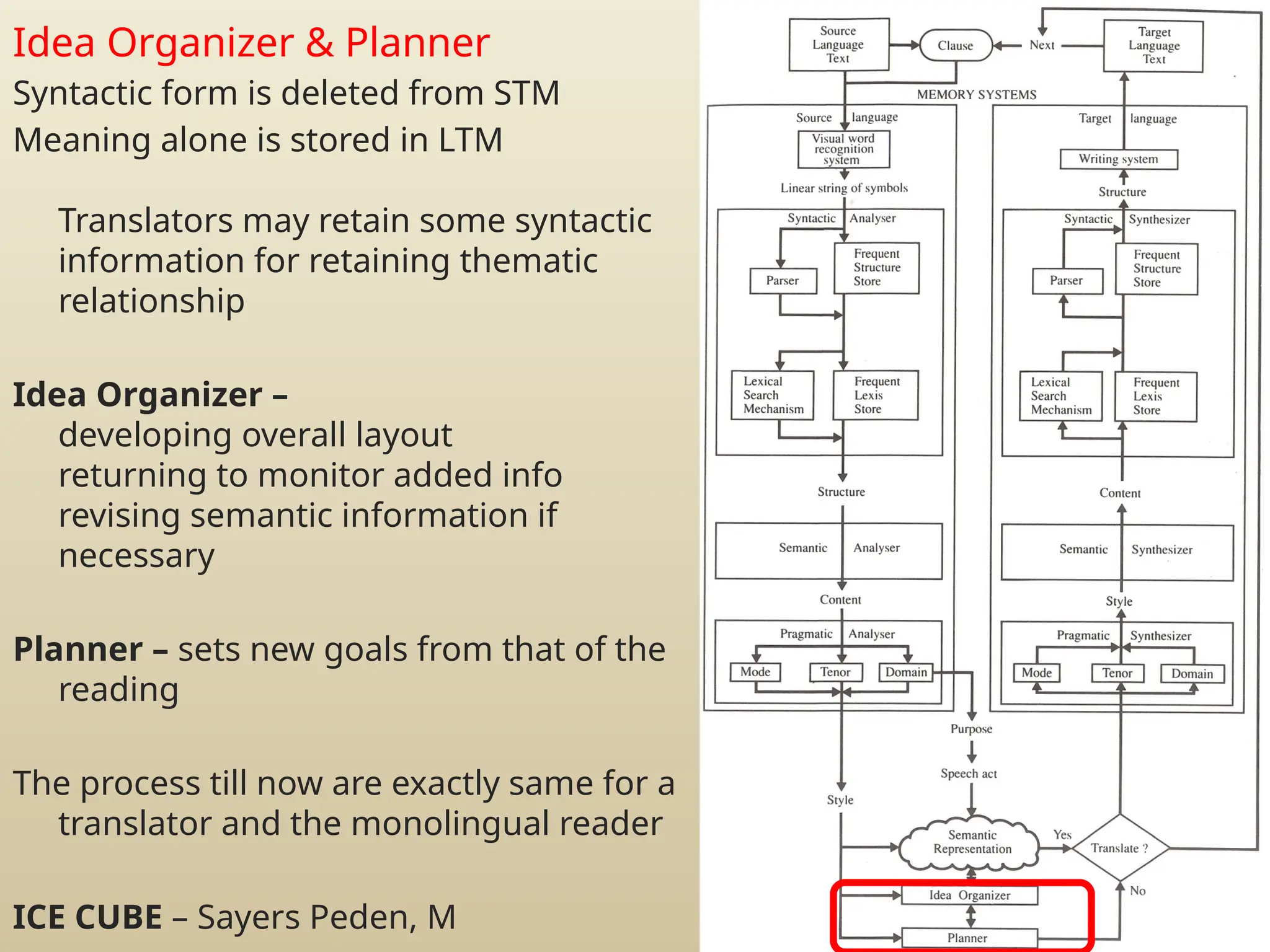
Idea Organizer &Planner
Syntactic form is deleted from STM
Meaning alone is stored in LTM
Translators may retain some syntactic
information for retaining thematic
relationship
Idea Organizer –
developing overall layout
returning to monitor added info
revising semantic information if
necessary
Planner – sets new goals from that of the
reading
The process till now are exactly same for a
translator and the monolingual reader
ICE CUBE – Sayers Peden, M
32.
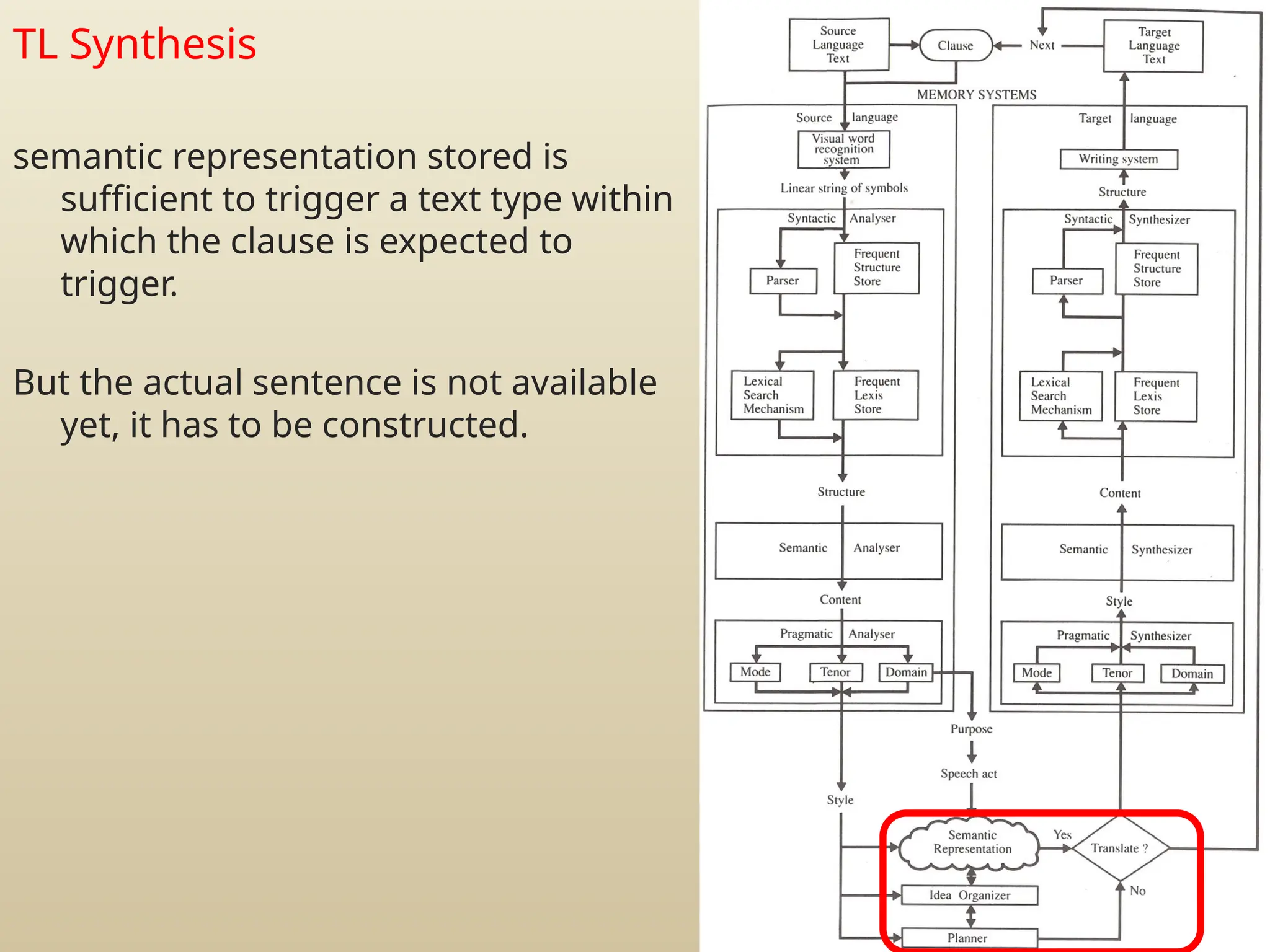
TL Synthesis
semantic representationstored is
sufficient to trigger a text type within
which the clause is expected to
trigger.
But the actual sentence is not available
yet, it has to be constructed.
33.
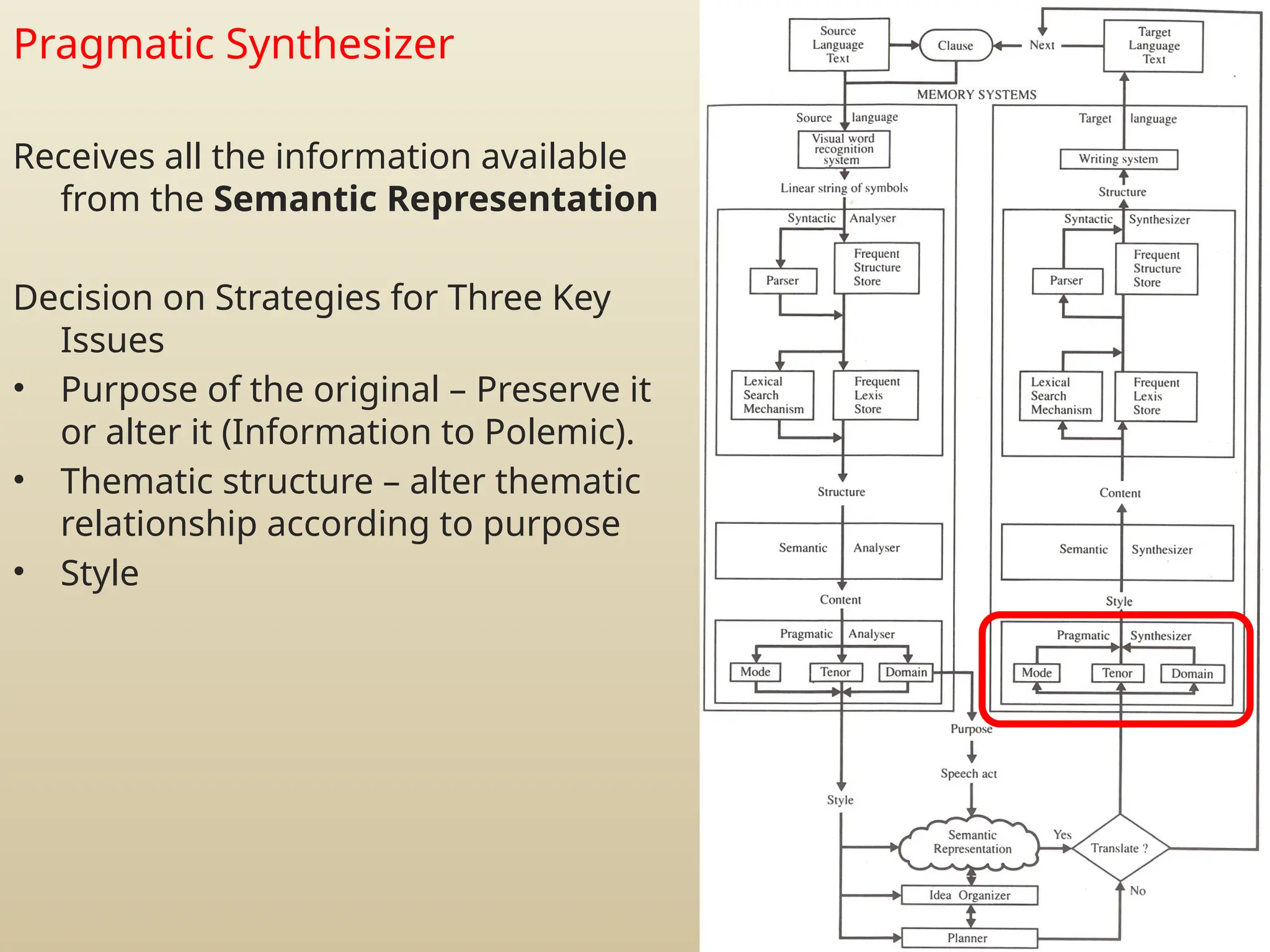
Pragmatic Synthesizer
Receives allthe information available
from the Semantic Representation
Decision on Strategies for Three Key
Issues
• Purpose of the original – Preserve it
or alter it (Information to Polemic).
• Thematic structure – alter thematic
relationship according to purpose
• Style
34.
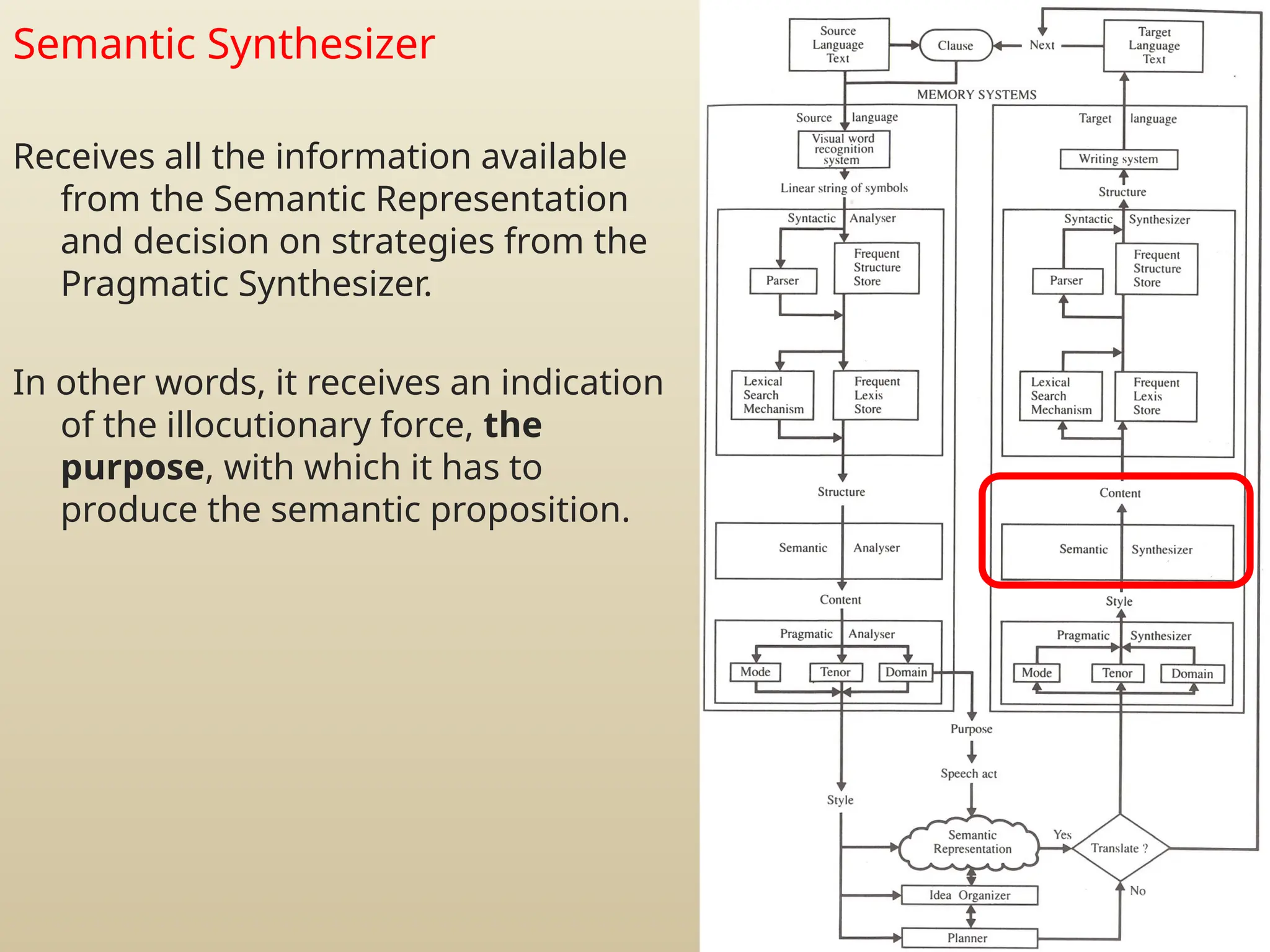
Semantic Synthesizer
Receives allthe information available
from the Semantic Representation
and decision on strategies from the
Pragmatic Synthesizer.
In other words, it receives an indication
of the illocutionary force, the
purpose, with which it has to
produce the semantic proposition.
35.
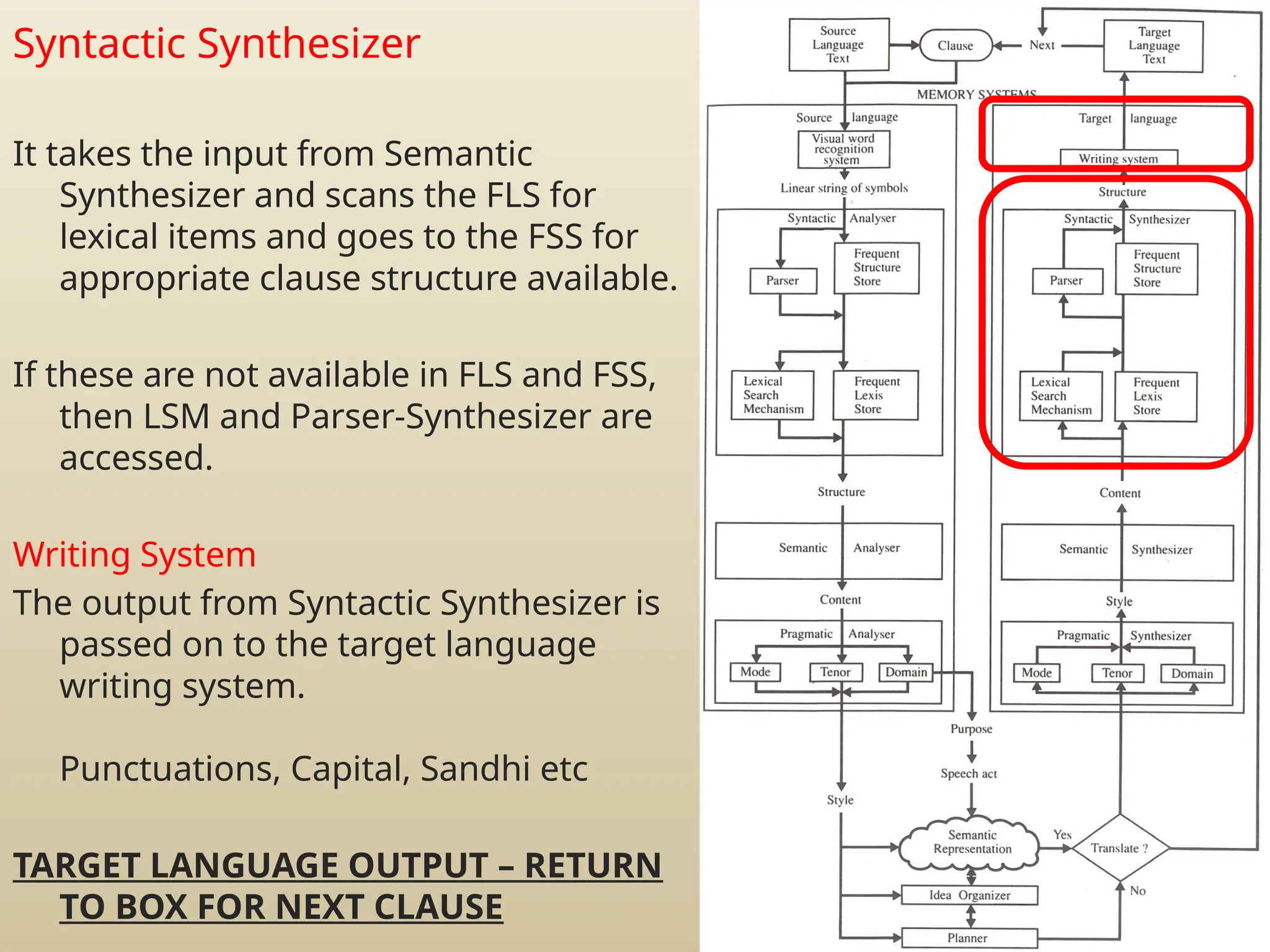
Syntactic Synthesizer
It takesthe input from Semantic
Synthesizer and scans the FLS for
lexical items and goes to the FSS for
appropriate clause structure available.
If these are not available in FLS and FSS,
then LSM and Parser-Synthesizer are
accessed.
Writing System
The output from Syntactic Synthesizer is
passed on to the target language
writing system.
Punctuations, Capital, Sandhi etc
TARGET LANGUAGE OUTPUT – RETURN
TO BOX FOR NEXT CLAUSE
![Syntactic Analyser
Ex. Once upon a time…
Takes a default route for the
Italian - C’era una volta
Kannada – ondaanoMdu kaaladalli
Frequent Structure Store (FSS)
Clause level Ex.vah aayi (S P)
The monkey ate the oranges (S P O)
Arun built the palace (S P O)
Phrase level
Ex.a beautiful flower
(m[det] m[adj] h[noun)
Frequent Lexis Store (FLS)
Instant look up glossary
Lexical items usually associated with
structures
Ex. kauva = ‘crow’
‘this’ = yah, is
Marked structures are not available](https://image.slidesharecdn.com/linguistictheoryfortranslators10-07-17-250401033909-7f45b1d4/75/Linguistic-Theory-for-Translators-10-07-17-pptx-24-2048.jpg)