Field Study
1&2

Experiential Learning Courses
Prepared By: Xyrille

Yves A. Zaide
BSED - IV
General Objective #1
Identify the stage of the physical,
motor, linguistic, cognitive, social
and emotional development of
the students as manifested in the
actual classroom setting.
General Objective #2
Observe and reflect on the
different approaches employed
by the teacher in dealing with
learners in the different stages
of development.
General Objective #3
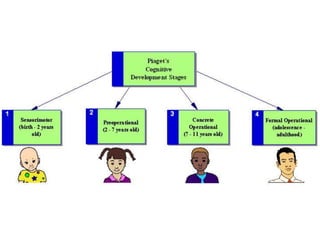
Analyze how the teaching and
learning process should be
conducted considering the
different phases of child
development
The School
as a Learning Environment
Episode

1
“Building Friendship”
Peace Concept in Focus
The purpose of observation
is to provide opportunity
for you to relate theory to
actual practice
To help you do this, remember to:
Know and understand what you exactly need
to observe
Study the observation guides, listen to your
FS teacher and do not hesitate to ask
questions to make sure all is clear to you.
Always have pen and paper ready to jot down
details
Carefully separate facts from
interpretations
Accomplish the checklists/forms A.S.A.P. so
that the details are still fresh in your mind
The core business
of schools is to provide
students with a rich
learning environment that
is open, respectful, caring
and safe.

LEARNING ENVIRONMENT
This ideal learning environment
optimises wellbeing.
It reflects a positive school
ethos that makes the school an
exciting, stimulating and welcoming
place.

http://deta.qld.gov.au/initiatives/learningandwellbeing/learning-environment.html
Episode 1 – Specific Tasks
 Visit a school, look into its
facilities and areas that support
learning
 Describe the learning environment

Prepare an observation log
Episode 1 – Learning Evidence
An illustration of a school that is
supportive of learning or a “childfriendly school” through any of the
following:
 Descriptive Paragraph
Photo essay
Episode 1 - Domain
Learning environment
Curriculum
Episode 1 - Competencies
Determines an environment that
provides social, psychological and
physical environment supportive of
learning.
“I entered the classroom with the
conviction that it was crucial for me
and every other student to be an
active participant,
not a passive consumer…
Learning is a place where paradise
can be created.”

- Bell Hooks
“To learn and not to think over what
you have learned is perfectly useless.
To think without having learned is
dangerous.”
- Gore Vidal
Learner’s Characteristics and
Needs
Episode

2
YOU AND I
ARE DIFFERENT
“Valuing Diversity”
Peace Concept in Focus
A person's
individual profile or learner
characteristics will determine
the way they respond to both
formal and informal learning
environments.

LEARNERS
– Characteristics and needs –
Although learner characteristics
can provide some general information,
be careful not to stereotype your
learners. Every learner is an individual
and "general" learner characteristics
should only be used as a guide.

http://toolboxes.flexiblelearning.net.au/demosites/series12/12_09/toolbox12_09/resource
s/training/book/qg/understandlearn/characteristics.htm
Episode 2 – Specific Tasks
 Observe 3 groups of learners from
different levels
 describe each group of learners
based on your observations
Validate your observation by
interviewing the learners
Compare them in terms of their
interests and needs
Episode 2 – Learning Evidence
Narrative description
of Diversity among children
Episode 2 - Domain
 Diversity of Learners
Episode 2 - Competencies
Differentiate Learners of varied
characteristics and needs.
“ To be a teacher in the right sense
is to be a learner.
Instruction begins when you, the
teacher, learn from the learner.
Put yourself in his place so that you
may understand what he understands
and in the way he understands it.”
- Soren Kierkegaard
Erikson’s Epigenetic Principle
This principle says that we
develop through a predetermined
unfolding of our personalities. Our
progress through each stage of life
is in part determined by our success,
or lack of success in all the previous
stages.
“It is little like the unfolding of a
rose bud petal opens up at a certain
time, in a certain order, which
nature, through its genetics, has
determined. If we interfere in the
natural order of development by
pulling a petal forward prematurely
or out of order, we ruin the
development of the entire flower.”
- Dr. C. George Boeree
2 teach, is
+ 2 touch lives
4 ever
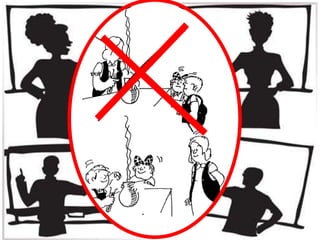
Classroom Management
and Learning
Episode 3
“Inclusivity”
Peace Concept in Focus
The process of
ensuring that classroom lessons
run smoothly despite disruptive
behavior by students

CLASSROOM MANAGEMENT
Constructivist teachers feel that
effective classroom management skills
impact the way in which students learn.
“Classroom management refers to
all the things that teachers do to
organize students, space, time, and
materials
to
maximize
effective
teaching and student learning”
- Wong & Wong, 1998
http://www.aug.edu/~mwarner/promise/Management/article_intro.htm
Episode 3 – Specific Tasks
Using a checklist, find out the
evident classroom components
Describe how the classroom is
structured / designed to allow
everyone to participate in learning
activities
Relate the data in your checklist to
the learners’ behavior
Reflect
on
how
classroom
management affects learning
Episode 3 – Learning Evidence
 Checklist on classroom management
components
 Photo documentation of classroom
setting
 Reflection paper on activities that
allow
inclusivity
rather
than
exclusivity among learners
Episode 3 - Domain
Learning environment
Diversity of Learners
Episode 3 - Competencies
Teacher manages time, space and

resources to provide an environment
appropriate to the learners and
conducive for learning.
"No matter how well a teacher knows
the subject matter or how well he or
she can teach, a teacher who cannot
manage a class is finished.“
- Howard Seeman
Individual Differences
and Learner’s Interaction
Episode 4
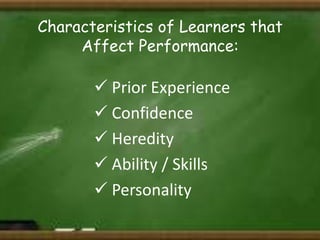
Characteristics of Learners that
Affect Performance:

 Prior Experience
 Confidence
 Heredity
 Ability / Skills
 Personality
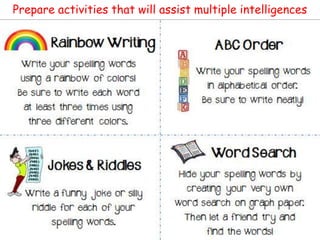
Prepare activities that will assist multiple intelligences
Teachers nurture students’
engagement through authentic
activities and opportunities to work
with classmates.

LEARNERS

– Characteristics and Activities –
Teachers offer choices because
they understand that students are
more motivated when they can make
choices and or choose the activities
where they could perform best.

http://www.education.com/reference/article/characteristics-learners-classroom/
Episode 4 – Specific Tasks
Take
note
of
characteristics in class

Learners’

Enumerate
and
describe
the
activities that took place in the class
Analyze
how
the
activities
facilitated learning considering the
learners’ characteristics.
Episode 4 – Learning Evidence
 Collection of classroom activities
written on card boards of rainbow colors
 A reflection paper on the congruence or
match of learning activities to the
learners’ characteristics
 Reflection on the interaction
learners despite differences

of
Episode 4 - Domain
Learning environment
Diversity of Learners
Episode 4 - Competencies
 Recognizes multi-cultural
backgrounds of learners when
providing opportunities
Determines Teaching approaches
and techniques appropriate to the
learners.
“It takes a world of difference to
make a difference in the world.“
- From a children’s song
(Quoted In Covey’s 8th habit DVD)
Individual Differences
And Learner’s Interaction
Episode 5
To learn is to acquire knowledge or
skill. Learning also may involve a change
in attitude or behavior.
An individual's background strongly
influences the way that person learns.
To be effective, the learning situation
also should be purposeful, based on
experience, multifaceted, and involve
an active process.
http://www.dynamicflight.com/avcfibook/learning_process
/
“Sameness in dIfferences”
Peace Concept in Focus
The study processes used by a
student during learning will be
related to both the amount learned
and the quality of his learning.

LEARNING PROCESS
– Individual Differences –
Motivation, abilities and intelligence
are not the only determinants of
learning outcomes.
A number of other individual
variables shape what and how well
students will learn.
http://cte-blog.uwaterloo.ca/?p=2348
These include:
• prior knowledge and
experience which refer to the
quality and accuracy of
relevant prior knowledge;
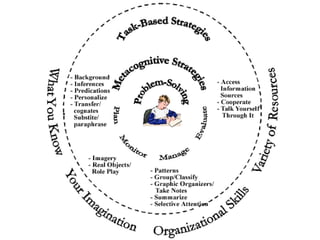
• learning strategies and tactics
which refer to cognitive and
metacognitive strategies used
by learners;
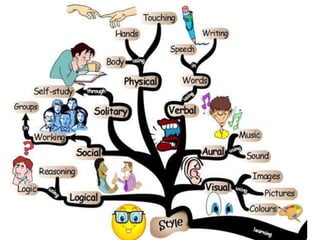
• learning or cognitive styles which
refer to preferred ways for
processing information and
approaching a learning task;
• learners’ conceptions of learning and
themselves as learners;
• personality
(self-esteem, risk-taking, resilience, sensitivity to
rejection, tolerance to ambiguity, anxiety, etc.).
Episode 5 – Specific Tasks
Observe learners of different
learning abilities but the same
grade/year
Take note of characteristics of the
learners in the class focusing on
gender and cultural diversity

Write a narrative report
Episode 5 – Learning Evidence
Learner’s profile

Narrative report of diversity among
children
Description on how the teacher instil
among children the values and
knowledge on differences in gender,
social and cultural backgrounds.
Episode 5 - Domain
Diversity of Learners
Episode 5 - Competencies
Determines, understands and accepts
the learners’ diverse background
Relates the learners’ background to
their performance in the classroom
Recognizes cultural backgrounds of
learners
Diversity

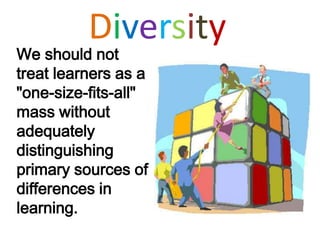
We should not
treat learners as a
"one-size-fits-all"
mass without
adequately
distinguishing
primary sources of
differences in
learning.
Home-School Link
Episode 6
“Unity in Diversity”
Peace Concept in Focus
discipline is about children
learning self control. it helps
them learn that there are
consequences for their
actions, and that they need to
think carefully about the
decisions they make.

Home and School
– link on discipline –
Episode 6 – Specific Tasks
Select a learner from the class
observed and conduct a home visit
Describe the family in terms of:
- Number of siblings
- Number of siblings in school

Interview the parents about
- Rules implemented at home concerning their
child’s schooling
- The learner’s activities and behavior while at
home
Episode 6 – Learning Evidence
Reflection on the impact of
home and family life to learning
Episode 6 – Domain
Learning environment
Field Study 1 & 2
Experiential Learning Courses
General Objective #1
Arrive at an experiential
knowledge and understanding
of the principles of teaching
and learning.
General Objective #2
Reflect on the application of the
principles of teaching and
learning for meaningful and
lasting learning.
4 components of a
MEANINGFUL LEARNING
1. ENVIRONMENT- emphasizes the
teacher-student relationship.
2. EXPERIENCE
3. MEANING- a teacher should make
the meaning more personal, for the
students to understand and relate.
4. MOTIVATION- the most important
component and a major factor in
developing and improving the
eagerness, willingness and interest of
a learner to learn.
http://precioustine.blogspot.com/2010/08/article22components-of-meaningful.html
General Objective #3
Analyze how the teaching and
learning process should be
conducted considering the
different phases of child
development
General Objective #4
Acquire the skill in developing
cognitive, skill and value lessons
meaningfully and interestingly by
an in-depth treatment of the
subject matter by integrating
thinking skills
General Objective #5
Apply the guiding principles in
the selection of teaching
strategies
General Objective #6
Identify the teaching approach
employed
General Objective #7
Trace the logical development
of a lesson.
General Objective #8
Identify effective questioning
and reacting techniques.
Principles of Learning
Episode

1
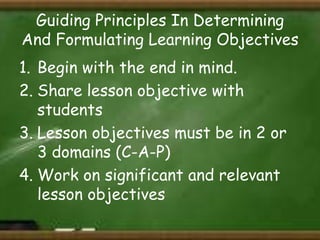
Guiding Principles In Determining
And Formulating Learning Objectives
1. Begin with the end in mind.
2. Share lesson objective with
students
3. Lesson objectives must be in 2 or
3 domains (C-A-P)
4. Work on significant and relevant
lesson objectives
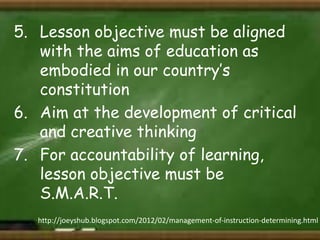
5. Lesson objective must be aligned
with the aims of education as
embodied in our country’s
constitution
6. Aim at the development of critical
and creative thinking
7. For accountability of learning,
lesson objective must be
S.M.A.R.T.
http://joeyshub.blogspot.com/2012/02/management-of-instruction-determining.html
Lesson Objectives as My
Guiding Star
Episode 2
Organizing Content for
Meaningful Learning
Episode

3
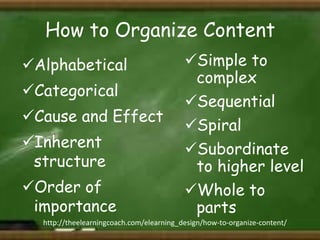
How to Organize Content
Alphabetical

Categorical
Cause and Effect

Inherent
structure
Order of
importance

Simple to
complex
Sequential
Spiral
Subordinate
to higher level
Whole to
parts

http://theelearningcoach.com/elearning_design/how-to-organize-content/
Guiding Principles in the
Selection and use of
Teaching Strategies
Episode 4
Teaching Approaches
and Methods
Episode 5
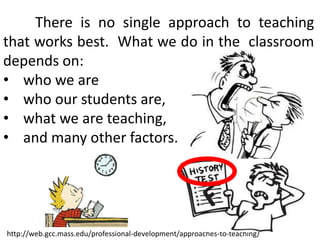
There is no single approach to teaching
that works best. What we do in the classroom
depends on:
• who we are
• who our students are,
• what we are teaching,
• and many other factors.

http://web.gcc.mass.edu/professional-development/approaches-to-teaching/
Look for ways to prompt students to
think more deeply about course concepts
and the learning process through Prompts
that get Students to Analyze, Reflect,
Relate, and Question.
Home-School Link
Episode 6
Home–School Partnerships
display many of the following features:
• Relationships in successful home–school
partnerships are collaborative and mutually
respectful.
• Successful partnerships are multi-dimensional,
and responsive to community needs.
• Successful home–school partnerships are
planned for; embedded within whole school
development plans; well resourced and
regularly reviewed.
• Successful partnerships are goal oriented and
focused on learning.
• Effective parental engagement happens
largely at home.
• There is timely two-way communication
between school and parents in successful
partnerships.
Effective Questioning
and Reacting Techniques
Episode 5
Why Ask Questions?
Teachers ask questions for a variety of
purposes, including:
•
•
•
•
•
•
•
•

To actively involve students in the lesson
To increase motivation or interest
To evaluate students’ preparation
To check on completion of work
To develop critical thinking skills
To review previous lessons
To nurture insights
To assess achievement or mastery of goals
and objectives
• To stimulate independent learning
http://beyondpenguins.ehe.osu.edu/issue/energy-and-the-polar-environment/questioningtechniques-research-based-strategies-for-teachers
Types of Questions
Educators have traditionally
classified questions according to
Bloom’s Taxonomy, a hierarchy of
increasingly complex intellectual
skills.
FEEDBACK :
Redirecting, Probing and Responding
A teacher’s response to students’
answers is just as important as the
question asked.
A response may redirect students
when an incorrect answer is given or
students misinterpret the question.
Teachers may probe for further
explanation when a partial answer is
given. Finally, teachers may validate a
correct response.
“Children go to school as question
marks and leave school as periods.”
-Neil Postman.

www.slideshare.net/rowenativoli/effective-questioning-2-3427422
In teaching, it takes the form of a
problem at the start of an
investigation or query about a current
issue such as time or classroom
management. It is a statement that
demands an explanation, a purpose or
an argument. It is the question, stated
in any form that unlocks thinking.
Hence, it is integral in the teaching
practice.
-Rowena M. Tivoli
www.slideshare.net/rowenativoli/effective-questioning-2-3427422
Fs 1 & 2

Fs 1 & 2

  • 1.
    Field Study 1&2 Experiential LearningCourses Prepared By: Xyrille Yves A. Zaide BSED - IV
  • 3.
    General Objective #1 Identifythe stage of the physical, motor, linguistic, cognitive, social and emotional development of the students as manifested in the actual classroom setting.
  • 4.
    General Objective #2 Observeand reflect on the different approaches employed by the teacher in dealing with learners in the different stages of development.
  • 5.
    General Objective #3 Analyzehow the teaching and learning process should be conducted considering the different phases of child development
  • 6.
    The School as aLearning Environment Episode 1
  • 8.
  • 9.
    The purpose ofobservation is to provide opportunity for you to relate theory to actual practice To help you do this, remember to:
  • 10.
    Know and understandwhat you exactly need to observe Study the observation guides, listen to your FS teacher and do not hesitate to ask questions to make sure all is clear to you. Always have pen and paper ready to jot down details Carefully separate facts from interpretations Accomplish the checklists/forms A.S.A.P. so that the details are still fresh in your mind
  • 11.
    The core business ofschools is to provide students with a rich learning environment that is open, respectful, caring and safe. LEARNING ENVIRONMENT
  • 12.
    This ideal learningenvironment optimises wellbeing. It reflects a positive school ethos that makes the school an exciting, stimulating and welcoming place. http://deta.qld.gov.au/initiatives/learningandwellbeing/learning-environment.html
  • 13.
    Episode 1 –Specific Tasks  Visit a school, look into its facilities and areas that support learning  Describe the learning environment Prepare an observation log
  • 14.
    Episode 1 –Learning Evidence An illustration of a school that is supportive of learning or a “childfriendly school” through any of the following:  Descriptive Paragraph Photo essay
  • 15.
    Episode 1 -Domain Learning environment Curriculum
  • 16.
    Episode 1 -Competencies Determines an environment that provides social, psychological and physical environment supportive of learning.
  • 17.
    “I entered theclassroom with the conviction that it was crucial for me and every other student to be an active participant, not a passive consumer… Learning is a place where paradise can be created.” - Bell Hooks
  • 18.
    “To learn andnot to think over what you have learned is perfectly useless. To think without having learned is dangerous.” - Gore Vidal
  • 19.
  • 20.
    YOU AND I AREDIFFERENT
  • 22.
  • 23.
    A person's individual profileor learner characteristics will determine the way they respond to both formal and informal learning environments. LEARNERS – Characteristics and needs –
  • 24.
    Although learner characteristics canprovide some general information, be careful not to stereotype your learners. Every learner is an individual and "general" learner characteristics should only be used as a guide. http://toolboxes.flexiblelearning.net.au/demosites/series12/12_09/toolbox12_09/resource s/training/book/qg/understandlearn/characteristics.htm
  • 25.
    Episode 2 –Specific Tasks  Observe 3 groups of learners from different levels  describe each group of learners based on your observations Validate your observation by interviewing the learners Compare them in terms of their interests and needs
  • 26.
    Episode 2 –Learning Evidence Narrative description of Diversity among children
  • 27.
    Episode 2 -Domain  Diversity of Learners
  • 28.
    Episode 2 -Competencies Differentiate Learners of varied characteristics and needs.
  • 29.
    “ To bea teacher in the right sense is to be a learner. Instruction begins when you, the teacher, learn from the learner. Put yourself in his place so that you may understand what he understands and in the way he understands it.” - Soren Kierkegaard
  • 30.
    Erikson’s Epigenetic Principle Thisprinciple says that we develop through a predetermined unfolding of our personalities. Our progress through each stage of life is in part determined by our success, or lack of success in all the previous stages.
  • 31.
    “It is littlelike the unfolding of a rose bud petal opens up at a certain time, in a certain order, which nature, through its genetics, has determined. If we interfere in the natural order of development by pulling a petal forward prematurely or out of order, we ruin the development of the entire flower.” - Dr. C. George Boeree
  • 32.
    2 teach, is +2 touch lives 4 ever
  • 33.
  • 35.
  • 36.
    The process of ensuringthat classroom lessons run smoothly despite disruptive behavior by students CLASSROOM MANAGEMENT
  • 37.
    Constructivist teachers feelthat effective classroom management skills impact the way in which students learn. “Classroom management refers to all the things that teachers do to organize students, space, time, and materials to maximize effective teaching and student learning” - Wong & Wong, 1998 http://www.aug.edu/~mwarner/promise/Management/article_intro.htm
  • 38.
    Episode 3 –Specific Tasks Using a checklist, find out the evident classroom components Describe how the classroom is structured / designed to allow everyone to participate in learning activities
  • 39.
    Relate the datain your checklist to the learners’ behavior Reflect on how classroom management affects learning
  • 40.
    Episode 3 –Learning Evidence  Checklist on classroom management components  Photo documentation of classroom setting  Reflection paper on activities that allow inclusivity rather than exclusivity among learners
  • 41.
    Episode 3 -Domain Learning environment Diversity of Learners
  • 42.
    Episode 3 -Competencies Teacher manages time, space and resources to provide an environment appropriate to the learners and conducive for learning.
  • 43.
    "No matter howwell a teacher knows the subject matter or how well he or she can teach, a teacher who cannot manage a class is finished.“ - Howard Seeman
  • 44.
  • 45.
    Characteristics of Learnersthat Affect Performance:  Prior Experience  Confidence  Heredity  Ability / Skills  Personality
  • 46.
    Prepare activities thatwill assist multiple intelligences
  • 47.
    Teachers nurture students’ engagementthrough authentic activities and opportunities to work with classmates. LEARNERS – Characteristics and Activities –
  • 48.
    Teachers offer choicesbecause they understand that students are more motivated when they can make choices and or choose the activities where they could perform best. http://www.education.com/reference/article/characteristics-learners-classroom/
  • 49.
    Episode 4 –Specific Tasks Take note of characteristics in class Learners’ Enumerate and describe the activities that took place in the class Analyze how the activities facilitated learning considering the learners’ characteristics.
  • 50.
    Episode 4 –Learning Evidence  Collection of classroom activities written on card boards of rainbow colors  A reflection paper on the congruence or match of learning activities to the learners’ characteristics  Reflection on the interaction learners despite differences of
  • 51.
    Episode 4 -Domain Learning environment Diversity of Learners
  • 52.
    Episode 4 -Competencies  Recognizes multi-cultural backgrounds of learners when providing opportunities Determines Teaching approaches and techniques appropriate to the learners.
  • 53.
    “It takes aworld of difference to make a difference in the world.“ - From a children’s song (Quoted In Covey’s 8th habit DVD)
  • 54.
  • 55.
    To learn isto acquire knowledge or skill. Learning also may involve a change in attitude or behavior. An individual's background strongly influences the way that person learns. To be effective, the learning situation also should be purposeful, based on experience, multifaceted, and involve an active process. http://www.dynamicflight.com/avcfibook/learning_process /
  • 57.
  • 58.
    The study processesused by a student during learning will be related to both the amount learned and the quality of his learning. LEARNING PROCESS – Individual Differences –
  • 59.
    Motivation, abilities andintelligence are not the only determinants of learning outcomes. A number of other individual variables shape what and how well students will learn. http://cte-blog.uwaterloo.ca/?p=2348
  • 60.
    These include: • priorknowledge and experience which refer to the quality and accuracy of relevant prior knowledge; • learning strategies and tactics which refer to cognitive and metacognitive strategies used by learners;
  • 61.
    • learning orcognitive styles which refer to preferred ways for processing information and approaching a learning task; • learners’ conceptions of learning and themselves as learners; • personality (self-esteem, risk-taking, resilience, sensitivity to rejection, tolerance to ambiguity, anxiety, etc.).
  • 62.
    Episode 5 –Specific Tasks Observe learners of different learning abilities but the same grade/year Take note of characteristics of the learners in the class focusing on gender and cultural diversity Write a narrative report
  • 63.
    Episode 5 –Learning Evidence Learner’s profile Narrative report of diversity among children Description on how the teacher instil among children the values and knowledge on differences in gender, social and cultural backgrounds.
  • 64.
    Episode 5 -Domain Diversity of Learners
  • 65.
    Episode 5 -Competencies Determines, understands and accepts the learners’ diverse background Relates the learners’ background to their performance in the classroom Recognizes cultural backgrounds of learners
  • 66.
    Diversity We should not treatlearners as a "one-size-fits-all" mass without adequately distinguishing primary sources of differences in learning.
  • 67.
  • 68.
  • 69.
    discipline is aboutchildren learning self control. it helps them learn that there are consequences for their actions, and that they need to think carefully about the decisions they make. Home and School – link on discipline –
  • 70.
    Episode 6 –Specific Tasks Select a learner from the class observed and conduct a home visit Describe the family in terms of: - Number of siblings - Number of siblings in school Interview the parents about - Rules implemented at home concerning their child’s schooling - The learner’s activities and behavior while at home
  • 71.
    Episode 6 –Learning Evidence Reflection on the impact of home and family life to learning
  • 72.
    Episode 6 –Domain Learning environment
  • 74.
    Field Study 1& 2 Experiential Learning Courses
  • 76.
    General Objective #1 Arriveat an experiential knowledge and understanding of the principles of teaching and learning.
  • 78.
    General Objective #2 Reflecton the application of the principles of teaching and learning for meaningful and lasting learning.
  • 79.
    4 components ofa MEANINGFUL LEARNING 1. ENVIRONMENT- emphasizes the teacher-student relationship. 2. EXPERIENCE
  • 80.
    3. MEANING- ateacher should make the meaning more personal, for the students to understand and relate. 4. MOTIVATION- the most important component and a major factor in developing and improving the eagerness, willingness and interest of a learner to learn. http://precioustine.blogspot.com/2010/08/article22components-of-meaningful.html
  • 81.
    General Objective #3 Analyzehow the teaching and learning process should be conducted considering the different phases of child development
  • 83.
    General Objective #4 Acquirethe skill in developing cognitive, skill and value lessons meaningfully and interestingly by an in-depth treatment of the subject matter by integrating thinking skills
  • 85.
    General Objective #5 Applythe guiding principles in the selection of teaching strategies
  • 87.
    General Objective #6 Identifythe teaching approach employed
  • 89.
    General Objective #7 Tracethe logical development of a lesson.
  • 91.
    General Objective #8 Identifyeffective questioning and reacting techniques.
  • 93.
  • 94.
    Guiding Principles InDetermining And Formulating Learning Objectives 1. Begin with the end in mind. 2. Share lesson objective with students 3. Lesson objectives must be in 2 or 3 domains (C-A-P) 4. Work on significant and relevant lesson objectives
  • 95.
    5. Lesson objectivemust be aligned with the aims of education as embodied in our country’s constitution 6. Aim at the development of critical and creative thinking 7. For accountability of learning, lesson objective must be S.M.A.R.T. http://joeyshub.blogspot.com/2012/02/management-of-instruction-determining.html
  • 96.
    Lesson Objectives asMy Guiding Star Episode 2
  • 98.
  • 99.
    How to OrganizeContent Alphabetical Categorical Cause and Effect Inherent structure Order of importance Simple to complex Sequential Spiral Subordinate to higher level Whole to parts http://theelearningcoach.com/elearning_design/how-to-organize-content/
  • 100.
    Guiding Principles inthe Selection and use of Teaching Strategies Episode 4
  • 103.
  • 105.
    There is nosingle approach to teaching that works best. What we do in the classroom depends on: • who we are • who our students are, • what we are teaching, • and many other factors. http://web.gcc.mass.edu/professional-development/approaches-to-teaching/
  • 106.
    Look for waysto prompt students to think more deeply about course concepts and the learning process through Prompts that get Students to Analyze, Reflect, Relate, and Question.
  • 107.
  • 109.
    Home–School Partnerships display manyof the following features: • Relationships in successful home–school partnerships are collaborative and mutually respectful. • Successful partnerships are multi-dimensional, and responsive to community needs.
  • 110.
    • Successful home–schoolpartnerships are planned for; embedded within whole school development plans; well resourced and regularly reviewed. • Successful partnerships are goal oriented and focused on learning.
  • 111.
    • Effective parentalengagement happens largely at home. • There is timely two-way communication between school and parents in successful partnerships.
  • 112.
  • 113.
  • 114.
    Teachers ask questionsfor a variety of purposes, including: • • • • • • • • To actively involve students in the lesson To increase motivation or interest To evaluate students’ preparation To check on completion of work To develop critical thinking skills To review previous lessons To nurture insights To assess achievement or mastery of goals and objectives • To stimulate independent learning http://beyondpenguins.ehe.osu.edu/issue/energy-and-the-polar-environment/questioningtechniques-research-based-strategies-for-teachers
  • 115.
    Types of Questions Educatorshave traditionally classified questions according to Bloom’s Taxonomy, a hierarchy of increasingly complex intellectual skills.
  • 116.
    FEEDBACK : Redirecting, Probingand Responding A teacher’s response to students’ answers is just as important as the question asked. A response may redirect students when an incorrect answer is given or students misinterpret the question. Teachers may probe for further explanation when a partial answer is given. Finally, teachers may validate a correct response.
  • 117.
    “Children go toschool as question marks and leave school as periods.” -Neil Postman. www.slideshare.net/rowenativoli/effective-questioning-2-3427422
  • 118.
    In teaching, ittakes the form of a problem at the start of an investigation or query about a current issue such as time or classroom management. It is a statement that demands an explanation, a purpose or an argument. It is the question, stated in any form that unlocks thinking. Hence, it is integral in the teaching practice. -Rowena M. Tivoli www.slideshare.net/rowenativoli/effective-questioning-2-3427422