Student: Aura Villa
Teacher: Gonzalo Puma
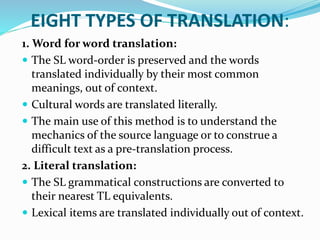
EIGHT TYPES OF TRANSLATION:
1. Word for word translation:
 The SL word-order is preserved and the words
translated individually by their most common
meanings, out of context.
 Cultural words are translated literally.
 The main use of this method is to understand the
mechanics of the source language or to construe a
difficult text as a pre-translation process.
2. Literal translation:
 The SL grammatical constructions are converted to
their nearest TL equivalents.
 Lexical items are translated individually out of context.
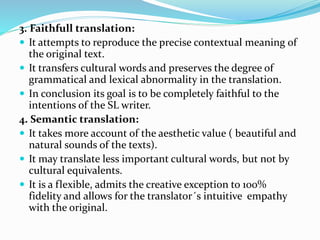
3. Faithfull translation:
 It attempts to reproduce the precise contextual meaning of
the original text.
 It transfers cultural words and preserves the degree of
grammatical and lexical abnormality in the translation.
 In conclusion its goal is to be completely faithful to the
intentions of the SL writer.
4. Semantic translation:
 It takes more account of the aesthetic value ( beautiful and
natural sounds of the texts).
 It may translate less important cultural words, but not by
cultural equivalents.
 It is a flexible, admits the creative exception to 100%
fidelity and allows for the translator´s intuitive empathy
with the original.
5. Adaptation:
 It is the freest form of translation.
 It is used mainly for plays ( comedy and poetry)
 The SL culture converted to the TL culture and the text
rewritten.
6. Free Translation:
 It reproduces the matter without the manner, or the
content without the form of the original.
 It is a paraphrase much longer than the original (
intralingual translation).
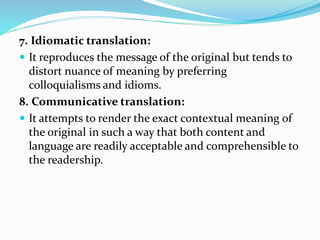
7. Idiomatic translation:
 It reproduces the message of the original but tends to
distort nuance of meaning by preferring
colloquialisms and idioms.
8. Communicative translation:
 It attempts to render the exact contextual meaning of
the original in such a way that both content and
language are readily acceptable and comprehensible to
the readership.
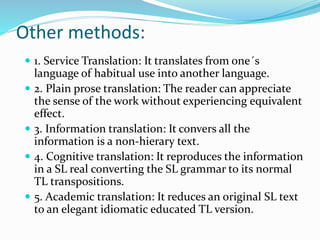
Other methods:
 1. Service Translation: It translates from one´s
language of habitual use into another language.
 2. Plain prose translation: The reader can appreciate
the sense of the work without experiencing equivalent
effect.
 3. Information translation: It convers all the
information is a non-hierary text.
 4. Cognitive translation: It reproduces the information
in a SL real converting the SL grammar to its normal
TL transpositions.
 5. Academic translation: It reduces an original SL text
to an elegant idiomatic educated TL version.

Translation methods

  • 1.
  • 2.
    EIGHT TYPES OFTRANSLATION: 1. Word for word translation:  The SL word-order is preserved and the words translated individually by their most common meanings, out of context.  Cultural words are translated literally.  The main use of this method is to understand the mechanics of the source language or to construe a difficult text as a pre-translation process. 2. Literal translation:  The SL grammatical constructions are converted to their nearest TL equivalents.  Lexical items are translated individually out of context.
  • 3.
    3. Faithfull translation: It attempts to reproduce the precise contextual meaning of the original text.  It transfers cultural words and preserves the degree of grammatical and lexical abnormality in the translation.  In conclusion its goal is to be completely faithful to the intentions of the SL writer. 4. Semantic translation:  It takes more account of the aesthetic value ( beautiful and natural sounds of the texts).  It may translate less important cultural words, but not by cultural equivalents.  It is a flexible, admits the creative exception to 100% fidelity and allows for the translator´s intuitive empathy with the original.
  • 4.
    5. Adaptation:  Itis the freest form of translation.  It is used mainly for plays ( comedy and poetry)  The SL culture converted to the TL culture and the text rewritten. 6. Free Translation:  It reproduces the matter without the manner, or the content without the form of the original.  It is a paraphrase much longer than the original ( intralingual translation).
  • 5.
    7. Idiomatic translation: It reproduces the message of the original but tends to distort nuance of meaning by preferring colloquialisms and idioms. 8. Communicative translation:  It attempts to render the exact contextual meaning of the original in such a way that both content and language are readily acceptable and comprehensible to the readership.
  • 6.
    Other methods:  1.Service Translation: It translates from one´s language of habitual use into another language.  2. Plain prose translation: The reader can appreciate the sense of the work without experiencing equivalent effect.  3. Information translation: It convers all the information is a non-hierary text.  4. Cognitive translation: It reproduces the information in a SL real converting the SL grammar to its normal TL transpositions.  5. Academic translation: It reduces an original SL text to an elegant idiomatic educated TL version.