S U HR I A
POSTGRADUATE PROGRAM OF UM PAREPARE
Translating & Interpreting
2.
TRANSLATION
1.Definitions in somekinds of Paradigm
2.Procedure of Translation
3.Method of Translation
4.Problem in Translation
5.Categories of Translation
According to Newmark:
Newmarkmakes two greatest contributions to translation studies. The first
one is his defining and illustrating of semantic translation and
communicative translation. According to him, the semantic translation is
inclined to the source language emphasis and mainly confined to
expressive texts, whereas communicative translation is inclined to the target
language emphasis and mainly confined to informative or vocative texts.
And we should not divide the two, but see them as a whole. The second
one is his understanding of translation.
TRANSLATION DEFINITIONS IN
LINGUISTIC PARADIGM
5.
According to Bassnett:
InBassnett’s opinion, translation is not only a kind of pure lingual
activity but also a kind of communication intra-culture and inter-
culture. In other words, translation is not a mere linguistic transfer
but a cross-cultural activity. She proposes that the cultural
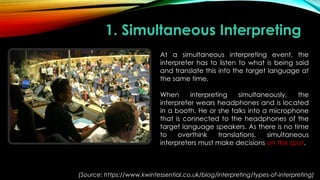
aspects should be taken into consideration for the study of
translation, especially for the equivalence of source text and
target text
TRANSLATION DEFINITIONS IN
CULTURAL PARADIGM
6.
According to EdwinGentzler:
Based on the recent studies in the Americas, especially multiculturalism in
the United States, feminism and theater in Canada, Cannibalism in Brazil,
the fictional turn in Latin America and border writing in the Caribbean,
Gentzler comes to the conclusion: translation is not a marginal activity in the
America but one of the central activities there which plays great roles in
forming a nation’s identity. He suggests including social and psychological
aspects to broaden the definition of translation
TRANSLATION DEFINITIONS IN
SOCIAL & PSYCHOLOGICAL PARADIGM
7.
The Translating Procedures,as depicted by
Nida(1964) as follow:
Procedure of Translation
II. Organizational procedures :
(1)Constant reevaluation of the attempt made; (2) contrasting it with
the existing available translations of the same text done by other
translators, and (3) checking the text's communicative effectiveness by
asking the target language readers to evaluate its accuracy and
effectiveness and studying their reactions (pp. 246-47).
I. Technical procedures:
(1)Analysis of the source and target languages; (2) A through study of
the source language text before making attempts translate it; (3) Making
judgments of the semantic and syntactic approximations. (pp. 241- 45)
8.
According to Newmark(1988):
Translation Method
vs Translation Procedure
The difference between translation methods and
translation procedures that translation methods relate
to whole texts, translation procedures are used for
sentences and the smaller units of language" (p.81).
9.
1. Word forword Translation
METHOD of Translation
Word-for-word translation: in which the SL word order is
preserved and the words translated singly by their most
common meanings, out of context.
By Newmark (1988)
10.
2. Literal Translation
METHODof Translation
Literal translation: in which the SL grammatical
constructions are converted to their nearest TL
equivalents, but the lexical words are again
translated singly, out of context.
11.
3. Faithful Translation
METHODof Translation
Faithful translation: it attempts to produce the
precise contextual meaning of the original within
the constraints of the TL grammatical structures.
12.
4. Semantic Translation
METHODof Translation
Semantic translation: which differs from 'faithful
translation' only in as far as it must take more
account of the aesthetic value of the SL text.
13.
5. Adaption Translation
METHODof Translation
Adaptation: which is the freest form of translation,
and is used mainly for plays (comedies) and
poetry; the themes, characters, plots are usually
preserved, the SL culture is converted to the TL
culture and the text is rewritten.
14.
6. Free Translation
METHODof Translation
Free translation: it produces the TL text without the
style, form, or content of the original.
15.
7. Idiomatic Translation
METHODof Translation
Idiomatic translation: it reproduces the 'message'
of the original but tends to distort nuances of
meaning by preferring colloquialisms and idioms
where these do not exist in the original.
16.
8. Communicative Translation
METHODof Translation
Communicative translation: it attempts to render
the exact contextual meaning of the original in
such a way that both content and language are
readily acceptable and comprehensible to the
readership
17.
Full vs PartialTranslatation
METHOD of Translation
This distinction relates to the extent, in a syntagmatic sense, of
source language text which is submitted to the translation process.
By text we tilean any stretch of language, spoken or written, which
is under discussion. According to the circumstances a text may thus
be a whole library of books, a single volume, a chapter, a
paragraph, a sentence, a cause.... Etc. It may also be a fragment
not coextensive with any formal literary or linguistic unit
18.
Full vs PartialTranslation
METHOD of Translation
In a full translation the entire
text is submitted to the
translation process; that is,
every part of the source
language text is replaced by
target language text material
In a partial translation, some part
or parts of the source language
text are left untranslated; they
are simply transferred to and
incorporated in the target
language text.
19.
Total vs RestrictedTranslation
METHOD of Translation
By total translation we mean what
is most usually meant by
translation. That is, translation
in which all levels of the source
language text are replaced by
target language material.
Strictly speaking, total translation
is a misleading term, since,
though total replacement is
involved it is not replacement by
equivalents at all levels.
By restricted translation Catford
means: replacement of source
language text material by
equivalent target language
textual material, at only one
level, that is translation
performed
only at the phonological or at the
graphological level, or at only
one of the two levels of
grammar and lexis.
20.
1. Perfect Translation
Translationof all purely informative statement such as are
encountered by the traveler or are used by the advertiser comes
under this category.
The perfection of the translation is a result of the nature of the
original message which is direct, unemotional and is made in
plain words to which no intense associations are attached
Savory (1959) Recognizes and
Categorizes translation as
21.
2. Adequate Translation
Adequatetranslation is which is so satisfactorily in practice that a grumble
at words and phrases here and there may be dismissed as a quibble. All
translations made for the general reader who may use them without giving
a thought to the fact that what he is reading was not originally written in his
own language. fall into this category. Both in the original and in the
translation the matter is more important than the manner, In most instances
of this kind the readers may know little or nothing of the language of the
original. This includes the translation of literature made by scholars for serious
students and for all earnest readers who seek something more than mere
entertainment.
Savory (1959) Recognizes and
Categorizes translation as
22.
3. Composite Translation
Itincludes the translation of prose into prose, of poetry into prose,
and of poetry into poetry. ie., all translations of literature come
under this. The translator neglecting the commercial value of the
translation, spends a very long time on his work. A great quantity
of translation is made, printed and published for the only reason
that the translator has enjoyed the reading of some passage or
poem, has felt the urge to try to render or express it in another
language he knew. He just wishes to share his pleasure with
others
Savory (1959) Recognizes and
Categorizes translation as
23.
4. Scientific andTechnical Translation
Scientific and technical translation: Here the first
importance is to the matter. The manner is of no
significance whatever. This type of translation is made
solely for the intrinsic importance of the original work.
Savory (1959) Recognizes and
Categorizes translation as
24.
Problem in Translation
Becauseliterature consists of conventional symbols, there exists
in literature the problem of translation which does not exist in
the other arts . When one seeks to make a work of literature
available to a wider audience than that composed of only the
native speakers of the language in which the work was written,
the process of translation must be restored to and in the
process a great deal of the work's original character is lost.
25.
1. Types ofInterpreting
2. Basic Skills in Interpreting
3. Code of Ethics in Interpreting
4. Strategies & Testing in Interpreting
5. Quality in Interpreting Criteria & Tools
Interpreting
26.
What is Interpreting?
Interpretingis the facilitation of spoken or signed language
communication between users of different languages. The formal
ISO (International Standards Organization) definition for interpreting
is as follows:
“Rendering a spoken or signed message into another spoken or
signed language, preserving the register and meaning of the source
language content.”
(Note: This definition is derived from ISO, 2014, p. 1.)
Source: https://www.gala-global.org/what-interpreting
1. Simultaneous Interpreting
Ata simultaneous interpreting event, the
interpreter has to listen to what is being said
and translate this into the target language at
the same time.
When interpreting simultaneously, the
interpreter wears headphones and is located
in a booth. He or she talks into a microphone
that is connected to the headphones of the
target language speakers. As there is no time
to overthink translations, simultaneous
interpreters must make decisions on the spot.
(Source: https://www.kwintessential.co.uk/blog/interpreting/types-of-interpreting)
29.
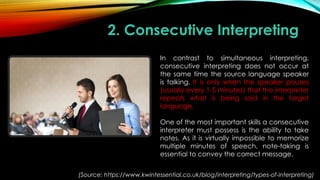
2. Consecutive Interpreting
Incontrast to simultaneous interpreting,
consecutive interpreting does not occur at
the same time the source language speaker
is talking. It is only when the speaker pauses
(usually every 1-5 minutes) that the interpreter
repeats what is being said in the target
language.
One of the most important skills a consecutive
interpreter must possess is the ability to take
notes. As it is virtually impossible to memorize
multiple minutes of speech, note-taking is
essential to convey the correct message.
(Source: https://www.kwintessential.co.uk/blog/interpreting/types-of-interpreting)
30.
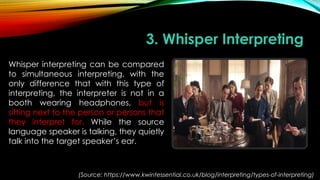
3. Whisper Interpreting
Whisperinterpreting can be compared
to simultaneous interpreting, with the
only difference that with this type of
interpreting, the interpreter is not in a
booth wearing headphones, but is
sitting next to the person or persons that
they interpret for. While the source
language speaker is talking, they quietly
talk into the target speaker’s ear.
(Source: https://www.kwintessential.co.uk/blog/interpreting/types-of-interpreting)
31.
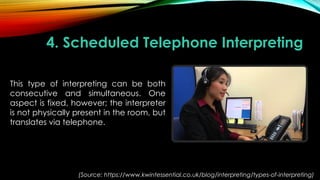
4. Scheduled TelephoneInterpreting
This type of interpreting can be both
consecutive and simultaneous. One
aspect is fixed, however; the interpreter
is not physically present in the room, but
translates via telephone.
(Source: https://www.kwintessential.co.uk/blog/interpreting/types-of-interpreting)