ESPE
THEORY AND PRACTICE OF
TRANSLATION
TRANSLATION METHODS
Fernanda Dávalos
1. Word for word translation
• Interlinear translation
• SL word order is preserved
• Words are translated by their most common
meaning, no context involved
• Cultural words are translated literally
• It is used to understand the mechanism of SL
The apple is red
La manzana es roja
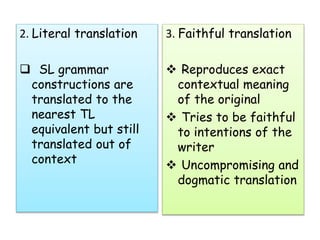
2. Literal translation
 SL grammar
constructions are
translated to the
nearest TL
equivalent but still
translated out of
context
3. Faithful translation
 Reproduces exact
contextual meaning
of the original
 Tries to be faithful
to intentions of the
writer
 Uncompromising and
dogmatic translation
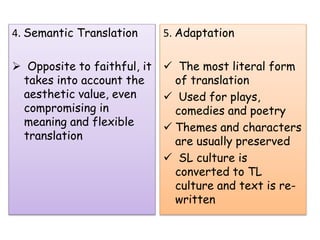
4. Semantic Translation
 Opposite to faithful, it
takes into account the
aesthetic value, even
compromising in
meaning and flexible
translation
5. Adaptation
 The most literal form
of translation
 Used for plays,
comedies and poetry
 Themes and characters
are usually preserved
 SL culture is
converted to TL
culture and text is re-
written
6. Free translation
 Reproduces the
content without the
form of the original,
uses paraphrasing
7. Idiomatic Translation
• Reproduces the
message but distorts
nuances by using
colloquialisms and
idioms
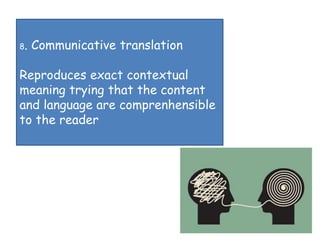
8. Communicative translation
Reproduces exact contextual
meaning trying that the content
and language are comprenhensible
to the reader

Translation methods

  • 1.
    ESPE THEORY AND PRACTICEOF TRANSLATION TRANSLATION METHODS Fernanda Dávalos
  • 2.
    1. Word forword translation • Interlinear translation • SL word order is preserved • Words are translated by their most common meaning, no context involved • Cultural words are translated literally • It is used to understand the mechanism of SL The apple is red La manzana es roja
  • 3.
    2. Literal translation SL grammar constructions are translated to the nearest TL equivalent but still translated out of context 3. Faithful translation  Reproduces exact contextual meaning of the original  Tries to be faithful to intentions of the writer  Uncompromising and dogmatic translation
  • 4.
    4. Semantic Translation Opposite to faithful, it takes into account the aesthetic value, even compromising in meaning and flexible translation 5. Adaptation  The most literal form of translation  Used for plays, comedies and poetry  Themes and characters are usually preserved  SL culture is converted to TL culture and text is re- written
  • 5.
    6. Free translation Reproduces the content without the form of the original, uses paraphrasing 7. Idiomatic Translation • Reproduces the message but distorts nuances by using colloquialisms and idioms
  • 6.
    8. Communicative translation Reproducesexact contextual meaning trying that the content and language are comprenhensible to the reader