TRANSLATION METHODS
By: Diana Priscila Montesdeoca Benitez.
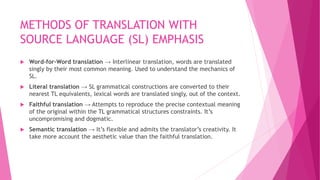
METHODS OF TRANSLATION WITH
SOURCE LANGUAGE (SL) EMPHASIS
 Word-for-Word translation → Interlinear translation, words are translated
singly by their most common meaning. Used to understand the mechanics of
SL.
 Literal translation → SL grammatical constructions are converted to their
nearest TL equivalents, lexical words are translated singly, out of the context.
 Faithful translation → Attempts to reproduce the precise contextual meaning
of the original within the TL grammatical structures constraints. It’s
uncompromising and dogmatic.
 Semantic translation → It’s flexible and admits the translator’s creativity. It
take more account the aesthetic value than the faithful translation.
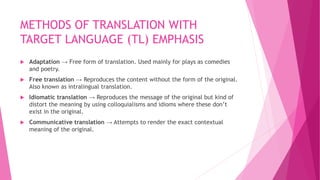
METHODS OF TRANSLATION WITH
TARGET LANGUAGE (TL) EMPHASIS
 Adaptation → Free form of translation. Used mainly for plays as comedies
and poetry.
 Free translation → Reproduces the content without the form of the original.
Also known as intralingual translation.
 Idiomatic translation → Reproduces the message of the original but kind of
distort the meaning by using colloquialisms and idioms where these don’t
exist in the original.
 Communicative translation → Attempts to render the exact contextual
meaning of the original.
COMMENTS IN THESE METHODS
The two methods that fulfil the two main aims of translation (accuracy and economy)
are: semantic and communicative translation.
EQUIVALENT EFFECT → It’s the desirable result of translation
 In communicative translation of vocative texts, equivalent effect is essential
 In semantic translation the more universal the text is the more the equivalent
effect is possible
Semantic translation
• More economical
• Written at the autor’s
level
• Used for expressive texts
• Is personal and individual
Communicative translation
• Less economical
• Written at the
readership’s level
• Used for informative and
vocative texts
• Is social
METHODS AND TEXT CATEGORIES
Text categories:
 Vocative texts → translated too literally
 Informative texts → translated too literally more closely than vocative texts
 Expressive texts → translated not literally enough, its unite of translation is
small
Other methods:
 Service translation → translation from one’s language of habitual use into
another language.
 Plain prose translation → translation of poems and poetic dramas. These are
often published in parallel with their originals.
 Information translation → conveys all the information in a non-hierarchy text.
 Academic translation → Reduces an original SL text to an elegant idiomatic
educated TL version.

Translation methods

  • 1.
    TRANSLATION METHODS By: DianaPriscila Montesdeoca Benitez.
  • 2.
    METHODS OF TRANSLATIONWITH SOURCE LANGUAGE (SL) EMPHASIS  Word-for-Word translation → Interlinear translation, words are translated singly by their most common meaning. Used to understand the mechanics of SL.  Literal translation → SL grammatical constructions are converted to their nearest TL equivalents, lexical words are translated singly, out of the context.  Faithful translation → Attempts to reproduce the precise contextual meaning of the original within the TL grammatical structures constraints. It’s uncompromising and dogmatic.  Semantic translation → It’s flexible and admits the translator’s creativity. It take more account the aesthetic value than the faithful translation.
  • 3.
    METHODS OF TRANSLATIONWITH TARGET LANGUAGE (TL) EMPHASIS  Adaptation → Free form of translation. Used mainly for plays as comedies and poetry.  Free translation → Reproduces the content without the form of the original. Also known as intralingual translation.  Idiomatic translation → Reproduces the message of the original but kind of distort the meaning by using colloquialisms and idioms where these don’t exist in the original.  Communicative translation → Attempts to render the exact contextual meaning of the original.
  • 4.
    COMMENTS IN THESEMETHODS The two methods that fulfil the two main aims of translation (accuracy and economy) are: semantic and communicative translation. EQUIVALENT EFFECT → It’s the desirable result of translation  In communicative translation of vocative texts, equivalent effect is essential  In semantic translation the more universal the text is the more the equivalent effect is possible Semantic translation • More economical • Written at the autor’s level • Used for expressive texts • Is personal and individual Communicative translation • Less economical • Written at the readership’s level • Used for informative and vocative texts • Is social
  • 5.
    METHODS AND TEXTCATEGORIES Text categories:  Vocative texts → translated too literally  Informative texts → translated too literally more closely than vocative texts  Expressive texts → translated not literally enough, its unite of translation is small Other methods:  Service translation → translation from one’s language of habitual use into another language.  Plain prose translation → translation of poems and poetic dramas. These are often published in parallel with their originals.  Information translation → conveys all the information in a non-hierarchy text.  Academic translation → Reduces an original SL text to an elegant idiomatic educated TL version.