Translation Methodology
Methods, Levels and
Techniques
Contents
1 THE ANALYSIS OF THE TEXT
2 DISCOURSE ANALYSIS
3 THE INTENTION OF THE TEXT
4 THE INTENTION OF THE TRANSLATOR
5 THE QUALITY OF THE WRITING
6 TRANSLATION METHODS AND LEVELS
7 TRANSLATION TECHNIQUES
The Analysis Of The Text
 Reading the text
- Is the starting point
We read the text to:
 Understand what it is about.
 Analyse it from a translator’s point of view not
from linguist’s, literary, teacher nor
student
 To determine it’s intention
 To determine the way it’s written to select a
suitable translation method
Kinds Of Reading When Analysing
The Text
 General reading is required
 We read the words both
• Out of the context
• In the context
 Close reading
• To get the gist
• To get the essence
• To get the substance
(literal
meaning)
(Interpretation)
The Last Reading
This last reading is done for the purpose
of
• Noting the cultural aspects of the SL text
 We have to underline all: Neologism,
Methophors, cultural words and
institutional terms peculiar to the SL,
proper names, technical terms and the
untranslatable words
The Analysis Of The Text
 Macro analysis
 Micro analysis
 Reading the text
• The intention of
the text
• The intention of
the translator
• The last reading
 Text styles
• The readership
 The quality of
the writing
DISCOURSE ANALYSIS
IN TRANSLATION
 MACRO ANALYSIS
 MICRO ANALYSIS
Macroanalysis
 This analysis
answers these
questions
 Who ?
 When ?
 Where ?
 For whom?
 How ?
Microanalysis
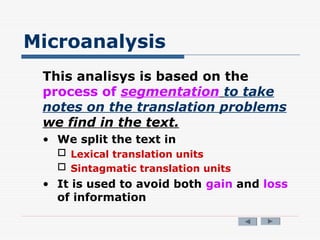
This analisys is based on the
process of segmentation to take
notes on the translation problems
we find in the text.
• We split the text in
 Lexical translation units
 Sintagmatic translation units
• It is used to avoid both gain and loss
of information
Microanalysis
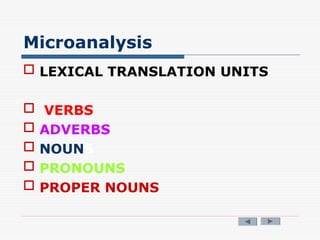
 LEXICAL TRANSLATION UNITS
 VERBS
 ADVERBS
 NOUNS
 PRONOUNS
 PROPER NOUNS
Microanalysis
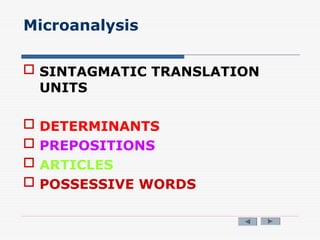
 SINTAGMATIC TRANSLATION
UNITS
 DETERMINANTS
 PREPOSITIONS
 ARTICLES
 POSSESSIVE WORDS
Examples
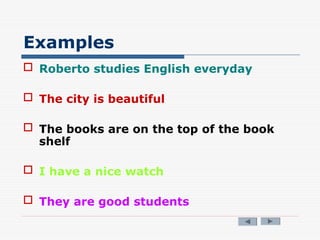
 Roberto studies English everyday
 The city is beautiful
 The books are on the top of the book
shelf
 I have a nice watch
 They are good students
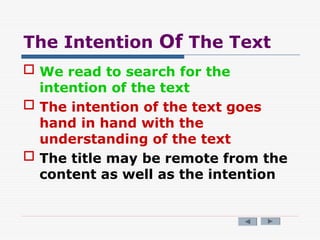
The Intention Of The Text
 We read to search for the
intention of the text
 The intention of the text goes
hand in hand with the
understanding of the text
 The title may be remote from the
content as well as the intention
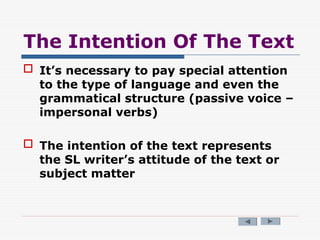
The Intention Of The Text
 It’s necessary to pay special attention
to the type of language and even the
grammatical structure (passive voice –
impersonal verbs)
 The intention of the text represents
the SL writer’s attitude of the text or
subject matter
The Intention Of The Translator
 Usually, the translator’s intention is
identical with that of the author of
the SL text
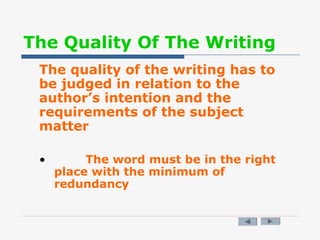
The Quality Of The Writing
The quality of the writing has to
be judged in relation to the
author’s intention and the
requirements of the subject
matter
• The word must be in the right
place with the minimum of
redundancy
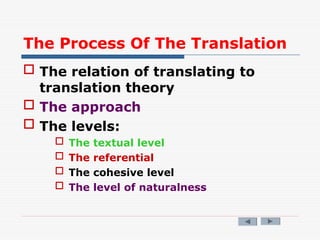
The Process Of The Translation
 The relation of translating to
translation theory
 The approach
 The levels:
 The textual level
 The referential
 The cohesive level
 The level of naturalness
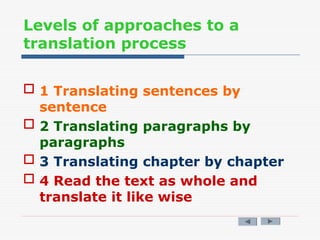
Levels of approaches to a
translation process
 1 Translating sentences by
sentence
 2 Translating paragraphs by
paragraphs
 3 Translating chapter by chapter
 4 Read the text as whole and
translate it like wise
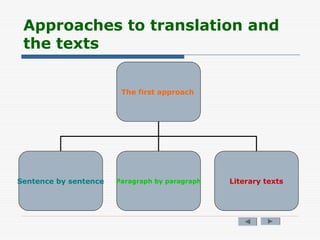
Approaches to translation and
the texts
The first approach
Sentence by sentence Paragraph by paragraph Literary texts
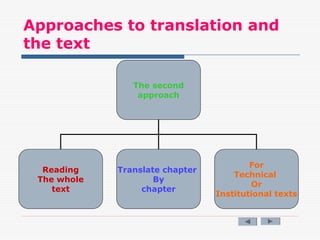
Approaches to translation and
the text
The second
approach
Reading
The whole
text
Translate chapter
By
chapter
For
Technical
Or
Institutional texts
DANGERS OF THE APPROACHES
 The fisrt approach
 It may leave you with
too much revision to
do in the early part
 It is time-wasting
 The second approach
 It is usually preferable
 It can be mechanical
 It may may inhibit the
translator`s free play
of intution
APPROACHES ALTERNATIVES
 The fisrt approach is advisable for
a relatively easy text
 The second approach is advisable
for harder texts
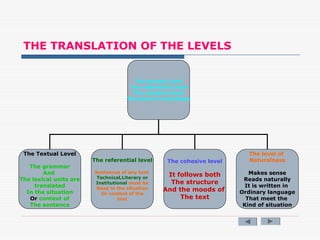
THE TRANSLATION OF THE LEVELS
The textual Level
The referential Level
The cohesive level
The level of naturlness
The Textual Level
The grammar
And
The lexical units are
translated
In the situation
Or context of
The sentence
The referential level
Sentences of any text
Technical,Literary or
Institutional must be
Read in the situation
Or context of the
text
The cohesive level
It follows both
The structure
And the moods of
The text
The level of
Naturalness
Makes sense
Reads naturally
It is written in
Ordinary language
That meet the
Kind of situation
Translation Methods And levels
Translation methods obey to the
main problem of translation it self
 To translate literally or freely
 This argument has been going on since
at least the first century B.C up to the
beginning the nineteenth century
 Many writers are in favor of free
translation
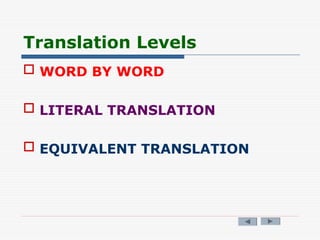
Translation Levels
 WORD BY WORD
 LITERAL TRANSLATION
 EQUIVALENT TRANSLATION
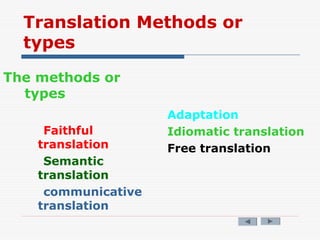
Translation Methods or
types
The methods or
types
Faithful
translation
Semantic
translation
communicative
translation
Adaptation
Idiomatic translation
Free translation
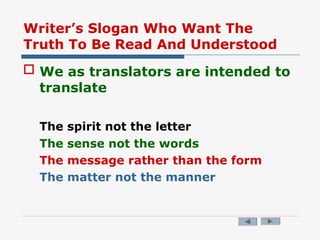
Writer’s Slogan Who Want The
Truth To Be Read And Understood
 We as translators are intended to
translate
The spirit not the letter
The sense not the words
The message rather than the form
The matter not the manner
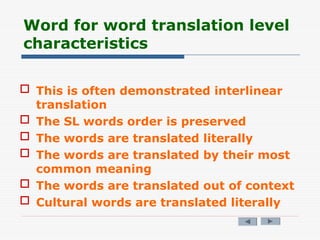
Word for word translation level
characteristics
 This is often demonstrated interlinear
translation
 The SL words order is preserved
 The words are translated literally
 The words are translated by their most
common meaning
 The words are translated out of context
 Cultural words are translated literally
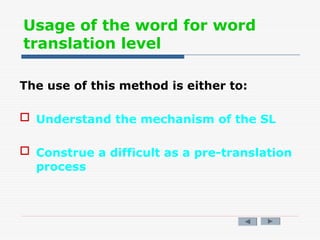
Usage of the word for word
translation level
The use of this method is either to:
 Understand the mechanism of the SL
 Construe a difficult as a pre-translation
process
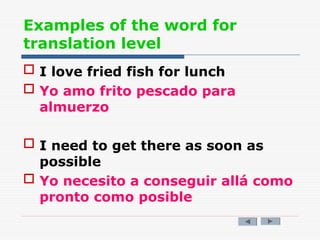
Examples of the word for
translation level
 I love fried fish for lunch
 Yo amo frito pescado para
almuerzo
 I need to get there as soon as
possible
 Yo necesito a conseguir allá como
pronto como posible
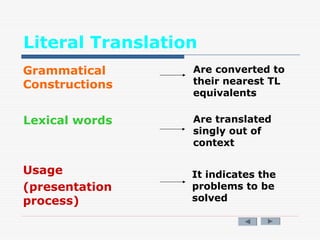
Literal Translation
Usage
(presentation
process)
Lexical words
Grammatical
Constructions
Are converted to
their nearest TL
equivalents
Are translated
singly out of
context
It indicates the
problems to be
solved
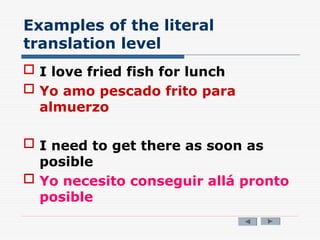
Examples of the literal
translation level
 I love fried fish for lunch
 Yo amo pescado frito para
almuerzo
 I need to get there as soon as
posible
 Yo necesito conseguir allá pronto
posible
Faithful Translation
 Attempts to reproduce the precise
contextual meaning of the original
within the constraints of the TL
grammatical structures
 It transfers cultural words
 It preserves the degree of
grammatical and lexical
abnormality
Semantic Translation
 It is faithful
 It takes more account the aesthetic
value of SL text
 The beautiful and natural sound of the
SL text concerning it is meaning
 A semantic translation is written at the
author`s linguistic level
 It may translate less important cultural
words, not cultural equivalents, intact
transference
 It is used for expressive texts
Communicative Translation
 It attemps to render the exact
contextual meaning of the
original
 Both the content and the
language comprehensible to the
readership
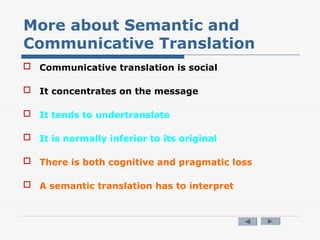
More about Semantic and
Communicative Translation
 They must be seen as wholes
 Semantic translation is personal and
individual
 It tends to over translate
 It has to explain
 It follows the thought processes of the
author
 It aims at concision in order to
reproduce the pragmatic impact
More about Semantic and
Communicative Translation
 Communicative translation is social
 It concentrates on the message
 It tends to undertranslate
 It is normally inferior to its original
 There is both cognitive and pragmatic loss
 A semantic translation has to interpret
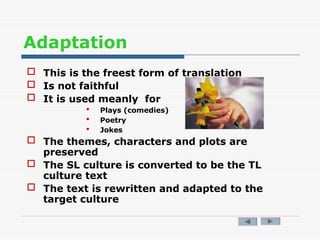
Adaptation
 This is the freest form of translation
 Is not faithful
 It is used meanly for
 Plays (comedies)
 Poetry
 Jokes
 The themes, characters and plots are
preserved
 The SL culture is converted to be the TL
culture text
 The text is rewritten and adapted to the
target culture
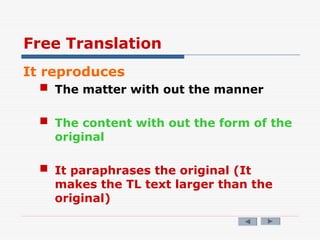
Free Translation
It reproduces
 The matter with out the manner
 The content with out the form of the
original
 It paraphrases the original (It
makes the TL text larger than the
original)
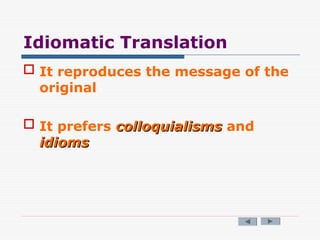
Idiomatic Translation
 It reproduces the message of the
original
 It prefers colloquialisms
colloquialisms and
idioms
idioms
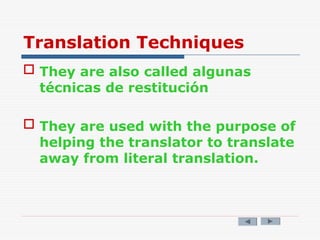
Translation Techniques
 They are also called algunas
técnicas de restitución
 They are used with the purpose of
helping the translator to translate
away from literal translation.
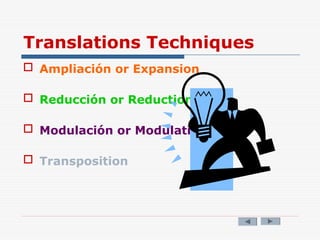
Translations Techniques
 Ampliación or Expansion
 Reducción or Reduction
 Modulación or Modulation
 Transposition
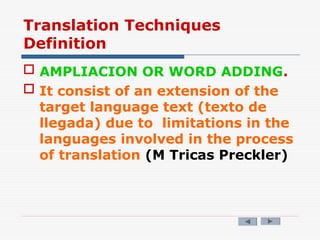
Translation Techniques
Definition
 AMPLIACION OR WORD ADDING.
 It consist of an extension of the
target language text (texto de
llegada) due to limitations in the
languages involved in the process
of translation (M Tricas Preckler)
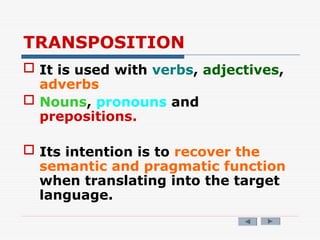
TRANSPOSITION
 It is used with verbs, adjectives,
adverbs
 Nouns, pronouns and
prepositions.
 Its intention is to recover the
semantic and pragmatic function
when translating into the target
language.
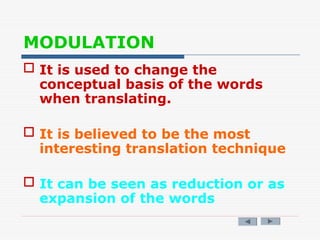
MODULATION
 It is used to change the
conceptual basis of the words
when translating.
 It is believed to be the most
interesting translation technique
 It can be seen as reduction or as
expansion of the words
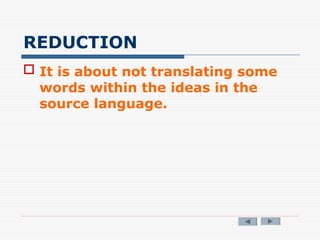
REDUCTION
 It is about not translating some
words within the ideas in the
source language.
Translation Techniques
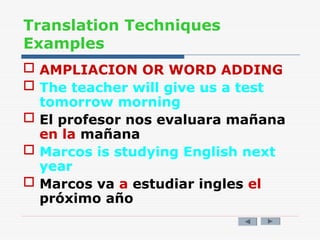
Examples
 AMPLIACION OR WORD ADDING
 The teacher will give us a test
tomorrow morning
 El profesor nos evaluara mañana
en la mañana
 Marcos is studying English next
year
 Marcos va a estudiar ingles el
próximo año
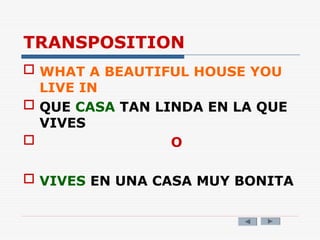
TRANSPOSITION
 WHAT A BEAUTIFUL HOUSE YOU
LIVE IN
 QUE CASA TAN LINDA EN LA QUE
VIVES
 O
 VIVES EN UNA CASA MUY BONITA
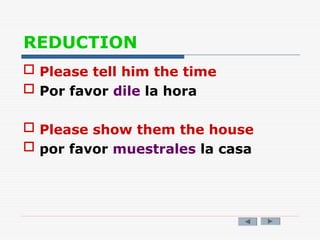
REDUCTION
 Please tell him the time
 Por favor dile la hora
 Please show them the house
 por favor muestrales la casa
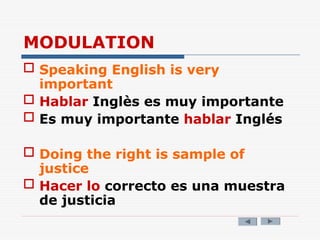
MODULATION
 Speaking English is very
important
 Hablar Inglès es muy importante
 Es muy importante hablar Inglés
 Doing the right is sample of
justice
 Hacer lo correcto es una muestra
de justicia

theanalysisofthetext.ppttttttttttttttttttttttttttttttt

  • 1.
  • 2.
    Contents 1 THE ANALYSISOF THE TEXT 2 DISCOURSE ANALYSIS 3 THE INTENTION OF THE TEXT 4 THE INTENTION OF THE TRANSLATOR 5 THE QUALITY OF THE WRITING 6 TRANSLATION METHODS AND LEVELS 7 TRANSLATION TECHNIQUES
  • 3.
    The Analysis OfThe Text  Reading the text - Is the starting point We read the text to:  Understand what it is about.  Analyse it from a translator’s point of view not from linguist’s, literary, teacher nor student  To determine it’s intention  To determine the way it’s written to select a suitable translation method
  • 4.
    Kinds Of ReadingWhen Analysing The Text  General reading is required  We read the words both • Out of the context • In the context  Close reading • To get the gist • To get the essence • To get the substance (literal meaning) (Interpretation)
  • 5.
    The Last Reading Thislast reading is done for the purpose of • Noting the cultural aspects of the SL text  We have to underline all: Neologism, Methophors, cultural words and institutional terms peculiar to the SL, proper names, technical terms and the untranslatable words
  • 6.
    The Analysis OfThe Text  Macro analysis  Micro analysis  Reading the text • The intention of the text • The intention of the translator • The last reading  Text styles • The readership  The quality of the writing
  • 7.
    DISCOURSE ANALYSIS IN TRANSLATION MACRO ANALYSIS  MICRO ANALYSIS
  • 8.
    Macroanalysis  This analysis answersthese questions  Who ?  When ?  Where ?  For whom?  How ?
  • 9.
    Microanalysis This analisys isbased on the process of segmentation to take notes on the translation problems we find in the text. • We split the text in  Lexical translation units  Sintagmatic translation units • It is used to avoid both gain and loss of information
  • 10.
    Microanalysis  LEXICAL TRANSLATIONUNITS  VERBS  ADVERBS  NOUNS  PRONOUNS  PROPER NOUNS
  • 11.
    Microanalysis  SINTAGMATIC TRANSLATION UNITS DETERMINANTS  PREPOSITIONS  ARTICLES  POSSESSIVE WORDS
  • 12.
    Examples  Roberto studiesEnglish everyday  The city is beautiful  The books are on the top of the book shelf  I have a nice watch  They are good students
  • 13.
    The Intention OfThe Text  We read to search for the intention of the text  The intention of the text goes hand in hand with the understanding of the text  The title may be remote from the content as well as the intention
  • 14.
    The Intention OfThe Text  It’s necessary to pay special attention to the type of language and even the grammatical structure (passive voice – impersonal verbs)  The intention of the text represents the SL writer’s attitude of the text or subject matter
  • 15.
    The Intention OfThe Translator  Usually, the translator’s intention is identical with that of the author of the SL text
  • 16.
    The Quality OfThe Writing The quality of the writing has to be judged in relation to the author’s intention and the requirements of the subject matter • The word must be in the right place with the minimum of redundancy
  • 17.
    The Process OfThe Translation  The relation of translating to translation theory  The approach  The levels:  The textual level  The referential  The cohesive level  The level of naturalness
  • 18.
    Levels of approachesto a translation process  1 Translating sentences by sentence  2 Translating paragraphs by paragraphs  3 Translating chapter by chapter  4 Read the text as whole and translate it like wise
  • 19.
    Approaches to translationand the texts The first approach Sentence by sentence Paragraph by paragraph Literary texts
  • 20.
    Approaches to translationand the text The second approach Reading The whole text Translate chapter By chapter For Technical Or Institutional texts
  • 21.
    DANGERS OF THEAPPROACHES  The fisrt approach  It may leave you with too much revision to do in the early part  It is time-wasting  The second approach  It is usually preferable  It can be mechanical  It may may inhibit the translator`s free play of intution
  • 22.
    APPROACHES ALTERNATIVES  Thefisrt approach is advisable for a relatively easy text  The second approach is advisable for harder texts
  • 23.
    THE TRANSLATION OFTHE LEVELS The textual Level The referential Level The cohesive level The level of naturlness The Textual Level The grammar And The lexical units are translated In the situation Or context of The sentence The referential level Sentences of any text Technical,Literary or Institutional must be Read in the situation Or context of the text The cohesive level It follows both The structure And the moods of The text The level of Naturalness Makes sense Reads naturally It is written in Ordinary language That meet the Kind of situation
  • 24.
    Translation Methods Andlevels Translation methods obey to the main problem of translation it self  To translate literally or freely  This argument has been going on since at least the first century B.C up to the beginning the nineteenth century  Many writers are in favor of free translation
  • 25.
    Translation Levels  WORDBY WORD  LITERAL TRANSLATION  EQUIVALENT TRANSLATION
  • 26.
    Translation Methods or types Themethods or types Faithful translation Semantic translation communicative translation Adaptation Idiomatic translation Free translation
  • 27.
    Writer’s Slogan WhoWant The Truth To Be Read And Understood  We as translators are intended to translate The spirit not the letter The sense not the words The message rather than the form The matter not the manner
  • 28.
    Word for wordtranslation level characteristics  This is often demonstrated interlinear translation  The SL words order is preserved  The words are translated literally  The words are translated by their most common meaning  The words are translated out of context  Cultural words are translated literally
  • 29.
    Usage of theword for word translation level The use of this method is either to:  Understand the mechanism of the SL  Construe a difficult as a pre-translation process
  • 30.
    Examples of theword for translation level  I love fried fish for lunch  Yo amo frito pescado para almuerzo  I need to get there as soon as possible  Yo necesito a conseguir allá como pronto como posible
  • 31.
    Literal Translation Usage (presentation process) Lexical words Grammatical Constructions Areconverted to their nearest TL equivalents Are translated singly out of context It indicates the problems to be solved
  • 32.
    Examples of theliteral translation level  I love fried fish for lunch  Yo amo pescado frito para almuerzo  I need to get there as soon as posible  Yo necesito conseguir allá pronto posible
  • 33.
    Faithful Translation  Attemptsto reproduce the precise contextual meaning of the original within the constraints of the TL grammatical structures  It transfers cultural words  It preserves the degree of grammatical and lexical abnormality
  • 34.
    Semantic Translation  Itis faithful  It takes more account the aesthetic value of SL text  The beautiful and natural sound of the SL text concerning it is meaning  A semantic translation is written at the author`s linguistic level  It may translate less important cultural words, not cultural equivalents, intact transference  It is used for expressive texts
  • 35.
    Communicative Translation  Itattemps to render the exact contextual meaning of the original  Both the content and the language comprehensible to the readership
  • 36.
    More about Semanticand Communicative Translation  They must be seen as wholes  Semantic translation is personal and individual  It tends to over translate  It has to explain  It follows the thought processes of the author  It aims at concision in order to reproduce the pragmatic impact
  • 37.
    More about Semanticand Communicative Translation  Communicative translation is social  It concentrates on the message  It tends to undertranslate  It is normally inferior to its original  There is both cognitive and pragmatic loss  A semantic translation has to interpret
  • 38.
    Adaptation  This isthe freest form of translation  Is not faithful  It is used meanly for  Plays (comedies)  Poetry  Jokes  The themes, characters and plots are preserved  The SL culture is converted to be the TL culture text  The text is rewritten and adapted to the target culture
  • 39.
    Free Translation It reproduces The matter with out the manner  The content with out the form of the original  It paraphrases the original (It makes the TL text larger than the original)
  • 40.
    Idiomatic Translation  Itreproduces the message of the original  It prefers colloquialisms colloquialisms and idioms idioms
  • 41.
    Translation Techniques  Theyare also called algunas técnicas de restitución  They are used with the purpose of helping the translator to translate away from literal translation.
  • 42.
    Translations Techniques  Ampliaciónor Expansion  Reducción or Reduction  Modulación or Modulation  Transposition
  • 43.
    Translation Techniques Definition  AMPLIACIONOR WORD ADDING.  It consist of an extension of the target language text (texto de llegada) due to limitations in the languages involved in the process of translation (M Tricas Preckler)
  • 44.
    TRANSPOSITION  It isused with verbs, adjectives, adverbs  Nouns, pronouns and prepositions.  Its intention is to recover the semantic and pragmatic function when translating into the target language.
  • 45.
    MODULATION  It isused to change the conceptual basis of the words when translating.  It is believed to be the most interesting translation technique  It can be seen as reduction or as expansion of the words
  • 46.
    REDUCTION  It isabout not translating some words within the ideas in the source language.
  • 47.
    Translation Techniques Examples  AMPLIACIONOR WORD ADDING  The teacher will give us a test tomorrow morning  El profesor nos evaluara mañana en la mañana  Marcos is studying English next year  Marcos va a estudiar ingles el próximo año
  • 48.
    TRANSPOSITION  WHAT ABEAUTIFUL HOUSE YOU LIVE IN  QUE CASA TAN LINDA EN LA QUE VIVES  O  VIVES EN UNA CASA MUY BONITA
  • 49.
    REDUCTION  Please tellhim the time  Por favor dile la hora  Please show them the house  por favor muestrales la casa
  • 50.
    MODULATION  Speaking Englishis very important  Hablar Inglès es muy importante  Es muy importante hablar Inglés  Doing the right is sample of justice  Hacer lo correcto es una muestra de justicia