TRANSISTOR AS AN
AMPLIFIER
By-
ANSHU KUMAR
BRANCH-EE(2nd Year)
ENROLL NO- 12118015
INTRODUCTION
• What is an amplifier?
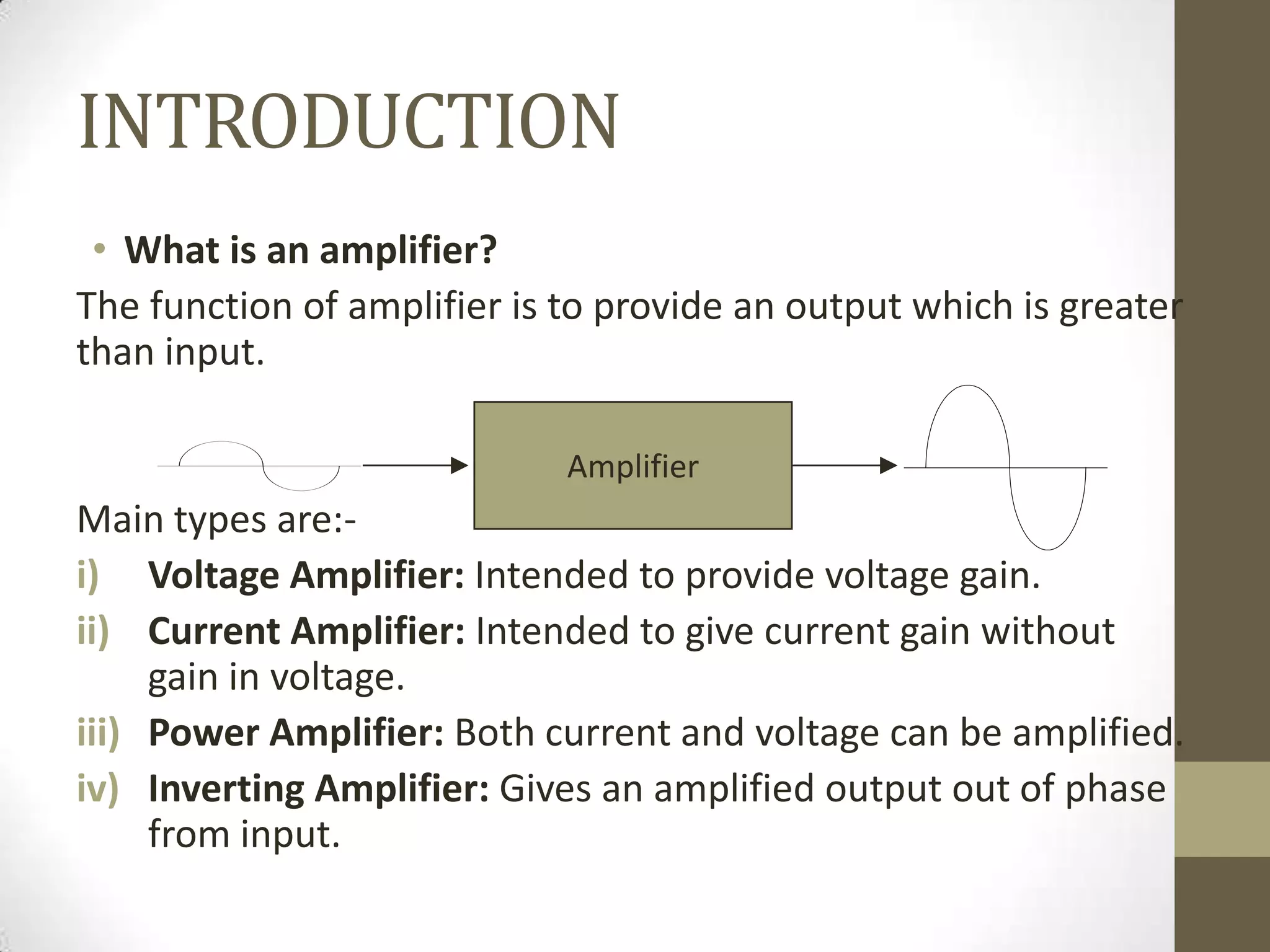
The function of amplifier is to provide an output which is greater
than input.
Main types are:-
i) Voltage Amplifier: Intended to provide voltage gain.
ii) Current Amplifier: Intended to give current gain without
gain in voltage.
iii) Power Amplifier: Both current and voltage can be amplified.
iv) Inverting Amplifier: Gives an amplified output out of phase
from input.
Amplifier
CURRENT AMPLIFIER
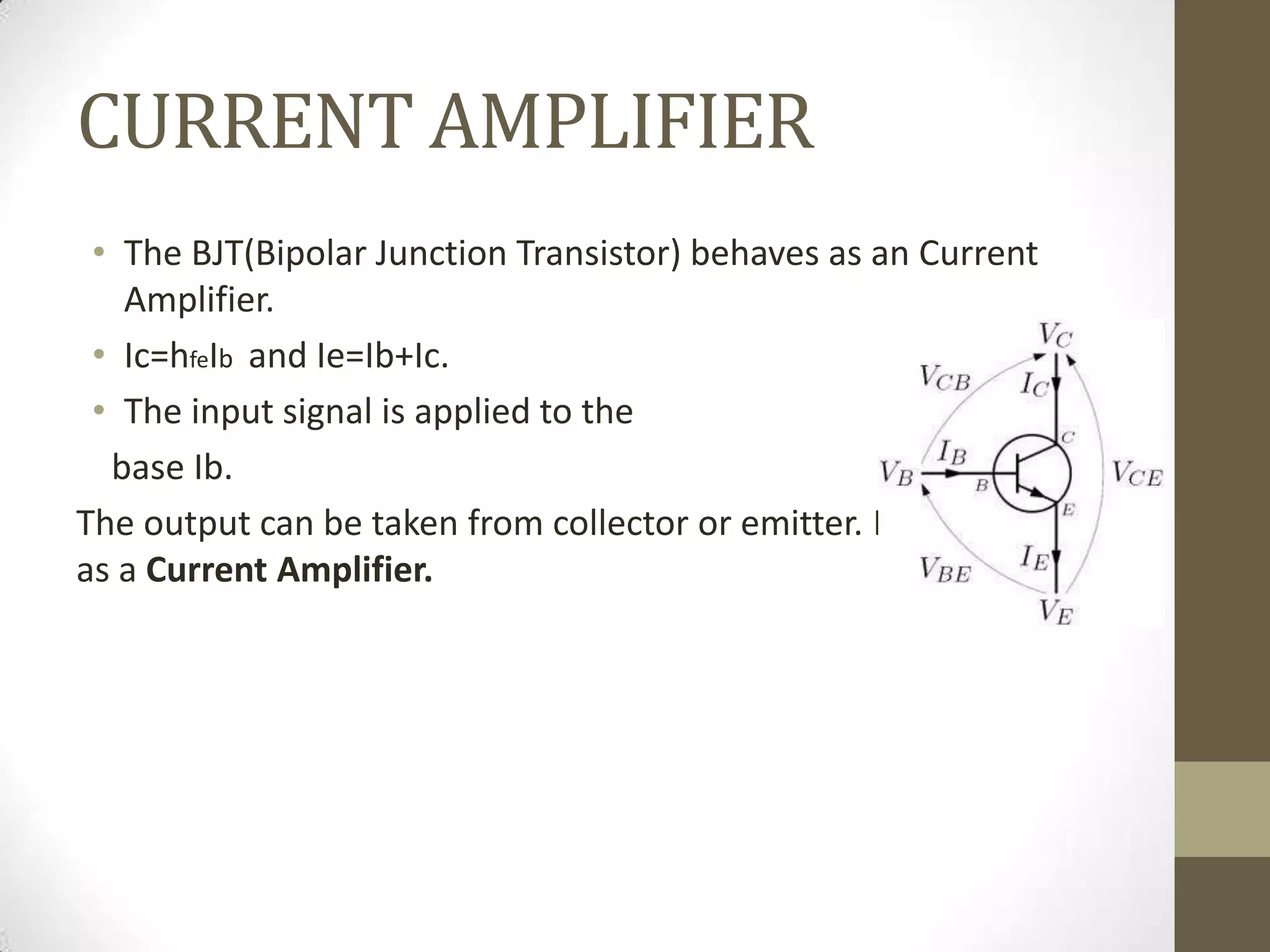
• The BJT(Bipolar Junction Transistor) behaves as an Current
Amplifier.
• Ic=hfeIb and Ie=Ib+Ic.
• The input signal is applied to the
base Ib.
The output can be taken from collector or emitter. Hence,acting
as a Current Amplifier.
AC VOLTAGE AMPLIFIER
• Any signal that is to be amplifiedmust be between 0.6V and
0.72V.
• Any lower than 0.6V, transistor will be off.
• Any higher than 0.72V, the transistor is saturated.
• So it amplifies only one half of the input signal i.e above 0.7 V
input signal. In order to amplify the whole input signal we
need biasing of the transistor circuit as an amplifier.
BIASING OF THE CIRCUIT
• We bias the circuit by adding something like resistor to the base to
turn the transistor ON even during other half cycle.
• Amplifier biased to produce maximum swing. Output is set at half
the supply voltage with no input.
• Value of bias or base resistance is chosen to produce base current.
This adds about 1V to the input signal.
• Base current produces collector current i.e it makes the transistor
to conduct.
• Output is supply voltage less voltage drop across collector
resistance.
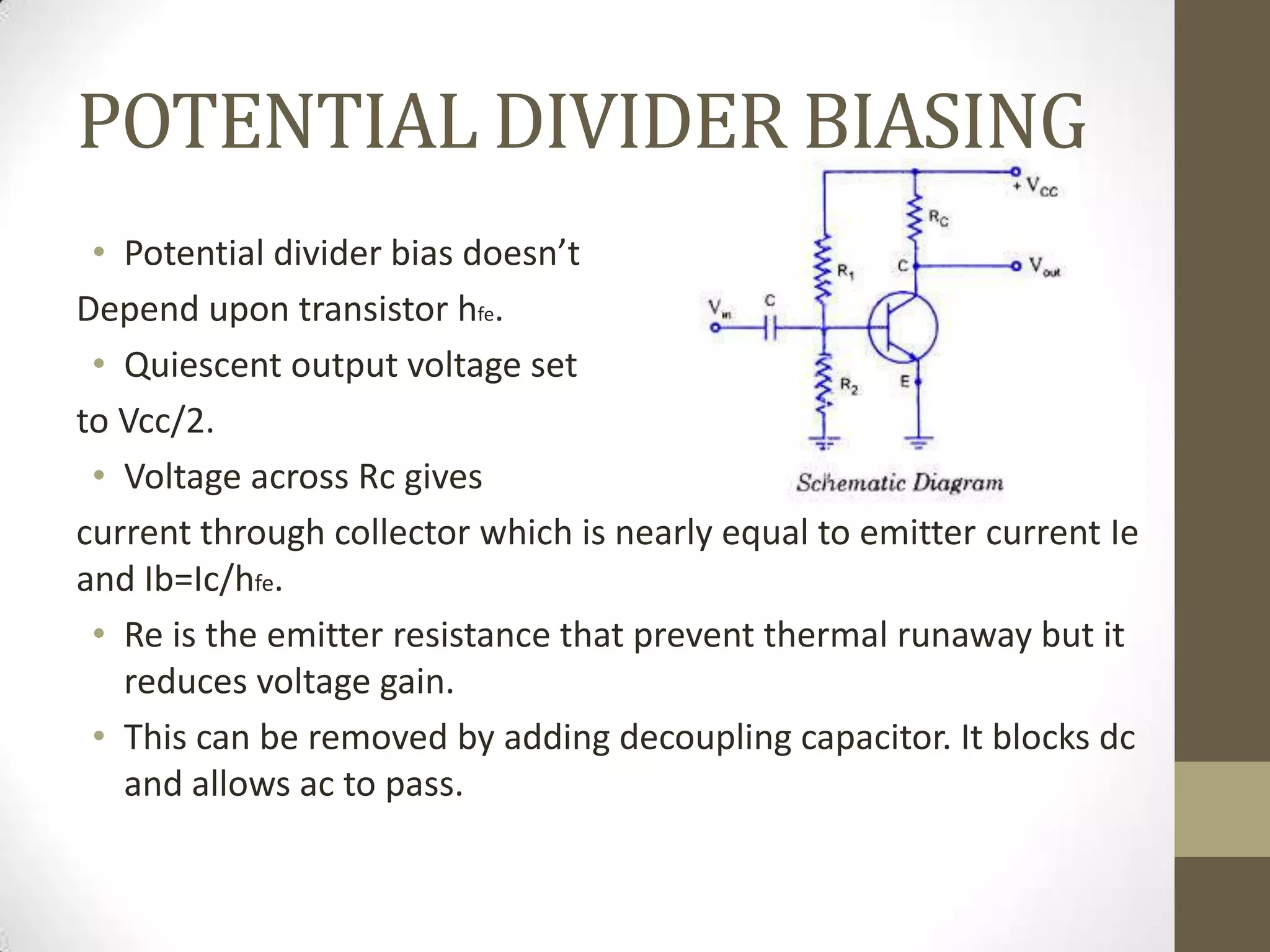
POTENTIAL DIVIDER BIASING
• Potential divider bias doesn’t
Depend upon transistor hfe.
• Quiescent output voltage set
to Vcc/2.
• Voltage across Rc gives
current through collector which is nearly equal to emitter current Ie
and Ib=Ic/hfe.
• Re is the emitter resistance that prevent thermal runaway but it
reduces voltage gain.
• This can be removed by adding decoupling capacitor. It blocks dc
and allows ac to pass.
SUMMARY(IMPORTANT)
• When a transistor is biased such that
i) Its Base Emitter junction is forward biased. This implies low value
of base emitter resistance thus high value of Ie.
ii) Its Base Collector junction is reversed biased which implies high
base collector resistance.
SUMMARY CONT…
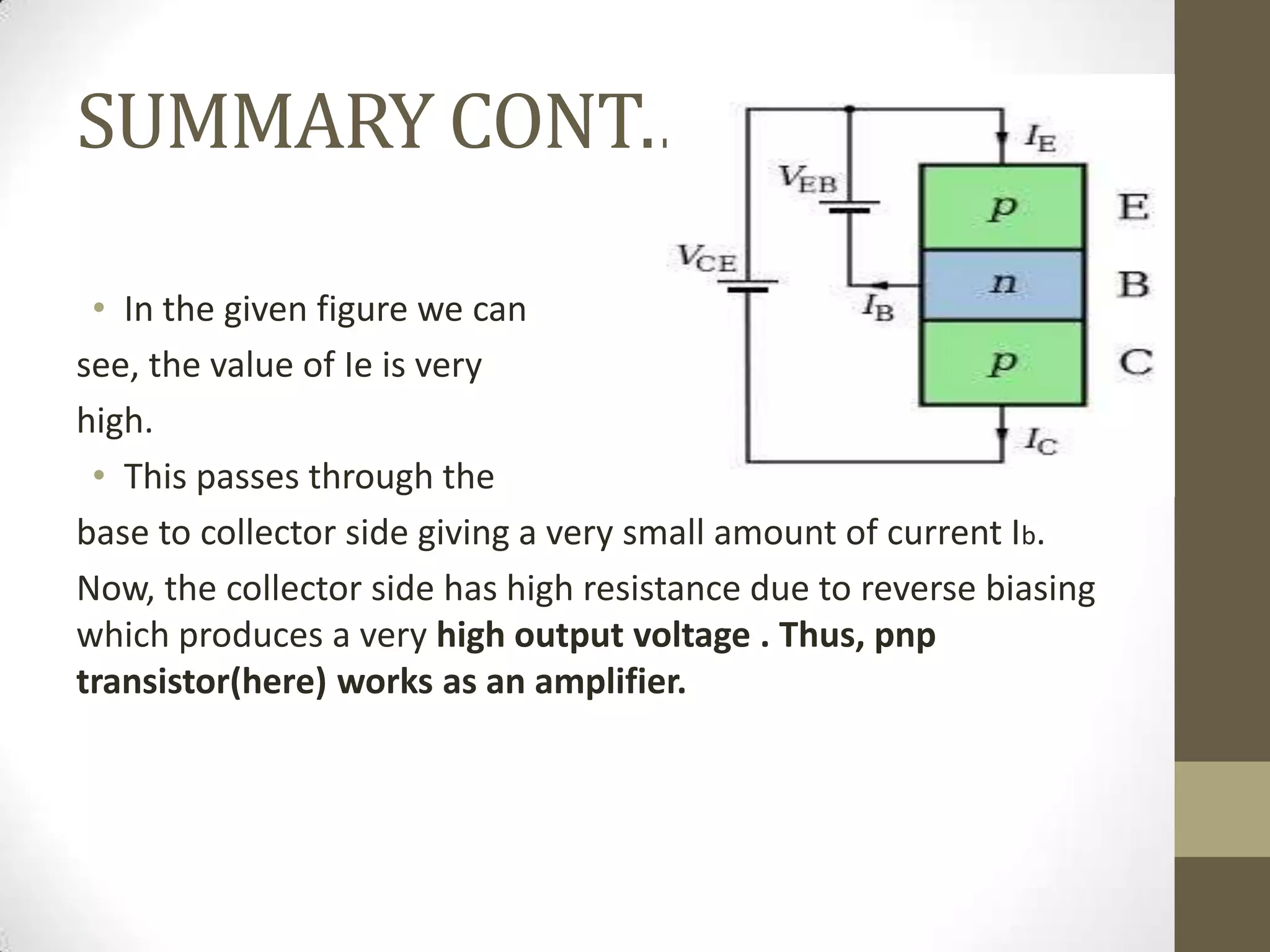
• In the given figure we can
see, the value of Ie is very
high.
• This passes through the
base to collector side giving a very small amount of current Ib.
Now, the collector side has high resistance due to reverse biasing
which produces a very high output voltage . Thus, pnp
transistor(here) works as an amplifier.

Transistor as an amplifier

  • 1.
    TRANSISTOR AS AN AMPLIFIER By- ANSHUKUMAR BRANCH-EE(2nd Year) ENROLL NO- 12118015
  • 2.
    INTRODUCTION • What isan amplifier? The function of amplifier is to provide an output which is greater than input. Main types are:- i) Voltage Amplifier: Intended to provide voltage gain. ii) Current Amplifier: Intended to give current gain without gain in voltage. iii) Power Amplifier: Both current and voltage can be amplified. iv) Inverting Amplifier: Gives an amplified output out of phase from input. Amplifier
  • 3.
    CURRENT AMPLIFIER • TheBJT(Bipolar Junction Transistor) behaves as an Current Amplifier. • Ic=hfeIb and Ie=Ib+Ic. • The input signal is applied to the base Ib. The output can be taken from collector or emitter. Hence,acting as a Current Amplifier.
  • 4.
    AC VOLTAGE AMPLIFIER •Any signal that is to be amplifiedmust be between 0.6V and 0.72V. • Any lower than 0.6V, transistor will be off. • Any higher than 0.72V, the transistor is saturated. • So it amplifies only one half of the input signal i.e above 0.7 V input signal. In order to amplify the whole input signal we need biasing of the transistor circuit as an amplifier.
  • 5.
    BIASING OF THECIRCUIT • We bias the circuit by adding something like resistor to the base to turn the transistor ON even during other half cycle. • Amplifier biased to produce maximum swing. Output is set at half the supply voltage with no input. • Value of bias or base resistance is chosen to produce base current. This adds about 1V to the input signal. • Base current produces collector current i.e it makes the transistor to conduct. • Output is supply voltage less voltage drop across collector resistance.
  • 6.
  • 7.
    POTENTIAL DIVIDER BIASING •Potential divider bias doesn’t Depend upon transistor hfe. • Quiescent output voltage set to Vcc/2. • Voltage across Rc gives current through collector which is nearly equal to emitter current Ie and Ib=Ic/hfe. • Re is the emitter resistance that prevent thermal runaway but it reduces voltage gain. • This can be removed by adding decoupling capacitor. It blocks dc and allows ac to pass.
  • 8.
    SUMMARY(IMPORTANT) • When atransistor is biased such that i) Its Base Emitter junction is forward biased. This implies low value of base emitter resistance thus high value of Ie. ii) Its Base Collector junction is reversed biased which implies high base collector resistance.
  • 9.
    SUMMARY CONT… • Inthe given figure we can see, the value of Ie is very high. • This passes through the base to collector side giving a very small amount of current Ib. Now, the collector side has high resistance due to reverse biasing which produces a very high output voltage . Thus, pnp transistor(here) works as an amplifier.