1 
Transistors 
Bipolar Junction Transistors (BJT) 
Transistor Basics 
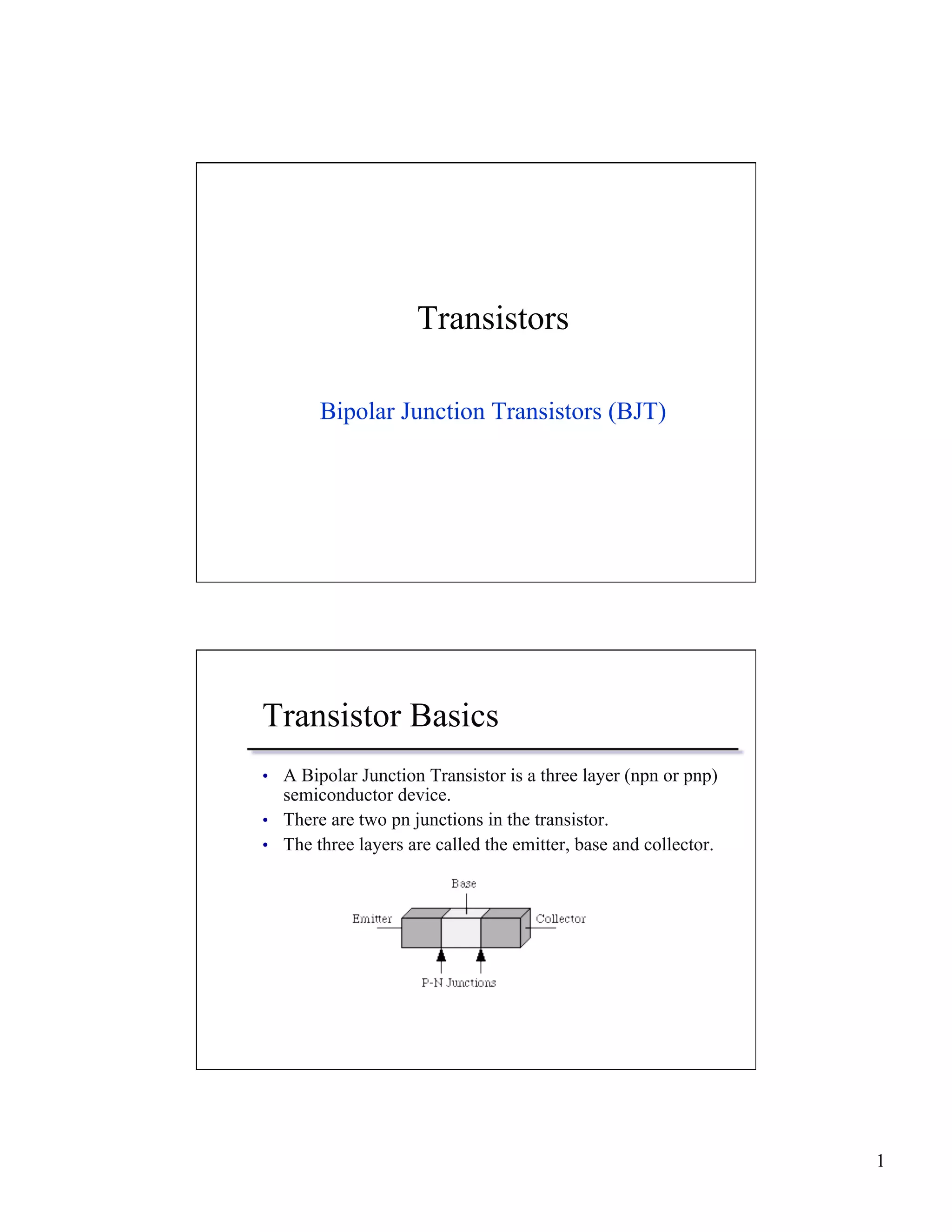
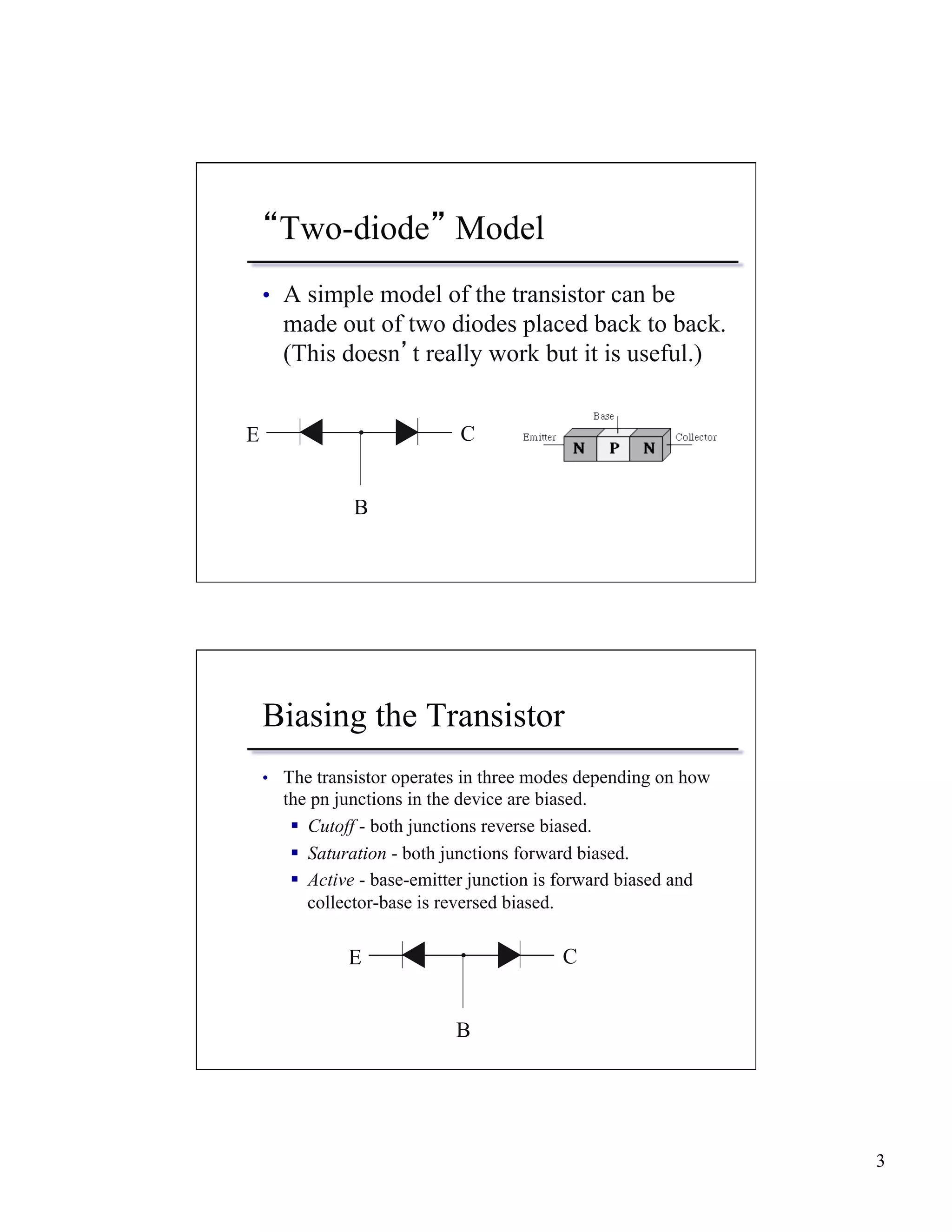
• A Bipolar Junction Transistor is a three layer (npn or pnp) 
semiconductor device. 
• There are two pn junctions in the transistor. 
• The three layers are called the emitter, base and collector.
2 
Transistor Basics 
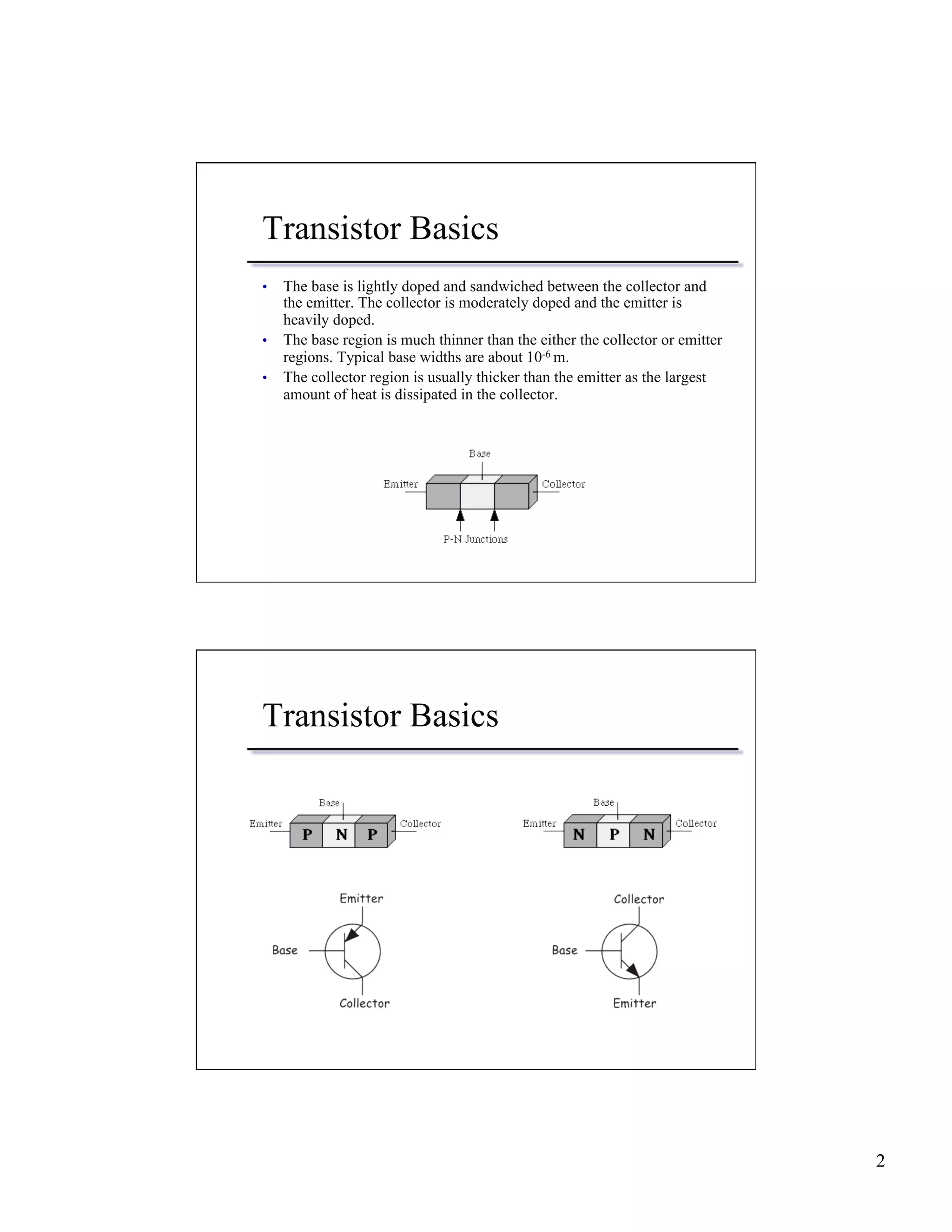
• The base is lightly doped and sandwiched between the collector and 
the emitter. The collector is moderately doped and the emitter is 
heavily doped. 
• The base region is much thinner than the either the collector or emitter 
regions. Typical base widths are about 10-6 m. 
• The collector region is usually thicker than the emitter as the largest 
amount of heat is dissipated in the collector. 
Transistor Basics
3 
“Two-diode” Model 
• A simple model of the transistor can be 
made out of two diodes placed back to back. 
(This doesn’t really work but it is useful.) 
E C 
B 
Biasing the Transistor 
• The transistor operates in three modes depending on how 
the pn junctions in the device are biased. 
§ Cutoff - both junctions reverse biased. 
§ Saturation - both junctions forward biased. 
§ Active - base-emitter junction is forward biased and 
collector-base is reversed biased. 
E C 
B
4 
A Note About Labeling Voltages 
• Voltages with capital letter subscripts are DC voltages, 
(VBE, VCC). 
• When a voltage has a single subscript it is measured from 
the terminal to ground, (VE, VC). 
• When a voltage has a double subscript with different 
letters it is the voltage measured between two terminals, 
(VBE, VEC). 
• When a voltage has a double subscript with the same 
letters it is a supply voltage, (VEE, VCC). 
Cutoff 
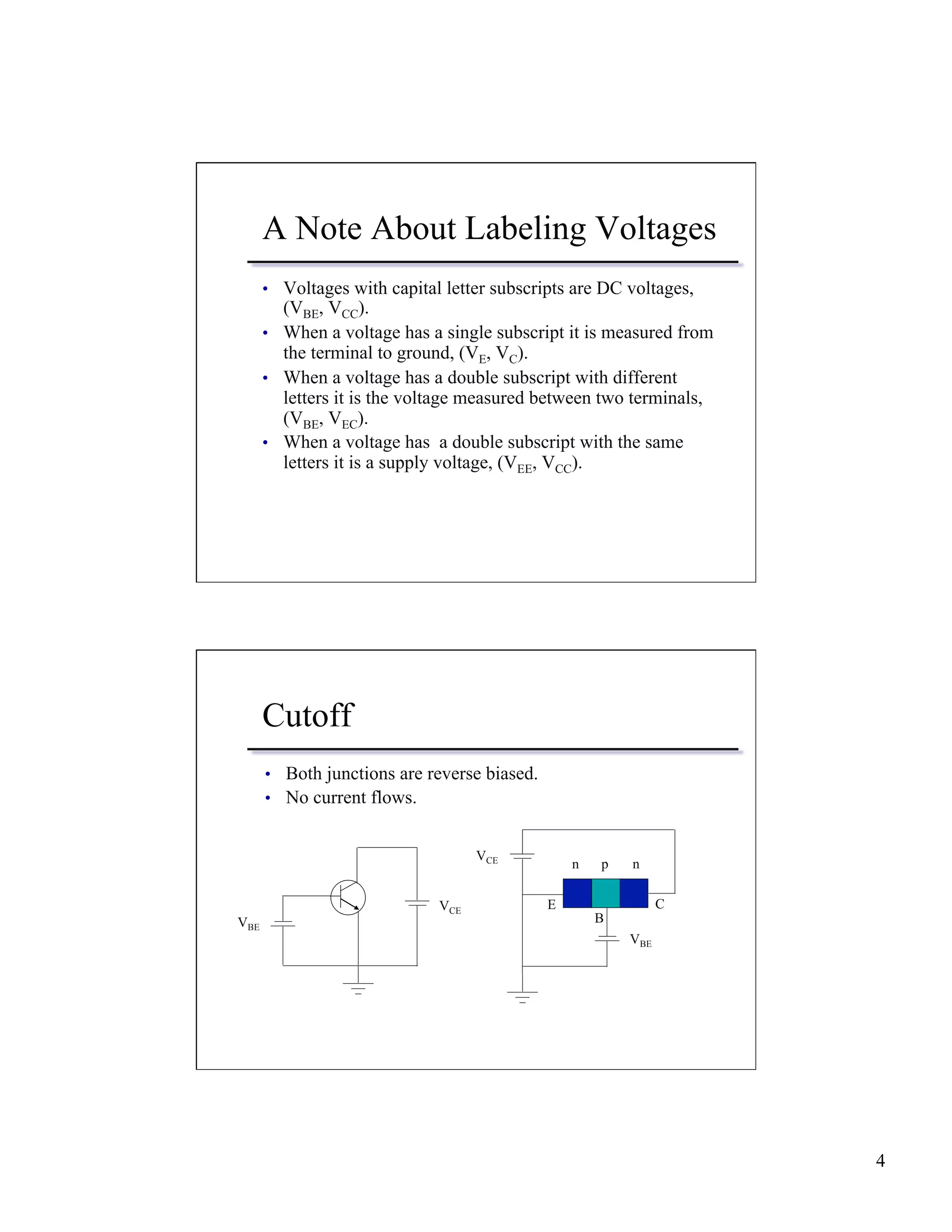
• Both junctions are reverse biased. 
• No current flows. 
n p n 
VBE VCE 
VBE 
VCE 
E C 
B
5 
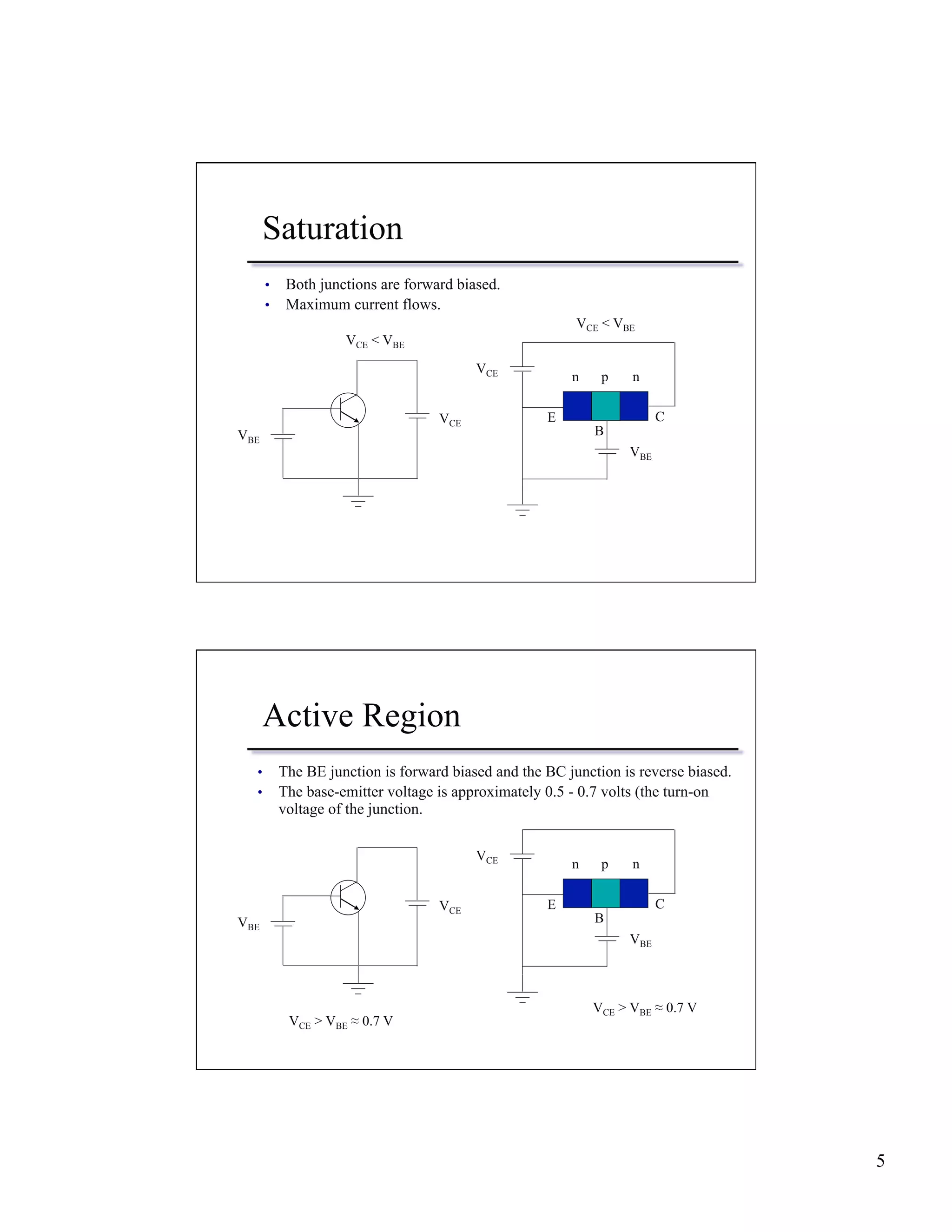
Saturation 
• Both junctions are forward biased. 
• Maximum current flows. 
VCE < VBE VCE < VBE 
n p n 
VBE VCE 
VBE 
VCE 
E C 
B 
Active Region 
• The BE junction is forward biased and the BC junction is reverse biased. 
• The base-emitter voltage is approximately 0.5 - 0.7 volts (the turn-on 
voltage of the junction. 
n p n 
VBE VCE 
VBE 
VCE 
E C 
B 
VCE > VBE ≈ 0.7 V VCE > VBE ≈ 0.7 V
6 
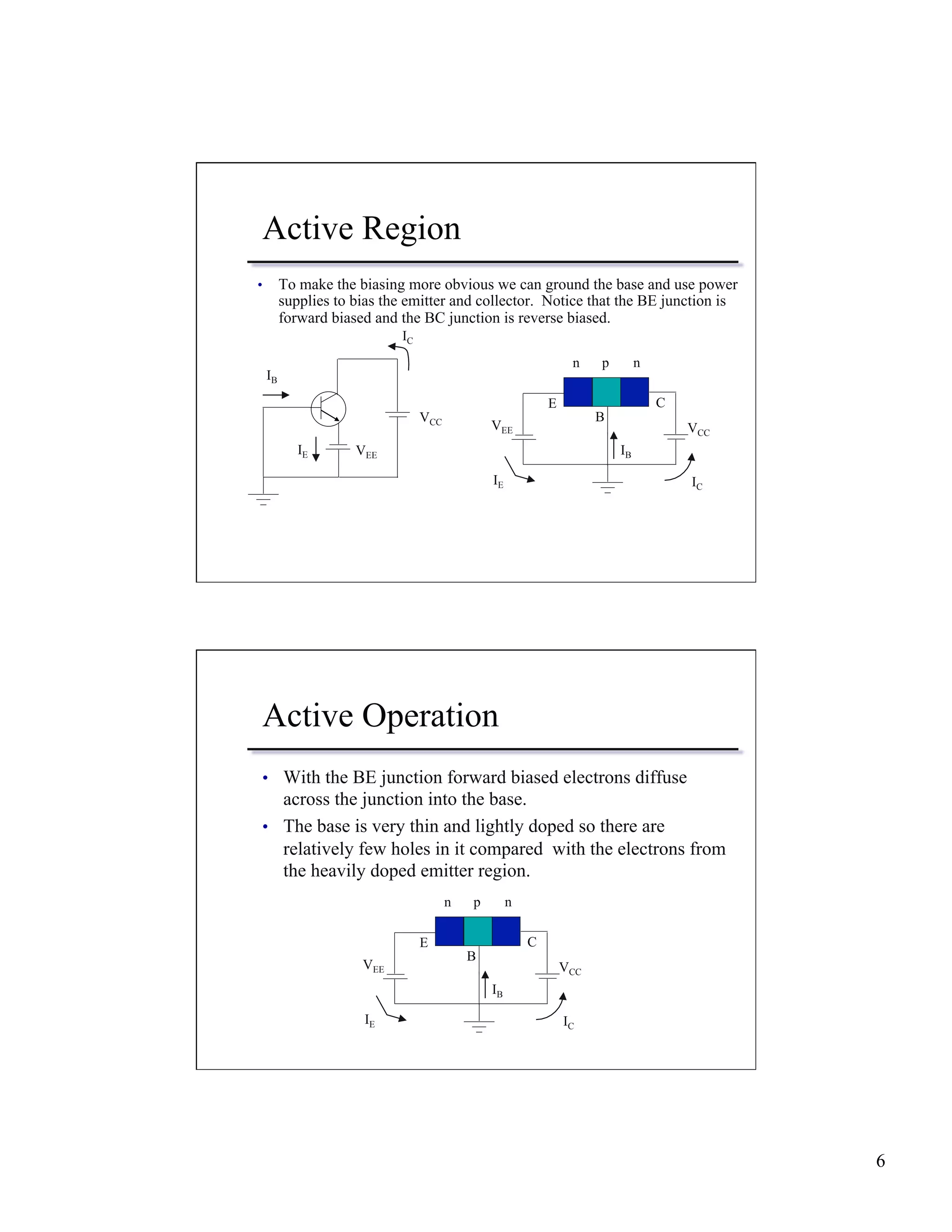
Active Region 
• To make the biasing more obvious we can ground the base and use power 
supplies to bias the emitter and collector. Notice that the BE junction is 
forward biased and the BC junction is reverse biased. 
IB n p n 
VEE 
VCC 
IC 
IE 
VEE 
E C 
B 
VCC 
IB 
IE IC 
Active Operation 
• With the BE junction forward biased electrons diffuse 
across the junction into the base. 
• The base is very thin and lightly doped so there are 
relatively few holes in it compared with the electrons from 
the heavily doped emitter region. 
n p n 
VEE 
E C 
B 
VCC 
IB 
IE IC
7 
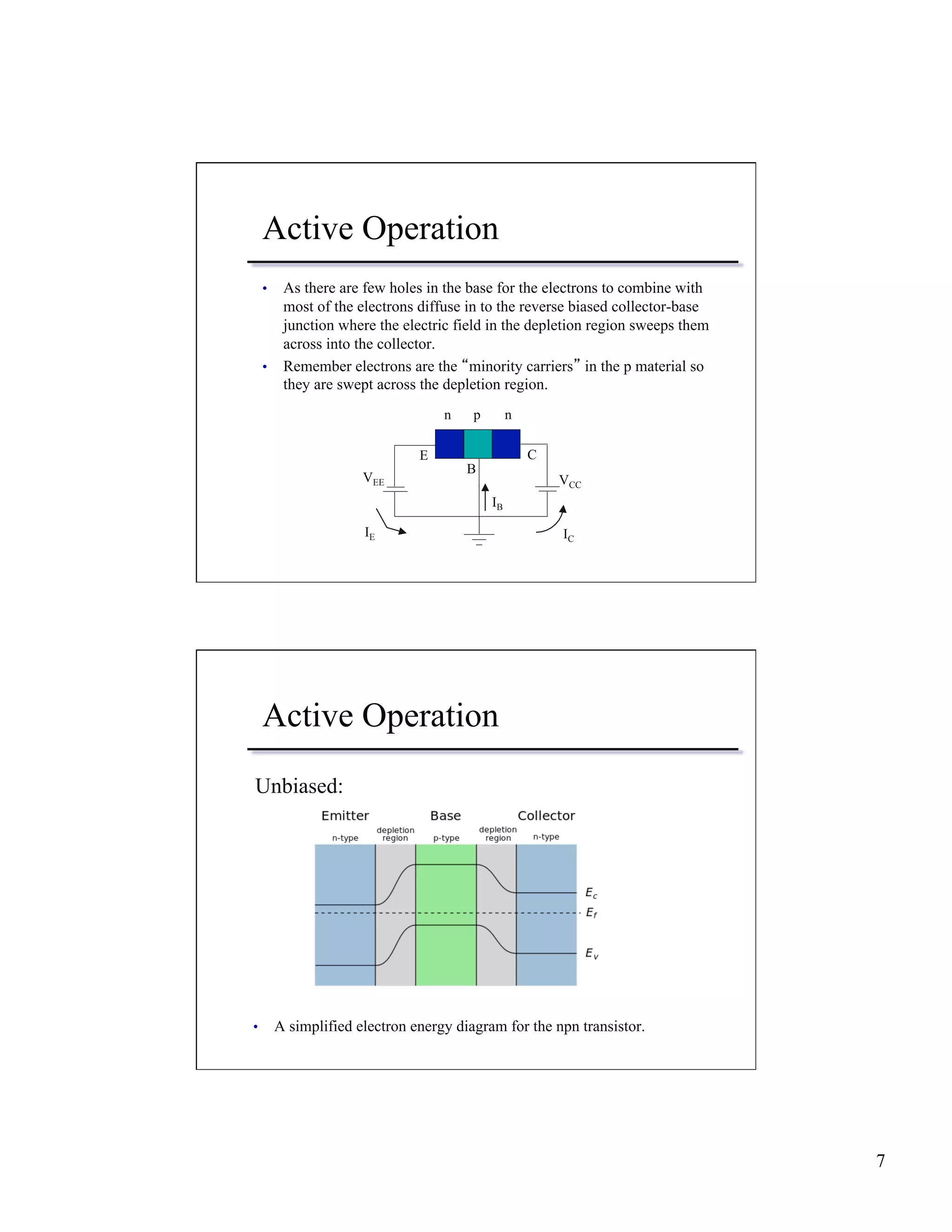
Active Operation 
• As there are few holes in the base for the electrons to combine with 
most of the electrons diffuse in to the reverse biased collector-base 
junction where the electric field in the depletion region sweeps them 
across into the collector. 
• Remember electrons are the “minority carriers” in the p material so 
they are swept across the depletion region. 
n p n 
VEE 
E C 
B 
VCC 
IB 
IE IC 
Active Operation 
Unbiased: 
• A simplified electron energy diagram for the npn transistor.
8 
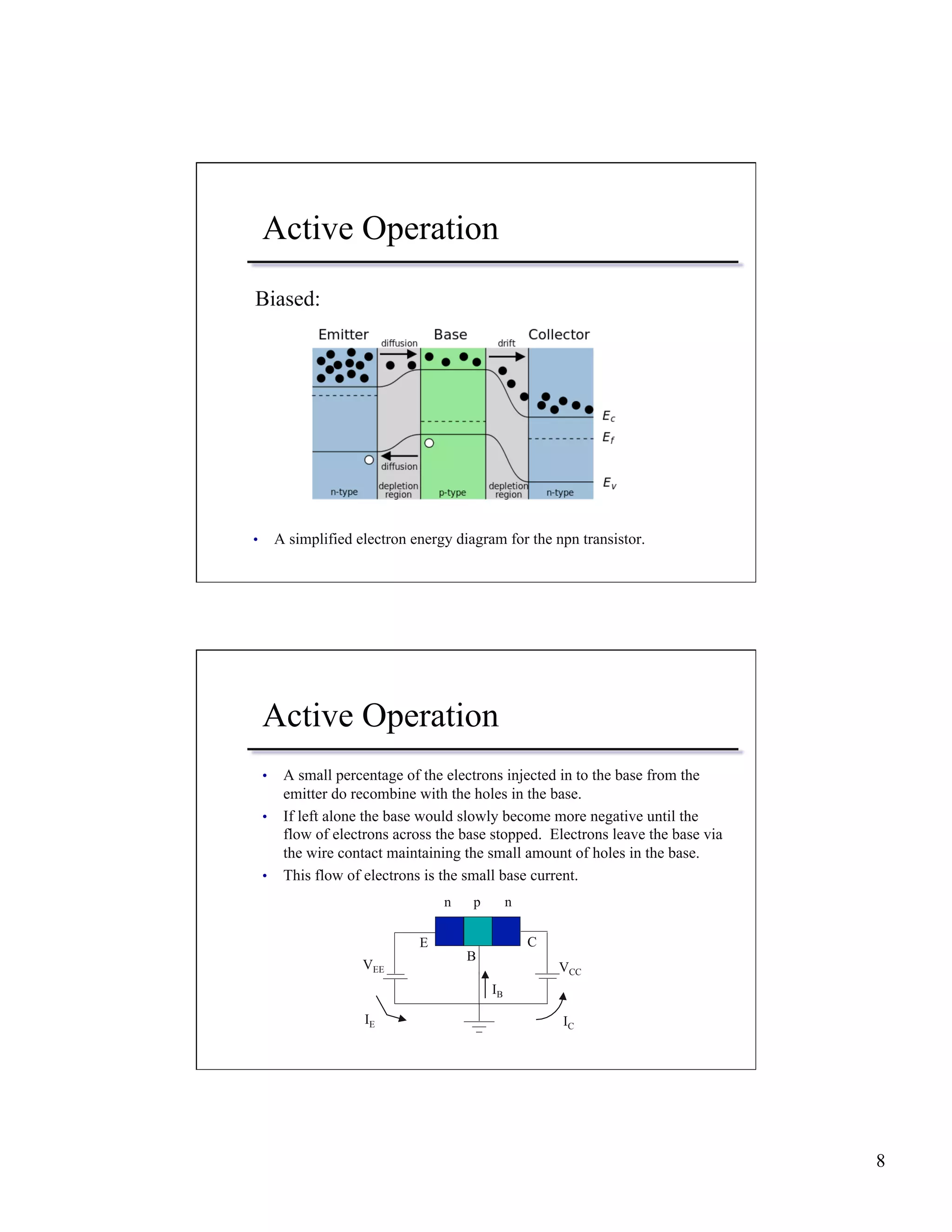
Active Operation 
Biased: 
• A simplified electron energy diagram for the npn transistor. 
Active Operation 
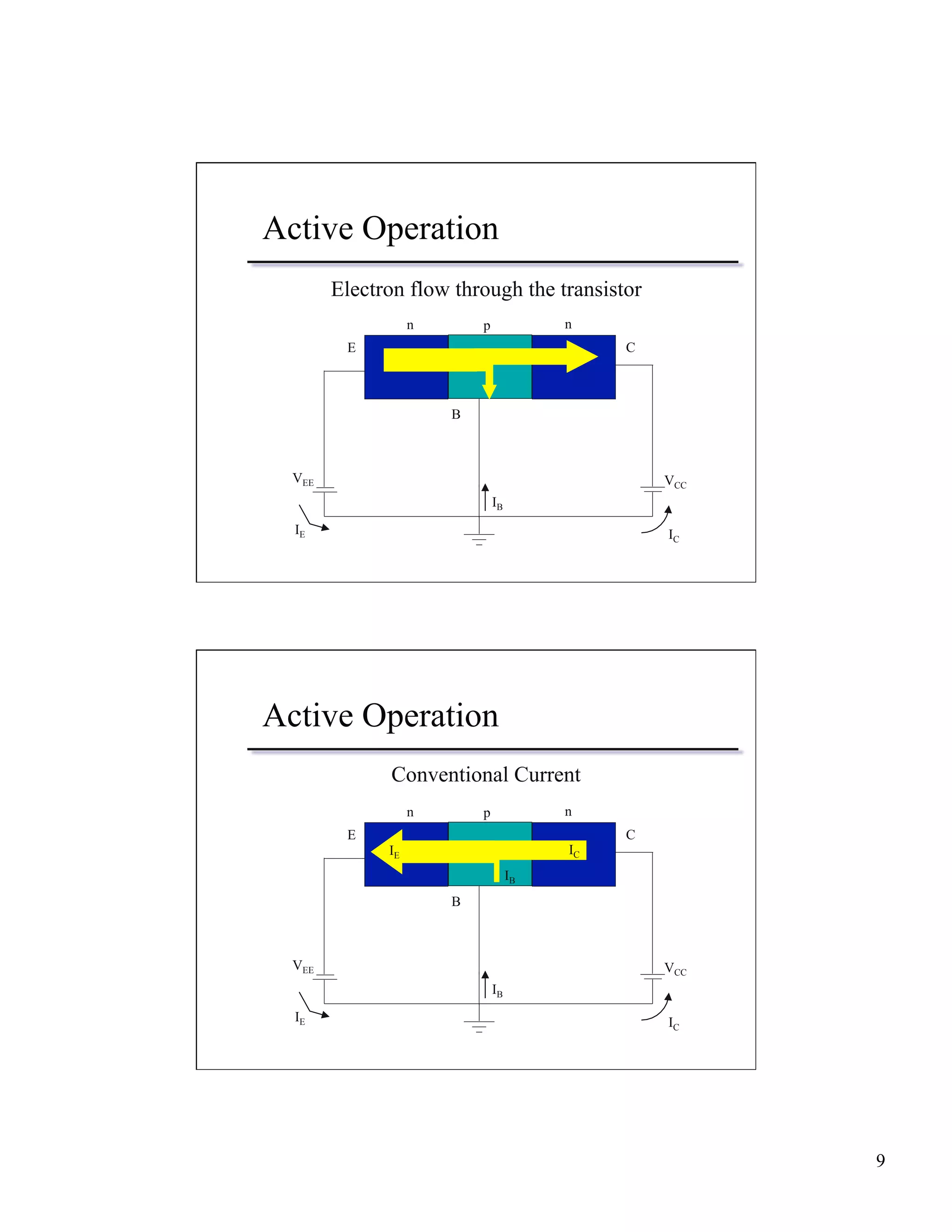
• A small percentage of the electrons injected in to the base from the 
emitter do recombine with the holes in the base. 
• If left alone the base would slowly become more negative until the 
flow of electrons across the base stopped. Electrons leave the base via 
the wire contact maintaining the small amount of holes in the base. 
• This flow of electrons is the small base current. 
n p n 
VEE 
E C 
B 
VCC 
IB 
IE IC
9 
Active Operation 
Electron flow through the transistor 
n p n 
VEE 
E C 
B 
VCC 
IB 
IE IC 
Active Operation 
Conventional Current 
n p n 
VEE 
E C 
IE IC 
B 
VCC 
IB 
IB 
IE IC
10 
Active Operation 
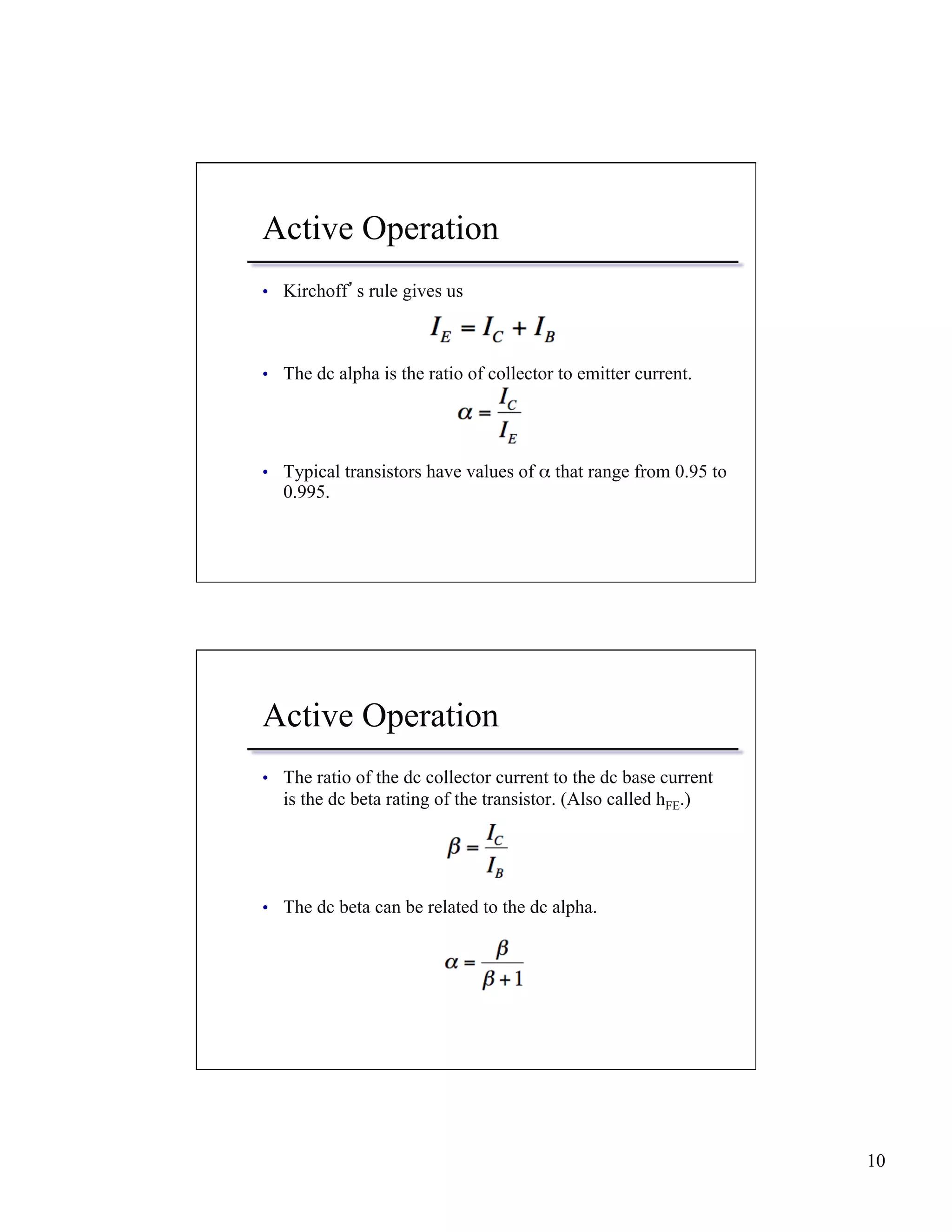
• Kirchoff’s rule gives us 
• The dc alpha is the ratio of collector to emitter current. 
• Typical transistors have values of α that range from 0.95 to 
0.995. 
Active Operation 
• The ratio of the dc collector current to the dc base current 
is the dc beta rating of the transistor. (Also called hFE.) 
• The dc beta can be related to the dc alpha.
11 
Transistor Curves 
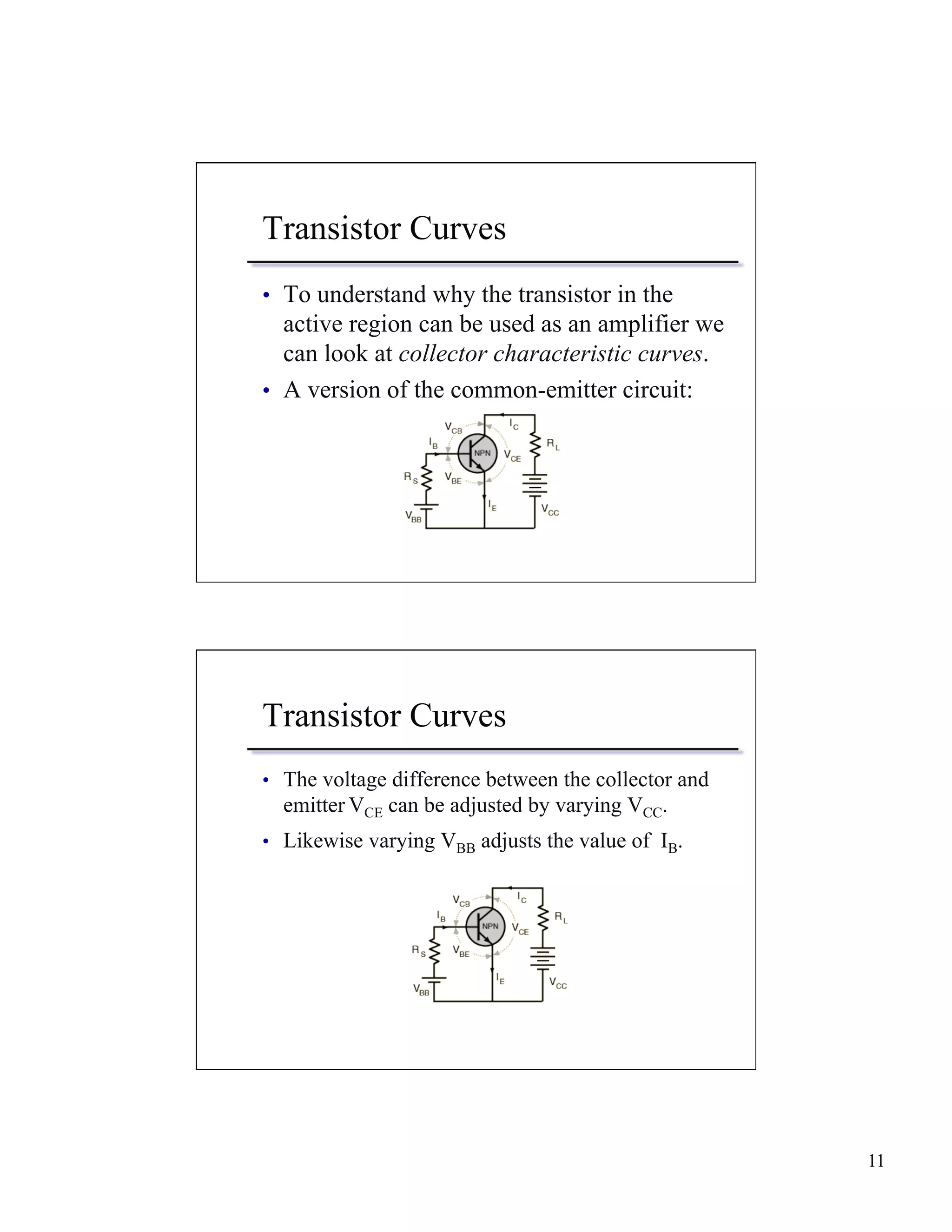
• To understand why the transistor in the 
active region can be used as an amplifier we 
can look at collector characteristic curves. 
• A version of the common-emitter circuit: 
Transistor Curves 
• The voltage difference between the collector and 
emitter VCE can be adjusted by varying VCC. 
• Likewise varying VBB adjusts the value of IB.
12 
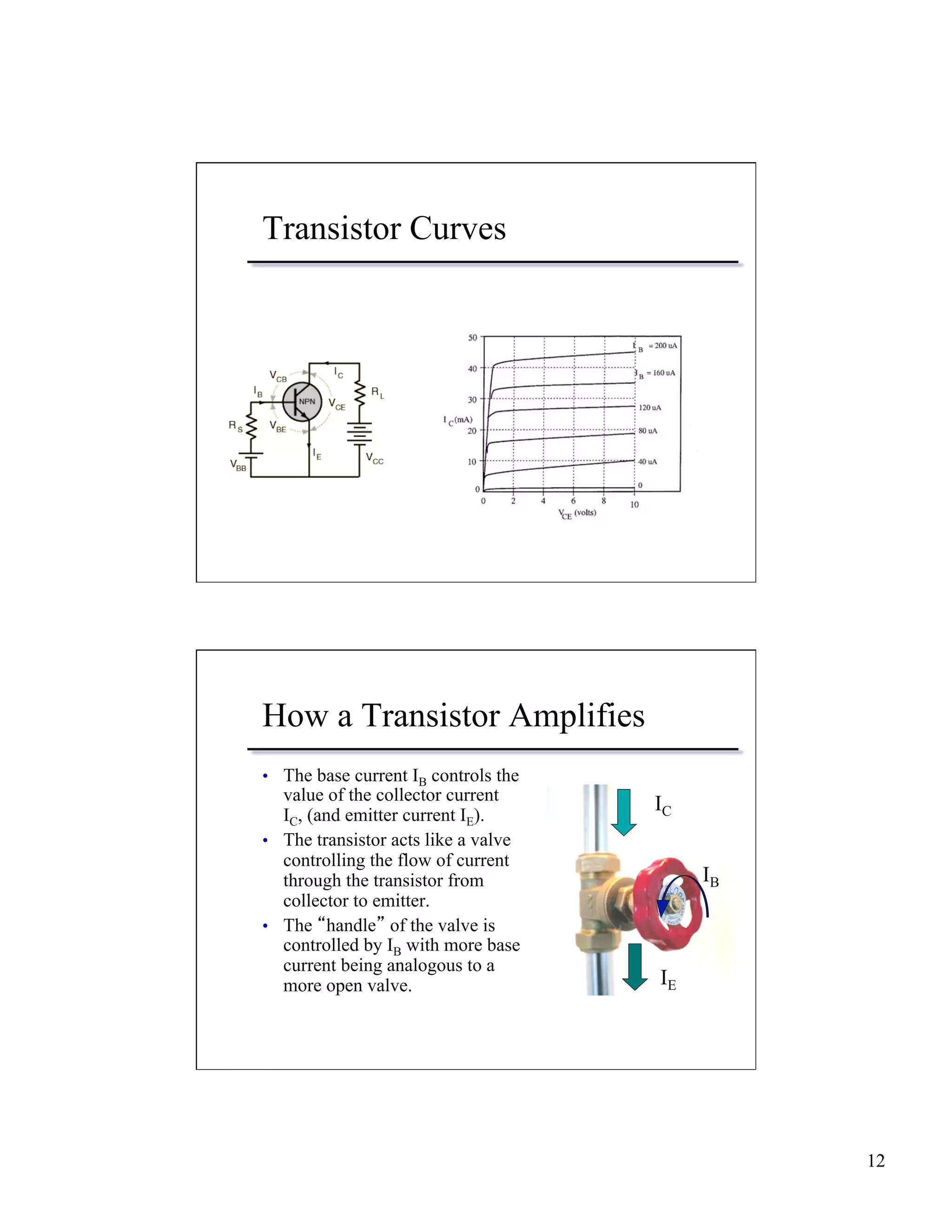
Transistor Curves 
How a Transistor Amplifies 
• The base current IB controls the 
value of the collector current 
IC, (and emitter current IE). 
• The transistor acts like a valve 
controlling the flow of current 
through the transistor from 
collector to emitter. 
• The “handle” of the valve is 
controlled by IB with more base 
current being analogous to a 
more open valve. 
IC 
IE 
IB
13 
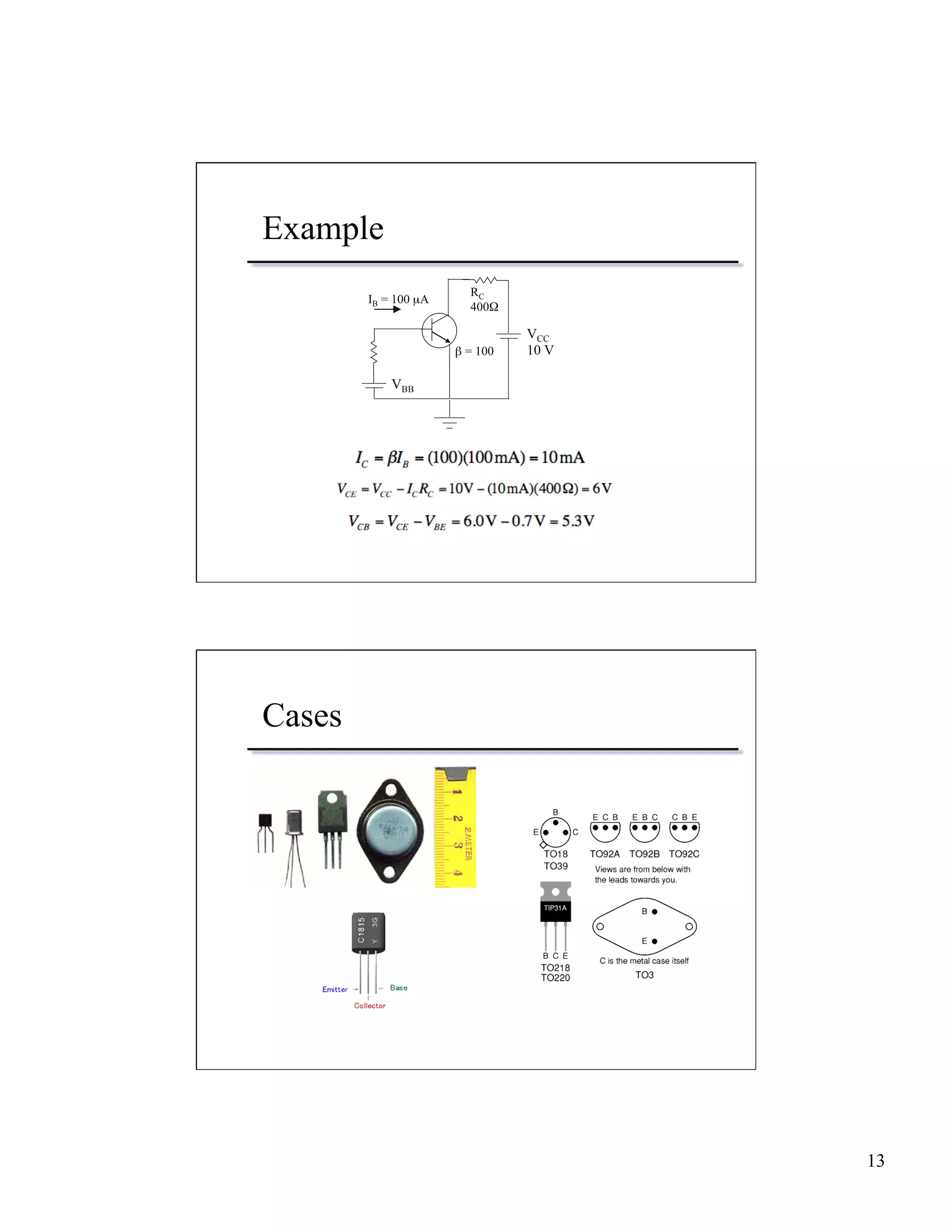
Example 
VBB 
VCC 
10 V 
IB = 100 μA RC 
400Ω 
β = 100 
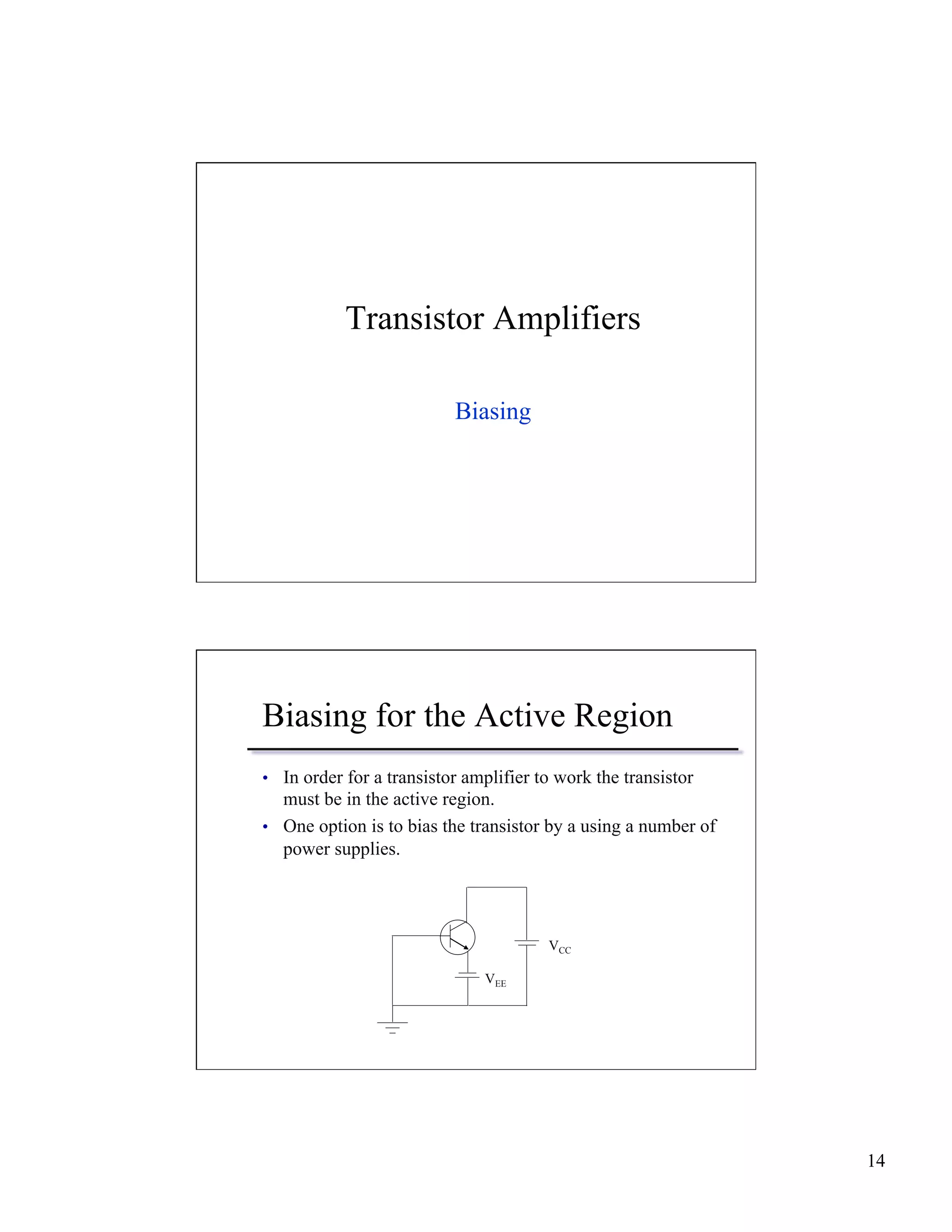
Cases
14 
Transistor Amplifiers 
Biasing 
Biasing for the Active Region 
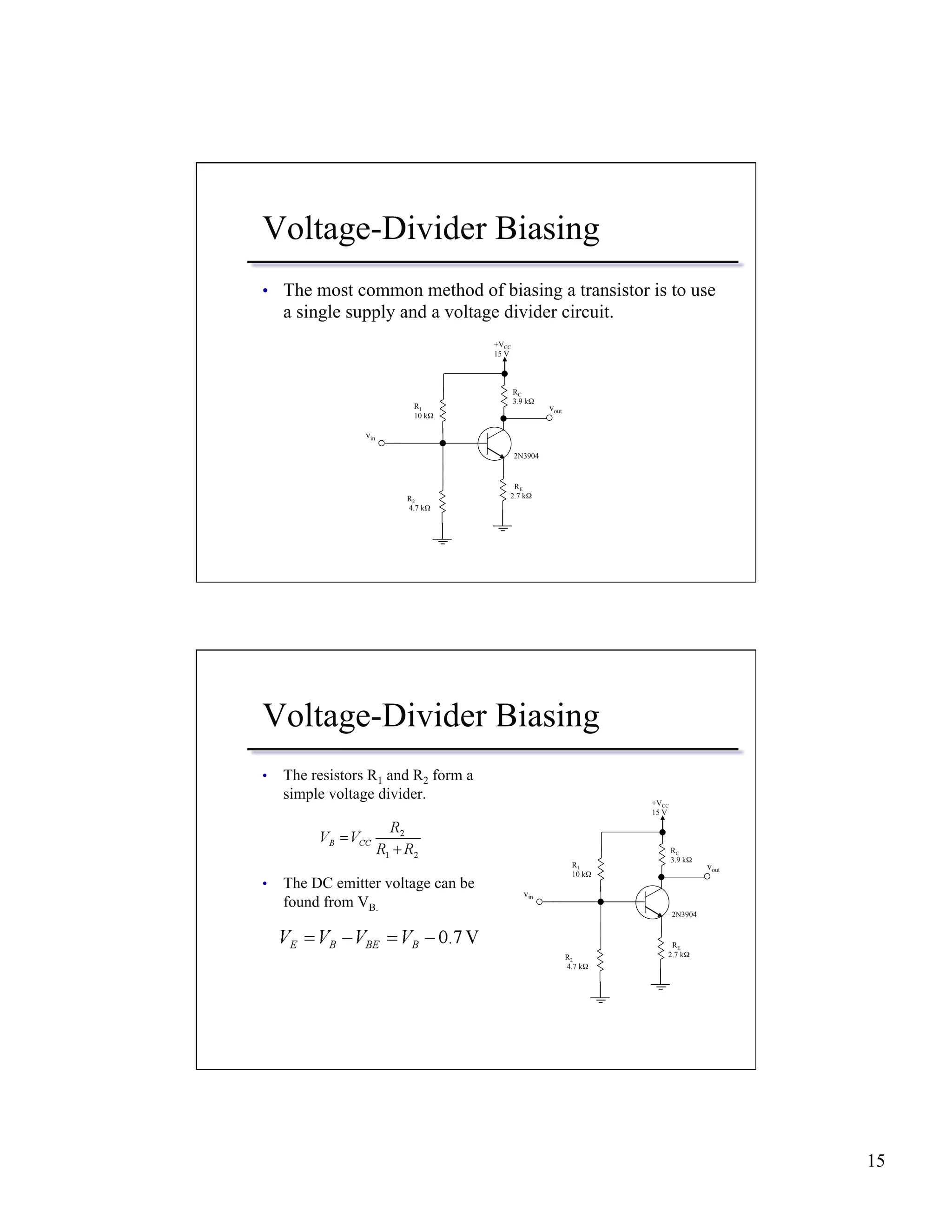
• In order for a transistor amplifier to work the transistor 
must be in the active region. 
• One option is to bias the transistor by a using a number of 
power supplies. 
VEE 
VCC
15 
Voltage-Divider Biasing 
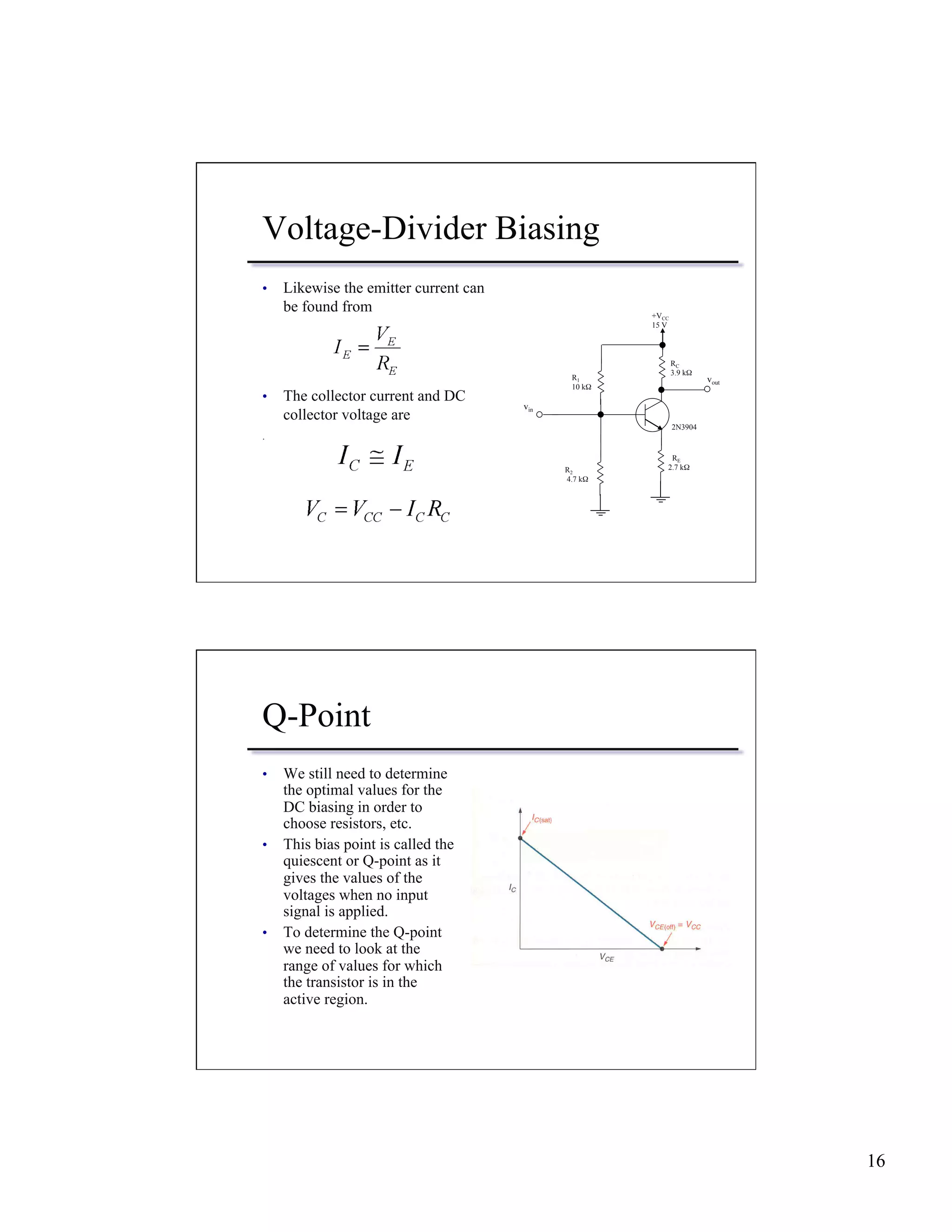
• The most common method of biasing a transistor is to use 
a single supply and a voltage divider circuit. 
vout 
R2 
4.7 kΩ 
RC 
3.9 kΩ 
2N3904 
R1 
10 kΩ 
+VCC 
15 V 
RE 
2.7 kΩ 
vin 
Voltage-Divider Biasing 
• The resistors R1 and R2 form a 
simple voltage divider. 
• The DC emitter voltage can be 
found from VB. 
vout 
R2 
4.7 kΩ 
RC 
3.9 kΩ 
2N3904 
R1 
10 kΩ 
+VCC 
15 V 
RE 
2.7 kΩ 
vin
16 
Voltage-Divider Biasing 
• Likewise the emitter current can 
be found from 
• The collector current and DC 
collector voltage are 
. 
vout 
R2 
4.7 kΩ 
RC 
3.9 kΩ 
2N3904 
R1 
10 kΩ 
+VCC 
15 V 
RE 
2.7 kΩ 
vin 
Q-Point 
• We still need to determine 
the optimal values for the 
DC biasing in order to 
choose resistors, etc. 
• This bias point is called the 
quiescent or Q-point as it 
gives the values of the 
voltages when no input 
signal is applied. 
• To determine the Q-point 
we need to look at the 
range of values for which 
the transistor is in the 
active region.
17 
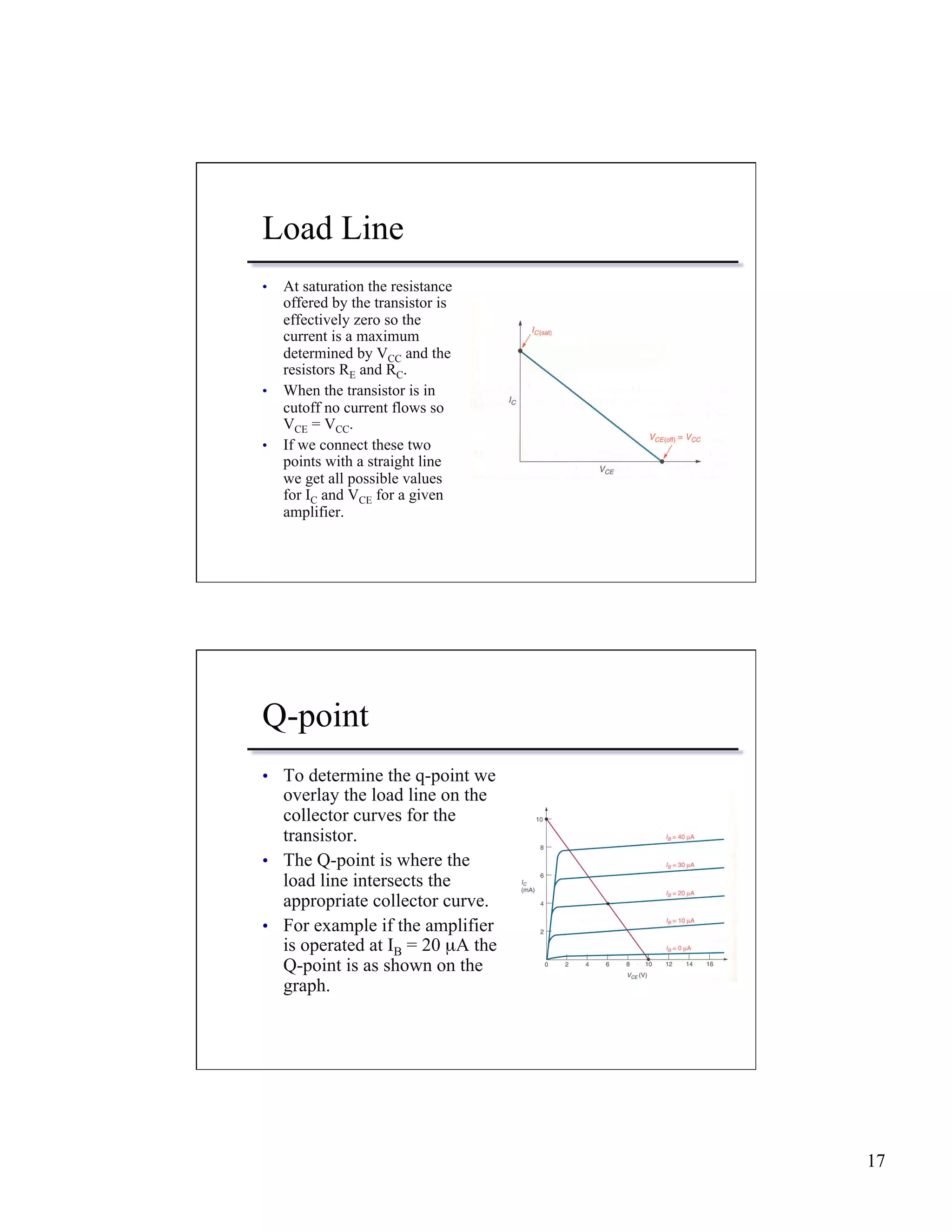
Load Line 
• At saturation the resistance 
offered by the transistor is 
effectively zero so the 
current is a maximum 
determined by VCC and the 
resistors RE and RC. 
• When the transistor is in 
cutoff no current flows so 
VCE = VCC. 
• If we connect these two 
points with a straight line 
we get all possible values 
for IC and VCE for a given 
amplifier. 
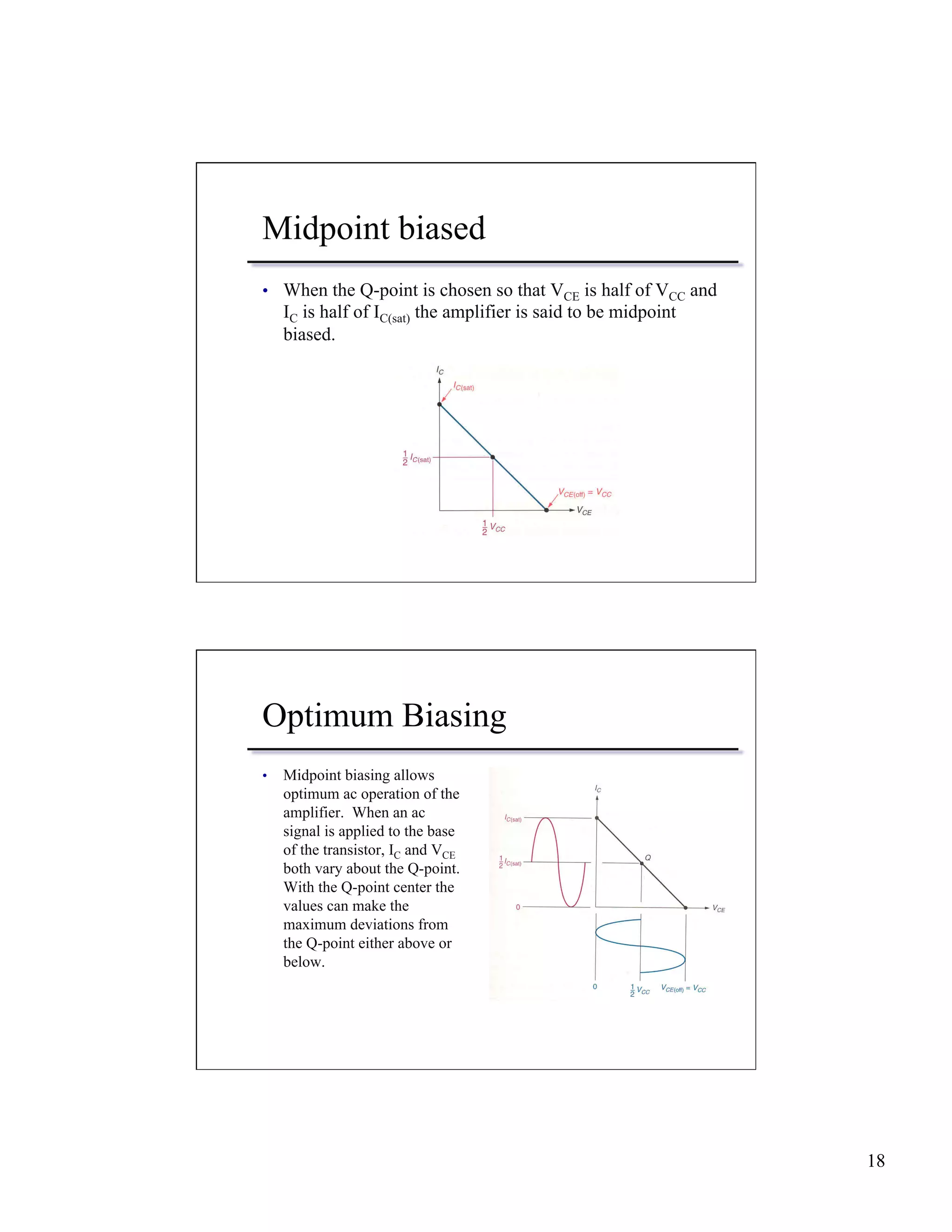
Q-point 
• To determine the q-point we 
overlay the load line on the 
collector curves for the 
transistor. 
• The Q-point is where the 
load line intersects the 
appropriate collector curve. 
• For example if the amplifier 
is operated at IB = 20 μA the 
Q-point is as shown on the 
graph.
18 
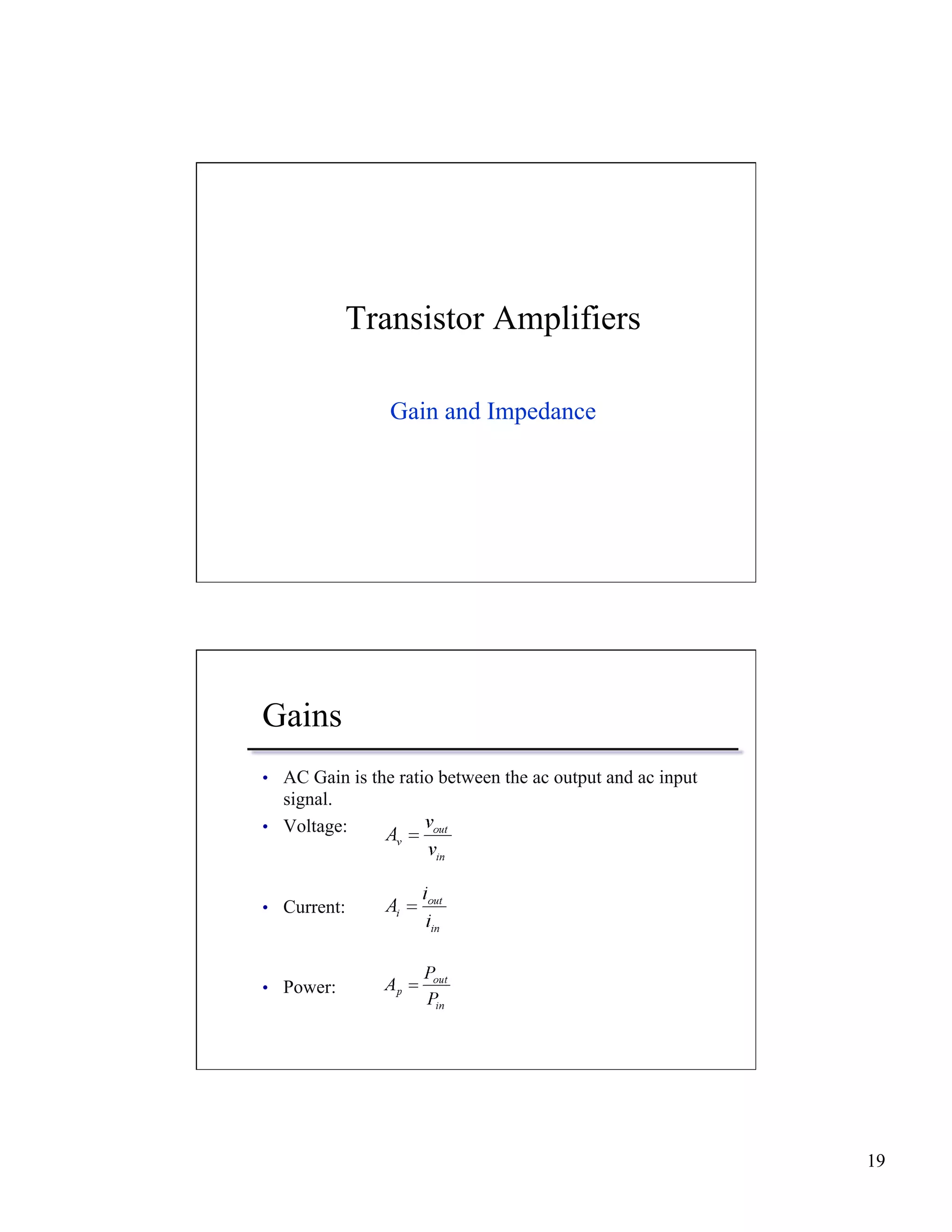
Midpoint biased 
• When the Q-point is chosen so that VCE is half of VCC and 
IC is half of IC(sat) the amplifier is said to be midpoint 
biased. 
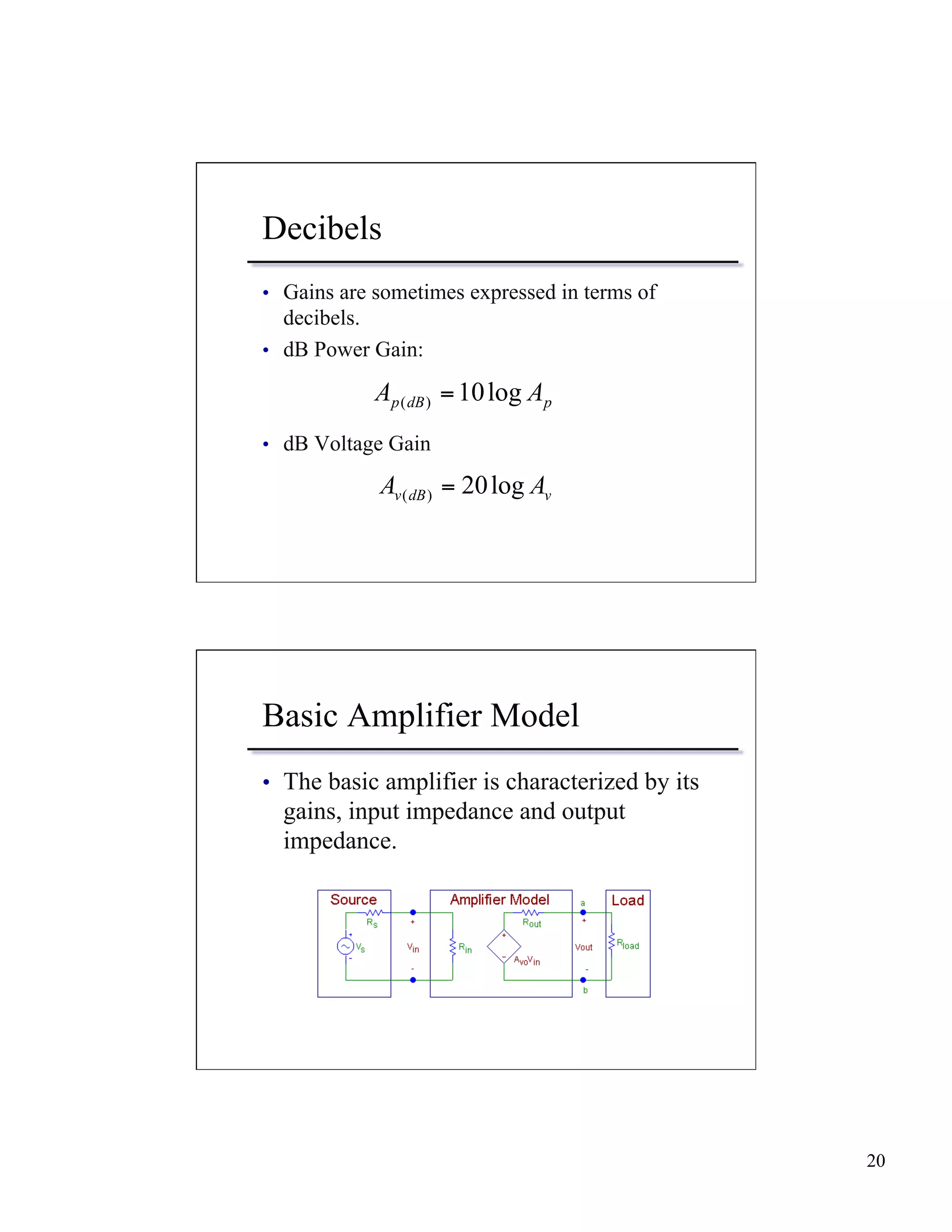
Optimum Biasing 
• Midpoint biasing allows 
optimum ac operation of the 
amplifier. When an ac 
signal is applied to the base 
of the transistor, IC and VCE 
both vary about the Q-point. 
With the Q-point center the 
values can make the 
maximum deviations from 
the Q-point either above or 
below.
19 
Transistor Amplifiers 
Gain and Impedance 
Gains 
• AC Gain is the ratio between the ac output and ac input 
signal. 
• Voltage: 
• Current: 
• Power:
20 
Decibels 
• Gains are sometimes expressed in terms of 
decibels. 
• dB Power Gain: 
p dB p A 10log A ( ) = 
• dB Voltage Gain 
v dB v A 20log A ( ) = 
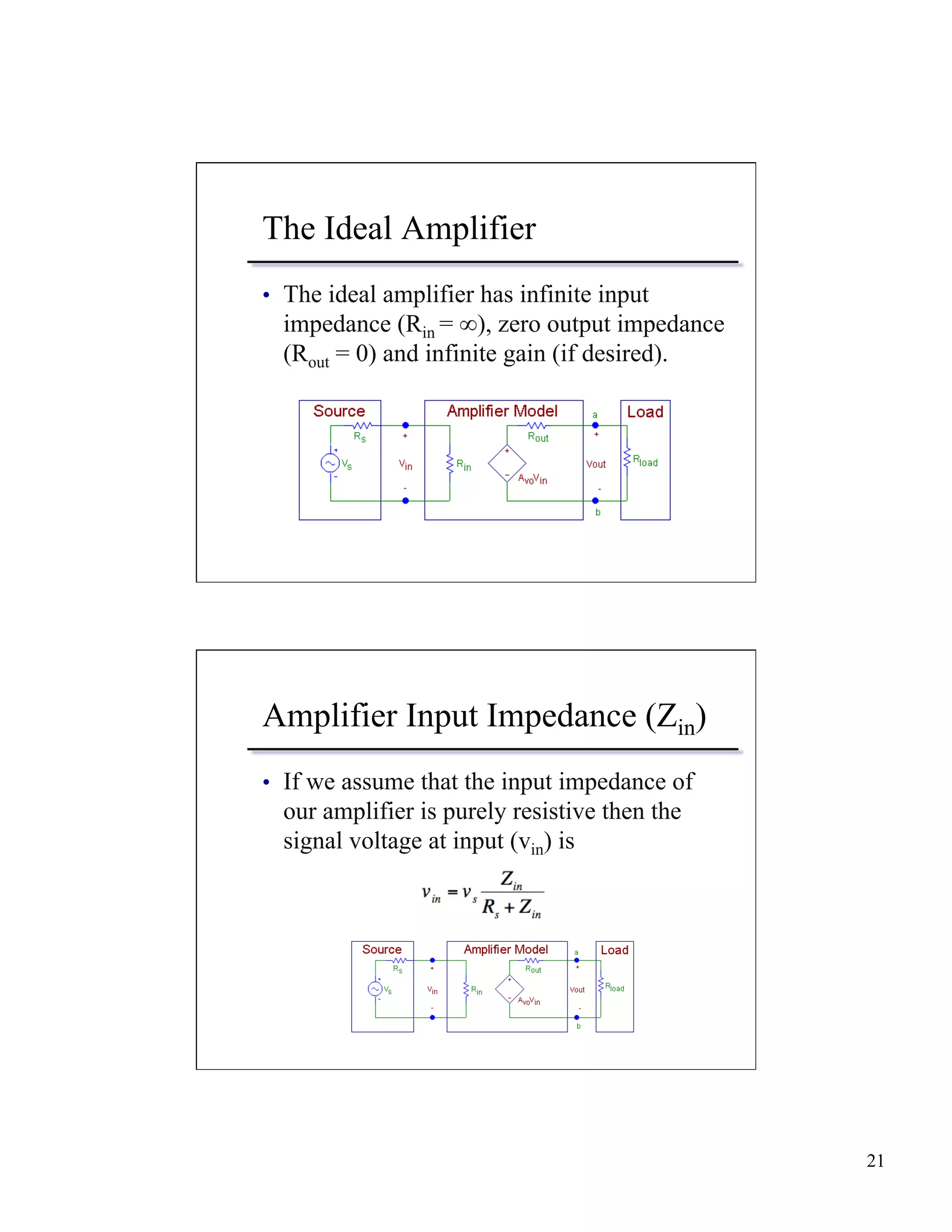
Basic Amplifier Model 
• The basic amplifier is characterized by its 
gains, input impedance and output 
impedance.
21 
The Ideal Amplifier 
• The ideal amplifier has infinite input 
impedance (Rin = ∞), zero output impedance 
(Rout = 0) and infinite gain (if desired). 
Amplifier Input Impedance (Zin) 
• If we assume that the input impedance of 
our amplifier is purely resistive then the 
signal voltage at input (vin) is
22 
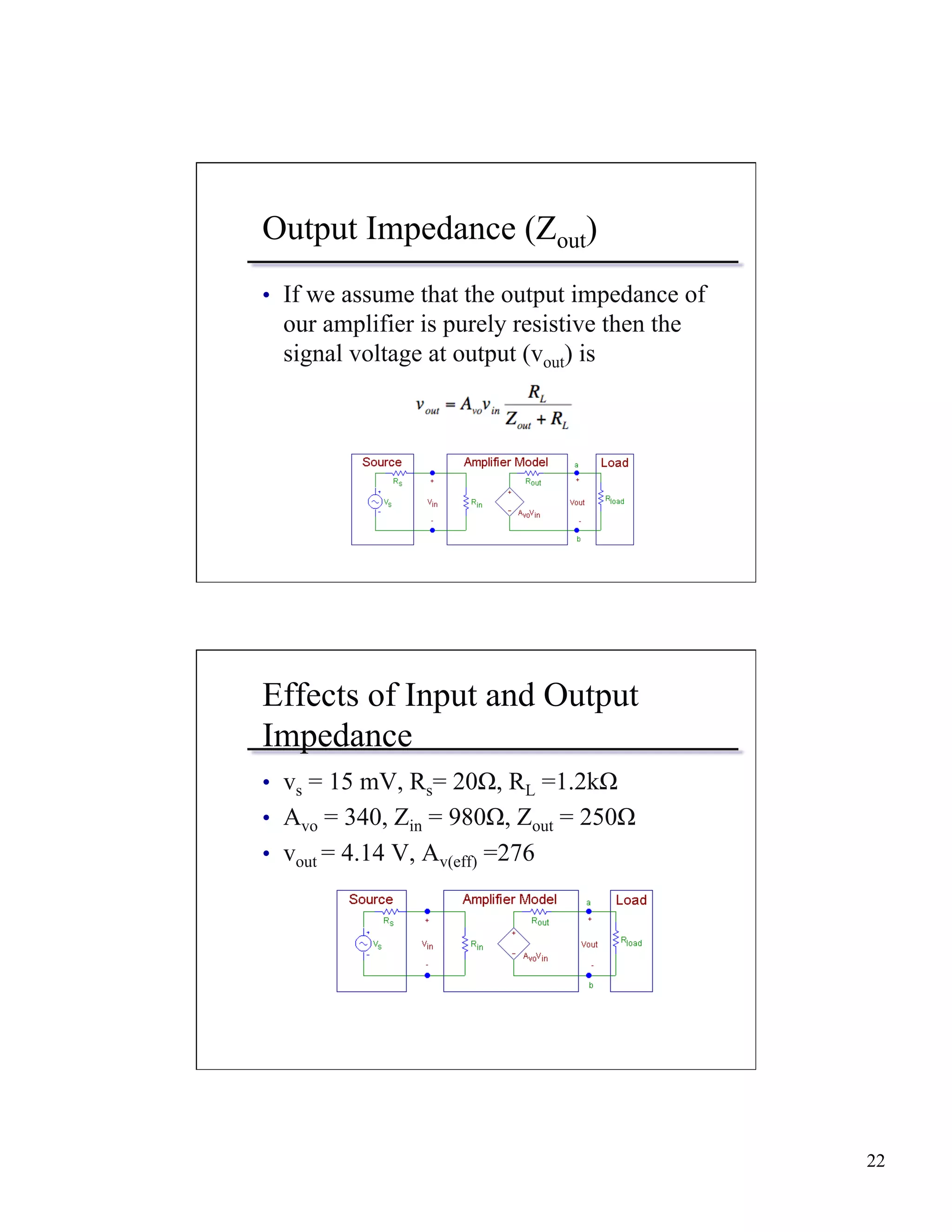
Output Impedance (Zout) 
• If we assume that the output impedance of 
our amplifier is purely resistive then the 
signal voltage at output (vout) is 
Effects of Input and Output 
Impedance 
• vs = 15 mV, Rs= 20Ω, RL =1.2kΩ 
• Avo = 340, Zin = 980Ω, Zout = 250Ω 
• vout = 4.14 V, Av(eff) =276
23 
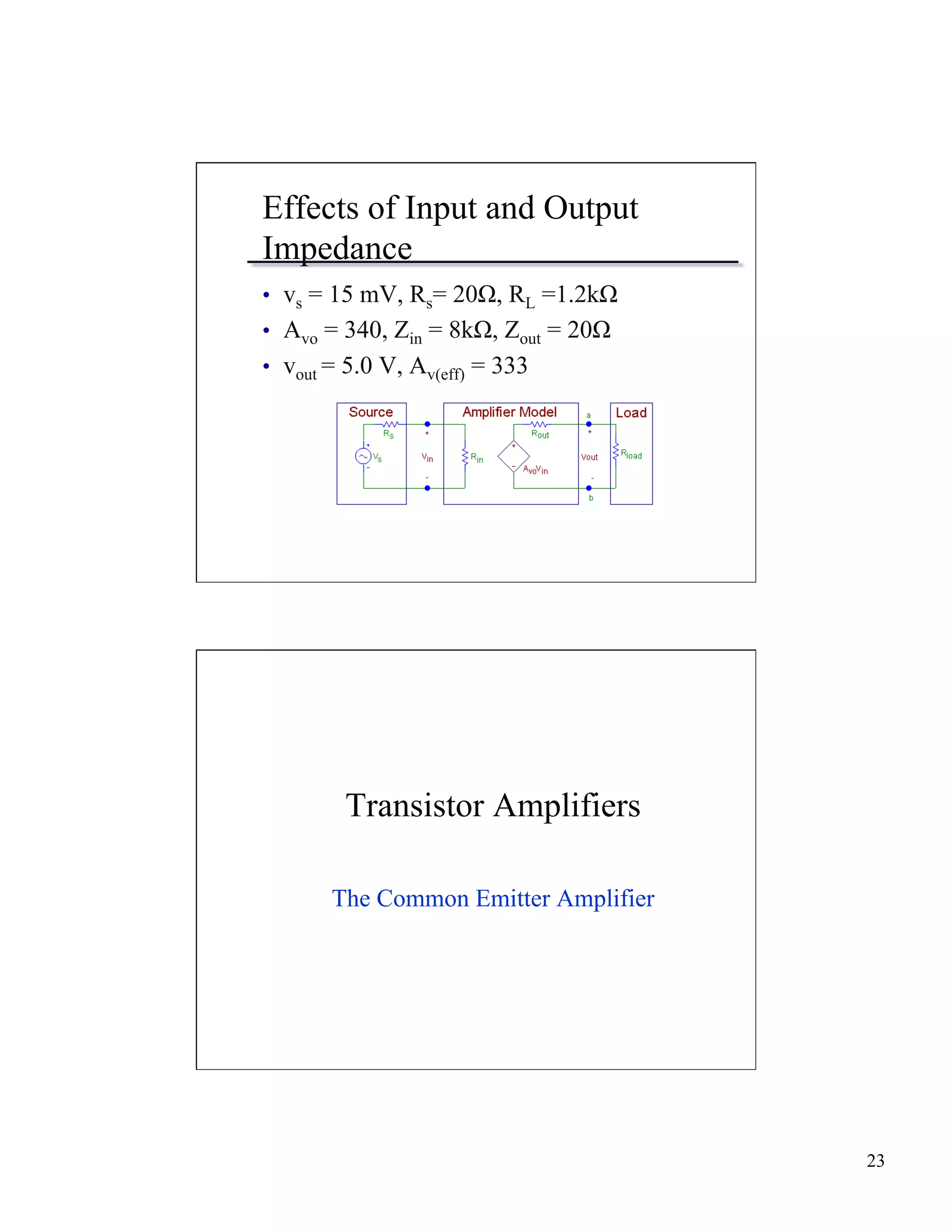
Effects of Input and Output 
Impedance 
• vs = 15 mV, Rs= 20Ω, RL =1.2kΩ 
• Avo = 340, Zin = 8kΩ, Zout = 20Ω 
• vout = 5.0 V, Av(eff) = 333 
Transistor Amplifiers 
The Common Emitter Amplifier
24 
Basic Design 
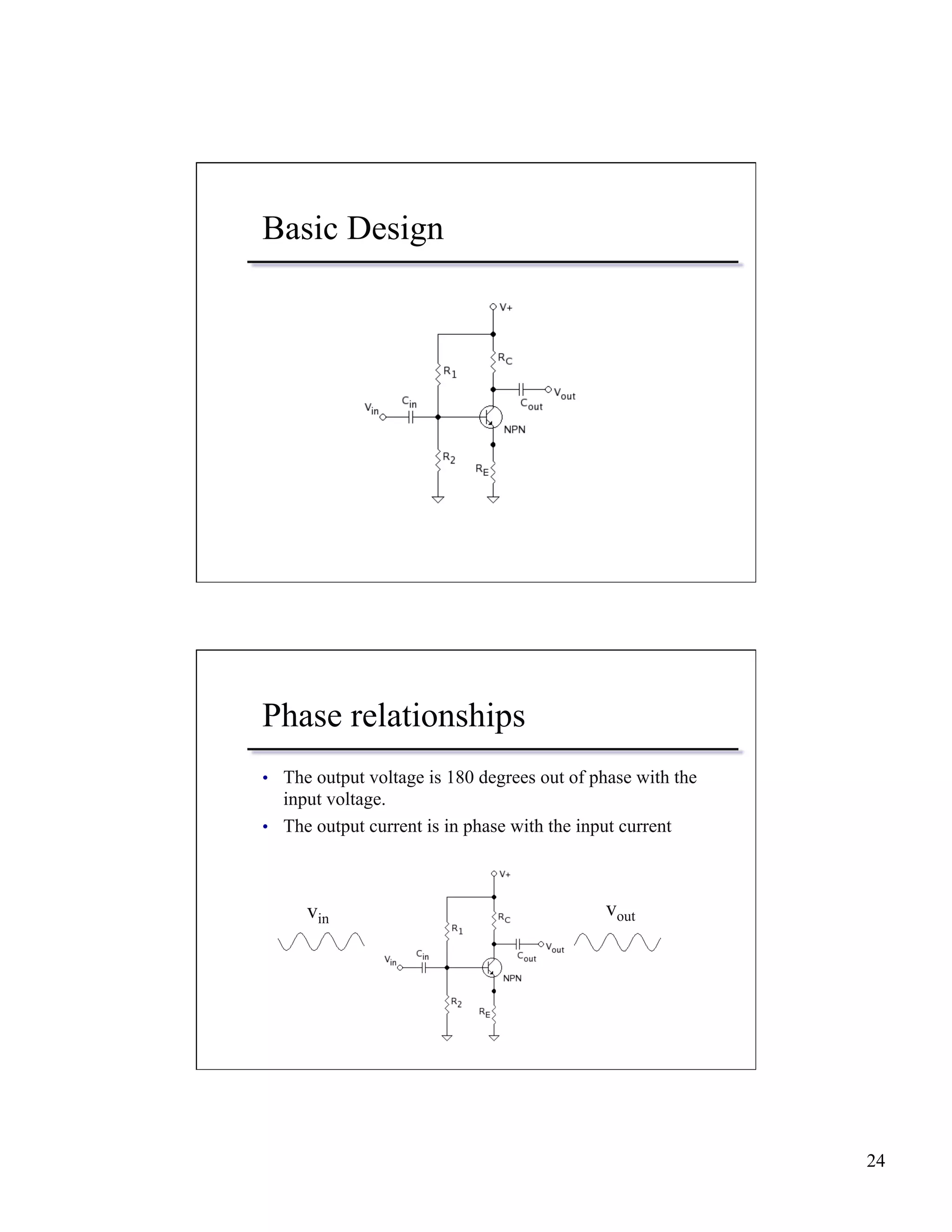
Phase relationships 
• The output voltage is 180 degrees out of phase with the 
input voltage. 
• The output current is in phase with the input current 
vin vout
25 
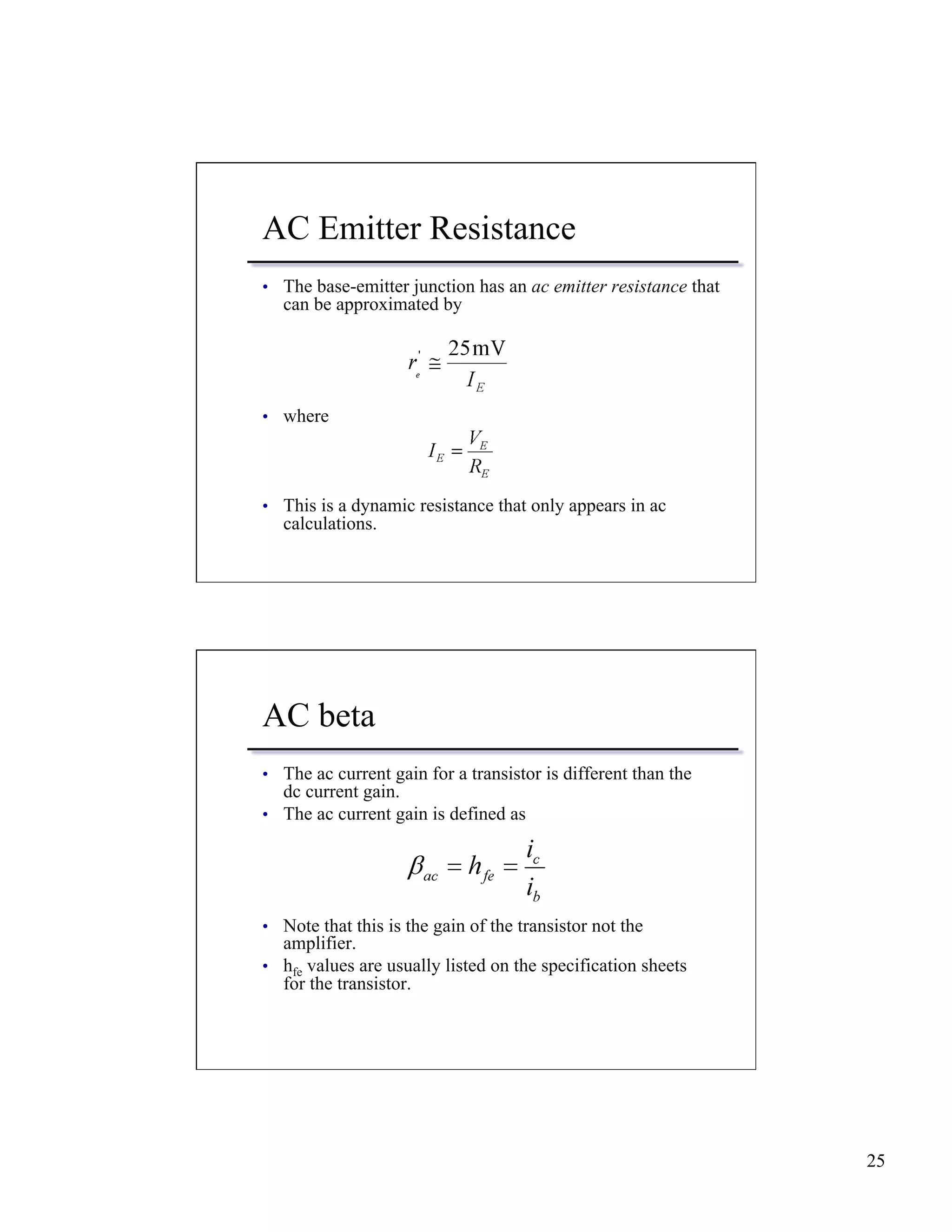
AC Emitter Resistance 
• The base-emitter junction has an ac emitter resistance that 
can be approximated by 
• where 
• This is a dynamic resistance that only appears in ac 
calculations. 
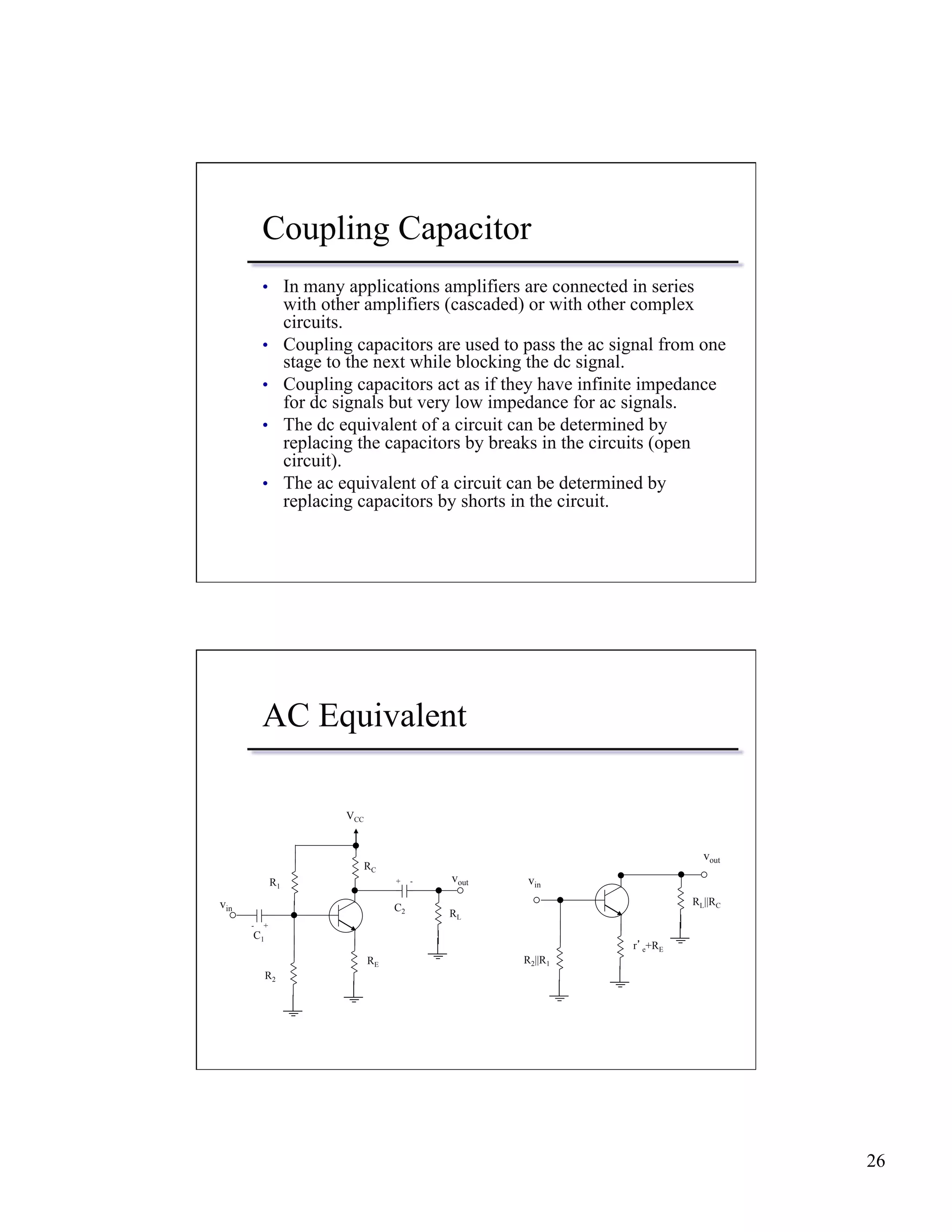
AC beta 
• The ac current gain for a transistor is different than the 
dc current gain. 
• The ac current gain is defined as 
• Note that this is the gain of the transistor not the 
amplifier. 
• hfe values are usually listed on the specification sheets 
for the transistor.
26 
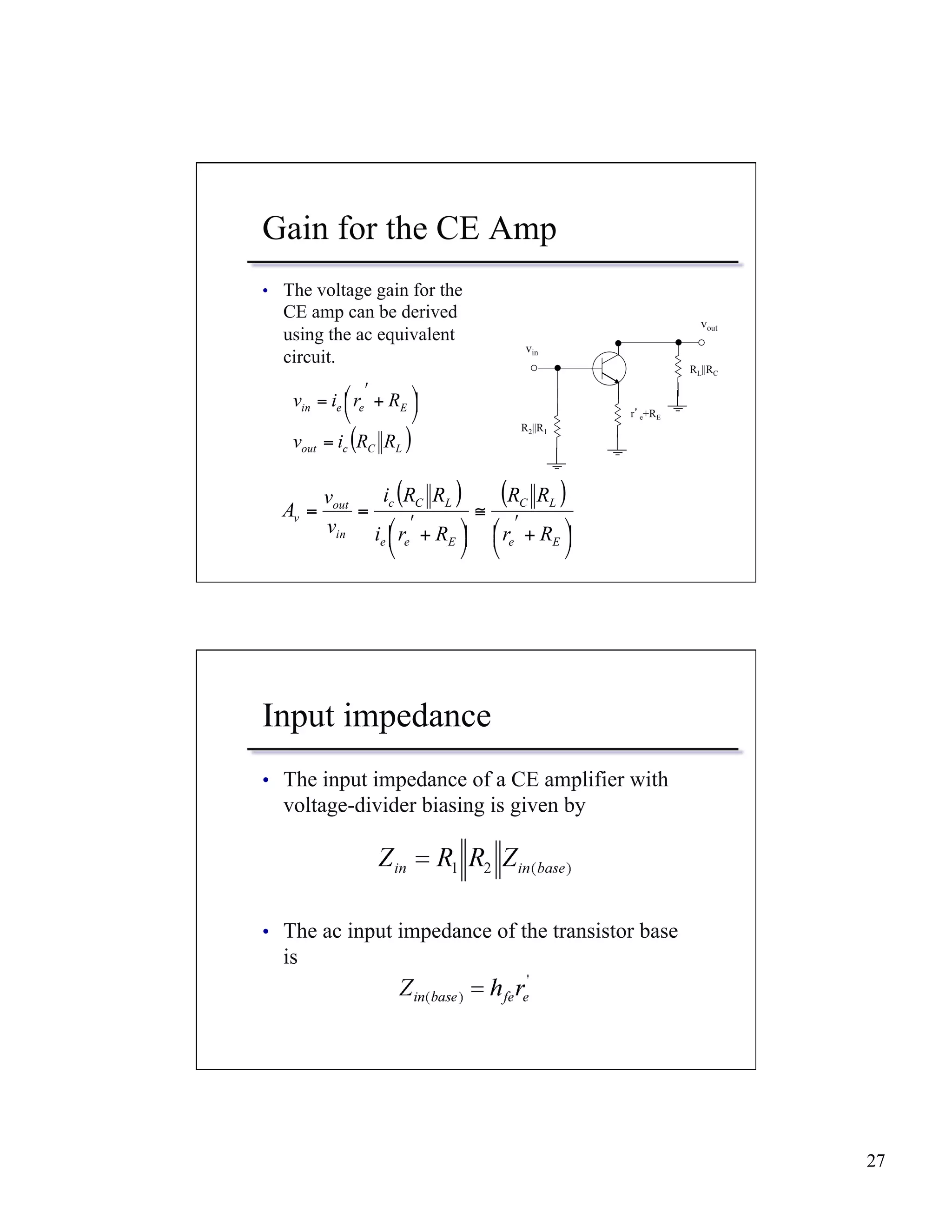
Coupling Capacitor 
• In many applications amplifiers are connected in series 
with other amplifiers (cascaded) or with other complex 
circuits. 
• Coupling capacitors are used to pass the ac signal from one 
stage to the next while blocking the dc signal. 
• Coupling capacitors act as if they have infinite impedance 
for dc signals but very low impedance for ac signals. 
• The dc equivalent of a circuit can be determined by 
replacing the capacitors by breaks in the circuits (open 
circuit). 
• The ac equivalent of a circuit can be determined by 
replacing capacitors by shorts in the circuit. 
AC Equivalent 
vout 
R2 
C2 RL 
R1 
VCC 
RE 
+ - 
- + 
RC 
vin 
C1 
vout 
R2||R1 
RL||RC 
r’e+RE 
vin
27 
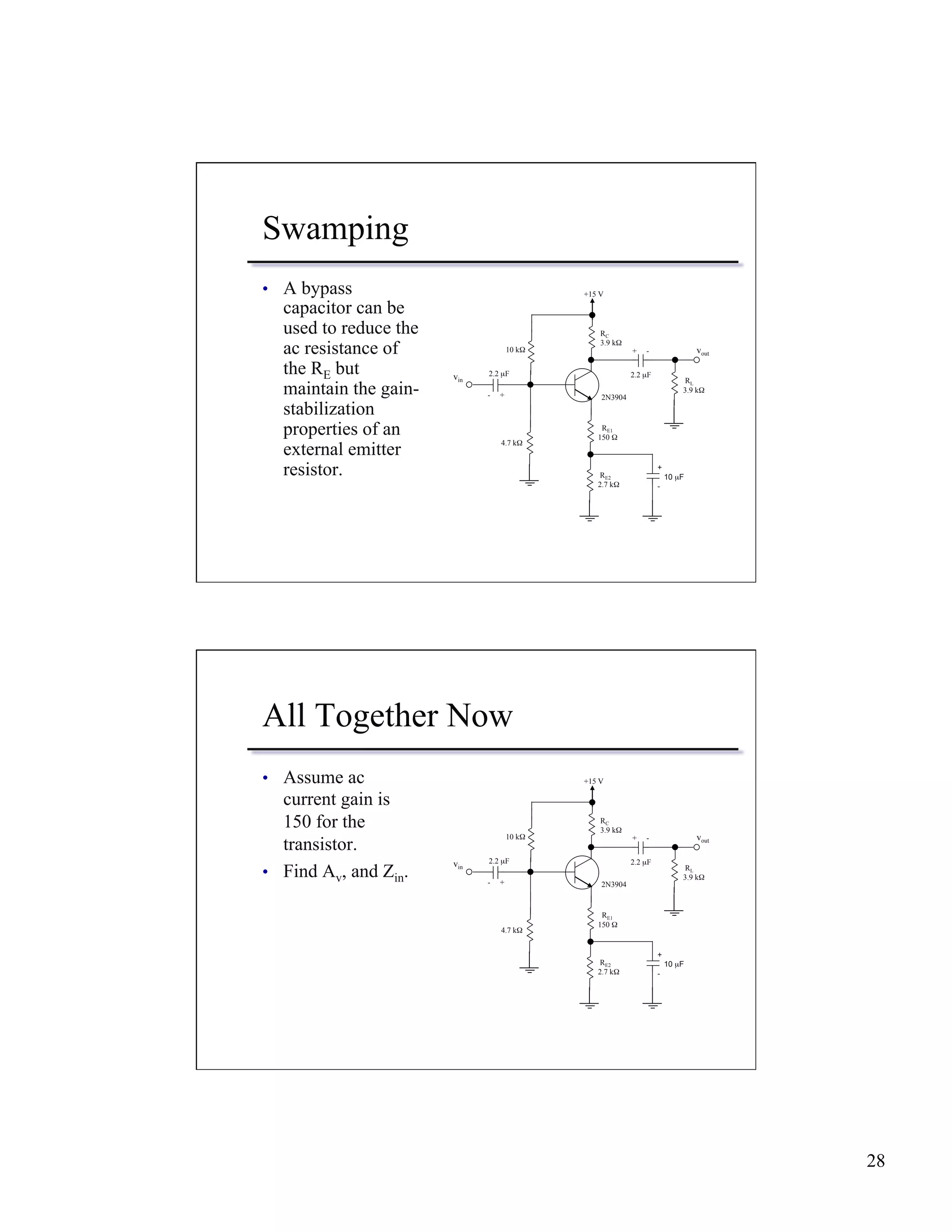
Gain for the CE Amp 
• The voltage gain for the 
CE amp can be derived 
using the ac equivalent 
circuit. 
= ʹ′ + 
v i r R 
in e e E 
v i R R 
out = 
( ) 
c C L ⎟⎠⎞ 
⎜⎝⎛ 
vout 
R2||R1 
RL||RC 
r’e+RE 
vin 
( ) ( ) 
⎟⎠⎞ 
⎜⎝⎛ 
R R 
C L 
ʹ′ + 
≅ 
⎟⎠⎞ 
i R R 
c C L 
⎜⎝⎛ 
ʹ′ + 
A v 
out 
= = 
e E 
e e E 
in 
v 
r R 
i r R 
v 
Input impedance 
• The input impedance of a CE amplifier with 
voltage-divider biasing is given by 
• The ac input impedance of the transistor base 
is
28 
Swamping 
• A bypass 
capacitor can be 
used to reduce the 
ac resistance of 
the RE but 
maintain the gain-stabilization 
properties of an 
external emitter 
resistor. 
vout 
RL 
3.9 kΩ 2.2 μF 
4.7 kΩ 
2N3904 
2.2 μF 
RE2 
2.7 kΩ 
10 kΩ 
+15 V 
RE1 
150 Ω 
+ - 
- + 
+ 
10 μF 
- 
RC 
3.9 kΩ 
vin 
All Together Now 
• Assume ac 
current gain is 
150 for the 
transistor. 
• Find Av, and Zin. 
vout 
RL 
3.9 kΩ 2.2 μF 
4.7 kΩ 
2N3904 
2.2 μF 
RE2 
2.7 kΩ 
10 kΩ 
+15 V 
RE1 
150 Ω 
+ - 
- + 
+ 
10 μF 
- 
RC 
3.9 kΩ 
vin
29 
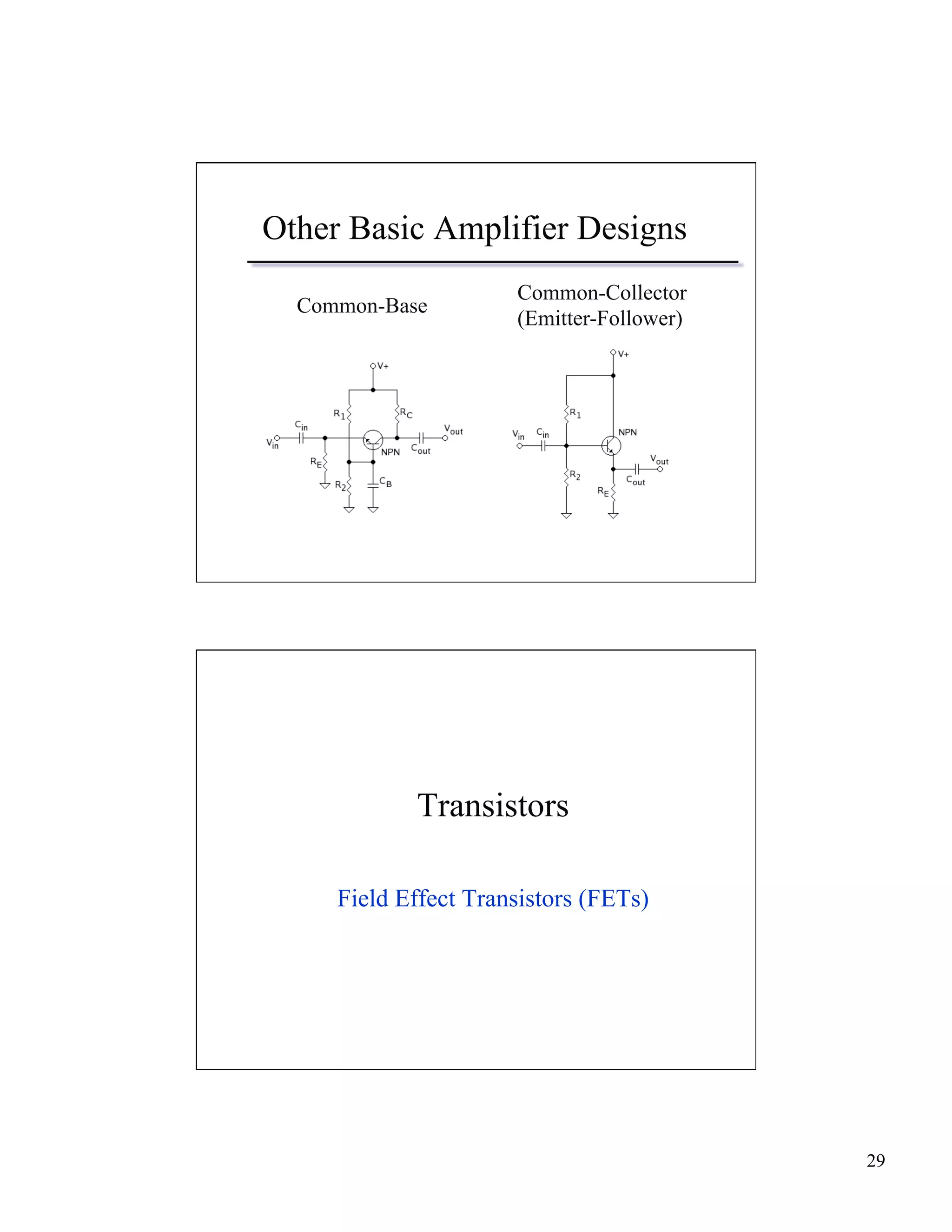
Other Basic Amplifier Designs 
Common-Base Common-Collector 
(Emitter-Follower) 
Transistors 
Field Effect Transistors (FETs)
30 
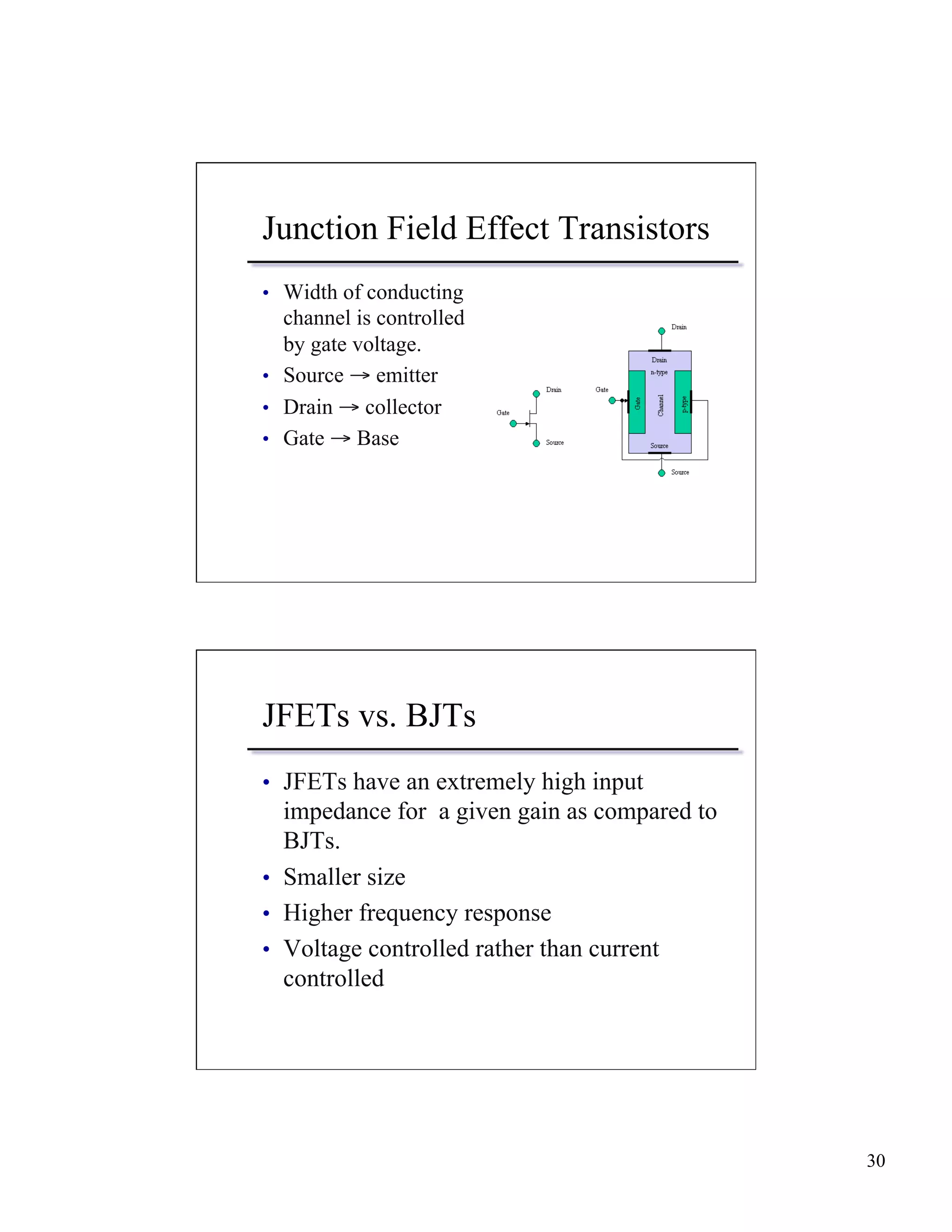
Junction Field Effect Transistors 
• Width of conducting 
channel is controlled 
by gate voltage. 
• Source → emitter 
• Drain → collector 
• Gate → Base 
JFETs vs. BJTs 
• JFETs have an extremely high input 
impedance for a given gain as compared to 
BJTs. 
• Smaller size 
• Higher frequency response 
• Voltage controlled rather than current 
controlled
31 
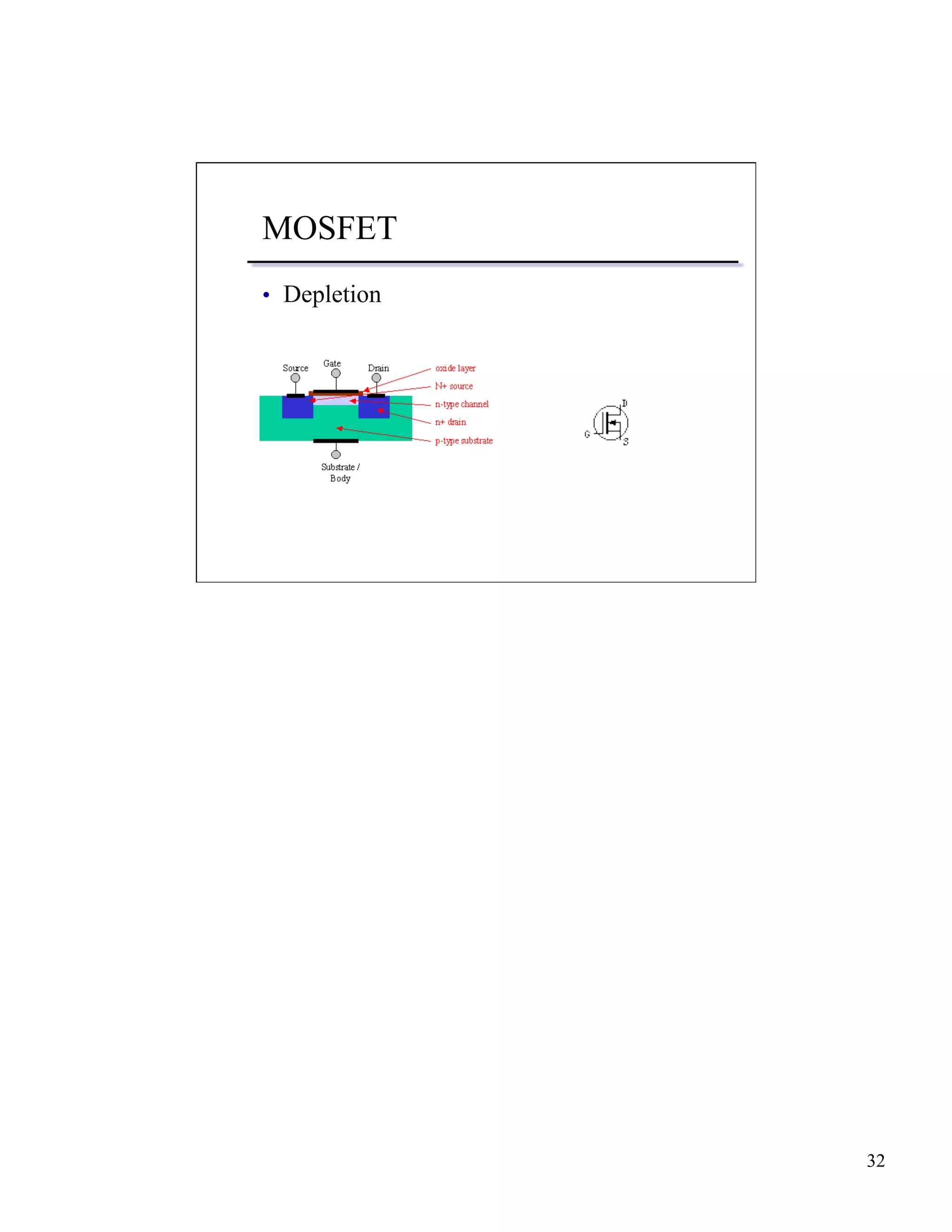
MOSFET 
• Metal Oxide Semiconductor FET 
• Very low current devices 
• Most VLSI circuits use MOSFETs. 
• Two types: 
§ Enhancement 
§ Depletion 
MOSFET 
• Enhancement
32 
MOSFET 
• Depletion

Transistors handout

  • 1.
    1 Transistors BipolarJunction Transistors (BJT) Transistor Basics • A Bipolar Junction Transistor is a three layer (npn or pnp) semiconductor device. • There are two pn junctions in the transistor. • The three layers are called the emitter, base and collector.
  • 2.
    2 Transistor Basics • The base is lightly doped and sandwiched between the collector and the emitter. The collector is moderately doped and the emitter is heavily doped. • The base region is much thinner than the either the collector or emitter regions. Typical base widths are about 10-6 m. • The collector region is usually thicker than the emitter as the largest amount of heat is dissipated in the collector. Transistor Basics
  • 3.
    3 “Two-diode” Model • A simple model of the transistor can be made out of two diodes placed back to back. (This doesn’t really work but it is useful.) E C B Biasing the Transistor • The transistor operates in three modes depending on how the pn junctions in the device are biased. § Cutoff - both junctions reverse biased. § Saturation - both junctions forward biased. § Active - base-emitter junction is forward biased and collector-base is reversed biased. E C B
  • 4.
    4 A NoteAbout Labeling Voltages • Voltages with capital letter subscripts are DC voltages, (VBE, VCC). • When a voltage has a single subscript it is measured from the terminal to ground, (VE, VC). • When a voltage has a double subscript with different letters it is the voltage measured between two terminals, (VBE, VEC). • When a voltage has a double subscript with the same letters it is a supply voltage, (VEE, VCC). Cutoff • Both junctions are reverse biased. • No current flows. n p n VBE VCE VBE VCE E C B
  • 5.
    5 Saturation •Both junctions are forward biased. • Maximum current flows. VCE < VBE VCE < VBE n p n VBE VCE VBE VCE E C B Active Region • The BE junction is forward biased and the BC junction is reverse biased. • The base-emitter voltage is approximately 0.5 - 0.7 volts (the turn-on voltage of the junction. n p n VBE VCE VBE VCE E C B VCE > VBE ≈ 0.7 V VCE > VBE ≈ 0.7 V
  • 6.
    6 Active Region • To make the biasing more obvious we can ground the base and use power supplies to bias the emitter and collector. Notice that the BE junction is forward biased and the BC junction is reverse biased. IB n p n VEE VCC IC IE VEE E C B VCC IB IE IC Active Operation • With the BE junction forward biased electrons diffuse across the junction into the base. • The base is very thin and lightly doped so there are relatively few holes in it compared with the electrons from the heavily doped emitter region. n p n VEE E C B VCC IB IE IC
  • 7.
    7 Active Operation • As there are few holes in the base for the electrons to combine with most of the electrons diffuse in to the reverse biased collector-base junction where the electric field in the depletion region sweeps them across into the collector. • Remember electrons are the “minority carriers” in the p material so they are swept across the depletion region. n p n VEE E C B VCC IB IE IC Active Operation Unbiased: • A simplified electron energy diagram for the npn transistor.
  • 8.
    8 Active Operation Biased: • A simplified electron energy diagram for the npn transistor. Active Operation • A small percentage of the electrons injected in to the base from the emitter do recombine with the holes in the base. • If left alone the base would slowly become more negative until the flow of electrons across the base stopped. Electrons leave the base via the wire contact maintaining the small amount of holes in the base. • This flow of electrons is the small base current. n p n VEE E C B VCC IB IE IC
  • 9.
    9 Active Operation Electron flow through the transistor n p n VEE E C B VCC IB IE IC Active Operation Conventional Current n p n VEE E C IE IC B VCC IB IB IE IC
  • 10.
    10 Active Operation • Kirchoff’s rule gives us • The dc alpha is the ratio of collector to emitter current. • Typical transistors have values of α that range from 0.95 to 0.995. Active Operation • The ratio of the dc collector current to the dc base current is the dc beta rating of the transistor. (Also called hFE.) • The dc beta can be related to the dc alpha.
  • 11.
    11 Transistor Curves • To understand why the transistor in the active region can be used as an amplifier we can look at collector characteristic curves. • A version of the common-emitter circuit: Transistor Curves • The voltage difference between the collector and emitter VCE can be adjusted by varying VCC. • Likewise varying VBB adjusts the value of IB.
  • 12.
    12 Transistor Curves How a Transistor Amplifies • The base current IB controls the value of the collector current IC, (and emitter current IE). • The transistor acts like a valve controlling the flow of current through the transistor from collector to emitter. • The “handle” of the valve is controlled by IB with more base current being analogous to a more open valve. IC IE IB
  • 13.
    13 Example VBB VCC 10 V IB = 100 μA RC 400Ω β = 100 Cases
  • 14.
    14 Transistor Amplifiers Biasing Biasing for the Active Region • In order for a transistor amplifier to work the transistor must be in the active region. • One option is to bias the transistor by a using a number of power supplies. VEE VCC
  • 15.
    15 Voltage-Divider Biasing • The most common method of biasing a transistor is to use a single supply and a voltage divider circuit. vout R2 4.7 kΩ RC 3.9 kΩ 2N3904 R1 10 kΩ +VCC 15 V RE 2.7 kΩ vin Voltage-Divider Biasing • The resistors R1 and R2 form a simple voltage divider. • The DC emitter voltage can be found from VB. vout R2 4.7 kΩ RC 3.9 kΩ 2N3904 R1 10 kΩ +VCC 15 V RE 2.7 kΩ vin
  • 16.
    16 Voltage-Divider Biasing • Likewise the emitter current can be found from • The collector current and DC collector voltage are . vout R2 4.7 kΩ RC 3.9 kΩ 2N3904 R1 10 kΩ +VCC 15 V RE 2.7 kΩ vin Q-Point • We still need to determine the optimal values for the DC biasing in order to choose resistors, etc. • This bias point is called the quiescent or Q-point as it gives the values of the voltages when no input signal is applied. • To determine the Q-point we need to look at the range of values for which the transistor is in the active region.
  • 17.
    17 Load Line • At saturation the resistance offered by the transistor is effectively zero so the current is a maximum determined by VCC and the resistors RE and RC. • When the transistor is in cutoff no current flows so VCE = VCC. • If we connect these two points with a straight line we get all possible values for IC and VCE for a given amplifier. Q-point • To determine the q-point we overlay the load line on the collector curves for the transistor. • The Q-point is where the load line intersects the appropriate collector curve. • For example if the amplifier is operated at IB = 20 μA the Q-point is as shown on the graph.
  • 18.
    18 Midpoint biased • When the Q-point is chosen so that VCE is half of VCC and IC is half of IC(sat) the amplifier is said to be midpoint biased. Optimum Biasing • Midpoint biasing allows optimum ac operation of the amplifier. When an ac signal is applied to the base of the transistor, IC and VCE both vary about the Q-point. With the Q-point center the values can make the maximum deviations from the Q-point either above or below.
  • 19.
    19 Transistor Amplifiers Gain and Impedance Gains • AC Gain is the ratio between the ac output and ac input signal. • Voltage: • Current: • Power:
  • 20.
    20 Decibels •Gains are sometimes expressed in terms of decibels. • dB Power Gain: p dB p A 10log A ( ) = • dB Voltage Gain v dB v A 20log A ( ) = Basic Amplifier Model • The basic amplifier is characterized by its gains, input impedance and output impedance.
  • 21.
    21 The IdealAmplifier • The ideal amplifier has infinite input impedance (Rin = ∞), zero output impedance (Rout = 0) and infinite gain (if desired). Amplifier Input Impedance (Zin) • If we assume that the input impedance of our amplifier is purely resistive then the signal voltage at input (vin) is
  • 22.
    22 Output Impedance(Zout) • If we assume that the output impedance of our amplifier is purely resistive then the signal voltage at output (vout) is Effects of Input and Output Impedance • vs = 15 mV, Rs= 20Ω, RL =1.2kΩ • Avo = 340, Zin = 980Ω, Zout = 250Ω • vout = 4.14 V, Av(eff) =276
  • 23.
    23 Effects ofInput and Output Impedance • vs = 15 mV, Rs= 20Ω, RL =1.2kΩ • Avo = 340, Zin = 8kΩ, Zout = 20Ω • vout = 5.0 V, Av(eff) = 333 Transistor Amplifiers The Common Emitter Amplifier
  • 24.
    24 Basic Design Phase relationships • The output voltage is 180 degrees out of phase with the input voltage. • The output current is in phase with the input current vin vout
  • 25.
    25 AC EmitterResistance • The base-emitter junction has an ac emitter resistance that can be approximated by • where • This is a dynamic resistance that only appears in ac calculations. AC beta • The ac current gain for a transistor is different than the dc current gain. • The ac current gain is defined as • Note that this is the gain of the transistor not the amplifier. • hfe values are usually listed on the specification sheets for the transistor.
  • 26.
    26 Coupling Capacitor • In many applications amplifiers are connected in series with other amplifiers (cascaded) or with other complex circuits. • Coupling capacitors are used to pass the ac signal from one stage to the next while blocking the dc signal. • Coupling capacitors act as if they have infinite impedance for dc signals but very low impedance for ac signals. • The dc equivalent of a circuit can be determined by replacing the capacitors by breaks in the circuits (open circuit). • The ac equivalent of a circuit can be determined by replacing capacitors by shorts in the circuit. AC Equivalent vout R2 C2 RL R1 VCC RE + - - + RC vin C1 vout R2||R1 RL||RC r’e+RE vin
  • 27.
    27 Gain forthe CE Amp • The voltage gain for the CE amp can be derived using the ac equivalent circuit. = ʹ′ + v i r R in e e E v i R R out = ( ) c C L ⎟⎠⎞ ⎜⎝⎛ vout R2||R1 RL||RC r’e+RE vin ( ) ( ) ⎟⎠⎞ ⎜⎝⎛ R R C L ʹ′ + ≅ ⎟⎠⎞ i R R c C L ⎜⎝⎛ ʹ′ + A v out = = e E e e E in v r R i r R v Input impedance • The input impedance of a CE amplifier with voltage-divider biasing is given by • The ac input impedance of the transistor base is
  • 28.
    28 Swamping •A bypass capacitor can be used to reduce the ac resistance of the RE but maintain the gain-stabilization properties of an external emitter resistor. vout RL 3.9 kΩ 2.2 μF 4.7 kΩ 2N3904 2.2 μF RE2 2.7 kΩ 10 kΩ +15 V RE1 150 Ω + - - + + 10 μF - RC 3.9 kΩ vin All Together Now • Assume ac current gain is 150 for the transistor. • Find Av, and Zin. vout RL 3.9 kΩ 2.2 μF 4.7 kΩ 2N3904 2.2 μF RE2 2.7 kΩ 10 kΩ +15 V RE1 150 Ω + - - + + 10 μF - RC 3.9 kΩ vin
  • 29.
    29 Other BasicAmplifier Designs Common-Base Common-Collector (Emitter-Follower) Transistors Field Effect Transistors (FETs)
  • 30.
    30 Junction FieldEffect Transistors • Width of conducting channel is controlled by gate voltage. • Source → emitter • Drain → collector • Gate → Base JFETs vs. BJTs • JFETs have an extremely high input impedance for a given gain as compared to BJTs. • Smaller size • Higher frequency response • Voltage controlled rather than current controlled
  • 31.
    31 MOSFET •Metal Oxide Semiconductor FET • Very low current devices • Most VLSI circuits use MOSFETs. • Two types: § Enhancement § Depletion MOSFET • Enhancement
  • 32.
    32 MOSFET •Depletion