By                               Anita a thattil                         S5 ec alphaRajagiri school of engineering,kakkanadIC VOLTAGE REGULATORS
INTRODUCTIONIntegrated ICs with improved capabilities are appearing in an ever increasing numbers.Often ,the use of specialized IC produces a simpler and more accurate circuits.Examples: MF5(National ‘s switched capacitor filter),  SE/NE 565(Signetics’Phase locked loop-PLL)  , timer SE/NE 555 etcApplications of specialized ICs:                           *universal filters                          *timers                          *Phase locked loop(PLL)                          *power amplifiers                          *voltage regulators                          *switching regulators                          *voltage references
Topics to be dealt78XX  series79XX series317 variable regulators1723 switching regulators
IC Voltage Regulators4Voltage regulator: is a circuit that supplies constant voltage regardless of changes in the load current.
Advantages of IC voltage regulator:               inexpensive,versatile,provides current /voltage boosting, internal short circuit current limiting, thermal shutdown, floating operation for high voltage applications.      Classification of  IC voltage regulators: There are basically two kinds of IC voltage regulators:
Multi-pin type, e.g. LM723C
3-pin type, e.g. 78/79XX
Multi-pin regulators are less popular but they provide the greatest flexibility and produce the highest quality voltage regulation
3-pin types make regulator circuit design simpleTypes of IC voltage regulators:Fixed output voltage regulators:positive fixed output regulator(78XX series) and negative fixed output regulator(79XX series)
Adjustable output voltage regulators:       positive (LM317) and negative(LM337)
Switching regulators:motorola ‘s MC1723
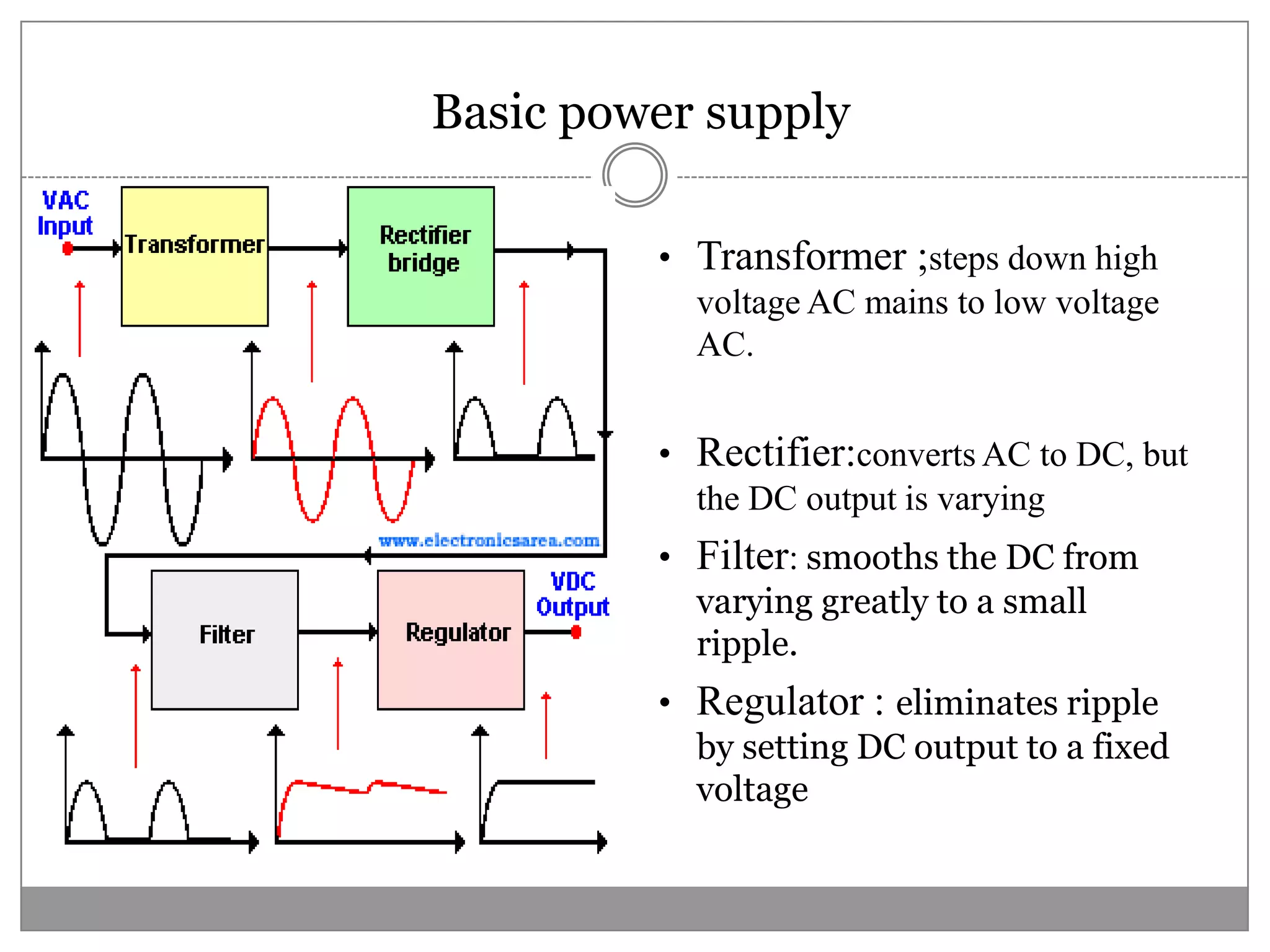
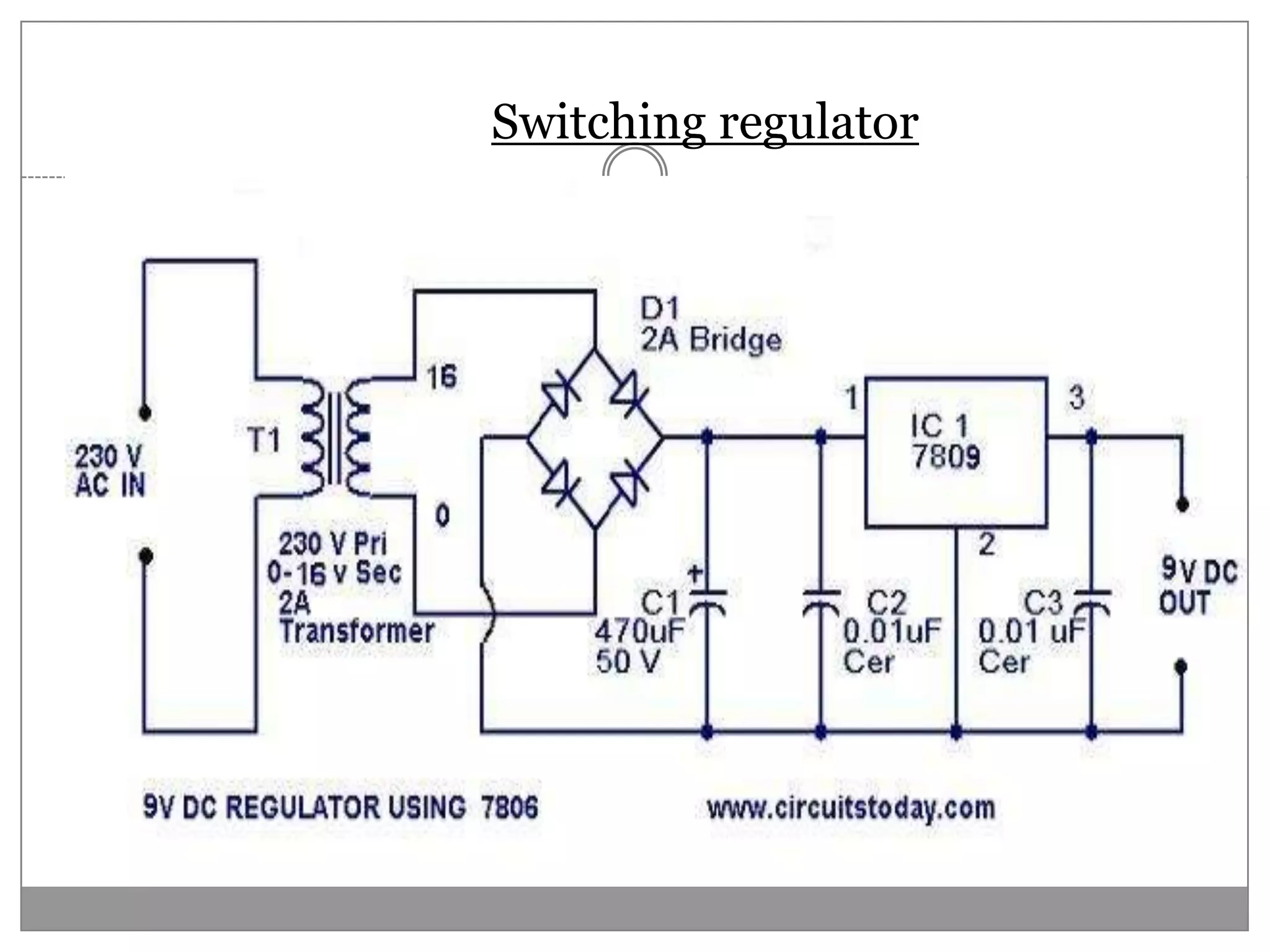
NOTE: MC1723  is a general purpose regulator ;it can be used in many ways as a fixed positive or negative output voltage regulator, variable output voltage regulator or as a switching regulator.Due to its flexibility it has become as a standard type in the electronics industry.Basic power supplyTransformer ;steps down high voltage AC mains to low voltage AC.
Rectifier:converts AC to DC, but the DC output is varying
Filter: smooths the DC from varying greatly to a small ripple.
Regulator : eliminates ripple by setting DC output to a fixed voltageNeed for regulationWithout stable potentials, circuit performance degrades and if the variations are large enough the components may get destroyed.
In order to avoid this regulation is usedPerformance parameters of voltage regulatorsLine or input regulation:defined as a change in output voltage for a change in input voltage
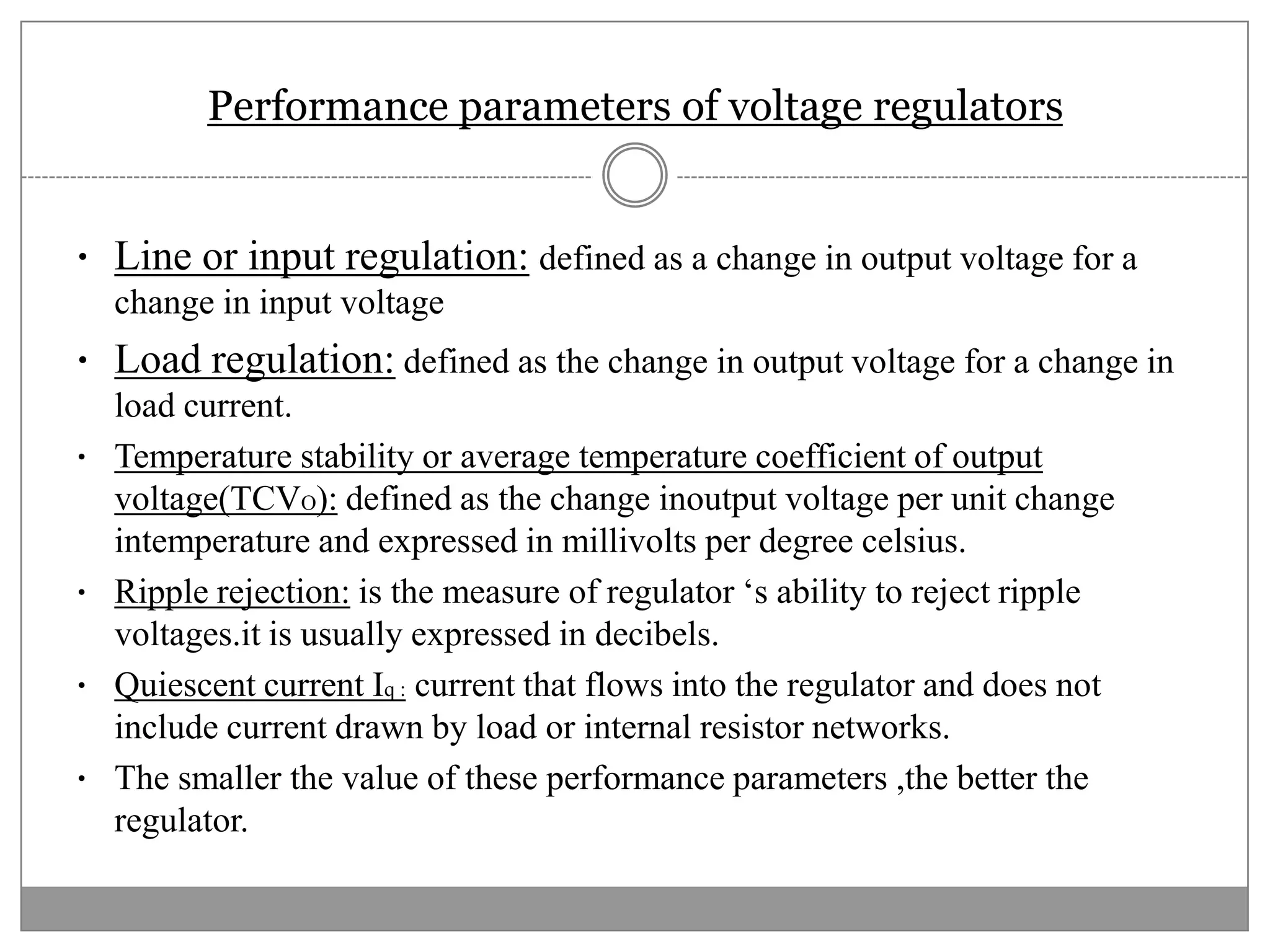
Load regulation: defined as the change in output voltage for a change in load current.
Temperature stability or average temperature coefficient of output voltage(TCVO): defined as the change inoutput voltage per unit change intemperature and expressed in millivolts per degree celsius.
Ripple rejection: is the measure of regulator ‘s ability to reject ripple voltages.it is usually expressed in decibels.
Quiescent current Iq : current that flows into the regulator and does not include current drawn by load or internal resistor networks.
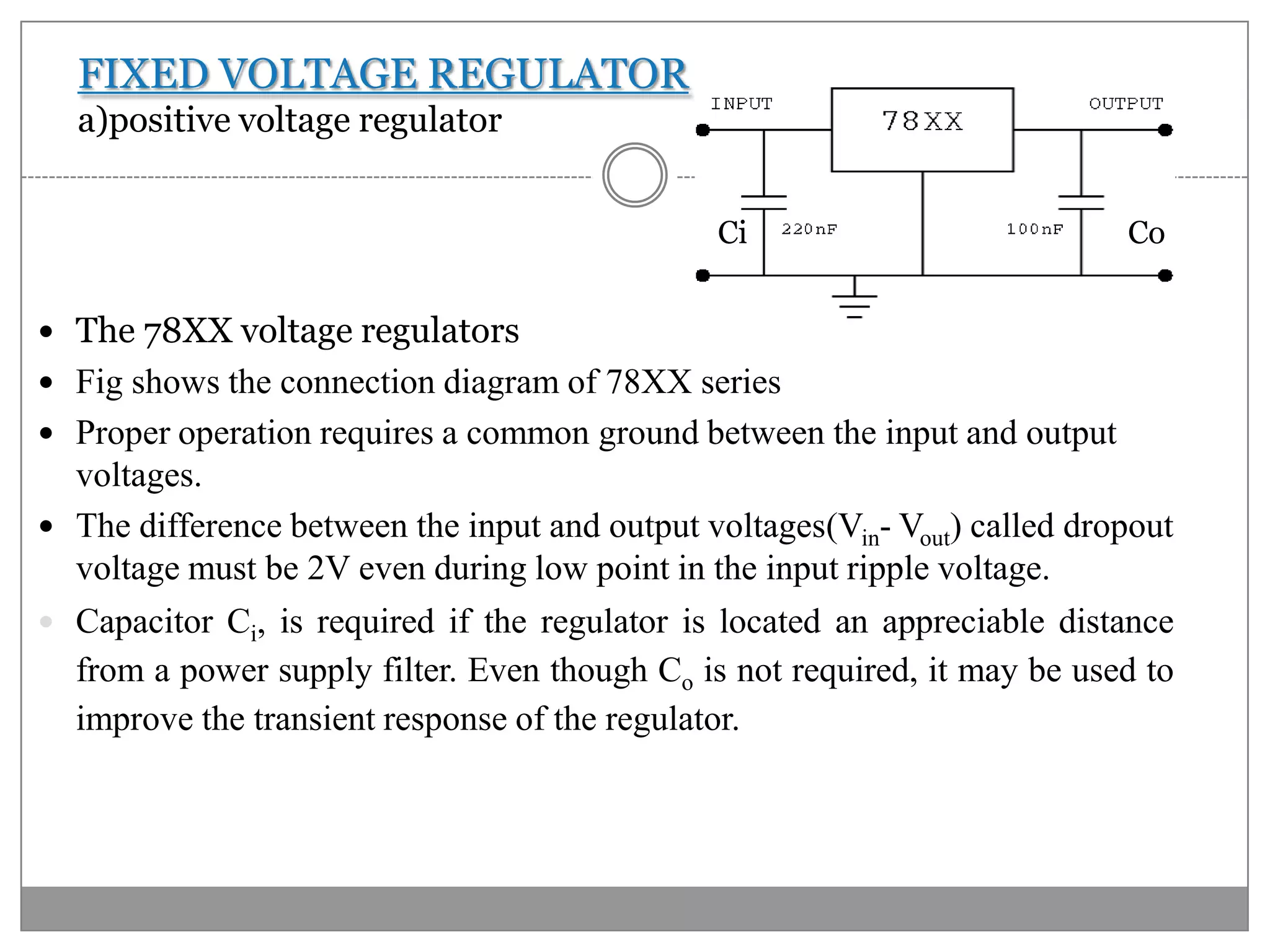
The smaller the value of these performance parameters ,the better the regulator.FIXED VOLTAGE REGULATORa)positive voltage regulator CiCoThe 78XX voltage regulators Fig shows the connection diagram of 78XX series Proper operation requires a common ground between the input and output voltages.The difference between the input and output voltages(Vin- Vout) called dropout voltage must be 2V even during low point in the input ripple voltage.Capacitor Ci, is required if the regulator is located an appreciable distance from a power supply filter. Even though Co is not required, it may be used to improve the transient response of the regulator.
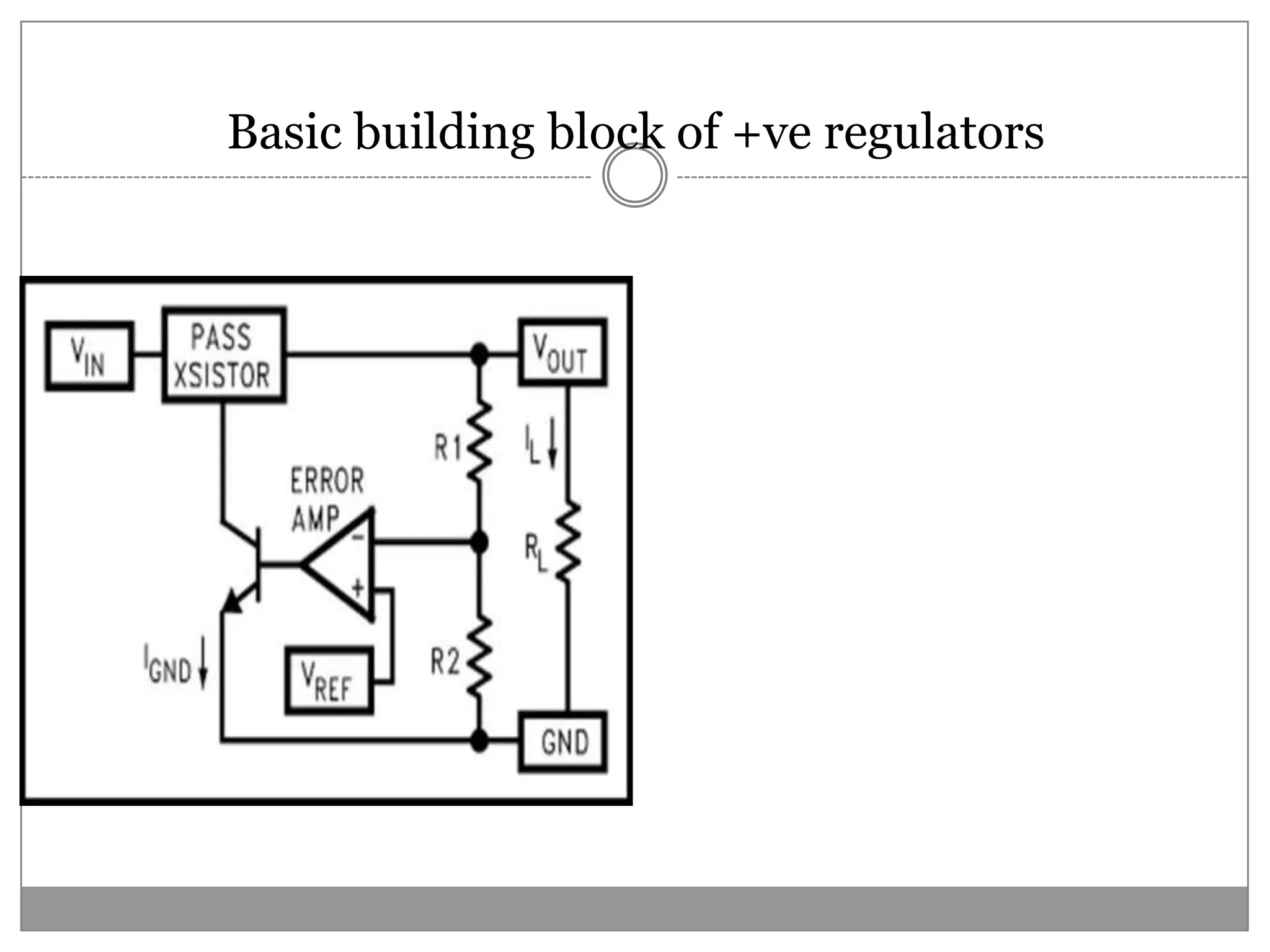
Basic building block of +ve regulators
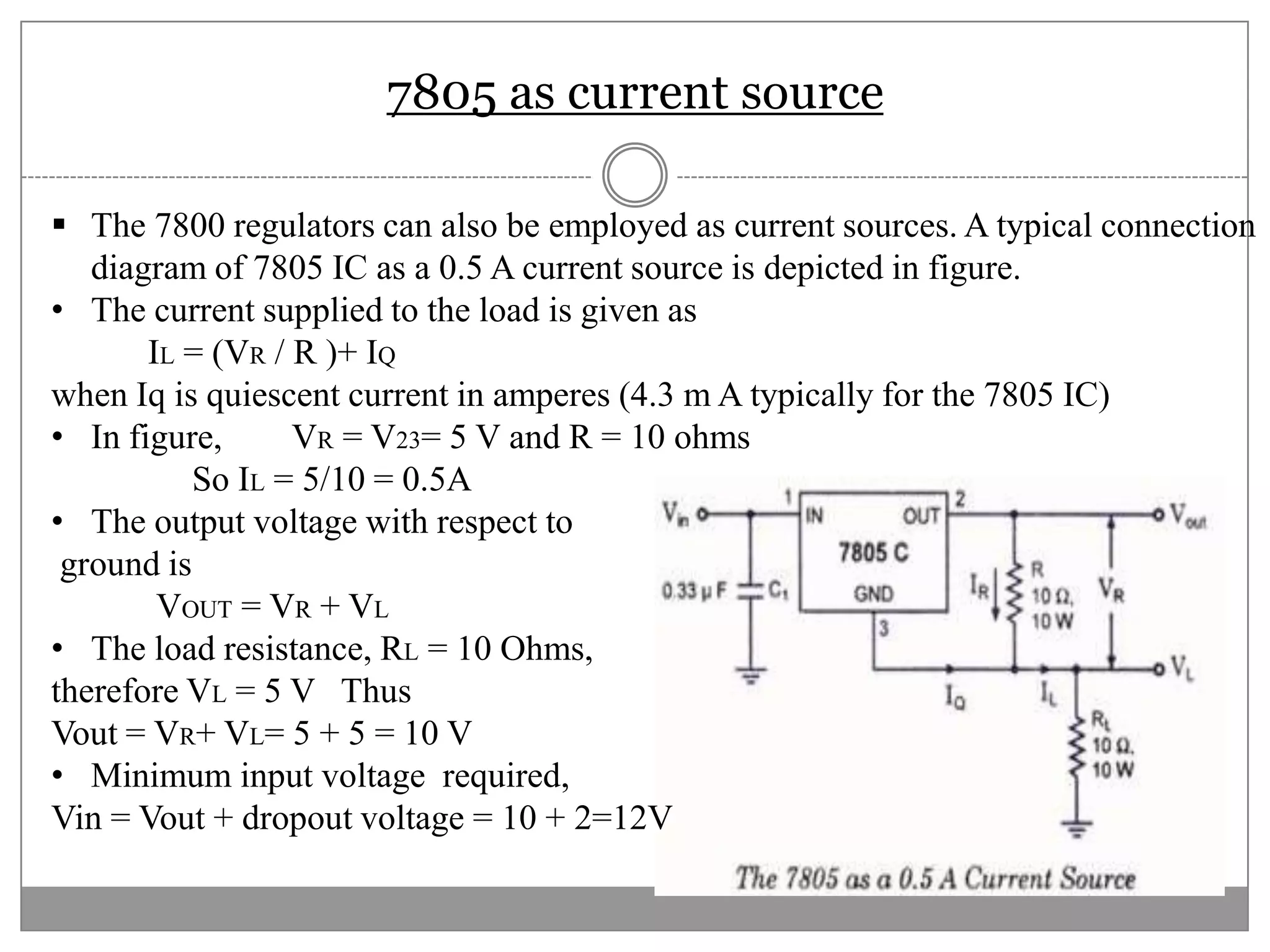
7805 as current sourceThe 7800 regulators can also be employed as current sources. A typical connection diagram of 7805 IC as a 0.5 A current source is depicted in figure.
The current supplied to the load is given as           IL= (VR/ R )+ IQwhen Iq is quiescent current in amperes (4.3 m A typically for the 7805 IC)In figure,        VR= V23= 5 V and R = 10 ohms                So IL= 5/10 = 0.5AThe output voltage with respect toground is            VOUT= VR+ VLThe load resistance, RL= 10 Ohms, therefore VL= 5 V   Thus  Vout= VR+ VL= 5 + 5 = 10 V Minimum input voltage  required,Vin = Vout + dropout voltage = 10 + 2=12V
78XX basic featuresFeatures
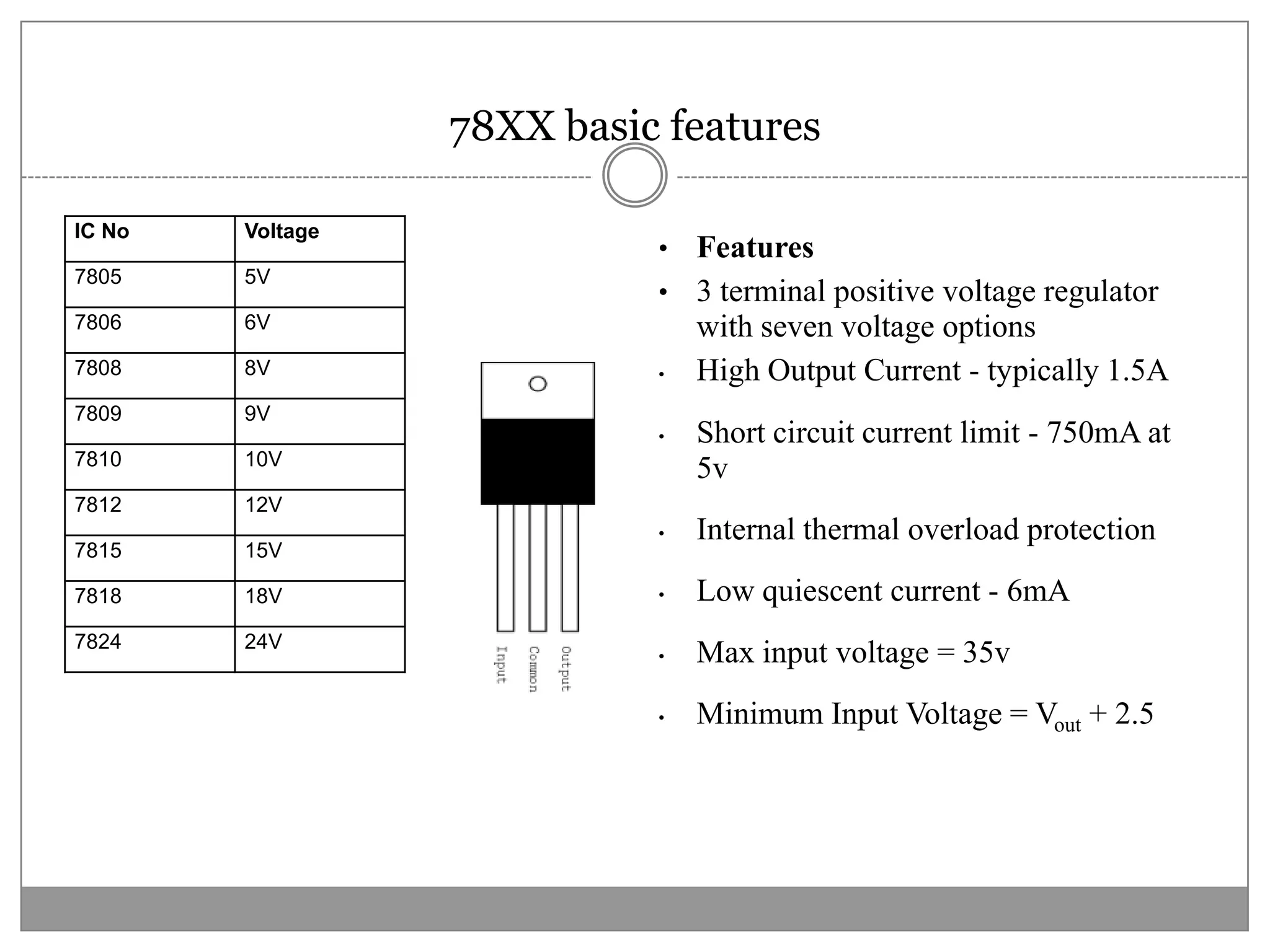
3 terminal positive voltage regulator with seven voltage options
High Output Current - typically 1.5A
Short circuit current limit - 750mA at 5v
Internal thermal overload protection
Low quiescent current - 6mA
Max input voltage = 35v
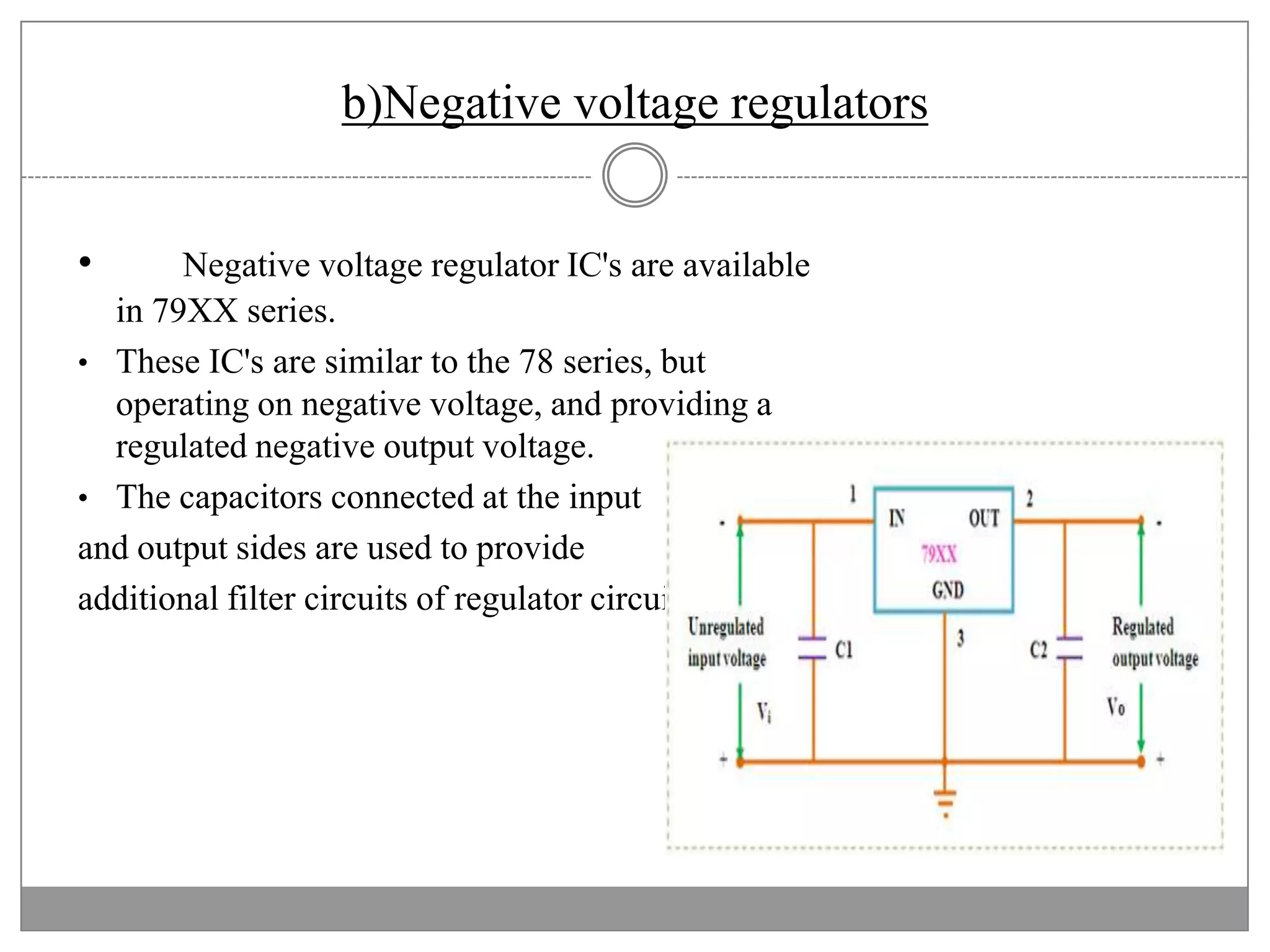
Minimum Input Voltage = Vout + 2.5 b)Negative voltage regulators      Negative voltage regulator IC's are available in 79XX series.

Ic voltage regulators

  • 1.
    By Anita a thattil S5 ec alphaRajagiri school of engineering,kakkanadIC VOLTAGE REGULATORS
  • 2.
    INTRODUCTIONIntegrated ICs withimproved capabilities are appearing in an ever increasing numbers.Often ,the use of specialized IC produces a simpler and more accurate circuits.Examples: MF5(National ‘s switched capacitor filter), SE/NE 565(Signetics’Phase locked loop-PLL) , timer SE/NE 555 etcApplications of specialized ICs: *universal filters *timers *Phase locked loop(PLL) *power amplifiers *voltage regulators *switching regulators *voltage references
  • 3.
    Topics to bedealt78XX series79XX series317 variable regulators1723 switching regulators
  • 4.
    IC Voltage Regulators4Voltageregulator: is a circuit that supplies constant voltage regardless of changes in the load current.
  • 5.
    Advantages of ICvoltage regulator: inexpensive,versatile,provides current /voltage boosting, internal short circuit current limiting, thermal shutdown, floating operation for high voltage applications. Classification of IC voltage regulators: There are basically two kinds of IC voltage regulators:
  • 6.
  • 7.
  • 8.
    Multi-pin regulators areless popular but they provide the greatest flexibility and produce the highest quality voltage regulation
  • 9.
    3-pin types makeregulator circuit design simpleTypes of IC voltage regulators:Fixed output voltage regulators:positive fixed output regulator(78XX series) and negative fixed output regulator(79XX series)
  • 10.
    Adjustable output voltageregulators: positive (LM317) and negative(LM337)
  • 11.
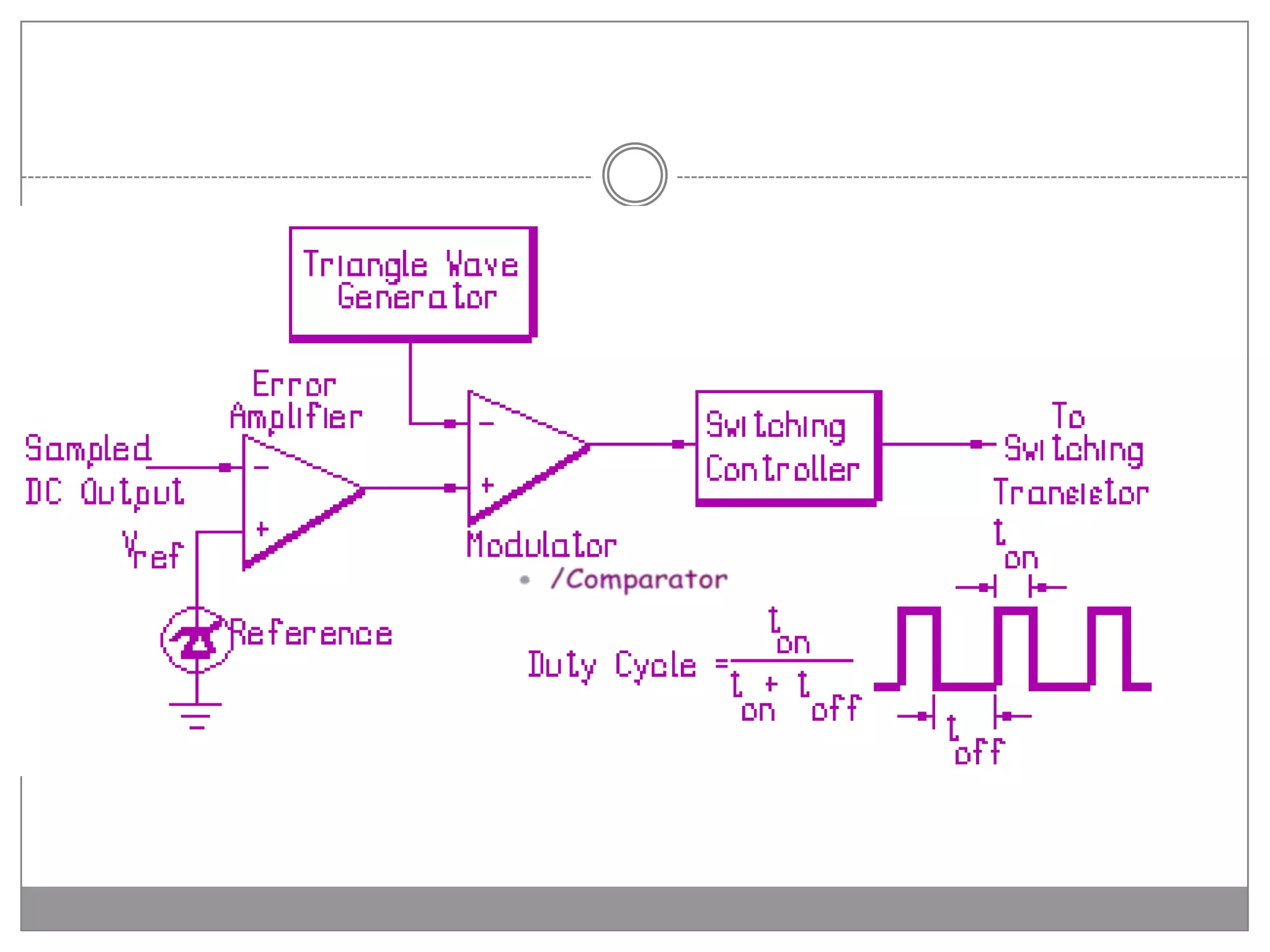
  • 12.
    NOTE: MC1723 is a general purpose regulator ;it can be used in many ways as a fixed positive or negative output voltage regulator, variable output voltage regulator or as a switching regulator.Due to its flexibility it has become as a standard type in the electronics industry.Basic power supplyTransformer ;steps down high voltage AC mains to low voltage AC.
  • 13.
    Rectifier:converts AC toDC, but the DC output is varying
  • 14.
    Filter: smooths theDC from varying greatly to a small ripple.
  • 15.
    Regulator : eliminatesripple by setting DC output to a fixed voltageNeed for regulationWithout stable potentials, circuit performance degrades and if the variations are large enough the components may get destroyed.
  • 16.
    In order toavoid this regulation is usedPerformance parameters of voltage regulatorsLine or input regulation:defined as a change in output voltage for a change in input voltage
  • 17.
    Load regulation: definedas the change in output voltage for a change in load current.
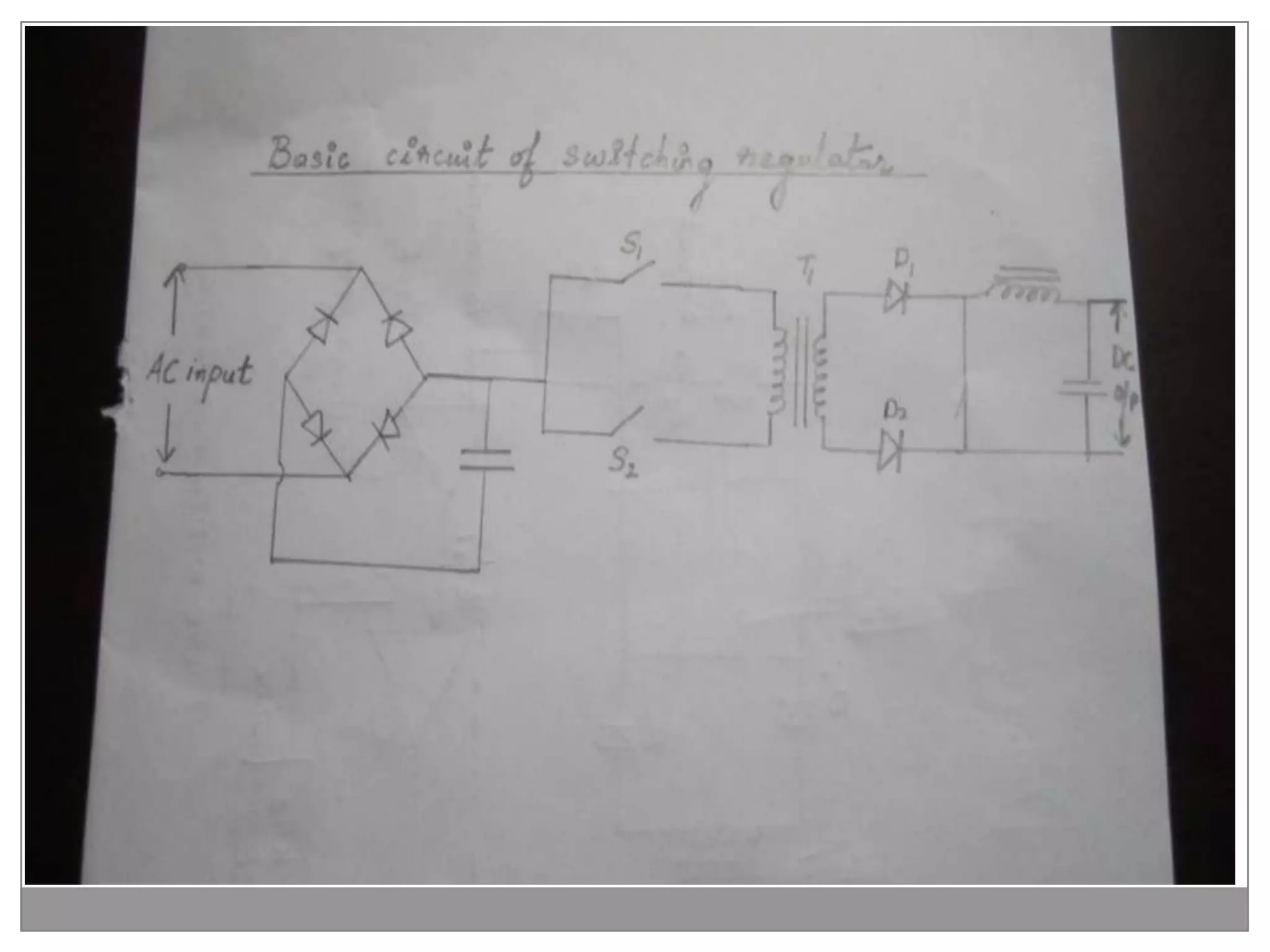
  • 18.
    Temperature stability oraverage temperature coefficient of output voltage(TCVO): defined as the change inoutput voltage per unit change intemperature and expressed in millivolts per degree celsius.
  • 19.
    Ripple rejection: isthe measure of regulator ‘s ability to reject ripple voltages.it is usually expressed in decibels.
  • 20.
    Quiescent current Iq: current that flows into the regulator and does not include current drawn by load or internal resistor networks.
  • 21.
    The smaller thevalue of these performance parameters ,the better the regulator.FIXED VOLTAGE REGULATORa)positive voltage regulator CiCoThe 78XX voltage regulators Fig shows the connection diagram of 78XX series Proper operation requires a common ground between the input and output voltages.The difference between the input and output voltages(Vin- Vout) called dropout voltage must be 2V even during low point in the input ripple voltage.Capacitor Ci, is required if the regulator is located an appreciable distance from a power supply filter. Even though Co is not required, it may be used to improve the transient response of the regulator.
  • 22.
    Basic building blockof +ve regulators
  • 23.
    7805 as currentsourceThe 7800 regulators can also be employed as current sources. A typical connection diagram of 7805 IC as a 0.5 A current source is depicted in figure.
  • 24.
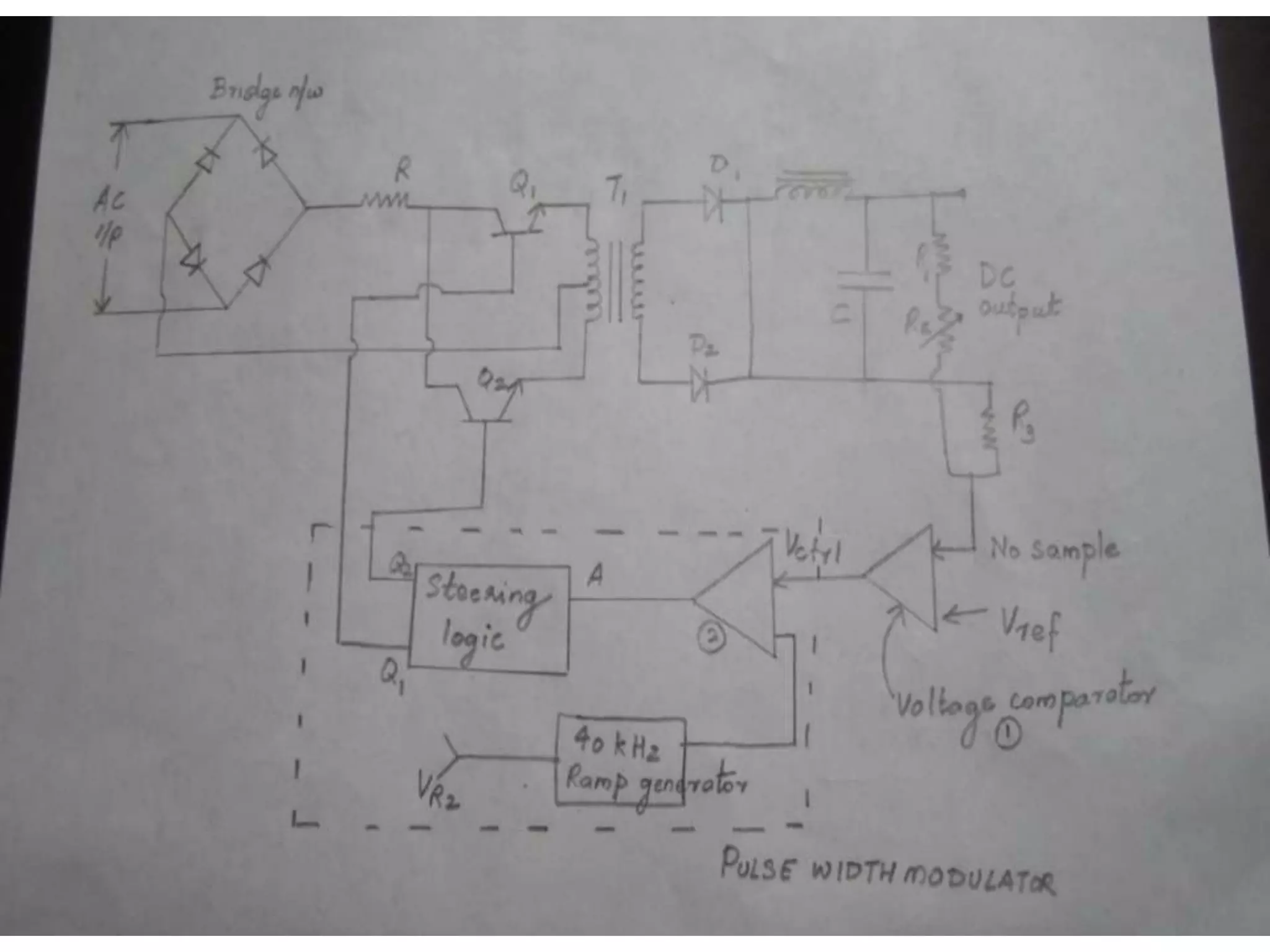
    The current suppliedto the load is given as IL= (VR/ R )+ IQwhen Iq is quiescent current in amperes (4.3 m A typically for the 7805 IC)In figure, VR= V23= 5 V and R = 10 ohms So IL= 5/10 = 0.5AThe output voltage with respect toground is VOUT= VR+ VLThe load resistance, RL= 10 Ohms, therefore VL= 5 V Thus Vout= VR+ VL= 5 + 5 = 10 V Minimum input voltage required,Vin = Vout + dropout voltage = 10 + 2=12V
  • 25.
  • 26.
    3 terminal positivevoltage regulator with seven voltage options
  • 27.
    High Output Current- typically 1.5A
  • 28.
    Short circuit currentlimit - 750mA at 5v
  • 29.
  • 30.
  • 31.
  • 32.
    Minimum Input Voltage= Vout + 2.5 b)Negative voltage regulators      Negative voltage regulator IC's are available in 79XX series.
  • 33.
    These IC's aresimilar to the 78 series, but operating on negative voltage, and providing a regulated negative output voltage.
  • 34.
    The capacitors connectedat the input and output sides are used to provide additional filter circuits of regulator circuits.
  • 35.
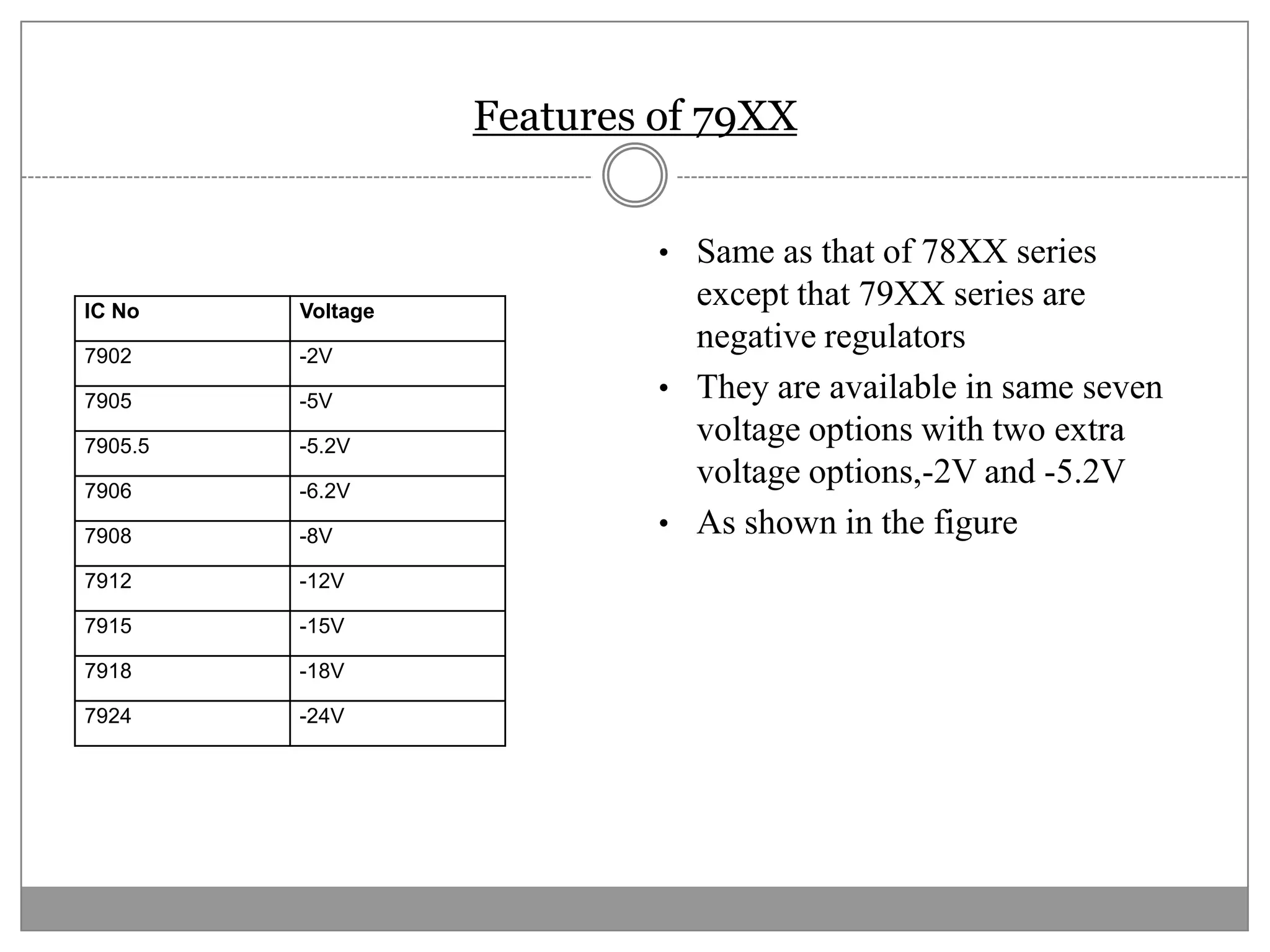
    Features of 79XXSameas that of 78XX series except that 79XX series are negative regulators
  • 36.
    They are availablein same seven voltage options with two extra voltage options,-2V and -5.2V
  • 37.
    As shown inthe figureADJUSTABLE VOLTAGE REGULATORAdjustable voltage regulators are those who voltage can be varied and utilized.
  • 38.
    Advantages of adjustablevoltage regulators:
  • 39.
    * improved system performance
  • 40.
    * improved overload protection
  • 41.
    *improved system reliability
  • 42.
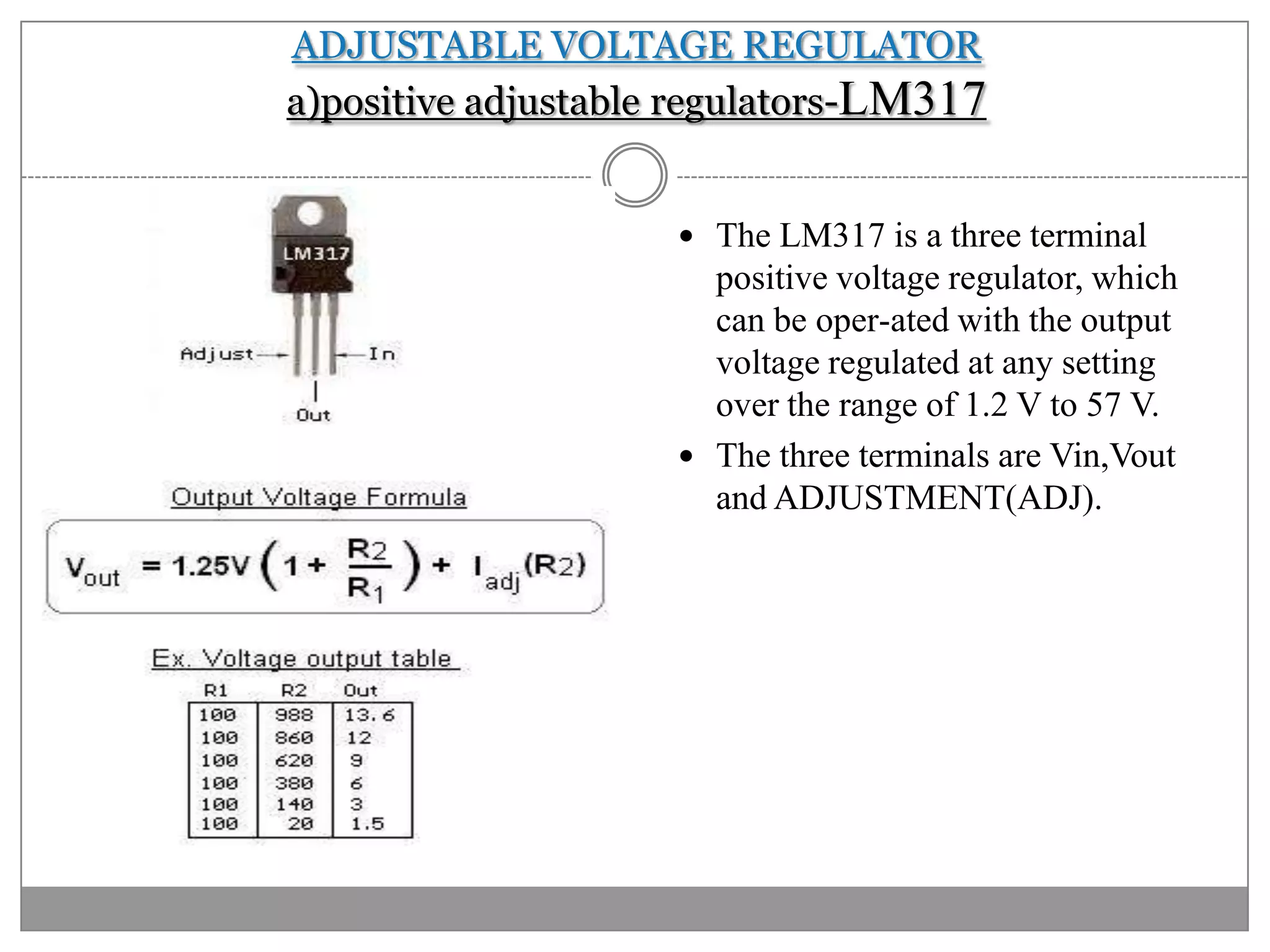
    Example: LM317ADJUSTABLE VOLTAGEREGULATORa)positive adjustable regulators-LM317The LM317 is a three terminal positive voltage regulator, which can be oper­ated with the output voltage regulated at any setting over the range of 1.2 V to 57 V. The three terminals are Vin,Vout and ADJUSTMENT(ADJ).
  • 43.
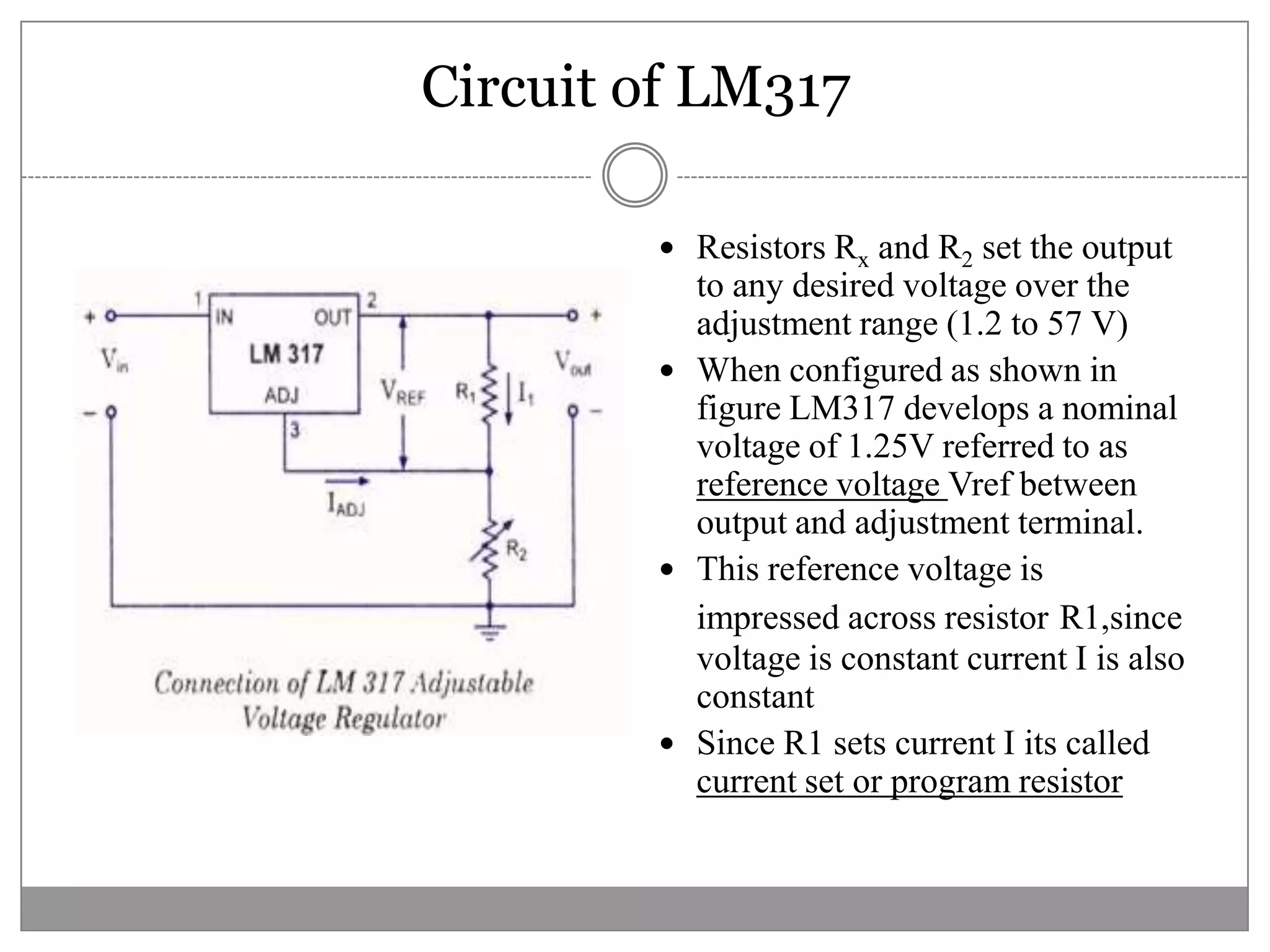
    Circuit of LM317ResistorsRx and R2 set the output to any desired voltage over the adjustment range (1.2 to 57 V)When configured as shown in figure LM317 develops a nominal voltage of 1.25V referred to as reference voltage Vrefbetween output and adjustment terminal.This reference voltage is impressed across resistorR1,since voltage is constant current I is also constantSince R1 sets current I its called current set or program resistor
  • 44.
    Referring to figure,theoutput voltage Vo isVo = R1 + R2 (I1 +Iadj)………….(1)Where I1= Vref/R1……….(2)R1 =current set resistorR2 =output set resistor Iadj= adjustment pin current Substituting (2) in (1) we get :Vout = VREF [1+ R2/R1] + IADJR2where VREF = 1.25 V, the reference voltage between the output and adjustment terminalsthe current IADJ is very small (100 micro Amperes) and constant. So the voltage drop across R2 due to IADJ is also very small and can be neglected so that equation  can be written asVout = 1.25 [1+ R2/R1]The current set resistor Rx is usually 240 Ohms, and to achieve good load regulation it should be tied directly to the output of the regulator rather than near the load.The load regulation is 0.1 percent while the line regulation is 0.01 percent per volt.
  • 45.
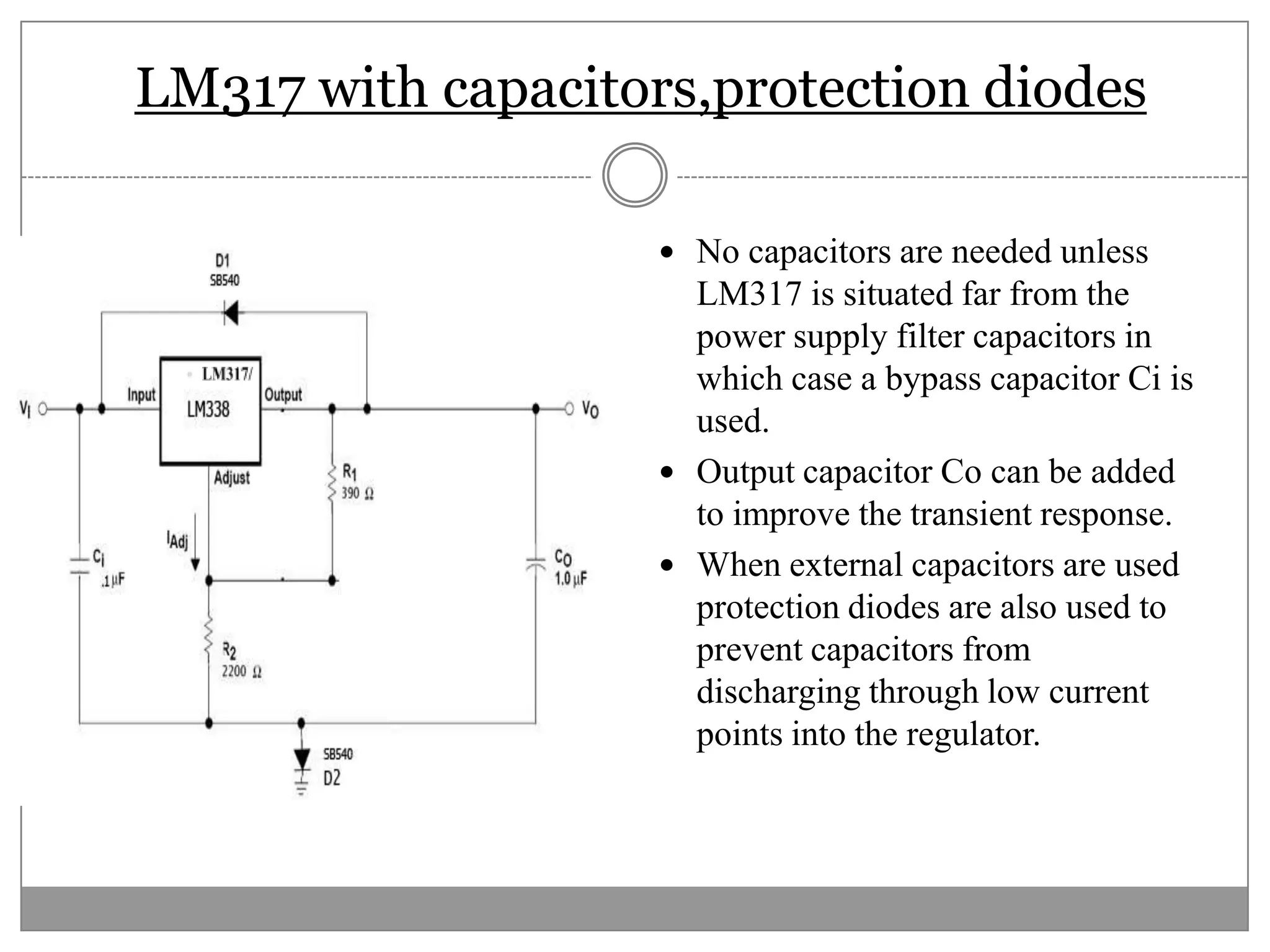
    LM317 with capacitors,protectiondiodesNo capacitors are needed unless LM317 is situated far from the power supply filter capacitors in which case a bypass capacitor Ci is used.Output capacitor Co can be added to improve the transient response.When external capacitors are used protection diodes are also used to prevent capacitors from discharging through low current points into the regulator.
  • 46.
    b)Adjustable negative voltageregulators-LM337The LM337 series of voltage regulators are a complement of LM317 series.
  • 47.
    They are negativeadjustable voltage regulators
  • 48.
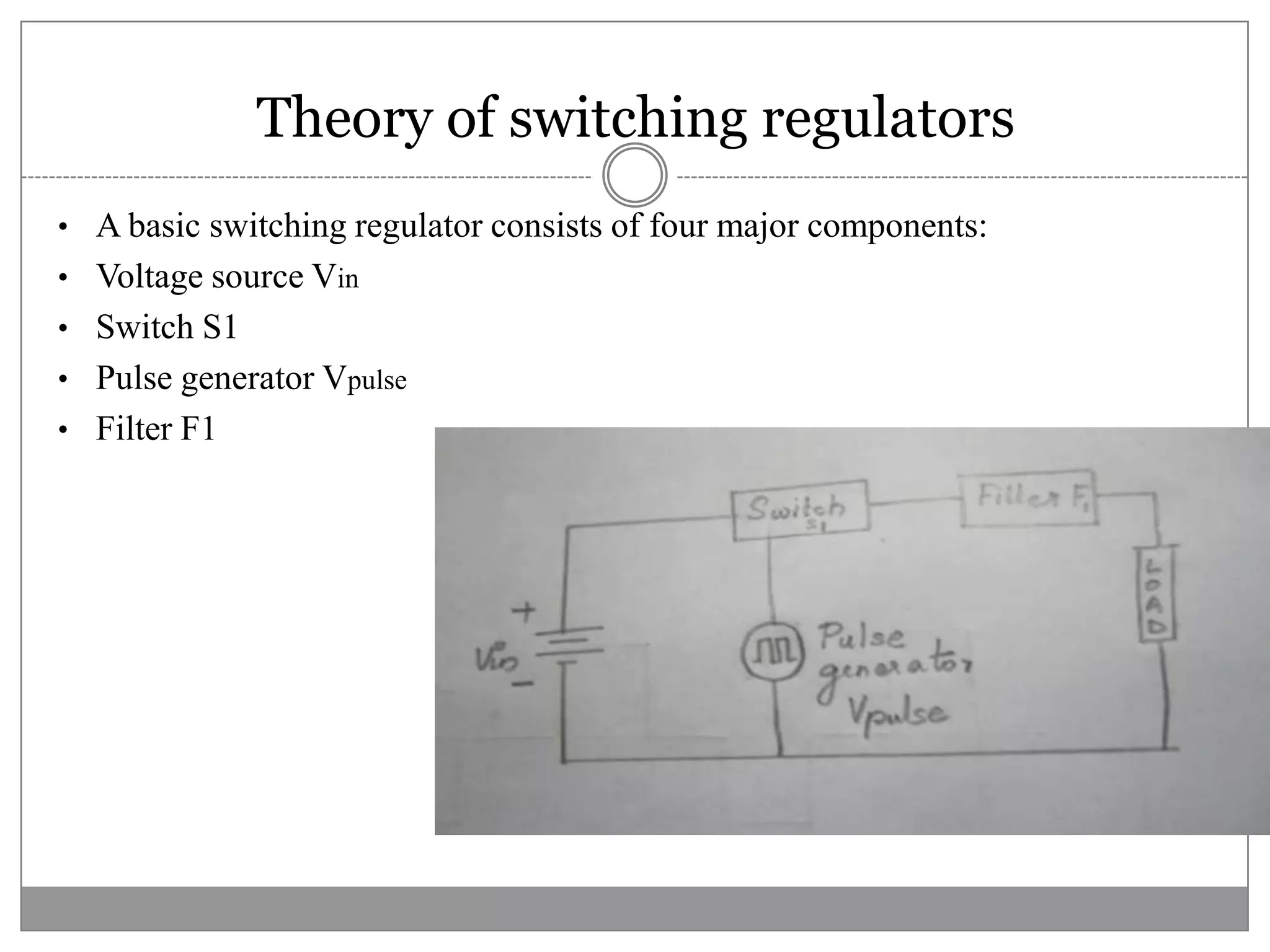
    These negative voltageregulators are available in the same voltage and current options as the positive adjustable voltage regulator LM317.Theory of switching regulatorsA basic switching regulator consists of four major components:
  • 49.
  • 50.
  • 51.
  • 52.
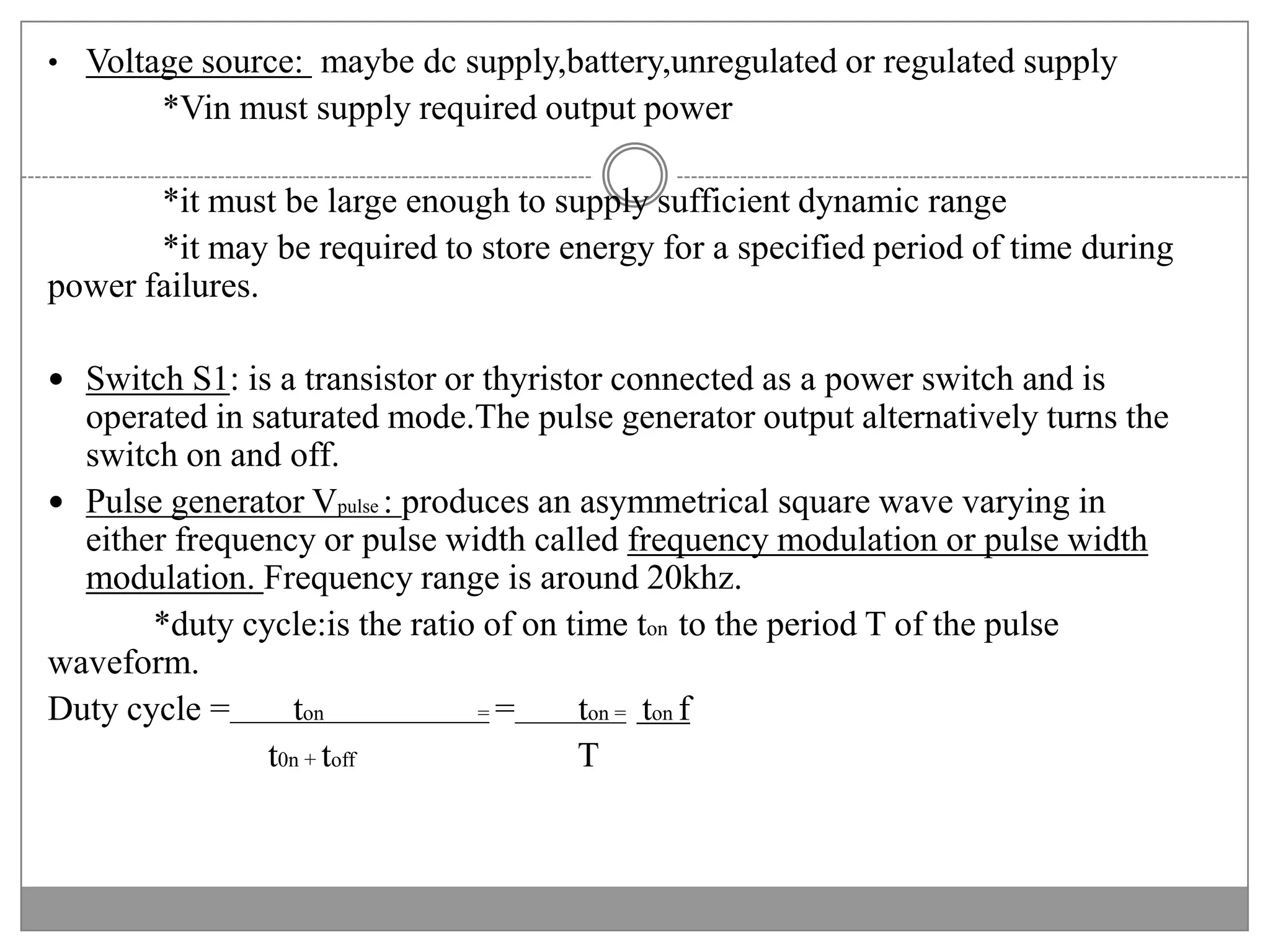
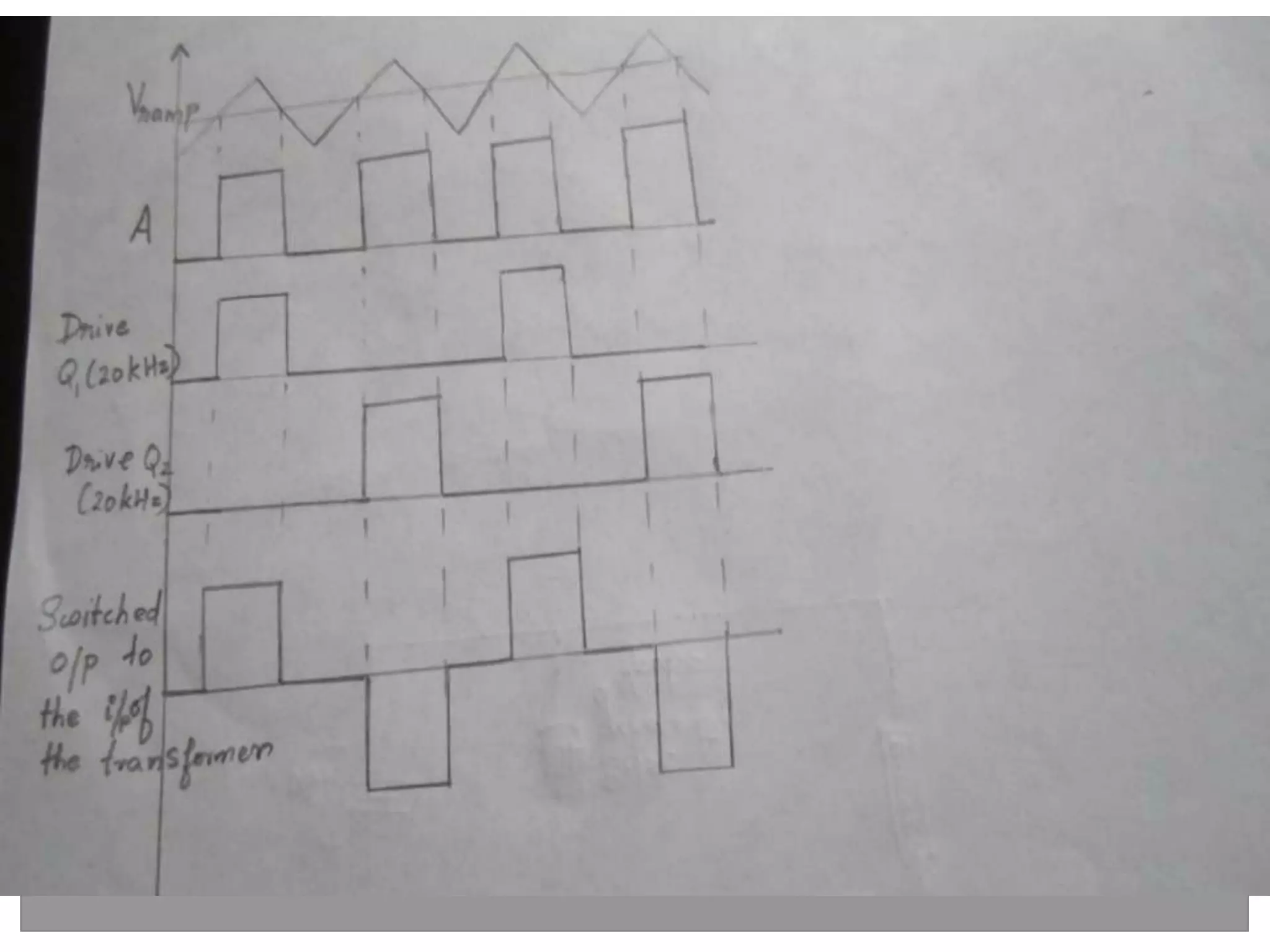
    Filter F1Voltage source: maybe dc supply,battery,unregulated or regulated supply *Vin must supply required output power *it must be large enough to supply sufficient dynamic range *it may be required to store energy for a specified period of time during power failures.Switch S1: is a transistor or thyristor connected as a power switch and is operated in saturated mode.The pulse generator output alternatively turns the switch on and off.Pulse generator Vpulse: produces an asymmetrical square wave varying in either frequency or pulse width called frequency modulation or pulse width modulation. Frequency range is around 20khz. *duty cycle:is the ratio of on time ton to the period T of the pulse waveform.Duty cycle =ton ==ton =ton f t0n + toffT
  • 53.
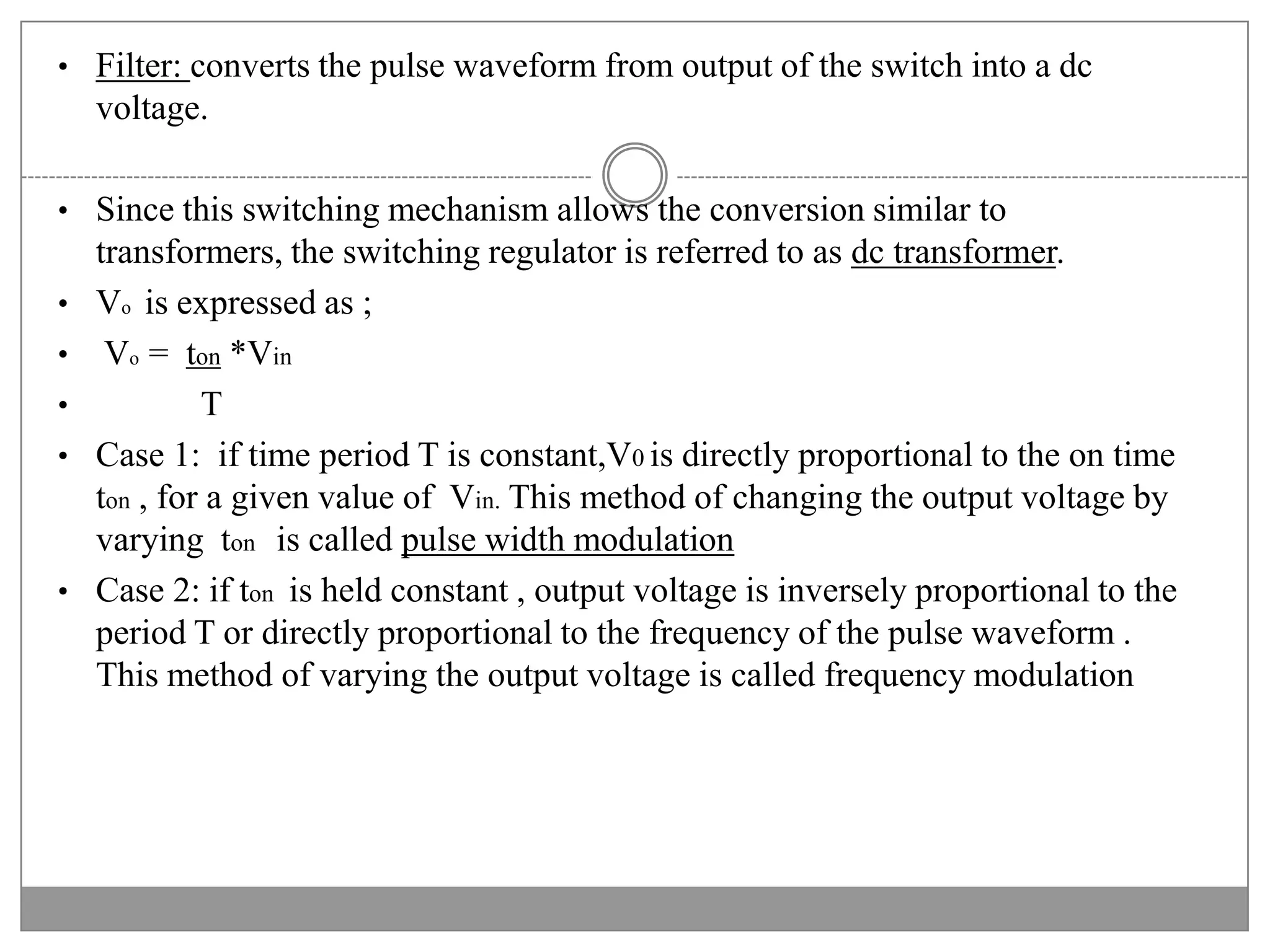
    Filter: converts thepulse waveform from output of the switch into a dc voltage.
  • 54.
    Since this switchingmechanism allows the conversion similar to transformers, the switching regulator is referred to as dc transformer.
  • 55.
    Vo isexpressed as ;
  • 56.
    Vo = ton*Vin
  • 57.
    T
  • 58.
    Case 1: if time period T is constant,V0 is directly proportional to the on time ton , for a given value of Vin. This method of changing the output voltage by varying ton is called pulse width modulation
  • 59.
    Case 2: ifton is held constant , output voltage is inversely proportional to the period T or directly proportional to the frequency of the pulse waveform . This method of varying the output voltage is called frequency modulation Switching regulator
  • 61.
    In switching regulator,thetransistor acts as a switch.
  • 62.
    When the transistoris off(switch is open) , no current flows,therefore no power dissapation.
  • 63.
    When the transistoris on,(switch is closed), high current flows but Vce becomes low and therefore power dissapation is less.
  • 64.
    Basic circuit ofswitching regulator
  • 65.
  • 66.
    Bridge rectifier convertsac input signal to unregulated dc
  • 67.
    Switch : closedimplies currrent is allowed to flow
  • 68.
    open implies no current is allowed to flow
  • 69.
    Transformer: the outputof the switching network is coupled to the rectifier through the transformer
  • 70.
    Rectifier: provides finalrectification and smoothing of the dc output
  • 73.
  • 74.
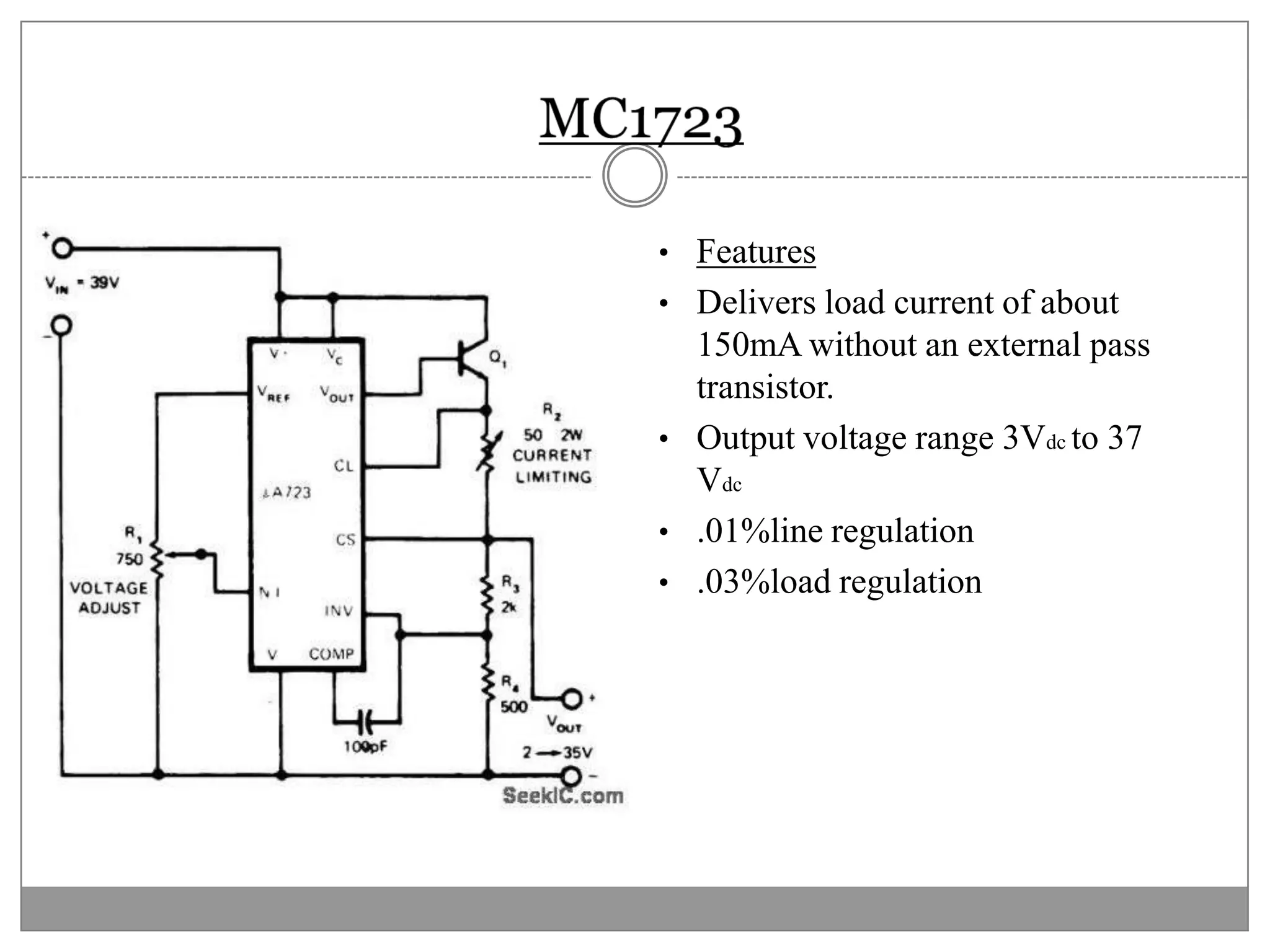
    Delivers load currentof about 150mA without an external pass transistor.
  • 75.
    Output voltage range3Vdc to 37 Vdc
  • 76.
  • 77.
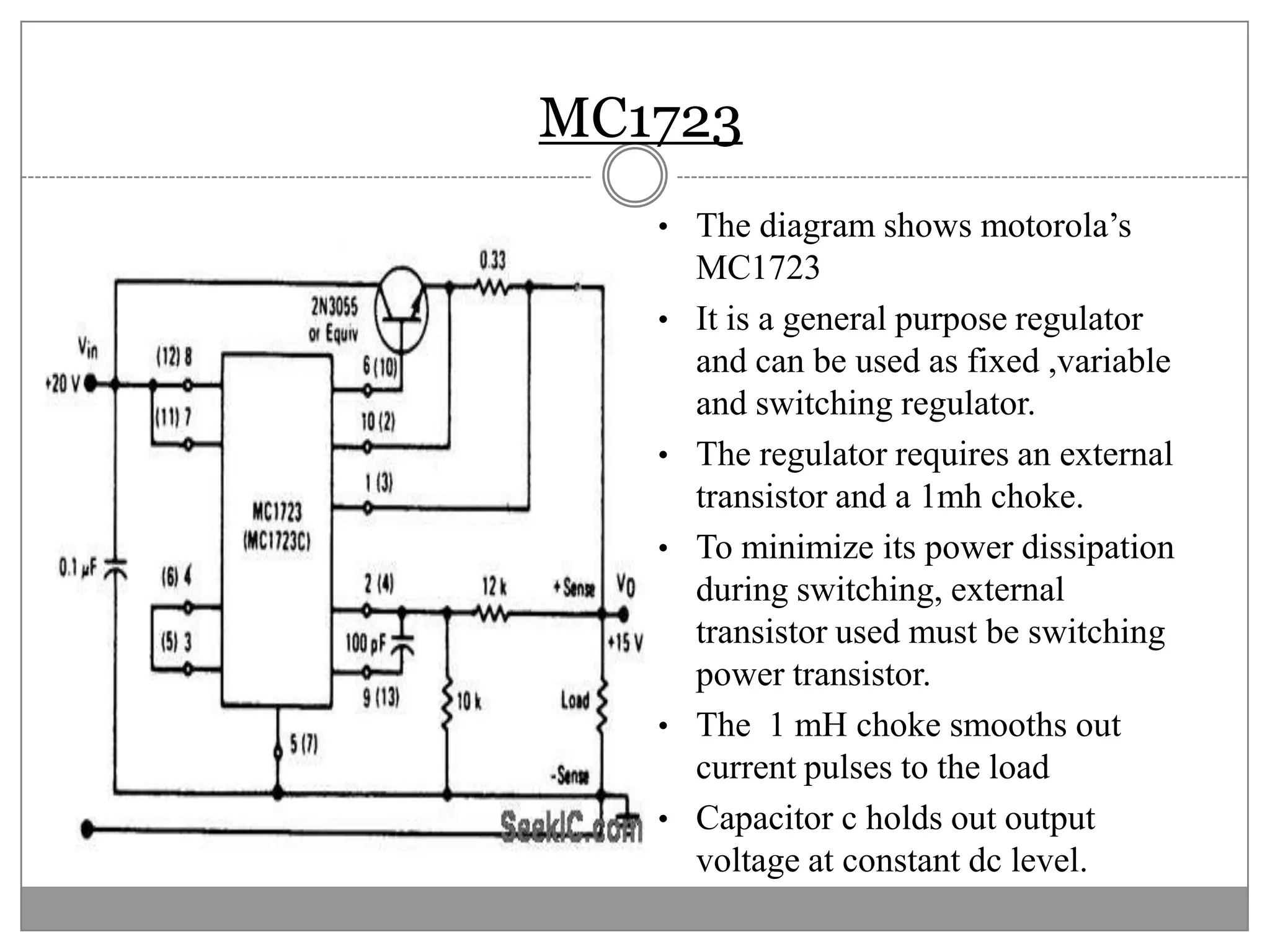
    .03%load regulationMC1723The diagramshows motorola’s MC1723
  • 78.
    It is ageneral purpose regulator and can be used as fixed ,variable and switching regulator.
  • 79.
    The regulator requiresan external transistor and a 1mh choke.
  • 80.
    To minimize itspower dissipation during switching, external transistor used must be switching power transistor.
  • 81.
    The 1mH choke smooths out current pulses to the load
  • 82.
    Capacitor c holdsout output voltage at constant dc level. THANK U