Number System
Created By: Palash
Sachan
CONTENTS
 Introduction
 Decimal Number System
 Binary Number System
 Why Binary?
 Octal Number System
 Hexadecimal Number System
 Relationship between Hexadecimal, Octal,
Decimal, and Binary
 Number Conversions
INTRODUCTION
In early days when there were no means of
counting, people use to count with the help of
fingers, stones, sticks, etc.
These methods were not adequate and had many
limitations.
Many number system were introduced with the
passage of time like:
 Decimal Number System
 Binary Number System
 Octal Number System
 Hexadecimal Number System
Decimal Number System
• It consist of ten digit i.e. 0, 1, 2, 3, 4, 5, 6, 7, 8,
9 with the base 10.
• Each number can be used individually or they
can be grouped to form a numeric value as
85,48,35,456 etc.
BINARY NUMBER SYSTEM
• The Binary Number System consist of only two
digits– 0 and 1.
• Since this system use two digits, it has the
base 2.
• All digital computer use this number system
and convert the data input from the decimal
format into its binary equivalent.
Why Binary?
Since the computer is made up of electronic
components; it can have only two states, either
• On(1)
• Off(0)
The data which is given to the computer is
converted into binary form because a computer
understand only binary language.
It further converts the binary results into their
decimal equivalents for output.
Octal Number System
 In the Octal Number System it consist of 8
digits i.e. 0, 1, 2, 3, 4, 5, 6, 7 with a base 8.
 The sequence of octal number goes as 0, 1, 2,
3, 4, 5, 6, 7, 10, 11, 12, 13, 14, 15, 16, 17, 20,
21, 22, …..as go on.
 See each successive number after 7 is a
combination of two or more unique symbols of
octal system.
Hexadecimal Number System
 The Hexadecimal system use base 16.
 It has 16 possible digit symbol.
 It use the digit 0 through 9 plus the letters A, B,
C, D, E, and F as the 16 digit symbols.
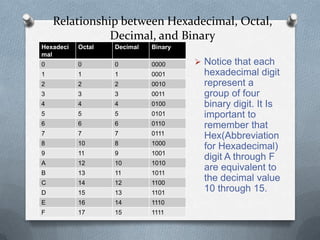
Relationship between Hexadecimal, Octal,
Decimal, and Binary
 Notice that each
hexadecimal digit
represent a
group of four
binary digit. It Is
important to
remember that
Hex(Abbreviation
for Hexadecimal)
digit A through F
are equivalent to
the decimal value
10 through 15.
Hexadeci
mal
Octal Decimal Binary
0 0 0 0000
1 1 1 0001
2 2 2 0010
3 3 3 0011
4 4 4 0100
5 5 5 0101
6 6 6 0110
7 7 7 0111
8 10 8 1000
9 11 9 1001
A 12 10 1010
B 13 11 1011
C 14 12 1100
D 15 13 1101
E 16 14 1110
F 17 15 1111
NUMBER CONVERSIONS
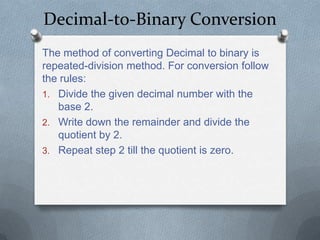
Decimal-to-Binary Conversion
The method of converting Decimal to binary is
repeated-division method. For conversion follow
the rules:
1. Divide the given decimal number with the
base 2.
2. Write down the remainder and divide the
quotient by 2.
3. Repeat step 2 till the quotient is zero.
2 200 Remainders
2 100 0 LSB
2 50 0
2 25 0
Write
2 12 1 in
2 6 0 this
2 3 0
order
2 1 1
0 1 MSB
Binary-to-Decimal Conversion
To convert a binary number follow the steps:
1. Multiply each binary number with 2 having the
power 0 for last position, starting from the right
digit.
2. Increase the power one by one, with base as
2.
3. Sum up all the products to get decimal
number.
Decimal-to-Octal
The method of converting Decimal to Octal is
repeated-division method. For conversion follow
the rules:
1. Divide the given decimal number with the
base 8,
2. Write down the remainder and divide the
quotient by 8,
3. Repeat step 2 till the quotient is zero.
8 266 Remainders
8 33 2 LSB
8 4 1
0 4
MSB
Octal-to-Decimal Conversion
To convert a octal number follow the steps:
1. Multiply each binary number with 8 having the
power 0 for last position, starting from the right
digit.
2. Increase the power one by one, with base as
8.
3. Sum up all the products to get decimal
number.
Octal-to-Binary Conversion
The conversion from octal to binary is performed
by converting each octal digit to its 3-bit binary
equivalent.
The eight possible digits are converted as
indicated below:
Using these conversions, any octal number is
converted to binary by individually converting
each digit.
Octal Digit 0 1 2 3 4 5 6 7
Binary
Equivalent
000 001 010 011 100 101 110 111
Binary-to-Octal Conversion
Decimal-to-Hexadecimal Conversion
The method of converting Decimal to binary is
repeated-division method. For conversion follow
the rules:
1. Divide the given decimal number with the
base 16.
2. Write down the remainder and divide the
quotient by 16.
3. Repeat step 2 till the quotient is zero.
16 423 Remainders
16 26 7 LSB
16 1 A
0 1 MSB
Hexadecimal-to-Decimal Conversion
To convert a binary number follow the steps:
1. Multiply each binary number with 16 having
the power 0 for last position, starting from the
right digit.
2. Increase the power one by one, with base as
16.
3. Sum up all the products to get decimal
number.
Binary-to-Hexadecimal Conversion
Hexadecimal-to-Binary Conversion
Thank You For Attention
Any Query??? Ask Me..

Number system

  • 1.
  • 2.
    CONTENTS  Introduction  DecimalNumber System  Binary Number System  Why Binary?  Octal Number System  Hexadecimal Number System  Relationship between Hexadecimal, Octal, Decimal, and Binary  Number Conversions
  • 3.
    INTRODUCTION In early dayswhen there were no means of counting, people use to count with the help of fingers, stones, sticks, etc. These methods were not adequate and had many limitations. Many number system were introduced with the passage of time like:  Decimal Number System  Binary Number System  Octal Number System  Hexadecimal Number System
  • 4.
    Decimal Number System •It consist of ten digit i.e. 0, 1, 2, 3, 4, 5, 6, 7, 8, 9 with the base 10. • Each number can be used individually or they can be grouped to form a numeric value as 85,48,35,456 etc.
  • 5.
    BINARY NUMBER SYSTEM •The Binary Number System consist of only two digits– 0 and 1. • Since this system use two digits, it has the base 2. • All digital computer use this number system and convert the data input from the decimal format into its binary equivalent.
  • 6.
    Why Binary? Since thecomputer is made up of electronic components; it can have only two states, either • On(1) • Off(0) The data which is given to the computer is converted into binary form because a computer understand only binary language. It further converts the binary results into their decimal equivalents for output.
  • 7.
    Octal Number System In the Octal Number System it consist of 8 digits i.e. 0, 1, 2, 3, 4, 5, 6, 7 with a base 8.  The sequence of octal number goes as 0, 1, 2, 3, 4, 5, 6, 7, 10, 11, 12, 13, 14, 15, 16, 17, 20, 21, 22, …..as go on.  See each successive number after 7 is a combination of two or more unique symbols of octal system.
  • 8.
    Hexadecimal Number System The Hexadecimal system use base 16.  It has 16 possible digit symbol.  It use the digit 0 through 9 plus the letters A, B, C, D, E, and F as the 16 digit symbols.
  • 9.
    Relationship between Hexadecimal,Octal, Decimal, and Binary  Notice that each hexadecimal digit represent a group of four binary digit. It Is important to remember that Hex(Abbreviation for Hexadecimal) digit A through F are equivalent to the decimal value 10 through 15. Hexadeci mal Octal Decimal Binary 0 0 0 0000 1 1 1 0001 2 2 2 0010 3 3 3 0011 4 4 4 0100 5 5 5 0101 6 6 6 0110 7 7 7 0111 8 10 8 1000 9 11 9 1001 A 12 10 1010 B 13 11 1011 C 14 12 1100 D 15 13 1101 E 16 14 1110 F 17 15 1111
  • 10.
  • 11.
    Decimal-to-Binary Conversion The methodof converting Decimal to binary is repeated-division method. For conversion follow the rules: 1. Divide the given decimal number with the base 2. 2. Write down the remainder and divide the quotient by 2. 3. Repeat step 2 till the quotient is zero.
  • 12.
    2 200 Remainders 2100 0 LSB 2 50 0 2 25 0 Write 2 12 1 in 2 6 0 this 2 3 0 order 2 1 1 0 1 MSB
  • 13.
    Binary-to-Decimal Conversion To converta binary number follow the steps: 1. Multiply each binary number with 2 having the power 0 for last position, starting from the right digit. 2. Increase the power one by one, with base as 2. 3. Sum up all the products to get decimal number.
  • 15.
    Decimal-to-Octal The method ofconverting Decimal to Octal is repeated-division method. For conversion follow the rules: 1. Divide the given decimal number with the base 8, 2. Write down the remainder and divide the quotient by 8, 3. Repeat step 2 till the quotient is zero.
  • 16.
    8 266 Remainders 833 2 LSB 8 4 1 0 4 MSB
  • 17.
    Octal-to-Decimal Conversion To converta octal number follow the steps: 1. Multiply each binary number with 8 having the power 0 for last position, starting from the right digit. 2. Increase the power one by one, with base as 8. 3. Sum up all the products to get decimal number.
  • 19.
    Octal-to-Binary Conversion The conversionfrom octal to binary is performed by converting each octal digit to its 3-bit binary equivalent. The eight possible digits are converted as indicated below: Using these conversions, any octal number is converted to binary by individually converting each digit. Octal Digit 0 1 2 3 4 5 6 7 Binary Equivalent 000 001 010 011 100 101 110 111
  • 21.
  • 22.
    Decimal-to-Hexadecimal Conversion The methodof converting Decimal to binary is repeated-division method. For conversion follow the rules: 1. Divide the given decimal number with the base 16. 2. Write down the remainder and divide the quotient by 16. 3. Repeat step 2 till the quotient is zero.
  • 23.
    16 423 Remainders 1626 7 LSB 16 1 A 0 1 MSB
  • 24.
    Hexadecimal-to-Decimal Conversion To converta binary number follow the steps: 1. Multiply each binary number with 16 having the power 0 for last position, starting from the right digit. 2. Increase the power one by one, with base as 16. 3. Sum up all the products to get decimal number.
  • 26.
  • 27.
  • 28.
    Thank You ForAttention
  • 29.