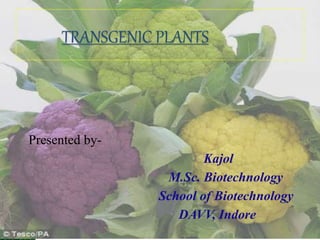
TRANSGENIC PLANTS
Presented by-
Kajol
M.Sc. Biotechnology
School of Biotechnology
DAVV, Indore
terms to know
TRANSGENE- It is a foreign gene or genetic
material that has been transferred naturally or by
any of a number of genetic engineering techniques
from one organism to another.
TRANSGENESIS- The phenomenon of introduction
of exogenous DNA into the genome to create and
maintain a stable and heritable character.
TRANSGENIC PLANTS- The plant whose genome
is altered by adding one or more transgenes are
known as transgenic plants.
history
1982
• 1st transgenic plant produced which is an antibiotic resistance tobacco
plant.
1984
• 1st successful plant genetic engineering experiments using caulimovirus
vector.
1994
• 1st genetically modified crop approved for sale in U.S. was FlavrSavr
tomato.
1995
• 1st pesticide producing crop, Bt Potato was approved by U.S.
Environmental Protection Agency
1996
• 1st genetically modified flower Moondust, bluish colored carnation, was
introduced.
2000
• Golden rice with β- carotene developed with increased nutrient value.
2013
• 1st genetically engineered crop developed by Robert Fraley, Marc Van
Montagu &Marry Dell Chilton were awarded World Food Prize.
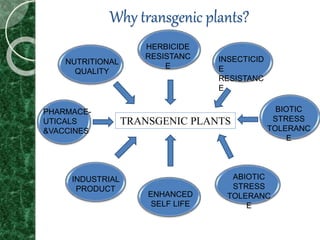
Why transgenic plants?
TRANSGENIC PLANTS
NUTRITIONAL
QUALITY
HERBICIDE
RESISTANC
E
INSECTICID
E
RESISTANC
E
BIOTIC
STRESS
TOLERANC
E
ABIOTIC
STRESS
TOLERANC
E
ENHANCED
SELF LIFE
INDUSTRIAL
PRODUCT
PHARMACE-
UTICALS
&VACCINES
GENE TRANSFER METHODS
BIOLOGICAL METHODS
 Agrobacterium mediated gene transfer
 Plant virus vectors
PHYSICAL METHODS
 Electroporation
 Microprojectile
 Microinjection
 Liposome Fusion
CHEMICAL METHODS
 Polyethylene glycol mediated
 Diethylaminoethyl dextran mediated
AGROBACTERIUM MEDIATED GENE TRANSFER
Agrobacterium is treated as
nature’s most effective
plant genetic engineer.
A.tumifaciens infects
wounded or damaged plant
tissues results in the
formation of plant tumor
called crown gall.
The bacterium releases Ti
plasmid into the plant cell
cytoplasm which induce
crown gall.
Several dicots are affected
by this disease e.g. grapes,
roses, etc.
ORGANIZATION OF TI PLASMID
The size of Ti plasmid is approx. 200 kb.
The Ti plasmid has three important regions:
(i) T-DNA region
(ii) Virulence region
(iii) Opine catabolism region
 There is ori region that is responsible for the origin of DNA replication.
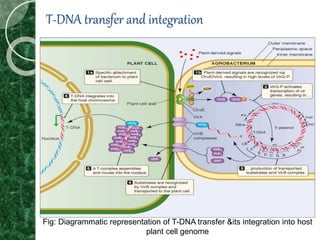
T-DNA transfer and integration
Fig: Diagrammatic representation of T-DNA transfer &its integration into host
plant cell genome
TRANSFORMATION TECHNIQUE USING
AGROBACTERIUM MEDIATED GENE TRANSFER
PLANT VIRus VECTORS
 Plant viruses are considered as efficient gene transfer agents as they can
infect the intact plants and amplify the transferred genes through viral
genome replication.
 It has some limitations like that vast majority of plant viruses have
genome not of DNA but of RNA. Two classes of DNA viruses are known
to infect higher plants, caulimovirus and geminivirus & neither is ideally
suited for gene cloning.
i) CAULIMOVIRUS:
They contain circular dsDNA and are spherical in shape. The
caulimovirus group has around 15 viruses & among these Cauliflower
Mosaic Virus(CaMV) is the most important for gene transfer.
CaMV infects many plants & can be easily transmitted. The infection
is systemic. It’s genome does not contain any non-coding regions.
It has certain limitations-
i) CaMV vectors has a limited capacity for insertion of foreign
genes.
ii) Infective capacity of CaMV is lost if more than a few hundred
nucleotides are introduced.
iii) Helper viruses cannot be used since the foreign DNA gets
expelled and wild-type viruses are produced.
II) GEMINIVIRUS:
They contain one or two circular ssDNA. They are particularly
interesting because their natural host include plant size such as
maize & wheat. They could therefore be potential vector for these
and other monocots.
They have their own set of difficulties-
It is very difficult to introduce purified viral DNA into the plants.
PHYSICAL GENE TRANSFER METHODS
1) ELECTROPORATION
Electroporation involves the creation of pores in the cell membrane
using electric pulse of high field strength. If DNA is present in the buffer
solution at sufficient concentration, it will be taken up through these
pores.
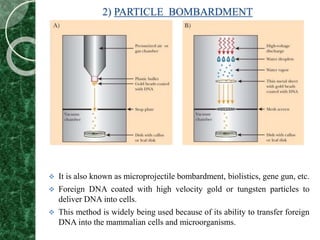
2) PARTICLE BOMBARDMENT
 It is also known as microprojectile bombardment, biolistics, gene gun, etc.
 Foreign DNA coated with high velocity gold or tungsten particles to
deliver DNA into cells.
 This method is widely being used because of its ability to transfer foreign
DNA into the mammalian cells and microorganisms.
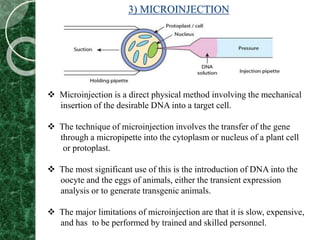
3) MICROINJECTION
 Microinjection is a direct physical method involving the mechanical
insertion of the desirable DNA into a target cell.
 The technique of microinjection involves the transfer of the gene
through a micropipette into the cytoplasm or nucleus of a plant cell
or protoplast.
 The most significant use of this is the introduction of DNA into the
oocyte and the eggs of animals, either the transient expression
analysis or to generate transgenic animals.
 The major limitations of microinjection are that it is slow, expensive,
and has to be performed by trained and skilled personnel.
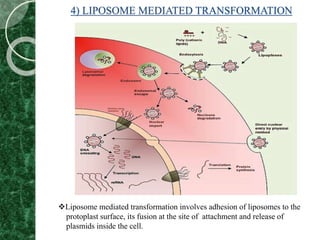
4) LIPOSOME MEDIATED TRANSFORMATION
Liposome mediated transformation involves adhesion of liposomes to the
protoplast surface, its fusion at the site of attachment and release of
plasmids inside the cell.
CHEMICAL GENE MEDIATED TRANSFER
1) POLYETHYLENE GLYCOL- MEDIATED TRANSFORMATION
 Polyethylene glycol (PEG), in the presence of divalent cations,
destabilizes the plasma membrane of protoplasts and renders it
permeable to naked DNA.
 A large number of protoplasts can be simultaneously transformed.
 This technique can be successfully used for a wide variety of plant
species.
 It has certain limitations:
i) The DNA is susceptible for degradation and rearrangement.
ii) Random integration of foreign DNA into genome may result in
undesirable traits.
iii) Regeneration of plants from transformed protoplasts is a difficult task.
2) DEAE-DEXTRAN MEDIATED TRANSFER
 The desirable DNA can be complexed with a high molecular weight
polymer diethyl amino ethyl(DEAE)dextran and transferred.
 The major limitation of this approach is that it does not yield stable
transformants.
Marker genes for plant transformation
 Some methods for selecting the transformed plant materials have been devised
by using a set of genes referred to as marker genes.
 These marker genes are introduced into the plant material along with the target
gene. The marker genes are of two types:
i) Selectable marker genes- The selection is based on the survival of
transformed cells when grown on a medium containing a toxic substance
(antibiotic, herbicide, antimetabolite). This is due to the fact that the selectable
marker gene confers resistance to toxicity in the transformed cells, while the
non-transformed cells will get killed.
Some of them are given below:
Antibiotic resistance genes( Hygromycin phosphotransferase, hpt gene)
Herbicide resistance genes( Enolpyruvylshikimate phosphate synthase, epsps)
Antimetabolite marker genes( Dihydrofolate reductase, dhfr gene)
ii) Reporter genes- An assay for the reporter gene is carried out by estimating
the quantity of the protein it produces or the final products formed.
Some of the important ones are given below:
Opine synthase (ocs), β-Glucuronidase (gus), Bacterial luciferase (luxA),
Firefly luciferase (luc)
APPLICATIONS
 Transgenic plants have various applications -:
RESISTANCE TO BIOTIC STRESS
1) INSECT RESISTANCE
2) VIRUS RESISTANCE
3) FUNGALAND BACTERIAL RESISTANCE
RESISTANCE TO ABIOTIC STRESS
1) HERBICIDE RESISTANCE
2) GLYPHOSATE RESISTANCE
IMPROVEMENT OF CROP YIELD & QUALITY
1) EXTENDED SELF LIFE OF FRUITS
2) IMPROVED NUTRITION
3) IMPROVED COLORATION
PRODUCTION OF LOW-COST PHARMACEUTICALS
1) EDIBLE VACCINES
2) ESSENTIAL PROTEINS
Insect resistant plants
 It is estimated that about 15% of the world’s crop yield is lost due to insects or
pests.
 Bacillus thuringiensis was first discovered by Ishiwaki in 1901. It is a gram
negative soil bacterium.
 Most of the Bt toxins are active against Lepidopteron larvae, while some of
them are specific against Dipterans and Coleopteran insects.
 Different cry protein produced by Bacillus:
Cry I : kills butterflies and moths
Cry II : kills butterflies and flies
Cry III : kills beetles
Cry IV : kills only flies
 Plant made only low levels of toxin because they are designed to express well in
bacteria and not in plants as they are produced from bacterium.
 Insect toxin gene was altered by changing many bases of the third position of
the redundant codon to improve its toxicity.
Action of Bt toxin
Virus resistant plants
 Plants may be engineered with genes for resistance to
viruses, bacteria, and fungi.
 Virus-resistant plants have a viral protein coat gene
that is overproduced, preventing the virus from
reproducing in the host cell, because the plant shuts off
the virus protein coat gene in response to the
overproduction.
 Coat protein genes are involved in resistance to
diseases such as cucumber mosaic virus, tobacco rattle
virus, and potato virus X.
Herbicide resistance
 Weeds are unwanted and useless plants that grow along with the crop
plants. To tackle these, herbicides are used.
Phosphoenolpyruvate Shikimate
Compete EPSPS
Glyphosate
Enolpyruvylshikimate-3- phosphate
Tryptophan Tyrosine
Phenylalanine
Fig: Glyphosate competes with the phosphoenolpyruvate in the EPSPS
catalyzed synthesis of enolpyruvylshikimate-3- phosphate and inhibits
synthesis of tryptophan, tyrosine and phenylalanine.
 EPSPS- Enolpyruvylshikimate-3- phosphate synthase
 The 1st crops to be engineered for glyphosate resistance were
produced by Monsanto Co. and called “Roundup Ready”.
Vaccine production
 Potatoes have been studied using a portion of the E. coli enterotoxin
in mice and humans and then transgenic potatoes were produced.
Ingestion of this transgenic potato resulted in satisfactory
vaccinations and no adverse effects.
 Other candidates for edible vaccines include banana and tomato,
and alfalfa, corn, and wheat are possible candidates for use in
livestock.
 Edible vaccines are vaccines produced in plants that can be
administered directly through the ingestion of plant materials
containing the vaccine. Eating the plant would then confer
immunity against diseases.
One focus of current vaccine effort is on hepatitis B.
Transgenic tobacco and potatoes were engineered to
express hepatitis B virus vaccine.
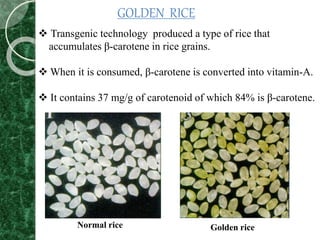
Golden riceNormal rice
GOLDEN RICE
 Transgenic technology produced a type of rice that
accumulates β-carotene in rice grains.
 When it is consumed, β-carotene is converted into vitamin-A.
 It contains 37 mg/g of carotenoid of which 84% is β-carotene.
FLAVR-SAVR TOMATO
This is produced by antisense technology.
The polygalactouronase gene, which is responsible for fruit decay is
silenced.
Biopolymers and plants
a) Plant seeds may be a potential source for plastics that could
be produced and easily extracted.
b) A type of PHA (polyhydroxylalkanoate) polymer called
“poly-beta-hydroxybutyrate”, or PHB, is produced in
Arabidopsis or mustard plant.
c) PHB can be made in canola seeds by the transfer of three
genes from the bacterium Alcaligenes eutrophus, which
codes for enzymes in the PHB synthesis pathway.
d) A polymer called PHBV produced through Alcaligenes
fermentation, which is sold under the name Biopol.
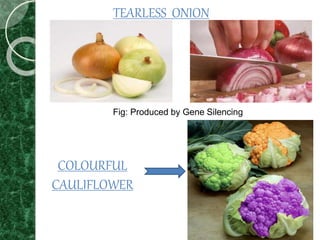
Fig: Produced by Gene Silencing
TEARLESS ONION
COLOURFUL
CAULIFLOWER
PURPLE TOMATOES PURPLE ROSE
COLOURFUL CORNS
bibliography
Biotechnology
-By U. Satyanarayana
Chapter- 49, 50
Gene Cloning and DNAAnalysis
- By T. A. Brown
Chapter- 15
Fundamentals of Plant Biotechnology
-By R.S. Singh & B.S.Singh
Chapter- 11
Plant Protoplast & Genetic Engineering II
-By Y.P.S. Bajaj
Molecular Biology and Genetic Engineering
- By P.K. Gupta
Transgenic plants  ppt

Transgenic plants ppt

  • 1.
    TRANSGENIC PLANTS Presented by- Kajol M.Sc.Biotechnology School of Biotechnology DAVV, Indore
  • 2.
    terms to know TRANSGENE-It is a foreign gene or genetic material that has been transferred naturally or by any of a number of genetic engineering techniques from one organism to another. TRANSGENESIS- The phenomenon of introduction of exogenous DNA into the genome to create and maintain a stable and heritable character. TRANSGENIC PLANTS- The plant whose genome is altered by adding one or more transgenes are known as transgenic plants.
  • 3.
    history 1982 • 1st transgenicplant produced which is an antibiotic resistance tobacco plant. 1984 • 1st successful plant genetic engineering experiments using caulimovirus vector. 1994 • 1st genetically modified crop approved for sale in U.S. was FlavrSavr tomato. 1995 • 1st pesticide producing crop, Bt Potato was approved by U.S. Environmental Protection Agency 1996 • 1st genetically modified flower Moondust, bluish colored carnation, was introduced. 2000 • Golden rice with β- carotene developed with increased nutrient value. 2013 • 1st genetically engineered crop developed by Robert Fraley, Marc Van Montagu &Marry Dell Chilton were awarded World Food Prize.
  • 4.
    Why transgenic plants? TRANSGENICPLANTS NUTRITIONAL QUALITY HERBICIDE RESISTANC E INSECTICID E RESISTANC E BIOTIC STRESS TOLERANC E ABIOTIC STRESS TOLERANC E ENHANCED SELF LIFE INDUSTRIAL PRODUCT PHARMACE- UTICALS &VACCINES
  • 5.
    GENE TRANSFER METHODS BIOLOGICALMETHODS  Agrobacterium mediated gene transfer  Plant virus vectors PHYSICAL METHODS  Electroporation  Microprojectile  Microinjection  Liposome Fusion CHEMICAL METHODS  Polyethylene glycol mediated  Diethylaminoethyl dextran mediated
  • 6.
    AGROBACTERIUM MEDIATED GENETRANSFER Agrobacterium is treated as nature’s most effective plant genetic engineer. A.tumifaciens infects wounded or damaged plant tissues results in the formation of plant tumor called crown gall. The bacterium releases Ti plasmid into the plant cell cytoplasm which induce crown gall. Several dicots are affected by this disease e.g. grapes, roses, etc.
  • 7.
    ORGANIZATION OF TIPLASMID The size of Ti plasmid is approx. 200 kb. The Ti plasmid has three important regions: (i) T-DNA region (ii) Virulence region (iii) Opine catabolism region  There is ori region that is responsible for the origin of DNA replication.
  • 8.
    T-DNA transfer andintegration Fig: Diagrammatic representation of T-DNA transfer &its integration into host plant cell genome
  • 9.
  • 10.
    PLANT VIRus VECTORS Plant viruses are considered as efficient gene transfer agents as they can infect the intact plants and amplify the transferred genes through viral genome replication.  It has some limitations like that vast majority of plant viruses have genome not of DNA but of RNA. Two classes of DNA viruses are known to infect higher plants, caulimovirus and geminivirus & neither is ideally suited for gene cloning. i) CAULIMOVIRUS: They contain circular dsDNA and are spherical in shape. The caulimovirus group has around 15 viruses & among these Cauliflower Mosaic Virus(CaMV) is the most important for gene transfer. CaMV infects many plants & can be easily transmitted. The infection is systemic. It’s genome does not contain any non-coding regions.
  • 11.
    It has certainlimitations- i) CaMV vectors has a limited capacity for insertion of foreign genes. ii) Infective capacity of CaMV is lost if more than a few hundred nucleotides are introduced. iii) Helper viruses cannot be used since the foreign DNA gets expelled and wild-type viruses are produced. II) GEMINIVIRUS: They contain one or two circular ssDNA. They are particularly interesting because their natural host include plant size such as maize & wheat. They could therefore be potential vector for these and other monocots. They have their own set of difficulties- It is very difficult to introduce purified viral DNA into the plants.
  • 12.
    PHYSICAL GENE TRANSFERMETHODS 1) ELECTROPORATION Electroporation involves the creation of pores in the cell membrane using electric pulse of high field strength. If DNA is present in the buffer solution at sufficient concentration, it will be taken up through these pores.
  • 13.
    2) PARTICLE BOMBARDMENT It is also known as microprojectile bombardment, biolistics, gene gun, etc.  Foreign DNA coated with high velocity gold or tungsten particles to deliver DNA into cells.  This method is widely being used because of its ability to transfer foreign DNA into the mammalian cells and microorganisms.
  • 14.
    3) MICROINJECTION  Microinjectionis a direct physical method involving the mechanical insertion of the desirable DNA into a target cell.  The technique of microinjection involves the transfer of the gene through a micropipette into the cytoplasm or nucleus of a plant cell or protoplast.  The most significant use of this is the introduction of DNA into the oocyte and the eggs of animals, either the transient expression analysis or to generate transgenic animals.  The major limitations of microinjection are that it is slow, expensive, and has to be performed by trained and skilled personnel.
  • 15.
    4) LIPOSOME MEDIATEDTRANSFORMATION Liposome mediated transformation involves adhesion of liposomes to the protoplast surface, its fusion at the site of attachment and release of plasmids inside the cell.
  • 16.
    CHEMICAL GENE MEDIATEDTRANSFER 1) POLYETHYLENE GLYCOL- MEDIATED TRANSFORMATION  Polyethylene glycol (PEG), in the presence of divalent cations, destabilizes the plasma membrane of protoplasts and renders it permeable to naked DNA.  A large number of protoplasts can be simultaneously transformed.  This technique can be successfully used for a wide variety of plant species.  It has certain limitations: i) The DNA is susceptible for degradation and rearrangement. ii) Random integration of foreign DNA into genome may result in undesirable traits. iii) Regeneration of plants from transformed protoplasts is a difficult task. 2) DEAE-DEXTRAN MEDIATED TRANSFER  The desirable DNA can be complexed with a high molecular weight polymer diethyl amino ethyl(DEAE)dextran and transferred.  The major limitation of this approach is that it does not yield stable transformants.
  • 17.
    Marker genes forplant transformation  Some methods for selecting the transformed plant materials have been devised by using a set of genes referred to as marker genes.  These marker genes are introduced into the plant material along with the target gene. The marker genes are of two types: i) Selectable marker genes- The selection is based on the survival of transformed cells when grown on a medium containing a toxic substance (antibiotic, herbicide, antimetabolite). This is due to the fact that the selectable marker gene confers resistance to toxicity in the transformed cells, while the non-transformed cells will get killed. Some of them are given below: Antibiotic resistance genes( Hygromycin phosphotransferase, hpt gene) Herbicide resistance genes( Enolpyruvylshikimate phosphate synthase, epsps) Antimetabolite marker genes( Dihydrofolate reductase, dhfr gene) ii) Reporter genes- An assay for the reporter gene is carried out by estimating the quantity of the protein it produces or the final products formed. Some of the important ones are given below: Opine synthase (ocs), β-Glucuronidase (gus), Bacterial luciferase (luxA), Firefly luciferase (luc)
  • 18.
    APPLICATIONS  Transgenic plantshave various applications -: RESISTANCE TO BIOTIC STRESS 1) INSECT RESISTANCE 2) VIRUS RESISTANCE 3) FUNGALAND BACTERIAL RESISTANCE RESISTANCE TO ABIOTIC STRESS 1) HERBICIDE RESISTANCE 2) GLYPHOSATE RESISTANCE IMPROVEMENT OF CROP YIELD & QUALITY 1) EXTENDED SELF LIFE OF FRUITS 2) IMPROVED NUTRITION 3) IMPROVED COLORATION PRODUCTION OF LOW-COST PHARMACEUTICALS 1) EDIBLE VACCINES 2) ESSENTIAL PROTEINS
  • 19.
    Insect resistant plants It is estimated that about 15% of the world’s crop yield is lost due to insects or pests.  Bacillus thuringiensis was first discovered by Ishiwaki in 1901. It is a gram negative soil bacterium.  Most of the Bt toxins are active against Lepidopteron larvae, while some of them are specific against Dipterans and Coleopteran insects.  Different cry protein produced by Bacillus: Cry I : kills butterflies and moths Cry II : kills butterflies and flies Cry III : kills beetles Cry IV : kills only flies  Plant made only low levels of toxin because they are designed to express well in bacteria and not in plants as they are produced from bacterium.  Insect toxin gene was altered by changing many bases of the third position of the redundant codon to improve its toxicity.
  • 20.
  • 21.
    Virus resistant plants Plants may be engineered with genes for resistance to viruses, bacteria, and fungi.  Virus-resistant plants have a viral protein coat gene that is overproduced, preventing the virus from reproducing in the host cell, because the plant shuts off the virus protein coat gene in response to the overproduction.  Coat protein genes are involved in resistance to diseases such as cucumber mosaic virus, tobacco rattle virus, and potato virus X.
  • 22.
    Herbicide resistance  Weedsare unwanted and useless plants that grow along with the crop plants. To tackle these, herbicides are used. Phosphoenolpyruvate Shikimate Compete EPSPS Glyphosate Enolpyruvylshikimate-3- phosphate Tryptophan Tyrosine Phenylalanine Fig: Glyphosate competes with the phosphoenolpyruvate in the EPSPS catalyzed synthesis of enolpyruvylshikimate-3- phosphate and inhibits synthesis of tryptophan, tyrosine and phenylalanine.  EPSPS- Enolpyruvylshikimate-3- phosphate synthase  The 1st crops to be engineered for glyphosate resistance were produced by Monsanto Co. and called “Roundup Ready”.
  • 23.
    Vaccine production  Potatoeshave been studied using a portion of the E. coli enterotoxin in mice and humans and then transgenic potatoes were produced. Ingestion of this transgenic potato resulted in satisfactory vaccinations and no adverse effects.  Other candidates for edible vaccines include banana and tomato, and alfalfa, corn, and wheat are possible candidates for use in livestock.  Edible vaccines are vaccines produced in plants that can be administered directly through the ingestion of plant materials containing the vaccine. Eating the plant would then confer immunity against diseases. One focus of current vaccine effort is on hepatitis B. Transgenic tobacco and potatoes were engineered to express hepatitis B virus vaccine.
  • 24.
    Golden riceNormal rice GOLDENRICE  Transgenic technology produced a type of rice that accumulates β-carotene in rice grains.  When it is consumed, β-carotene is converted into vitamin-A.  It contains 37 mg/g of carotenoid of which 84% is β-carotene.
  • 25.
    FLAVR-SAVR TOMATO This isproduced by antisense technology. The polygalactouronase gene, which is responsible for fruit decay is silenced.
  • 26.
    Biopolymers and plants a)Plant seeds may be a potential source for plastics that could be produced and easily extracted. b) A type of PHA (polyhydroxylalkanoate) polymer called “poly-beta-hydroxybutyrate”, or PHB, is produced in Arabidopsis or mustard plant. c) PHB can be made in canola seeds by the transfer of three genes from the bacterium Alcaligenes eutrophus, which codes for enzymes in the PHB synthesis pathway. d) A polymer called PHBV produced through Alcaligenes fermentation, which is sold under the name Biopol.
  • 27.
    Fig: Produced byGene Silencing TEARLESS ONION COLOURFUL CAULIFLOWER
  • 28.
  • 29.
  • 30.
    bibliography Biotechnology -By U. Satyanarayana Chapter-49, 50 Gene Cloning and DNAAnalysis - By T. A. Brown Chapter- 15 Fundamentals of Plant Biotechnology -By R.S. Singh & B.S.Singh Chapter- 11 Plant Protoplast & Genetic Engineering II -By Y.P.S. Bajaj Molecular Biology and Genetic Engineering - By P.K. Gupta

Editor's Notes