DAVANGERE UNIVERSITY
SHIVAGANGOTRI CAMPUS, SH 76, DAVANAGERE -577007.
DEPARTMENT OF P.G. STUDIES AND RESEARCH IN FOOD TECHNOLOGY
SEMINAR ON:
TRANSGENIC PLANTS
Presenting By: Presenting Through:
Dhanush Rayapati G. Dr. Santhosh Kumar S. R.
II M.Sc. IV Semester. Assistant Professor
Dept. of Food Technology Dept. of Food Technology
Davangere University Davangere University
CONTENTS
 INTRODUCTION
 HISTORY
 GENE TRANSFER TECHNIQUES
 VECTOR MIDEATED GENE TRANSFER
 VECTORLESS OR DIRECT GENE TRANSFER
 IMPROVED PEROFRMANCE
 IMPROVED PRODUCTIVITY
 ADVANTAGES
 DISADVANTAGES
 CONCLUSION
 REFERENCES
INTRODUCTION
 Genetic variations are necessary in plant cells and tissues for the
production of improved crop varieties.
 This would be achieved by manipulating the gene and it is called Genetic
Engineering.
 This is carried out by Biotechnologists or Genetic Engineers.
 Definition:
 The plants obtained through genetic engineering contain a gene or
genes usually from unrelated organisms; such genes are called “Trans
Genes” and the plants containing the transgenes are known as
“Transgenic Plants”.
 Till date number of transgenic plant varieties have been developed.
HISTORY
 Humans are domesticated plants and animals since around12,000 BCE.
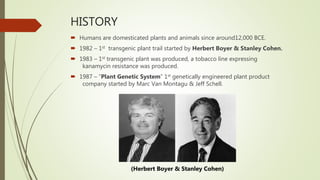
 1982 – 1st transgenic plant trail started by Herbert Boyer & Stanley Cohen.
 1983 – 1st transgenic plant was produced, a tobacco line expressing
kanamycin resistance was produced.
 1987 – “Plant Genetic System” 1st genetically engineered plant product
company started by Marc Van Montagu & Jeff Schell.
(Herbert Boyer & Stanley Cohen)
GENE TRANSFER TECHNIQUES
 VECTOR MEDIATED GENE TRANSFER
 pTi (Tumour inducing plasmid) of Agrobacterium tumeficians is used as a
vector in gene transfer.
 VECTORLESS OR DIRECT GENE TRANSFER
 The foreign gene of interest is delivered in to host plant cell without the help of
a vector.
 This method involves:
Chemical mediated gene transfer
Microinjection
Electroporation
Particle gun/Particle bombardment
Lipofection
VECTOR MEDIATED GENE TRANSFER
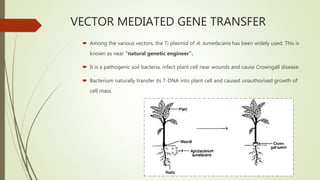
 Among the various vectors, the Ti plasmid of A. tumefaciens has been widely used. This is
known as near “natural genetic engineer”.
 It is a pathogenic soil bacteria, infect plant cell near wounds and cause Crowngall disease.
 Bacterium naturally transfer its T-DNA into plant cell and caused unauthorised growth of
cell mass.
Ti plasmid
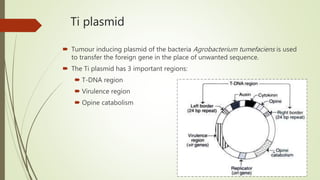
 Tumour inducing plasmid of the bacteria Agrobacterium tumefaciens is used
to transfer the foreign gene in the place of unwanted sequence.
 The Ti plasmid has 3 important regions:
 T-DNA region
 Virulence region
 Opine catabolism
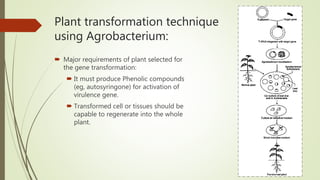
Plant transformation technique
using Agrobacterium:
 Major requirements of plant selected for
the gene transformation:
 It must produce Phenolic compounds
(eg, autosyringone) for activation of
virulence gene.
 Transformed cell or tissues should be
capable to regenerate into the whole
plant.
VECTORLESS OR DIRECT GENE TRANSFER
Chemical mediated gene transfer
Microinjection
Electroporation
Particle gun/Particle bombardment
Lipofection
Chemical mediated gene transfer
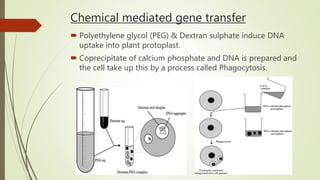
 Polyethylene glycol (PEG) & Dextran sulphate induce DNA
uptake into plant protoplast.
 Coprecipitate of calcium phosphate and DNA is prepared and
the cell take up this by a process called Phagocytosis.
Microinjection
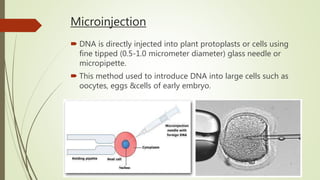
 DNA is directly injected into plant protoplasts or cells using
fine tipped (0.5-1.0 micrometer diameter) glass needle or
micropipette.
 This method used to introduce DNA into large cells such as
oocytes, eggs &cells of early embryo.
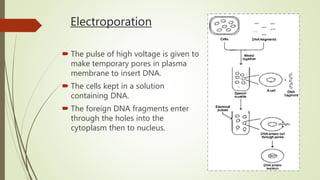
Electroporation
 The pulse of high voltage is given to
make temporary pores in plasma
membrane to insert DNA.
 The cells kept in a solution
containing DNA.
 The foreign DNA fragments enter
through the holes into the
cytoplasm then to nucleus.
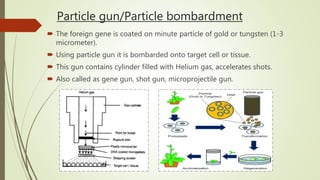
Particle gun/Particle bombardment
 The foreign gene is coated on minute particle of gold or tungsten (1-3
micrometer).
 Using particle gun it is bombarded onto target cell or tissue.
 This gun contains cylinder filled with Helium gas, accelerates shots.
 Also called as gene gun, shot gun, microprojectile gun.
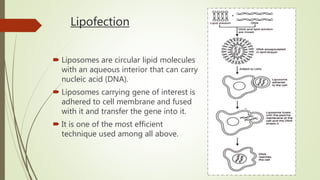
Lipofection
 Liposomes are circular lipid molecules
with an aqueous interior that can carry
nucleic acid (DNA).
 Liposomes carrying gene of interest is
adhered to cell membrane and fused
with it and transfer the gene into it.
 It is one of the most efficient
technique used among all above.
IMPROVED PERFORMANCE
 Stress tolerance
 Herbicide tolerance
 Insect resistance
 Bacterial, fungal & viral resistance
 Delayed fruit ripening
 Male sterility
IMPROVED PRODUCTIVITY
 Improved nutrient quality
 Improved seed protein quality
 Diagnostic and therapeutic proteins
 Edible vaccines
 Bio degradable plastics
ADVANTAGES
 Desired genetic modification
 Transgenic plants work as Bioreactor to produce number of valuable
products related to:
Pharmaceuticals
Therapeutic proteins
Vaccines
Industrial enzymes
Antibodies
Other secondary metabolites
 Short time duration with high yield production.
DISADVANTAGES
 Different in codon usage between plants and prokaryotes can leads to
inefficient expression of prokaryotic proteins in plants.
 Some plants may produce allergic compounds.
CONCLUSION
 Transgenic plants have the potential to solve many of the
worlds hunger and malnutrition problems.
 By this technology productivity and performances of plants
have been increased.
 It potentially reduces the use of pesticides and herbicides.
 Its products are also used at commercial level.
REFERENCES
 Transgenic plants; Encyclopaedia Britannica.Inc, Chicago; Encyclopaedia
Britannica, 1993; pp. 173-178. ISBN: 0852295715.
 Narayanswamy S (1994); Plant cell and Tissue culture; Tata McGraw-Hill
Education; pp. vi; ISBN: 9780074602775.
 Articles:
 Nandkishor Jha; Methods of gene transfer in plants.
 Rashmi V. Juyal; Asst. professor, Division of Life Science, Shri Guru Ram Rai
Institute of Technology and Science; Transgenic plants.
 Samiksha S; Agrobacterium mediated gene transfer in plants.
THANK YOU
HAVE A GOOD DAY

Transgenic plants

  • 1.
    DAVANGERE UNIVERSITY SHIVAGANGOTRI CAMPUS,SH 76, DAVANAGERE -577007. DEPARTMENT OF P.G. STUDIES AND RESEARCH IN FOOD TECHNOLOGY SEMINAR ON: TRANSGENIC PLANTS Presenting By: Presenting Through: Dhanush Rayapati G. Dr. Santhosh Kumar S. R. II M.Sc. IV Semester. Assistant Professor Dept. of Food Technology Dept. of Food Technology Davangere University Davangere University
  • 2.
    CONTENTS  INTRODUCTION  HISTORY GENE TRANSFER TECHNIQUES  VECTOR MIDEATED GENE TRANSFER  VECTORLESS OR DIRECT GENE TRANSFER  IMPROVED PEROFRMANCE  IMPROVED PRODUCTIVITY  ADVANTAGES  DISADVANTAGES  CONCLUSION  REFERENCES
  • 3.
    INTRODUCTION  Genetic variationsare necessary in plant cells and tissues for the production of improved crop varieties.  This would be achieved by manipulating the gene and it is called Genetic Engineering.  This is carried out by Biotechnologists or Genetic Engineers.  Definition:  The plants obtained through genetic engineering contain a gene or genes usually from unrelated organisms; such genes are called “Trans Genes” and the plants containing the transgenes are known as “Transgenic Plants”.  Till date number of transgenic plant varieties have been developed.
  • 4.
    HISTORY  Humans aredomesticated plants and animals since around12,000 BCE.  1982 – 1st transgenic plant trail started by Herbert Boyer & Stanley Cohen.  1983 – 1st transgenic plant was produced, a tobacco line expressing kanamycin resistance was produced.  1987 – “Plant Genetic System” 1st genetically engineered plant product company started by Marc Van Montagu & Jeff Schell. (Herbert Boyer & Stanley Cohen)
  • 5.
    GENE TRANSFER TECHNIQUES VECTOR MEDIATED GENE TRANSFER  pTi (Tumour inducing plasmid) of Agrobacterium tumeficians is used as a vector in gene transfer.  VECTORLESS OR DIRECT GENE TRANSFER  The foreign gene of interest is delivered in to host plant cell without the help of a vector.  This method involves: Chemical mediated gene transfer Microinjection Electroporation Particle gun/Particle bombardment Lipofection
  • 6.
    VECTOR MEDIATED GENETRANSFER  Among the various vectors, the Ti plasmid of A. tumefaciens has been widely used. This is known as near “natural genetic engineer”.  It is a pathogenic soil bacteria, infect plant cell near wounds and cause Crowngall disease.  Bacterium naturally transfer its T-DNA into plant cell and caused unauthorised growth of cell mass.
  • 7.
    Ti plasmid  Tumourinducing plasmid of the bacteria Agrobacterium tumefaciens is used to transfer the foreign gene in the place of unwanted sequence.  The Ti plasmid has 3 important regions:  T-DNA region  Virulence region  Opine catabolism
  • 8.
    Plant transformation technique usingAgrobacterium:  Major requirements of plant selected for the gene transformation:  It must produce Phenolic compounds (eg, autosyringone) for activation of virulence gene.  Transformed cell or tissues should be capable to regenerate into the whole plant.
  • 9.
    VECTORLESS OR DIRECTGENE TRANSFER Chemical mediated gene transfer Microinjection Electroporation Particle gun/Particle bombardment Lipofection
  • 10.
    Chemical mediated genetransfer  Polyethylene glycol (PEG) & Dextran sulphate induce DNA uptake into plant protoplast.  Coprecipitate of calcium phosphate and DNA is prepared and the cell take up this by a process called Phagocytosis.
  • 11.
    Microinjection  DNA isdirectly injected into plant protoplasts or cells using fine tipped (0.5-1.0 micrometer diameter) glass needle or micropipette.  This method used to introduce DNA into large cells such as oocytes, eggs &cells of early embryo.
  • 12.
    Electroporation  The pulseof high voltage is given to make temporary pores in plasma membrane to insert DNA.  The cells kept in a solution containing DNA.  The foreign DNA fragments enter through the holes into the cytoplasm then to nucleus.
  • 13.
    Particle gun/Particle bombardment The foreign gene is coated on minute particle of gold or tungsten (1-3 micrometer).  Using particle gun it is bombarded onto target cell or tissue.  This gun contains cylinder filled with Helium gas, accelerates shots.  Also called as gene gun, shot gun, microprojectile gun.
  • 14.
    Lipofection  Liposomes arecircular lipid molecules with an aqueous interior that can carry nucleic acid (DNA).  Liposomes carrying gene of interest is adhered to cell membrane and fused with it and transfer the gene into it.  It is one of the most efficient technique used among all above.
  • 15.
    IMPROVED PERFORMANCE  Stresstolerance  Herbicide tolerance  Insect resistance  Bacterial, fungal & viral resistance  Delayed fruit ripening  Male sterility
  • 16.
    IMPROVED PRODUCTIVITY  Improvednutrient quality  Improved seed protein quality  Diagnostic and therapeutic proteins  Edible vaccines  Bio degradable plastics
  • 17.
    ADVANTAGES  Desired geneticmodification  Transgenic plants work as Bioreactor to produce number of valuable products related to: Pharmaceuticals Therapeutic proteins Vaccines Industrial enzymes Antibodies Other secondary metabolites  Short time duration with high yield production.
  • 18.
    DISADVANTAGES  Different incodon usage between plants and prokaryotes can leads to inefficient expression of prokaryotic proteins in plants.  Some plants may produce allergic compounds.
  • 19.
    CONCLUSION  Transgenic plantshave the potential to solve many of the worlds hunger and malnutrition problems.  By this technology productivity and performances of plants have been increased.  It potentially reduces the use of pesticides and herbicides.  Its products are also used at commercial level.
  • 20.
    REFERENCES  Transgenic plants;Encyclopaedia Britannica.Inc, Chicago; Encyclopaedia Britannica, 1993; pp. 173-178. ISBN: 0852295715.  Narayanswamy S (1994); Plant cell and Tissue culture; Tata McGraw-Hill Education; pp. vi; ISBN: 9780074602775.  Articles:  Nandkishor Jha; Methods of gene transfer in plants.  Rashmi V. Juyal; Asst. professor, Division of Life Science, Shri Guru Ram Rai Institute of Technology and Science; Transgenic plants.  Samiksha S; Agrobacterium mediated gene transfer in plants.
  • 21.