WHAT ARE TRANSGENIC
PLANTS?
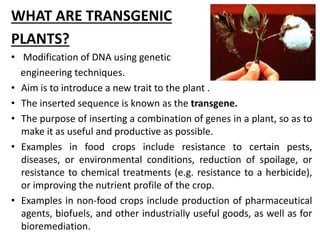
• Modification of DNA using genetic
engineering techniques.
• Aim is to introduce a new trait to the plant .
• The inserted sequence is known as the transgene.
• The purpose of inserting a combination of genes in a plant, so as to
make it as useful and productive as possible.
• Examples in food crops include resistance to certain pests,
diseases, or environmental conditions, reduction of spoilage, or
resistance to chemical treatments (e.g. resistance to a herbicide),
or improving the nutrient profile of the crop.
• Examples in non-food crops include production of pharmaceutical
agents, biofuels, and other industrially useful goods, as well as for
bioremediation.
WHY MAKE TRANSGENIC
PLANTS?
• Desirable genes may provide features such as higher yield or
improved quality, pest or disease resistance, or tolerance to
heat, cold and drought.
• Transgenic technology enables plant breeders to bring
together in one plant useful genes from a wide range of living
sources.
• Generate more useful and productive crop varieties
containing new combinations of genes.
• Expands the possibilities beyond the limitations imposed by
traditional cross-pollination and selection techniques.
HISTORY
• The first genetically modified crop plant was produced in 1982, an
antibiotic-resistant tobacco plant.
• In 1987, Plant Genetic Systems ,founded by Marc Van Montagu
and Jeff Schell, was the first company to genetically engineer
insect-resistant (tobacco) plants by incorporating genes that
produced insecticidal proteins from Bacillus thuringiensis (Bt).
• The first genetically modified crop approved for sale in the U.S, in
1994, was the FlavrSavr tomato as it had a longer shelf life.
• In 1994, the European Union approved tobacco engineered to be
resistant to the herbicide bromoxynil, making it the first
commercially genetically engineered crop marketed in Europe.
HISTORY
• In 1995, Bt Potato was approved by the US Environmental
Protection Agency, making it the country's first pesticide
producing crop.
• In 1995 canola with modified oil composition (Calgene),
(Calgene), Bt cotton (Monsanto), glyphosate-resistant
soybeans (Monsanto), virus-resistant squash (Asgrow), and
additional delayed ripening tomatoes (DNAP, Zeneca/Peto,
and Monsanto) were approved.
• In 2000, Vitamin A-enriched golden rice, was the first food
with increased nutrient value.
MOST COMMONLY USED GENETIC
ENGINEERING TECHNIQUES
• Microprojectiles (biolistics or particle
gun) for gene transfer
• Agrobacterium tumefaciens mediated
transformation
• Electroporation
• Microinjection
TRANSGENIC PLANTS FOR CROP
IMPROVEMENT
• Nutrition
Some GM soybeans offer improved oil profiles for processing or
healthier eating. Camelina sativa has been modified to produce
plants that accumulate high levels of oils similar to fish oils.
• Vitamin enrichment
Golden rice, developed by the International Rice Research Institute
(IRRI), provides greater amounts of Vitamin A targeted at reducing
Vitamin A deficiency.
• Toxin reduction
A genetically modified cassava under development offers lower
cyanogen glucosides and enhanced protein and other nutrients
(called Bio Cassava).
• Stress resistance
In 2011, Monsanto's Drought Gard maize became the first drought-
resistant GM crop to receive US marketing approval.
• Herbicides
(i) Glyphosate-The transgenic petunia plants resistant to
glyphosate(active ingredient of Roundup herbicide) were
developed by transfer of a gene for EPSPS(5-enol-pyruvyl-
shikimat-3-phosphate synthase), that overproduces this
enzyme.
(ii) Bromoxynil-Tobacco plants have been engineered to be
resistant to the herbicide bromoxynil.
(iii) 2-4D- The transgenic maize and soyabean resistant to 2-4D
were developed by inserting a bacterial aryloxyalkanoate
dioxygenase gene, aad1 makes the corn resistant to 2,4D.
• Pest resistance
(i) Insects-The Bt toxin produced by Bacillus thuringiensis has
been isolated and used for Agrobacterium Ti plasmid mediated
transformation of tobacco, cotton and tomato plants.
(ii) Virus- 80% of Hawaiian papaya plants were genetically
modified by incorporating Pseudorabies virus (PRV) DNA.
ADVANTAGES
• For the producers of the new varieties
- A high efficiency in plants is obtained.
• For farmers
-Process of pests destroying is simplified, therefore less damage.
-Production output is increasing as well as the profits of transgenic cultures,
even the obtaining cost of the GMO is rather high.
• For industry
- As in the case of modified starch, low lignin content wood (in this case paper
manufacturing is less pollutant), human protein production(for therapeutic
aim)
• For consumers
- More nutritious
-Fruits and vegetables with delayed maturation can easily be stored, with
minimum losses.
-In future, transgenic plants contain higher content of vitamins, minerals,
essential amino acids by using the vaccine plants, the rice enriched in pro-
vitamin A etc.
• For the environment and human future
-Imply lower pollution
-Higher agricultural productions
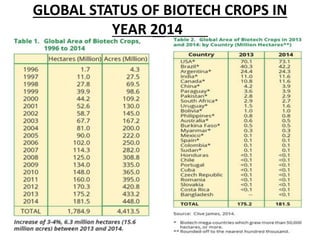
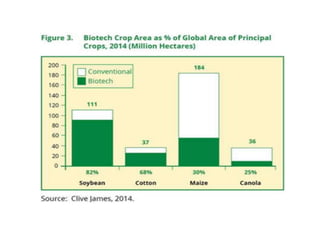
GLOBAL STATUS OF BIOTECH CROPS IN
YEAR 2014
EXAMPLES OF
TRANSGENIC PLANTS
 The high productivity, nutritional quality and amenability to
genetic manipulation makes potato a choice crop for
developing transgenic plants on diverse parameters.
 Late blight, bacterial wilt, viruses, the potato tuber moth and
sensitivity to high temperatures are the major production
constraints best addressed by transgenic potatoes.
 The alteration of the carbohydrate metabolism for the
industrial production of cyclodextrin, fructan, and quality
starch would overcome certain utilization constraints. The
production of vaccines for major livestock diseases such as
Rinderpest and Foot and Mouth Disease of cattle, and New
Castle disease of poultry are new utilization possibilities.
Potato Annexin- Drought Tolerance &
Light stress
• Annexins are a family of calcium- and membrane-
binding proteins that are important for plant
tolerance to adverse environmental conditions.
• Annexins function to counteract oxidative stress,
maintain cell redox homeostasis, and enhance
drought tolerance.
• Consequently, these plants were able to maintain
effective photosynthesis during drought, which
resulted in greater productivity than WT plants
despite water scarcity.
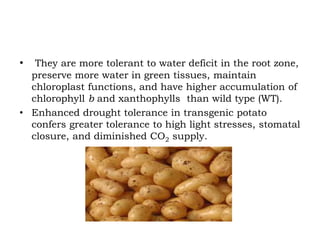
• They are more tolerant to water deficit in the root zone,
preserve more water in green tissues, maintain
chloroplast functions, and have higher accumulation of
chlorophyll b and xanthophylls than wild type (WT).
• Enhanced drought tolerance in transgenic potato
confers greater tolerance to high light stresses, stomatal
closure, and diminished CO2 supply.
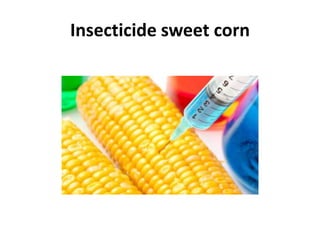
Insecticide sweet corn
• Scientists have genetically modified sweet
corn so that it produces a poison which kills
harmful insects. This means the farmer no
longer needs to fight insects with insecticides.
The genetically modified corn is called Bt-corn,
because the insect-killing gene in the plant
comes from the bacteria Bacillus
thuringiensis.
Insecticide sweet corn
Advantages
• The farmer no longer has to use insecticide to
kill insects, so the surrounding environment is
no longer exposed to large amounts of
harmful insecticide. The farmer no longer
needs to walk around with a drum of toxic
spray wearing a mask and protective clothing
Disadvantages
• This type of genetically modified corn will poison the insects
over a longer period than the farmer who would spray the
crops once or twice. In this way the insects can become
accustomed (or resistant) to the poison. If that happens both
crop spraying and the use of genetically modified Bt-corn
become ineffective.
• A variety of insects are at risk of being killed. It might be
predatory insects that eat the harmful ones or, perhaps
attractive insects such as butterflies. In the USA, where Bt-
corn is used a great deal there is much debate over the
harmful effects of Bt-corn on the beautiful Monarch butterfly.
• Cotton and potatoes are other examples of plants that
scientists have , genetically modified to produce insecticide.
Golden rice
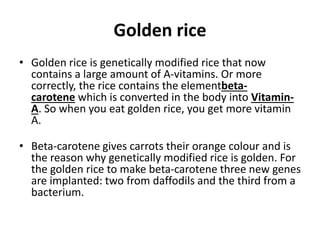
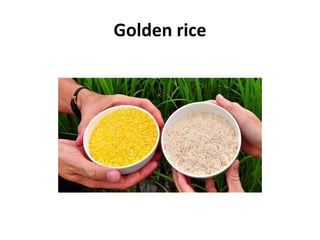
• Golden rice is genetically modified rice that now
contains a large amount of A-vitamins. Or more
correctly, the rice contains the elementbeta-
carotene which is converted in the body into Vitamin-
A. So when you eat golden rice, you get more vitamin
A.
• Beta-carotene gives carrots their orange colour and is
the reason why genetically modified rice is golden. For
the golden rice to make beta-carotene three new genes
are implanted: two from daffodils and the third from a
bacterium.
Golden rice
Advantages
• The rice can be considered a particular advantage to
poor people in underdeveloped countries. They eat only
an extremely limited diet lacking in the essential bodily
vitamins. The consequences of this restricted diet causes
many people to die or become blind. This is particularly
true in areas of Asia, where most of the population live
on rice from morning to evening.
Disadvantages
• Critics fear that poor people in underdeveloped countries
are becoming too dependent on the rich western world.
Usually, it is the large private companies in the West that
have the means to develop genetically modified plants. By
making the plants sterile these large companies can
prevent farmers from growing plant-seed for the following
year - forcing them to buy new rice from the companies.
• Some opposes of genetic modification see the "golden rice"
as a method of making genetic engineering more widely
accepted. Opponents fear that companies will go on to
develop other genetically modified plants from which they
can make a profit. A situation could develop where the
large companies own the rights to all the good crops
Long-lasting tomatoes
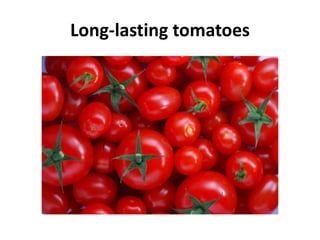
• Long-lasting, genetically modified tomatoes
came on to the market in 1994 and were the
first genetically modified food available to
consumers. The genetically modified tomato
produces less of the substance that causes
tomatoes to rot, so remains firm and fresh for
a long time.
Long-lasting tomatoes
Advantages
• Because the GM tomatoes can remain fresh
longer they can be allowed to ripen in the sun
before picking - resulting in a better tasting
tomato.
• GM tomatoes can tolerate a lengthier transport
time. This means that market gardens can avoid
picking tomatoes while they are green in order
that they will tolerate the transport.
• The producers also have the advantage that all
the tomatoes can be harvested simultaneously.
Disadvantages
• Scientists today can genetically modify tomatoes
without inserting genes for antibiotic resistance.
However the first genetically modified tomatoes
contained genes that made them resistant
toantibiotics. Doctors and vets use antibiotics to
fight infections. These genes spread to animals
and people, doctors would have difficulties
fighting infectious diseases.
• Strawberries, pineapples, sweet peppers and
bananas have all been genetically modified by
scientists to remain fresh for longer.
DISADVANTAGES OF TRANSGENIC
PLANTS
• Damage to human health
• allergies
• horizontal transfer and antibiotic resistance
• eating foreign DNA
• changed nutrient levels
• Damage to the natural environment
• crop-to-weed gene flow
• leakage of GM proteins into soil
• reductions in pesticide spraying: are they real?
• Disruption of current practices of farming and food production in
developed countries
• crop-to-crop gene flow
• Disruption of traditional practices and economies in less developed
countries.
• Lack of research on consequences of transgenic crops.
CURRENT SCENARIO
• Commercially grown transgenic crops in developed
countries include ‘Flavr Savr’ and ‘Endless Summer’
tomatoes, ‘High-lauric rapeseed (canola) and ‘Roundup
Ready’ soyabean.
• More than 60 transgenic dicot plants including herbs,
shrubs and trees and several monocots like maize, oat,
rice, wheat, etc. have been produced.
• Currently, India is importing both grain legumes and
edible oils to meet people’s demand.
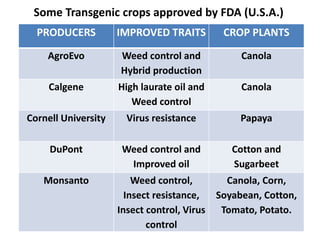
Some Transgenic crops approved by FDA (U.S.A.)
PRODUCERS IMPROVED TRAITS CROP PLANTS
AgroEvo Weed control and
Hybrid production
Canola
Calgene High laurate oil and
Weed control
Canola
Cornell University Virus resistance Papaya
DuPont Weed control and
Improved oil
Cotton and
Sugarbeet
Monsanto Weed control,
Insect resistance,
Insect control, Virus
control
Canola, Corn,
Soyabean, Cotton,
Tomato, Potato.
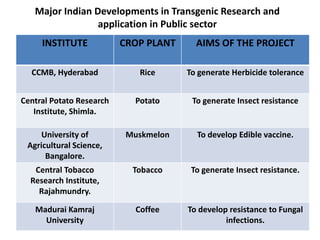
Major Indian Developments in Transgenic Research and
application in Public sector
INSTITUTE CROP PLANT AIMS OF THE PROJECT
CCMB, Hyderabad Rice To generate Herbicide tolerance
Central Potato Research
Institute, Shimla.
Potato To generate Insect resistance
University of
Agricultural Science,
Bangalore.
Muskmelon To develop Edible vaccine.
Central Tobacco
Research Institute,
Rajahmundry.
Tobacco To generate Insect resistance.
Madurai Kamraj
University
Coffee To develop resistance to Fungal
infections.
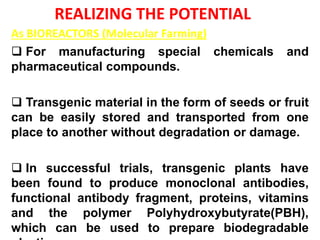
REALIZING THE POTENTIAL
As BIOREACTORS (Molecular Farming)
 For manufacturing special chemicals and
pharmaceutical compounds.
 Transgenic material in the form of seeds or fruit
can be easily stored and transported from one
place to another without degradation or damage.
 In successful trials, transgenic plants have
been found to produce monoclonal antibodies,
functional antibody fragment, proteins, vitamins
and the polymer Polyhydroxybutyrate(PBH),
which can be used to prepare biodegradable
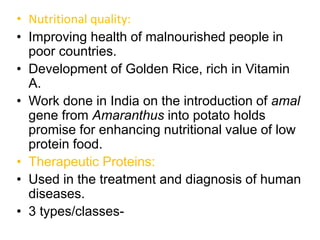
• Nutritional quality:
• Improving health of malnourished people in
poor countries.
• Development of Golden Rice, rich in Vitamin
A.
• Work done in India on the introduction of amal
gene from Amaranthus into potato holds
promise for enhancing nutritional value of low
protein food.
• Therapeutic Proteins:
• Used in the treatment and diagnosis of human
diseases.
• 3 types/classes-
o Edible Vaccines-
• Vaccines against infectious diseases of the
gastrointestinal tract have been produced in
plants like potato and banana.
• A rabies virus coat glycoprotein gene has
been expressed in tomato plants. Orally
administered protein provided protective
immunity in animals.
o Edible Antibodies-
• Antibodies directed against dental caries,
cholera, malaria, influenza, and hepatitis B
virus are known to be produced in transgenic
plants.
• An anti cancer antibody has recently
expressed in rice and wheat seed that
recognizes cells of lung, breast and colon
cancer and hence could be useful in both
diagnosis and therapy in the future.
o Edible Interferons-
• The Indian scientists at ICGEB, New Delhi
have successfully produced transgenic
maize, tobacco, rice, etc. capable of
producing interferon gamma (IFN-).
THE FUTURE
The enhanced production of GM crops to
eliminate hunger, carries hidden costs in
environment and health concerns.
More research is required to determine the true
safety of these plants and to decide, whether
they are safe for both the environment and for
the human consumers.
In future, the transgenic crops will be used not
only for improved agronomic traits, but also for
traits involving food processing, pharmaceuticals
and specialty chemicals.
• Transgenic rubber has also been produced
and will be used for a variety of purposes.
• Thus, the future of these crops is bright and
optimistic.
• The market of these crops is expected to reach
the level of 10 billion US dollars in 2020.
• The public and farmers will have to respond to
the changing scenario.
• Future generations of GM plants are intended
to be suitable for harsh environments, and for
enhancement of nutrient content, production
of pharmaceutical agents and production of
Bioenergy and Biofuels.
THANK YOU

Transgenic plants

  • 1.
    WHAT ARE TRANSGENIC PLANTS? •Modification of DNA using genetic engineering techniques. • Aim is to introduce a new trait to the plant . • The inserted sequence is known as the transgene. • The purpose of inserting a combination of genes in a plant, so as to make it as useful and productive as possible. • Examples in food crops include resistance to certain pests, diseases, or environmental conditions, reduction of spoilage, or resistance to chemical treatments (e.g. resistance to a herbicide), or improving the nutrient profile of the crop. • Examples in non-food crops include production of pharmaceutical agents, biofuels, and other industrially useful goods, as well as for bioremediation.
  • 2.
    WHY MAKE TRANSGENIC PLANTS? •Desirable genes may provide features such as higher yield or improved quality, pest or disease resistance, or tolerance to heat, cold and drought. • Transgenic technology enables plant breeders to bring together in one plant useful genes from a wide range of living sources. • Generate more useful and productive crop varieties containing new combinations of genes. • Expands the possibilities beyond the limitations imposed by traditional cross-pollination and selection techniques.
  • 3.
    HISTORY • The firstgenetically modified crop plant was produced in 1982, an antibiotic-resistant tobacco plant. • In 1987, Plant Genetic Systems ,founded by Marc Van Montagu and Jeff Schell, was the first company to genetically engineer insect-resistant (tobacco) plants by incorporating genes that produced insecticidal proteins from Bacillus thuringiensis (Bt). • The first genetically modified crop approved for sale in the U.S, in 1994, was the FlavrSavr tomato as it had a longer shelf life. • In 1994, the European Union approved tobacco engineered to be resistant to the herbicide bromoxynil, making it the first commercially genetically engineered crop marketed in Europe.
  • 4.
    HISTORY • In 1995,Bt Potato was approved by the US Environmental Protection Agency, making it the country's first pesticide producing crop. • In 1995 canola with modified oil composition (Calgene), (Calgene), Bt cotton (Monsanto), glyphosate-resistant soybeans (Monsanto), virus-resistant squash (Asgrow), and additional delayed ripening tomatoes (DNAP, Zeneca/Peto, and Monsanto) were approved. • In 2000, Vitamin A-enriched golden rice, was the first food with increased nutrient value.
  • 5.
    MOST COMMONLY USEDGENETIC ENGINEERING TECHNIQUES • Microprojectiles (biolistics or particle gun) for gene transfer • Agrobacterium tumefaciens mediated transformation • Electroporation • Microinjection
  • 6.
    TRANSGENIC PLANTS FORCROP IMPROVEMENT • Nutrition Some GM soybeans offer improved oil profiles for processing or healthier eating. Camelina sativa has been modified to produce plants that accumulate high levels of oils similar to fish oils. • Vitamin enrichment Golden rice, developed by the International Rice Research Institute (IRRI), provides greater amounts of Vitamin A targeted at reducing Vitamin A deficiency. • Toxin reduction A genetically modified cassava under development offers lower cyanogen glucosides and enhanced protein and other nutrients (called Bio Cassava). • Stress resistance In 2011, Monsanto's Drought Gard maize became the first drought- resistant GM crop to receive US marketing approval.
  • 7.
    • Herbicides (i) Glyphosate-Thetransgenic petunia plants resistant to glyphosate(active ingredient of Roundup herbicide) were developed by transfer of a gene for EPSPS(5-enol-pyruvyl- shikimat-3-phosphate synthase), that overproduces this enzyme. (ii) Bromoxynil-Tobacco plants have been engineered to be resistant to the herbicide bromoxynil. (iii) 2-4D- The transgenic maize and soyabean resistant to 2-4D were developed by inserting a bacterial aryloxyalkanoate dioxygenase gene, aad1 makes the corn resistant to 2,4D. • Pest resistance (i) Insects-The Bt toxin produced by Bacillus thuringiensis has been isolated and used for Agrobacterium Ti plasmid mediated transformation of tobacco, cotton and tomato plants. (ii) Virus- 80% of Hawaiian papaya plants were genetically modified by incorporating Pseudorabies virus (PRV) DNA.
  • 8.
    ADVANTAGES • For theproducers of the new varieties - A high efficiency in plants is obtained. • For farmers -Process of pests destroying is simplified, therefore less damage. -Production output is increasing as well as the profits of transgenic cultures, even the obtaining cost of the GMO is rather high. • For industry - As in the case of modified starch, low lignin content wood (in this case paper manufacturing is less pollutant), human protein production(for therapeutic aim) • For consumers - More nutritious -Fruits and vegetables with delayed maturation can easily be stored, with minimum losses. -In future, transgenic plants contain higher content of vitamins, minerals, essential amino acids by using the vaccine plants, the rice enriched in pro- vitamin A etc. • For the environment and human future -Imply lower pollution -Higher agricultural productions
  • 9.
    GLOBAL STATUS OFBIOTECH CROPS IN YEAR 2014
  • 11.
  • 12.
     The highproductivity, nutritional quality and amenability to genetic manipulation makes potato a choice crop for developing transgenic plants on diverse parameters.  Late blight, bacterial wilt, viruses, the potato tuber moth and sensitivity to high temperatures are the major production constraints best addressed by transgenic potatoes.  The alteration of the carbohydrate metabolism for the industrial production of cyclodextrin, fructan, and quality starch would overcome certain utilization constraints. The production of vaccines for major livestock diseases such as Rinderpest and Foot and Mouth Disease of cattle, and New Castle disease of poultry are new utilization possibilities.
  • 13.
    Potato Annexin- DroughtTolerance & Light stress • Annexins are a family of calcium- and membrane- binding proteins that are important for plant tolerance to adverse environmental conditions. • Annexins function to counteract oxidative stress, maintain cell redox homeostasis, and enhance drought tolerance. • Consequently, these plants were able to maintain effective photosynthesis during drought, which resulted in greater productivity than WT plants despite water scarcity.
  • 14.
    • They aremore tolerant to water deficit in the root zone, preserve more water in green tissues, maintain chloroplast functions, and have higher accumulation of chlorophyll b and xanthophylls than wild type (WT). • Enhanced drought tolerance in transgenic potato confers greater tolerance to high light stresses, stomatal closure, and diminished CO2 supply.
  • 15.
    Insecticide sweet corn •Scientists have genetically modified sweet corn so that it produces a poison which kills harmful insects. This means the farmer no longer needs to fight insects with insecticides. The genetically modified corn is called Bt-corn, because the insect-killing gene in the plant comes from the bacteria Bacillus thuringiensis.
  • 16.
  • 17.
    Advantages • The farmerno longer has to use insecticide to kill insects, so the surrounding environment is no longer exposed to large amounts of harmful insecticide. The farmer no longer needs to walk around with a drum of toxic spray wearing a mask and protective clothing
  • 18.
    Disadvantages • This typeof genetically modified corn will poison the insects over a longer period than the farmer who would spray the crops once or twice. In this way the insects can become accustomed (or resistant) to the poison. If that happens both crop spraying and the use of genetically modified Bt-corn become ineffective. • A variety of insects are at risk of being killed. It might be predatory insects that eat the harmful ones or, perhaps attractive insects such as butterflies. In the USA, where Bt- corn is used a great deal there is much debate over the harmful effects of Bt-corn on the beautiful Monarch butterfly. • Cotton and potatoes are other examples of plants that scientists have , genetically modified to produce insecticide.
  • 19.
    Golden rice • Goldenrice is genetically modified rice that now contains a large amount of A-vitamins. Or more correctly, the rice contains the elementbeta- carotene which is converted in the body into Vitamin- A. So when you eat golden rice, you get more vitamin A. • Beta-carotene gives carrots their orange colour and is the reason why genetically modified rice is golden. For the golden rice to make beta-carotene three new genes are implanted: two from daffodils and the third from a bacterium.
  • 20.
  • 21.
    Advantages • The ricecan be considered a particular advantage to poor people in underdeveloped countries. They eat only an extremely limited diet lacking in the essential bodily vitamins. The consequences of this restricted diet causes many people to die or become blind. This is particularly true in areas of Asia, where most of the population live on rice from morning to evening.
  • 22.
    Disadvantages • Critics fearthat poor people in underdeveloped countries are becoming too dependent on the rich western world. Usually, it is the large private companies in the West that have the means to develop genetically modified plants. By making the plants sterile these large companies can prevent farmers from growing plant-seed for the following year - forcing them to buy new rice from the companies. • Some opposes of genetic modification see the "golden rice" as a method of making genetic engineering more widely accepted. Opponents fear that companies will go on to develop other genetically modified plants from which they can make a profit. A situation could develop where the large companies own the rights to all the good crops
  • 23.
    Long-lasting tomatoes • Long-lasting,genetically modified tomatoes came on to the market in 1994 and were the first genetically modified food available to consumers. The genetically modified tomato produces less of the substance that causes tomatoes to rot, so remains firm and fresh for a long time.
  • 24.
  • 25.
    Advantages • Because theGM tomatoes can remain fresh longer they can be allowed to ripen in the sun before picking - resulting in a better tasting tomato. • GM tomatoes can tolerate a lengthier transport time. This means that market gardens can avoid picking tomatoes while they are green in order that they will tolerate the transport. • The producers also have the advantage that all the tomatoes can be harvested simultaneously.
  • 26.
    Disadvantages • Scientists todaycan genetically modify tomatoes without inserting genes for antibiotic resistance. However the first genetically modified tomatoes contained genes that made them resistant toantibiotics. Doctors and vets use antibiotics to fight infections. These genes spread to animals and people, doctors would have difficulties fighting infectious diseases. • Strawberries, pineapples, sweet peppers and bananas have all been genetically modified by scientists to remain fresh for longer.
  • 27.
    DISADVANTAGES OF TRANSGENIC PLANTS •Damage to human health • allergies • horizontal transfer and antibiotic resistance • eating foreign DNA • changed nutrient levels • Damage to the natural environment • crop-to-weed gene flow • leakage of GM proteins into soil • reductions in pesticide spraying: are they real? • Disruption of current practices of farming and food production in developed countries • crop-to-crop gene flow • Disruption of traditional practices and economies in less developed countries. • Lack of research on consequences of transgenic crops.
  • 28.
    CURRENT SCENARIO • Commerciallygrown transgenic crops in developed countries include ‘Flavr Savr’ and ‘Endless Summer’ tomatoes, ‘High-lauric rapeseed (canola) and ‘Roundup Ready’ soyabean. • More than 60 transgenic dicot plants including herbs, shrubs and trees and several monocots like maize, oat, rice, wheat, etc. have been produced. • Currently, India is importing both grain legumes and edible oils to meet people’s demand.
  • 29.
    Some Transgenic cropsapproved by FDA (U.S.A.) PRODUCERS IMPROVED TRAITS CROP PLANTS AgroEvo Weed control and Hybrid production Canola Calgene High laurate oil and Weed control Canola Cornell University Virus resistance Papaya DuPont Weed control and Improved oil Cotton and Sugarbeet Monsanto Weed control, Insect resistance, Insect control, Virus control Canola, Corn, Soyabean, Cotton, Tomato, Potato.
  • 30.
    Major Indian Developmentsin Transgenic Research and application in Public sector INSTITUTE CROP PLANT AIMS OF THE PROJECT CCMB, Hyderabad Rice To generate Herbicide tolerance Central Potato Research Institute, Shimla. Potato To generate Insect resistance University of Agricultural Science, Bangalore. Muskmelon To develop Edible vaccine. Central Tobacco Research Institute, Rajahmundry. Tobacco To generate Insect resistance. Madurai Kamraj University Coffee To develop resistance to Fungal infections.
  • 31.
    REALIZING THE POTENTIAL AsBIOREACTORS (Molecular Farming)  For manufacturing special chemicals and pharmaceutical compounds.  Transgenic material in the form of seeds or fruit can be easily stored and transported from one place to another without degradation or damage.  In successful trials, transgenic plants have been found to produce monoclonal antibodies, functional antibody fragment, proteins, vitamins and the polymer Polyhydroxybutyrate(PBH), which can be used to prepare biodegradable
  • 32.
    • Nutritional quality: •Improving health of malnourished people in poor countries. • Development of Golden Rice, rich in Vitamin A. • Work done in India on the introduction of amal gene from Amaranthus into potato holds promise for enhancing nutritional value of low protein food. • Therapeutic Proteins: • Used in the treatment and diagnosis of human diseases. • 3 types/classes-
  • 33.
    o Edible Vaccines- •Vaccines against infectious diseases of the gastrointestinal tract have been produced in plants like potato and banana. • A rabies virus coat glycoprotein gene has been expressed in tomato plants. Orally administered protein provided protective immunity in animals. o Edible Antibodies- • Antibodies directed against dental caries, cholera, malaria, influenza, and hepatitis B virus are known to be produced in transgenic plants.
  • 34.
    • An anticancer antibody has recently expressed in rice and wheat seed that recognizes cells of lung, breast and colon cancer and hence could be useful in both diagnosis and therapy in the future. o Edible Interferons- • The Indian scientists at ICGEB, New Delhi have successfully produced transgenic maize, tobacco, rice, etc. capable of producing interferon gamma (IFN-).
  • 35.
    THE FUTURE The enhancedproduction of GM crops to eliminate hunger, carries hidden costs in environment and health concerns. More research is required to determine the true safety of these plants and to decide, whether they are safe for both the environment and for the human consumers. In future, the transgenic crops will be used not only for improved agronomic traits, but also for traits involving food processing, pharmaceuticals and specialty chemicals.
  • 36.
    • Transgenic rubberhas also been produced and will be used for a variety of purposes. • Thus, the future of these crops is bright and optimistic. • The market of these crops is expected to reach the level of 10 billion US dollars in 2020. • The public and farmers will have to respond to the changing scenario. • Future generations of GM plants are intended to be suitable for harsh environments, and for enhancement of nutrient content, production of pharmaceutical agents and production of Bioenergy and Biofuels.
  • 37.