Development of Biopharmaceuticals
What are Biopharmaceuticals Biopharmaceuticals are defined as pharmaceuticals manufactured by biotechnology methods, with the products having biological sources, usually involving live organisms or their active components Biopharmaceuticals are protein or nucleic acid based pharmaceuticals (substance used for therapeutic or in vivo diagnostic purpose), which are produced by mean other than direct extraction from a native biological source.
Pharmaceutical Technology The methods and techniques that involve the use of living organisms (such as cells, bacteria, yeast and others) are tools to perform specific industrial or manufacturing process are called biotechnology Pharmaceutical Technology will continue to provide new breakthroughs in medical research in the years to come, leading to treatment in field which have previously eluded us (including AIDS, cancer asthma, Parkinson’s disease, Alzheimer disease)
Pharmaceutical Biotechnology Biotechnology offers better product-targeting for specific diseases and patient groups, through the use of innovative technologies, in particular, genetics. Examples include, amongst others, treatment for rare diseases and cancers. Some products are not naturally created in sufficient quantities for therapeutics purpose. Biotechnology makes large-scale production of existing substances possible, for example, insulin in the field of diabetes treatment
Biopharmaceuticals history
Protein Therapeutics Proteins/peptides are gaining prominence Proteins - ideal drugs as they carry out essentially all biologic processes and reactions Recombinant DNA, hybridoma techniques, scale fermentation and purification processes brought new series of Proteins/peptides
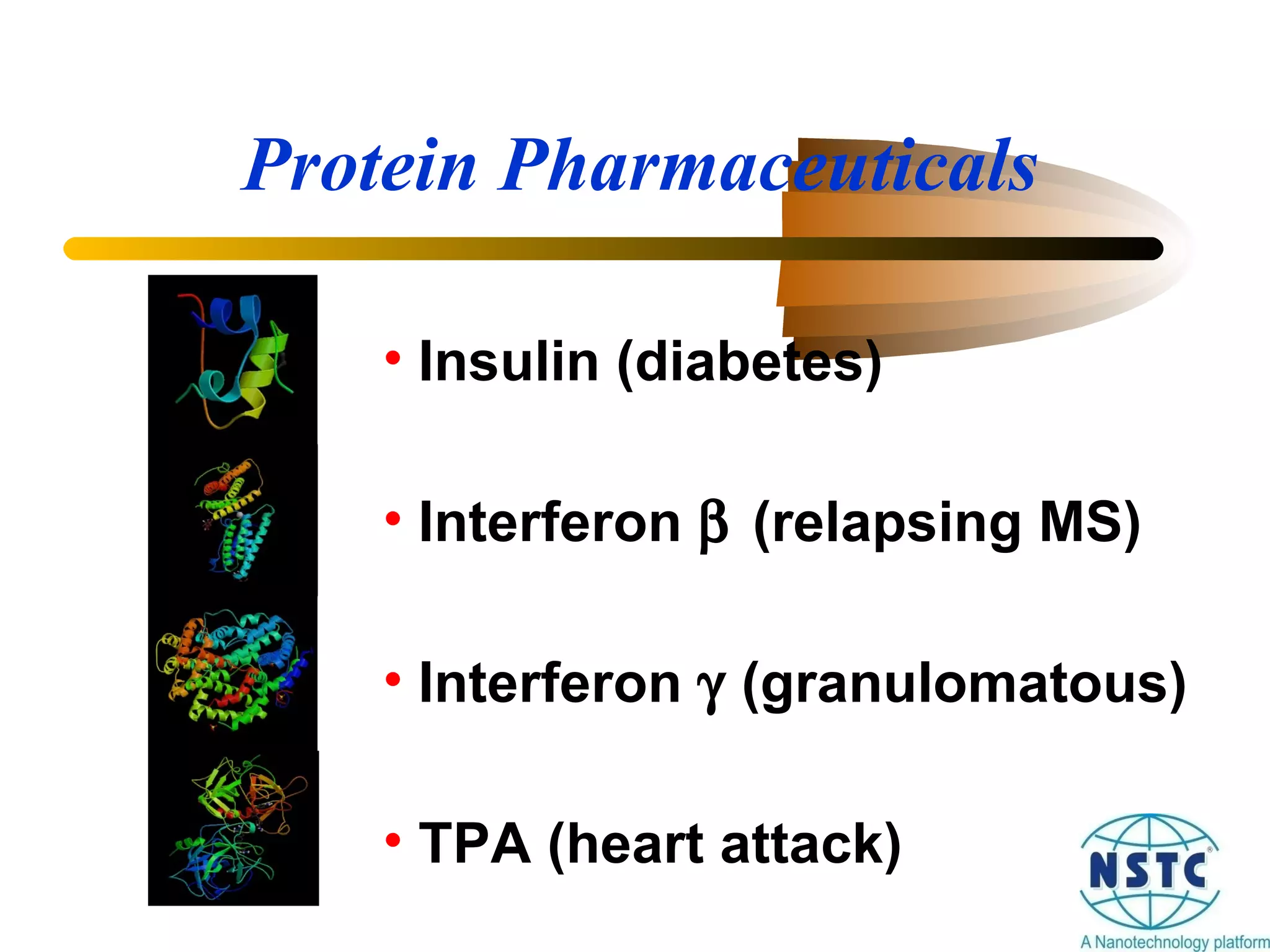
Protein Pharmaceuticals Insulin (diabetes) Interferon   (relapsing MS) Interferon    (granulomatous) TPA (heart attack)
Protein Pharmaceuticals Actimmune (If g) Activase (TPA) BeneFix (F IX) Betaseron (If b) Humulin Novolin Pegademase (AD) Epogen Regranex (PDGF) Novoseven (F VIIa) Intron-A Neupogen Pulmozyme Infergen
Challenges with Proteins Very large and unstable molecules Structure is held together by weak non-covalent forces Easily destroyed by relatively mild storage conditions Easily destroyed/eliminated by the body Hard to obtain in large quantities
Problem with Proteins  (in vivo – in the body)  Elimination by B and T cells Proteolysis by endo/exo peptidases Small proteins (< 30 kD) filtered out by the kidneys very quickly Unwanted allergic reactions may develop (even toxicity) Loss due to insolubility/adsorption
 
How to Deal with These Problems Storage Delivery Formulation
Storage   (additives) Addition of stabilizing salts or ions (Zn +  for insulin) Addition of polyols (glycerol and/or polyethylene glycol) to solubilize Addition of sugars or dextran to displace water or reduce microbe growth Use of surfactants (CHAPS) to reduce adsorption and aggregation
Protein Formulation Protein sequence modification (site directed mutagenisis) PEGylation Proteinylation Peptide Micelles Formulating with permeabilizers
Formulation with permeabilizers Salicylates (aspirin) Fatty acids Metal chelators (EDTA) Anything that is known to “punch holes” into the intestine or lumen
Drug Delivery Non-conventional way of administering drugs (novel drug delivery) Conventional way  Oral (Tablets, Capsules) Parenteral (IV injections)
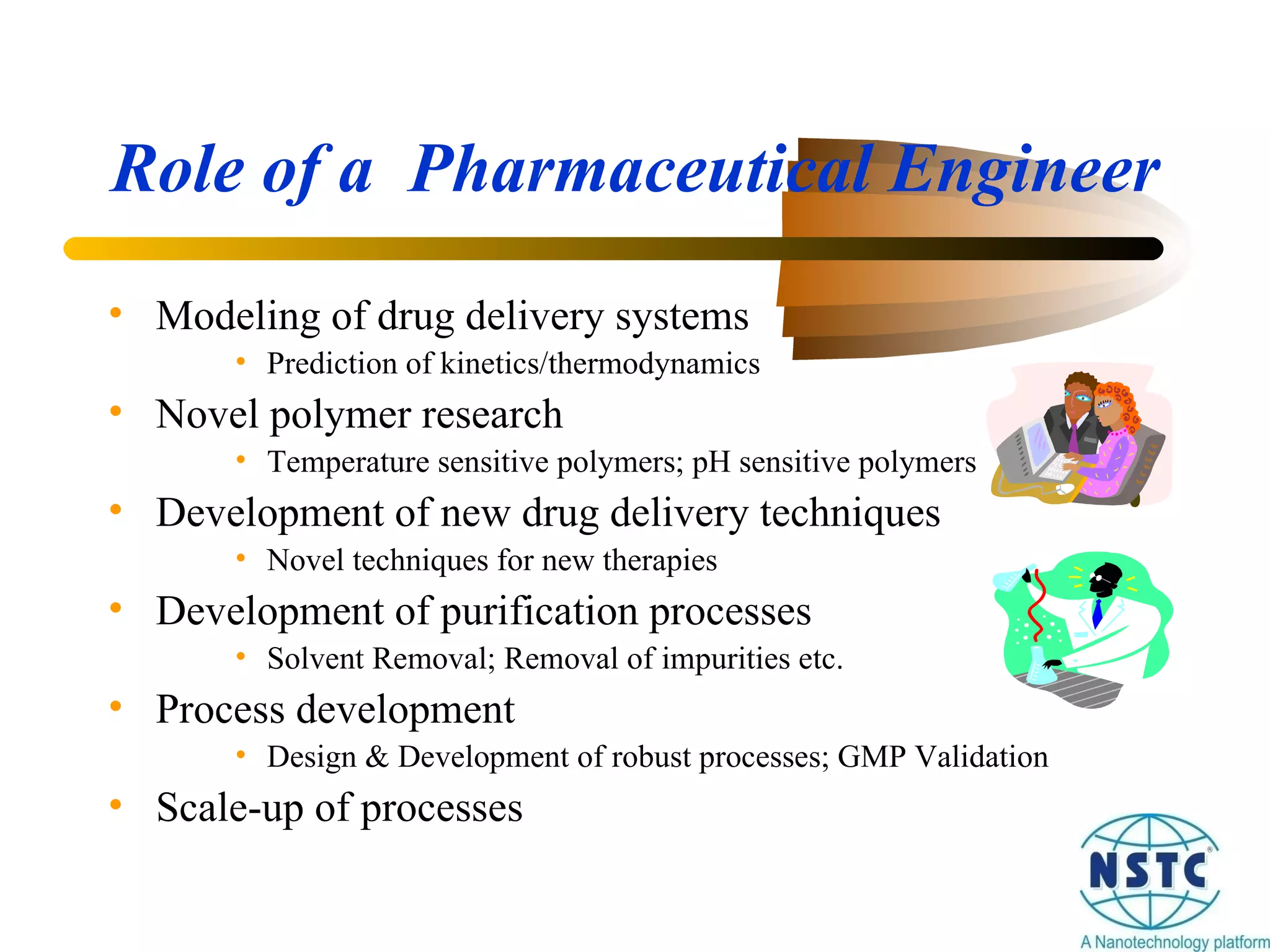
Role of a  Pharmaceutical Engineer Modeling of drug delivery systems Prediction of kinetics/thermodynamics Novel polymer research Temperature sensitive polymers; pH sensitive polymers Development of new drug delivery techniques Novel techniques for new therapies Development of purification processes  Solvent Removal; Removal of impurities etc. Process development Design & Development of robust processes; GMP Validation Scale-up of processes

Biopharmaceuticals

  • 1.
  • 2.
    What are BiopharmaceuticalsBiopharmaceuticals are defined as pharmaceuticals manufactured by biotechnology methods, with the products having biological sources, usually involving live organisms or their active components Biopharmaceuticals are protein or nucleic acid based pharmaceuticals (substance used for therapeutic or in vivo diagnostic purpose), which are produced by mean other than direct extraction from a native biological source.
  • 3.
    Pharmaceutical Technology Themethods and techniques that involve the use of living organisms (such as cells, bacteria, yeast and others) are tools to perform specific industrial or manufacturing process are called biotechnology Pharmaceutical Technology will continue to provide new breakthroughs in medical research in the years to come, leading to treatment in field which have previously eluded us (including AIDS, cancer asthma, Parkinson’s disease, Alzheimer disease)
  • 4.
    Pharmaceutical Biotechnology Biotechnologyoffers better product-targeting for specific diseases and patient groups, through the use of innovative technologies, in particular, genetics. Examples include, amongst others, treatment for rare diseases and cancers. Some products are not naturally created in sufficient quantities for therapeutics purpose. Biotechnology makes large-scale production of existing substances possible, for example, insulin in the field of diabetes treatment
  • 5.
  • 6.
    Protein Therapeutics Proteins/peptidesare gaining prominence Proteins - ideal drugs as they carry out essentially all biologic processes and reactions Recombinant DNA, hybridoma techniques, scale fermentation and purification processes brought new series of Proteins/peptides
  • 7.
    Protein Pharmaceuticals Insulin(diabetes) Interferon  (relapsing MS) Interferon  (granulomatous) TPA (heart attack)
  • 8.
    Protein Pharmaceuticals Actimmune(If g) Activase (TPA) BeneFix (F IX) Betaseron (If b) Humulin Novolin Pegademase (AD) Epogen Regranex (PDGF) Novoseven (F VIIa) Intron-A Neupogen Pulmozyme Infergen
  • 9.
    Challenges with ProteinsVery large and unstable molecules Structure is held together by weak non-covalent forces Easily destroyed by relatively mild storage conditions Easily destroyed/eliminated by the body Hard to obtain in large quantities
  • 10.
    Problem with Proteins (in vivo – in the body) Elimination by B and T cells Proteolysis by endo/exo peptidases Small proteins (< 30 kD) filtered out by the kidneys very quickly Unwanted allergic reactions may develop (even toxicity) Loss due to insolubility/adsorption
  • 11.
  • 12.
    How to Dealwith These Problems Storage Delivery Formulation
  • 13.
    How to Dealwith These Problems Storage Delivery Formulation
  • 14.
    Storage (additives) Addition of stabilizing salts or ions (Zn + for insulin) Addition of polyols (glycerol and/or polyethylene glycol) to solubilize Addition of sugars or dextran to displace water or reduce microbe growth Use of surfactants (CHAPS) to reduce adsorption and aggregation
  • 15.
    Protein Formulation Proteinsequence modification (site directed mutagenisis) PEGylation Proteinylation Peptide Micelles Formulating with permeabilizers
  • 16.
    Formulation with permeabilizersSalicylates (aspirin) Fatty acids Metal chelators (EDTA) Anything that is known to “punch holes” into the intestine or lumen
  • 17.
    Drug Delivery Non-conventionalway of administering drugs (novel drug delivery) Conventional way Oral (Tablets, Capsules) Parenteral (IV injections)
  • 18.
    Role of a Pharmaceutical Engineer Modeling of drug delivery systems Prediction of kinetics/thermodynamics Novel polymer research Temperature sensitive polymers; pH sensitive polymers Development of new drug delivery techniques Novel techniques for new therapies Development of purification processes Solvent Removal; Removal of impurities etc. Process development Design & Development of robust processes; GMP Validation Scale-up of processes