BY
SATYA SWARUP PATRA
AProjectWorkSubmittedtoVikramDebAutonomousCollege,JeyporeforFulfillmentofBachelorinScienceinBotany
Underthesupervisionof
Dr. Gopal Halder
Head of The Department Botany
vikram deb(auto) college, jeypore
College Roll No- BS16-319
Registration No-27385/2016
VIKARAM DEB AUTONOMOUS COLLEGE, JEYPORE
DIST- KORAPUT (764001)
ODISHA
EDUCATIONAL YEAR 2016 – 2019
TRANSGENICPLANTFORFARMERS
TOPICS TO BE DISCUSSED
1. Introduction
2. History
3. Methods of producing Transgenic Plant
4. Examples of Transgenic Crops that would benefit world
agriculture
BT Cotton
Golden Rice
Flavr Savr Tomato
Roundup Ready Soyabin
Moondust (Ornamental plant)
5. Application
6. Advantages
7. Disadvantages
8. Summery
INTRODUCTION
• Transgenic plants are those plants that have been
genetically engineered.
• They are identified as a class of genetically modified
organism (GMO)
• The aim to introduced new character to the plant which
does not occurs naturally in the species.
• Transgenic plant contains a gene or a set of genes,
usually from an unrelated organism; such genes are
called Transgenes.
• The process of producing transgenic organism is called
Transgenesis.
• The plant, which contains the transgene is called as GM
Plants.
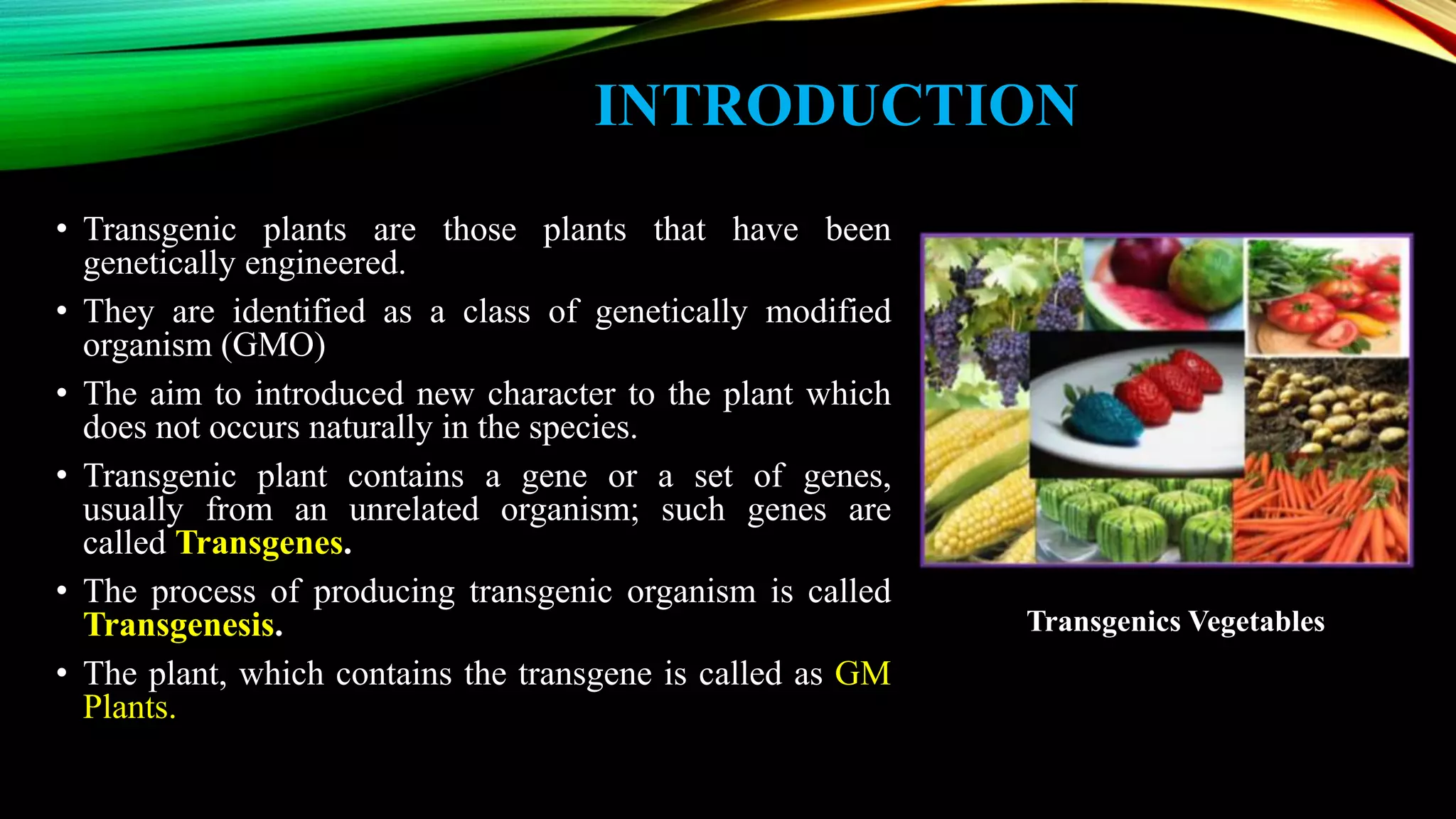
Transgenics Vegetables
HISTORY
• A hybrid cereal grain was created in 1875 by
crossing wheat and rye.
• An antibiotic resistance tobacco plant in 1982
• The first GM crop approved for sale in U.S. in
1994,was the Flavr savr tomato.
• In 1995 Bt potato was also approved by U.S.
environmental protection agency, to making it the
country’s first pesticide producing crop.
TRNSGENIC TOBACCO PLANT
METHODS OF PRODUCING TRANSGENIC PLANT
The transfer of exogenous DNA to higher plants can be accomplished by various methods.
Different types of techniques are given below;
1. Transfer of DNA via a vector:
 Agrobacterium mediated gene transfer
2. Direct transfer of DNA:
 Gene guns
 Electroporation
 Microinjection
AGROBACTERIUM MEDIATED GENE TRANSFER
Agrobacterium-mediated transformation is most
commonly used method for transgenesis.
A.tumefaciens is a rod shaped Gram negative soil
bacterium found in the rhizosphere.
It contains Ti plasmid(tumor-inducing) which causes
crown gall disease in dicot plants.
It mainly infect the wound site and causes disease
symptoms.
The gene of intrest is introduced in to the bacterial
plasmid and treated it into the host plant.
The bacteris grows inside the host plant cell and
regenerate to form a transgenic plant.
GENE GUN METHOD
The method was first used by Klein etal(1987) to
transform epidermal cell of Allium cepa.
 This method is mainly used for cereals transformation.
 It is used for plants that cannot be transformed by
Agrobacterium, e.g. most monocot.
 DNA is bound to tiny particles of gold or tungsten
which are subsequently shot into plant tissue or single
plant cells under high pressure.The particles penetrate
both the cell wall and membranes.
The microcarriers left outside the cell and the DNA
enters into the host cell and regenerate to form
Transgenic Plant.
ELECTROPORATION METHOD
In this technique , short pulses of high
voltage are applied to protoplasts which
make temporary pores in the plasma
membrane to increase their permeability
and facilitate the uptake of foreign gene.
MICROINJECTION METHOD
 The protoplasts are immobilized in agarose or on
glass slides coated with poly-lysine or by holding
them under suction by a micropipette.
 The exogenous DNA of interest is taken in
microinjector and then directly delivered inside
the cell.
EXAMPLES OF TRANSGENIC CROPS THAT WOULD
BENEFIT WORLD AGRICULTURE
 There are different types of transgenic crops have
developed to reduce the world hunger by yielding
improved variety and high production of crops. The
different types are described below;
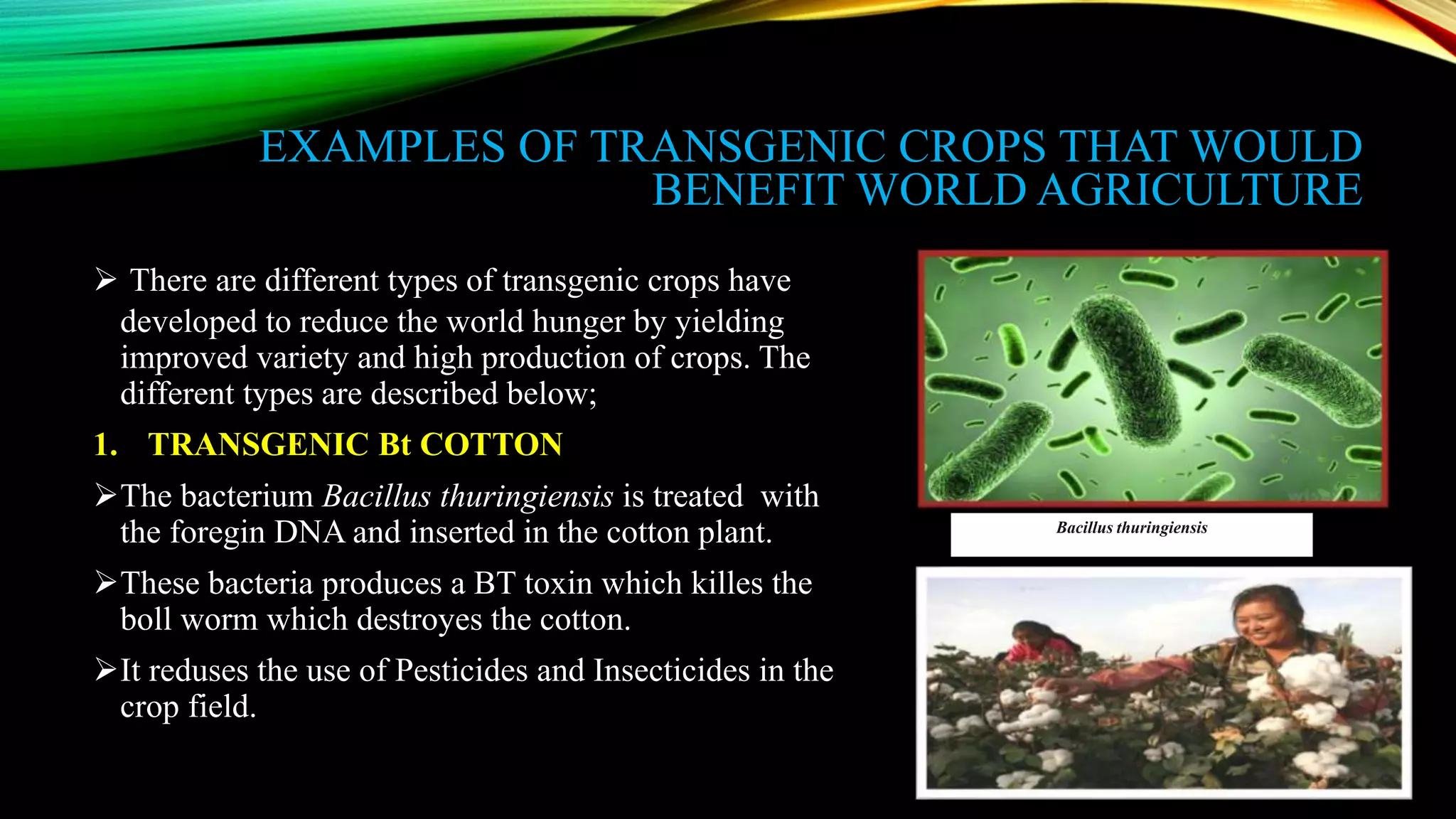
1. TRANSGENIC Bt COTTON
The bacterium Bacillus thuringiensis is treated with
the foregin DNA and inserted in the cotton plant.
These bacteria produces a BT toxin which killes the
boll worm which destroyes the cotton.
It reduses the use of Pesticides and Insecticides in the
crop field.
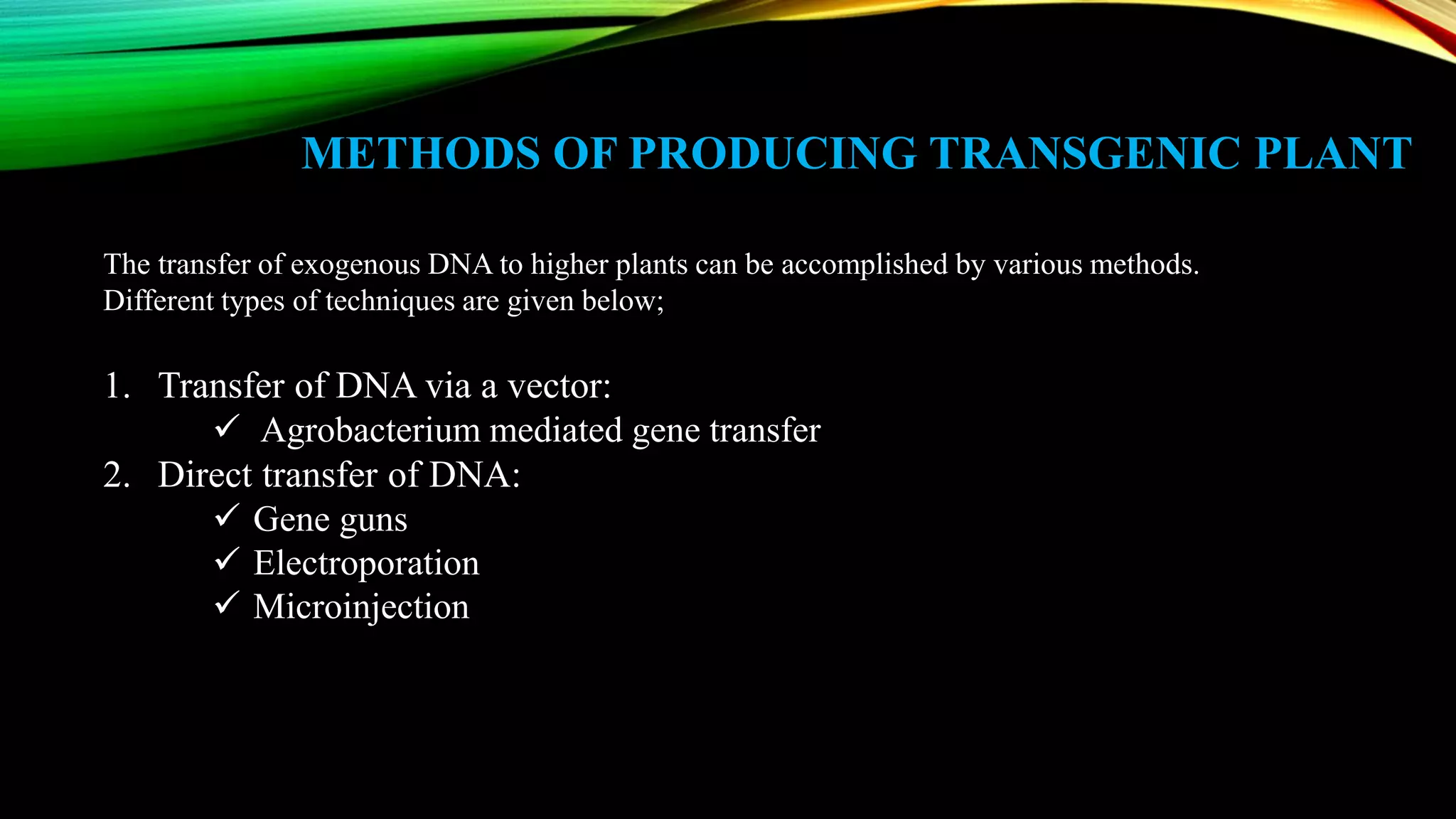
Bacillus thuringiensis
2. Golden Rice
Golden Rice is the name of a rice that has been
genetically modified (GM, or genetically
engineered) to produce beta-carotene, which the
body can convert into vitamin A. This beta-
carotene gives the rice grains the yellowish colour
that has inspired its name.
Golden rice differs from its parental strain by the
addition of three beta-carotene biosynthesis genes.
In 2005, Golden Rice 2 was announced, which
produces up to 23 times more beta-carotene than
the original golden rice
Golden Rice
3. Flavr Savr Tomato
Flavr Savr is a genetically modified tomato.
It was the first commercially grown genetically
engineered food to be granted a license for
human consumption.
These tomatos are Purple in colour due to
presence of 20% higher anthocyanins, which are
antioxidants guarding the body against chronic
diseases and cancer.
4. Roundup Ready Soybeans
The first-generation Roundup Readysoybean
trait
It was world’s most widely adopted biotech
trait, planted by farmers on billions of acres
since 1996—comes off patent in 2015.
It is also known as “ glyphosate tolerant”
soybeans
5. Moondust (Ornamental plant)
• Moondust Carnation, first grown commercially in1997.
• It is an ornamental plant grown widely in india.
• The flower colour of moondust is velvet blue.
• It is scientifically known as Dianthus caryophyllus.
APPLICATION
There are mainly 6 applications are find out;
Resistance to biotic stresses
Resistance to abiotic strases
Improvement of Crop yield quality
Transgenic Plant with improve nutrient
Commercial Transgenic Crop plants
Transgenic plants as bioreactor
ADVANTAGES
Improvement in Yield
Improvement in Insect and Disease
Resistance
Improvement in Quality
Herbicide Resistance
Resistance to Abiotic Stresses
Industrial Products
Rapid and Accurate Technique
No Barrier for Gene Transfer
DISADVANTAGES
Allergic Reactions
Production of toxins
Reduced nutritional value
Disadvantages of Genetically Modified
Foods On The Environment
Resistance of pests to toxins
Disruption of biodiversity Biodiversity
SUMMERY
• Transgenic plants are very essential that
we improve food production and
distribution in order to feed and free from
hunger a growing world population.
• Fruits can be produced through the use of
GM technology that are more nutritious,
stable in storage and in principle health
promoting bringing benefit to consumers
in both industrialised and developing
nation.
Transgenic plant

Transgenic plant

  • 1.
    BY SATYA SWARUP PATRA AProjectWorkSubmittedtoVikramDebAutonomousCollege,JeyporeforFulfillmentofBachelorinScienceinBotany Underthesupervisionof Dr.Gopal Halder Head of The Department Botany vikram deb(auto) college, jeypore College Roll No- BS16-319 Registration No-27385/2016 VIKARAM DEB AUTONOMOUS COLLEGE, JEYPORE DIST- KORAPUT (764001) ODISHA EDUCATIONAL YEAR 2016 – 2019 TRANSGENICPLANTFORFARMERS
  • 2.
    TOPICS TO BEDISCUSSED 1. Introduction 2. History 3. Methods of producing Transgenic Plant 4. Examples of Transgenic Crops that would benefit world agriculture BT Cotton Golden Rice Flavr Savr Tomato Roundup Ready Soyabin Moondust (Ornamental plant) 5. Application 6. Advantages 7. Disadvantages 8. Summery
  • 3.
    INTRODUCTION • Transgenic plantsare those plants that have been genetically engineered. • They are identified as a class of genetically modified organism (GMO) • The aim to introduced new character to the plant which does not occurs naturally in the species. • Transgenic plant contains a gene or a set of genes, usually from an unrelated organism; such genes are called Transgenes. • The process of producing transgenic organism is called Transgenesis. • The plant, which contains the transgene is called as GM Plants. Transgenics Vegetables
  • 4.
    HISTORY • A hybridcereal grain was created in 1875 by crossing wheat and rye. • An antibiotic resistance tobacco plant in 1982 • The first GM crop approved for sale in U.S. in 1994,was the Flavr savr tomato. • In 1995 Bt potato was also approved by U.S. environmental protection agency, to making it the country’s first pesticide producing crop. TRNSGENIC TOBACCO PLANT
  • 5.
    METHODS OF PRODUCINGTRANSGENIC PLANT The transfer of exogenous DNA to higher plants can be accomplished by various methods. Different types of techniques are given below; 1. Transfer of DNA via a vector:  Agrobacterium mediated gene transfer 2. Direct transfer of DNA:  Gene guns  Electroporation  Microinjection
  • 6.
    AGROBACTERIUM MEDIATED GENETRANSFER Agrobacterium-mediated transformation is most commonly used method for transgenesis. A.tumefaciens is a rod shaped Gram negative soil bacterium found in the rhizosphere. It contains Ti plasmid(tumor-inducing) which causes crown gall disease in dicot plants. It mainly infect the wound site and causes disease symptoms. The gene of intrest is introduced in to the bacterial plasmid and treated it into the host plant. The bacteris grows inside the host plant cell and regenerate to form a transgenic plant.
  • 7.
    GENE GUN METHOD Themethod was first used by Klein etal(1987) to transform epidermal cell of Allium cepa.  This method is mainly used for cereals transformation.  It is used for plants that cannot be transformed by Agrobacterium, e.g. most monocot.  DNA is bound to tiny particles of gold or tungsten which are subsequently shot into plant tissue or single plant cells under high pressure.The particles penetrate both the cell wall and membranes. The microcarriers left outside the cell and the DNA enters into the host cell and regenerate to form Transgenic Plant.
  • 8.
    ELECTROPORATION METHOD In thistechnique , short pulses of high voltage are applied to protoplasts which make temporary pores in the plasma membrane to increase their permeability and facilitate the uptake of foreign gene. MICROINJECTION METHOD  The protoplasts are immobilized in agarose or on glass slides coated with poly-lysine or by holding them under suction by a micropipette.  The exogenous DNA of interest is taken in microinjector and then directly delivered inside the cell.
  • 9.
    EXAMPLES OF TRANSGENICCROPS THAT WOULD BENEFIT WORLD AGRICULTURE  There are different types of transgenic crops have developed to reduce the world hunger by yielding improved variety and high production of crops. The different types are described below; 1. TRANSGENIC Bt COTTON The bacterium Bacillus thuringiensis is treated with the foregin DNA and inserted in the cotton plant. These bacteria produces a BT toxin which killes the boll worm which destroyes the cotton. It reduses the use of Pesticides and Insecticides in the crop field. Bacillus thuringiensis
  • 10.
    2. Golden Rice GoldenRice is the name of a rice that has been genetically modified (GM, or genetically engineered) to produce beta-carotene, which the body can convert into vitamin A. This beta- carotene gives the rice grains the yellowish colour that has inspired its name. Golden rice differs from its parental strain by the addition of three beta-carotene biosynthesis genes. In 2005, Golden Rice 2 was announced, which produces up to 23 times more beta-carotene than the original golden rice Golden Rice
  • 11.
    3. Flavr SavrTomato Flavr Savr is a genetically modified tomato. It was the first commercially grown genetically engineered food to be granted a license for human consumption. These tomatos are Purple in colour due to presence of 20% higher anthocyanins, which are antioxidants guarding the body against chronic diseases and cancer.
  • 12.
    4. Roundup ReadySoybeans The first-generation Roundup Readysoybean trait It was world’s most widely adopted biotech trait, planted by farmers on billions of acres since 1996—comes off patent in 2015. It is also known as “ glyphosate tolerant” soybeans
  • 13.
    5. Moondust (Ornamentalplant) • Moondust Carnation, first grown commercially in1997. • It is an ornamental plant grown widely in india. • The flower colour of moondust is velvet blue. • It is scientifically known as Dianthus caryophyllus.
  • 14.
    APPLICATION There are mainly6 applications are find out; Resistance to biotic stresses Resistance to abiotic strases Improvement of Crop yield quality Transgenic Plant with improve nutrient Commercial Transgenic Crop plants Transgenic plants as bioreactor
  • 15.
    ADVANTAGES Improvement in Yield Improvementin Insect and Disease Resistance Improvement in Quality Herbicide Resistance Resistance to Abiotic Stresses Industrial Products Rapid and Accurate Technique No Barrier for Gene Transfer
  • 16.
    DISADVANTAGES Allergic Reactions Production oftoxins Reduced nutritional value Disadvantages of Genetically Modified Foods On The Environment Resistance of pests to toxins Disruption of biodiversity Biodiversity
  • 17.
    SUMMERY • Transgenic plantsare very essential that we improve food production and distribution in order to feed and free from hunger a growing world population. • Fruits can be produced through the use of GM technology that are more nutritious, stable in storage and in principle health promoting bringing benefit to consumers in both industrialised and developing nation.