TRANSGENIC
PLANTS
LACY
LOVELEEN
BSC. BIOTECH
5TH SEM
NORMAL TOMATO E. coli
Desired gene
vector Modified
vector
Normal
tomato plant
GM PLANT
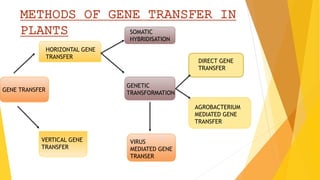
METHODS OF GENE TRANSFER IN
PLANTS
GENE TRANSFER
HORIZONTAL GENE
TRANSFER
VERTICAL GENE
TRANSFER
SOMATIC
HYBRIDISATION
GENETIC
TRANSFORMATION
DIRECT GENE
TRANSFER
AGROBACTERIUM
MEDIATED GENE
TRANSFER
VIRUS
MEDIATED GENE
TRANSER
MECHANISM OF
TRANSFORMATION
There are mainly 3 methods for genetic transformation :-
Agrobacterium mediated gene transfer
Ti plasmid
Ri plasmid
Virus mediated gene transfer
Direct gene transfer/physical method
microinjection , electroporation , chemical
transformation, particle bombardment
AGROBACTERIUM MEDIATED GENE
TRANSFER
 Most classical example of HGT in plants is the
infection of dicot plant cells with Agrobacterium. It
has 2 species that are useful in gene transfer ,
Agrobacterium tumifaciens & Agrobacterium
rhizogenes.
 These are gram negative soil bacteria responsible for
causing crown gall disease and hairy root in plants
respectively.
 The plasmids carrying for these characters are known
as Ti (tumour inducing) plasmid & Ri (root inducing)
plasmid respectively.
Ti plasmid :- Plasmid
conjugation
Virulence
region
Right
borderLeft
border
T - DNA
Over drive
ORI
Norpaline /
octopine
catabolism
(2,00,000 nucleotide pairs)
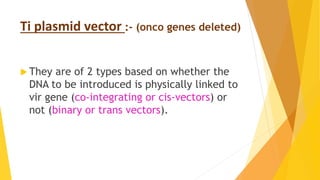
Ti plasmid vector :- (onco genes deleted)
 They are of 2 types based on whether the
DNA to be introduced is physically linked to
vir gene (co-integrating or cis-vectors) or
not (binary or trans vectors).
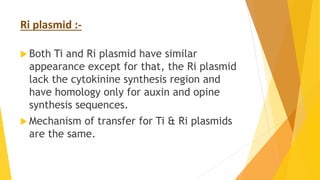
Ri plasmid :-
 Both Ti and Ri plasmid have similar
appearance except for that, the Ri plasmid
lack the cytokinine synthesis region and
have homology only for auxin and opine
synthesis sequences.
 Mechanism of transfer for Ti & Ri plasmids
are the same.
Method of agrobacterium mediated
gene transfer:-
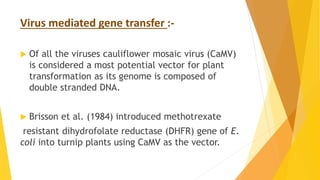
Virus mediated gene transfer :-
 Of all the viruses cauliflower mosaic virus (CaMV)
is considered a most potential vector for plant
transformation as its genome is composed of
double stranded DNA.
 Brisson et al. (1984) introduced methotrexate
resistant dihydrofolate reductase (DHFR) gene of E.
coli into turnip plants using CaMV as the vector.
Limitation of virus mediated
transformation :-
 It is not expected to bring about heritable
transformation as neither the gene gets
integrated into plant genome nor is the virus
transmitted through seeds.
 As a plant transformation vector is that genes
larger than a few hundred bp (DHFR is 234 bp)
interfere with the packaging of the genome into
the virion particle.
Direct gene transfer :-
(i) Chemical transformation :-
 Many chemicals such as polyamines (poly-L-
ornithine and poly-L-lysine) and dextran sulphate
stimulate DNA uptake into protoplasts. However,
they also highly reduce cell viability. Of the many
chemicals tested for their ability to stimulate DNA
uptake into protoplasts polyethylene glycol (PEG)
has proved most effective. Treatment of
protoplasts with MgC12 (5-25 mM)
significantly improves transformation rates.
(ii) Electroporation :-
A popular physical method
for introducing new genes
into protoplasts is the use
of electric field which
makes the protoplasts
temporarily permeable
to DNA.
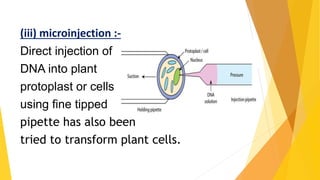
(iii) microinjection :-
Direct injection of
DNA into plant
protoplast or cells
using fine tipped
pipette has also been
tried to transform plant cells.
(iv) Particle bombardment method:-
Particle bombardment
(or Biolistics), wherein
microscopic tungsten or
gold particles (1-3 ttm)
coated with genetically
engineered DNA are
explosively hurled into
plant cells with high
velocity.
Application :-
Herbicide resistant plants :-
Several classes of herbicides are quite effective for broad
spectrum weed control. However, as they act by
inactivating target proteins (mostly enzymes) essential for
vital functions in plants, such as photosynthesis, shared by
both crop and weed plants, they are either nonselective
and kill the crop plants or cause significant injury to them
at the application rates required to eliminate the weeds.
Production of herbicide resistant/tolerant crop plants can
considerably reduce these losses.
Three approaches have been followed to obtain herbicide
resistant transgenic plants:-
(1) modification of the plant enzyme or other sensitive
biochemical target of herbicidal action to render it
insensitive to the herbicide
(2) overproduction of the unmodified target protein
permitting normal metabolism to occur even in the presence
of the herbicide
(3) introduction of an enzyme or enzyme system to degrade
and/or detoxify the herbicide prior to its action.
Insect resistance :-
Insects are serious pests of agricultural products in the
field and during storage.
Insects belonging to the orders Coleoptera, Lepidoptera
and Diptera are the most serious plant pests.
 Bacillus thuringiensis (Bt), employed as an
insecticide for over 20 years and its demand is
continuing to increase because of its specificity
towards lepidopteran pests and being environmentally
safe.
 Insect resistant transgenic plants have also been
created by introducing trypsin inhibitor gene.
(i) Bt toxin gene expression:-
 Sporulating Bt produces non-toxic proteinaceous
endotoxin (protoxin) of 130-140 kDa which upon
hydrolysis, under highly alkaline conditions (pH 9-12) of
the insect gut, produces smaller insecticidally active
peptides of 65 -70kDa.These polypeptides specifically
attack the brush bordermembrane of midgut epithelial
cells paralysing the insect and eventually killing it.
 The first Bt gene was cloned and characterized in 1985.
 The first transgenic plants showing field resistance to
insects were produced by introducing the truncated Bt
toxin gene.
(ii) Trypsin inhibitor gene expression :-
 The occurrence of certain proteins in plants which
inhibit the common insect digestive protease have
been implicated in natural mechanism of plant
defence against insect attack.
 For example, the leaves of a number of plants,
including tomato, synthesize protease inhibitors in
response to insect attack. Similarly, cowpea trypsin
inhibitor (CpTI), a 80 amino acid polypeptide, has
been identified as an insecticidal component of
cowpea seeds, which is active against a range of
economically important field and storage pests,
including bruchid beetle, a major pest of stored
cowpea.

Transgenic plants

  • 1.
  • 2.
    NORMAL TOMATO E.coli Desired gene vector Modified vector Normal tomato plant GM PLANT
  • 3.
    METHODS OF GENETRANSFER IN PLANTS GENE TRANSFER HORIZONTAL GENE TRANSFER VERTICAL GENE TRANSFER SOMATIC HYBRIDISATION GENETIC TRANSFORMATION DIRECT GENE TRANSFER AGROBACTERIUM MEDIATED GENE TRANSFER VIRUS MEDIATED GENE TRANSER
  • 4.
    MECHANISM OF TRANSFORMATION There aremainly 3 methods for genetic transformation :- Agrobacterium mediated gene transfer Ti plasmid Ri plasmid Virus mediated gene transfer Direct gene transfer/physical method microinjection , electroporation , chemical transformation, particle bombardment
  • 5.
    AGROBACTERIUM MEDIATED GENE TRANSFER Most classical example of HGT in plants is the infection of dicot plant cells with Agrobacterium. It has 2 species that are useful in gene transfer , Agrobacterium tumifaciens & Agrobacterium rhizogenes.  These are gram negative soil bacteria responsible for causing crown gall disease and hairy root in plants respectively.  The plasmids carrying for these characters are known as Ti (tumour inducing) plasmid & Ri (root inducing) plasmid respectively.
  • 6.
    Ti plasmid :-Plasmid conjugation Virulence region Right borderLeft border T - DNA Over drive ORI Norpaline / octopine catabolism (2,00,000 nucleotide pairs)
  • 7.
    Ti plasmid vector:- (onco genes deleted)  They are of 2 types based on whether the DNA to be introduced is physically linked to vir gene (co-integrating or cis-vectors) or not (binary or trans vectors).
  • 8.
    Ri plasmid :- Both Ti and Ri plasmid have similar appearance except for that, the Ri plasmid lack the cytokinine synthesis region and have homology only for auxin and opine synthesis sequences.  Mechanism of transfer for Ti & Ri plasmids are the same.
  • 9.
    Method of agrobacteriummediated gene transfer:-
  • 10.
    Virus mediated genetransfer :-  Of all the viruses cauliflower mosaic virus (CaMV) is considered a most potential vector for plant transformation as its genome is composed of double stranded DNA.  Brisson et al. (1984) introduced methotrexate resistant dihydrofolate reductase (DHFR) gene of E. coli into turnip plants using CaMV as the vector.
  • 11.
    Limitation of virusmediated transformation :-  It is not expected to bring about heritable transformation as neither the gene gets integrated into plant genome nor is the virus transmitted through seeds.  As a plant transformation vector is that genes larger than a few hundred bp (DHFR is 234 bp) interfere with the packaging of the genome into the virion particle.
  • 12.
    Direct gene transfer:- (i) Chemical transformation :-  Many chemicals such as polyamines (poly-L- ornithine and poly-L-lysine) and dextran sulphate stimulate DNA uptake into protoplasts. However, they also highly reduce cell viability. Of the many chemicals tested for their ability to stimulate DNA uptake into protoplasts polyethylene glycol (PEG) has proved most effective. Treatment of protoplasts with MgC12 (5-25 mM) significantly improves transformation rates.
  • 13.
    (ii) Electroporation :- Apopular physical method for introducing new genes into protoplasts is the use of electric field which makes the protoplasts temporarily permeable to DNA.
  • 14.
    (iii) microinjection :- Directinjection of DNA into plant protoplast or cells using fine tipped pipette has also been tried to transform plant cells.
  • 15.
    (iv) Particle bombardmentmethod:- Particle bombardment (or Biolistics), wherein microscopic tungsten or gold particles (1-3 ttm) coated with genetically engineered DNA are explosively hurled into plant cells with high velocity.
  • 16.
    Application :- Herbicide resistantplants :- Several classes of herbicides are quite effective for broad spectrum weed control. However, as they act by inactivating target proteins (mostly enzymes) essential for vital functions in plants, such as photosynthesis, shared by both crop and weed plants, they are either nonselective and kill the crop plants or cause significant injury to them at the application rates required to eliminate the weeds. Production of herbicide resistant/tolerant crop plants can considerably reduce these losses.
  • 17.
    Three approaches havebeen followed to obtain herbicide resistant transgenic plants:- (1) modification of the plant enzyme or other sensitive biochemical target of herbicidal action to render it insensitive to the herbicide (2) overproduction of the unmodified target protein permitting normal metabolism to occur even in the presence of the herbicide (3) introduction of an enzyme or enzyme system to degrade and/or detoxify the herbicide prior to its action.
  • 18.
    Insect resistance :- Insectsare serious pests of agricultural products in the field and during storage. Insects belonging to the orders Coleoptera, Lepidoptera and Diptera are the most serious plant pests.  Bacillus thuringiensis (Bt), employed as an insecticide for over 20 years and its demand is continuing to increase because of its specificity towards lepidopteran pests and being environmentally safe.  Insect resistant transgenic plants have also been created by introducing trypsin inhibitor gene.
  • 19.
    (i) Bt toxingene expression:-  Sporulating Bt produces non-toxic proteinaceous endotoxin (protoxin) of 130-140 kDa which upon hydrolysis, under highly alkaline conditions (pH 9-12) of the insect gut, produces smaller insecticidally active peptides of 65 -70kDa.These polypeptides specifically attack the brush bordermembrane of midgut epithelial cells paralysing the insect and eventually killing it.  The first Bt gene was cloned and characterized in 1985.  The first transgenic plants showing field resistance to insects were produced by introducing the truncated Bt toxin gene.
  • 20.
    (ii) Trypsin inhibitorgene expression :-  The occurrence of certain proteins in plants which inhibit the common insect digestive protease have been implicated in natural mechanism of plant defence against insect attack.  For example, the leaves of a number of plants, including tomato, synthesize protease inhibitors in response to insect attack. Similarly, cowpea trypsin inhibitor (CpTI), a 80 amino acid polypeptide, has been identified as an insecticidal component of cowpea seeds, which is active against a range of economically important field and storage pests, including bruchid beetle, a major pest of stored cowpea.