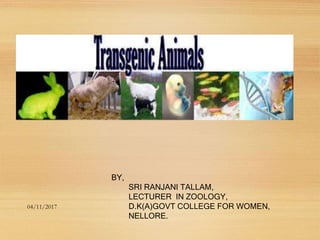
BY,
SRI RANJANI TALLAM,
LECTURER IN ZOOLOGY,
D.K(A)GOVT COLLEGE FOR WOMEN,
NELLORE.
04/11/2017
 A transgenic animal is one that carries a foreign gene
that has been deliberately inserted into its genome.
 Transgenesis is the process by which mixing up of
genes takes place.
 Foreign genes are inserted into the germ line of
the animal, so it can be transmitted to the progeny.
 Transgenic technology has led to the development of
fishes, live stock and other animals with altered
genetic profiles which are useful to mankind.
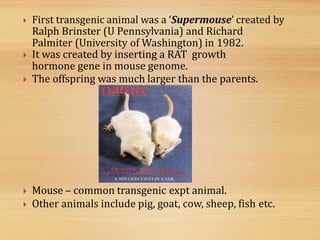
 First transgenic animal was a ‘Supermouse’ created by
Ralph Brinster (U Pennsylvania) and Richard
Palmiter (University of Washington) in 1982.
 It was created by inserting a RAT growth
hormone gene in mouse genome.
 The offspring was much larger than the parents.
 Mouse – common transgenic expt animal.
 Other animals include pig, goat, cow, sheep, fish etc.
METHODS OF GENE
TRANSFER
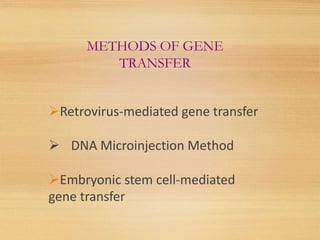
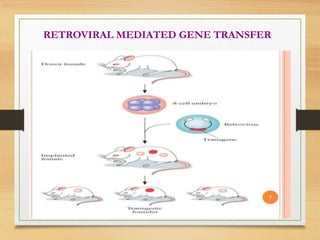
Retrovirus-mediated gene transfer
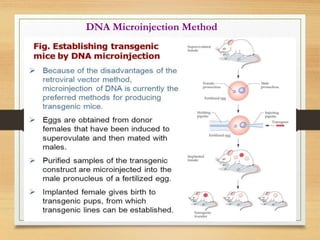
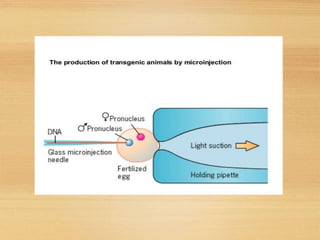
 DNA Microinjection Method
Embryonic stem cell-mediated
gene transfer
RETROVIRAL MEDIATED GENE TRANSFER
DNA Microinjection Method
.
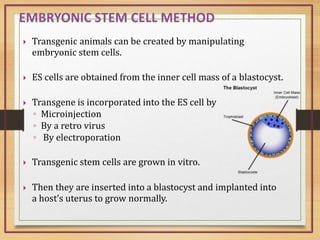
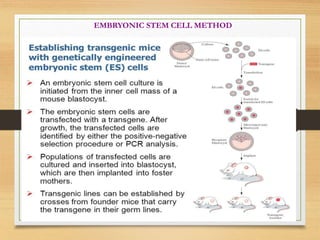
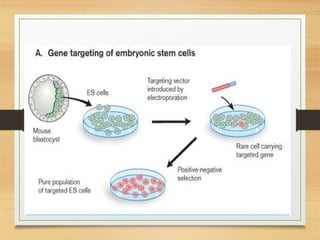
 Transgenic animals can be created by manipulating
embryonic stem cells.
 ES cells are obtained from the inner cell mass of a blastocyst.
 Transgene is incorporated into the ES cell by
◦ Microinjection
◦ By a retro virus
◦ By electroporation
 Transgenic stem cells are grown in vitro.
 Then they are inserted into a blastocyst and implanted into
a host’s uterus to grow normally.
EMBRYONIC STEM CELL METHOD
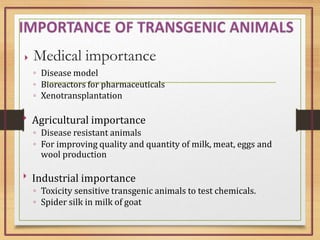
 Medical importance
◦ Disease model
◦ Bioreactors for pharmaceuticals
◦ Xenotransplantation


Agricultural importance
◦ Disease resistant animals
◦ For improving quality and quantity of milk, meat, eggs and
wool production
Industrial importance
◦ Toxicity sensitive transgenic animals to test chemicals.
◦ Spider silk in milk of goat
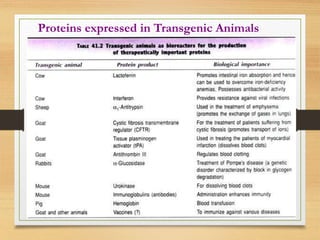
Proteins expressed in Transgenic Animals
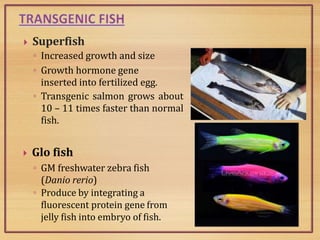
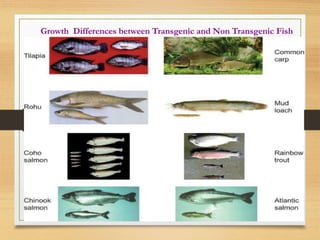
 Superfish
◦ Increased growth and size
◦ Growth hormone gene
inserted into fertilized egg.
◦ Transgenic salmon grows about
10 – 11 times faster than normal
fish.
 Glo fish
◦ GM freshwater zebra fish
(Danio rerio)
◦ Produce by integrating a
fluorescent protein gene from
jelly fish into embryo of fish.
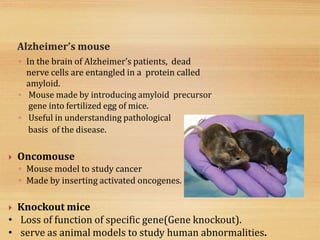
Alzheimer’s mouse
◦ In the brain of Alzheimer’s patients, dead
nerve cells are entangled in a protein called
amyloid.
◦ Mouse made by introducing amyloid precursor
gene into fertilized egg of mice.
◦ Useful in understanding pathological
basis of the disease.
 Oncomouse
◦ Mouse model to study cancer
◦ Made by inserting activated oncogenes.
 Knockout mice
• Loss of function of specific gene(Gene knockout).
• serve as animal models to study human abnormalities.
Growth Differences between Transgenic and Non Transgenic Fish
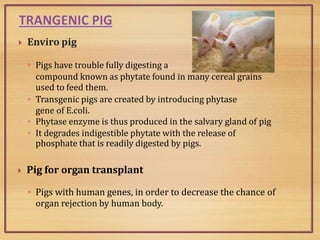
 Enviro pig
◦ Pigs have trouble fully digesting a
compound known as phytate found in many cereal grains
used to feed them.
◦ Transgenic pigs are created by introducing phytase
gene of E.coli.
◦ Phytase enzyme is thus produced in the salvary gland of pig
◦ It degrades indigestible phytate with the release of
phosphate that is readily digested by pigs.
 Pig for organ transplant
◦ Pigs with human genes, in order to decrease the chance of
organ rejection by human body.
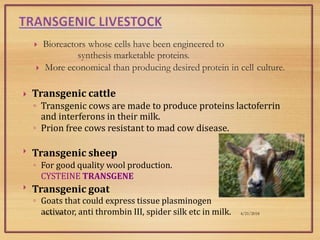
 Bioreactors whose cells have been engineered to
synthesis marketable proteins.
 More economical than producing desired protein in cell culture.
4/21/201804/11/2017
 Transgenic cattle
◦ Transgenic cows are made to produce proteins lactoferrin
and interferons in their milk.
◦ Prion free cows resistant to mad cow disease.


Transgenic sheep
◦ For good quality wool production.
CYSTEINE TRANSGENE
Transgenic goat
◦ Goats that could express tissue plasminogen
activator, anti thrombin III, spider silk etc in milk.
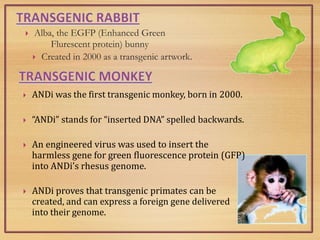
 Alba, the EGFP (Enhanced Green
Flurescent protein) bunny
 Created in 2000 as a transgenic artwork.
 ANDi was the first transgenic monkey, born in 2000.
 “ANDi” stands for “inserted DNA” spelled backwards.
 An engineered virus was used to insert the
harmless gene for green fluorescence protein (GFP)
into ANDi’s rhesus genome.
 ANDi proves that transgenic primates can be
created, and can express a foreign gene delivered
into their genome.
 Blurring the lines between species by creating
transgenic combinations.
 There may be health risks associated with transgenics.
 There may be long term effects on the environment
when transgenic animals are released into the field.
 Various bioethicist argue that it is wrong to create animals
that would suffer as a result of genetic alteration.
 Transgenic technology is a field that is under constant evolution.
 Many transgenic animals have been successfully created for
a variety of purposes, and the prospects are enormous.
 It holds great potential in many fields including
agriculture, medicine and industry.
 With proper research and careful use the transgenic animals
can go a long way in solving several problems for which science
doesn’t have a solution till now.
THANK YOU

Transgenic Animals

  • 1.
    BY, SRI RANJANI TALLAM, LECTURERIN ZOOLOGY, D.K(A)GOVT COLLEGE FOR WOMEN, NELLORE. 04/11/2017
  • 2.
     A transgenicanimal is one that carries a foreign gene that has been deliberately inserted into its genome.  Transgenesis is the process by which mixing up of genes takes place.  Foreign genes are inserted into the germ line of the animal, so it can be transmitted to the progeny.  Transgenic technology has led to the development of fishes, live stock and other animals with altered genetic profiles which are useful to mankind.
  • 3.
     First transgenicanimal was a ‘Supermouse’ created by Ralph Brinster (U Pennsylvania) and Richard Palmiter (University of Washington) in 1982.  It was created by inserting a RAT growth hormone gene in mouse genome.  The offspring was much larger than the parents.  Mouse – common transgenic expt animal.  Other animals include pig, goat, cow, sheep, fish etc.
  • 4.
    METHODS OF GENE TRANSFER Retrovirus-mediatedgene transfer  DNA Microinjection Method Embryonic stem cell-mediated gene transfer
  • 5.
  • 6.
  • 7.
  • 8.
     Transgenic animalscan be created by manipulating embryonic stem cells.  ES cells are obtained from the inner cell mass of a blastocyst.  Transgene is incorporated into the ES cell by ◦ Microinjection ◦ By a retro virus ◦ By electroporation  Transgenic stem cells are grown in vitro.  Then they are inserted into a blastocyst and implanted into a host’s uterus to grow normally.
  • 9.
  • 12.
     Medical importance ◦Disease model ◦ Bioreactors for pharmaceuticals ◦ Xenotransplantation   Agricultural importance ◦ Disease resistant animals ◦ For improving quality and quantity of milk, meat, eggs and wool production Industrial importance ◦ Toxicity sensitive transgenic animals to test chemicals. ◦ Spider silk in milk of goat
  • 13.
    Proteins expressed inTransgenic Animals
  • 15.
     Superfish ◦ Increasedgrowth and size ◦ Growth hormone gene inserted into fertilized egg. ◦ Transgenic salmon grows about 10 – 11 times faster than normal fish.  Glo fish ◦ GM freshwater zebra fish (Danio rerio) ◦ Produce by integrating a fluorescent protein gene from jelly fish into embryo of fish.
  • 16.
    Alzheimer’s mouse ◦ Inthe brain of Alzheimer’s patients, dead nerve cells are entangled in a protein called amyloid. ◦ Mouse made by introducing amyloid precursor gene into fertilized egg of mice. ◦ Useful in understanding pathological basis of the disease.  Oncomouse ◦ Mouse model to study cancer ◦ Made by inserting activated oncogenes.  Knockout mice • Loss of function of specific gene(Gene knockout). • serve as animal models to study human abnormalities.
  • 17.
    Growth Differences betweenTransgenic and Non Transgenic Fish
  • 18.
     Enviro pig ◦Pigs have trouble fully digesting a compound known as phytate found in many cereal grains used to feed them. ◦ Transgenic pigs are created by introducing phytase gene of E.coli. ◦ Phytase enzyme is thus produced in the salvary gland of pig ◦ It degrades indigestible phytate with the release of phosphate that is readily digested by pigs.  Pig for organ transplant ◦ Pigs with human genes, in order to decrease the chance of organ rejection by human body.
  • 19.
     Bioreactors whosecells have been engineered to synthesis marketable proteins.  More economical than producing desired protein in cell culture. 4/21/201804/11/2017  Transgenic cattle ◦ Transgenic cows are made to produce proteins lactoferrin and interferons in their milk. ◦ Prion free cows resistant to mad cow disease.   Transgenic sheep ◦ For good quality wool production. CYSTEINE TRANSGENE Transgenic goat ◦ Goats that could express tissue plasminogen activator, anti thrombin III, spider silk etc in milk.
  • 20.
     Alba, theEGFP (Enhanced Green Flurescent protein) bunny  Created in 2000 as a transgenic artwork.  ANDi was the first transgenic monkey, born in 2000.  “ANDi” stands for “inserted DNA” spelled backwards.  An engineered virus was used to insert the harmless gene for green fluorescence protein (GFP) into ANDi’s rhesus genome.  ANDi proves that transgenic primates can be created, and can express a foreign gene delivered into their genome.
  • 21.
     Blurring thelines between species by creating transgenic combinations.  There may be health risks associated with transgenics.  There may be long term effects on the environment when transgenic animals are released into the field.  Various bioethicist argue that it is wrong to create animals that would suffer as a result of genetic alteration.
  • 22.
     Transgenic technologyis a field that is under constant evolution.  Many transgenic animals have been successfully created for a variety of purposes, and the prospects are enormous.  It holds great potential in many fields including agriculture, medicine and industry.  With proper research and careful use the transgenic animals can go a long way in solving several problems for which science doesn’t have a solution till now.
  • 23.