TRANSFER OF
LEARNING
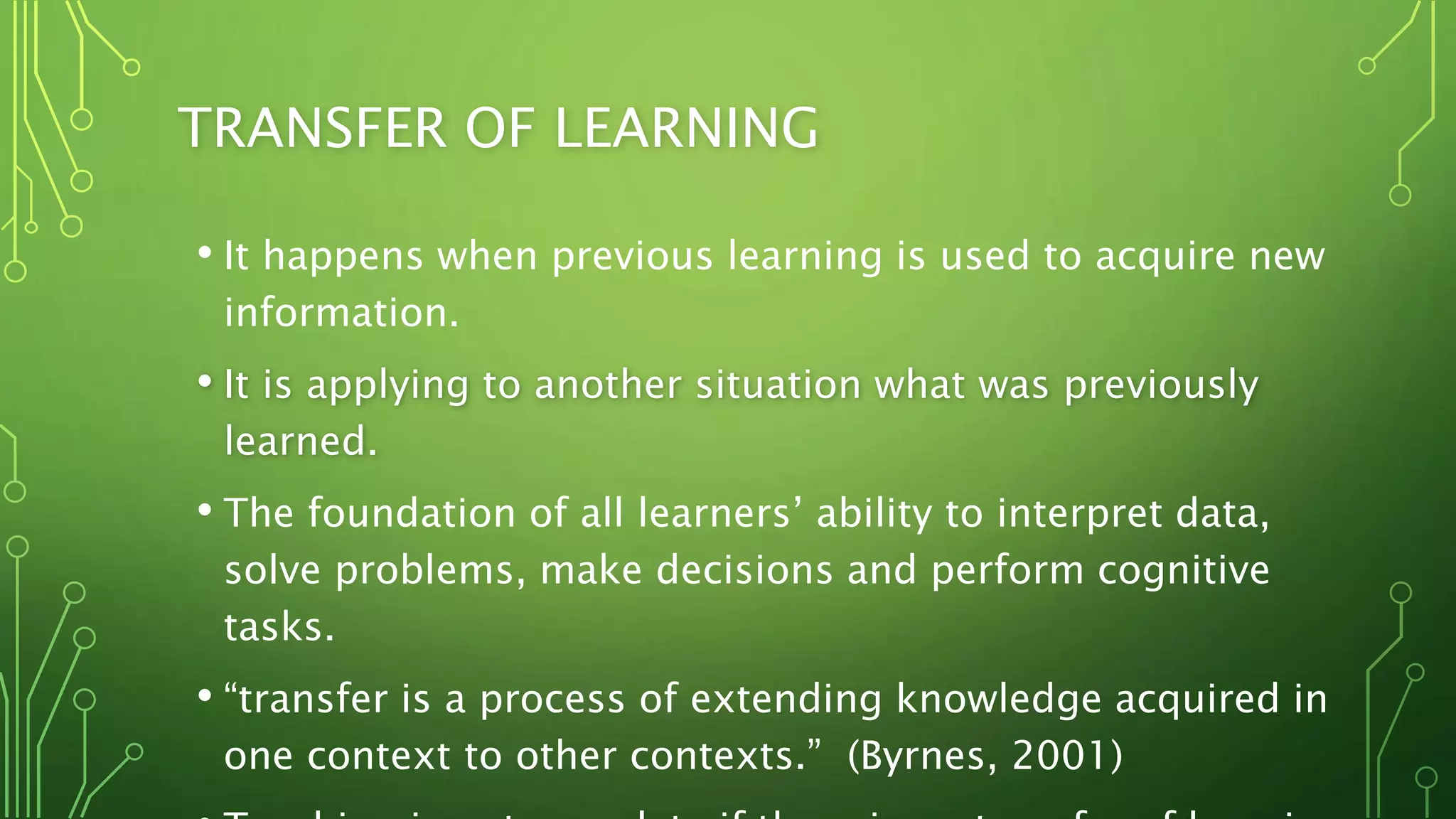
TRANSFER OF LEARNING
• It happens when previous learning is used to acquire new
information.
• It is applying to another situation what was previously
learned.
• The foundation of all learners’ ability to interpret data,
solve problems, make decisions and perform cognitive
tasks.
• “transfer is a process of extending knowledge acquired in
one context to other contexts.” (Byrnes, 2001)
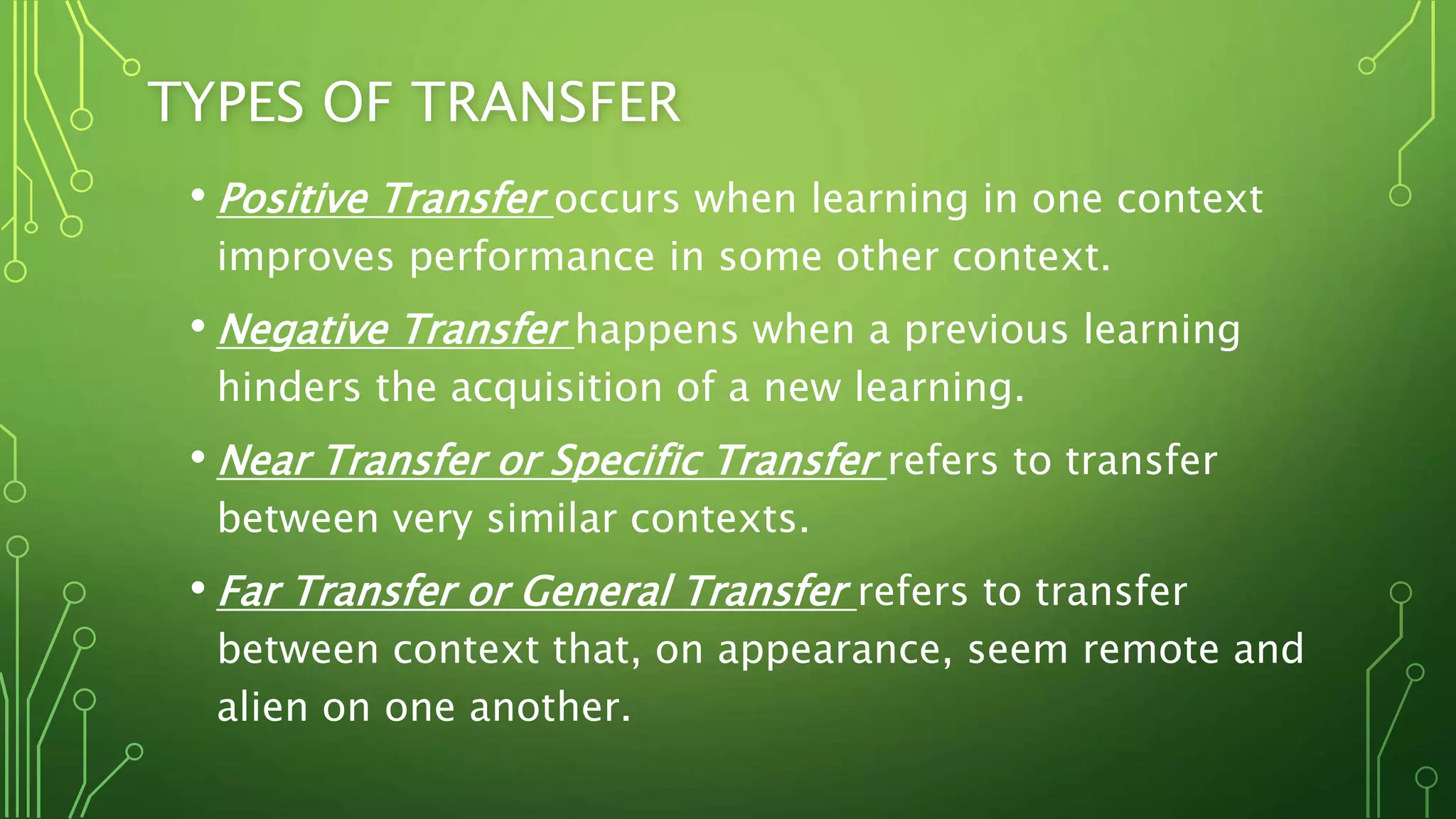
TYPES OF TRANSFER
• Positive Transfer occurs when learning in one context
improves performance in some other context.
• Negative Transfer happens when a previous learning
hinders the acquisition of a new learning.
• Near Transfer or Specific Transfer refers to transfer
between very similar contexts.
• Far Transfer or General Transfer refers to transfer
between context that, on appearance, seem remote and
alien on one another.
REASONS WHY TRANSFER DOES NOT WORK
(BYRNES)
• Some bits of knowledge are embedded in single context.
Learners fail to transfer what they know because they are
confined to a single context in which knowledge is acquired.
• Lack of conditional knowledge. Conditional means contingent,
dependent or provisional.
• Lack of conceptual knowledge. When students have a deep
understanding of concepts, then they can make possible
transfer because learning a concept leads to understanding
another concept.
REASONS WHY TRANSFER DOES NOT WORK
(BYRNES)
• Inaccurate conceptions of the mind. This account for how
students view their minds in relation to learning.
• Lack of metacognition. When students do not possess the
ability to think how their thought processes develop or if
they lack the ability to regulate or monitor their own
thoughts, then they cannot afford to develop transfer.
CONDITIONS AND PRINCIPLES FOR
TRANSFER
• Principles that are based on the factors that affect
transfer of learning.
• Also called Conditions of Transfer (Perkins)
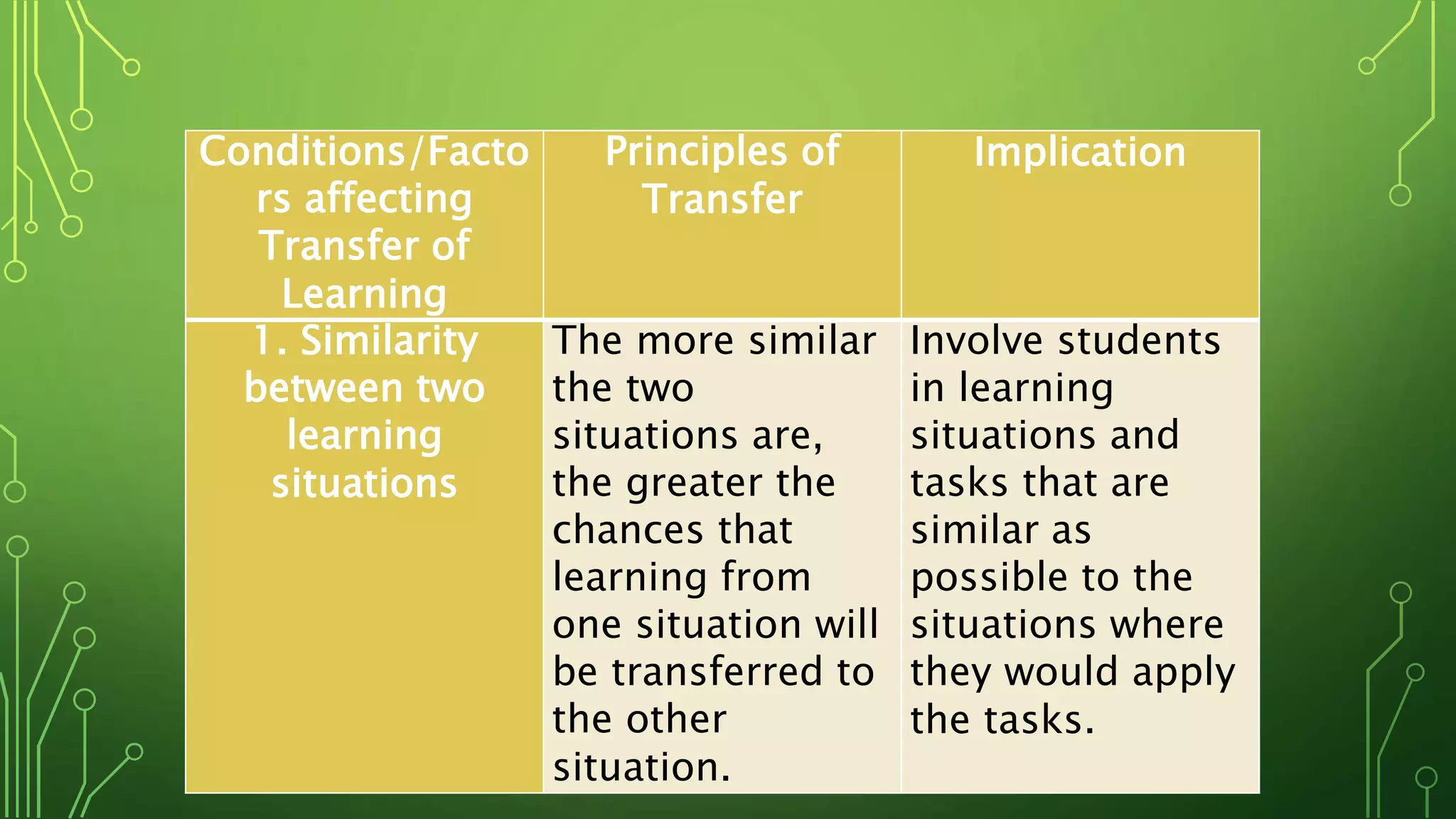
Conditions/Facto
rs affecting
Transfer of
Learning
Principles of
Transfer
Implication
1. Similarity
between two
learning
situations
The more similar
the two
situations are,
the greater the
chances that
learning from
one situation will
be transferred to
the other
situation.
Involve students
in learning
situations and
tasks that are
similar as
possible to the
situations where
they would apply
the tasks.
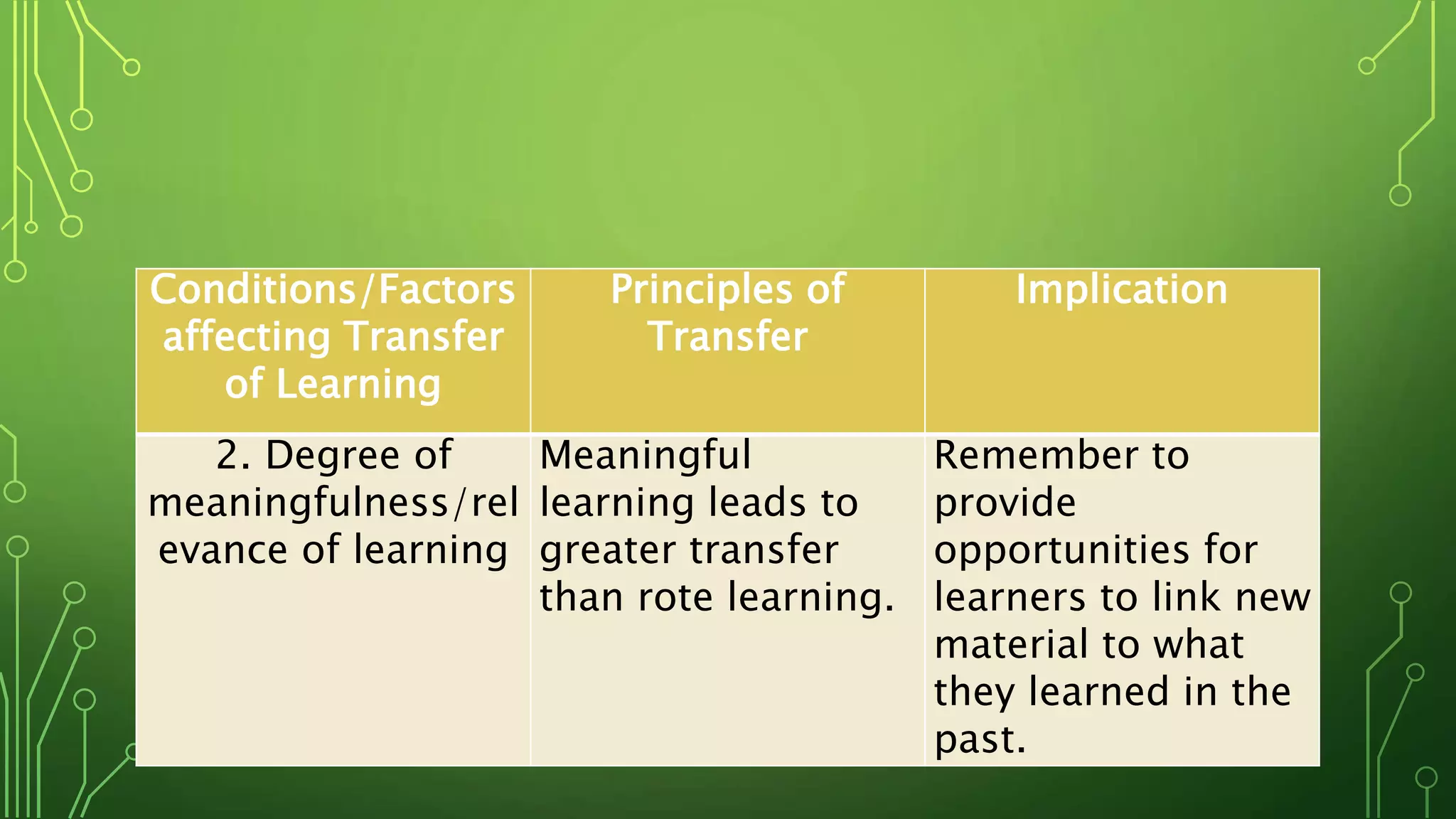
Conditions/Factors
affecting Transfer
of Learning
Principles of
Transfer
Implication
2. Degree of
meaningfulness/rel
evance of learning
Meaningful
learning leads to
greater transfer
than rote learning.
Remember to
provide
opportunities for
learners to link new
material to what
they learned in the
past.
Conditions/Factors
affecting Transfer
of Learning
Principles of
Transfer
Implication
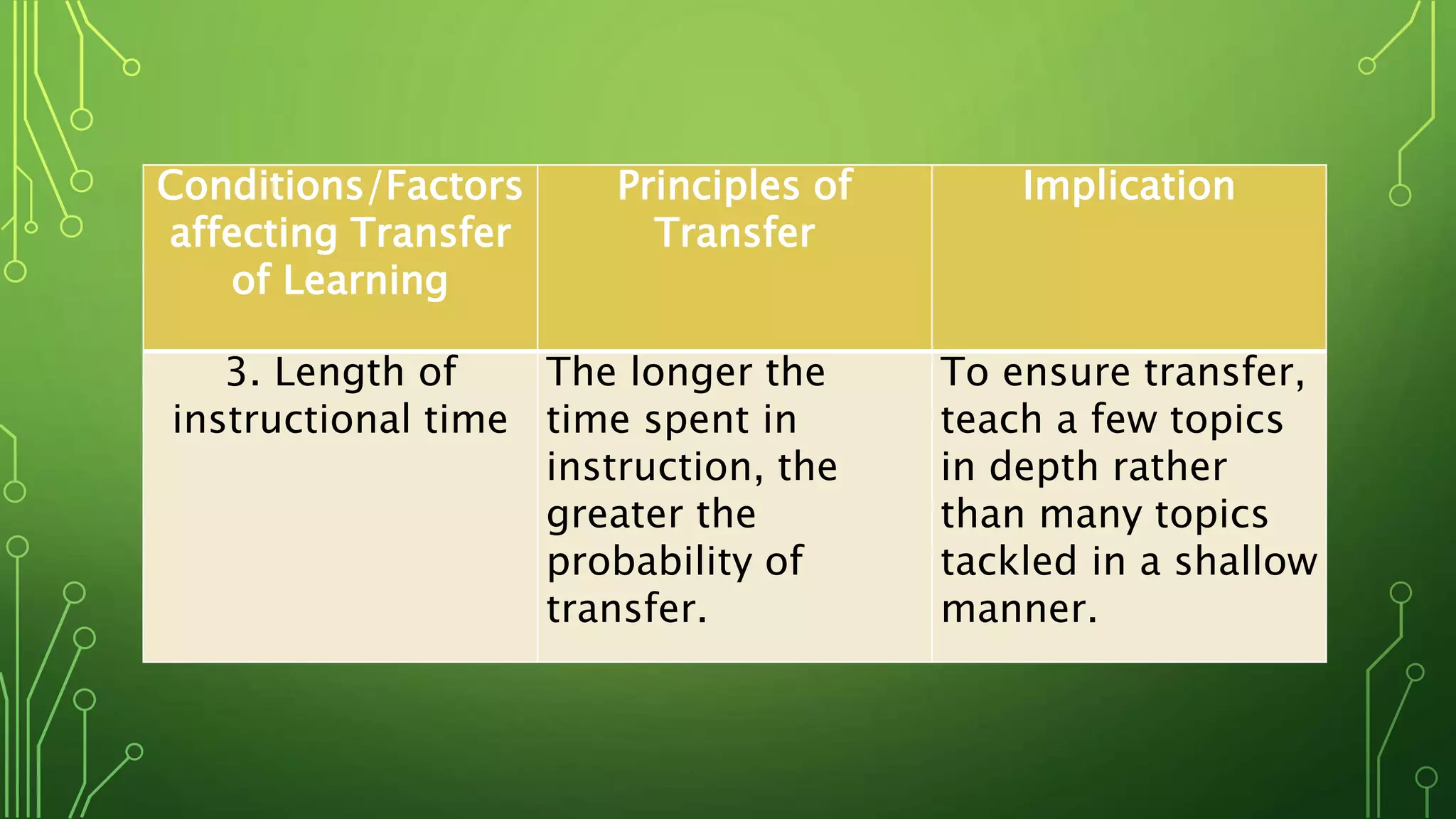
3. Length of
instructional time
The longer the
time spent in
instruction, the
greater the
probability of
transfer.
To ensure transfer,
teach a few topics
in depth rather
than many topics
tackled in a shallow
manner.
Conditions/Factors
affecting Transfer
of Learning
Principles of
Transfer
Implication
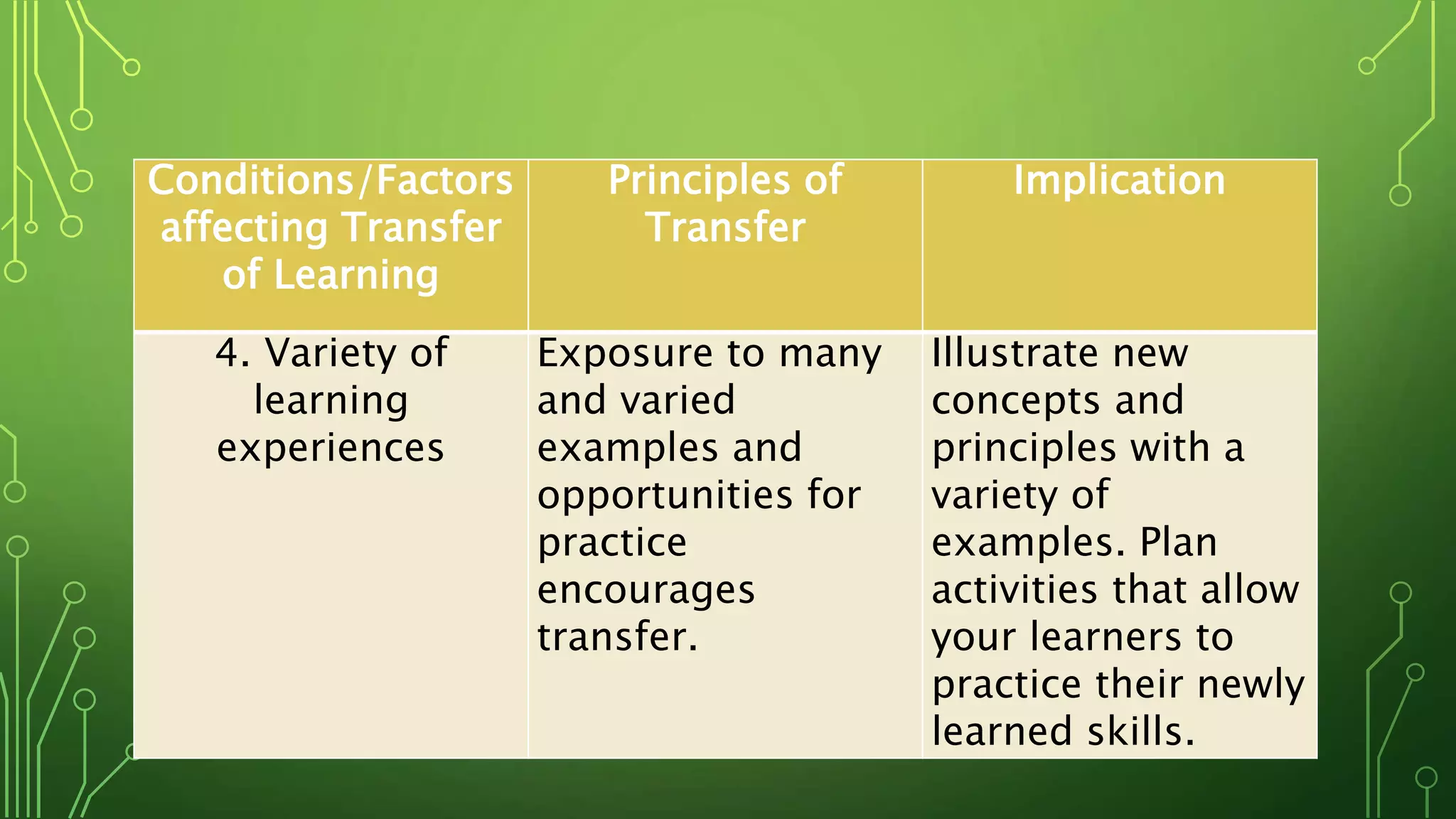
4. Variety of
learning
experiences
Exposure to many
and varied
examples and
opportunities for
practice
encourages
transfer.
Illustrate new
concepts and
principles with a
variety of
examples. Plan
activities that allow
your learners to
practice their newly
learned skills.
Conditions/Factors
affecting Transfer
of Learning
Principles of
Transfer
Implication
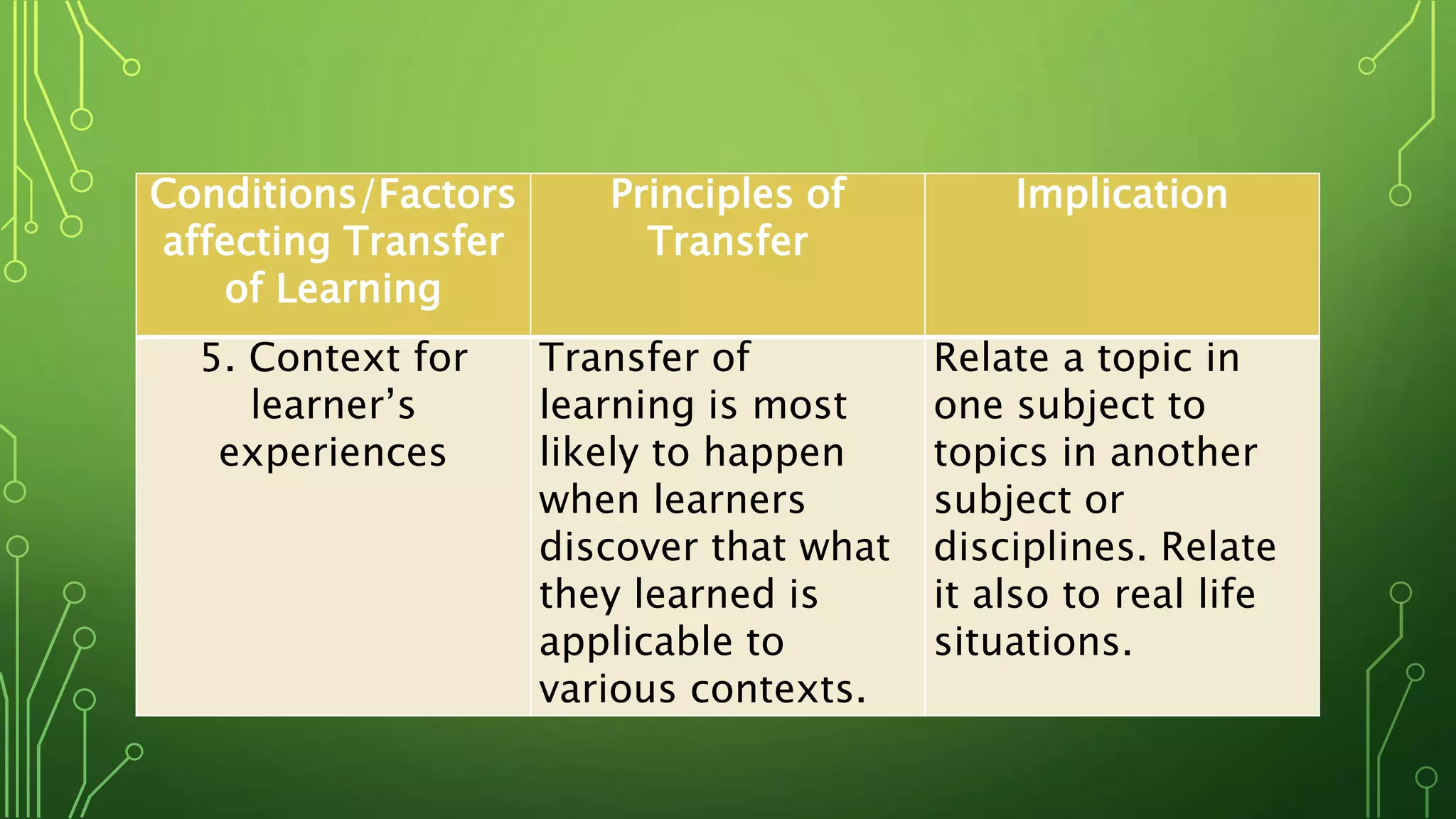
5. Context for
learner’s
experiences
Transfer of
learning is most
likely to happen
when learners
discover that what
they learned is
applicable to
various contexts.
Relate a topic in
one subject to
topics in another
subject or
disciplines. Relate
it also to real life
situations.
Conditions/Factors
affecting Transfer
of Learning
Principles of
Transfer
Implication
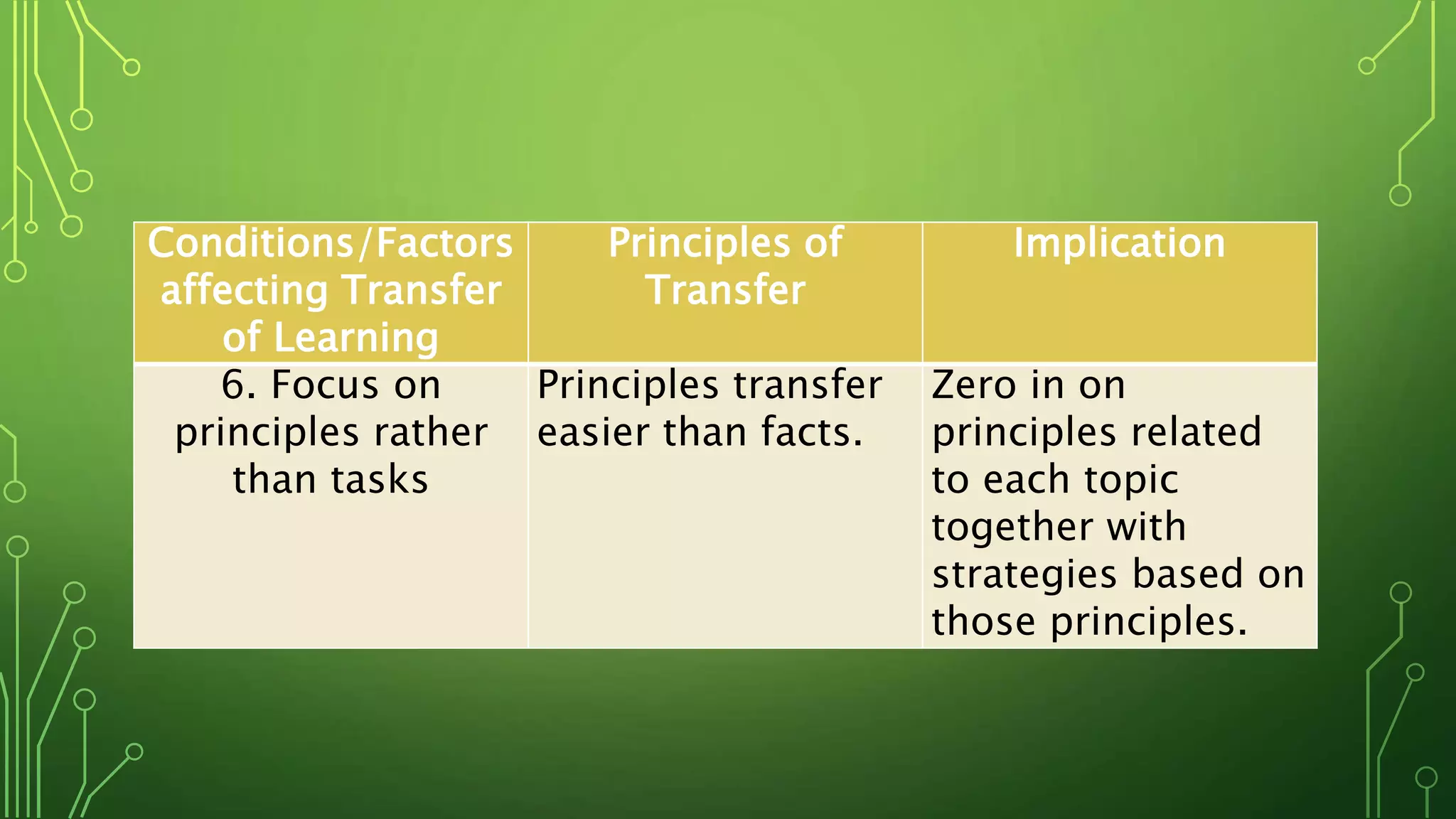
6. Focus on
principles rather
than tasks
Principles transfer
easier than facts.
Zero in on
principles related
to each topic
together with
strategies based on
those principles.
Conditions/Factors
affecting Transfer
of Learning
Principles of
Transfer
Implication
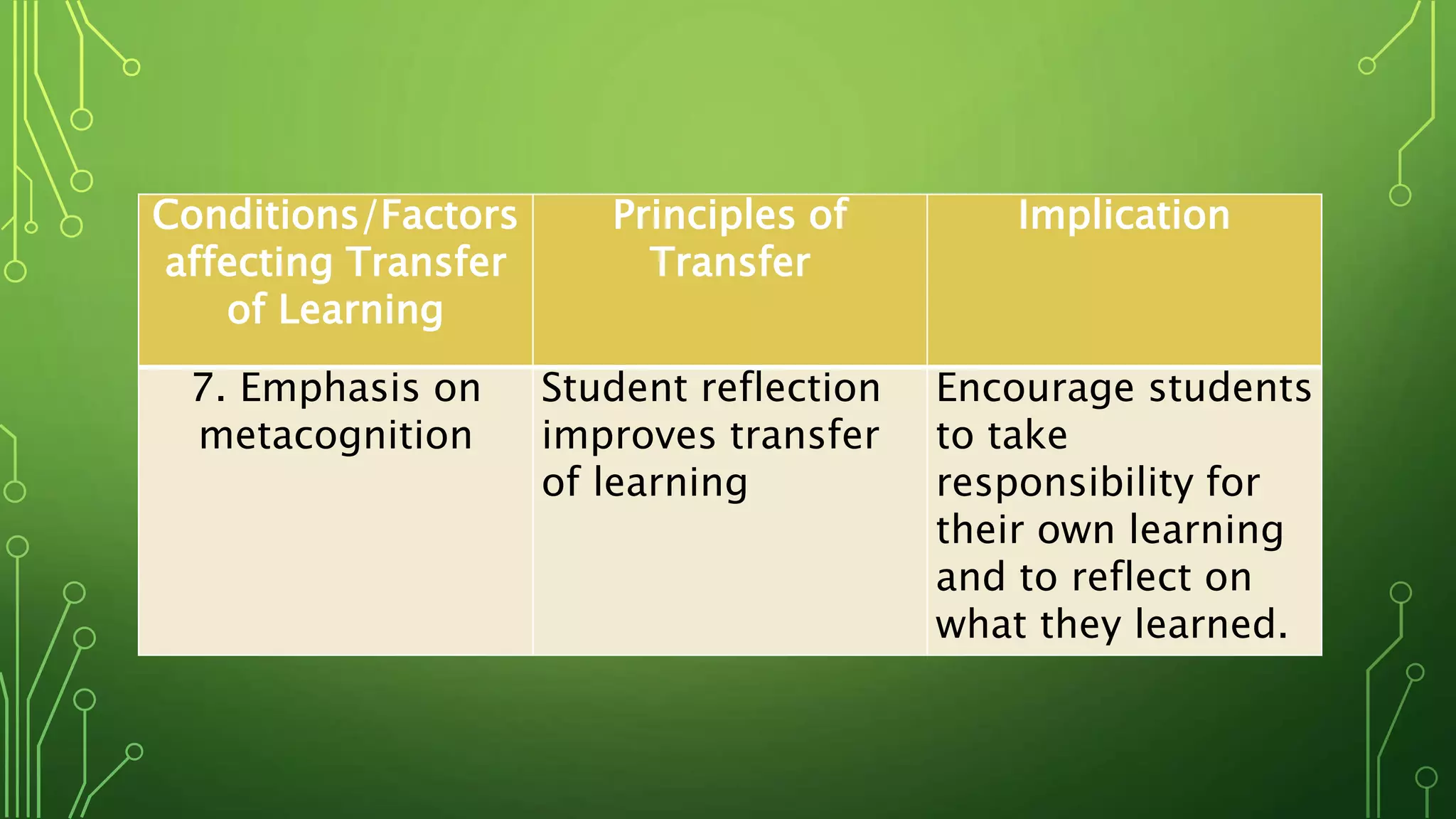
7. Emphasis on
metacognition
Student reflection
improves transfer
of learning
Encourage students
to take
responsibility for
their own learning
and to reflect on
what they learned.

Transfer of Learning

  • 1.
  • 2.
    TRANSFER OF LEARNING •It happens when previous learning is used to acquire new information. • It is applying to another situation what was previously learned. • The foundation of all learners’ ability to interpret data, solve problems, make decisions and perform cognitive tasks. • “transfer is a process of extending knowledge acquired in one context to other contexts.” (Byrnes, 2001)
  • 3.
    TYPES OF TRANSFER •Positive Transfer occurs when learning in one context improves performance in some other context. • Negative Transfer happens when a previous learning hinders the acquisition of a new learning. • Near Transfer or Specific Transfer refers to transfer between very similar contexts. • Far Transfer or General Transfer refers to transfer between context that, on appearance, seem remote and alien on one another.
  • 4.
    REASONS WHY TRANSFERDOES NOT WORK (BYRNES) • Some bits of knowledge are embedded in single context. Learners fail to transfer what they know because they are confined to a single context in which knowledge is acquired. • Lack of conditional knowledge. Conditional means contingent, dependent or provisional. • Lack of conceptual knowledge. When students have a deep understanding of concepts, then they can make possible transfer because learning a concept leads to understanding another concept.
  • 5.
    REASONS WHY TRANSFERDOES NOT WORK (BYRNES) • Inaccurate conceptions of the mind. This account for how students view their minds in relation to learning. • Lack of metacognition. When students do not possess the ability to think how their thought processes develop or if they lack the ability to regulate or monitor their own thoughts, then they cannot afford to develop transfer.
  • 6.
    CONDITIONS AND PRINCIPLESFOR TRANSFER • Principles that are based on the factors that affect transfer of learning. • Also called Conditions of Transfer (Perkins)
  • 7.
    Conditions/Facto rs affecting Transfer of Learning Principlesof Transfer Implication 1. Similarity between two learning situations The more similar the two situations are, the greater the chances that learning from one situation will be transferred to the other situation. Involve students in learning situations and tasks that are similar as possible to the situations where they would apply the tasks.
  • 8.
    Conditions/Factors affecting Transfer of Learning Principlesof Transfer Implication 2. Degree of meaningfulness/rel evance of learning Meaningful learning leads to greater transfer than rote learning. Remember to provide opportunities for learners to link new material to what they learned in the past.
  • 9.
    Conditions/Factors affecting Transfer of Learning Principlesof Transfer Implication 3. Length of instructional time The longer the time spent in instruction, the greater the probability of transfer. To ensure transfer, teach a few topics in depth rather than many topics tackled in a shallow manner.
  • 10.
    Conditions/Factors affecting Transfer of Learning Principlesof Transfer Implication 4. Variety of learning experiences Exposure to many and varied examples and opportunities for practice encourages transfer. Illustrate new concepts and principles with a variety of examples. Plan activities that allow your learners to practice their newly learned skills.
  • 11.
    Conditions/Factors affecting Transfer of Learning Principlesof Transfer Implication 5. Context for learner’s experiences Transfer of learning is most likely to happen when learners discover that what they learned is applicable to various contexts. Relate a topic in one subject to topics in another subject or disciplines. Relate it also to real life situations.
  • 12.
    Conditions/Factors affecting Transfer of Learning Principlesof Transfer Implication 6. Focus on principles rather than tasks Principles transfer easier than facts. Zero in on principles related to each topic together with strategies based on those principles.
  • 13.
    Conditions/Factors affecting Transfer of Learning Principlesof Transfer Implication 7. Emphasis on metacognition Student reflection improves transfer of learning Encourage students to take responsibility for their own learning and to reflect on what they learned.

Editor's Notes

  • #3 Transfer of learning is one of the basic concerns of educational practitioners. It happens when previous learning is used to acquire new information. It when learning in one context or with one set of materials affects performance in another context or with other related materials. It is basically applying to another situation what was previously learned. When previous learning is moved from “storage” to working memory, then it there is transfer. Transfer of learning becomes the foundation of all learners’ ability to interpret data, solve problems, make decisions and perform cognitive tasks. For example, learning to bike will help make you learn how to drive a car easier. For some musicians, learning how to play the guitar first helped them learn how to play the piano and other musical instruments. According to Byrnes (2001), “transfer is a process of extending knowledge acquired in one context to other contexts.” Transfer is a very significant concept in education and learning theory because most of those concerned in education aim to achieve transfer. Transfer of knowledge and skills is the major concern of every teacher. Teachers does not only teach cognition and they say, teaching is not complete if there is no transfer and application of that cognition.
  • #4 TYPES OF TRANSFER Positive Transfer occurs when learning in one context improves performance in some other context. If the new material is facilitated easily without any hassle, then the transfer is positive. For example, we know that a declarative sentence states a fact. If we know how to make a declarative sentence an interrogative sentence, then there is positive transfer. Negative Transfer happens when a previous learning hinders the acquisition of a new learning. It is when learning in one context impacts negatively on performing in another. If we do not know how to make a declarative sentence an interrogative one, or vice versa, then there is negative transfer. Near Transfer or Specific Transfer refers to transfer between very similar contexts. For example, the way we do our math drills is also similar to how we do it during exams or the way we do our routine ballet lessons is similar to how we will perform during a ballet recital. This is almost like, “practice makes perfect”. Far Transfer or General Transfer refers to transfer between context that, on appearance, seem remote and alien on one another. This is very evident during our Literature classes, where we try to learn the theme and the moral lesson of a story or poem and apply it in real-life context. It is true that in most cases, the g
  • #5 It is true that in most cases, the goal of transfer of learning from classroom to real life situation is not achieved. Some teachers and even parents complain that their students cannot think on their own. The students has failed to use the knowledge they learned in school to solve problem in real life context, making it a display of a very little interest in transfer. It is true that in most cases, the goal of transfer of learning from classroom to real life situation is not achieved. Some teachers and even parents complain that their students cannot think on their own. The students has failed to use the knowledge they learned in school to solve problem in real life context, making it a display of a very little interest in transfer.
  • #6 Inaccurate conceptions of the mind. This account for how students view their minds in relation to learning. Usually, when students who have a clear understanding of how the human mind works have a better chance of developing positive transfer. The more you understand how your mind works, the better your chances are for positive transfer of knowledge. How well you know how you learn and your strategies for learning will make your positive transfer successful. Lack of metacognition. When students do not possess the ability to think how their thought processes develop or if they lack the ability to regulate or monitor their own thoughts, then they cannot afford to develop transfer. When students does not help themselves to learn, there will be no transfer. If the students themselves will learn how to learn, practicing several learning strategies, the more transfer will be successful.
  • #7 CONDITIONS AND PRINCIPLES FOR TRANSFER There are conditions and principles for transfer to occur. These principles are based on the factors that affect transfer of learning. These are also similar to what Perkins call “conditions of transfer”.