TRANSFER OF LEARNINGRohema G. MaguadBTTE 4A – (AFT)
Transfer of LearningOccurs when learning in one context or with one set of materials impacts of one performances in another context or with other related materials.
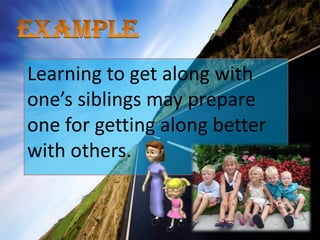
ExampleLearning to get along with one’s siblings may prepare one for getting along better with others.
Types of Transfer POSITIVE TRANSFEROccurs when learning in one context improves performance in some other context.
ExampleA Spanish speaker would find it easier  to learn Mexican language than Japanese.
 NEGATIVE TRANSFEROccurs when learning in one context impacts negatively on performance in another.
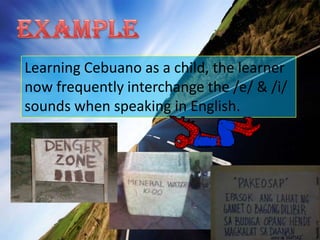
ExampleLearning Cebuano as a child, the learner now frequently interchange the /e/ & /i/ sounds when speaking in English.
 FAR TRANSFER tasks involve skills and knowledge being applied in situations that change. Far transfer tasks require instruction where learners are trained to adapt guidelines to changing situations or environments.This is also called General  Transfer.
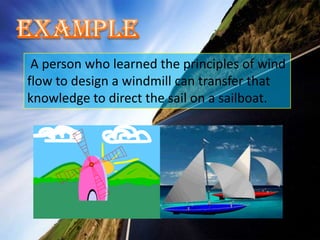
Example A person who learned the principles of wind flow to design a windmill can transfer that knowledge to direct the sail on a sailboat.
NEAR TRANSFERNear transfer of skills and knowledge are applied the same way every time the skills and knowledge are used. Near transfer training usually involves tasks that are procedural in nature, that is, tasks which are always applied in the same order. 
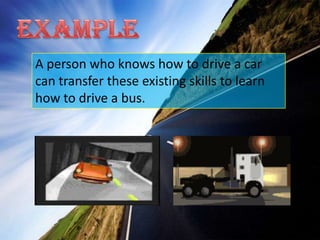
ExampleA person who knows how to drive a car can transfer these existing skills to learn how to drive a bus.
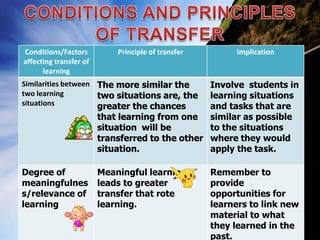
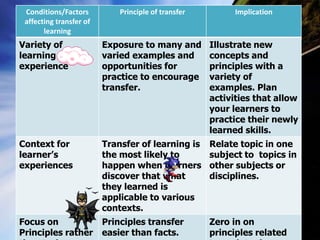
CONDITIONS AND PRINCIPLES OF TRANSFER
Transfer of learning

Transfer of learning

  • 1.
    TRANSFER OF LEARNINGRohemaG. MaguadBTTE 4A – (AFT)
  • 2.
    Transfer of LearningOccurswhen learning in one context or with one set of materials impacts of one performances in another context or with other related materials.
  • 3.
    ExampleLearning to getalong with one’s siblings may prepare one for getting along better with others.
  • 4.
    Types of TransferPOSITIVE TRANSFEROccurs when learning in one context improves performance in some other context.
  • 5.
    ExampleA Spanish speakerwould find it easier to learn Mexican language than Japanese.
  • 6.
    NEGATIVE TRANSFEROccurswhen learning in one context impacts negatively on performance in another.
  • 7.
    ExampleLearning Cebuano asa child, the learner now frequently interchange the /e/ & /i/ sounds when speaking in English.
  • 8.
    FAR TRANSFER tasksinvolve skills and knowledge being applied in situations that change. Far transfer tasks require instruction where learners are trained to adapt guidelines to changing situations or environments.This is also called General Transfer.
  • 9.
    Example A person wholearned the principles of wind flow to design a windmill can transfer that knowledge to direct the sail on a sailboat.
  • 10.
    NEAR TRANSFERNear transferof skills and knowledge are applied the same way every time the skills and knowledge are used. Near transfer training usually involves tasks that are procedural in nature, that is, tasks which are always applied in the same order. 
  • 11.
    ExampleA person whoknows how to drive a car can transfer these existing skills to learn how to drive a bus.
  • 12.