When Learning in one situation
or one form of activity effects one’s
ability in other types of activity or
one’s performance in different
situations, this referred to as…
Richard Z. Zonio
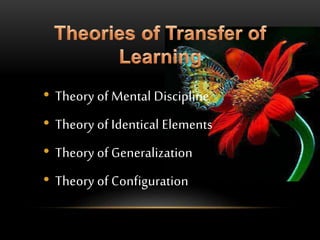
• Theory of Mental Discipline
• Theory of Identical Elements
• Theory of Generalization
• Theory of Configuration
Thus, the training of the faculty
of memory through memorizing
nonsense syllables presumably
improves one’s memory for names,
meaningful material and, in fact, for
anything which calls for memory.
This theory holds that since
faculties supposedly
strengthened through mental
practice in much the same way
as muscles are strengthened
through physical exercise.
What do most psychologist
and professional educators
say of this theory today?
Memory – as a general
function is not improved by
strenuous memorization of
poetry.
Likewise, reasoning in fields
other than of mathematics is not
automatically improved by
studying algebra and geometry.
The identical elements, such
as content, method, aim or
attitude present in both
situations facilitate learning.
Theory of Identical Elements -
formulated by Thorndike maintains that
the amount of transfer depends upon
the identical elements or elements that
are common in both situations.
The best known and probably
the most influential theory to explain
transfer of learning is the near-
transfer vs. far-transfer.
Simply put, this theory implied
that transfer of learning would take
place only if two activities contained
similar or common elements.
Within this theory, near
transfer means that skills and
knowledge are applied in the
same manner each time the
knowledge and skills are used. An
example would be procedural
training, perhaps using a software
application to perform routine
tasks – creating documents in MS
Word.
Far transfer means that skills
and knowledge are applied in
situations that change. An example
of this will be perhaps understanding
the economic concepts associated
with how the stock market functions
and then analysing trends and
utilizing information to build a strong
portfolio.
It means that experiences
obtained in one situation are
applicable to other situations.
Theory of Generalization –
formulated by Charles H. Judd,
maintains that transfer is a form of
generalization which can be
encouraged by training.
It puts emphasis upon the
value to understand, organize,
and generalize specific
experiences.
Theory of Configuration –
is based on Gestalt Theory of
learning.
It holds that that transfer of
training from one situation to
another is the result of the
application of certain
principles of configuration.
Transfer implies that what is
learned in one situation can be
shifted directly to another
situation only when similarity (in
content, method, or attitude) of
the two situations is perceived
by the learner.
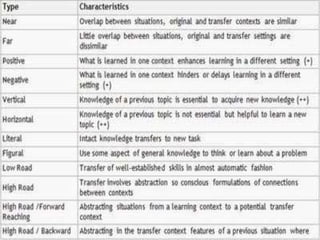
Post this theory; many new theories
have been propounded. From the Wikipedia,
here is a table, presenting different types of
transfer, as adapted from Schunk (2004, p.
220). All these theories distinguish transfer
into different types based on two parameters
– the similarity and difference between two
learning situations and the cognitive process
and mental analysis involved in the learning.
It is obvious that there are
certain significant factors that would
affect such transfer in school.
These factors are:
1. Mental ability of the learner
2. Nature of the subject matter
3. Attitudes and efforts of the learner
4. Manner of teaching
5. Learning environment
Increasingly, transfer of learning
is being discussed with a meta-
cognitive point of view. So, learning
from learning is perhaps more
important than learning itself! Sounds
strange but what it means is to allow
learners to think about learning and
therefore construct their own
connections between what has been
learnt in the past versus what is being
learnt in the present. It is about being
aware of your learning and taking
control of the same.
In that sense, when learners
manage their own learning and
are more self-aware, they
increase the accessibility of their
learning to be applied in situations
that occur in the future and help
themselves in transferring their
learning! In this context, our role
as teachers changes to helping
learners learn meta-cognition
skills and strategies! Interesting.
Thank You!!!

Transfer of Learning

  • 1.
    When Learning inone situation or one form of activity effects one’s ability in other types of activity or one’s performance in different situations, this referred to as… Richard Z. Zonio
  • 7.
    • Theory ofMental Discipline • Theory of Identical Elements • Theory of Generalization • Theory of Configuration
  • 9.
    Thus, the trainingof the faculty of memory through memorizing nonsense syllables presumably improves one’s memory for names, meaningful material and, in fact, for anything which calls for memory.
  • 10.
    This theory holdsthat since faculties supposedly strengthened through mental practice in much the same way as muscles are strengthened through physical exercise.
  • 11.
    What do mostpsychologist and professional educators say of this theory today?
  • 12.
    Memory – asa general function is not improved by strenuous memorization of poetry. Likewise, reasoning in fields other than of mathematics is not automatically improved by studying algebra and geometry.
  • 13.
    The identical elements,such as content, method, aim or attitude present in both situations facilitate learning. Theory of Identical Elements - formulated by Thorndike maintains that the amount of transfer depends upon the identical elements or elements that are common in both situations.
  • 14.
    The best knownand probably the most influential theory to explain transfer of learning is the near- transfer vs. far-transfer. Simply put, this theory implied that transfer of learning would take place only if two activities contained similar or common elements.
  • 15.
    Within this theory,near transfer means that skills and knowledge are applied in the same manner each time the knowledge and skills are used. An example would be procedural training, perhaps using a software application to perform routine tasks – creating documents in MS Word.
  • 16.
    Far transfer meansthat skills and knowledge are applied in situations that change. An example of this will be perhaps understanding the economic concepts associated with how the stock market functions and then analysing trends and utilizing information to build a strong portfolio.
  • 17.
    It means thatexperiences obtained in one situation are applicable to other situations. Theory of Generalization – formulated by Charles H. Judd, maintains that transfer is a form of generalization which can be encouraged by training.
  • 18.
    It puts emphasisupon the value to understand, organize, and generalize specific experiences.
  • 19.
    Theory of Configuration– is based on Gestalt Theory of learning. It holds that that transfer of training from one situation to another is the result of the application of certain principles of configuration.
  • 20.
    Transfer implies thatwhat is learned in one situation can be shifted directly to another situation only when similarity (in content, method, or attitude) of the two situations is perceived by the learner.
  • 21.
    Post this theory;many new theories have been propounded. From the Wikipedia, here is a table, presenting different types of transfer, as adapted from Schunk (2004, p. 220). All these theories distinguish transfer into different types based on two parameters – the similarity and difference between two learning situations and the cognitive process and mental analysis involved in the learning.
  • 23.
    It is obviousthat there are certain significant factors that would affect such transfer in school. These factors are: 1. Mental ability of the learner 2. Nature of the subject matter 3. Attitudes and efforts of the learner 4. Manner of teaching 5. Learning environment
  • 24.
    Increasingly, transfer oflearning is being discussed with a meta- cognitive point of view. So, learning from learning is perhaps more important than learning itself! Sounds strange but what it means is to allow learners to think about learning and therefore construct their own connections between what has been learnt in the past versus what is being learnt in the present. It is about being aware of your learning and taking control of the same.
  • 25.
    In that sense,when learners manage their own learning and are more self-aware, they increase the accessibility of their learning to be applied in situations that occur in the future and help themselves in transferring their learning! In this context, our role as teachers changes to helping learners learn meta-cognition skills and strategies! Interesting.
  • 26.