Two Key Understandings
• You must design “backward” from
understanding if you want to achieve
understanding “by design”
• Without transparent and important
priorities - stated as performance, not
content - neither teacher nor student can
be effective.
Twin Sins of Unit Design:
“Coverage-focused” teaching
“Activity-focused” teaching
Teacher 1 is focused on “getting through” the
material; Teacher 2 is focused on keeping
students active and engaged.
Neither method reveals any clear intellectual
goals. Any understanding that happens is
essentially a piece of good luck.
Understanding is not a part of the design.
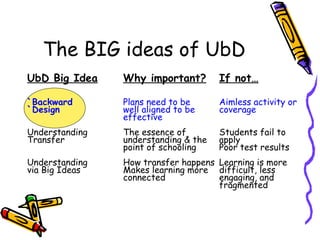
The BIG ideas of UbD
UbD Big Idea Why important? If not…
`Backward Plans need to be Aimless activity or
`Design well aligned to be coverage
effective
Understanding The essence of Students fail to
Transfer understanding & the apply
point of schooling Poor test results
Understanding How transfer happens Learning is more
via Big Ideas Makes learning more difficult, less
connected engaging, and
fragmented
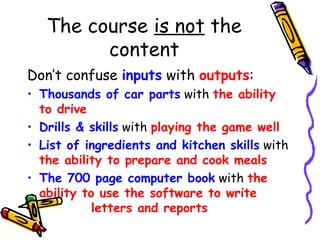
The course is not the
content
Don’t confuse inputs with outputs:
• Thousands of car parts with the ability
to drive
• Drills & skills with playing the game well
• List of ingredients and kitchen skills with
the ability to prepare and cook meals
• The 700 page computer book with the
ability to use the software to write
letters and reports
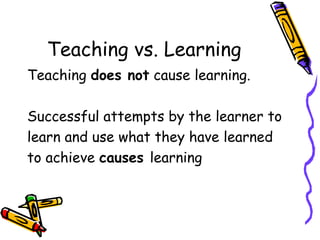
Teaching vs. Learning
Teaching does not cause learning.
Successful attempts by the learner to
learn and use what they have learned
to achieve causes learning
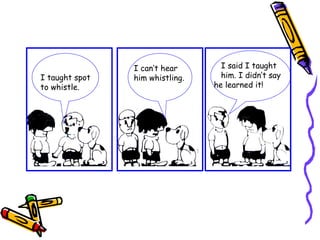
I taught spot
to whistle.
I can’t hear
him whistling.
I said I taught
him. I didn’t say
he learned it!
Textbooks & Transfer
The textbook almost never focuses
on transfer; rather it provides
mostly logically organized content
and drills only.
Teachers, do you get
frustrated by students who:
• fail to recall last week’s or even yesterday’s
lessons?
• cannot transfer their learning?
• don’t have any idea what they are to do?
• don’t “get it” and ask “dumb questions’?
• are bored yet otherwise seem bright?
Then UbD may be able to help you!
Backward Design from
“Content Coverage”
I want students to understand -
The Constitution
The three branches of government
This is not a learning goal - this just
states what the content is.
Backward Design from the
Understanding Sought
I want students to leave my course having
understood that:
 the Constitution was a solution based on
compromise to real and pressing problems and
disagreements in governance; not an idea out of
thin air
 the Constitution was a brilliant balance and limit
of powers but was grounded in a long and
sometimes bitter history, with many fights that
are and always will be with us
Backward Design from the
Understanding Sought
(continued)
I then want students to transfer that
understanding to a modern relevant
situation:
The problem of designing a government
for Iraq
A system of governance for our school
Backward Design from
Understanding
Implications to the teacher:
You have to design your courses
backward from the kinds of
problems, tasks, situations, and
conditions you want students to be
able to eventually handle on their own
(student autonomy).
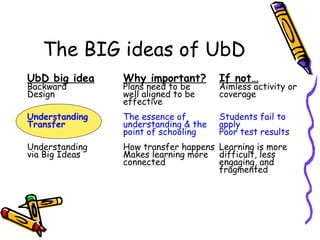
The BIG ideas of UbD
UbD big idea Why important? If not…
Backward Plans need to be Aimless activity or
Design well aligned to be coverage
effective
Understanding The essence of Students fail to
Transfer understanding & the apply
point of schooling Poor test results
Understanding How transfer happens Learning is more
via Big Ideas Makes learning more difficult, less
connected engaging, and
fragmented
Transfer:
Defined & Justified
What is transfer of learning?
Transfer of learning is the use of knowledge
and skills, acquired in an earlier context, in a
new context. It occurs when a person’s
learning in one situation influences that
person’s learning and performance in other
situations.
The Transfer Question
What should the student be able to
do effectively with a repertoire of
knowledge and skills, increasingly on
their own, in future tasks?
How will transfer ability be
developed over the course of the
course?
Transfer - the real
“game” of using content
on your own
Applying prior learning to
* a novel and increasingly new and unfamiliar
looking task
* an increasingly challenging context
and situation in terms of purpose,
audience, dilemmas, etc.
Examples in Geography - Draft
• Make decisions in their lives to use resources more
efficiently to live sustainably.
• Critically appraise conditions of well-being that affect
people on this planet.
• Appreciate what you have and how well-being can be
improved for people in our community, our state, and
our world.
• Make choices to act ethically and to influence others
to ensure we can live sustainably into the future.
Examples in History - Draft
• Understand the relevance of historical events to the
world in which we live.
• Critically appraise historical and contemporary
claims/decisions.
• Evaluate and use sources of information to address a
question, form an opinion, or to solve a problem
• Communicate to inform and explain a topic, concept, or
process to a variety of audiences.
• Evaluate an argument and develop and/or defend a point
of view.
Examples in P.E.
• Live a healthy life by making
healthful choices and decisions
regarding diet, exer­cise, stress
management, alcohol/drug use.
• Participate in activities that promote
wellness throughout life.
Transfer goals
On link from Tom March
Transfer based on
BIG Ideas permits
future learning
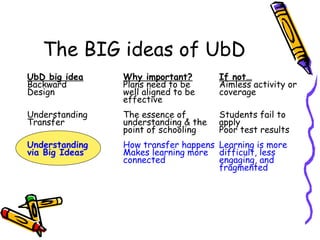
The BIG ideas of UbD
UbD big idea Why important? If not…
Backward Plans need to be Aimless activity or
Design well aligned to be coverage
effective
Understanding The essence of Students fail to
Transfer understanding & the apply
point of schooling Poor test results
Understanding How transfer happens Learning is more
via Big Ideas Makes learning more difficult, less
connected engaging, and
fragmented
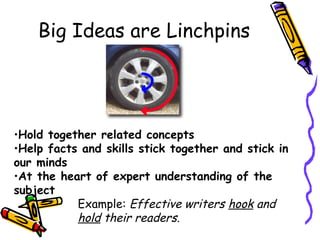
Big Ideas are Linchpins
•Hold together related concepts
•Help facts and skills stick together and stick in
our minds
•At the heart of expert understanding of the
subject
Example: Effective writers hook and
hold their readers.
Big Ideas have to be
Uncovered
* Not obvious and often counterintuitive.
* Like “guiding conjectures” – subject to
refinement and adjustment as learning goes
on.
* Require consideration and reconsideration -
Inquiry.
* Have great transfer value.
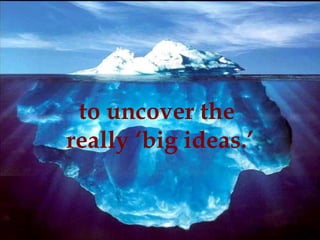
You’ve got to go
below the surface...
to uncover the
really ‘big ideas.’
Transfer is VitalTransfer is Vital
In each subject field there are some basic ideas which
summarize much of what scholars have learned…These
ideas give meaning to much that has been learned, and
they provide the basic ideas for dealing with many new
problems… We believe that this is a primary obligation
of the scholars (and) teachers to search constantly
for these abstractions, to find ways of helping
students learn them, and especially to help students
learn how to use them in a great variety of problem
situations…
Bloom, 1981, p.235

Ubd - An introduction to Understandings and Transfer Goals

  • 2.
    Two Key Understandings •You must design “backward” from understanding if you want to achieve understanding “by design” • Without transparent and important priorities - stated as performance, not content - neither teacher nor student can be effective.
  • 3.
    Twin Sins ofUnit Design: “Coverage-focused” teaching “Activity-focused” teaching Teacher 1 is focused on “getting through” the material; Teacher 2 is focused on keeping students active and engaged. Neither method reveals any clear intellectual goals. Any understanding that happens is essentially a piece of good luck. Understanding is not a part of the design.
  • 4.
    The BIG ideasof UbD UbD Big Idea Why important? If not… `Backward Plans need to be Aimless activity or `Design well aligned to be coverage effective Understanding The essence of Students fail to Transfer understanding & the apply point of schooling Poor test results Understanding How transfer happens Learning is more via Big Ideas Makes learning more difficult, less connected engaging, and fragmented
  • 5.
    The course isnot the content Don’t confuse inputs with outputs: • Thousands of car parts with the ability to drive • Drills & skills with playing the game well • List of ingredients and kitchen skills with the ability to prepare and cook meals • The 700 page computer book with the ability to use the software to write letters and reports
  • 6.
    Teaching vs. Learning Teachingdoes not cause learning. Successful attempts by the learner to learn and use what they have learned to achieve causes learning
  • 7.
    I taught spot towhistle. I can’t hear him whistling. I said I taught him. I didn’t say he learned it!
  • 8.
    Textbooks & Transfer Thetextbook almost never focuses on transfer; rather it provides mostly logically organized content and drills only.
  • 9.
    Teachers, do youget frustrated by students who: • fail to recall last week’s or even yesterday’s lessons? • cannot transfer their learning? • don’t have any idea what they are to do? • don’t “get it” and ask “dumb questions’? • are bored yet otherwise seem bright? Then UbD may be able to help you!
  • 10.
    Backward Design from “ContentCoverage” I want students to understand - The Constitution The three branches of government This is not a learning goal - this just states what the content is.
  • 11.
    Backward Design fromthe Understanding Sought I want students to leave my course having understood that:  the Constitution was a solution based on compromise to real and pressing problems and disagreements in governance; not an idea out of thin air  the Constitution was a brilliant balance and limit of powers but was grounded in a long and sometimes bitter history, with many fights that are and always will be with us
  • 12.
    Backward Design fromthe Understanding Sought (continued) I then want students to transfer that understanding to a modern relevant situation: The problem of designing a government for Iraq A system of governance for our school
  • 13.
    Backward Design from Understanding Implicationsto the teacher: You have to design your courses backward from the kinds of problems, tasks, situations, and conditions you want students to be able to eventually handle on their own (student autonomy).
  • 14.
    The BIG ideasof UbD UbD big idea Why important? If not… Backward Plans need to be Aimless activity or Design well aligned to be coverage effective Understanding The essence of Students fail to Transfer understanding & the apply point of schooling Poor test results Understanding How transfer happens Learning is more via Big Ideas Makes learning more difficult, less connected engaging, and fragmented
  • 15.
    Transfer: Defined & Justified Whatis transfer of learning? Transfer of learning is the use of knowledge and skills, acquired in an earlier context, in a new context. It occurs when a person’s learning in one situation influences that person’s learning and performance in other situations.
  • 16.
    The Transfer Question Whatshould the student be able to do effectively with a repertoire of knowledge and skills, increasingly on their own, in future tasks? How will transfer ability be developed over the course of the course?
  • 17.
    Transfer - thereal “game” of using content on your own Applying prior learning to * a novel and increasingly new and unfamiliar looking task * an increasingly challenging context and situation in terms of purpose, audience, dilemmas, etc.
  • 18.
    Examples in Geography- Draft • Make decisions in their lives to use resources more efficiently to live sustainably. • Critically appraise conditions of well-being that affect people on this planet. • Appreciate what you have and how well-being can be improved for people in our community, our state, and our world. • Make choices to act ethically and to influence others to ensure we can live sustainably into the future.
  • 19.
    Examples in History- Draft • Understand the relevance of historical events to the world in which we live. • Critically appraise historical and contemporary claims/decisions. • Evaluate and use sources of information to address a question, form an opinion, or to solve a problem • Communicate to inform and explain a topic, concept, or process to a variety of audiences. • Evaluate an argument and develop and/or defend a point of view.
  • 20.
    Examples in P.E. •Live a healthy life by making healthful choices and decisions regarding diet, exer­cise, stress management, alcohol/drug use. • Participate in activities that promote wellness throughout life.
  • 21.
    Transfer goals On linkfrom Tom March
  • 22.
    Transfer based on BIGIdeas permits future learning
  • 23.
    The BIG ideasof UbD UbD big idea Why important? If not… Backward Plans need to be Aimless activity or Design well aligned to be coverage effective Understanding The essence of Students fail to Transfer understanding & the apply point of schooling Poor test results Understanding How transfer happens Learning is more via Big Ideas Makes learning more difficult, less connected engaging, and fragmented
  • 24.
    Big Ideas areLinchpins •Hold together related concepts •Help facts and skills stick together and stick in our minds •At the heart of expert understanding of the subject Example: Effective writers hook and hold their readers.
  • 25.
    Big Ideas haveto be Uncovered * Not obvious and often counterintuitive. * Like “guiding conjectures” – subject to refinement and adjustment as learning goes on. * Require consideration and reconsideration - Inquiry. * Have great transfer value.
  • 26.
    You’ve got togo below the surface...
  • 27.
    to uncover the really‘big ideas.’
  • 28.
    Transfer is VitalTransferis Vital In each subject field there are some basic ideas which summarize much of what scholars have learned…These ideas give meaning to much that has been learned, and they provide the basic ideas for dealing with many new problems… We believe that this is a primary obligation of the scholars (and) teachers to search constantly for these abstractions, to find ways of helping students learn them, and especially to help students learn how to use them in a great variety of problem situations… Bloom, 1981, p.235

Editor's Notes

  • #27 The biggest thing to remember is that….
  • #28 The Backward Design model provides a practical framework for designing curriculum, instruction and assessment to make student learning more likely and to ensure the really big ideas are ‘uncovered’.