Learning/Thinking Styles and Multiple Intelligences
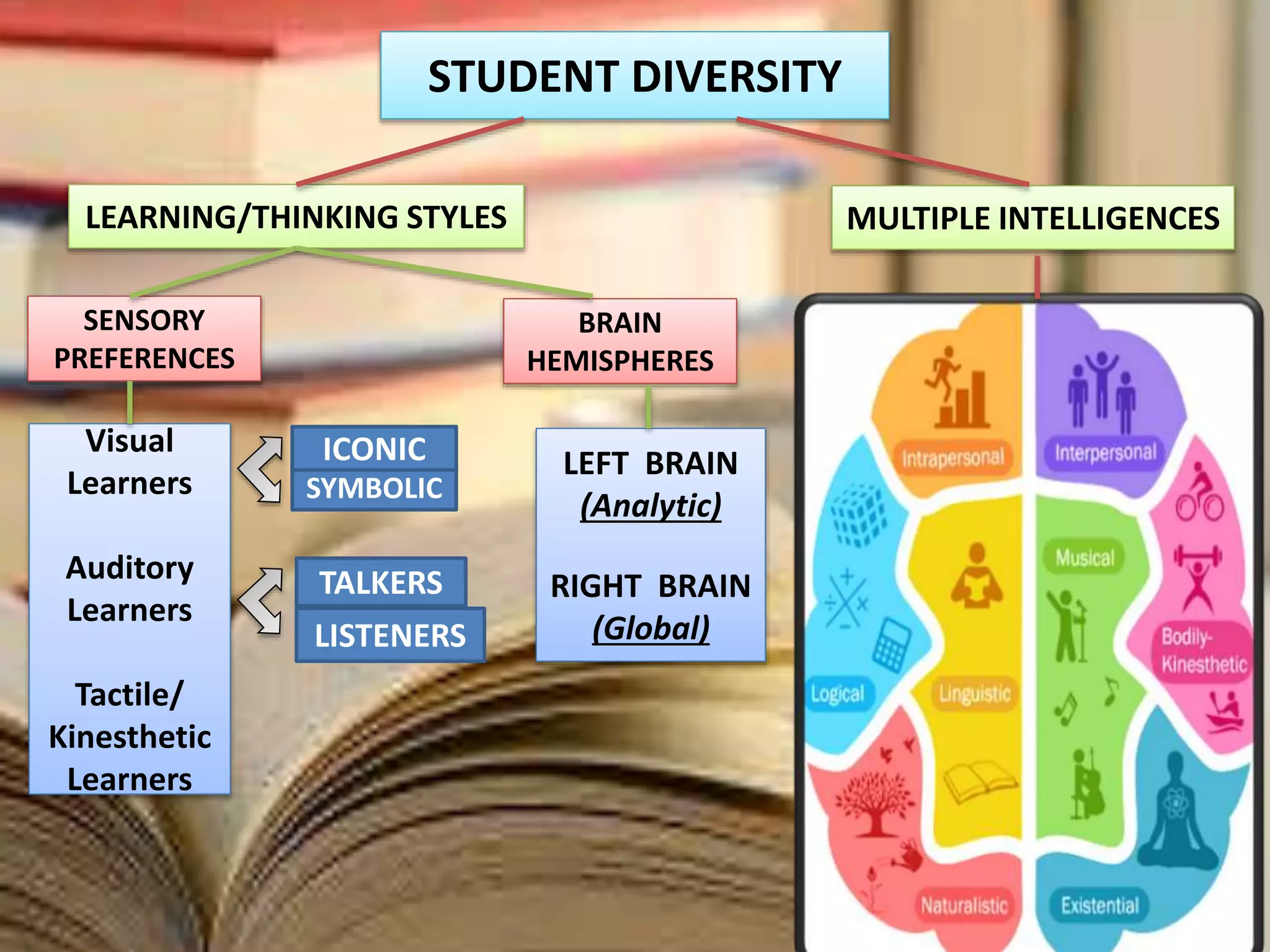
This document discusses different learning styles and preferences including sensory preferences, thinking styles, and brain hemisphere dominance. It describes visual, auditory, and tactile/kinesthetic learners and their preferences for visual, auditory, or hands-on sensory input. Within visual and auditory learners, it further distinguishes between visual-iconic vs. visual-symbolic learners and listener vs. talker learners. It also discusses left brain vs. right brain dominance and how people tend to prefer analytic or global styles of thinking. The goal is to understand individual differences in how people best process and learn information.
Introduction to learning facilitation by Ma. Rita D. Lucas, Ph.D. and Brenda B. Corpuz, Ph.D. modulating instructional strategies.
Discusses student diversity in learning, focusing on learning styles, sensory preferences, and intelligence types. Covers categories like visual, auditory, and tactile learners.
LEARNING / THINKINGSTYLES
- refer to the preferred way an
individual processes information.
- they describe a person’s typical mode
of thinking, remembering or problem
solving.
- Furthermore, styles are usually
considered to be bipolar dimensions.
5.
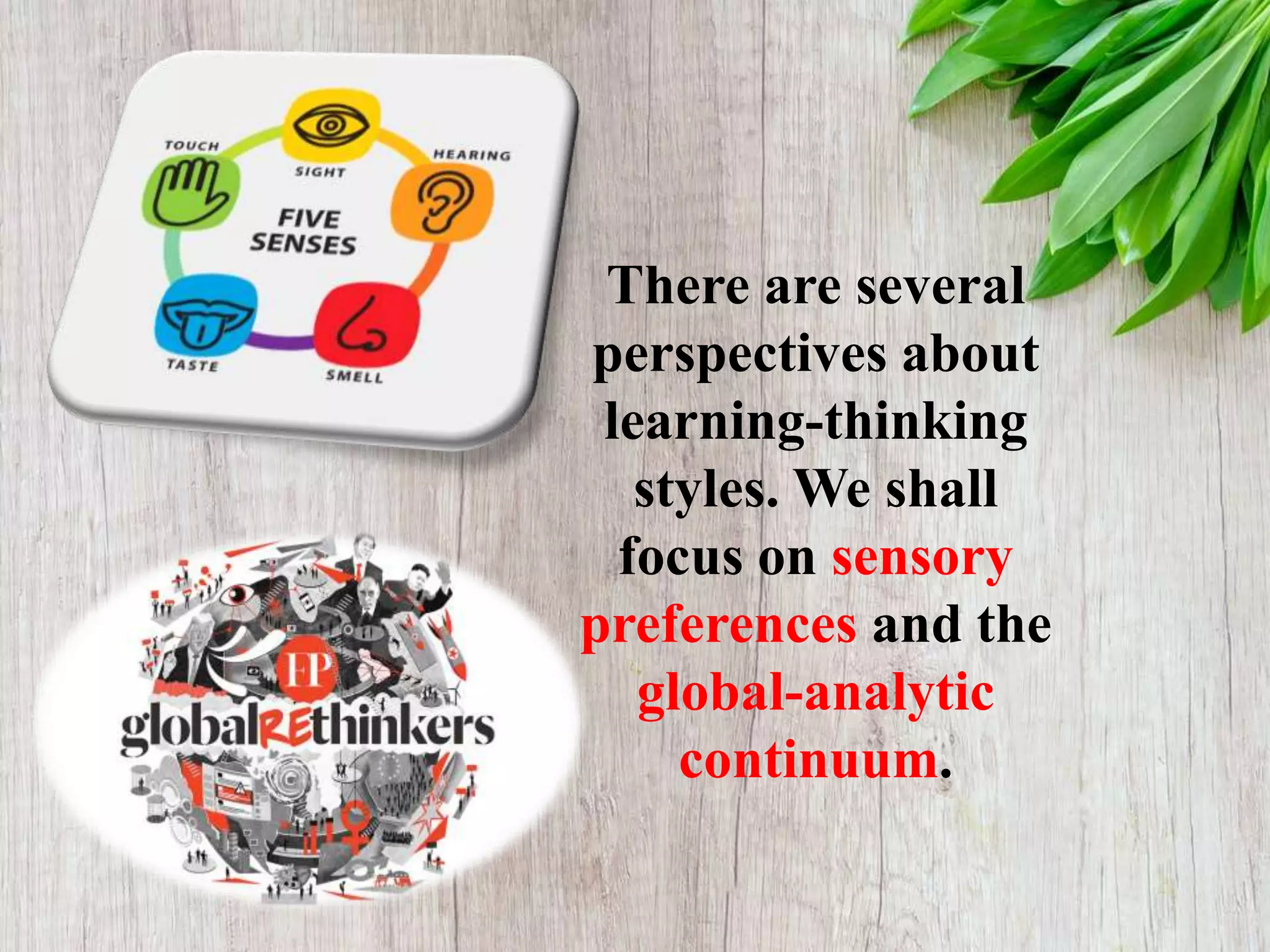
There are several
perspectivesabout
learning-thinking
styles. We shall
focus on sensory
preferences and the
global-analytic
continuum.
6.
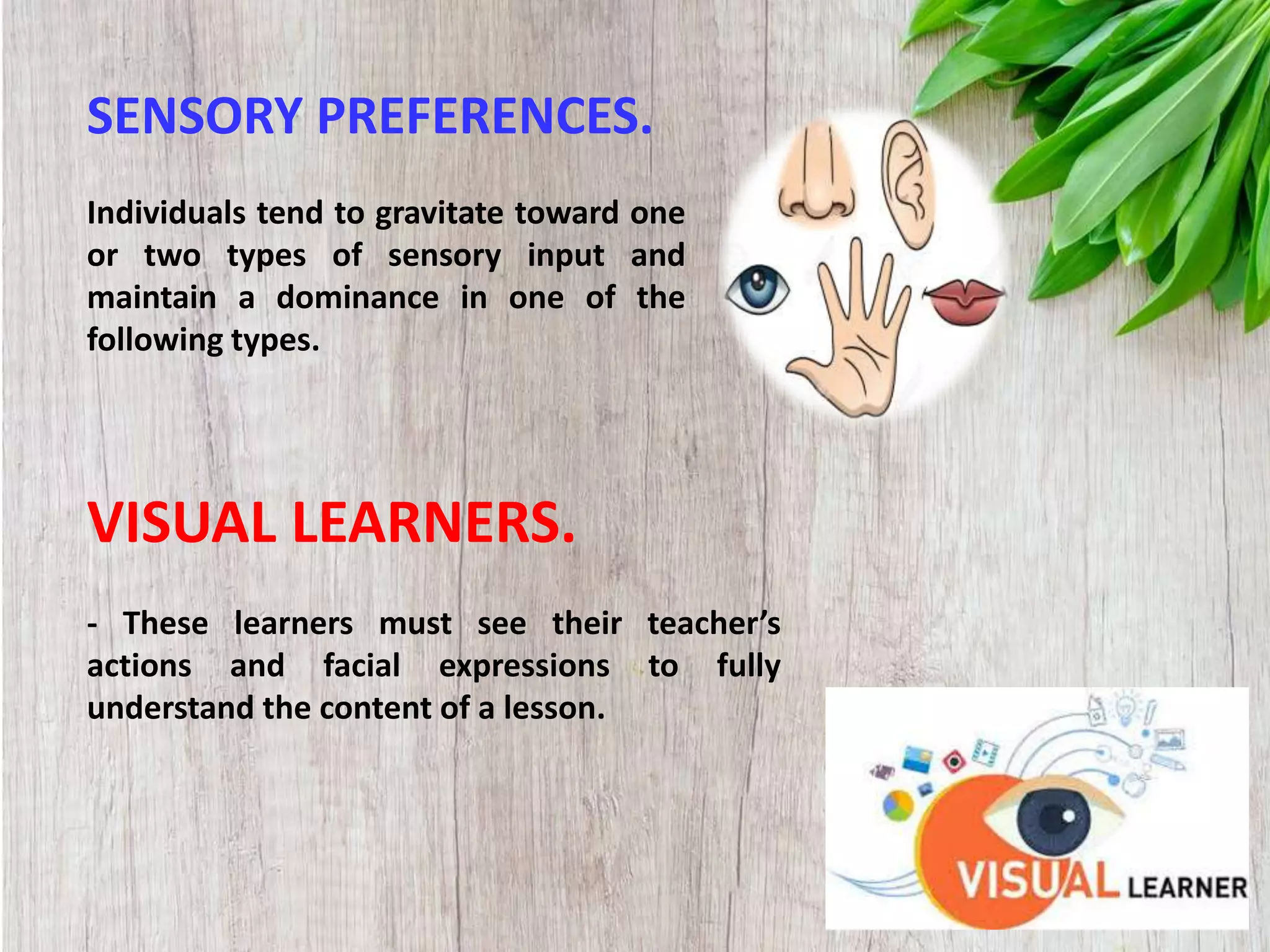
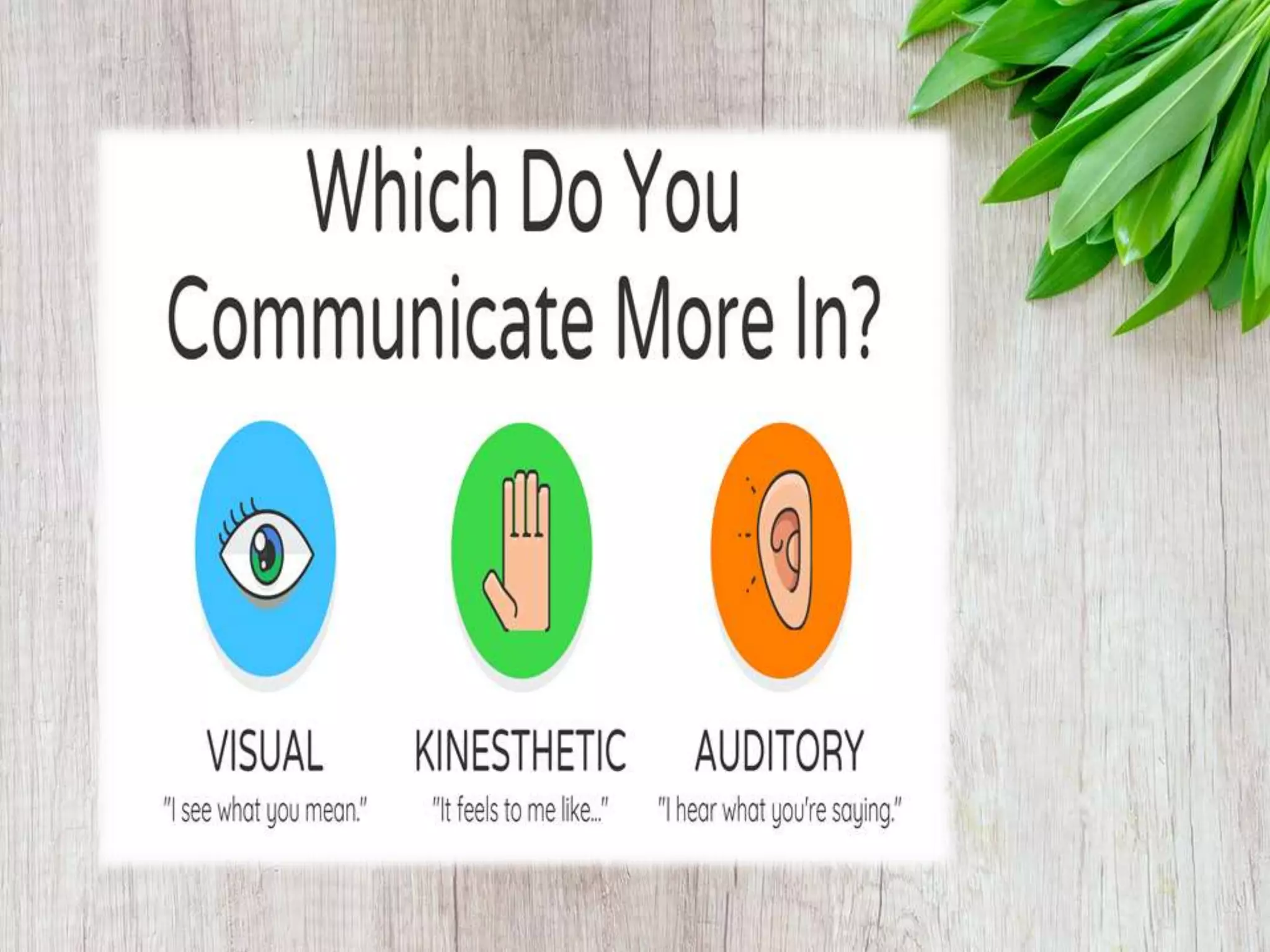
SENSORY PREFERENCES.
Individuals tendto gravitate toward one
or two types of sensory input and
maintain a dominance in one of the
following types.
VISUAL LEARNERS.
- These learners must see their teacher’s
actions and facial expressions to fully
understand the content of a lesson.
7.
Ri Charde furtherbreaks
down visual learners into:
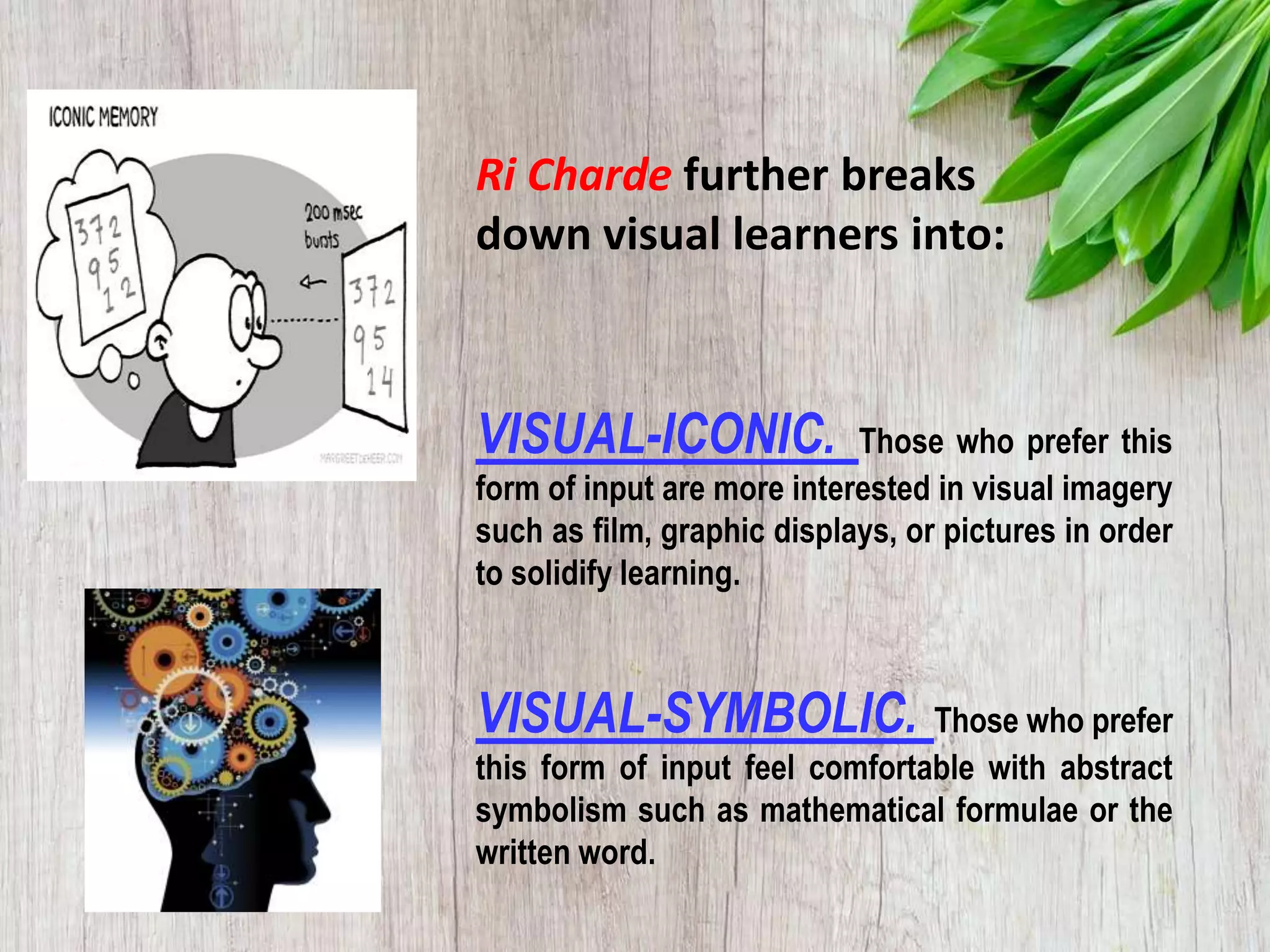
VISUAL-ICONIC. Those who prefer this
form of input are more interested in visual imagery
such as film, graphic displays, or pictures in order
to solidify learning.
VISUAL-SYMBOLIC. Those who prefer
this form of input feel comfortable with abstract
symbolism such as mathematical formulae or the
written word.
8.
AUDITORY LEARNERS
- theylearn
best
through
verbal
lectures,
discussions,
talking
things
through and
listening to
what others
have to say.
9.
AUDITORY LEARNERS
ALSO FALLINTO TWO
CATEGORIES:
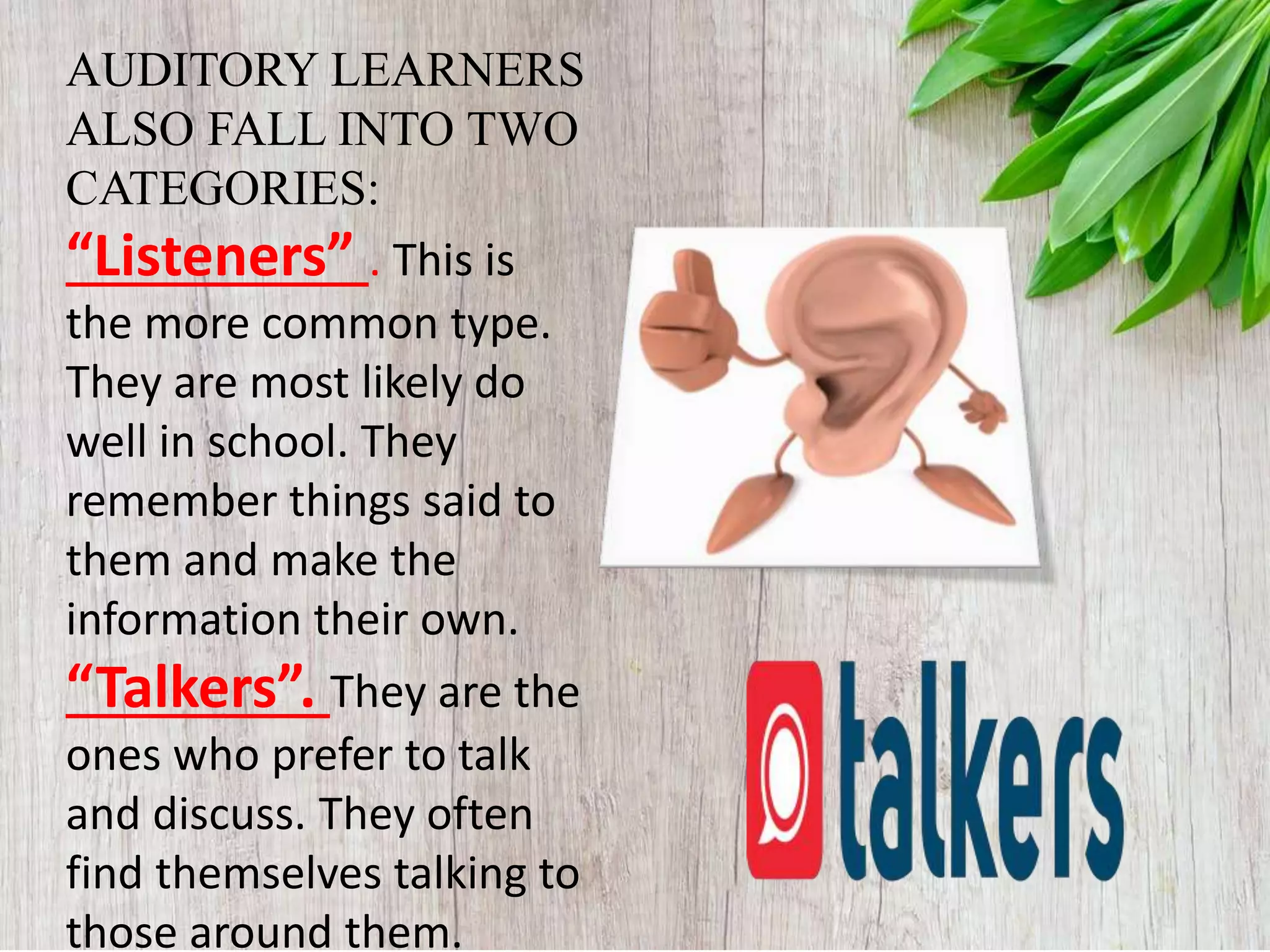
“Listeners” . This is
the more common type.
They are most likely do
well in school. They
remember things said to
them and make the
information their own.
“Talkers”. They are the
ones who prefer to talk
and discuss. They often
find themselves talking to
those around them.
10.
TACTILE / KINESTHETICLEARNERS.
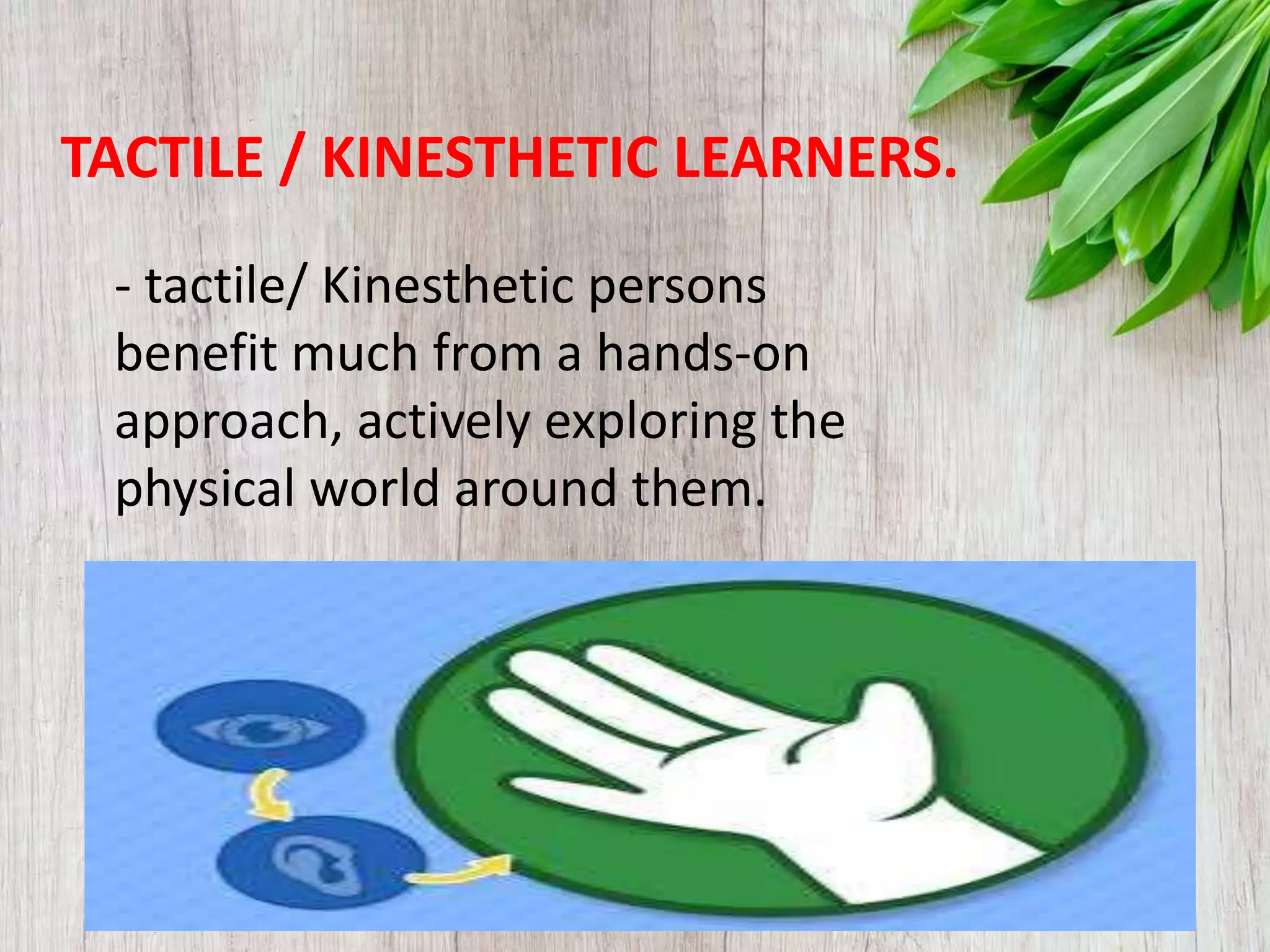
- tactile/ Kinesthetic persons
benefit much from a hands-on
approach, actively exploring the
physical world around them.



![Barcial [autosaved]](https://cdn.slidesharecdn.com/ss_thumbnails/barcialautosaved-121005013111-phpapp01-thumbnail.jpg?width=640&height=640&fit=bounds)


