Transfer of Learning
Prepared by:
Gracetyl Mae B. Calago
Loading . . . 20%30%60%80%100%
 Explain how transfer of learning occurs
 Identify the factors that affect transfer of learning
 Apply principles of transfer in facilitating transfer
of learning
Objectives
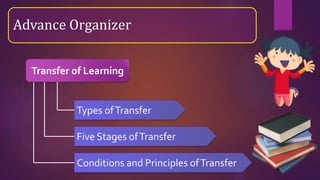
Advance Organizer
Transfer of Learning
Types ofTransfer
Conditions and Principles ofTransfer
Five Stages ofTransfer
 Refers to the ability to apply knowledge learned in
one context to new contexts (Bransford, Brown,
and Cocking 1999)
 Originally introduced as transfer of
practice by EdwardThorndike and Robert S.
Woodworth
(http://en.wikipedia.org/wiki/Transfer_of_learning)
Transfer of Learning
Transfer of learning occurs when the learner:
 recognizes common features among concepts,
skills, or principles
 links the information in memory
 sees the value of utilizing what was learned in
one situation in another
Transfer of Learning (cont.)
Knowledge of French may help the student learn
Spanish
Example
Learning to drive a car helps a person to later drive
a truck
Example
Learning mathematics prepares students to study
physics
Example
 If we did not transfer some of our prior
knowledge, then each new learning situation
would start from scratch.
Is transfer of learning important?
 Assumption of education: what is taught in a
course will be used in relevant situations in other
courses, in the workplace and out of school
Is transfer of learning important?
SOURCE: http://www.slideshare.net/FydaRahim/transfer-of-learning-29002564
 All new learning involves transfer based on
previous learning (Bransford, 41).
Is transfer of learning important?
Types of Transfer
Positive Transfer
Negative Transfer
Near Transfer
Far Transfer
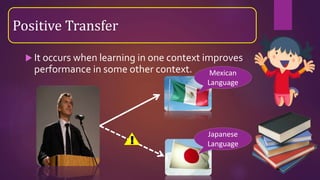
 It occurs when learning in one context improves
performance in some other context.
Positive Transfer
!
Japanese
Language
Mexican
Language
 It occurs when learning in one context impacts
negatively on performance in another.
Negative Transfer
Negative Transfer (cont.)
Example:
A student previously learned that when the
subject is singular, you will put an ‘s’ at the end of
the verb and when it is plural, you do not put an
‘s’ at the end of the verb. However, the subjects
‘I’ and ‘You’ do not follow the rule. If the student
have not learned the exception properly, he will
be adding an ‘s’ at the end of the verb.
 It refers to transfer between very similar contexts.
 Also referred to as specific transfer
Near Transfer

S4
S5
 It refers to transfer between contexts that, on
appearance, seem remote and alien to one
another.
 Also referred to as general transfer
Far Transfer
A chess player may apply basic strategies to
investment practices or policies
Far Transfer (cont.)
“… that almost magical link between classroom
performance and something which is supposed to
happen in the real world” – Swinney (1989)
“Transfer”
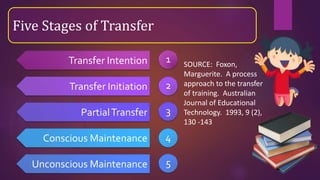
Five Stages of Transfer
Transfer Intention
Transfer Initiation
PartialTransfer
Conscious Maintenance
Unconscious Maintenance
1
2
3
4
5
SOURCE: Foxon,
Marguerite. A process
approach to the transfer
of training. Australian
Journal of Educational
Technology. 1993, 9 (2),
130 -143
 This is the end-of-course motivation of the
learner to apply aspects of the learning in
the work environment (Huczynski & Lewis,
1980; Noe, 1986).
Five Stages of Transfer (1st Stage)
Transfer Intention
 It refers to the attempts to apply any
aspect of the learning in the work
environment (Laker, 1990), and is a
necessary precursor to partial transfer
and transfer maintenance.
Five Stages of Transfer (2nd Stage)
Transfer Initiation
 It occurs when only some skills are
transferred.
Five Stages of Transfer (3rd Stage)
PartialTransfer
 In this stage, the learner makes a conscious
choice to use the skills whenever their use
is appropriate.
Five Stages of Transfer (4th Stage)
Conscious Maintenance
 In this stage, the skills have been integrated
into job behavior, and transfer has occurred
in full.
Five Stages of Transfer (5th Stage)
Unconscious Maintenance
Conditions and Principles of Transfer
Similarity between two learning situations
Degree of meaningfulness/relevance of learning
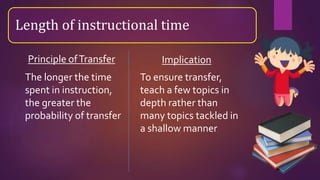
Length of instructional time
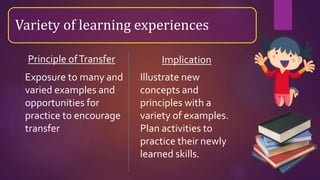
Variety of learning experiences
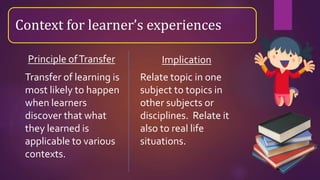
Context for learner’s experiences
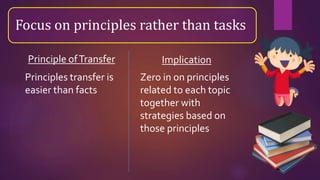
Focus on principles rather than tasks
Emphasis on metacognition
Similarity between two learning
situations
Principle ofTransfer Implication
The more similar the
two situations are, the
greater the chances
that learning from one
situation will be
transferred to the
other situation.
Involve students in
learning situations
and tasks that are
similar as possible to
the situations where
they would apply the
tasks.
Degree of meaningfulness/relevance
of learning
Meaningful learning
leads to greater
transfer than rote
learning
Remember to provide
opportunities for
learners to link new
material to what they
learned in the past.
Principle ofTransfer Implication
Length of instructional time
The longer the time
spent in instruction,
the greater the
probability of transfer
To ensure transfer,
teach a few topics in
depth rather than
many topics tackled in
a shallow manner
Principle ofTransfer Implication
Variety of learning experiences
Exposure to many and
varied examples and
opportunities for
practice to encourage
transfer
Illustrate new
concepts and
principles with a
variety of examples.
Plan activities to
practice their newly
learned skills.
Principle ofTransfer Implication
Context for learner’s experiences
Transfer of learning is
most likely to happen
when learners
discover that what
they learned is
applicable to various
contexts.
Relate topic in one
subject to topics in
other subjects or
disciplines. Relate it
also to real life
situations.
Principle ofTransfer Implication
Focus on principles rather than tasks
Principles transfer is
easier than facts
Zero in on principles
related to each topic
together with
strategies based on
those principles
Principle ofTransfer Implication
Emphasis on metacognition
Student reflection
improves transfer of
learning
Encourage students to
take responsibility for
their own learning,
and to reflect on what
they learned
Principle ofTransfer Implication
 What does transfer of learning mean?
 When can you say that transfer of learning has
occurred?
 Why is transfer of learning important?
 What are the types of transfer?
 What are the five stages of transfer?
 What are the conditions/factors that affect the
transfer of learning?
Summary
Thank you …

Transfer of learning

  • 1.
    Transfer of Learning Preparedby: Gracetyl Mae B. Calago Loading . . . 20%30%60%80%100%
  • 2.
     Explain howtransfer of learning occurs  Identify the factors that affect transfer of learning  Apply principles of transfer in facilitating transfer of learning Objectives
  • 3.
    Advance Organizer Transfer ofLearning Types ofTransfer Conditions and Principles ofTransfer Five Stages ofTransfer
  • 4.
     Refers tothe ability to apply knowledge learned in one context to new contexts (Bransford, Brown, and Cocking 1999)  Originally introduced as transfer of practice by EdwardThorndike and Robert S. Woodworth (http://en.wikipedia.org/wiki/Transfer_of_learning) Transfer of Learning
  • 5.
    Transfer of learningoccurs when the learner:  recognizes common features among concepts, skills, or principles  links the information in memory  sees the value of utilizing what was learned in one situation in another Transfer of Learning (cont.)
  • 6.
    Knowledge of Frenchmay help the student learn Spanish Example
  • 7.
    Learning to drivea car helps a person to later drive a truck Example
  • 8.
    Learning mathematics preparesstudents to study physics Example
  • 9.
     If wedid not transfer some of our prior knowledge, then each new learning situation would start from scratch. Is transfer of learning important?
  • 10.
     Assumption ofeducation: what is taught in a course will be used in relevant situations in other courses, in the workplace and out of school Is transfer of learning important? SOURCE: http://www.slideshare.net/FydaRahim/transfer-of-learning-29002564
  • 11.
     All newlearning involves transfer based on previous learning (Bransford, 41). Is transfer of learning important?
  • 12.
    Types of Transfer PositiveTransfer Negative Transfer Near Transfer Far Transfer
  • 13.
     It occurswhen learning in one context improves performance in some other context. Positive Transfer ! Japanese Language Mexican Language
  • 14.
     It occurswhen learning in one context impacts negatively on performance in another. Negative Transfer
  • 15.
    Negative Transfer (cont.) Example: Astudent previously learned that when the subject is singular, you will put an ‘s’ at the end of the verb and when it is plural, you do not put an ‘s’ at the end of the verb. However, the subjects ‘I’ and ‘You’ do not follow the rule. If the student have not learned the exception properly, he will be adding an ‘s’ at the end of the verb.
  • 16.
     It refersto transfer between very similar contexts.  Also referred to as specific transfer Near Transfer  S4 S5
  • 17.
     It refersto transfer between contexts that, on appearance, seem remote and alien to one another.  Also referred to as general transfer Far Transfer
  • 18.
    A chess playermay apply basic strategies to investment practices or policies Far Transfer (cont.)
  • 19.
    “… that almostmagical link between classroom performance and something which is supposed to happen in the real world” – Swinney (1989) “Transfer”
  • 20.
    Five Stages ofTransfer Transfer Intention Transfer Initiation PartialTransfer Conscious Maintenance Unconscious Maintenance 1 2 3 4 5 SOURCE: Foxon, Marguerite. A process approach to the transfer of training. Australian Journal of Educational Technology. 1993, 9 (2), 130 -143
  • 21.
     This isthe end-of-course motivation of the learner to apply aspects of the learning in the work environment (Huczynski & Lewis, 1980; Noe, 1986). Five Stages of Transfer (1st Stage) Transfer Intention
  • 22.
     It refersto the attempts to apply any aspect of the learning in the work environment (Laker, 1990), and is a necessary precursor to partial transfer and transfer maintenance. Five Stages of Transfer (2nd Stage) Transfer Initiation
  • 23.
     It occurswhen only some skills are transferred. Five Stages of Transfer (3rd Stage) PartialTransfer
  • 24.
     In thisstage, the learner makes a conscious choice to use the skills whenever their use is appropriate. Five Stages of Transfer (4th Stage) Conscious Maintenance
  • 25.
     In thisstage, the skills have been integrated into job behavior, and transfer has occurred in full. Five Stages of Transfer (5th Stage) Unconscious Maintenance
  • 26.
    Conditions and Principlesof Transfer Similarity between two learning situations Degree of meaningfulness/relevance of learning Length of instructional time Variety of learning experiences Context for learner’s experiences Focus on principles rather than tasks Emphasis on metacognition
  • 27.
    Similarity between twolearning situations Principle ofTransfer Implication The more similar the two situations are, the greater the chances that learning from one situation will be transferred to the other situation. Involve students in learning situations and tasks that are similar as possible to the situations where they would apply the tasks.
  • 28.
    Degree of meaningfulness/relevance oflearning Meaningful learning leads to greater transfer than rote learning Remember to provide opportunities for learners to link new material to what they learned in the past. Principle ofTransfer Implication
  • 29.
    Length of instructionaltime The longer the time spent in instruction, the greater the probability of transfer To ensure transfer, teach a few topics in depth rather than many topics tackled in a shallow manner Principle ofTransfer Implication
  • 30.
    Variety of learningexperiences Exposure to many and varied examples and opportunities for practice to encourage transfer Illustrate new concepts and principles with a variety of examples. Plan activities to practice their newly learned skills. Principle ofTransfer Implication
  • 31.
    Context for learner’sexperiences Transfer of learning is most likely to happen when learners discover that what they learned is applicable to various contexts. Relate topic in one subject to topics in other subjects or disciplines. Relate it also to real life situations. Principle ofTransfer Implication
  • 32.
    Focus on principlesrather than tasks Principles transfer is easier than facts Zero in on principles related to each topic together with strategies based on those principles Principle ofTransfer Implication
  • 33.
    Emphasis on metacognition Studentreflection improves transfer of learning Encourage students to take responsibility for their own learning, and to reflect on what they learned Principle ofTransfer Implication
  • 34.
     What doestransfer of learning mean?  When can you say that transfer of learning has occurred?  Why is transfer of learning important?  What are the types of transfer?  What are the five stages of transfer?  What are the conditions/factors that affect the transfer of learning? Summary
  • 35.