

The Trouble with
Transfer
How can we get students
to transfer learning
between contexts?
David Didau
R esearchED N at ional C onf erence
1 0 t h S e p t e m b e r 2 0 1 6
A definition of learning
Learning is:
• the long-term retention of knowledge and
skills and the ability to transfer between
contexts
Retention = durability
Transfer = flexibility
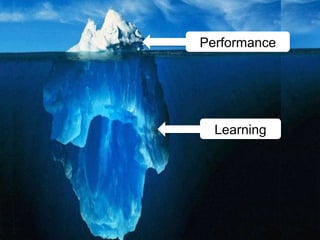
Performance
Learning
Warsaw
The trouble with transfer
“Unfortunately, what we learn does not
spontaneously or automatically generalise to
new contexts and so teachers need to
facilitate this process.”
Didau & Rose, (2016: 62)
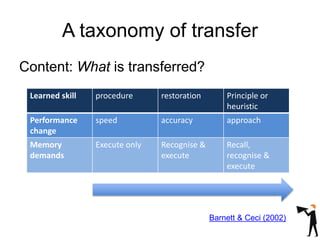
A taxonomy of transfer
Content: What is transferred?
Learned skill procedure restoration Principle or
heuristic
Performance
change
speed accuracy approach
Memory
demands
Execute only Recognise &
execute
Recall,
recognise &
execute
Barnett & Ceci (2002)
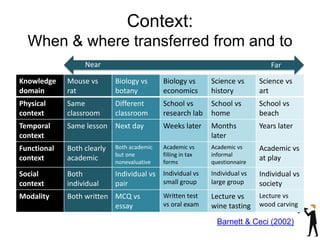
Context:
When & where transferred from and to
Barnett & Ceci (2002)
Knowledge
domain
Mouse vs
rat
Biology vs
botany
Biology vs
economics
Science vs
history
Science vs
art
Physical
context
Same
classroom
Different
classroom
School vs
research lab
School vs
home
School vs
beach
Temporal
context
Same lesson Next day Weeks later Months
later
Years later
Functional
context
Both clearly
academic
Both academic
but one
nonevaluative
Academic vs
filling in tax
forms
Academic vs
informal
questionnaire
Academic vs
at play
Social
context
Both
individual
Individual vs
pair
Individual vs
small group
Individual vs
large group
Individual vs
society
Modality Both written MCQ vs
essay
Written test
vs oral exam
Lecture vs
wine tasting
Lecture vs
wood carving
Near Far
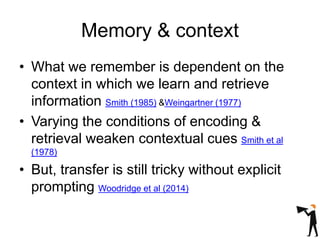
Memory & context
• What we remember is dependent on the
context in which we learn and retrieve
information Smith (1985) &Weingartner (1977)
• Varying the conditions of encoding &
retrieval weaken contextual cues Smith et al
(1978)
• But, transfer is still tricky without explicit
prompting Woodridge et al (2014)
How does learning transfer to new
situations?
• The transfer of knowledge
or skills to a novel problem requires both
knowledge of the problem’s context and a
deep understanding of the problem’s
underlying structure
Deans for Impact The Science of Learning
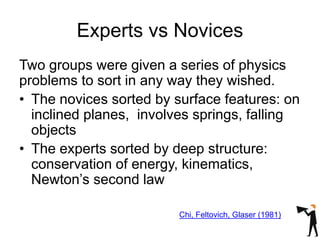
Experts vs Novices
Two groups were given a series of physics
problems to sort in any way they wished.
• The novices sorted by surface features: on
inclined planes, involves springs, falling
objects
• The experts sorted by deep structure:
conservation of energy, kinematics,
Newton’s second law
Chi, Feltovich, Glaser (1981)
4. How does learning transfer to new
situations?
• The transfer of knowledge
or skills to a novel problem requires both
knowledge of the problem’s context and a
deep understanding of the problem’s
underlying structure
• We understand new ideas via examples,
but it’s often hard
to see the unifying underlying concepts in
different examples
Deans for Impact The Science of Learning
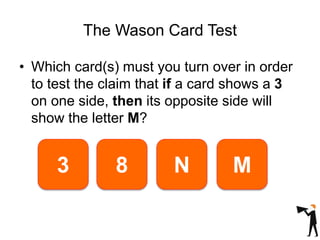
The Wason Card Test
• Which card(s) must you turn over in order
to test the claim that if a card shows a 3
on one side, then its opposite side will
show the letter M?
3 N8 M
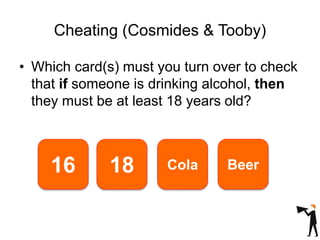
Cheating (Cosmides & Tooby)
• Which card(s) must you turn over to check
that if someone is drinking alcohol, then
they must be at least 18 years old?
16 Beer18 Cola
Flexible vs inflexible knowledge
“Knowledge is flexible when it can be
accessed out of the context in which it
was learned and applied in new
contexts.”
Dan Willingham
What we need to know
• Transfer can be facilitated by explicitly
telling students that they will need to
retrieve what they’re studying in a new
context
• Memory is context dependent – vary the
conditions of learning to weaken
dependencies
• The more you know, the easier it is to
transfer what you know
• Examples & narratives help
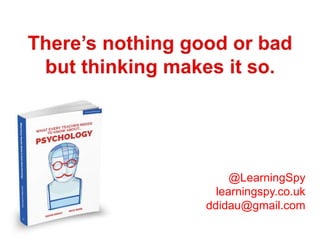
@LearningSpy
learningspy.co.uk
ddidau@gmail.com

ResearchED 2016 The Trouble with Transfer

  • 1.
    The Trouble with Transfer Howcan we get students to transfer learning between contexts? David Didau R esearchED N at ional C onf erence 1 0 t h S e p t e m b e r 2 0 1 6
  • 2.
    A definition oflearning Learning is: • the long-term retention of knowledge and skills and the ability to transfer between contexts Retention = durability Transfer = flexibility
  • 3.
  • 4.
  • 5.
    The trouble withtransfer “Unfortunately, what we learn does not spontaneously or automatically generalise to new contexts and so teachers need to facilitate this process.” Didau & Rose, (2016: 62)
  • 6.
    A taxonomy oftransfer Content: What is transferred? Learned skill procedure restoration Principle or heuristic Performance change speed accuracy approach Memory demands Execute only Recognise & execute Recall, recognise & execute Barnett & Ceci (2002)
  • 7.
    Context: When & wheretransferred from and to Barnett & Ceci (2002) Knowledge domain Mouse vs rat Biology vs botany Biology vs economics Science vs history Science vs art Physical context Same classroom Different classroom School vs research lab School vs home School vs beach Temporal context Same lesson Next day Weeks later Months later Years later Functional context Both clearly academic Both academic but one nonevaluative Academic vs filling in tax forms Academic vs informal questionnaire Academic vs at play Social context Both individual Individual vs pair Individual vs small group Individual vs large group Individual vs society Modality Both written MCQ vs essay Written test vs oral exam Lecture vs wine tasting Lecture vs wood carving Near Far
  • 8.
    Memory & context •What we remember is dependent on the context in which we learn and retrieve information Smith (1985) &Weingartner (1977) • Varying the conditions of encoding & retrieval weaken contextual cues Smith et al (1978) • But, transfer is still tricky without explicit prompting Woodridge et al (2014)
  • 9.
    How does learningtransfer to new situations? • The transfer of knowledge or skills to a novel problem requires both knowledge of the problem’s context and a deep understanding of the problem’s underlying structure Deans for Impact The Science of Learning
  • 10.
    Experts vs Novices Twogroups were given a series of physics problems to sort in any way they wished. • The novices sorted by surface features: on inclined planes, involves springs, falling objects • The experts sorted by deep structure: conservation of energy, kinematics, Newton’s second law Chi, Feltovich, Glaser (1981)
  • 11.
    4. How doeslearning transfer to new situations? • The transfer of knowledge or skills to a novel problem requires both knowledge of the problem’s context and a deep understanding of the problem’s underlying structure • We understand new ideas via examples, but it’s often hard to see the unifying underlying concepts in different examples Deans for Impact The Science of Learning
  • 12.
    The Wason CardTest • Which card(s) must you turn over in order to test the claim that if a card shows a 3 on one side, then its opposite side will show the letter M? 3 N8 M
  • 13.
    Cheating (Cosmides &Tooby) • Which card(s) must you turn over to check that if someone is drinking alcohol, then they must be at least 18 years old? 16 Beer18 Cola
  • 14.
    Flexible vs inflexibleknowledge “Knowledge is flexible when it can be accessed out of the context in which it was learned and applied in new contexts.” Dan Willingham
  • 15.
    What we needto know • Transfer can be facilitated by explicitly telling students that they will need to retrieve what they’re studying in a new context • Memory is context dependent – vary the conditions of learning to weaken dependencies • The more you know, the easier it is to transfer what you know • Examples & narratives help
  • 16.