Epistemology / Knowledge based theory of instructional design
Prepared by:
Soo Pei Zhi
P-QM0033/10
QIM 501 Instructional Design and Delivery
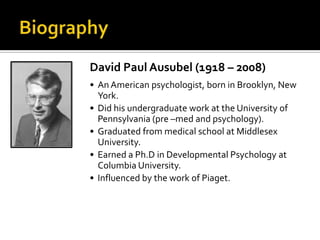
David Paul Ausubel (1918 – 2008)
• An American psychologist, born in Brooklyn, New
York.
• Did his undergraduate work at the University of
Pennsylvania (pre –med and psychology).
• Graduated from medical school at Middlesex
University.
• Earned a Ph.D in Developmental Psychology at
Columbia University.
• Influenced by the work of Piaget.
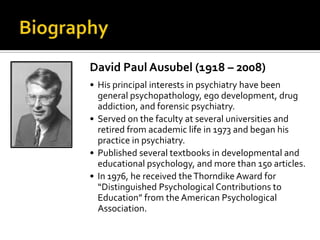
David Paul Ausubel (1918 – 2008)
• His principal interests in psychiatry have been
general psychopathology, ego development, drug
addiction, and forensic psychiatry.
• Served on the faculty at several universities and
retired from academic life in 1973 and began his
practice in psychiatry.
• Published several textbooks in developmental and
educational psychology, and more than 150 articles.
• In 1976, he received theThorndike Award for
“Distinguished Psychological Contributions to
Education” from the American Psychological
Association.
 During meaningful learning, the person “subsumes,” or organizes or
incorporates, new knowledge into old knowledge.
 Subsumption theory suggests that our mind has a way to subsume
information in a hierarchical or categorical manner if the new
information is linked/incorporated with prior knowledge/familiar
patterns.
 As a result prior knowledge is given absolute importance.
 Teachers are encouraged to teach prior knowledge first rather than new
information to help information subsume.
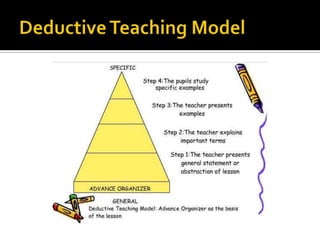
 Advance organizers provide concepts and principles to the students
directly in an organized format.
 The strategy of “advance organizers” basically means to classify/
categorize/ arrange (organize) information as you proceed (advance) to
the next complex level.
• The most general ideas of a subject should
be presented first and then progressively
differentiated in terms of detail and
specificity.
1
• Instructional materials should attempt to
integrate new material with previously
presented information through
comparisons and cross-referencing of new
and old ideas.
2
• Helps introduce a new lesson, unit, or course.
• Helps summarize major ideas in new lesson or unit.
• Based on student’s prior knowledge.
• Show similarities between old material and new material.
• Allows student to transfer or apply knowledge.
• Provides for structure for new information.
• Helps teach complex material that is similar to information learned
previously.
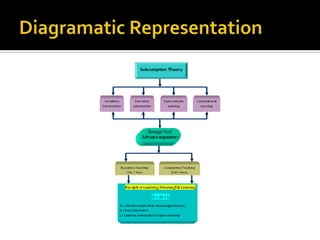
 Ausubel proposed four processes of meaningful
learning:
- Derivative subsumption
- Correlative subsumption
- Superordinate learning
- Combinatorial learning
 New material or relationships can be derived from the existing
structure. Information can be moved in the hierarchy, or linked to
other concepts or information to create new interpretations or
meaning.
• Suppose I have acquired a basic concept such as “tree” –
trunk, branches, green leaves, and may have some kind of
fruit.
• Now, I learn about a kind of tree that I have never learn
before “persimmon tree” – conforms to my previous
understanding of tree.
• My new knowledge of persimmon trees is attached to my
concept of tree, without substantially altering that concept in
any way.
• So, I had learned about the persimmon trees through the
process of derivative subsumption.
Example
(Stage 1)
 New material is an extension or elaboration of what is already
known.
• Suppose I encounter a new kind of tree that has red leaves,
rather than green.
• In order to accommodate this new information, I have to alter
or extend my concept of tree to include the possibility of red
leaves.
• I have learned about this new kind of tree through the
process of correlative subsumption.
• In a sense, you might say that this is more “valuable” learning
than of derivative subsumption, since it enriches the higher-
level concept.
Example
(Stage 2)
 An individual is able to give a lot of examples of the
concept but does not know the concept itself until it is
taught.
• Imagine that I was well acquainted with maples, oaks, apple
trees, etc., but I did not know, until I was taught, that these
were all examples of deciduous trees.
• In this case, I already knew a lot of examples of the
concept, but I did not know the concept itself until it was
taught to me.
• This is superordinate learning.
Example
(Stage 3)
 The first three learning processes all involve new information that
"attaches" to a hierarchy at a level that is either below or above
previously acquired knowledge. Combinatorial learning is
different; it describes a process by which the new idea is derived
from another idea that is neither higher nor lower in the
hierarchy, but at the same level.
• Now, suppose I learn about how fish eggs are fertilized.
• I might relate it to previously acquired knowledge about
pollination in plants.
• Both of the ideas are different, but it is related to the “process
of breeding”.
• You could think of this as learning by analogy.
Example
(Stage 4)
 Advance organizers are used to relate prior
information to new concepts.
 They are part of Ausubel's subsumption theory
that "contends that meaningful learning and
permanent retention of material is a function of
the stability of existing anchoring ideas"
(Applin).
 Can be classified : expository or comparative.
 While presenting new material.
 Use beginning of lesson.
 Presents several encompassing generalizations where detailed
contents will be added later.
• The teacher discuss the process of the absorption of water
and minerals into the plants through the tap and fibrous root
system.
Example
 Useful when the knowledge to be presented is new to learner.
 Compares new material with knowledge already known by
emphasizing the similarities between 2 types of material &
showing the information that is to be learnt.
 Ausubel’s teaching approach is deductive in nature.
• A teacher shows the similarities and differences among two
major root system, the tap root and the fibrous root system.Example
 Ausubel’s theory is concerned with how
individuals learn large amounts of meaningful
material from verbal/ textual (lecture/ books)
presentations in a school setting as opposed to
theories developed based on experimental
settings.
 Therefore, learning is based upon the kinds of
superordinate, representational, and
combinatorial processes that occur during the
presentation of information.
 Ivie, Stanley D. “Ausubel’s LearningTheory: An Approach to
Teaching Higher OrderThinking Skills,” High School Journal. Oct.
1998:Vol. 82,, i1, p.35.
 Cooper, S. (2009).Theories of Learning in Educational Psychology:
DavidAusubel: MeaningfulVerbal Learning & Subsumption
Theory. Retrieved on from http://www.lifecircles-
inc.com/Learningtheories/constructivism/ausubel.html
 Goconstructivism, (2007). David P. Ausubel. Retrieved from
http://goconstructivism.blogspot.com/2007/02/david-p-
ausubel.html
 Aziz, A,W. B., Razali, A. B., hasan, L. B. C., &Yunos,Y. A. B. M.
(2009). Cognitive learning theories and its implication on science
classroom teaching. Retrieved from
http://www.slideshare.net/niena17/learning-theory-by-ausubel
 Kearsley, G. (2009). SubsumptionTheory (D. Ausubel). Retrieved
from http://tip.psychology.org/ausubel.html

Subsumption theory by_david_paul_ausubel

  • 1.
    Epistemology / Knowledgebased theory of instructional design Prepared by: Soo Pei Zhi P-QM0033/10 QIM 501 Instructional Design and Delivery
  • 2.
    David Paul Ausubel(1918 – 2008) • An American psychologist, born in Brooklyn, New York. • Did his undergraduate work at the University of Pennsylvania (pre –med and psychology). • Graduated from medical school at Middlesex University. • Earned a Ph.D in Developmental Psychology at Columbia University. • Influenced by the work of Piaget.
  • 3.
    David Paul Ausubel(1918 – 2008) • His principal interests in psychiatry have been general psychopathology, ego development, drug addiction, and forensic psychiatry. • Served on the faculty at several universities and retired from academic life in 1973 and began his practice in psychiatry. • Published several textbooks in developmental and educational psychology, and more than 150 articles. • In 1976, he received theThorndike Award for “Distinguished Psychological Contributions to Education” from the American Psychological Association.
  • 4.
     During meaningfullearning, the person “subsumes,” or organizes or incorporates, new knowledge into old knowledge.  Subsumption theory suggests that our mind has a way to subsume information in a hierarchical or categorical manner if the new information is linked/incorporated with prior knowledge/familiar patterns.  As a result prior knowledge is given absolute importance.  Teachers are encouraged to teach prior knowledge first rather than new information to help information subsume.  Advance organizers provide concepts and principles to the students directly in an organized format.  The strategy of “advance organizers” basically means to classify/ categorize/ arrange (organize) information as you proceed (advance) to the next complex level.
  • 5.
    • The mostgeneral ideas of a subject should be presented first and then progressively differentiated in terms of detail and specificity. 1 • Instructional materials should attempt to integrate new material with previously presented information through comparisons and cross-referencing of new and old ideas. 2
  • 6.
    • Helps introducea new lesson, unit, or course. • Helps summarize major ideas in new lesson or unit. • Based on student’s prior knowledge. • Show similarities between old material and new material. • Allows student to transfer or apply knowledge. • Provides for structure for new information. • Helps teach complex material that is similar to information learned previously.
  • 8.
     Ausubel proposedfour processes of meaningful learning: - Derivative subsumption - Correlative subsumption - Superordinate learning - Combinatorial learning
  • 9.
     New materialor relationships can be derived from the existing structure. Information can be moved in the hierarchy, or linked to other concepts or information to create new interpretations or meaning. • Suppose I have acquired a basic concept such as “tree” – trunk, branches, green leaves, and may have some kind of fruit. • Now, I learn about a kind of tree that I have never learn before “persimmon tree” – conforms to my previous understanding of tree. • My new knowledge of persimmon trees is attached to my concept of tree, without substantially altering that concept in any way. • So, I had learned about the persimmon trees through the process of derivative subsumption. Example (Stage 1)
  • 10.
     New materialis an extension or elaboration of what is already known. • Suppose I encounter a new kind of tree that has red leaves, rather than green. • In order to accommodate this new information, I have to alter or extend my concept of tree to include the possibility of red leaves. • I have learned about this new kind of tree through the process of correlative subsumption. • In a sense, you might say that this is more “valuable” learning than of derivative subsumption, since it enriches the higher- level concept. Example (Stage 2)
  • 11.
     An individualis able to give a lot of examples of the concept but does not know the concept itself until it is taught. • Imagine that I was well acquainted with maples, oaks, apple trees, etc., but I did not know, until I was taught, that these were all examples of deciduous trees. • In this case, I already knew a lot of examples of the concept, but I did not know the concept itself until it was taught to me. • This is superordinate learning. Example (Stage 3)
  • 12.
     The firstthree learning processes all involve new information that "attaches" to a hierarchy at a level that is either below or above previously acquired knowledge. Combinatorial learning is different; it describes a process by which the new idea is derived from another idea that is neither higher nor lower in the hierarchy, but at the same level. • Now, suppose I learn about how fish eggs are fertilized. • I might relate it to previously acquired knowledge about pollination in plants. • Both of the ideas are different, but it is related to the “process of breeding”. • You could think of this as learning by analogy. Example (Stage 4)
  • 13.
     Advance organizersare used to relate prior information to new concepts.  They are part of Ausubel's subsumption theory that "contends that meaningful learning and permanent retention of material is a function of the stability of existing anchoring ideas" (Applin).  Can be classified : expository or comparative.
  • 14.
     While presentingnew material.  Use beginning of lesson.  Presents several encompassing generalizations where detailed contents will be added later. • The teacher discuss the process of the absorption of water and minerals into the plants through the tap and fibrous root system. Example
  • 15.
     Useful whenthe knowledge to be presented is new to learner.  Compares new material with knowledge already known by emphasizing the similarities between 2 types of material & showing the information that is to be learnt.  Ausubel’s teaching approach is deductive in nature. • A teacher shows the similarities and differences among two major root system, the tap root and the fibrous root system.Example
  • 17.
     Ausubel’s theoryis concerned with how individuals learn large amounts of meaningful material from verbal/ textual (lecture/ books) presentations in a school setting as opposed to theories developed based on experimental settings.  Therefore, learning is based upon the kinds of superordinate, representational, and combinatorial processes that occur during the presentation of information.
  • 18.
     Ivie, StanleyD. “Ausubel’s LearningTheory: An Approach to Teaching Higher OrderThinking Skills,” High School Journal. Oct. 1998:Vol. 82,, i1, p.35.  Cooper, S. (2009).Theories of Learning in Educational Psychology: DavidAusubel: MeaningfulVerbal Learning & Subsumption Theory. Retrieved on from http://www.lifecircles- inc.com/Learningtheories/constructivism/ausubel.html  Goconstructivism, (2007). David P. Ausubel. Retrieved from http://goconstructivism.blogspot.com/2007/02/david-p- ausubel.html  Aziz, A,W. B., Razali, A. B., hasan, L. B. C., &Yunos,Y. A. B. M. (2009). Cognitive learning theories and its implication on science classroom teaching. Retrieved from http://www.slideshare.net/niena17/learning-theory-by-ausubel  Kearsley, G. (2009). SubsumptionTheory (D. Ausubel). Retrieved from http://tip.psychology.org/ausubel.html