Transfer
   of
Learning
 It is the ability to take
understanding acquired
in one context and apply
it to a different context.
 It occurs when
previous learning affects
current performance.
What is meant by the transfer of
          learning?


  When we talk about the transfer of learning
we are interested in the extent to which
learning is transferred from one context to
another. Transfer of training is often used
synonymously with transfer of learning.
Within this book transfer of training is
considered a subset of transfer of learning.
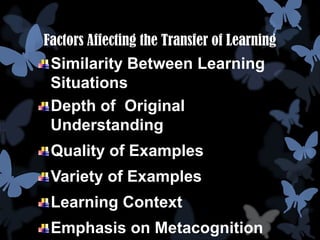
Factors Affecting the Transfer of Learning
 Similarity Between Learning
 Situations
 Depth of Original
 Understanding
 Quality of Examples
 Variety of Examples
 Learning Context
 Emphasis on Metacognition
Positive transfer
 • occurs when the solution of an
earlier problem facilitates solution of a
later problem.
Negative transfer
 • occurs when the solution of an
earlier problem impedes solution of a
later problem.
Other Types
of Transfer
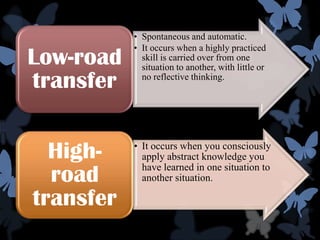
• Spontaneous and automatic.
           • It occurs when a highly practiced
Low-road     skill is carried over from one
             situation to another, with little or
transfer     no reflective thinking.


  High-    • It occurs when you consciously
             apply abstract knowledge you

  road       have learned in one situation to
             another situation.

transfer
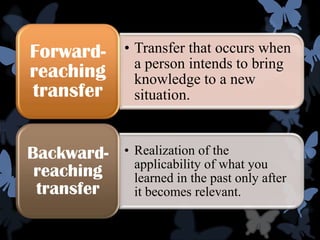
Forward-    • Transfer that occurs when
              a person intends to bring
reaching      knowledge to a new
transfer      situation.


Backward-   • Realization of the
              applicability of what you
 reaching     learned in the past only after
 transfer     it becomes relevant.
The Meaning of Transfer in
          Teaching

Example:
A simple case of transfer would be the
following:
  A pupil learns            4 x 9 = 36
  This should help him learn 9   x 4 =36
  And                       40 x 90 = 3600
These simple feats of transfer,
which to the reader may appear
as being close to identities are
not always easy for the beginner.
Common Misconceptions
     about Transfer

The first and most common error in thinking
about transfer is that it takes place through a
process of “formal discipline.”
The second misconception is just the opposite of
the first, and probably grew up as a reaction
against it. This is the notion that nothing transfers
from one situation to another except specific facts
or definite identities.
Common Misconceptions
     about Transfer

A third error which emasculates the effect of
teaching nearly as much as the first two, is the
notion that transfer of learning is automatic.
Finally, the emphasis which books about learning
and psychology have given to the topic of transfer
has tended to create the impression that somehow
transfer and learning are different.
Teaching
   for
Transfer
Ways teachers can promote
student’s transfer of knowledge
          and training

  Meaningfulness


  Encoding Specificity


  Organization


  Discrimination
List of suggestions which should form
  the basis of teaching for transfer:


 Have clear-cut objectives.
 Study the course content to find what it contains
 that is applicable to other school subjects and to
 out-of-school life.
 Select instructional materials which are best suited
 to the job of making relationships apparent.
 Let students know when to expect tranfer, what
 kinds to expect, and the benefits which it can bring
 them.
Use methods of teaching which will facilitate
transfer.
Provide practice in transfer. It is not enough to
point out relationships. Students should be
given practice in finding relationships on their
own. Tests of application, guided discussion,
and actual class projects ought to provide this
kind of experience.
Concentrate on the process of learning as well
as upon products. Do not be satisfied with a
right answer or solution, but probe to find out
why a certain answer was given, and discuss
with the class the steps which led to their
answers.
Group 8
 Members:
   Kimberly Cecogo
   Bea Kristia Rebuton
   Ma. Regina Valencia


 BSPS 2A
References
Books
 Eggen, P., Kauchak, D. (2010). Educational
  Psychology, 8th Edition. New Jersey: Pearson
  Education, Inc.
 Di Vesta, F., Thompson, G. (1970). Educational
  Psychology Instruction and Behavioral Change.
  New York: Meredith Corp.
Internet
 http://www.mondofacto.com/facts/dictionary?tran
  sfer+of+learning
 http://learnweb.harvard.edu/alps/thinking/docs/tr
  aencyn.htm

Transfer of learning

  • 1.
    Transfer of Learning
  • 2.
     It isthe ability to take understanding acquired in one context and apply it to a different context.  It occurs when previous learning affects current performance.
  • 3.
    What is meantby the transfer of learning? When we talk about the transfer of learning we are interested in the extent to which learning is transferred from one context to another. Transfer of training is often used synonymously with transfer of learning. Within this book transfer of training is considered a subset of transfer of learning.
  • 5.
    Factors Affecting theTransfer of Learning Similarity Between Learning Situations Depth of Original Understanding Quality of Examples Variety of Examples Learning Context Emphasis on Metacognition
  • 7.
    Positive transfer •occurs when the solution of an earlier problem facilitates solution of a later problem. Negative transfer • occurs when the solution of an earlier problem impedes solution of a later problem.
  • 8.
  • 9.
    • Spontaneous andautomatic. • It occurs when a highly practiced Low-road skill is carried over from one situation to another, with little or transfer no reflective thinking. High- • It occurs when you consciously apply abstract knowledge you road have learned in one situation to another situation. transfer
  • 10.
    Forward- • Transfer that occurs when a person intends to bring reaching knowledge to a new transfer situation. Backward- • Realization of the applicability of what you reaching learned in the past only after transfer it becomes relevant.
  • 11.
    The Meaning ofTransfer in Teaching Example: A simple case of transfer would be the following: A pupil learns 4 x 9 = 36 This should help him learn 9 x 4 =36 And 40 x 90 = 3600
  • 12.
    These simple featsof transfer, which to the reader may appear as being close to identities are not always easy for the beginner.
  • 13.
    Common Misconceptions about Transfer The first and most common error in thinking about transfer is that it takes place through a process of “formal discipline.” The second misconception is just the opposite of the first, and probably grew up as a reaction against it. This is the notion that nothing transfers from one situation to another except specific facts or definite identities.
  • 14.
    Common Misconceptions about Transfer A third error which emasculates the effect of teaching nearly as much as the first two, is the notion that transfer of learning is automatic. Finally, the emphasis which books about learning and psychology have given to the topic of transfer has tended to create the impression that somehow transfer and learning are different.
  • 15.
    Teaching for Transfer
  • 16.
    Ways teachers canpromote student’s transfer of knowledge and training Meaningfulness Encoding Specificity Organization Discrimination
  • 17.
    List of suggestionswhich should form the basis of teaching for transfer: Have clear-cut objectives. Study the course content to find what it contains that is applicable to other school subjects and to out-of-school life. Select instructional materials which are best suited to the job of making relationships apparent. Let students know when to expect tranfer, what kinds to expect, and the benefits which it can bring them.
  • 18.
    Use methods ofteaching which will facilitate transfer. Provide practice in transfer. It is not enough to point out relationships. Students should be given practice in finding relationships on their own. Tests of application, guided discussion, and actual class projects ought to provide this kind of experience. Concentrate on the process of learning as well as upon products. Do not be satisfied with a right answer or solution, but probe to find out why a certain answer was given, and discuss with the class the steps which led to their answers.
  • 19.
    Group 8 Members: Kimberly Cecogo Bea Kristia Rebuton Ma. Regina Valencia BSPS 2A
  • 20.
    References Books  Eggen, P.,Kauchak, D. (2010). Educational Psychology, 8th Edition. New Jersey: Pearson Education, Inc.  Di Vesta, F., Thompson, G. (1970). Educational Psychology Instruction and Behavioral Change. New York: Meredith Corp. Internet  http://www.mondofacto.com/facts/dictionary?tran sfer+of+learning  http://learnweb.harvard.edu/alps/thinking/docs/tr aencyn.htm