From Genes to Proteins Transcription
Ch. 17
Sections 17.1, 17.2, & 17.3
To aid in your notetaking…
Key vocabulary terms are in
orange, bold font and underlined
Overview of Concepts
1. The information in DNA is in the
sequence of nucleotides
2. Transcription is the production of RNA
1. There are several types of RNA
2. mRNA is the transcribed code for a protein
based on the DNA

3. mRNA is modified in eukaryotic cells
before it is functional
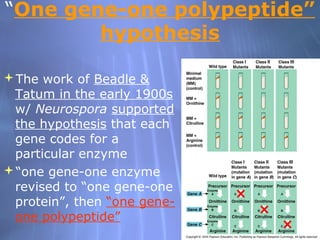
“One gene-one polypeptide”
hypothesis
The work of Beadle &
Tatum in the early 1900s
w/ Neurospora supported
the hypothesis that each
gene codes for a
particular enzyme
“one gene-one enzyme
revised to “one gene-one
protein”, then “one geneone polypeptide”
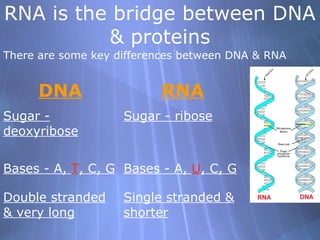
RNA is the bridge between DNA
& proteins
There are some key differences between DNA & RNA

DNA
Sugar deoxyribose

RNA
Sugar - ribose

Bases - A, T, C, G Bases - A, U, C, G
Double stranded
& very long

Single stranded &
shorter
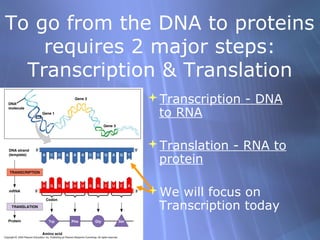
To go from the DNA to proteins
requires 2 major steps:
Transcription & Translation
Transcription - DNA
to RNA
Translation - RNA to
protein
We will focus on
Transcription today
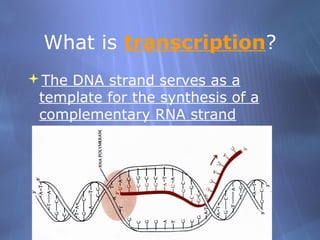
What is transcription?
The DNA strand serves as a
template for the synthesis of a
complementary RNA strand
Why can’t we just go straight
from DNA to proteins?
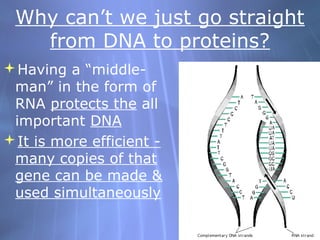
Having a “middleman” in the form of
RNA protects the all
important DNA
It is more efficient many copies of that
gene can be made &
used simultaneously
Quick Think
What is transcription and why
is it important in the
synthesis of proteins?
Prokaryotes vs. Eukaryotes
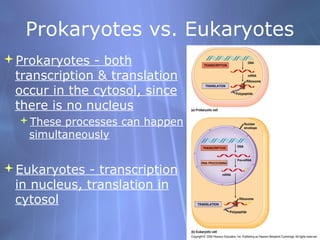
Prokaryotes - both
transcription & translation
occur in the cytosol, since
there is no nucleus
These processes can happen
simultaneously

Eukaryotes - transcription
in nucleus, translation in
cytosol
The synthesis of mRNA
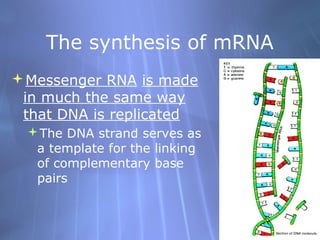
Messenger RNA is made
in much the same way
that DNA is replicated
The DNA strand serves as
a template for the linking
of complementary base
pairs
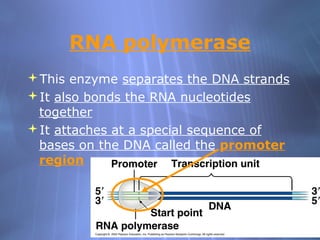
RNA polymerase
This enzyme separates the DNA strands
It also bonds the RNA nucleotides
together
It attaches at a special sequence of
bases on the DNA called the promoter
region
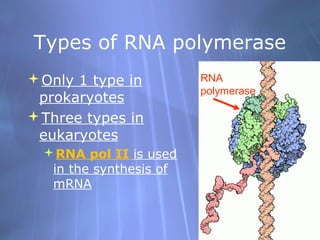
Types of RNA polymerase
Only 1 type in
prokaryotes
Three types in
eukaryotes
RNA pol II is used
in the synthesis of
mRNA

RNA
polymerase
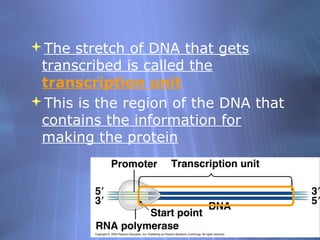
The stretch of DNA that gets
transcribed is called the
transcription unit
This is the region of the DNA that
contains the information for
making the protein
Quick Think

How does the process
of transcription begin?
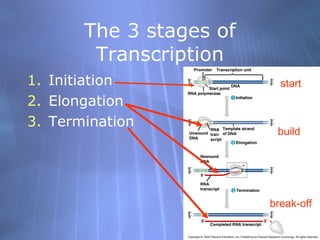
The 3 stages of
Transcription
1. Initiation
2. Elongation
3. Termination

start

build

break-off
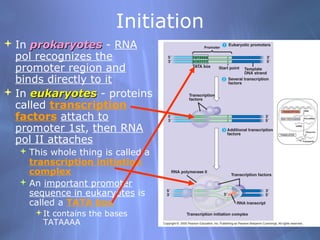
Initiation
 In prokaryotes - RNA
pol recognizes the
promoter region and
binds directly to it
 In eukaryotes - proteins
called transcription
factors attach to
promoter 1st, then RNA
pol II attaches
 This whole thing is called a
transcription initiation
complex
 An important promoter
sequence in eukaryotes is
called a TATA box
It contains the bases
TATAAAA
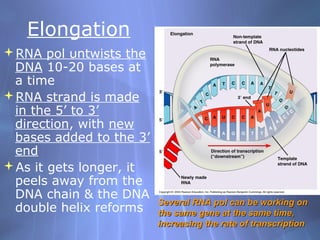
Elongation
RNA pol untwists the
DNA 10-20 bases at
a time
RNA strand is made
in the 5’ to 3’
direction, with new
bases added to the 3’
end
As it gets longer, it
peels away from the
DNA chain & the DNA
double helix reforms

Several RNA pol can be working on
the same gene at the same time,
increasing the rate of transcription
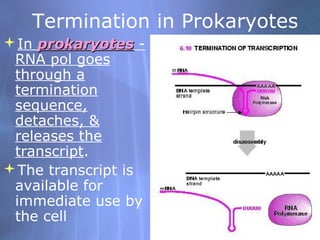
Termination in Prokaryotes
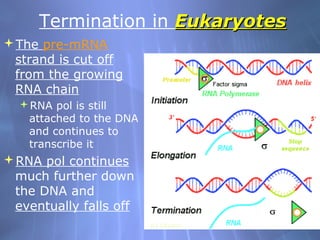
In prokaryotes RNA pol goes
through a
termination
sequence,
detaches, &
releases the
transcript.
The transcript is
available for
immediate use by
the cell
Quick Write
Describe the process of
transcription, including the 3
stages, in prokaryotes
Termination in Eukaryotes
The pre-mRNA
strand is cut off
from the growing
RNA chain
RNA pol is still
attached to the DNA
and continues to
transcribe it

RNA pol continues
much further down
the DNA and
eventually falls off
Quick Write
How is termination of transcription
different in prokaryotes versus
eukaryotes?
eukaryotes
Modification of the mRNA in
eukaryotes
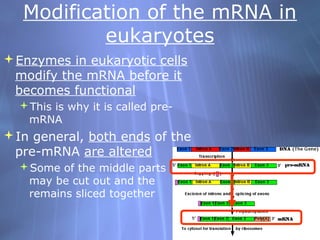
Enzymes in eukaryotic cells
modify the mRNA before it
becomes functional
This is why it is called premRNA

In general, both ends of the
pre-mRNA are altered
Some of the middle parts
may be cut out and the
remains sliced together
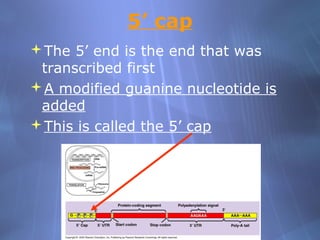
5’ cap
The 5’ end is the end that was
transcribed first
A modified guanine nucleotide is
added
This is called the 5’ cap
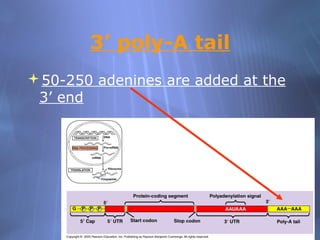
3’ poly-A tail
50-250 adenines are added at the
3’ end
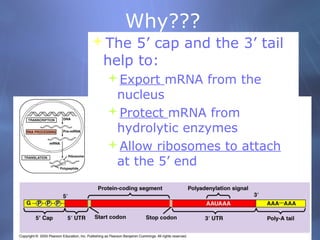
Why???
The 5’ cap and the 3’ tail
help to:
Export mRNA from the
nucleus
Protect mRNA from
hydrolytic enzymes
Allow ribosomes to attach
at the 5’ end
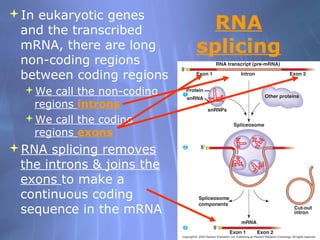
In eukaryotic genes
and the transcribed
mRNA, there are long
non-coding regions
between coding regions
We call
regions
We call
regions

the non-coding
introns
the coding
exons

RNA splicing removes
the introns & joins the
exons to make a
continuous coding
sequence in the mRNA

RNA
splicing
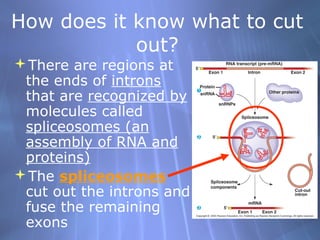
How does it know what to cut
out?
There are regions at
the ends of introns
that are recognized by
molecules called
spliceosomes (an
assembly of RNA and
proteins)
The spliceosomes
cut out the introns and
fuse the remaining
exons
Quick Write
What are some ways the RNA is
modified before it is translated in
eukaryotic cells?
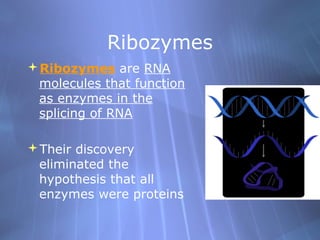
Ribozymes
Ribozymes are RNA
molecules that function
as enzymes in the
splicing of RNA
Their discovery
eliminated the
hypothesis that all
enzymes were proteins
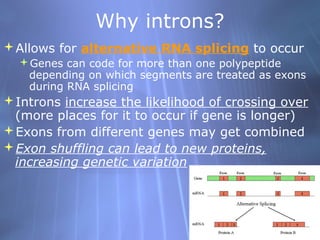
Why introns?
Allows for alternative RNA splicing to occur
Genes can code for more than one polypeptide
depending on which segments are treated as exons
during RNA splicing

Introns increase the likelihood of crossing over
(more places for it to occur if gene is longer)
Exons from different genes may get combined
Exon shuffling can lead to new proteins,
increasing genetic variation
Quick Write
How is the functional mRNA
different from the DNA template
that was used to produce it?
Think of as many differences as
you can. I can think of at least 7
differences.

AP Bio Ch 17 part 1 translation

  • 1.
    From Genes toProteins Transcription Ch. 17 Sections 17.1, 17.2, & 17.3
  • 2.
    To aid inyour notetaking… Key vocabulary terms are in orange, bold font and underlined
  • 3.
    Overview of Concepts 1.The information in DNA is in the sequence of nucleotides 2. Transcription is the production of RNA 1. There are several types of RNA 2. mRNA is the transcribed code for a protein based on the DNA 3. mRNA is modified in eukaryotic cells before it is functional
  • 4.
    “One gene-one polypeptide” hypothesis Thework of Beadle & Tatum in the early 1900s w/ Neurospora supported the hypothesis that each gene codes for a particular enzyme “one gene-one enzyme revised to “one gene-one protein”, then “one geneone polypeptide”
  • 5.
    RNA is thebridge between DNA & proteins There are some key differences between DNA & RNA DNA Sugar deoxyribose RNA Sugar - ribose Bases - A, T, C, G Bases - A, U, C, G Double stranded & very long Single stranded & shorter
  • 6.
    To go fromthe DNA to proteins requires 2 major steps: Transcription & Translation Transcription - DNA to RNA Translation - RNA to protein We will focus on Transcription today
  • 7.
    What is transcription? TheDNA strand serves as a template for the synthesis of a complementary RNA strand
  • 8.
    Why can’t wejust go straight from DNA to proteins? Having a “middleman” in the form of RNA protects the all important DNA It is more efficient many copies of that gene can be made & used simultaneously
  • 9.
    Quick Think What istranscription and why is it important in the synthesis of proteins?
  • 10.
    Prokaryotes vs. Eukaryotes Prokaryotes- both transcription & translation occur in the cytosol, since there is no nucleus These processes can happen simultaneously Eukaryotes - transcription in nucleus, translation in cytosol
  • 11.
    The synthesis ofmRNA Messenger RNA is made in much the same way that DNA is replicated The DNA strand serves as a template for the linking of complementary base pairs
  • 12.
    RNA polymerase This enzymeseparates the DNA strands It also bonds the RNA nucleotides together It attaches at a special sequence of bases on the DNA called the promoter region
  • 13.
    Types of RNApolymerase Only 1 type in prokaryotes Three types in eukaryotes RNA pol II is used in the synthesis of mRNA RNA polymerase
  • 14.
    The stretch ofDNA that gets transcribed is called the transcription unit This is the region of the DNA that contains the information for making the protein
  • 15.
    Quick Think How doesthe process of transcription begin?
  • 16.
    The 3 stagesof Transcription 1. Initiation 2. Elongation 3. Termination start build break-off
  • 17.
    Initiation  In prokaryotes- RNA pol recognizes the promoter region and binds directly to it  In eukaryotes - proteins called transcription factors attach to promoter 1st, then RNA pol II attaches  This whole thing is called a transcription initiation complex  An important promoter sequence in eukaryotes is called a TATA box It contains the bases TATAAAA
  • 18.
    Elongation RNA pol untwiststhe DNA 10-20 bases at a time RNA strand is made in the 5’ to 3’ direction, with new bases added to the 3’ end As it gets longer, it peels away from the DNA chain & the DNA double helix reforms Several RNA pol can be working on the same gene at the same time, increasing the rate of transcription
  • 19.
    Termination in Prokaryotes Inprokaryotes RNA pol goes through a termination sequence, detaches, & releases the transcript. The transcript is available for immediate use by the cell
  • 20.
    Quick Write Describe theprocess of transcription, including the 3 stages, in prokaryotes
  • 21.
    Termination in Eukaryotes Thepre-mRNA strand is cut off from the growing RNA chain RNA pol is still attached to the DNA and continues to transcribe it RNA pol continues much further down the DNA and eventually falls off
  • 22.
    Quick Write How istermination of transcription different in prokaryotes versus eukaryotes? eukaryotes
  • 23.
    Modification of themRNA in eukaryotes Enzymes in eukaryotic cells modify the mRNA before it becomes functional This is why it is called premRNA In general, both ends of the pre-mRNA are altered Some of the middle parts may be cut out and the remains sliced together
  • 24.
    5’ cap The 5’end is the end that was transcribed first A modified guanine nucleotide is added This is called the 5’ cap
  • 25.
    3’ poly-A tail 50-250adenines are added at the 3’ end
  • 26.
    Why??? The 5’ capand the 3’ tail help to: Export mRNA from the nucleus Protect mRNA from hydrolytic enzymes Allow ribosomes to attach at the 5’ end
  • 27.
    In eukaryotic genes andthe transcribed mRNA, there are long non-coding regions between coding regions We call regions We call regions the non-coding introns the coding exons RNA splicing removes the introns & joins the exons to make a continuous coding sequence in the mRNA RNA splicing
  • 28.
    How does itknow what to cut out? There are regions at the ends of introns that are recognized by molecules called spliceosomes (an assembly of RNA and proteins) The spliceosomes cut out the introns and fuse the remaining exons
  • 29.
    Quick Write What aresome ways the RNA is modified before it is translated in eukaryotic cells?
  • 30.
    Ribozymes Ribozymes are RNA moleculesthat function as enzymes in the splicing of RNA Their discovery eliminated the hypothesis that all enzymes were proteins
  • 31.
    Why introns? Allows foralternative RNA splicing to occur Genes can code for more than one polypeptide depending on which segments are treated as exons during RNA splicing Introns increase the likelihood of crossing over (more places for it to occur if gene is longer) Exons from different genes may get combined Exon shuffling can lead to new proteins, increasing genetic variation
  • 32.
    Quick Write How isthe functional mRNA different from the DNA template that was used to produce it? Think of as many differences as you can. I can think of at least 7 differences.