Transcription
Presented by: Ahtisham Ali
Riphah International University
INTRODUCTION:
The copying process, during which a DNA strand serves
as a template for the synthesis of RNA, is called
transcription.
Transcription produces messenger RNAs (mRNAs) that
are translated into sequences of amino acids,
polypeptide chains or proteins.
PROCESS:
 The process of transcription of a typical gene can be
divided into three phases:
• Initiation
• Elongation
• Termination
RNA Polymerase:
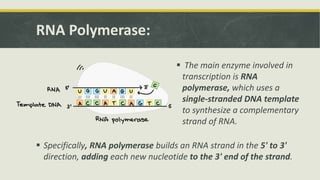
 The main enzyme involved in
transcription is RNA
polymerase, which uses a
single-stranded DNA template
to synthesize a complementary
strand of RNA.
 Specifically, RNA polymerase builds an RNA strand in the 5' to 3'
direction, adding each new nucleotide to the 3' end of the strand.
Properties of RNA Polymerase:
 RNA Polymerase is a multi-subunit enzyme that recognizes
a nucleotide sequence (the promoter region) at the
beginning of a length of DNA that is to be transcribed.
 It next makes a complementary RNA copy of the DNA
template strand.
 Then recognizes the end of the DNA sequence to be
transcribed (the termination region).
“RNA polymerase binds to a
sequence of DNA called
the promoter region, found near
the beginning of a gene”.
INITIATION
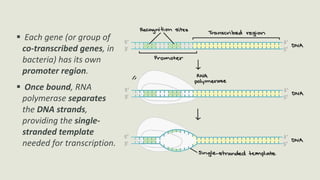
Initiation Process: Each gene (or group of
co-transcribed genes, in
bacteria) has its own
promoter region.
 Once bound, RNA
polymerase separates
the DNA strands,
providing the single-
stranded template
needed for transcription.
Promotor Regions:
 –35 Sequence:
A consensus sequence (5'-TTGACA-3'),
centered about 35 bases to the left of
the transcription start site is the initial
point of contact for the holoenzyme
and a closed complex is formed.
 Pribnow Box:
The holoenzyme moves and
covers a second consensus
sequence (5'-TATAAT-3'),
centered at about –10,
which is the site of initial
DNA melting (unwinding).
“Melting of a short stretch
(about 14 bases) converts the
closed complex to an open
complex known as a
transcription bubble.”
ELONGATION
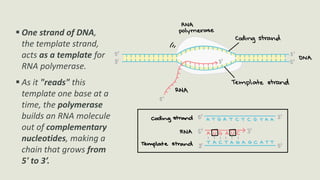
 One strand of DNA,
the template strand,
acts as a template for
RNA polymerase.
 As it "reads" this
template one base at a
time, the polymerase
builds an RNA molecule
out of complementary
nucleotides, making a
chain that grows from
5' to 3’.
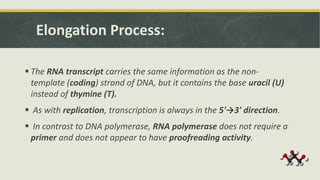
Elongation Process:
 The RNA transcript carries the same information as the non-
template (coding) strand of DNA, but it contains the base uracil (U)
instead of thymine (T).
 As with replication, transcription is always in the 5'→3' direction.
 In contrast to DNA polymerase, RNA polymerase does not require a
primer and does not appear to have proofreading activity.
“The elongation of the single-
stranded RNA chain continues
until a termination signal is
reached.”
TERMINATION
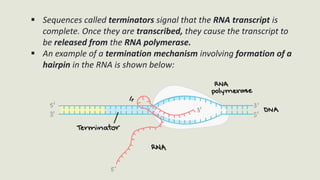
 Sequences called terminators signal that the RNA transcript is
complete. Once they are transcribed, they cause the transcript to
be released from the RNA polymerase.
 An example of a termination mechanism involving formation of a
hairpin in the RNA is shown below:
Eukaryotic Modifications:
 In bacteria, RNA transcripts can act as messenger
RNAs (mRNAs) right away. In eukaryotes, the transcript of a
protein-coding gene is called a pre-mRNA and must go through
extra processing before it can direct translation.
 Eukaryotic pre-mRNAs must have their ends modified, by
addition of a 5' cap (at the beginning) and 3' poly-A tail (at the
end).
 Each eukaryotic RNA polymerase has its own promoters and TFs
that bind core promoter sequences.
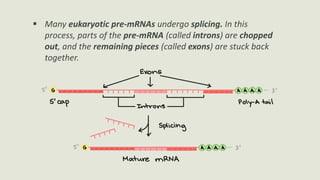
 Many eukaryotic pre-mRNAs undergo splicing. In this
process, parts of the pre-mRNA (called introns) are chopped
out, and the remaining pieces (called exons) are stuck back
together.
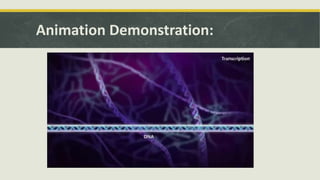
Animation Demonstration:
References:
 Alberts, B., Johnson, A., Lewis, J., Raff, M., Roberts, K., and Walter, P. (2002).
Posttranscriptional controls. In Molecular biology of the cell (4th ed.). New York, NY:
Garland Science. Retrieved from http://www.ncbi.nlm.nih.gov/books/NBK26890/.
 Berger, Shanna. (2006). Eukaryotic transcription. In Transcription and RNA polymerase II.
Retrieved
from http://www.chem.uwec.edu/Webpapers2006/sites/bergersl/pages/eukaryotic.html.
 Boundless (2016, January 8). Initiation of transcription in eukaryotes. In Boundless biology.
Retrieved from https://www.boundless.com/biology/textbooks/boundless-biology-
textbook/genes-and-proteins-15/eukaryotic-transcription-108/initiation-of-transcription-
in-eukaryotes-445-11670/.

Transcription

  • 1.
    Transcription Presented by: AhtishamAli Riphah International University
  • 2.
    INTRODUCTION: The copying process,during which a DNA strand serves as a template for the synthesis of RNA, is called transcription. Transcription produces messenger RNAs (mRNAs) that are translated into sequences of amino acids, polypeptide chains or proteins.
  • 3.
    PROCESS:  The processof transcription of a typical gene can be divided into three phases: • Initiation • Elongation • Termination
  • 4.
    RNA Polymerase:  Themain enzyme involved in transcription is RNA polymerase, which uses a single-stranded DNA template to synthesize a complementary strand of RNA.  Specifically, RNA polymerase builds an RNA strand in the 5' to 3' direction, adding each new nucleotide to the 3' end of the strand.
  • 5.
    Properties of RNAPolymerase:  RNA Polymerase is a multi-subunit enzyme that recognizes a nucleotide sequence (the promoter region) at the beginning of a length of DNA that is to be transcribed.  It next makes a complementary RNA copy of the DNA template strand.  Then recognizes the end of the DNA sequence to be transcribed (the termination region).
  • 6.
    “RNA polymerase bindsto a sequence of DNA called the promoter region, found near the beginning of a gene”. INITIATION
  • 7.
    Initiation Process: Eachgene (or group of co-transcribed genes, in bacteria) has its own promoter region.  Once bound, RNA polymerase separates the DNA strands, providing the single- stranded template needed for transcription.
  • 8.
    Promotor Regions:  –35Sequence: A consensus sequence (5'-TTGACA-3'), centered about 35 bases to the left of the transcription start site is the initial point of contact for the holoenzyme and a closed complex is formed.  Pribnow Box: The holoenzyme moves and covers a second consensus sequence (5'-TATAAT-3'), centered at about –10, which is the site of initial DNA melting (unwinding).
  • 9.
    “Melting of ashort stretch (about 14 bases) converts the closed complex to an open complex known as a transcription bubble.” ELONGATION
  • 10.
     One strandof DNA, the template strand, acts as a template for RNA polymerase.  As it "reads" this template one base at a time, the polymerase builds an RNA molecule out of complementary nucleotides, making a chain that grows from 5' to 3’.
  • 11.
    Elongation Process:  TheRNA transcript carries the same information as the non- template (coding) strand of DNA, but it contains the base uracil (U) instead of thymine (T).  As with replication, transcription is always in the 5'→3' direction.  In contrast to DNA polymerase, RNA polymerase does not require a primer and does not appear to have proofreading activity.
  • 12.
    “The elongation ofthe single- stranded RNA chain continues until a termination signal is reached.” TERMINATION
  • 13.
     Sequences calledterminators signal that the RNA transcript is complete. Once they are transcribed, they cause the transcript to be released from the RNA polymerase.  An example of a termination mechanism involving formation of a hairpin in the RNA is shown below:
  • 14.
    Eukaryotic Modifications:  Inbacteria, RNA transcripts can act as messenger RNAs (mRNAs) right away. In eukaryotes, the transcript of a protein-coding gene is called a pre-mRNA and must go through extra processing before it can direct translation.  Eukaryotic pre-mRNAs must have their ends modified, by addition of a 5' cap (at the beginning) and 3' poly-A tail (at the end).  Each eukaryotic RNA polymerase has its own promoters and TFs that bind core promoter sequences.
  • 15.
     Many eukaryoticpre-mRNAs undergo splicing. In this process, parts of the pre-mRNA (called introns) are chopped out, and the remaining pieces (called exons) are stuck back together.
  • 16.
  • 18.
    References:  Alberts, B.,Johnson, A., Lewis, J., Raff, M., Roberts, K., and Walter, P. (2002). Posttranscriptional controls. In Molecular biology of the cell (4th ed.). New York, NY: Garland Science. Retrieved from http://www.ncbi.nlm.nih.gov/books/NBK26890/.  Berger, Shanna. (2006). Eukaryotic transcription. In Transcription and RNA polymerase II. Retrieved from http://www.chem.uwec.edu/Webpapers2006/sites/bergersl/pages/eukaryotic.html.  Boundless (2016, January 8). Initiation of transcription in eukaryotes. In Boundless biology. Retrieved from https://www.boundless.com/biology/textbooks/boundless-biology- textbook/genes-and-proteins-15/eukaryotic-transcription-108/initiation-of-transcription- in-eukaryotes-445-11670/.