Transcription
An Integral part of Central Dogma
Presented by :
 Naseem ullah
 Samar Abbas
 Muhammad Yusuf
 Mujahid Sajjad
Central Dogma of Molecular Biology
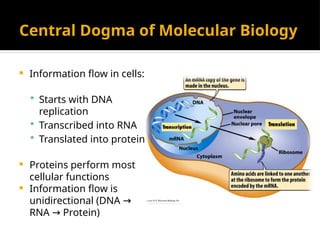
 Information flow in cells:
 Starts with DNA
replication
 Transcribed into RNA
 Translated into protein
 Proteins perform most
cellular functions
 Information flow is
unidirectional (DNA →
RNA Protein)
→
Transcription
 Transcription is the process of making an RNA copy of a single
gene. Genes are specific regions of the DNA of a chromosome.
 Requirements :
 DNA template: Provides the sequence for complementary
base pairing.
 RNA polymerase enzyme: Catalyzes the synthesis of RNA from
DNA template. RNA polymerase always builds a new RNA strand
in the 5’ to 3’ direction. That is, it can only add RNA nucleotides
(A, U, C, or G) to the 3' end of the strand.
 Ribonucleotide triphosphates (rNTPs): Serve as substrates
for building RNA strands.
 Promoter region: Initiates transcription by binding RNA
polymerase to the DNA template.
 Transcription factors: Assist in regulating the initiation and
rate of transcription.
Overview
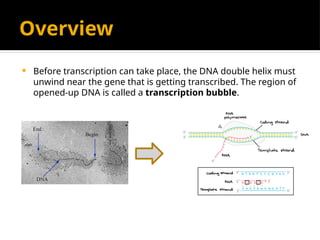
 Before transcription can take place, the DNA double helix must
unwind near the gene that is getting transcribed. The region of
opened-up DNA is called a transcription bubble.
Process of Transcription
The process can be divided into three steps :
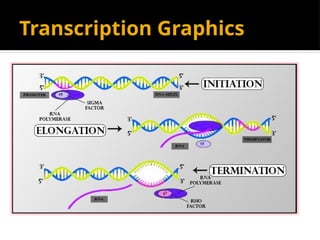
1. INITIATION
2. ELONGATION
3. TERMINATION
INITIATION
- RNA polymerase binds to the promoter region of the DNA
molecule.
- The promoter region signals the beginning of the gene
sequence to be transcribed.
- Transcription factors assist in the binding of RNA polymerase to
the promoter.
- RNA polymerase unwinds the DNA double helix near the
promoter to expose the template strand.
Initiation
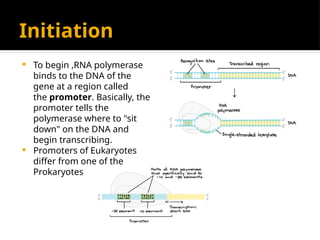
 To begin ,RNA polymerase
binds to the DNA of the
gene at a region called
the promoter. Basically, the
promoter tells the
polymerase where to "sit
down" on the DNA and
begin transcribing.
 Promoters of Eukaryotes
differ from one of the
Prokaryotes
ELONGATION
 Once RNA polymerase is in position
at the promoter, the next step of
transcription elongation can begin.
 Elongation is the stage when the
RNA strand gets longer by addition
of new nucleotides.
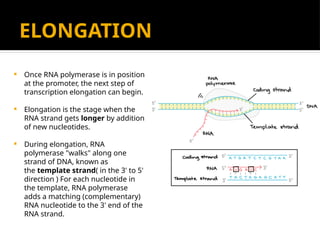
 During elongation, RNA
polymerase "walks" along one
strand of DNA, known as
the template strand( in the 3' to 5'
direction ) For each nucleotide in
the template, RNA polymerase
adds a matching (complementary)
RNA nucleotide to the 3' end of the
RNA strand.
TERMINATION
 There are two major termination
strategies found in bacteria: Rho-
dependent and Rho-
independent.
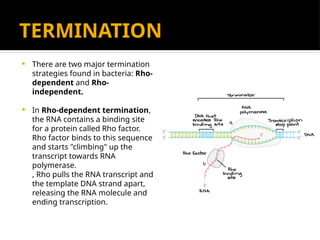
 In Rho-dependent termination,
the RNA contains a binding site
for a protein called Rho factor.
Rho factor binds to this sequence
and starts "climbing" up the
transcript towards RNA
polymerase.
, Rho pulls the RNA transcript and
the template DNA strand apart,
releasing the RNA molecule and
ending transcription.
TERMINATION
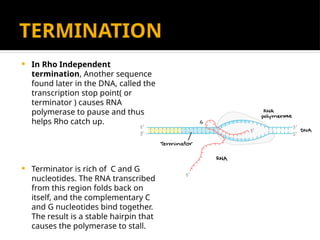
 In Rho Independent
termination, Another sequence
found later in the DNA, called the
transcription stop point( or
terminator ) causes RNA
polymerase to pause and thus
helps Rho catch up.
 Terminator is rich of C and G
nucleotides. The RNA transcribed
from this region folds back on
itself, and the complementary C
and G nucleotides bind together.
The result is a stable hairpin that
causes the polymerase to stall.
Transcription Graphics
After Transcription
 In prokaryotes, the RNA copy of a gene is messenger RNA,
ready to be translated into protein. In fact, translation starts
even before transcription is finished.
 In eukaryotes, The newly made RNA is immature and
hnRNA( Hybrid nuclear RNA)
 the primary RNA transcript of a gene needs further processing
before it can be translated. This step is called “RNA
processing”. Also, it needs to be transported out of the nucleus
into the cytoplasm.
 Steps in RNA processing:
 1. Add a cap to the 5’ end
 2. Add a poly-A tail to the 3’ end
 3. splice out introns.
Capping , Tailing
 RNA is inherently unstable,
especially at the ends. The
ends are modified to protect
it.
 At the 5’ end, a slightly
modified guanine (7-methyl
G) is attached “backwards”, by
a 5’ to 5’ linkage, to the
triphosphates of the first
transcribed base.
 At the 3’ end, the primary
transcript RNA is cut at a
specific site and 100-200
adenine nucleotides are
attached: the poly-A tail.
Note that these A’s are not
coded in the DNA of the gene.
Introns
 Introns are regions within a gene that don’t code for protein
and don’t appear in the final mRNA molecule.
 Protein-coding sections of a gene (called exons) are interrupted
by introns.
 The function of introns remains unclear. They may help is RNA
transport or in control of gene expression in some cases, and
they may make it easier for sections of genes to be shuffled in
evolution. But , no generally accepted reason for the existence
of introns exists.
 There are a few prokaryotic examples, but most introns are
found in eukaryotes.
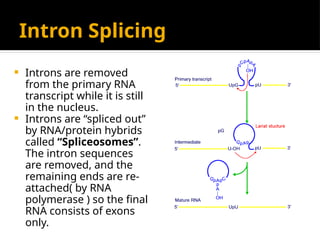
Intron Splicing
 Introns are removed
from the primary RNA
transcript while it is still
in the nucleus.
 Introns are “spliced out”
by RNA/protein hybrids
called “Spliceosomes”.
The intron sequences
are removed, and the
remaining ends are re-
attached( by RNA
polymerase ) so the final
RNA consists of exons
only.
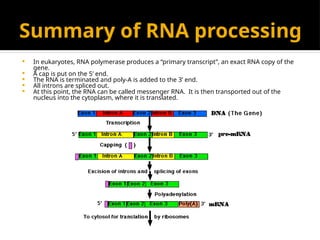
Summary of RNA processing
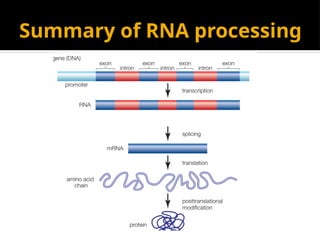
 In eukaryotes, RNA polymerase produces a “primary transcript”, an exact RNA copy of the
gene.
 A cap is put on the 5’ end.
 The RNA is terminated and poly-A is added to the 3’ end.
 All introns are spliced out.
 At this point, the RNA can be called messenger RNA. It is then transported out of the
nucleus into the cytoplasm, where it is translated.
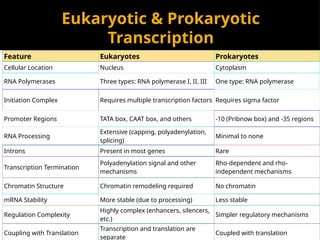
Eukaryotic & Prokaryotic
Transcription
Feature Eukaryotes Prokaryotes
Cellular Location Nucleus Cytoplasm
RNA Polymerases Three types: RNA polymerase I, II, III One type: RNA polymerase
Initiation Complex Requires multiple transcription factors Requires sigma factor
Promoter Regions TATA box, CAAT box, and others -10 (Pribnow box) and -35 regions
RNA Processing
Extensive (capping, polyadenylation,
splicing)
Minimal to none
Introns Present in most genes Rare
Transcription Termination
Polyadenylation signal and other
mechanisms
Rho-dependent and rho-
independent mechanisms
Chromatin Structure Chromatin remodeling required No chromatin
mRNA Stability More stable (due to processing) Less stable
Regulation Complexity
Highly complex (enhancers, silencers,
etc.)
Simpler regulatory mechanisms
Coupling with Translation
Transcription and translation are
separate
Coupled with translation
Summary of RNA processing

Transcription Presentation Central Dogma.pptx

  • 1.
    Transcription An Integral partof Central Dogma Presented by :  Naseem ullah  Samar Abbas  Muhammad Yusuf  Mujahid Sajjad
  • 2.
    Central Dogma ofMolecular Biology  Information flow in cells:  Starts with DNA replication  Transcribed into RNA  Translated into protein  Proteins perform most cellular functions  Information flow is unidirectional (DNA → RNA Protein) →
  • 3.
    Transcription  Transcription isthe process of making an RNA copy of a single gene. Genes are specific regions of the DNA of a chromosome.  Requirements :  DNA template: Provides the sequence for complementary base pairing.  RNA polymerase enzyme: Catalyzes the synthesis of RNA from DNA template. RNA polymerase always builds a new RNA strand in the 5’ to 3’ direction. That is, it can only add RNA nucleotides (A, U, C, or G) to the 3' end of the strand.  Ribonucleotide triphosphates (rNTPs): Serve as substrates for building RNA strands.  Promoter region: Initiates transcription by binding RNA polymerase to the DNA template.  Transcription factors: Assist in regulating the initiation and rate of transcription.
  • 4.
    Overview  Before transcriptioncan take place, the DNA double helix must unwind near the gene that is getting transcribed. The region of opened-up DNA is called a transcription bubble.
  • 5.
    Process of Transcription Theprocess can be divided into three steps : 1. INITIATION 2. ELONGATION 3. TERMINATION INITIATION - RNA polymerase binds to the promoter region of the DNA molecule. - The promoter region signals the beginning of the gene sequence to be transcribed. - Transcription factors assist in the binding of RNA polymerase to the promoter. - RNA polymerase unwinds the DNA double helix near the promoter to expose the template strand.
  • 6.
    Initiation  To begin,RNA polymerase binds to the DNA of the gene at a region called the promoter. Basically, the promoter tells the polymerase where to "sit down" on the DNA and begin transcribing.  Promoters of Eukaryotes differ from one of the Prokaryotes
  • 7.
    ELONGATION  Once RNApolymerase is in position at the promoter, the next step of transcription elongation can begin.  Elongation is the stage when the RNA strand gets longer by addition of new nucleotides.  During elongation, RNA polymerase "walks" along one strand of DNA, known as the template strand( in the 3' to 5' direction ) For each nucleotide in the template, RNA polymerase adds a matching (complementary) RNA nucleotide to the 3' end of the RNA strand.
  • 8.
    TERMINATION  There aretwo major termination strategies found in bacteria: Rho- dependent and Rho- independent.  In Rho-dependent termination, the RNA contains a binding site for a protein called Rho factor. Rho factor binds to this sequence and starts "climbing" up the transcript towards RNA polymerase. , Rho pulls the RNA transcript and the template DNA strand apart, releasing the RNA molecule and ending transcription.
  • 9.
    TERMINATION  In RhoIndependent termination, Another sequence found later in the DNA, called the transcription stop point( or terminator ) causes RNA polymerase to pause and thus helps Rho catch up.  Terminator is rich of C and G nucleotides. The RNA transcribed from this region folds back on itself, and the complementary C and G nucleotides bind together. The result is a stable hairpin that causes the polymerase to stall.
  • 10.
  • 11.
    After Transcription  Inprokaryotes, the RNA copy of a gene is messenger RNA, ready to be translated into protein. In fact, translation starts even before transcription is finished.  In eukaryotes, The newly made RNA is immature and hnRNA( Hybrid nuclear RNA)  the primary RNA transcript of a gene needs further processing before it can be translated. This step is called “RNA processing”. Also, it needs to be transported out of the nucleus into the cytoplasm.  Steps in RNA processing:  1. Add a cap to the 5’ end  2. Add a poly-A tail to the 3’ end  3. splice out introns.
  • 12.
    Capping , Tailing RNA is inherently unstable, especially at the ends. The ends are modified to protect it.  At the 5’ end, a slightly modified guanine (7-methyl G) is attached “backwards”, by a 5’ to 5’ linkage, to the triphosphates of the first transcribed base.  At the 3’ end, the primary transcript RNA is cut at a specific site and 100-200 adenine nucleotides are attached: the poly-A tail. Note that these A’s are not coded in the DNA of the gene.
  • 13.
    Introns  Introns areregions within a gene that don’t code for protein and don’t appear in the final mRNA molecule.  Protein-coding sections of a gene (called exons) are interrupted by introns.  The function of introns remains unclear. They may help is RNA transport or in control of gene expression in some cases, and they may make it easier for sections of genes to be shuffled in evolution. But , no generally accepted reason for the existence of introns exists.  There are a few prokaryotic examples, but most introns are found in eukaryotes.
  • 14.
    Intron Splicing  Intronsare removed from the primary RNA transcript while it is still in the nucleus.  Introns are “spliced out” by RNA/protein hybrids called “Spliceosomes”. The intron sequences are removed, and the remaining ends are re- attached( by RNA polymerase ) so the final RNA consists of exons only.
  • 15.
    Summary of RNAprocessing  In eukaryotes, RNA polymerase produces a “primary transcript”, an exact RNA copy of the gene.  A cap is put on the 5’ end.  The RNA is terminated and poly-A is added to the 3’ end.  All introns are spliced out.  At this point, the RNA can be called messenger RNA. It is then transported out of the nucleus into the cytoplasm, where it is translated.
  • 16.
    Eukaryotic & Prokaryotic Transcription FeatureEukaryotes Prokaryotes Cellular Location Nucleus Cytoplasm RNA Polymerases Three types: RNA polymerase I, II, III One type: RNA polymerase Initiation Complex Requires multiple transcription factors Requires sigma factor Promoter Regions TATA box, CAAT box, and others -10 (Pribnow box) and -35 regions RNA Processing Extensive (capping, polyadenylation, splicing) Minimal to none Introns Present in most genes Rare Transcription Termination Polyadenylation signal and other mechanisms Rho-dependent and rho- independent mechanisms Chromatin Structure Chromatin remodeling required No chromatin mRNA Stability More stable (due to processing) Less stable Regulation Complexity Highly complex (enhancers, silencers, etc.) Simpler regulatory mechanisms Coupling with Translation Transcription and translation are separate Coupled with translation
  • 17.
    Summary of RNAprocessing