
Ethical Issues in Research
RC Gupta
Professor Emeritus
National Institute of
Medical Sciences
Jaipur
- Moral philosophy
- A set of moral principles
- What is right and what is
wrong in human behaviour
Ethics
Intellectual – Related to intellect i.e. ability
to think logically and to understand things
Honesty – Integrity/Probity/Truthfulness
Intellectual Honesty
A Basic Requirement of Research
• Being honest is our moral duty
• This duty is particularly important when we
communicate our ideas to others
• Communicating our ideas informs, and can
persuade other people
• Intellectual honesty is honesty in acquiring,
analyzing, and communicating data/ideas
• We are being intellectually honest when we,
knowing the truth, state that truth
Examples of Honesty in Research
• Pertinent facts and information are not
purposefully omitted when they go against
our hypothesis
• Facts are presented without bias, and are not
twisted to give misleading impressions
• References, or earlier publications, are cited
without bias where necessary
Research on human beings
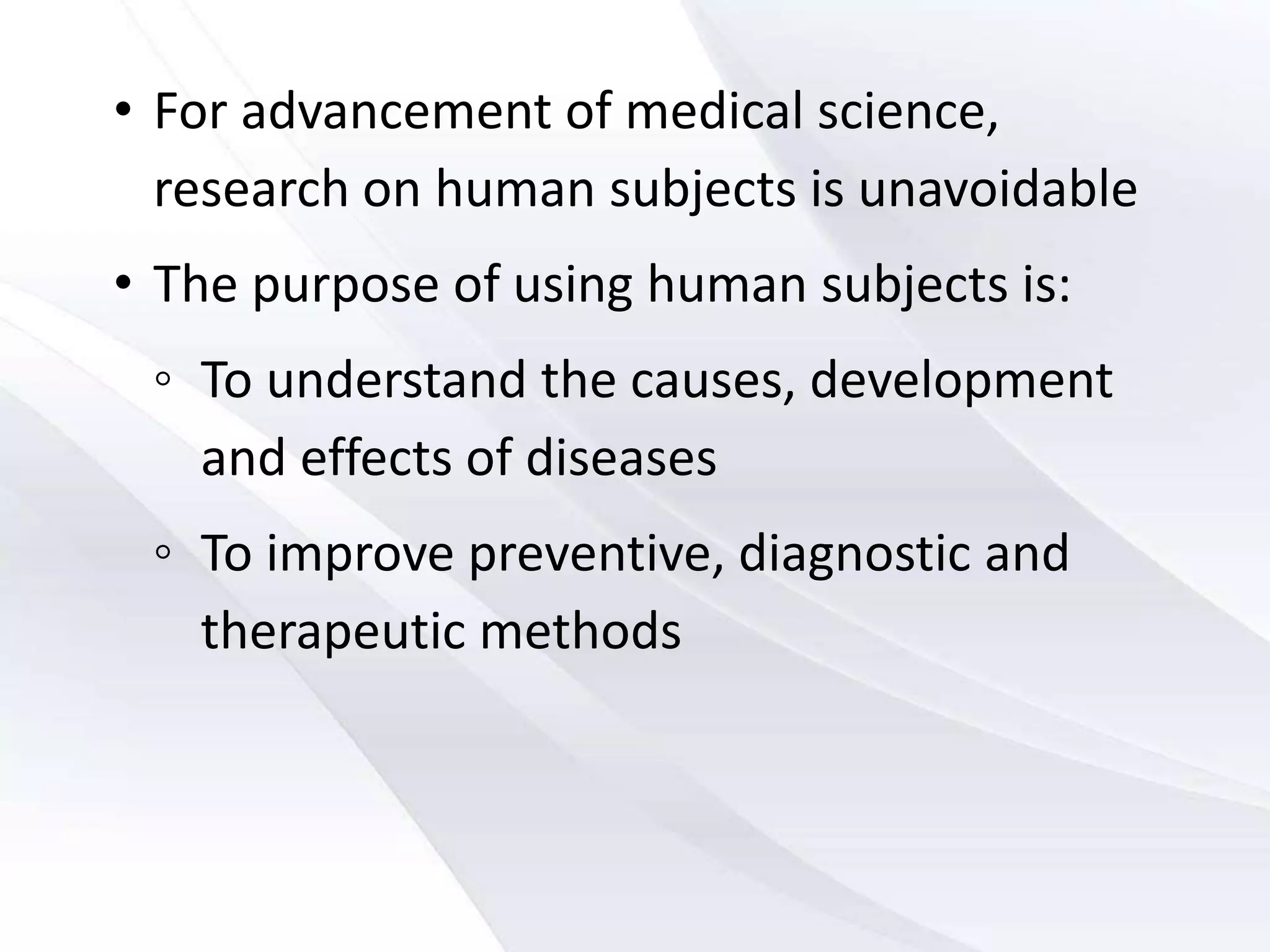
• For advancement of medical science,
research on human subjects is unavoidable
• The purpose of using human subjects is:
◦ To understand the causes, development
and effects of diseases
◦ To improve preventive, diagnostic and
therapeutic methods
Research must have a strong
ethical foundation, specially
scientific research involving
human beings
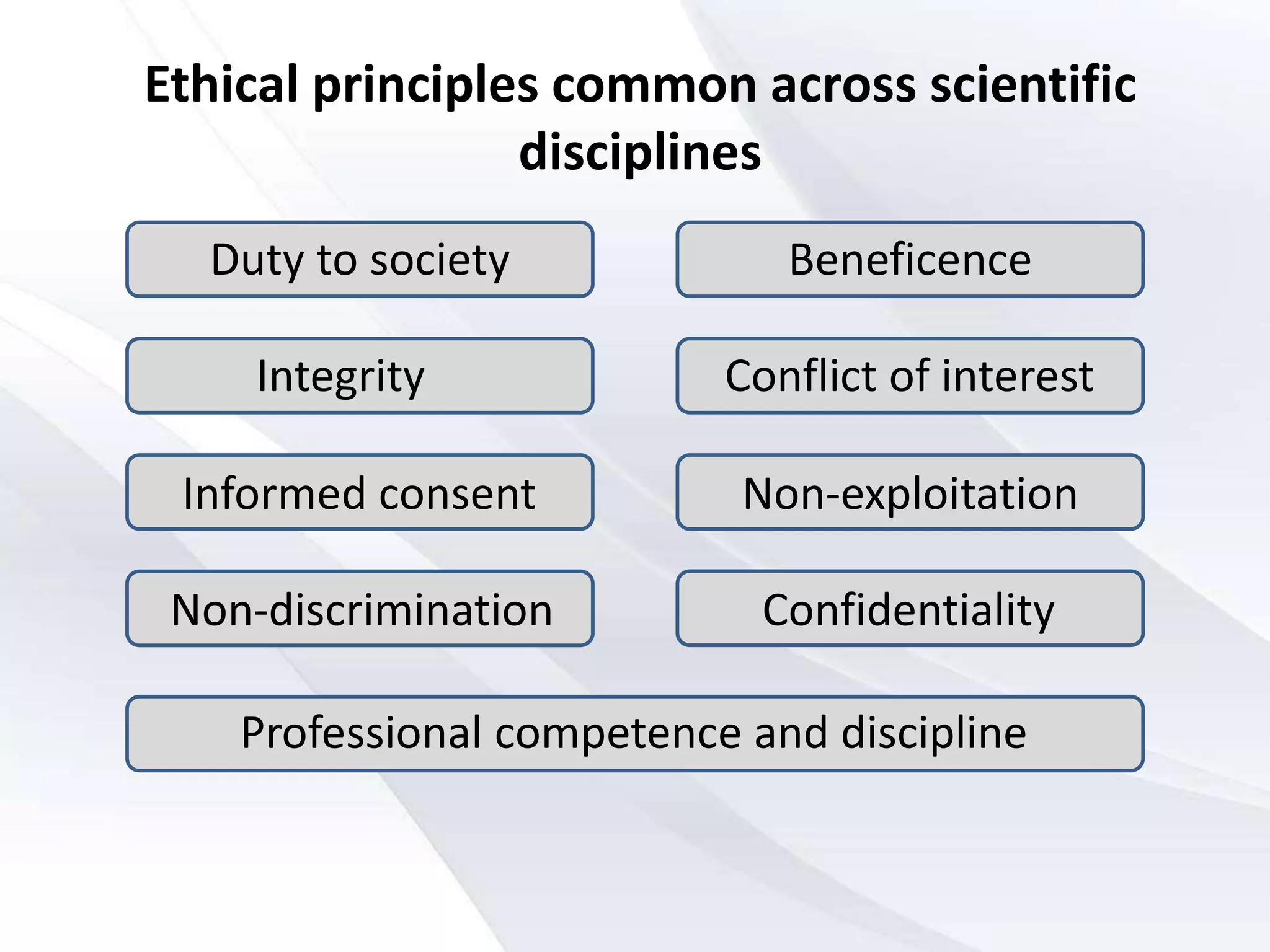
Ethical principles common across scientific
disciplines
Duty to society
Professional competence and discipline
Confidentiality
Non-exploitation
Non-discrimination
Integrity
Informed consent
Conflict of interest
Beneficence
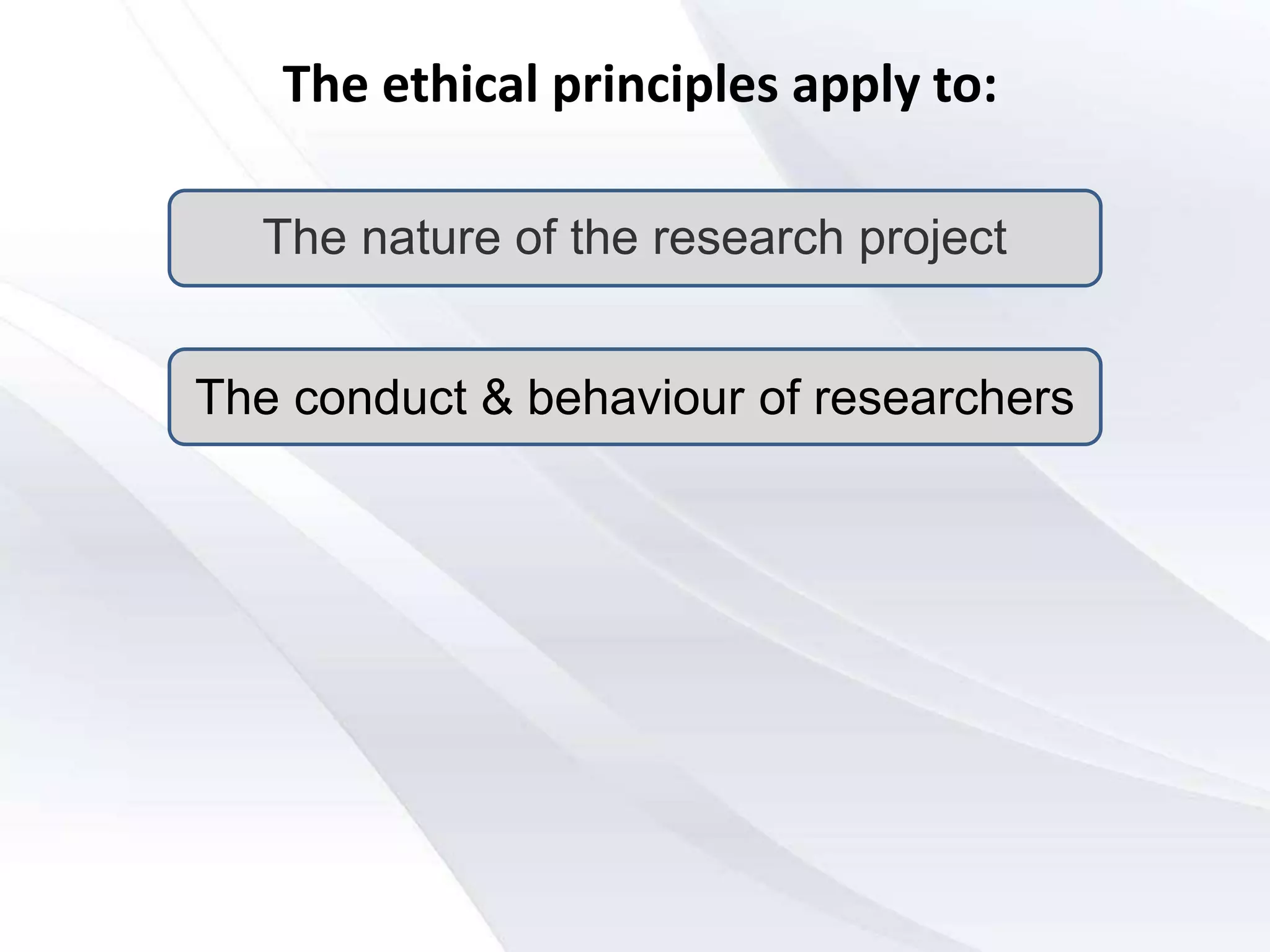
The ethical principles apply to:
The nature of the research project
The conduct & behaviour of researchers
• Historical events that raise new concerns
• Ethical lapses that require new safeguards
• Scientific advances that open new areas
of research
• Changing cultural and social norms
Ethics emerge, change, and evolve
due to:
• Research involving human participants
should adhere to international ethical
standards
• Indian ethical standards are no less
exacting, and are at par with international
ethical codes
• Nuremberg Code (1947)
• Helsinki Declaration (1964)
• Belmont report (1978)
• Council for International Organizations of
Medical Sciences (1993)
Some International Ethical Codes
Nuremberg War Crimes Trials
Nuremberg Code (1947)
Initiated discussion on:
• Rationale and justification for research
• Risk benefit analysis
• Competence of investigators
• Voluntary consent in research
Helsinki Declaration
(1964)
Brought out by World Medical Association
and focused on:
• Individual’s rights to make informed
decisions
• Investigators’ duties
• Research participants’ welfare
• Revised in 1983, 1989, 1996, 2000, 2008
and 2013
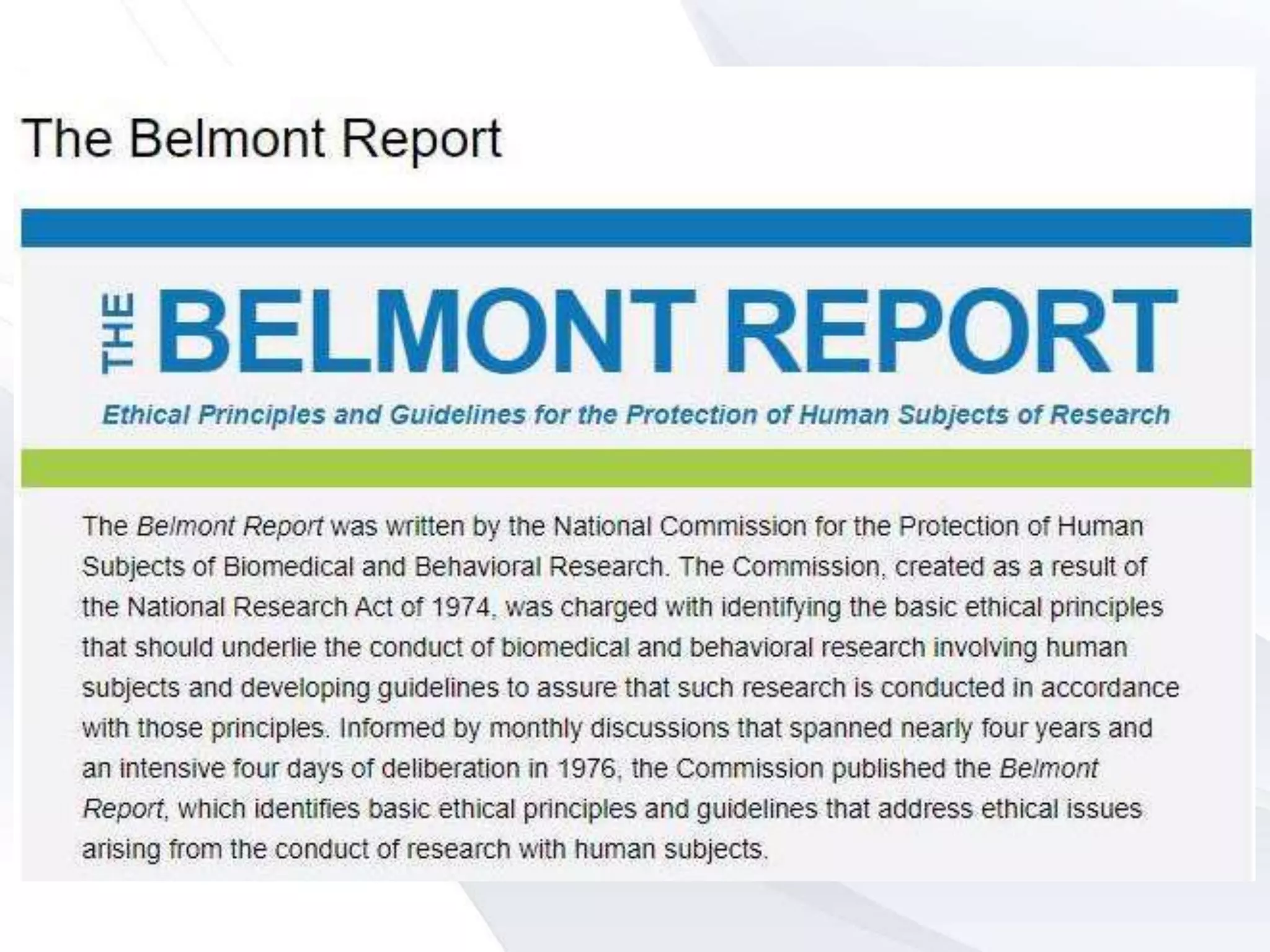
Belmont Report
• Described the principles of autonomy,
justice and beneficence
• Emphasized informed consent
• Introduced review by ethics committee
Council for International
Organizations of Medical
Sciences (CIOMS)
Published International Ethical Guidelines
for Biomedical Research Involving Human
Subjects in 1993 which emphasized:
• Safety of research subjects
• Analysis of benefit-risk balance
• Reporting of adverse drug reactions
• Need for pharmacovigilance
• ICMR guidelines (2000, 2006)
• Genome Policy and Genetic Research
(2000)
• Indian GCP (2001)
• Drugs and Cosmetics Act (2002)
• Assisted Reproductive Technology (2005)
• Stem Cell Research and Bio-banking
(2006)
Indian Ethical Codes
• Ethical Review
Procedures
• General Ethical Issues
• Clinical Evaluation of
Drugs, Devices etc
• Epidemiological
Studies
• Human Genetics and
Genomics Research
• Research in
Transplantation
• Assisted Reproductive
Technologies
Broad ethical principles for researchers
• Respect for autonomy
• Justice
• Beneficence
• Non-maleficence
Respect for autonomy
• Autonomy is Latin for self-rule: We have an
obligation to respect the decisions made
by people concerning their own lives
• We must not interfere with the decisions
made by competent adults, and must also
empower them to make independent
decisions
• Human research subjects must be given
complete autonomy
• They have a right to decide whether to
take part in research
• They have a right to decide whether to
continue as subjects
Justice
• All individuals should have an opportunity
to participate in research unless contra-
indicated
• We must not impose any unfair burden on
subjects
• We must treat all people equally, fairly and
impartially
Beneficence
• We must be fair and just in our actions
• We must take positive steps to prevent
harm
• While pursuing beneficence, we must not
come in conflict with autonomy of people
Non-maleficence
• We must do no harm
• If harm cannot be avoided, we must try to
minimize it
Informed consent
Informing potential participants about the
proposed research in a systematic manner
and empowering them to make an informed
decision to participate in the research study
• Understand study procedures
• Understand risks and benefits
• Get all questions and concerns answered
• Make a considered and informed decision
to participate or not to participate
Participants must be able to:
Informed Consent Document
• Description of research
• Risks
• Benefits
• Confidentiality
• Reimbursement and compensation
• Contacts
• Voluntary participation and withdrawal
Is the research procedure adequately
explained in the IC form?
• The language - simplicity and clarity
• Translations and certification of
translations
• Test of understanding
• Impartial witness
Check list
• Researchers and institutions: Information –
discussion & explanation – comprehension –
voluntary decision
• Participants: Must give informed, free and
independent consent without coercion or
force
• Sponsors, monitors & regulators: Assess
fairness of consenting procedure - Verify
consent documentation
Stakeholders in informed consent process
• Research participants should be reasonably
reimbursed for costs incurred during the
research e.g. travel costs
• They should be reimbursed reasonably for
their inconvenience and time spent
• Compensation can be monetary or non-
monetary
Reimbursement
Continued …
• Non-monetary reimbursement might
include free health services unrelated to
the research, medical insurance,
educational materials or other benefits
• Reimbursement must not be so large as to
induce potential participants to consent to
participate in the research against their
better judgment
• Participants who suffer physical, psycho-
logical or social harm as a result of taking
part in research must receive free treat-
ment and rehabilitation
• They should also be compensated for lost
wages
• If death results from participation in
research, the participant’s dependents
should be given compensation
Compensation
The research subjects should be given the
option of being informed about the
outcome and results of the study
Information about the outcome
• Researchers have an ethical obligation to
make public the results of research
• They should ensure completeness and
accuracy in reporting of research
• Negative or inconclusive results must also
be made publicly available
• Sources of funding, institutional
affiliations and conflicts of interest must
be declared in the publication
Publication of outcome
• Institutional ethics committee must be
formally established
• It should be given adequate powers and
support
• It should ensure timely and competent
review following clear and transparent
procedures
Ethics Committee
Continued …
• The ethics committee must have multi-
disciplinary membership to ensure a
complete review of proposed research
• Committee members must be duly
qualified
• They should regularly update themselves
about ethical issues related to health
research
Continued …
• The institution must put in place adequate
mechanisms to ensure independence of
the ethics committee
• All proposals for health-related research
involving humans must be submitted to
the ethics committee for its clearance
Continued …
• The committee will determine whether a
proposal needs ethical review and will
assess its ethical acceptability
• The committee can exempt a proposal
from ethical review (depending upon the
nature of the research and upon
applicable laws or regulations)
Continued …
• The researcher must obtain clearance
from ethics committee before beginning
the research
• The ethics committee can conduct further
reviews as necessary, for example, when
there are significant changes in the
protocol
Continued …
• The researcher must have a right to appeal
against the decision of ethics committee
• The ethics committee should have a clear
procedure for hearing appeals against the
decisions of ethics committee
• The research ethics committee must be
constituted according to a document that
specifies the manner in which members
and the chairperson will be appointed,
reappointed, and replaced
• Research ethics committees must have
members capable of providing competent
and thorough review of research
proposals
Continued …
Composition of ethics committee
• Membership must include physicians,
scientists and other professionals such as
social scientists, lawyers and ethicists
• The committee should have some
community members or representatives of
patients’ groups
• Ideally, one or more members should have
experience as study participants
Responsibility of institutional ethics
committee or review board
• Real or potential benefit to individuals/
community
• Rights of research participants
• Benefits vis-a-vis risks
• Will the participants and community have
access to benefits of research?
• Mechanism to provide safety, care and
support to research participants
Changing Scenario of Research Ethics
• Attention to ethical issues in research is
increasing
• Public expectations are increasing and will
increase further in future
• Policy makers and researchers should be
prepared for further strengthening of
ethical codes
Ethical issues in research.pptx

Ethical issues in research.pptx

  • 1.
    Ethical Issues inResearch RC Gupta Professor Emeritus National Institute of Medical Sciences Jaipur
  • 2.
    - Moral philosophy -A set of moral principles - What is right and what is wrong in human behaviour Ethics
  • 3.
    Intellectual – Relatedto intellect i.e. ability to think logically and to understand things Honesty – Integrity/Probity/Truthfulness Intellectual Honesty A Basic Requirement of Research
  • 4.
    • Being honestis our moral duty • This duty is particularly important when we communicate our ideas to others • Communicating our ideas informs, and can persuade other people
  • 5.
    • Intellectual honestyis honesty in acquiring, analyzing, and communicating data/ideas • We are being intellectually honest when we, knowing the truth, state that truth
  • 7.
    Examples of Honestyin Research • Pertinent facts and information are not purposefully omitted when they go against our hypothesis • Facts are presented without bias, and are not twisted to give misleading impressions • References, or earlier publications, are cited without bias where necessary
  • 8.
  • 9.
    • For advancementof medical science, research on human subjects is unavoidable • The purpose of using human subjects is: ◦ To understand the causes, development and effects of diseases ◦ To improve preventive, diagnostic and therapeutic methods
  • 10.
    Research must havea strong ethical foundation, specially scientific research involving human beings
  • 11.
    Ethical principles commonacross scientific disciplines Duty to society Professional competence and discipline Confidentiality Non-exploitation Non-discrimination Integrity Informed consent Conflict of interest Beneficence
  • 12.
    The ethical principlesapply to: The nature of the research project The conduct & behaviour of researchers
  • 13.
    • Historical eventsthat raise new concerns • Ethical lapses that require new safeguards • Scientific advances that open new areas of research • Changing cultural and social norms Ethics emerge, change, and evolve due to:
  • 14.
    • Research involvinghuman participants should adhere to international ethical standards • Indian ethical standards are no less exacting, and are at par with international ethical codes
  • 15.
    • Nuremberg Code(1947) • Helsinki Declaration (1964) • Belmont report (1978) • Council for International Organizations of Medical Sciences (1993) Some International Ethical Codes
  • 16.
  • 17.
    Nuremberg Code (1947) Initiateddiscussion on: • Rationale and justification for research • Risk benefit analysis • Competence of investigators • Voluntary consent in research
  • 18.
    Helsinki Declaration (1964) Brought outby World Medical Association and focused on: • Individual’s rights to make informed decisions • Investigators’ duties • Research participants’ welfare • Revised in 1983, 1989, 1996, 2000, 2008 and 2013
  • 20.
    Belmont Report • Describedthe principles of autonomy, justice and beneficence • Emphasized informed consent • Introduced review by ethics committee
  • 21.
    Council for International Organizationsof Medical Sciences (CIOMS) Published International Ethical Guidelines for Biomedical Research Involving Human Subjects in 1993 which emphasized: • Safety of research subjects • Analysis of benefit-risk balance • Reporting of adverse drug reactions • Need for pharmacovigilance
  • 22.
    • ICMR guidelines(2000, 2006) • Genome Policy and Genetic Research (2000) • Indian GCP (2001) • Drugs and Cosmetics Act (2002) • Assisted Reproductive Technology (2005) • Stem Cell Research and Bio-banking (2006) Indian Ethical Codes
  • 23.
    • Ethical Review Procedures •General Ethical Issues • Clinical Evaluation of Drugs, Devices etc • Epidemiological Studies • Human Genetics and Genomics Research • Research in Transplantation • Assisted Reproductive Technologies
  • 24.
    Broad ethical principlesfor researchers • Respect for autonomy • Justice • Beneficence • Non-maleficence
  • 25.
    Respect for autonomy •Autonomy is Latin for self-rule: We have an obligation to respect the decisions made by people concerning their own lives • We must not interfere with the decisions made by competent adults, and must also empower them to make independent decisions
  • 26.
    • Human researchsubjects must be given complete autonomy • They have a right to decide whether to take part in research • They have a right to decide whether to continue as subjects
  • 27.
    Justice • All individualsshould have an opportunity to participate in research unless contra- indicated • We must not impose any unfair burden on subjects • We must treat all people equally, fairly and impartially
  • 28.
    Beneficence • We mustbe fair and just in our actions • We must take positive steps to prevent harm • While pursuing beneficence, we must not come in conflict with autonomy of people
  • 29.
    Non-maleficence • We mustdo no harm • If harm cannot be avoided, we must try to minimize it
  • 30.
    Informed consent Informing potentialparticipants about the proposed research in a systematic manner and empowering them to make an informed decision to participate in the research study
  • 31.
    • Understand studyprocedures • Understand risks and benefits • Get all questions and concerns answered • Make a considered and informed decision to participate or not to participate Participants must be able to:
  • 32.
    Informed Consent Document •Description of research • Risks • Benefits • Confidentiality • Reimbursement and compensation • Contacts • Voluntary participation and withdrawal
  • 33.
    Is the researchprocedure adequately explained in the IC form? • The language - simplicity and clarity • Translations and certification of translations • Test of understanding • Impartial witness Check list
  • 34.
    • Researchers andinstitutions: Information – discussion & explanation – comprehension – voluntary decision • Participants: Must give informed, free and independent consent without coercion or force • Sponsors, monitors & regulators: Assess fairness of consenting procedure - Verify consent documentation Stakeholders in informed consent process
  • 35.
    • Research participantsshould be reasonably reimbursed for costs incurred during the research e.g. travel costs • They should be reimbursed reasonably for their inconvenience and time spent • Compensation can be monetary or non- monetary Reimbursement Continued …
  • 36.
    • Non-monetary reimbursementmight include free health services unrelated to the research, medical insurance, educational materials or other benefits • Reimbursement must not be so large as to induce potential participants to consent to participate in the research against their better judgment
  • 37.
    • Participants whosuffer physical, psycho- logical or social harm as a result of taking part in research must receive free treat- ment and rehabilitation • They should also be compensated for lost wages • If death results from participation in research, the participant’s dependents should be given compensation Compensation
  • 38.
    The research subjectsshould be given the option of being informed about the outcome and results of the study Information about the outcome
  • 39.
    • Researchers havean ethical obligation to make public the results of research • They should ensure completeness and accuracy in reporting of research • Negative or inconclusive results must also be made publicly available • Sources of funding, institutional affiliations and conflicts of interest must be declared in the publication Publication of outcome
  • 40.
    • Institutional ethicscommittee must be formally established • It should be given adequate powers and support • It should ensure timely and competent review following clear and transparent procedures Ethics Committee Continued …
  • 41.
    • The ethicscommittee must have multi- disciplinary membership to ensure a complete review of proposed research • Committee members must be duly qualified • They should regularly update themselves about ethical issues related to health research Continued …
  • 42.
    • The institutionmust put in place adequate mechanisms to ensure independence of the ethics committee • All proposals for health-related research involving humans must be submitted to the ethics committee for its clearance Continued …
  • 43.
    • The committeewill determine whether a proposal needs ethical review and will assess its ethical acceptability • The committee can exempt a proposal from ethical review (depending upon the nature of the research and upon applicable laws or regulations) Continued …
  • 44.
    • The researchermust obtain clearance from ethics committee before beginning the research • The ethics committee can conduct further reviews as necessary, for example, when there are significant changes in the protocol Continued …
  • 45.
    • The researchermust have a right to appeal against the decision of ethics committee • The ethics committee should have a clear procedure for hearing appeals against the decisions of ethics committee
  • 46.
    • The researchethics committee must be constituted according to a document that specifies the manner in which members and the chairperson will be appointed, reappointed, and replaced • Research ethics committees must have members capable of providing competent and thorough review of research proposals Continued … Composition of ethics committee
  • 47.
    • Membership mustinclude physicians, scientists and other professionals such as social scientists, lawyers and ethicists • The committee should have some community members or representatives of patients’ groups • Ideally, one or more members should have experience as study participants
  • 48.
    Responsibility of institutionalethics committee or review board • Real or potential benefit to individuals/ community • Rights of research participants • Benefits vis-a-vis risks • Will the participants and community have access to benefits of research? • Mechanism to provide safety, care and support to research participants
  • 49.
    Changing Scenario ofResearch Ethics • Attention to ethical issues in research is increasing • Public expectations are increasing and will increase further in future • Policy makers and researchers should be prepared for further strengthening of ethical codes