Training Manual on Organizational
Design
The Hospital for Sick Children
What is Organizational Design?
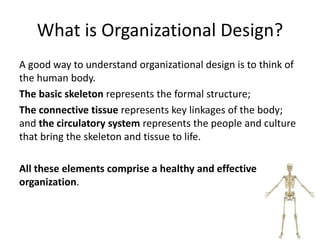
A good way to understand organizational design is to think of
the human body.
The basic skeleton represents the formal structure;
The connective tissue represents key linkages of the body;
and the circulatory system represents the people and culture
that bring the skeleton and tissue to life.
All these elements comprise a healthy and effective
organization.
What is Organizational Design?
• It is the creation of roles, processes, and
formal reporting relationships in an
organization.
• It is the way in which you set up your business
to best meet your business objectives.
8 Reasons Why It is Important
• Company Leadership: Organizational design sets
forth reporting relationships and lines of
authority reaching from the executive level to the
front line.
• Company Culture: The grouping of employees in
various departments and the managerial
hierarchy influences the way employees interact
with each other on the job.
• Future Growth: Organizational design choices
made in the early stages of a business can either
help or hinder growth plans.
8 Reasons Why It is Important
• Adaptability: Organizational design choices can
develop distinct competitive advantages. Savvy
business owners continually monitor changes in their
industries and markets, looking for opportunities to
adapt and develop new competitive advantages.
• Communication: Organizational structure enables the
distribution of authority. When a person starts a job,
he knows from day one to whom he will report.
• Evaluating Employee Performance: The linear
structure of functional and product organizational
structures allow supervisors to better evaluate the
work of their subordinates.
8 Reasons Why It is Important
• Goal Achievement: Organizational structure allows for
the chain of command. Department leaders are in
charge of delegating tasks and projects to subordinates
so the department can meet project deadlines.
• Decision Making: Most companies either have a tall or
flat organizational structure. Flat structures enable
small companies to make quicker decisions, as they are
often growing rapidly with new products and need this
flexibility. Large organizations often have many tiers or
echelons of management.
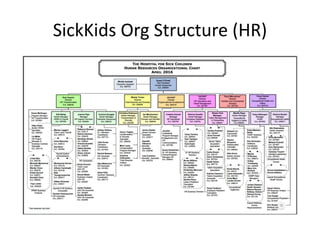
SickKids Org Structure (HR)
SickKids Org Structure- An Analysis
• Divisional structure
• Simple Structure
• High level of complexity is observed
• High level for formality is observed
• Communication is both bottom up, top down
and horizontal
How to Design your Org. Structure the
Right way
If I were to ask you a random and seemingly
strange question, “Why does a rocket behave
the way it does and how is it different from a
parachute that behaves the way it does?”
You’d probably say something like, “Well, they’re
designed differently!
How to Design your Org. Structure the
Right way
But if I were to ask you a similar question about
your business, “Why does your business behave
the way it does and how can you make it behave
differently?” would you answer “design?”
Very few people — even management experts
— would know the answer
How to Design your Org. Structure the
Right way
• Ensure that your org. structure reflects your business
strategy
• Business functions focused on effectiveness (sales,
marketing, people development) should not report to
functions focused on efficiency( customer service,
administration)
• Business functions that are focused on long-range
development (branding, strategy, R&D, people
development, etc.) should not report to functions
focused on driving daily results (sales, running current
marketing campaigns, administration, operations, etc.).
How to Design your Org. Structure the
Right way
• The autonomy to sell and meet customer
needs should always take precedence in the
structure — for without sales and repeat sales
the organization will quickly cease to exist. At
the same time, the organization must exercise
certain controls to protect itself from systemic
harm (the kind of harm that can destroy the
entire organization).
Structure Done Wrong
Structure Done Wrong- Why?
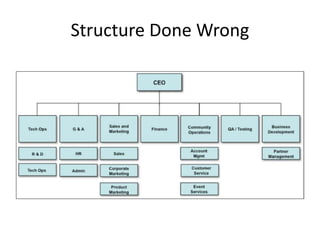
First, this proposed structure was created based
on the past precedents within the company, not
the core functions that need to be performed in
order to execute the new strategy
The second issue with the proposed structure is
that efficiency functions (Tech Ops and
Community Operations) are given authority over
effectiveness functions (R&D and Account
Management).
Structure Done Wrong- Why?
• Third, short-run functions are given authority
over long-run needs. For example, Sales &
Marketing are both focused on effectiveness
but should rarely, if ever, be the same
function.
• Fourth, it’s impossible to distinguish where
the authority to meet customer needs resides
and how the company is controlling for
systemic risk.
Structure Done Wrong- Why?
• Third, short-run functions are given authority
over long-run needs. For example, Sales &
Marketing are both focused on effectiveness
but should rarely, if ever, be the same
function.
• Fourth, it’s impossible to distinguish where
the authority to meet customer needs resides
and how the company is controlling for
systemic risk.
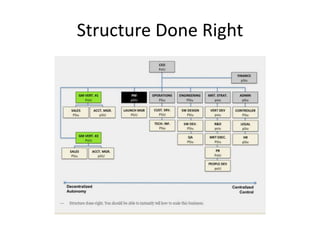
Structure Done Right
Structure Done Right-Why?
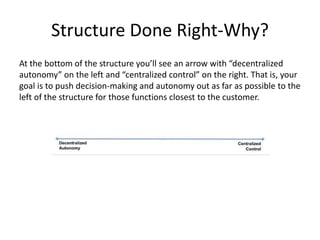
At the bottom of the structure you’ll see an arrow with “decentralized
autonomy” on the left and “centralized control” on the right. That is, your
goal is to push decision-making and autonomy out as far as possible to the
left of the structure for those functions closest to the customer.
Structure Done Right-Why?
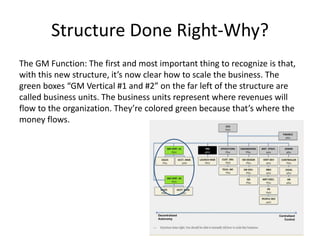
The GM Function: The first and most important thing to recognize is that,
with this new structure, it’s now clear how to scale the business. The
green boxes “GM Vertical #1 and #2” on the far left of the structure are
called business units. The business units represent where revenues will
flow to the organization. They’re colored green because that’s where the
money flows.
Structure Done Right-Why?
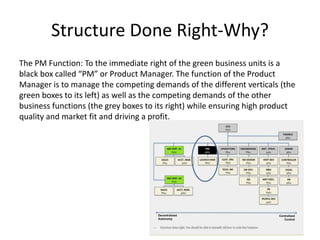
The PM Function: To the immediate right of the green business units is a
black box called “PM” or Product Manager. The function of the Product
Manager is to manage the competing demands of the different verticals (the
green boxes to its left) as well as the competing demands of the other
business functions (the grey boxes to its right) while ensuring high product
quality and market fit and driving a profit.
Structure Done Right-Why?
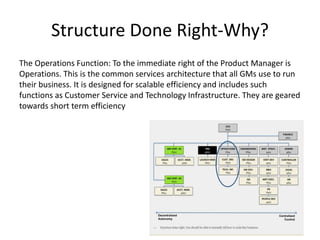
The Operations Function: To the immediate right of the Product Manager is
Operations. This is the common services architecture that all GMs use to run
their business. It is designed for scalable efficiency and includes such
functions as Customer Service and Technology Infrastructure. They are geared
towards short term efficiency
Structure Done Right-Why?
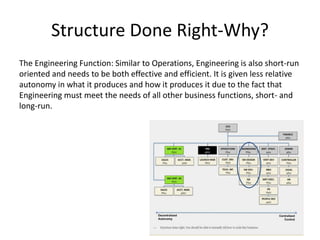
The Engineering Function: Similar to Operations, Engineering is also short-run
oriented and needs to be both effective and efficient. It is given less relative
autonomy in what it produces and how it produces it due to the fact that
Engineering must meet the needs of all other business functions, short- and
long-run.
Structure Done Right-Why?
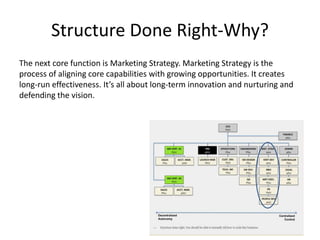
The next core function is Marketing Strategy. Marketing Strategy is the
process of aligning core capabilities with growing opportunities. It creates
long-run effectiveness. It’s all about long-term innovation and nurturing and
defending the vision.
Structure Done Right-Why?
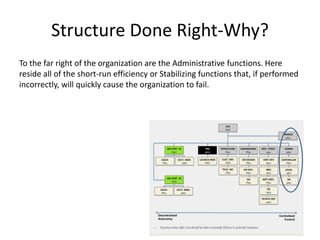
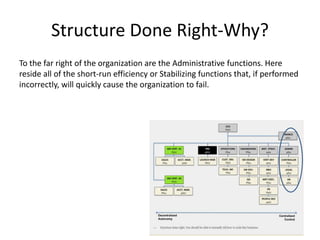
To the far right of the organization are the Administrative functions. Here
reside all of the short-run efficiency or Stabilizing functions that, if performed
incorrectly, will quickly cause the organization to fail.
Structure Done Right-Why?
To the far right of the organization are the Administrative functions. Here
reside all of the short-run efficiency or Stabilizing functions that, if performed
incorrectly, will quickly cause the organization to fail.
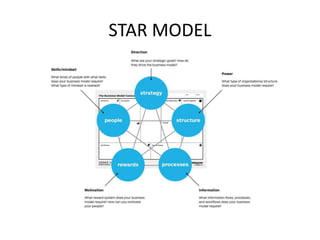
STAR MODEL
It’s Time for an Exercise
• On a chart paper, draw the current organization structure of your business
unit/client group (you don’t need to be 100% accurate)
• Flip the chart paper & map down the following information about your
division/client group in brief :
• What is the business strategy of your division/client group?
• Size of your division/client group?
• What are the external market factors that affect your business unit/client group?
• What are the internal factors that affect the operations of your business unit/client
group?
• What level of control is right for your unit/group?
• Draw a rough sketch of an Org structure that you feel encompasses all of
those elements (take your time!)
• Share your learnings with the rest of us ☺
RECAP
Refer to the Org. Design Manual

Training Manual on Organizational Design

  • 1.
    Training Manual onOrganizational Design The Hospital for Sick Children
  • 2.
    What is OrganizationalDesign? A good way to understand organizational design is to think of the human body. The basic skeleton represents the formal structure; The connective tissue represents key linkages of the body; and the circulatory system represents the people and culture that bring the skeleton and tissue to life. All these elements comprise a healthy and effective organization.
  • 3.
    What is OrganizationalDesign? • It is the creation of roles, processes, and formal reporting relationships in an organization. • It is the way in which you set up your business to best meet your business objectives.
  • 4.
    8 Reasons WhyIt is Important • Company Leadership: Organizational design sets forth reporting relationships and lines of authority reaching from the executive level to the front line. • Company Culture: The grouping of employees in various departments and the managerial hierarchy influences the way employees interact with each other on the job. • Future Growth: Organizational design choices made in the early stages of a business can either help or hinder growth plans.
  • 5.
    8 Reasons WhyIt is Important • Adaptability: Organizational design choices can develop distinct competitive advantages. Savvy business owners continually monitor changes in their industries and markets, looking for opportunities to adapt and develop new competitive advantages. • Communication: Organizational structure enables the distribution of authority. When a person starts a job, he knows from day one to whom he will report. • Evaluating Employee Performance: The linear structure of functional and product organizational structures allow supervisors to better evaluate the work of their subordinates.
  • 6.
    8 Reasons WhyIt is Important • Goal Achievement: Organizational structure allows for the chain of command. Department leaders are in charge of delegating tasks and projects to subordinates so the department can meet project deadlines. • Decision Making: Most companies either have a tall or flat organizational structure. Flat structures enable small companies to make quicker decisions, as they are often growing rapidly with new products and need this flexibility. Large organizations often have many tiers or echelons of management.
  • 7.
  • 8.
    SickKids Org Structure-An Analysis • Divisional structure • Simple Structure • High level of complexity is observed • High level for formality is observed • Communication is both bottom up, top down and horizontal
  • 9.
    How to Designyour Org. Structure the Right way If I were to ask you a random and seemingly strange question, “Why does a rocket behave the way it does and how is it different from a parachute that behaves the way it does?” You’d probably say something like, “Well, they’re designed differently!
  • 10.
    How to Designyour Org. Structure the Right way But if I were to ask you a similar question about your business, “Why does your business behave the way it does and how can you make it behave differently?” would you answer “design?” Very few people — even management experts — would know the answer
  • 11.
    How to Designyour Org. Structure the Right way • Ensure that your org. structure reflects your business strategy • Business functions focused on effectiveness (sales, marketing, people development) should not report to functions focused on efficiency( customer service, administration) • Business functions that are focused on long-range development (branding, strategy, R&D, people development, etc.) should not report to functions focused on driving daily results (sales, running current marketing campaigns, administration, operations, etc.).
  • 12.
    How to Designyour Org. Structure the Right way • The autonomy to sell and meet customer needs should always take precedence in the structure — for without sales and repeat sales the organization will quickly cease to exist. At the same time, the organization must exercise certain controls to protect itself from systemic harm (the kind of harm that can destroy the entire organization).
  • 13.
  • 14.
    Structure Done Wrong-Why? First, this proposed structure was created based on the past precedents within the company, not the core functions that need to be performed in order to execute the new strategy The second issue with the proposed structure is that efficiency functions (Tech Ops and Community Operations) are given authority over effectiveness functions (R&D and Account Management).
  • 15.
    Structure Done Wrong-Why? • Third, short-run functions are given authority over long-run needs. For example, Sales & Marketing are both focused on effectiveness but should rarely, if ever, be the same function. • Fourth, it’s impossible to distinguish where the authority to meet customer needs resides and how the company is controlling for systemic risk.
  • 16.
    Structure Done Wrong-Why? • Third, short-run functions are given authority over long-run needs. For example, Sales & Marketing are both focused on effectiveness but should rarely, if ever, be the same function. • Fourth, it’s impossible to distinguish where the authority to meet customer needs resides and how the company is controlling for systemic risk.
  • 17.
  • 18.
    Structure Done Right-Why? Atthe bottom of the structure you’ll see an arrow with “decentralized autonomy” on the left and “centralized control” on the right. That is, your goal is to push decision-making and autonomy out as far as possible to the left of the structure for those functions closest to the customer.
  • 19.
    Structure Done Right-Why? TheGM Function: The first and most important thing to recognize is that, with this new structure, it’s now clear how to scale the business. The green boxes “GM Vertical #1 and #2” on the far left of the structure are called business units. The business units represent where revenues will flow to the organization. They’re colored green because that’s where the money flows.
  • 20.
    Structure Done Right-Why? ThePM Function: To the immediate right of the green business units is a black box called “PM” or Product Manager. The function of the Product Manager is to manage the competing demands of the different verticals (the green boxes to its left) as well as the competing demands of the other business functions (the grey boxes to its right) while ensuring high product quality and market fit and driving a profit.
  • 21.
    Structure Done Right-Why? TheOperations Function: To the immediate right of the Product Manager is Operations. This is the common services architecture that all GMs use to run their business. It is designed for scalable efficiency and includes such functions as Customer Service and Technology Infrastructure. They are geared towards short term efficiency
  • 22.
    Structure Done Right-Why? TheEngineering Function: Similar to Operations, Engineering is also short-run oriented and needs to be both effective and efficient. It is given less relative autonomy in what it produces and how it produces it due to the fact that Engineering must meet the needs of all other business functions, short- and long-run.
  • 23.
    Structure Done Right-Why? Thenext core function is Marketing Strategy. Marketing Strategy is the process of aligning core capabilities with growing opportunities. It creates long-run effectiveness. It’s all about long-term innovation and nurturing and defending the vision.
  • 24.
    Structure Done Right-Why? Tothe far right of the organization are the Administrative functions. Here reside all of the short-run efficiency or Stabilizing functions that, if performed incorrectly, will quickly cause the organization to fail.
  • 25.
    Structure Done Right-Why? Tothe far right of the organization are the Administrative functions. Here reside all of the short-run efficiency or Stabilizing functions that, if performed incorrectly, will quickly cause the organization to fail.
  • 26.
  • 27.
    It’s Time foran Exercise • On a chart paper, draw the current organization structure of your business unit/client group (you don’t need to be 100% accurate) • Flip the chart paper & map down the following information about your division/client group in brief : • What is the business strategy of your division/client group? • Size of your division/client group? • What are the external market factors that affect your business unit/client group? • What are the internal factors that affect the operations of your business unit/client group? • What level of control is right for your unit/group? • Draw a rough sketch of an Org structure that you feel encompasses all of those elements (take your time!) • Share your learnings with the rest of us ☺
  • 28.
    RECAP Refer to theOrg. Design Manual

Editor's Notes

  • #3 Working on the body of an organization, therefore, is not an ad hoc process but one that involves collaboration and a whole-systems perspective.
  • #5 Future growth: Organizational designs built to easily accommodate new managers and employees at different levels of the organization can add new positions without making significant structural changes. Source: http://smallbusiness.chron.com/importance-organizational-design-choices-21117.html
  • #6 Source:http://smallbusiness.chron.com/importance-organizational-design-choices-21117.html
  • #7 Source:http://smallbusiness.chron.com/importance-organizational-design-choices-21117.html
  • #12 Second Point: For example, imagine a company predominantly focused on achieving Six Sigma efficiency (which is doing things “right”). Over time, the processes and systems become so efficient and tightly controlled, that there is very little flexibility or margin for error. By its nature, effectiveness (which is doing the right thing), which includes innovation and adapting to change, requires flexibility and margin for error. Keep in mind, therefore, that things can become so efficient that they lose their effectiveness. The takeaway here is: always avoid having functions focused on effectiveness reporting to functions focused on efficiency. If you do, your company will lose its effectiveness over time and it will fail. Third Point: For example, what happens if the marketing strategy function (a long-range orientation focused on branding, positioning, strategy, etc.) reports into the sales function (a short-range orientation focused on executing results now)? It’s easy to see that the marketing strategy function will quickly succumb to the pressure of sales and become a sales support function. Sales may get what it thinks it needs in the short run but the company will totally lose its ability to develop its products, brands, and strategy over the long range as a result.
  • #13 Fourth Point: One needs freedom to produce results, the other needs to regulate for greater efficiencies. The design principle here is that as much autonomy as possible should be given to those closest to the customer (functions like sales and account management) while the ability to control for systemic risk (functions like accounting, legal, and HR) should be as centralized as possible. Basically, rather than trying to make these functions play nice together, this design principle recognizes that inherent conflict, plans for it, and creates a structure that attempts to harness it for the overall good of the organization. For example, if Sales is forced to follow a bunch of bureaucratic accounting and legal procedures to win a new account, sales will suffer. However, if the sales team sells a bunch of underqualified leads that can’t pay, the whole company suffers. Therefore, Sales should be able to sell without restriction but also bear the burden of underperforming accounts. At the same time, Accounting and Legal should be centralized because if there’s a loss of cash or a legal liability, the whole business is at risk. So the structure must call this inherent conflict out and make it constructive for the entire business.
  • #14 The company is a software as a service (Saas) provider that has developed a new virtual trade show platform. They have about ten staff and $2M in annual revenues. I received this proposed structure just as the company was raising capital and hiring staff to scale its business and attack multiple industry verticals at once. In addition to securing growth capital, the company’s greatest challenge is shifting from a startup where the two co-founders do most everything to a scalable company where the co-founders can focus on what they do best. Source: http://organizationalphysics.com/2012/01/09/the-5-classic-mistakes-in-organizational-structure-or-how-to-design-your-organization-the-right-way/
  • #15 2nd Point:  What will happen in this case? The company’s operations will become very efficient but will lose effectiveness. Imagine being in charge of R&D, which requires exploration and risk taking, but having to report every day to Tech Ops, which requires great control and risk mitigation. Source: http://organizationalphysics.com/2012/01/09/the-5-classic-mistakes-in-organizational-structure-or-how-to-design-your-organization-the-right-way/
  • #16 4th Point:  As you look again at the proposed structure, how does the company scale? Where is new staff added and why? What’s the right sequence to add them? Who is ultimately responsible for profit and loss? Certainly it’s the CEO but if the CEO is running the day-to-day P&L across multiple verticals, then he is not going to be able to focus on the big picture and overall execution. At the same time, who is responsible for mitigating systemic risk? Within this current structure, it’s very likely that the CEO never extracts himself from those activities he’s always done and shouldn’t still be doing if the business is to scale. If he does attempt to extract himself, he’ll delegate without the requisite controls in place and the company will make a major mistake that threatens its life. Source: http://organizationalphysics.com/2012/01/09/the-5-classic-mistakes-in-organizational-structure-or-how-to-design-your-organization-the-right-way/
  • #17 4th Point:  As you look again at the proposed structure, how does the company scale? Where is new staff added and why? What’s the right sequence to add them? Who is ultimately responsible for profit and loss? Certainly it’s the CEO but if the CEO is running the day-to-day P&L across multiple verticals, then he is not going to be able to focus on the big picture and overall execution. At the same time, who is responsible for mitigating systemic risk? Within this current structure, it’s very likely that the CEO never extracts himself from those activities he’s always done and shouldn’t still be doing if the business is to scale. If he does attempt to extract himself, he’ll delegate without the requisite controls in place and the company will make a major mistake that threatens its life. Source: http://organizationalphysics.com/2012/01/09/the-5-classic-mistakes-in-organizational-structure-or-how-to-design-your-organization-the-right-way/
  • #18 Each box represents a key function that must be performed by the business in its chosen strategy. Again, this is not an org chart. One function may have multiple people such as three customer service reps within it and certain staff may be wearing multiple different hats. So when creating the structure, ignore the people involved and just identify the core business functions that must be performed. Again, first we want to create the right structure to support the chosen strategy. Then we can add roles and hats. Source: http://organizationalphysics.com/2012/01/09/the-5-classic-mistakes-in-organizational-structure-or-how-to-design-your-organization-the-right-way/
  • #19 At the same time you need to control for systemic risk on the right of the structure for those functions closest to the enterprise. There is a natural conflict that exists between decentralized autonomy and centralized control. This structure recognizes that conflict, plans for it, and creates a design that will harness and make it constructive. Here’s how. Source: http://organizationalphysics.com/2012/01/09/the-5-classic-mistakes-in-organizational-structure-or-how-to-design-your-organization-the-right-way/
  • #20 Source: http://organizationalphysics.com/2012/01/09/the-5-classic-mistakes-in-organizational-structure-or-how-to-design-your-organization-the-right-way/
  • #21 Source: http://organizationalphysics.com/2012/01/09/the-5-classic-mistakes-in-organizational-structure-or-how-to-design-your-organization-the-right-way/
  • #22 Source: http://organizationalphysics.com/2012/01/09/the-5-classic-mistakes-in-organizational-structure-or-how-to-design-your-organization-the-right-way/
  • #23 Source: http://organizationalphysics.com/2012/01/09/the-5-classic-mistakes-in-organizational-structure-or-how-to-design-your-organization-the-right-way/
  • #24 The basis for placing People Development under Marketing Strategy rather than under HR is that People Development is a long-range effectiveness function. If it’s placed under HR, then it will quickly devolve into a short-range tactical training function. For a similar reason, recruitment is kept here because a good recruiter will thrive under the long-range personal development function and will better reflect the organization’s real culture. Source: http://organizationalphysics.com/2012/01/09/the-5-classic-mistakes-in-organizational-structure-or-how-to-design-your-organization-the-right-way/
  • #25 Source: http://organizationalphysics.com/2012/01/09/the-5-classic-mistakes-in-organizational-structure-or-how-to-design-your-organization-the-right-way/
  • #26 Source: http://organizationalphysics.com/2012/01/09/the-5-classic-mistakes-in-organizational-structure-or-how-to-design-your-organization-the-right-way/
  • #29 Thank you!