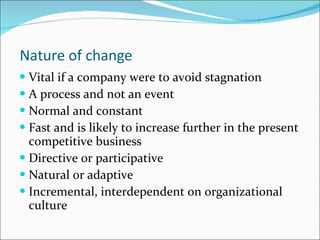
Nature of change Vital if a company were to avoid stagnation A process and not an event Normal and constant Fast and is likely to increase further in the present competitive business Directive or participative Natural or adaptive Incremental, interdependent on organizational culture
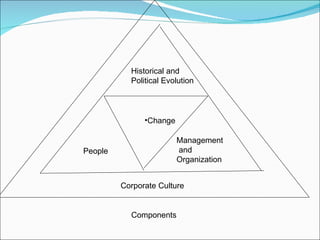
Historical and  Political Evolution Management and  Organization Change People Corporate Culture Components
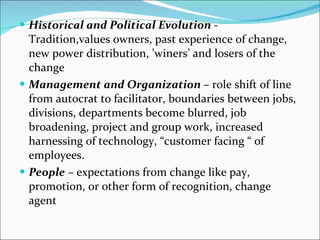
Historical and Political Evolution  - Tradition,values owners, past experience of change, new power distribution, ’winers’ and losers of the change Management and Organization  – role shift of line from autocrat to facilitator, boundaries between jobs, divisions, departments become blurred, job broadening, project and group work, increased harnessing of technology, “customer facing “ of employees. People  – expectations from change like pay, promotion, or other form of recognition, change agent
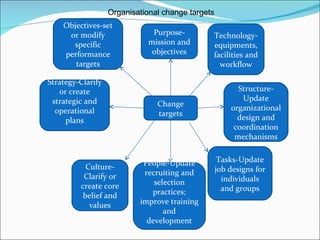
Change targets Purpose-mission and objectives Technology-equipments, facilities and workflow Structure-Update organizational design and coordination mechanisms Tasks-Update job designs for individuals and groups People-Update recruiting and selection practices; improve training and development Culture-Clarify or create core belief and values Strategy-Clarify or create strategic and operational plans Objectives-set or modify specific performance targets Organisational change targets
Forces for change in Organizations External Causes- Globalization, Workforce Diversity, Technological change, Managing ethical behavior, Government policies, Competition & Scarcity of resources Internal causes- Organizational silence, Falling effectiveness, Crisis, Changing employee expectations, change in the work & Climate
Stability v/s Change Stability induces certainty, change induces uncertainty Change can be small or big Change involves change in state, but in stability it is constant Stability will bring in strengths and weaknesses, while change will bring opportunities and threats Stability will make people passive and lethargic, while change will make people active Stability is usually triggered by individuals, but change is triggered by people and other environmental factors.
Stability v/s Change Stability is not permanent, while change is relatively permanent. Constructive change can bring in stability, but stability cant bring change. Stability fosters cohesiveness, while change fosters political behavior Stability has less scope for learning
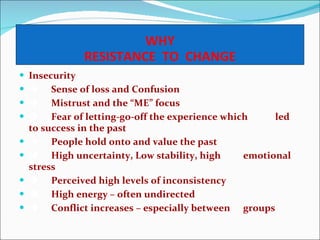
WHY RESISTANCE  TO  CHANGE Insecurity    Sense of loss and Confusion    Mistrust and the “ME” focus    Fear of letting-go-off the experience which  led to success in the past    People hold onto and value the past    High uncertainty, Low stability, high  emotional stress    Perceived high levels of inconsistency    High energy – often undirected    Conflict increases – especially between  groups
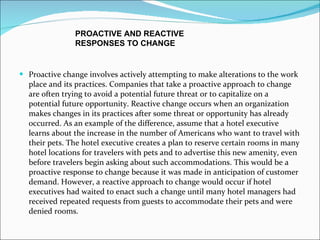
Proactive change involves actively attempting to make alterations to the work place and its practices. Companies that take a proactive approach to change are often trying to avoid a potential future threat or to capitalize on a potential future opportunity. Reactive change occurs when an organization makes changes in its practices after some threat or opportunity has already occurred. As an example of the difference, assume that a hotel executive learns about the increase in the number of Americans who want to travel with their pets. The hotel executive creates a plan to reserve certain rooms in many hotel locations for travelers with pets and to advertise this new amenity, even before travelers begin asking about such accommodations. This would be a proactive response to change because it was made in anticipation of customer demand. However, a reactive approach to change would occur if hotel executives had waited to enact such a change until many hotel managers had received repeated requests from guests to accommodate their pets and were denied rooms. PROACTIVE AND REACTIVE  RESPONSES TO CHANGE
‘ At the Heart of Managing Change lies the perception of change itself’  Is Change an Opportunity or a Problem ?
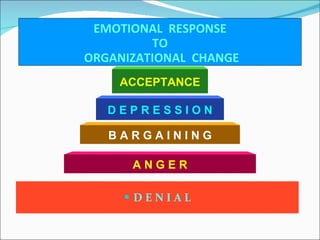
EMOTIONAL  RESPONSE TO  ORGANIZATIONAL  CHANGE D E N I A L A N G E R B A R G A I N I N G D E P R E S S I O N ACCEPTANCE
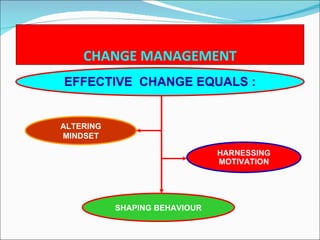
CHANGE MANAGEMENT EFFECTIVE  CHANGE EQUALS : ALTERING MINDSET HARNESSING MOTIVATION SHAPING BEHAVIOUR
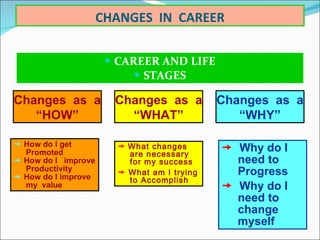
CHANGES  IN  CAREER CAREER AND LIFE STAGES Changes  as  a “ HOW”    How do I get Promoted    How do I  improve Productivity    How do I improve my  value Changes  as  a “ WHAT” Changes  as  a “ WHY”    What changes are necessary for my success    What am I trying to Accomplish    Why do I need to Progress    Why do I need to change myself
 

Change Management

  • 1.
  • 2.
    Natureof change Vital if a company were to avoid stagnation A process and not an event Normal and constant Fast and is likely to increase further in the present competitive business Directive or participative Natural or adaptive Incremental, interdependent on organizational culture
  • 3.
    Historical and Political Evolution Management and Organization Change People Corporate Culture Components
  • 4.
    Historical and PoliticalEvolution - Tradition,values owners, past experience of change, new power distribution, ’winers’ and losers of the change Management and Organization – role shift of line from autocrat to facilitator, boundaries between jobs, divisions, departments become blurred, job broadening, project and group work, increased harnessing of technology, “customer facing “ of employees. People – expectations from change like pay, promotion, or other form of recognition, change agent
  • 5.
    Change targets Purpose-missionand objectives Technology-equipments, facilities and workflow Structure-Update organizational design and coordination mechanisms Tasks-Update job designs for individuals and groups People-Update recruiting and selection practices; improve training and development Culture-Clarify or create core belief and values Strategy-Clarify or create strategic and operational plans Objectives-set or modify specific performance targets Organisational change targets
  • 6.
    Forces for changein Organizations External Causes- Globalization, Workforce Diversity, Technological change, Managing ethical behavior, Government policies, Competition & Scarcity of resources Internal causes- Organizational silence, Falling effectiveness, Crisis, Changing employee expectations, change in the work & Climate
  • 7.
    Stability v/s ChangeStability induces certainty, change induces uncertainty Change can be small or big Change involves change in state, but in stability it is constant Stability will bring in strengths and weaknesses, while change will bring opportunities and threats Stability will make people passive and lethargic, while change will make people active Stability is usually triggered by individuals, but change is triggered by people and other environmental factors.
  • 8.
    Stability v/s ChangeStability is not permanent, while change is relatively permanent. Constructive change can bring in stability, but stability cant bring change. Stability fosters cohesiveness, while change fosters political behavior Stability has less scope for learning
  • 9.
    WHY RESISTANCE TO CHANGE Insecurity  Sense of loss and Confusion  Mistrust and the “ME” focus  Fear of letting-go-off the experience which led to success in the past  People hold onto and value the past  High uncertainty, Low stability, high emotional stress  Perceived high levels of inconsistency  High energy – often undirected  Conflict increases – especially between groups
  • 10.
    Proactive change involvesactively attempting to make alterations to the work place and its practices. Companies that take a proactive approach to change are often trying to avoid a potential future threat or to capitalize on a potential future opportunity. Reactive change occurs when an organization makes changes in its practices after some threat or opportunity has already occurred. As an example of the difference, assume that a hotel executive learns about the increase in the number of Americans who want to travel with their pets. The hotel executive creates a plan to reserve certain rooms in many hotel locations for travelers with pets and to advertise this new amenity, even before travelers begin asking about such accommodations. This would be a proactive response to change because it was made in anticipation of customer demand. However, a reactive approach to change would occur if hotel executives had waited to enact such a change until many hotel managers had received repeated requests from guests to accommodate their pets and were denied rooms. PROACTIVE AND REACTIVE RESPONSES TO CHANGE
  • 11.
    ‘ At theHeart of Managing Change lies the perception of change itself’ Is Change an Opportunity or a Problem ?
  • 12.
    EMOTIONAL RESPONSETO ORGANIZATIONAL CHANGE D E N I A L A N G E R B A R G A I N I N G D E P R E S S I O N ACCEPTANCE
  • 13.
    CHANGE MANAGEMENT EFFECTIVE CHANGE EQUALS : ALTERING MINDSET HARNESSING MOTIVATION SHAPING BEHAVIOUR
  • 14.
    CHANGES IN CAREER CAREER AND LIFE STAGES Changes as a “ HOW”  How do I get Promoted  How do I improve Productivity  How do I improve my value Changes as a “ WHAT” Changes as a “ WHY”  What changes are necessary for my success  What am I trying to Accomplish  Why do I need to Progress  Why do I need to change myself
  • 15.