Organization
Transformation
Definition
• It is a term referring collectively to such activities as
reengineering, redesigning and redefining business
systems.
• Organization Transformation can occur in response to or
in anticipation major changes in the organization’s
environment or technology.
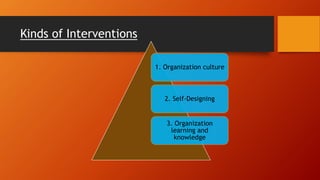
Kinds of Interventions
1. Organization culture
2. Self-Designing
3. Organization
learning and
knowledge
Characteristics of Transformational Change
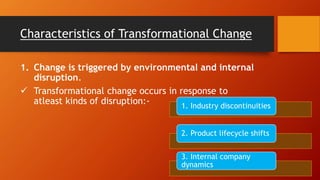
1. Change is triggered by environmental and internal
disruption.
 Transformational change occurs in response to
atleast kinds of disruption:- 1. Industry discontinuities
2. Product lifecycle shifts
3. Internal company
dynamics
2. Change is systemic and revolutionary.
 Transformational change involves reshaping the
organization’s culture and design element.
 These changes can be characterized as systemic and
revolutionary cause nature of the organization is
altered fundamentally.
3. Change demands a new organizing paradigm.
 Organization undertaking transformational change are,
by definition, involved in 2nd-order or gamma types of
change.
 Gamma change involves discontinuous shifts in mental
or organizational frameworks.
4. Change is driven by senior executives and line
management.
 They are responsible for the strategic direction and
operation of the organization and actively lead the
transformation.
The critical role of executives leadership in
transformational change is clearly emerging.
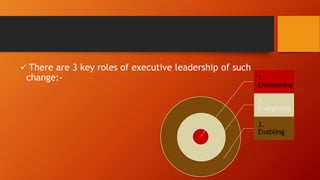
 There are 3 key roles of executive leadership of such
change:- 1.
Envisioning
2.
Energizing
3.
Enabling
5. Continuous learning and change.
 Transformational change requires considerable
innovation and learning.
Organizational members must learn how to enact the
new behaviors required to implement new strategy
direction.
Interventions
1. Culture Change
 Culture change is the most common form of
organization transformation. The number of culture
change interventions has grown accordingly.
 Org. culture is also the focus of growing research and
protecting these implied rights.
Interventions cont…
2. Self-Designing organizations
 A growing number of researchers and practitioners have
called for self-designing organizations that have built-in
capacity to transform themselves to achieve high
performance in today’s competitive and changing
environment.
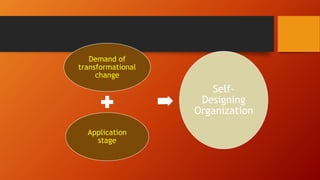
Demand of
transformational
change
Application
stage
Self-
Designing
Organization
a) Demand of transformational change
 There are 5 requirements for organizational
transformation:-
i. Systematic change
ii. Dynamic and iterative
iii. Organizational learning
iv. Multiple stakeholders
v. Multiple level of the organization
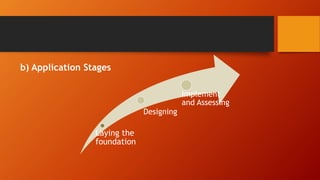
b) Application Stages
Laying the
foundation
Designing
Implement
and Assessing
3. Organization learning and knowledge management
 The 3rd organizational transformation intervention is
aimed at helping organizations develop ad use knowledge
to change and improve themselves continually.
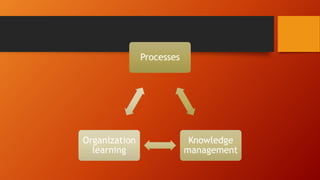
 It includes 2 interrelated change processes:-
Processes
Knowledge
management
Organization
learning

Organization transformation

  • 1.
  • 2.
    Definition • It isa term referring collectively to such activities as reengineering, redesigning and redefining business systems. • Organization Transformation can occur in response to or in anticipation major changes in the organization’s environment or technology.
  • 3.
    Kinds of Interventions 1.Organization culture 2. Self-Designing 3. Organization learning and knowledge
  • 4.
    Characteristics of TransformationalChange 1. Change is triggered by environmental and internal disruption.  Transformational change occurs in response to atleast kinds of disruption:- 1. Industry discontinuities 2. Product lifecycle shifts 3. Internal company dynamics
  • 5.
    2. Change issystemic and revolutionary.  Transformational change involves reshaping the organization’s culture and design element.  These changes can be characterized as systemic and revolutionary cause nature of the organization is altered fundamentally.
  • 6.
    3. Change demandsa new organizing paradigm.  Organization undertaking transformational change are, by definition, involved in 2nd-order or gamma types of change.  Gamma change involves discontinuous shifts in mental or organizational frameworks.
  • 7.
    4. Change isdriven by senior executives and line management.  They are responsible for the strategic direction and operation of the organization and actively lead the transformation. The critical role of executives leadership in transformational change is clearly emerging.
  • 8.
     There are3 key roles of executive leadership of such change:- 1. Envisioning 2. Energizing 3. Enabling
  • 9.
    5. Continuous learningand change.  Transformational change requires considerable innovation and learning. Organizational members must learn how to enact the new behaviors required to implement new strategy direction.
  • 10.
    Interventions 1. Culture Change Culture change is the most common form of organization transformation. The number of culture change interventions has grown accordingly.  Org. culture is also the focus of growing research and protecting these implied rights.
  • 11.
    Interventions cont… 2. Self-Designingorganizations  A growing number of researchers and practitioners have called for self-designing organizations that have built-in capacity to transform themselves to achieve high performance in today’s competitive and changing environment.
  • 12.
  • 13.
    a) Demand oftransformational change  There are 5 requirements for organizational transformation:- i. Systematic change ii. Dynamic and iterative iii. Organizational learning iv. Multiple stakeholders v. Multiple level of the organization
  • 14.
    b) Application Stages Layingthe foundation Designing Implement and Assessing
  • 15.
    3. Organization learningand knowledge management  The 3rd organizational transformation intervention is aimed at helping organizations develop ad use knowledge to change and improve themselves continually.  It includes 2 interrelated change processes:-
  • 16.