COMPETENCY BASED HR
MANAGEMENT
BY: ADITYA PARIMOO
DEFINING COMPETENCY
 Competency is an underlying characteristics (i.e.
Traits, skills, knowledge, aspect of ones’ self image, social role etc)
which results in effective and/or superior performance.
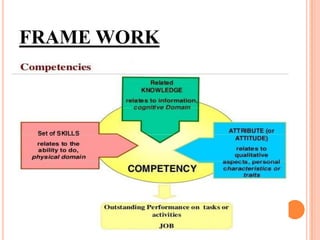
 Competency is a set of skills, related to knowledge and attributes that
allow an individual to successfully perform a task or an activity within
a specific job or function.
 Competencies are measureable, observable and critical to individual
as well as organizations performance.
IN OTHER WORDS
FRAME WORK
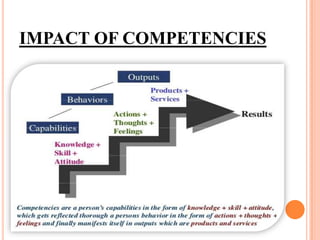
IMPACT OF COMPETENCIES
DEFINITION OF COMPETENCY
WHY COMPETENCIES?
 Structure and communicate the realignment of key
organizational roles.
 “Raise the bar” on performance.
 Provide clear expectations and stable measures of
success for both individual as well as for organisation.
 Provide a more focused method for
selection, development, performance
management, rewards, etc.
 It could be a powerful tools for an organisation to meet
its business results, through its most valuable resource-
its people.
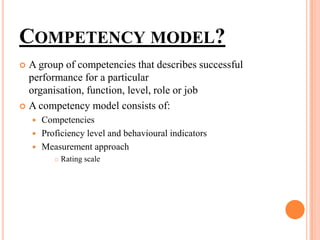
COMPETENCY MODEL?
 A group of competencies that describes successful
performance for a particular
organisation, function, level, role or job
 A competency model consists of:
 Competencies
 Proficiency level and behavioural indicators
 Measurement approach
 Rating scale
GUIDELINES FOR CREATING A
COMPETENCY MODEL
 It must be:
 Aligned with business and organisation goals and
needs.
 Support the business strategy.
 Be future focused.
 Be selective, focused on a few competencies that are
actually key for the company‘s and indivisual
performance.
 Do not make it so specific that it cannot be used
elsewhere in the organisation.
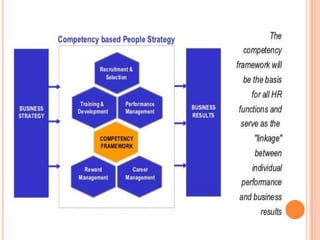
COMPETENCY BUSINESS MODEL
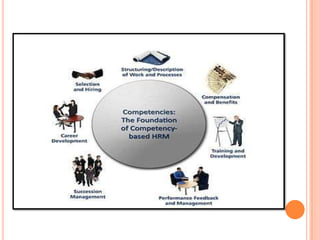
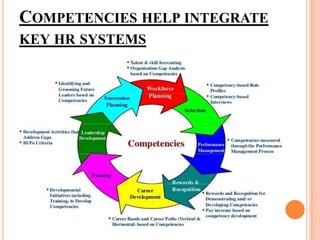
COMPETENCIES HELP INTEGRATE
KEY HR SYSTEMS
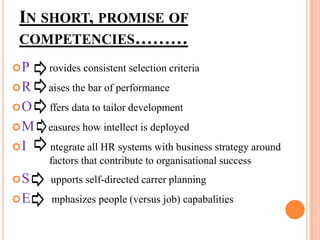
IN SHORT, PROMISE OF
COMPETENCIES………
P rovides consistent selection criteria
R aises the bar of performance
O ffers data to tailor development
M easures how intellect is deployed
I ntegrate all HR systems with business strategy around
factors that contribute to organisational success
S upports self-directed carrer planning
E mphasizes people (versus job) capabalities
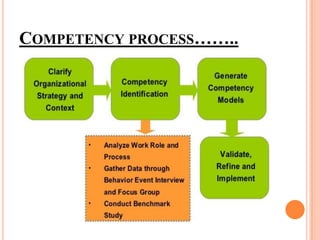
COMPETENCY PROCESS……..
BENEFITS OF USING COMPETENCY
MODEL
FOR MANAGERS:
 Identify performance criteria to improve the accuracy and ease
of the hiring and selection process.
 Clarify standards of excellence for easier communication of
performance expectations to direct reports.
 Provide a clear foundation for dialogue to occur between the
manager and the employee about the
performance, development, and career related issues
BENEFITS OF USING COMPETENCY
MODEL
FOR EMPLOYEES:
 Identify the success criteria (i.e., behavioural standards
of performance excellence) required to be successful in
their role.
 Support a more specific and objective assessment of
their strengths and specify targeted areas for
professional development.
 Provide development tools and methods for enhancing
their skills.
COMPETENCY BASED INTERVIEW
 Is a structured interview. The questions are focused
on disclosing of examples of behaviour in the past.
 The process of interview is intended to disclose
specifically and in detail examples of behaviour in
the past.
 Is designed based on the principle: Past Behaviour
Predicts Future Behaviour (candidates are most
likely to repeat these behaviours in similar
situations in the future)
 Has a high level of validity and reliability
 Equipped with a standard scoring system which
refers to behaviour indicators.
APPROACH IN COMPETENCY
BASED INTERVIEW
S what was the Situation in which you were involved?
T what was the Task you needed to accomplish?
A what Action(s) did you take?
R what Result did u achieve?
COMPETENCY PROFILE REQUIREMENTS PER
POSITION
TRAINING MATRIX
Competency based hr management

Competency based hr management

  • 1.
  • 2.
    DEFINING COMPETENCY  Competencyis an underlying characteristics (i.e. Traits, skills, knowledge, aspect of ones’ self image, social role etc) which results in effective and/or superior performance.  Competency is a set of skills, related to knowledge and attributes that allow an individual to successfully perform a task or an activity within a specific job or function.  Competencies are measureable, observable and critical to individual as well as organizations performance.
  • 3.
  • 6.
  • 7.
  • 8.
  • 9.
    WHY COMPETENCIES?  Structureand communicate the realignment of key organizational roles.  “Raise the bar” on performance.  Provide clear expectations and stable measures of success for both individual as well as for organisation.  Provide a more focused method for selection, development, performance management, rewards, etc.  It could be a powerful tools for an organisation to meet its business results, through its most valuable resource- its people.
  • 10.
    COMPETENCY MODEL?  Agroup of competencies that describes successful performance for a particular organisation, function, level, role or job  A competency model consists of:  Competencies  Proficiency level and behavioural indicators  Measurement approach  Rating scale
  • 11.
    GUIDELINES FOR CREATINGA COMPETENCY MODEL  It must be:  Aligned with business and organisation goals and needs.  Support the business strategy.  Be future focused.  Be selective, focused on a few competencies that are actually key for the company‘s and indivisual performance.  Do not make it so specific that it cannot be used elsewhere in the organisation.
  • 12.
  • 13.
  • 14.
    IN SHORT, PROMISEOF COMPETENCIES……… P rovides consistent selection criteria R aises the bar of performance O ffers data to tailor development M easures how intellect is deployed I ntegrate all HR systems with business strategy around factors that contribute to organisational success S upports self-directed carrer planning E mphasizes people (versus job) capabalities
  • 15.
  • 16.
    BENEFITS OF USINGCOMPETENCY MODEL FOR MANAGERS:  Identify performance criteria to improve the accuracy and ease of the hiring and selection process.  Clarify standards of excellence for easier communication of performance expectations to direct reports.  Provide a clear foundation for dialogue to occur between the manager and the employee about the performance, development, and career related issues
  • 17.
    BENEFITS OF USINGCOMPETENCY MODEL FOR EMPLOYEES:  Identify the success criteria (i.e., behavioural standards of performance excellence) required to be successful in their role.  Support a more specific and objective assessment of their strengths and specify targeted areas for professional development.  Provide development tools and methods for enhancing their skills.
  • 18.
    COMPETENCY BASED INTERVIEW Is a structured interview. The questions are focused on disclosing of examples of behaviour in the past.  The process of interview is intended to disclose specifically and in detail examples of behaviour in the past.  Is designed based on the principle: Past Behaviour Predicts Future Behaviour (candidates are most likely to repeat these behaviours in similar situations in the future)  Has a high level of validity and reliability  Equipped with a standard scoring system which refers to behaviour indicators.
  • 19.
    APPROACH IN COMPETENCY BASEDINTERVIEW S what was the Situation in which you were involved? T what was the Task you needed to accomplish? A what Action(s) did you take? R what Result did u achieve?
  • 20.
  • 21.